
Read in Ukrainian
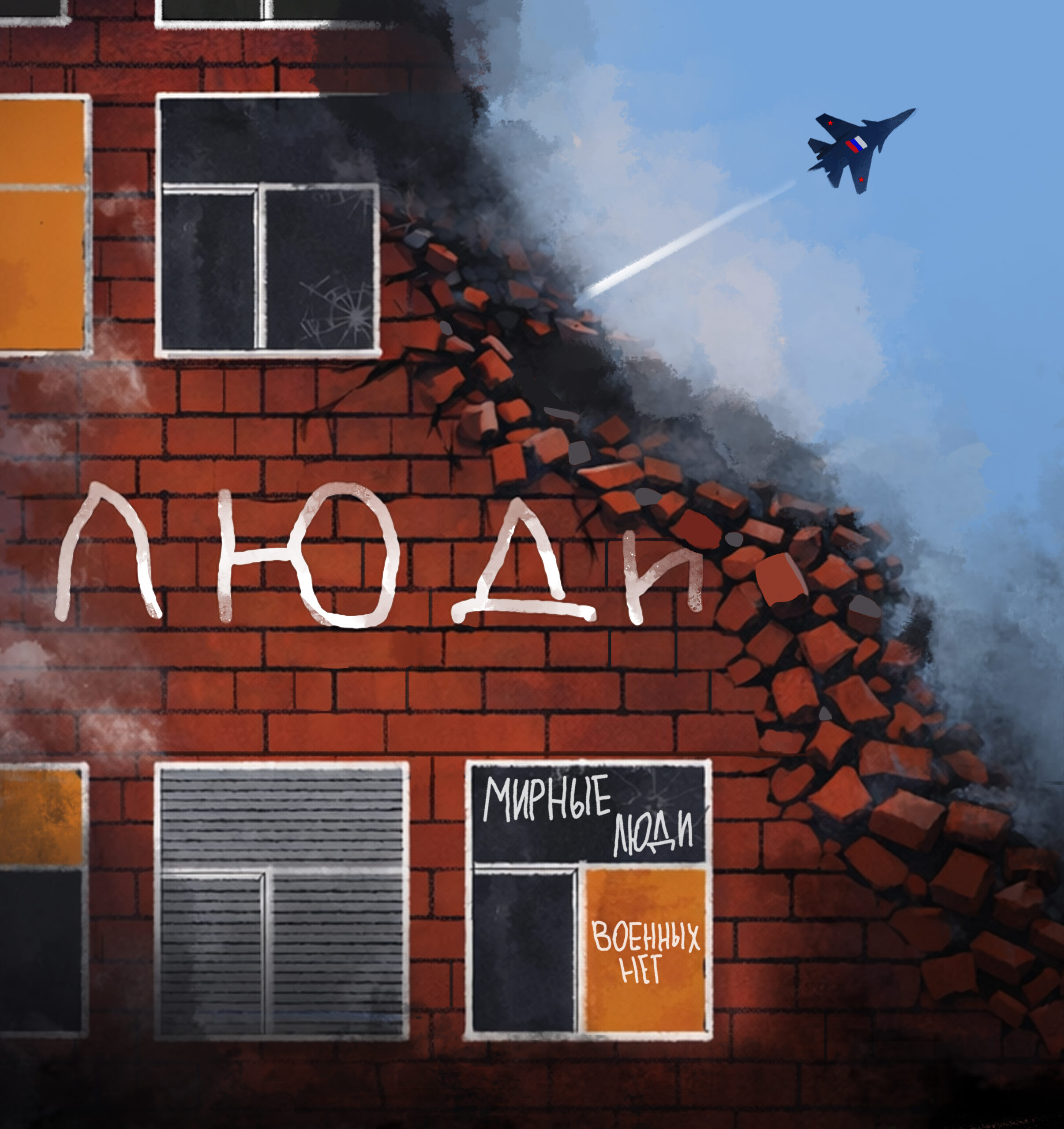
In the picture: “People” written in large letters and an inscription on the window reading “Peaceful civilians, no military personnel.”
Сontents
Introduction
During armed conflicts, civilians do not necessarily suffer exclusively at the hands of the enemy. Sometimes, parties to the conflict may strike their own citizens and their own territory, particularly in a targeted manner. For instance, in early December 2024, warplanes belonging to Russia and to the Syrian dictator Bashar Assad attacked[1] a densely populated area of the city of Idlib and the hospital in Aleppo,[2] over which Syrian rebels had gained control. At the time, the dictator claimed they were only attacking combatant positions; however, there were dozens of civilians among the victims. In March 2025, the army of Sudan, with its ongoing civil war, attacked[3] a market in the state of North Darfur from the air, killing thousands of civilians.
Under international law, such attacks constitute war crimes, regardless of whose territory they were committed on and whether the strikers’ own population came under the attack. In some international treaties, protection is dependent on nationality, such as in Geneva Convention IV.[4] However, other sources of international law, such as Additional Protocol I (AP I), do not link protection to citizenship and extend it to all non-combatants.[5] In addition, the International Committee of the Red Cross points out that the main issue in the protection of civilians is their non-combatant status rather than their citizenship.[6] Thus, international humanitarian law (hereinafter IHL) protects all civilians from intentional or indiscriminate attacks regardless of citizenship.
The shelling of the boarding school in Sudzha on February 1, 2025, was also likely a war crime. At the time, both the building and the city were under the control of the Armed Forces of Ukraine. The press officer of the Sudzha commandant’s office made a statement[7] on February 1, 2025, at 19:16, that the strike on the building was carried out by a Russian Su-34 aircraft, which dropped an aerial bomb on the boarding school. However, Russia blamed the strike on Ukraine, alleging that it was the Defense Forces of Ukraine that struck the building with HIMARS ballistic missiles.
Truth Hounds conducted their own investigation and concluded that the boarding school was indeed attacked by a Russian Su-34 plane. Investigators identified five potential airfields from which it may have struck. In addition, the advance airfield[8] played a major role in the attack.
NB:
In March 2025, Russia regained control of Sudzha. This makes it impossible to analyze the situation on the ground, inspect the impact site, and interview potential witnesses of the strike. Thus, open data remains the only source of information about the circumstances of the strike.
[8] Advance airfield, or forward airfield, is an interim airfield used for refueling and re-arming air units as part of long-ranging or forward operations. Their main function is to provide operational support for aircraft to perform tasks as close as possible to the combat zone.
Occupation of Sudzha under International Law
The capture of foreign territories alongside the liberation of one’s own is an integral part of armed conflicts, even for countries defending themselves. Sometimes such operations are carried out to create buffer zones or draw enemy forces away from another direction. This was the case with the Golan Heights in Syria. They were captured by Israel in 1967 during the Six-Day War to protect the border from shelling and monitor the Syrian territory. This was also the case on August 6, 2024, when Ukraine started advancing against the Kursk Oblast of Russia. In March 2025, President Volodymyr Zelenskyy recognized[9] that due to the Kursk operation, Russia was forced to withdraw troops from Pokrovsk, Kharkiv, and Sumy combat directions. Commander-in-Chief Oleksandr Syrskyi said directly that the Kursk operation allowed for the creation of a buffer zone on the Russian territory.[10]
The international legal definition of the concept of occupation is provided in the Regulations to the Hague Convention of 1907:
“Territory is considered occupied when it is actually placed under the authority of the hostile army. The occupation extends only to the territory where such authority has been established and can be exercised.”[11]
This definition of occupation applies to the city of Sudzha, which was effectively controlled by Ukraine from August 15, 2024, to March 12, 2025.
Ukraine’s operation on the territory of the Russian Federation and the occupation itself were also legal in terms of international law.[12] They were conducted in the context of Ukraine’s right to self-defense, in compliance with all criteria of the legitimacy of self-defense, in particular, the principles of necessity and proportionality.[13] Before the advance on the Kursk Oblast, both President Volodymyr Zelenskyy[14] and ISW analysts[15] reported that the Russians had accumulated troops in the Sumy and Kharkiv directions.
Simultaneously with the occupation of part of the Kursk Oblast, Ukraine established a military commandant’s office in Sudzha. It operated until Russia regained control of the city. The operation of the commandant’s office can be viewed as confirmation of the establishment of authority and ability to exercise it. Therefore, until the territory was recaptured by the Russian Federation, these territories of the Kursk Oblast were considered occupied by Ukraine.
According to the Hague Convention on the Laws and Customs of War on Land of 1907, the occupying power (in this case, Ukraine) was required to ensure public order and security.[16] Usually, this directly correlates with the establishment of an agency that would perform administrative functions on the controlled territory. IHL does not provide clear requirements for the name, structure, or model of such an agency. However, this body must exist so that the state exercising effective control over the territory would not disregard its obligations under IHL.
The occupying power is also obliged to provide the population with food and medicine. In particular, the occupying power must import them if there are not sufficient resources in the occupied territory. In fulfillment of these obligations, Ukraine established a military commandant’s office in the city of Sudzha, which undertook administrative functions, in particular, “ensuring law and order, as well as guaranteeing local residents access to medical services and medicines, food, and humanitarian aid.”[17]
Moreover, the wounded and sick, as well as people with disabilities and pregnant women, enjoy special protection and care. In particular, the occupation authorities must establish:
“safety zones and localities so organized as to protect from the effects of war, wounded, sick and aged persons, children under fifteen, expectant mothers and mothers of children under seven.”[18]
In Sudzha, this “safety zone” under GC IV[19] was the boarding school at 7 Lenina Street.
[12] Art. 51 of the UN Charter guarantees the inalienable right to self-defense in the event of an armed attack by another state.
[19] “Safety zones and localities,” generally of a permanent character, [are] established outside the combat zone in order to shelter certain categories of the civilian population, which, owing to their weakness, require special protection (children, old people, expectant mothers, etc.) from long-range weapons, especially aerial bombardment; See: 1958, to Art. 14, terminology “B.”
What Function Did the Boarding School Serve in Occupation?
The boarding school in Sudzha is a three-story Soviet-style building made of red brick, with a red roof and a large basement. Publicly available satellite images show that the boarding school is located in the central part of the city.[20] Its location has always been known to both the Russian and Ukrainian sides. The façade of the building also featured two large notes: “PEOPLE.”[21] This further facilitates the identification and visibility of the building from satellites, drones, or other geospatial intelligence tools.
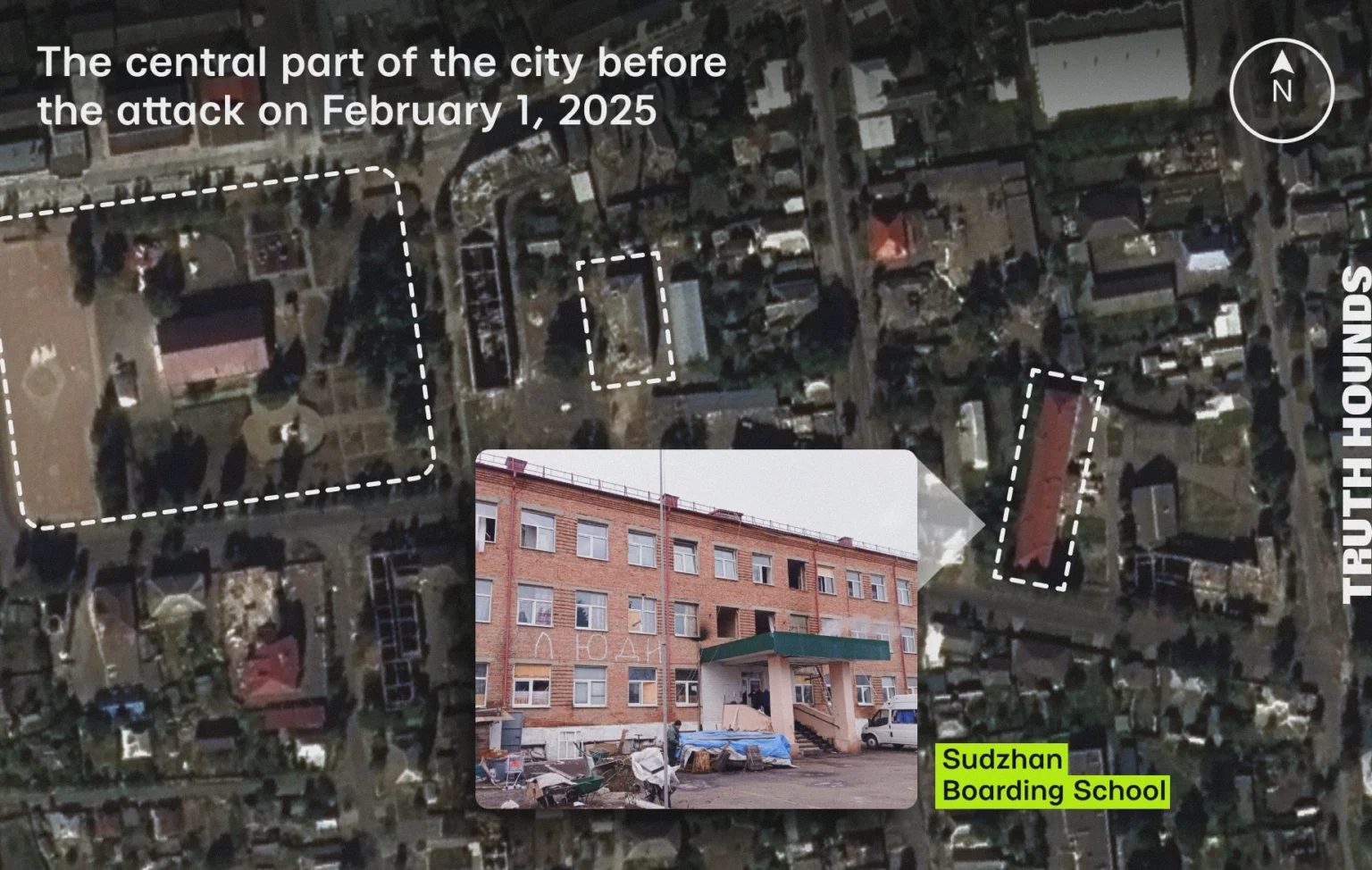
A picture of the Sudzhan Boarding School (right) before the impact on 02/01/2025 and other identifying landmarks of the building (left and center).
Source: PicsfromSpace, image date September 19, 2024
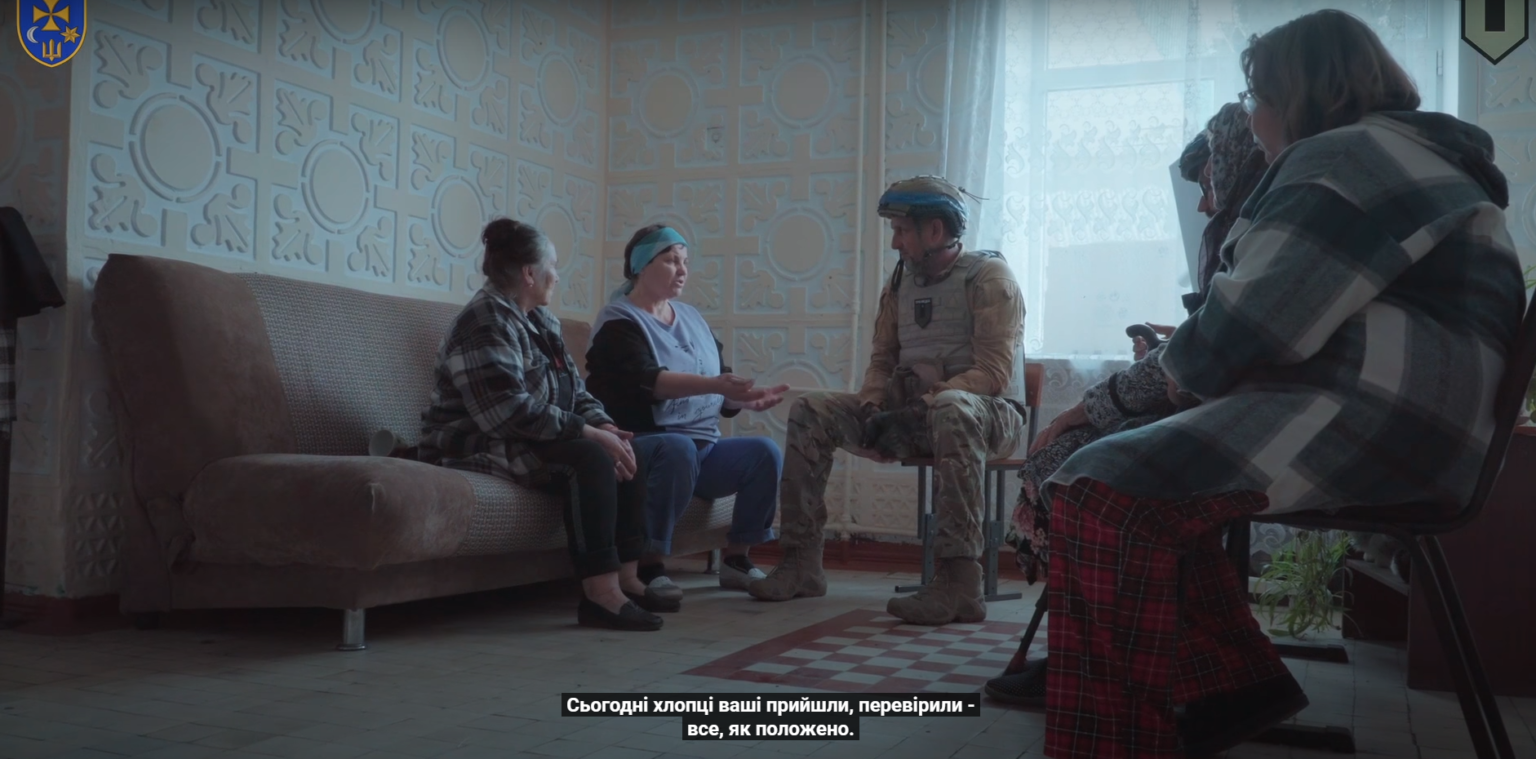
Based on the official page on the VK social network, before the operation carried out by the Armed Forces of Ukraine, the boarding school was evidently used for its intended purpose. On May 24, 2024, children left for the scheduled vacation.[22] Since the beginning of the hostilities in August 2024, the school did not have a centralized power and water supply.[23] Notably, the Defense Forces of Ukraine tried to provide the local population with all the necessary means (water, food, gas, etc.),[24] both on the territory of the boarding school and in the city of Sudzha in general. The school became a place for providing humanitarian aid. Various people,[25] including the elderly, people with disabilities, women with children, the sick,[26] or those who had lost their homes due to hostilities or other circumstances,[27] came to the school. Locals could receive medical assistance from a doctor or doctors,[28] food, and shelter. It was the military who brought food, medicine, and doctors to the boarding school.[29]
Based on the numerous videos[30] filmed directly in the boarding school, bedrooms were located on the first (ground) floor, and the left wing contained a large hall/dining room, a lobby with a generator and a heater, a kitchen, a food warehouse, and a medical facility. Sleeping accommodations were set up in the basement as well, and the hallway was used as firewood storage.[31]
There were also Ukrainian military representing the commandant’s office and/or police officers in the building.[32] They maintained public order around and inside the building. The military seen in photos and videos from Sudzha often wear armbands labeled “MP” (military police),[33] VK (military commandant’s office, UA воєнна комендатура)[34] and patches of the military administration[35] in Kursk Oblast.[36] The opposing side may use this fact to legitimize an attack, but under IHL, during an armed conflict, it is necessary to distinguish between two categories of persons: combatants[37] and civilians. Within this distinction, there is no intermediate category, so a person is either a legitimate target or a civilian who cannot be attacked except when directly participating in hostilities.[38]
As a rule, the police have a civilian status, since their main function is maintaining internal order.[39] This provision was confirmed, among other things, in the decision of the Special Tribunal for Sierra Leone in Prosecutor v. Sesay.[40] At the same time, this rule does not apply to the police integrated into the armed forces.[41] According to the Ukrainian legislation, it is special police that are endowed with such a nature. During martial law, they can take direct part in hostilities and thus acquire the status of combatants.[42]
Representatives of the National Police of Ukraine were known to have been present on the territory of the boarding school.[43] The National Police is not part of and is not subordinate to the Armed Forces of Ukraine.[44] This means that all representatives of the body, except for special police officers, have the status of civilians.[45] Thus, among all persons who were in the boarding school, the only ones with the status of combatants were representatives of the military commandant’s office or other individuals who had or may have had such contracts with the Armed Forces of Ukraine.
However, even theoretically, if combatants or civilians participating in hostilities were present on the territory of the facility, this did not automatically make the facility a legitimate target.[46] In general, a facility may be viewed as military only when two conditions are met simultaneously:
These two criteria are cumulative: if at least one of them is not met, the target is not considered military and, accordingly, falls under protection as civilian.[49] After the strike on February 1, 2025, on the boarding school in Sudzha, the Russian side claimed that there was a Ukrainian headquarters operating in the building.[50] This was presumably done to justify the attack carried out by Russia. However, there is no confirmed evidence for this claim. There are no indications that the building was used for combat operations: there is no information about weapons storage, command posts, permanent military deployment, or other activities consistent with military use. Thus, the boarding school could not provide any clear military advantage, and its destruction was not caused by any real military necessity.
Locals themselves report that there were civilians living in the boarding school, while the Ukrainian military only delivered food, water, medication, and doctors.[51] At the time of the attack, there were hundreds of civilians at the boarding school and only several representatives of the commandant’s office. Thus, the statements made by the Russian side about the presence of the military on the territory of the boarding school do not make the attack legitimate in any way.
Moreover, the Russian military, who conducted combat operations in the Kursk region, confirm that they knew about the placement of civilians at the school. In particular, Russian Lieutenant General Apti Alaudinov, commander of the “Akhmat” unit, who participated in the battles in Kursk, knew about this even before the February 1 strike.[52]
Alaudinov communicated at least several times with the press officer of the military commandant’s office, Colonel Oleksii Dmytrashkivskyi. Back on November 29, he informed Alaudinov the boarding school housed only civilians. Alaudinov confirmed that the Russians were aware of this. On January 31, the representative of the commandant’s office told Alaudinov that the boarding school had no heating due to shelling and became cold. He asked Alaudinov to stop the shelling, while the Russian general did not deny that it was the Russian side carrying out the strikes. However, he did say they were possibly Russian units “coming from the other side.”[53]
In addition to all these statements, it should be noted that the building featured a large inscription “PEOPLE,” which clearly distinguishes it from others and emphasizes its civilian nature.
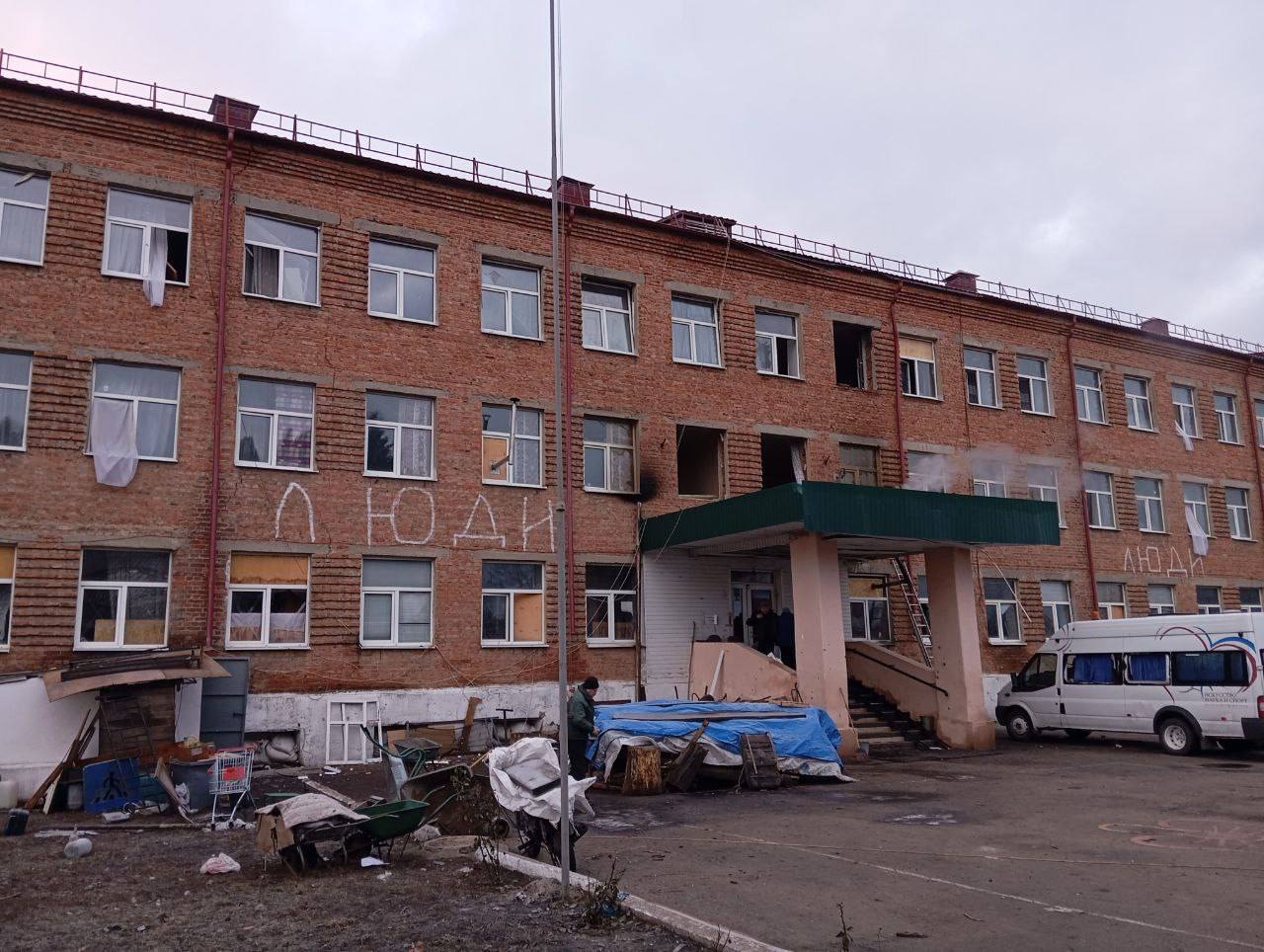
Boarding school as of January 12, 2025, and entrance to the basement.
Source: Sudzha Rodnaya /Telegram[54]
Cruelty Cascade: Examining the Pattern of Russian Double-Tap Strikes in Ukraine
The History of Attacks on the Sudzha Boarding School
When Sudzha came under Ukrainian control in August 2024, humanitarian aid began to be distributed in the boarding school dormitory, and some people remained to live there. As the Russian troops advanced, the shelling gradually approached the boarding school. On January 6, 2025, the city of Sudzha was confirmed to have been hit by a guided aerial bomb for the first time. Russian media reported a strike allegedly carried out by a FAB 3000 bomb.[55]
One of the local activists, Vladimir Sinelnikov, wrote that the boarding school had been shelled five times since Sudzha came under Ukrainian control.[56] According to him, the first time it happened was January 17, 2025, when two aerial bombs exploded on the territory of the school; a few days later, a Russian citizen was found dead due to an attack using two FPV drones, and on January 31, 2025, two more attacks were carried out with aerial bombs, during the day and during the night. Truth Hounds verified all the incidents mentioned, as well as those claimed by the Ukrainian authorities. By analyzing open sources, investigators were able to confidently confirm four of them:
- In the early hours of January 12, 2025.[57] Then, the Russians hit an abandoned fire station opposite the boarding school with two FABs equipped with the UMPK bomb kit. One strike landed 50 meters[58] away from the boarding school, the other one approximately 100 meters away.[59]
- On January 16, 2025,[61] two FPV drones hit two vehicles that were delivering food and were parked near the boarding school.[62] A civilian was standing close to one of the cars, talking to a soldier, and there were even more civilians 10 meters away.[63] As a result, 2 people suffered from blast trauma. This episode was published on Telegram by a Russian military member with the call sign “Buratino,” who serves in the 11th Separate Guards Airborne Assault Brigade. The page description states that he shares “the results of his work,” which most likely indicates his responsibility for the episode or the unit in which he serves.[64]
- On January 31, 2025, which the media calls “the most terrible day,” two airstrikes were carried out at 16:23 and 16:43.[65]
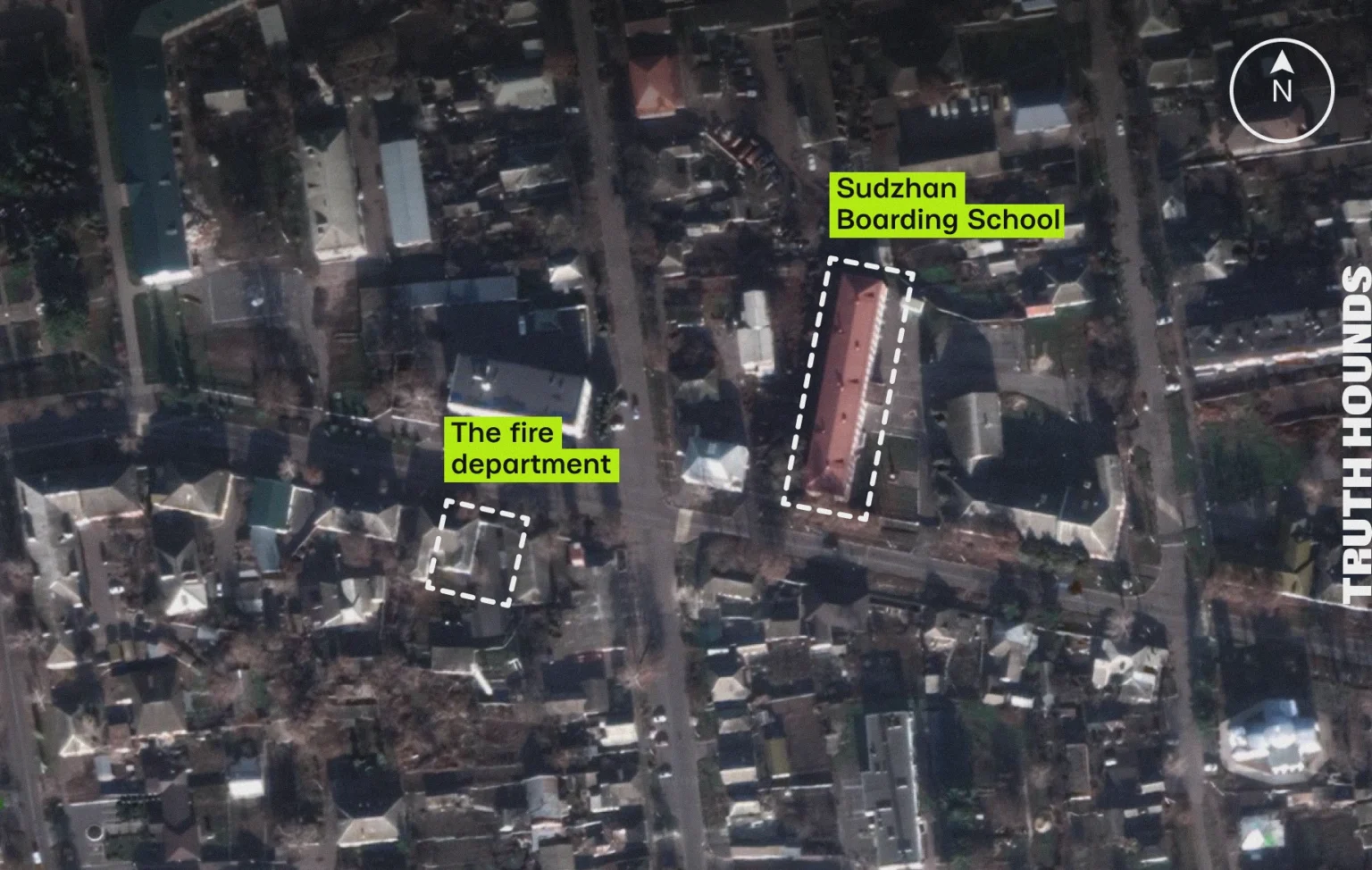
The fire department attacked by a UMPK-equipped FAB[60]
Individual Telegram channels and the press officer of the Sudzha district commandant’s office also reported other attacks. However, we have not found additional sources that could confirm or refute them.
The last and most destructive attack was on February 1, 2025. As reported by a number of Russian media and Telegram channels, this happened at 18:54 local time.[66] On that day, part of the building collapsed due to the shelling. According to the Sumy Oblast Prosecutor’s Office, there were 120 people at the boarding school at the time. Eleven of them were injured, six went missing, and four people died.
On his Facebook page[67] and live on the United News telethon,[68] the commandant of the Sudzha district claimed that after the first strike, during the clearing of the rubble, Russia carried out an additional strike nearby and kept using FPV drones against the territory of the yard, which made it impossible to use heavy equipment to clean up the rubble. The double-tap tactic may be in line with the pattern of war characteristic of the Russian military command. This was covered by Truth Hounds in a previous study.
Direction of the Strike
After the strike on February 1, 2025, civilians were injured and the building collapsed. This can be seen in the satellite image dated February 11. However, the image quality is not sufficient to establish the vector of the strike.
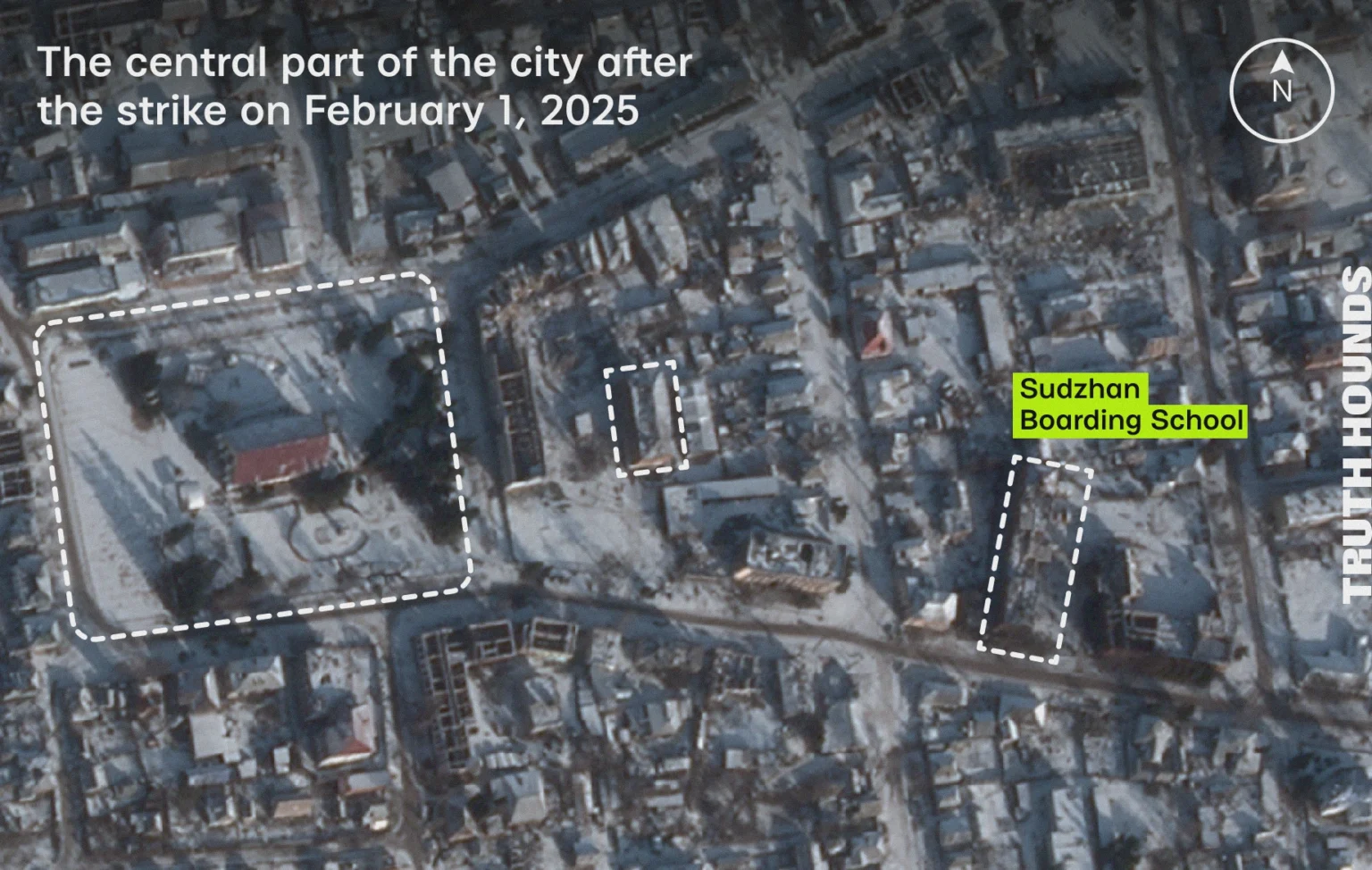
The image shows the destroyed Sudzha boarding school after the strike. (right) and other identifying landmarks of the area and the building (left and center).
Source: Planet, February 11, 2025
At the same time, representatives of the Sudzha commandant’s office (which exercised control of the territory following the strike) recorded the aftermath using a drone camera. As seen in the still, the most destruction landed in the central and top parts of the structure: the roof and the second and third floors. This indicates that the strike was most likely carried out by an air weapon rather than by explosion, gunfire, or from within.
NOTE:
Truth Hounds is also open to receiving other evidence/photos/videos or data that could change the version we have released.
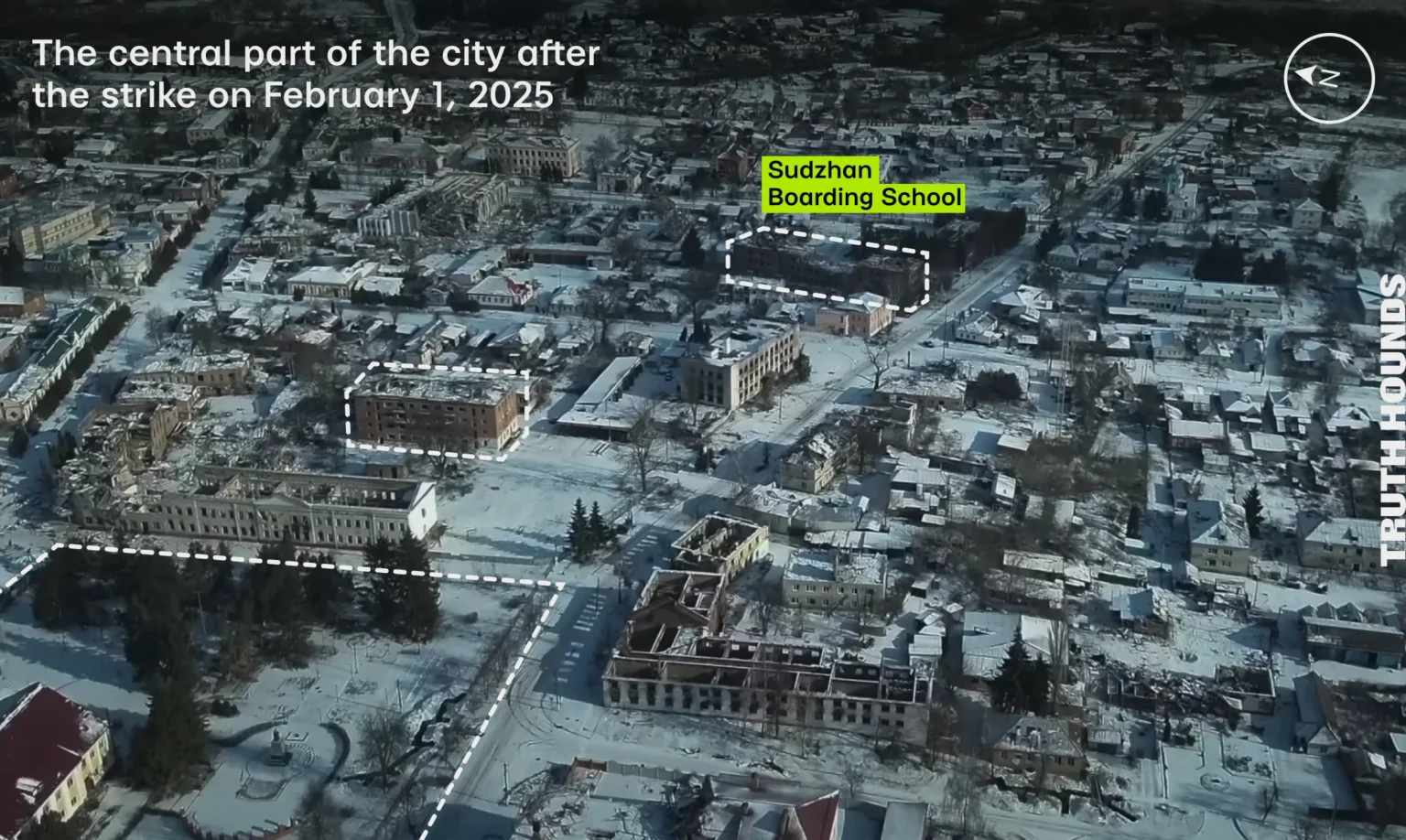
A still from a video of a panoramic drone shot by representatives of the Sudzha District Commandant’s Office of the central part of Sudzha after February 1, 2025.[69]
The school and other buildings identifying the location.
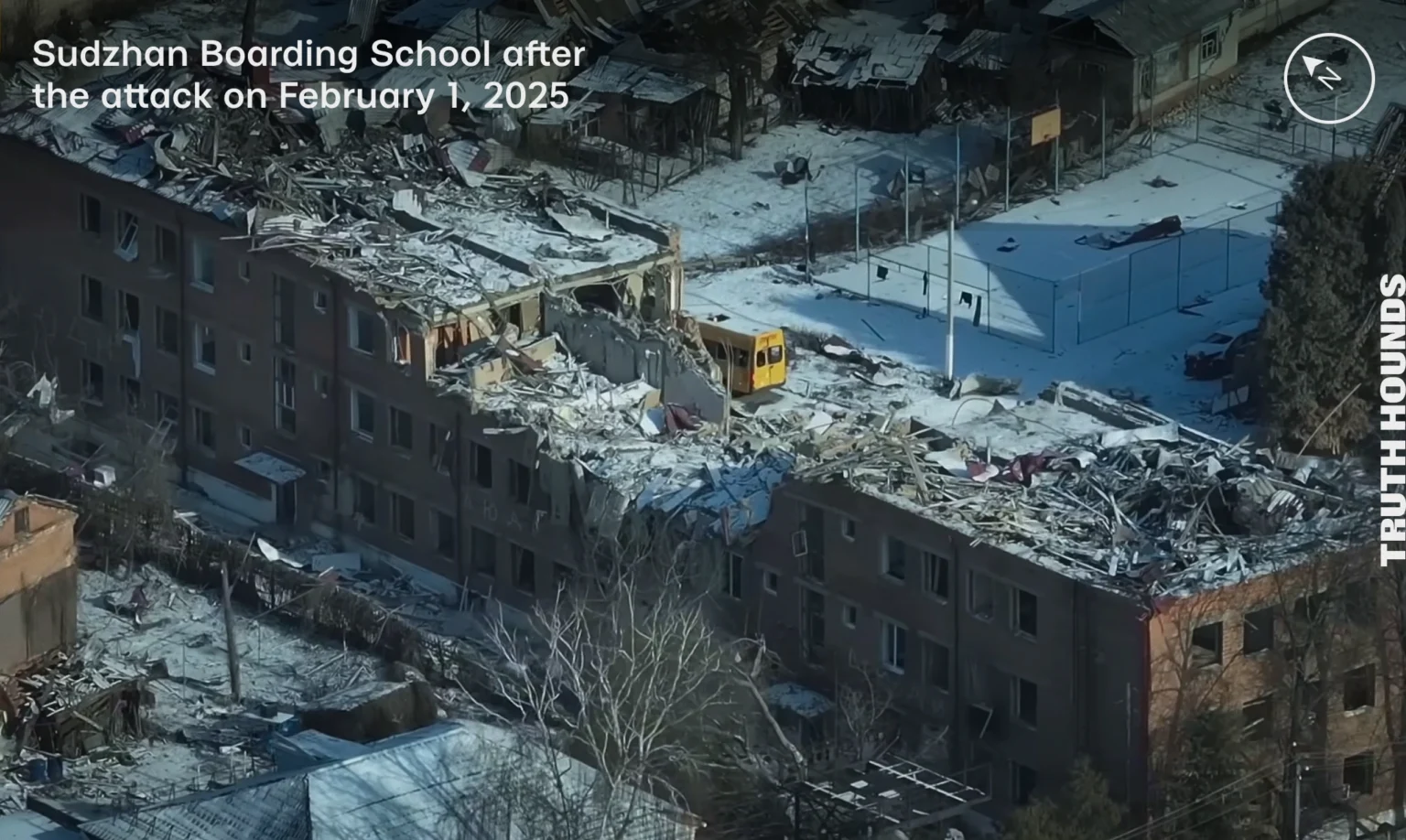
A still from a close-up video of the Sudzha boarding school after February 1, 2025[70]
In another still from a close-up shot by the Sudzha District Commandant’s Office, the eastern and western parts of the building can be assessed equally: the eastern side of the building is more severely damaged. This indicates that the shell hit the eastern wall and that the epicenter of the explosion was there. This also indicates the likely direction of approach of the projectile.
It can be assumed that during the attack on the boarding school building, the Russian Armed Forces could have used a FAB, as they did during previous attacks. Aerial bombs typically have a contact detonator. This means that such an aerial bomb does not explode deep inside the building but when the bomb hits the first solid obstacle. Thus, in this case, the epicenter and the biggest destruction would be in the place where the bomb most likely struck the building originally. In addition, Truth Hounds investigators found no evidence that Russia was using UMPK with concrete-piercing aerial bombs, which would explode inside the building.
There were also no facts that would point to the use of cruise weapons by either side. Furthermore, neither party declared such use.
NOTE:
Truth Hounds is also open to receiving other evidence/photos/videos or data that could change the version we have released.
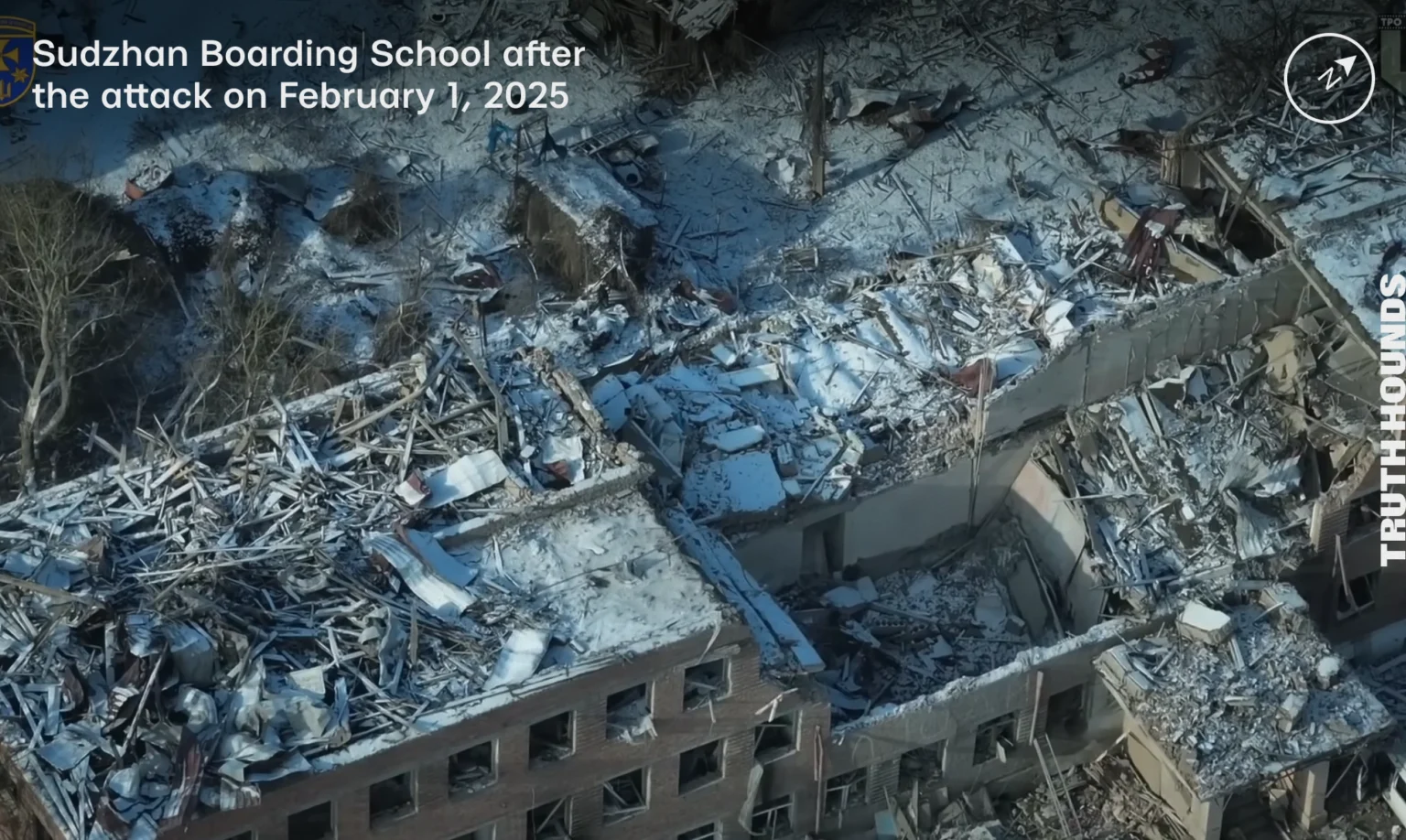
A still from a close-up video of the Sudzha boarding school after February 1, 2025[71]
Responsible Party and Probable Weapon
Officially, Ukraine and Russia have two conflicting versions of what weapon was used to strike the boarding school:
- The General Staff of the Armed Forces of Ukraine reported on February 1 at 20:25 (Ukrainian time) that the strike was carried out deliberately by a guided aerial bomb at 17:54 Ukrainian time, 18:54 Russian time.[72]
- The Severny Veter Telegram channel, which Russian media link[73] to the Russian North military group, stated on February 1 at 22:34 that Russian aerial defense had recorded six launches of the HIMARS missiles from the locality of Mala Rybytsia (Sumy Oblast, Ukraine, about 28 km south of the boarding school). Four of these launches were allegedly made on February 1 at 18:53.[74] Later, on February 2 at 00:13 (Ukrainian time), Russia’s Ministry of Defense claimed, without going into detail,[75] that the Armed Forces of Ukraine made a strike with missiles from Sumy Oblast. The weapons and quantity were not specified.
As of February 1, the territory east of the city of Sudzha was controlled by the Russian Federation, according to data from the Deep State service.[76] Only units of the Russian army were located in that direction, as confirmed also by the similar Russian resource “Map of the Special Military Operation.”[77]
The nature of the damage indicates that the strike was carried out from the eastern direction. This version was also confirmed by a group of experts on Russian missile weaponry and the chain of command during their use. For security reasons and in accordance with the terms of our cooperation, the identities of these experts remain anonymous. This also makes the version of a missile strike from Ukraine impossible. HIMARS or M270 missiles approach the target following a ballistic trajectory. In the case of multi-story buildings, such a missile would usually hit the upper part.[78] However, this does not rule out the possibility of a missile strike.
Still, Truth Hounds investigators found no evidence of combat operations of Ukrainian aircraft near Sudzha. Russian aviation, on the other hand, started strikes on Sudzha with UMPK-equipped FAB back on January 6, 2025,[79] as reported by Russian military channels themselves.[80]
In addition, the day after the attack, the Air Force of the Armed Forces of Ukraine published screenshots from the Virazh-Planshet application, an automated system for collecting information about the air situation.[81] The images indicate that it was Russia that used air weapons to the east of Sudzha.[82] Namely, the Su-34 airplane that launched a UMPK-equipped FAB. The Russian official side, on the other hand, published no evidence confirming their version of the strike.
Thus, the strike was most probably carried out by Russian aviation.
Possible Airfields Used for the Strike
The Su-34 fighter-bomber is the main carrier of a UMPK-equipped FAB. Russian media have posted multiple videos of these aircraft flying to bomb the AFU positions in the Kursk Oblast.[83]
According to the document “Recommendations on the Use of the FAB-500М62 Aerial Bomb with the Universal Planning and Adjustment Module,”[84] after dropping the UMPK-equipped FAB, the plane must take a turn in the direction opposite the direction of the strike. That is, after the aerial bomb is dropped, the plane must immediately turn in the opposite direction.[85] After this, the aircraft changes the height to the lower limit of enemy air defense and moves to the base/advance airfield. The Russians use this tactic with some exceptions and do not follow the recommendation to reduce altitude, as they do not potentially expect any danger from the Ukrainian side. This version was also confirmed by the group of experts on Russian missile weaponry and the chain of command during their use.
The process of dropping UMPK-equipped bombs on a video by the Russian MoD.
The footage is made from the cockpit of a Su-34.[86]
According to the group of experts on Russian missile weaponry and the chain of command in its use, the Su-34 that attacked the boarding school in Sudzha took off from the Buturlinovka airfield in Voronezh Oblast, 375 km as the crow flies from the boarding school. At the same time, as of February 1, 2025, there was no aviation unit equipped with Su-34 fighter-bombers based at the Buturlinovka airfield. Satellite images taken from mid-January to mid-February 2025[87] do not indicate high aircraft activity at Buturlinovka.
This section provides a detailed account of how Truth Hounds investigators worked to identify the potential airfields from which the plane that struck the Sudzha boarding school could have taken off, to take the readers through this process together with us.
[87] The Truth Hounds team analyzed high-quality footage of the Buturlinovka airfield from January 13, 2025, to February 17, 2025. What is more, they analyzed low-quality images from the Sentinel-2 satellite from January 22, 2025, to February 8, 2025. All satellite images show no activity of Su-34 bombers.
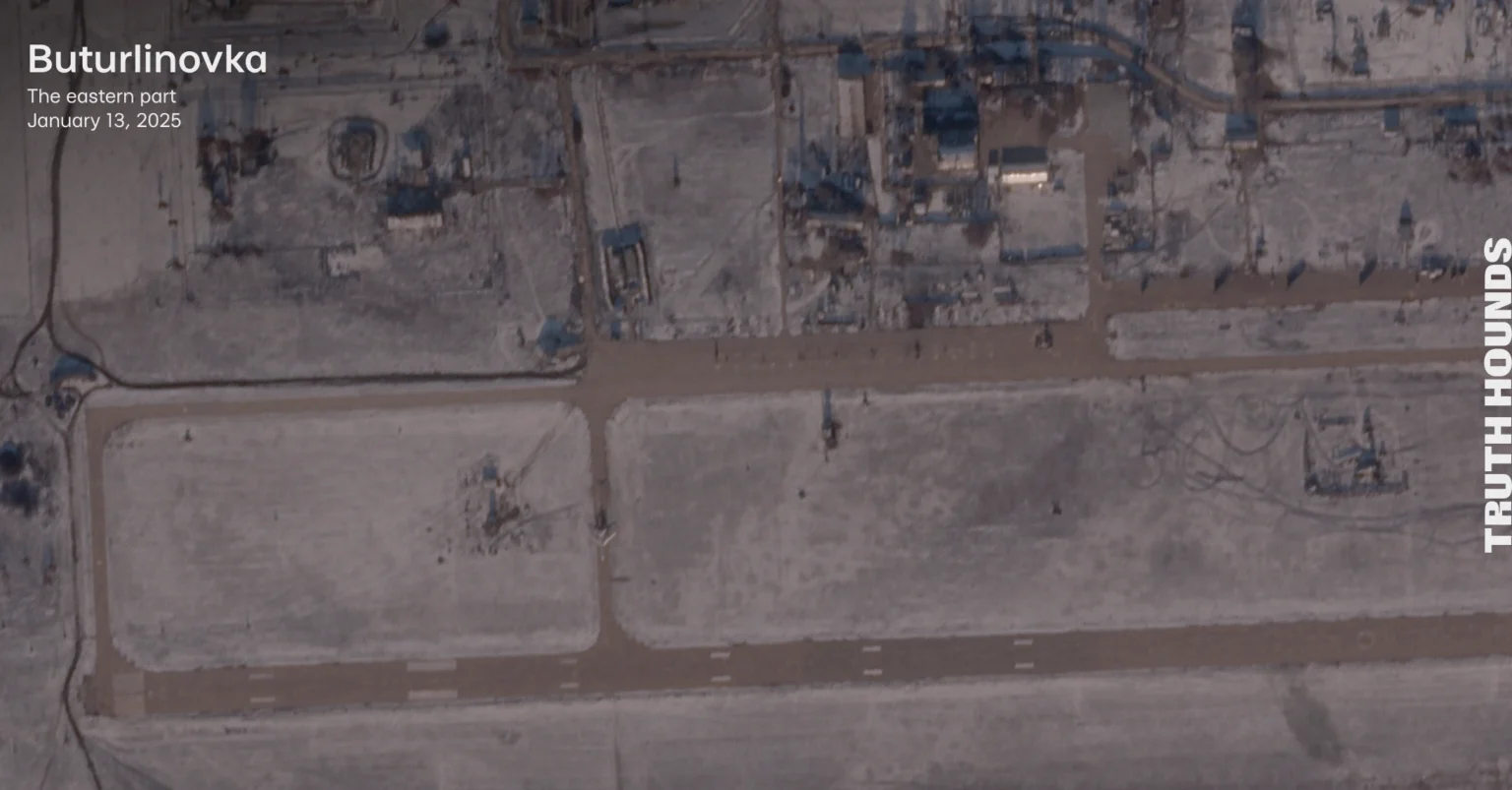
No bomber aircraft are visible in the satellite image of the eastern part of the Buturlinovka airfield.
Source: Planet, January 13, 2025
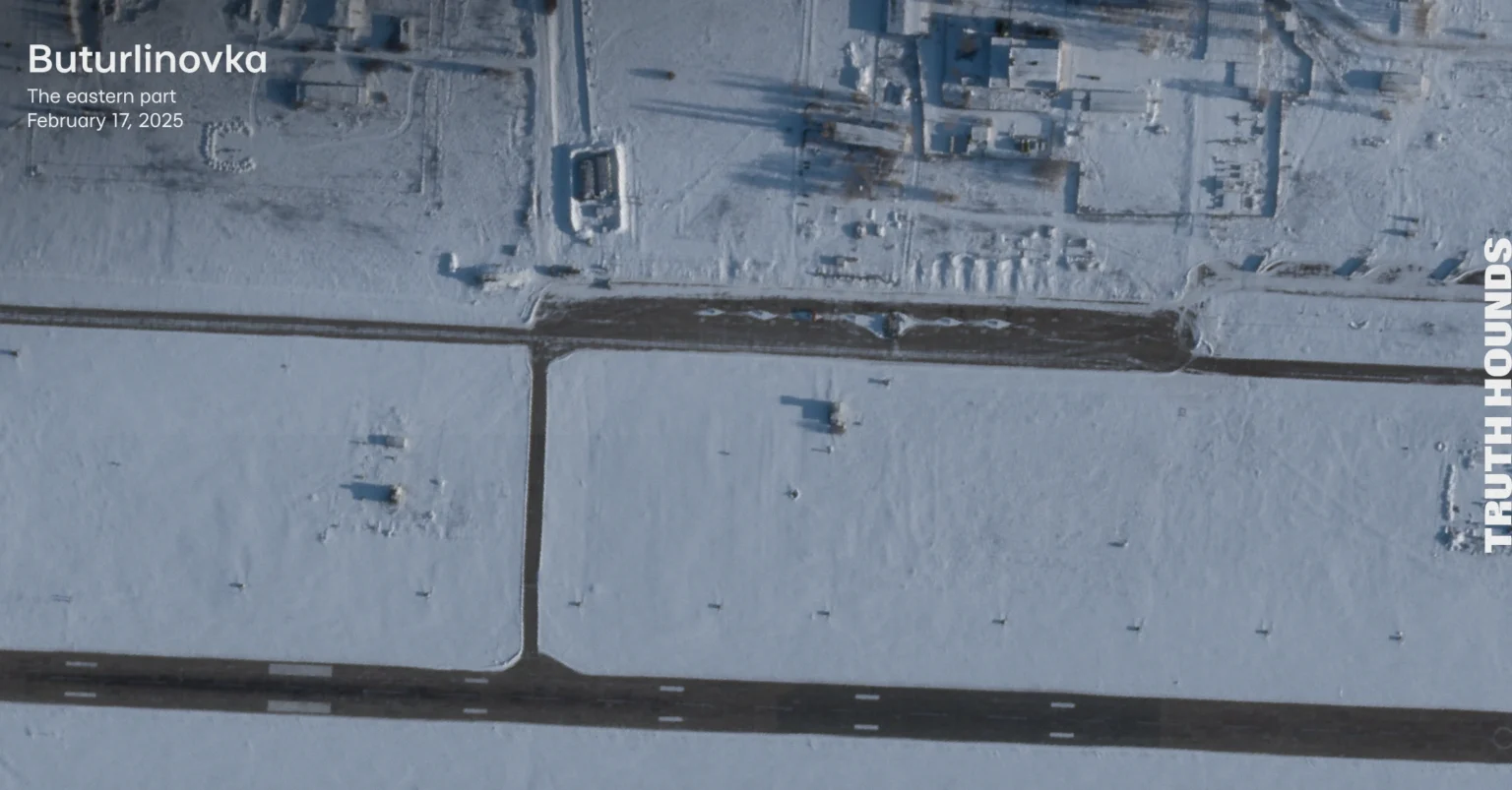
No bomber aircraft are visible in the satellite image of the eastern part of the Buturlinovka airfield.
Source: Planet, February 17, 2025
This may indicate that the Buturlinovka airfield is used as an advance point[88] for aircraft flying in from remote airfields in Russia. An advance/forward airfield is a temporary or interim airfield used by military aircraft for refueling, maintenance, or rest before they move on to the main target or to the so-called home airfield of their permanent stationing with the necessary engineering support and qualified personnel for this particular aircraft model.
Under this assumption, it makes sense to study the airfields where Su-34 bombers were based at the moment of the strike on February 1, 2025, and which are used for strikes against Ukraine.[89] These are airfields Maykop, Republic of Adygea; Marinovka, Volgograd Oblast; Savasleyka, Nizhny Novgorod Oblast; Mozdok, North Ossetia; Akhtubinsk, Astrakhan Oblast; Borisoglebsk, Voronezh Oblast; and Lipetsk, Lipetsk Oblast.
Let us consider them in more detail to understand from which airfield the Su-34 arrived at Buturlinovka to attack Sudzha.

The distance from likely airfields of aircraft departure to Sudzha.
Borisoglebsk and Lipetsk
As of February 2025, the 47th Bomber Aviation Regiment, consisting of six or more Su-34s, was deployed at the Borisoglebsk airfield.[90] Lipetsk airfield also housed six or more Su-34, probably of the 968th Mixed Instructor and Research Aviation Regiment.
The Borisoglebsk and Lipetsk airfields are located relatively close to Kursk Oblast and the city of Sudzha, at 470 and 330 km, respectively. Therefore, aircraft from these airfields can strike the area of Sudzha without using the advance airfield. It is therefore unlikely that the Su-34 arrived at Buturlinovka on that day from these two airfields, as this maneuver would lead to more fuel consumption and unnecessary moves. Instead of shortening the distance to a potential target, it creates a roundabout and an illogical path.
Theoretically, aircraft from the Lipetsk and Borisoglebsk airfields could be temporarily relocated to the Buturlinovka airfield. In this scenario, this was not captured in the available satellite images.
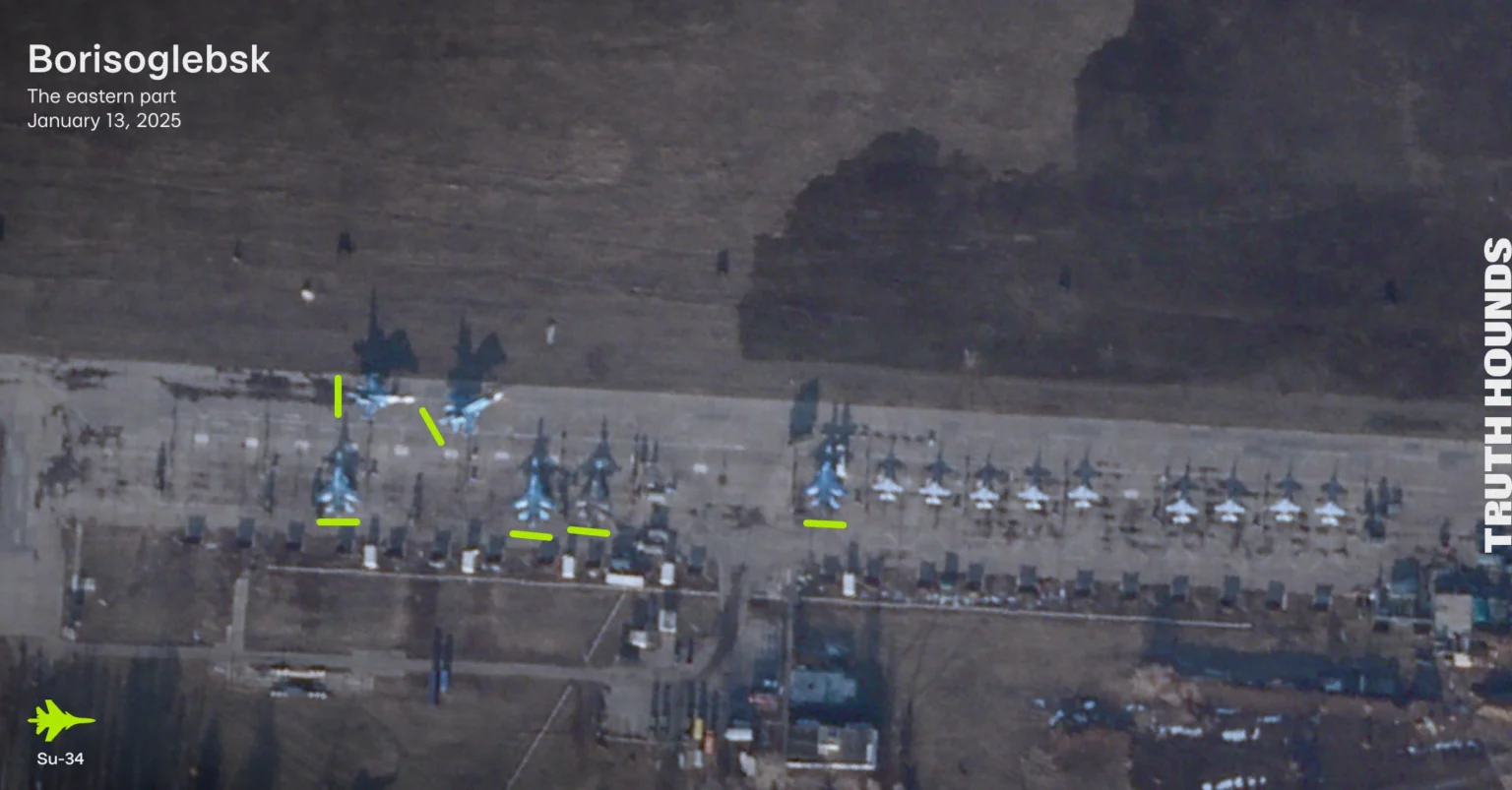
The satellite image of the eastern part of the Borisoglebsk airfield shows at least six Su-34 aircraft.
Source: Planet, January 13, 2025
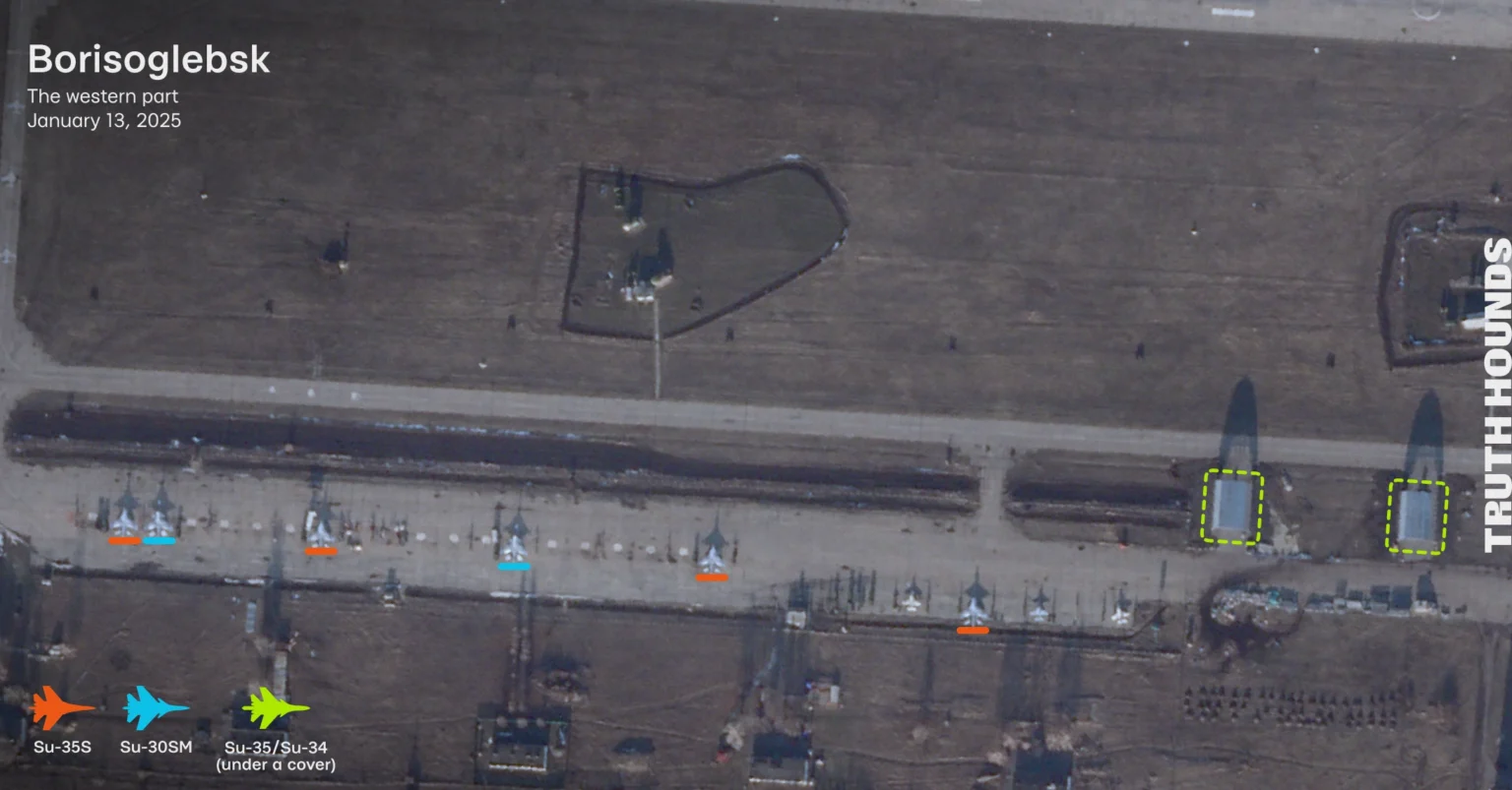
The satellite image of the western part of the Borisoglebsk airfield shows at least four Su-35S aircraft and two Su-30SM. There are also two Su-35/Su-34 aircraft under a cover.
Source: Planet, January 13, 2025
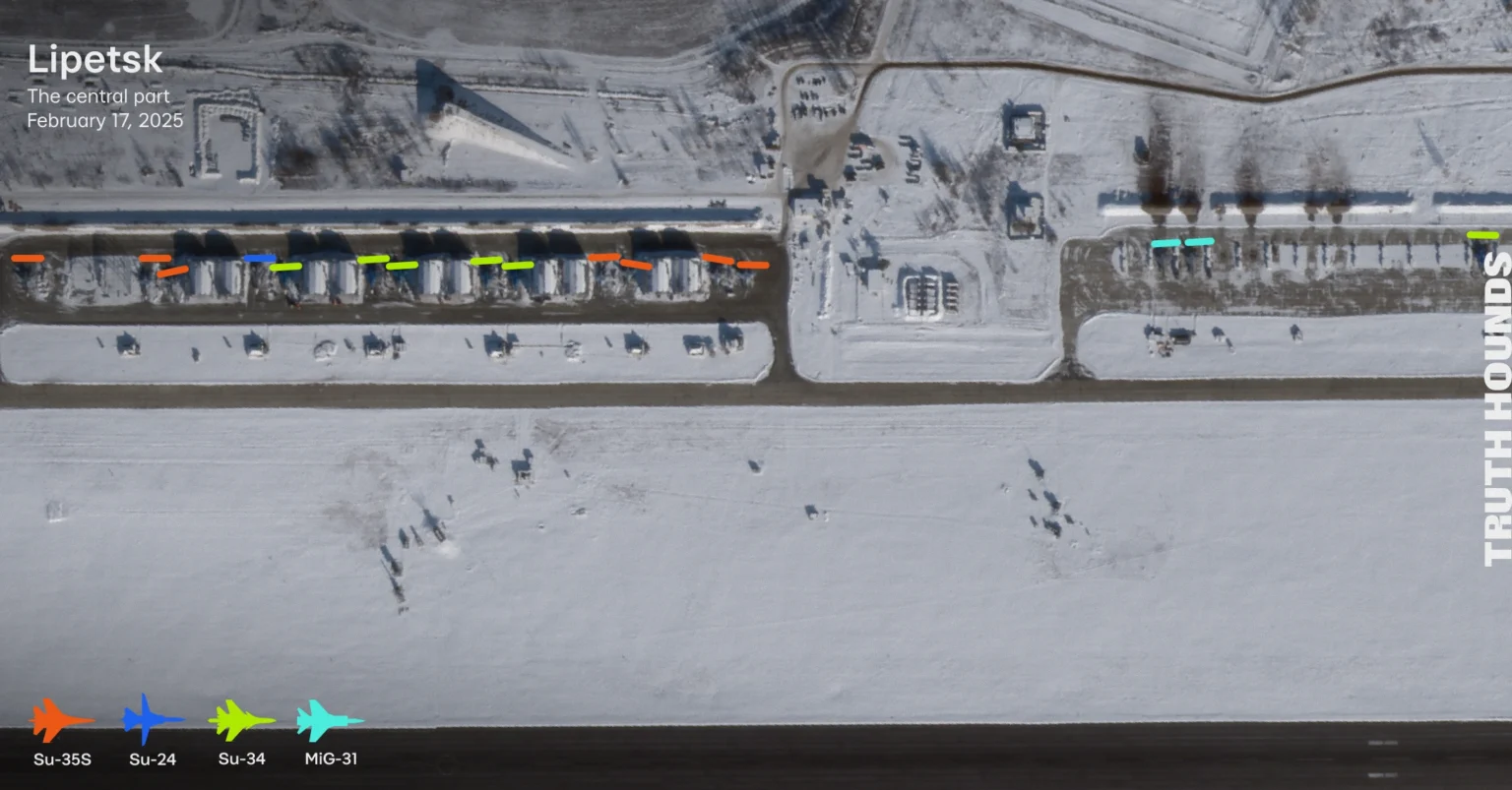
The satellite image of the central part of the Lipetsk airfield shows at least six Su-34 aircraft, one Su-24, seven Su-35S and 2 MiG-31 aircraft.
Source: Planet, February 17, 2025
Marinovka, Akhtubinsk, and Savasleyka
Marinovka, Akhtubinsk, and Savasleyka airfields are located farther away from Sudzha (650–870 km). Therefore, these aircraft would need refueling before striking Sudzha. This would be in particular due to maneuvering, the threat from air defense, and the need to return safely.
It is likely that aircraft taking off from airfields Marinovka, Akhtubinsk, and Savasleyka are refueled before the strike so that the plane would have a full supply of fuel to execute the combat mission. This would be particularly important to approach the target and avoid Ukrainian air defense. Similarly, F-16 aircraft during Operation Package Q Strike in Iraq refueled before the strike, not afterward.[91]
It is thus logical to use the Buturlinovka airfield as an advance airfield before the strikes, particularly, against localities in the Kursk Oblast.
As of February 2025, up to 22 Su-34s were deployed at the Marinovka airfield. They belong to the 559th Bombardment Aviation Regiment and probably the 277th Bombardment and 2nd Mixed Aviation Regiments.
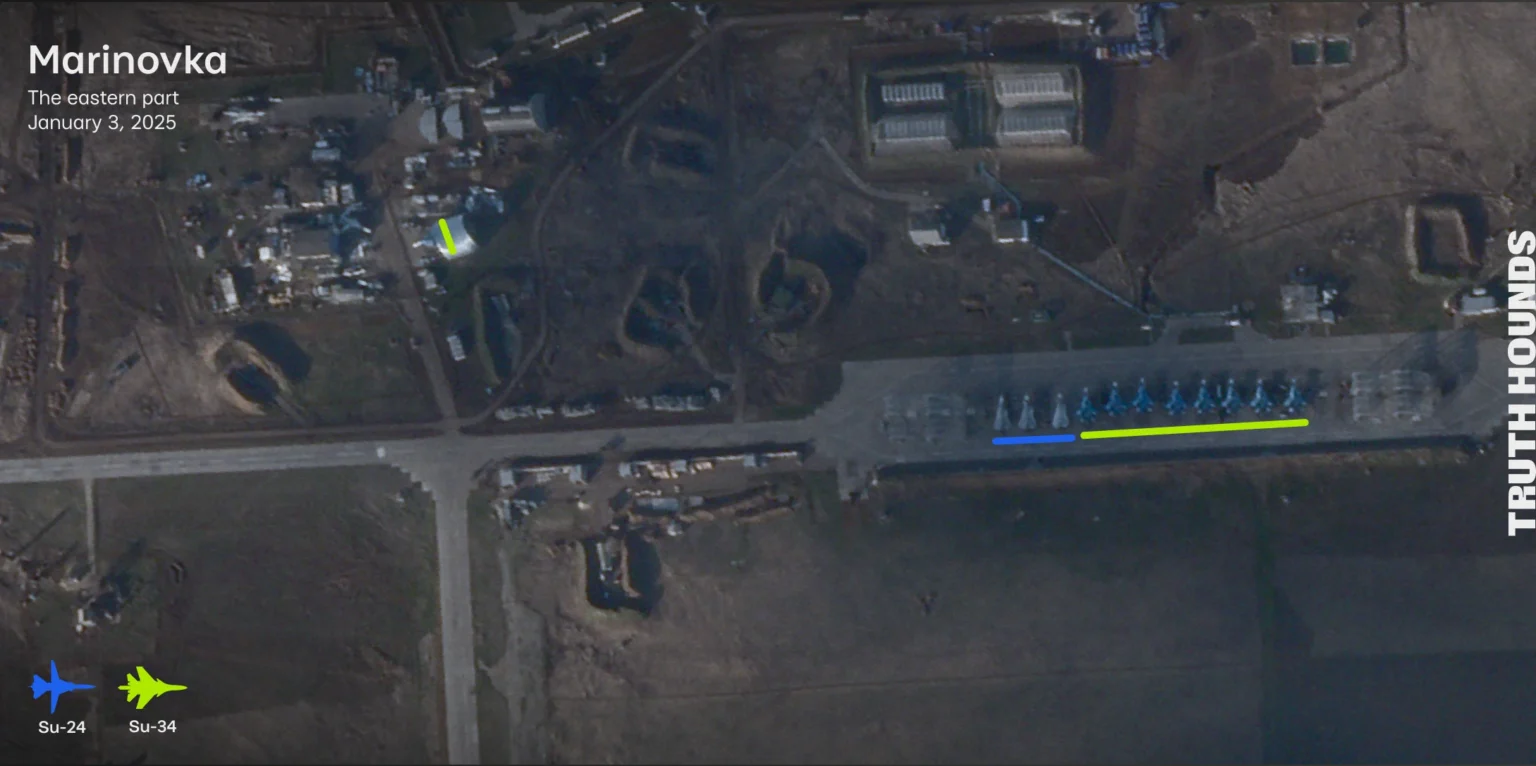
The satellite image of the eastern part of the Marinovka airfield shows at least nine Su-34 aircraft and three Su-24 planes.
Source: Planet, January 3, 2025
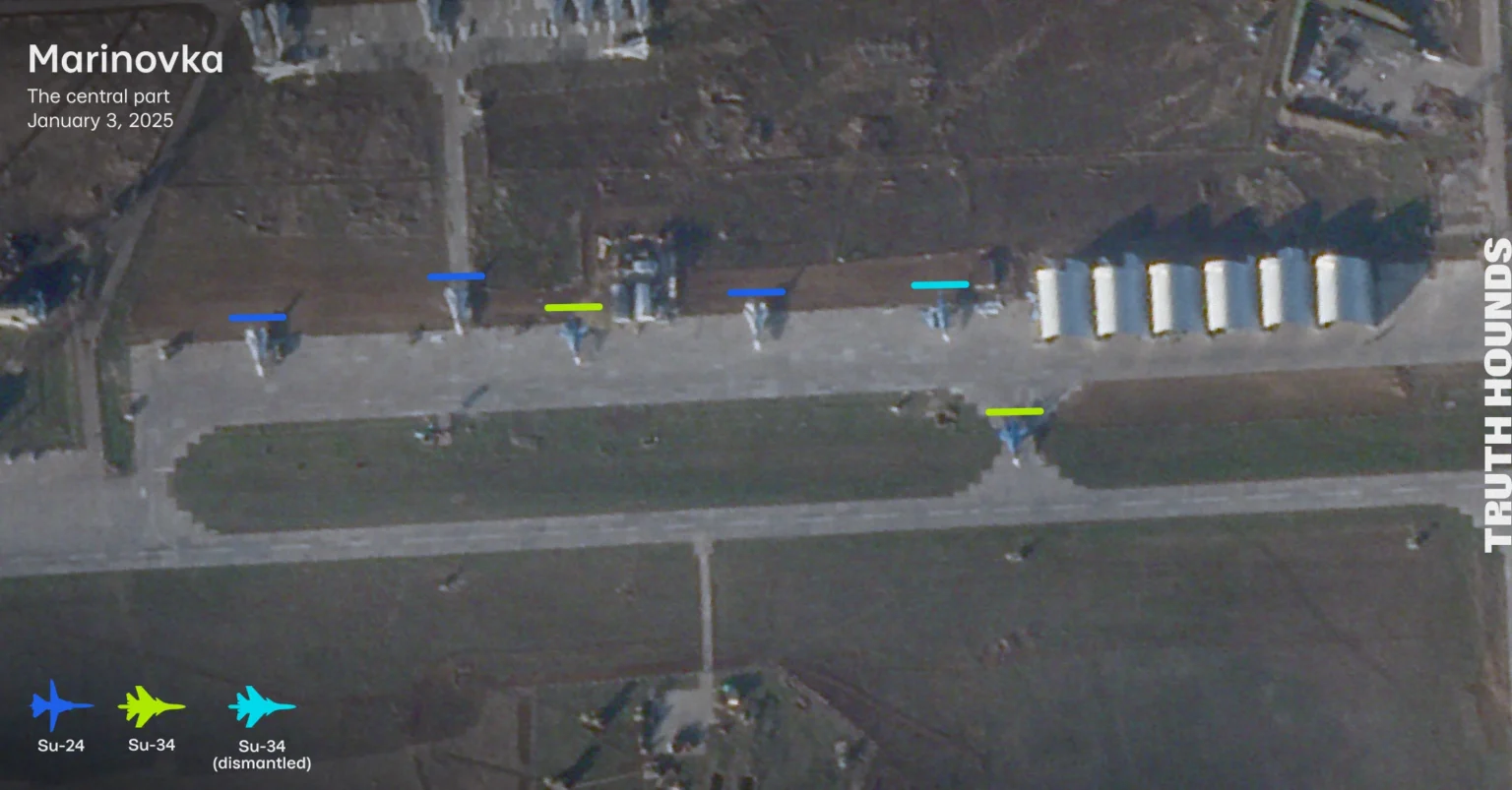
The satellite image of the central part of the Marinovka airfield shows at least three Su-34 (one dismantled) and three Su-24 planes.
Source: Planet, January 3, 2025
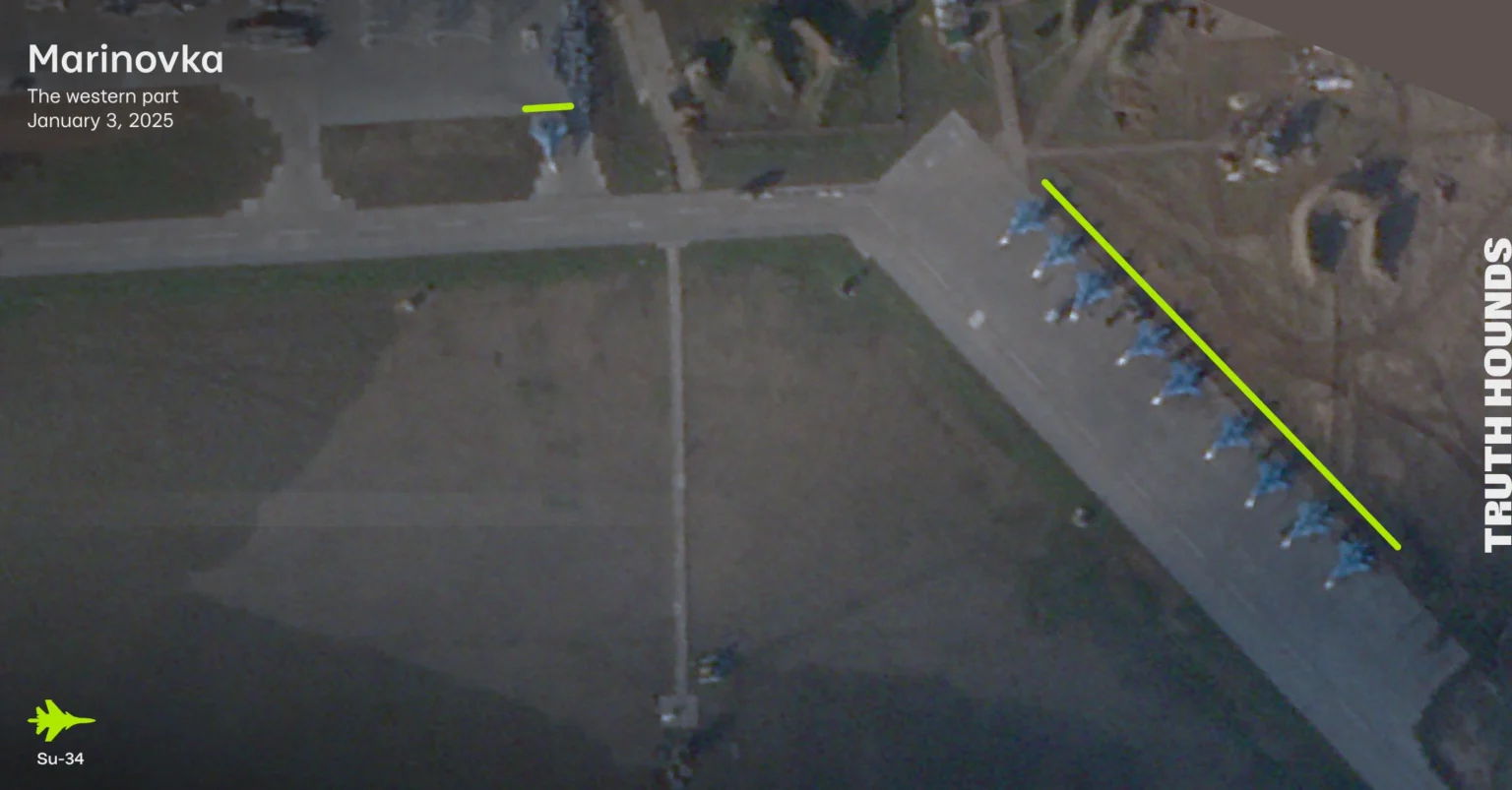
The satellite image of the western part of the Marinovka airfield shows at least ten Su-34 aircraft.
Source: Planet, January 3, 2025
There is little up-to-date information about planes from this airfield. Therefore, in 2025, only one Su-34 of the 559th Regiment was identified.[92] In 2024, the airfield housed both planes of the 559th Regiment[93] and the 2nd Mixed Regiment.[94] In 2022, the 277th Bombardment Regiment was also deployed at this airfield, but currently, its presence at Marinovka cannot be confirmed.[95]
Since early autumn 2024, the number of Su-34 airplanes in this airfield increased.[96] It probably became an alternative to the Morozovsk airfield, which came under attack on August 3, 2024.[97] Among other things, the latter housed Su-34s from the 277th Bombardment Regiment.[98] Thus, the majority of planes from Morozovsk were probably relocated to Marinovka.
At the same time, satellite images of the Akhtubinsk airfield show that at least four Su-34 aircraft were deployed at the airfield.
[96] A detailed analysis of the Marinovka and Morozovsk airfields is provided in section V. Attacks on civilian infrastructure in Kherson with aerial bombs are described in the Guided Chaos investigation.
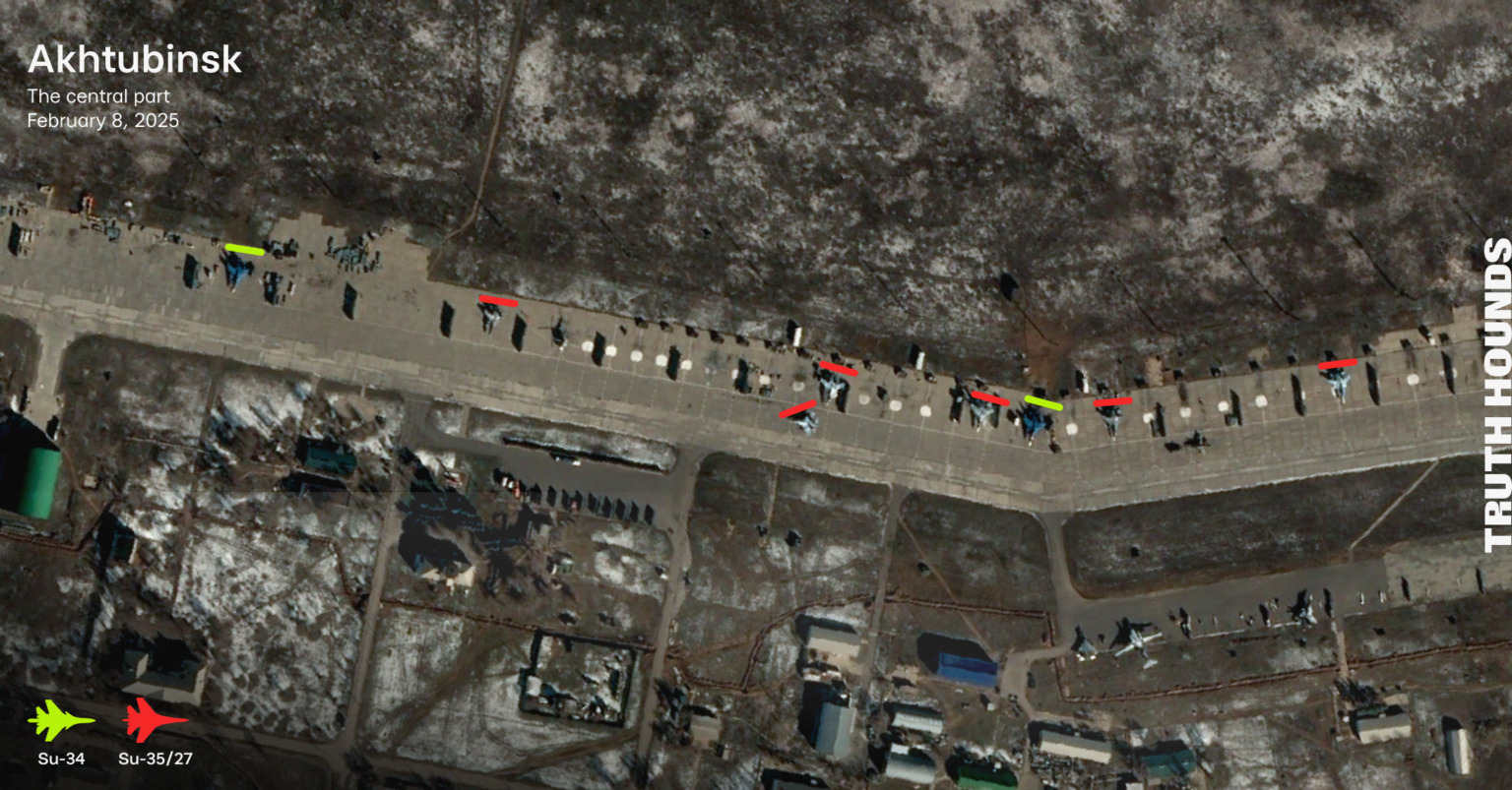
A satellite image of the central part of the Akhtubinsk airfield shows at least two Su-34s and six Su-35/27s.
Source: OnGeo Intelligence, February 8, 2025
The 929th State Flight Test Center, which also includes Su-34 aircraft, is permanently stationed at Akhtubinsk.[99]
The situation is similar with the Savasleyka airfield in the Nizhny Novgorod Oblast. Since early 2025, up to six Su-34s have been deployed at the airfield. In July 2025, one of the Su-34s from this airfield experienced a technical malfunction, forcing the pilot and navigator to eject, resulting in the latter’s death. Analysis indicated that the pilots of this Su-34 served in the 2nd Mixed Regiment.[100] It is thus most likely that the other planes from this airfield also belong to the 2nd Mixed Regiment. Su-34s from the Savasleyka airfield are used for attacks, including with UMPK-equipped FAB munitions, on the territory of Ukraine.[101]
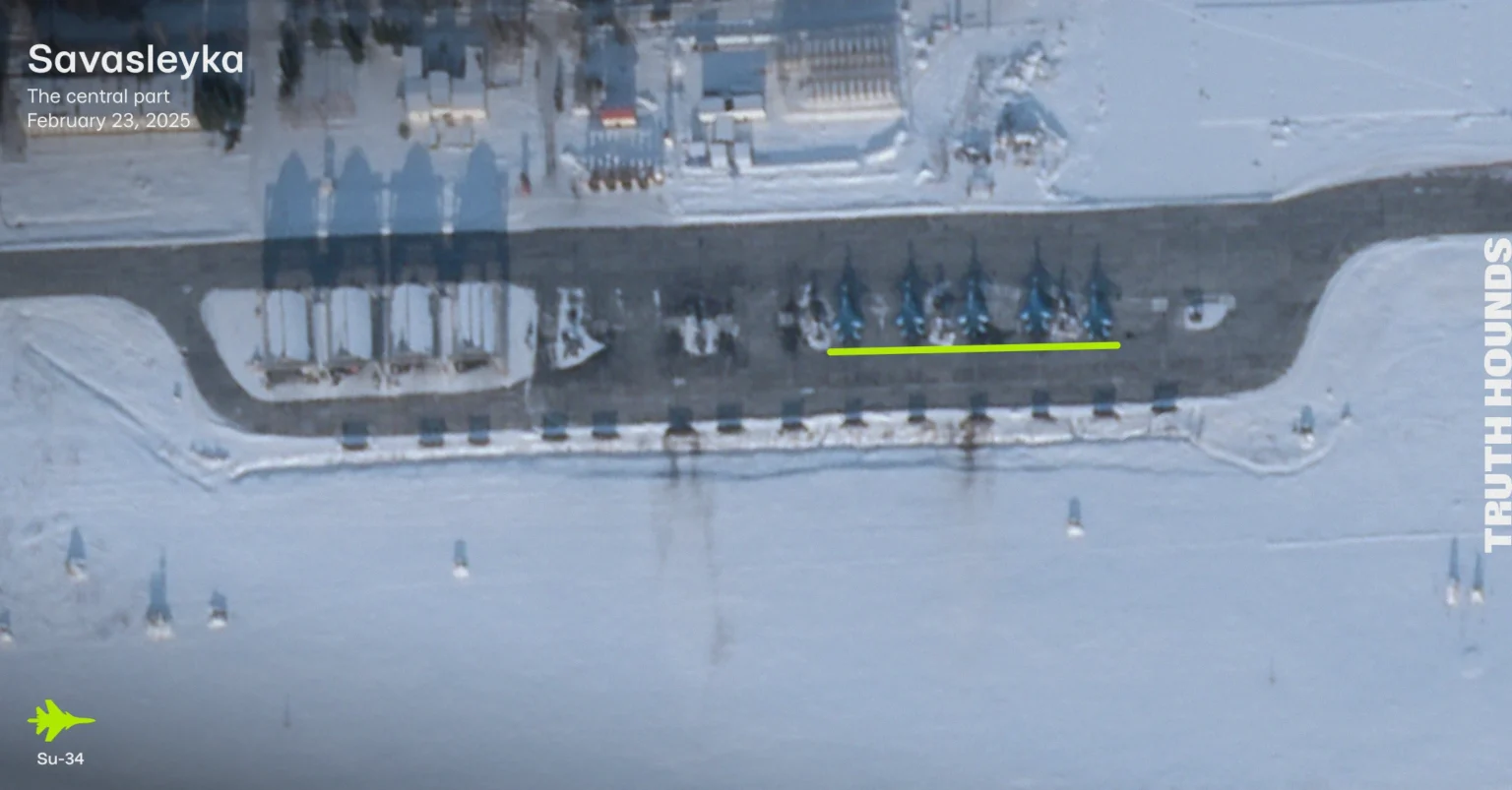
A satellite image of the central part of the Savasleyka airfield shows at least five Su-34s.
Source: Planet, February 23, 2025
Maykop and Mozdok
Similarly to Marinovka, Savasleyka, and Akhtubinsk, the Russian Aerospace Forces may have used planes from the Maykop or Mozdok airfields to carry out a strike on the city of Sudzha. To do this, planes from these airfields would have had to land at the Buturlinovka airfield to refuel.
Given the maximum combat range of the Su-34 airplanes loaded with UMPK-equipped FAB (up to 1100 km),[102] planes departing from these airfields may have used Buturlinovka as a point for refueling and advance. This is logistically feasible and technically sound. The distance from each of these airfields to Sudzha is over 1000 km. Planes may safely conduct a combat sortie to Buturlinovka from these airfields across the territory of Russia, avoiding a critical shortage of fuel.
As of February 2025, the Maykop airfield housed up to 12 Su-34s from two units, namely, the 277th and the 559th Bombardment Aviation Regiments.
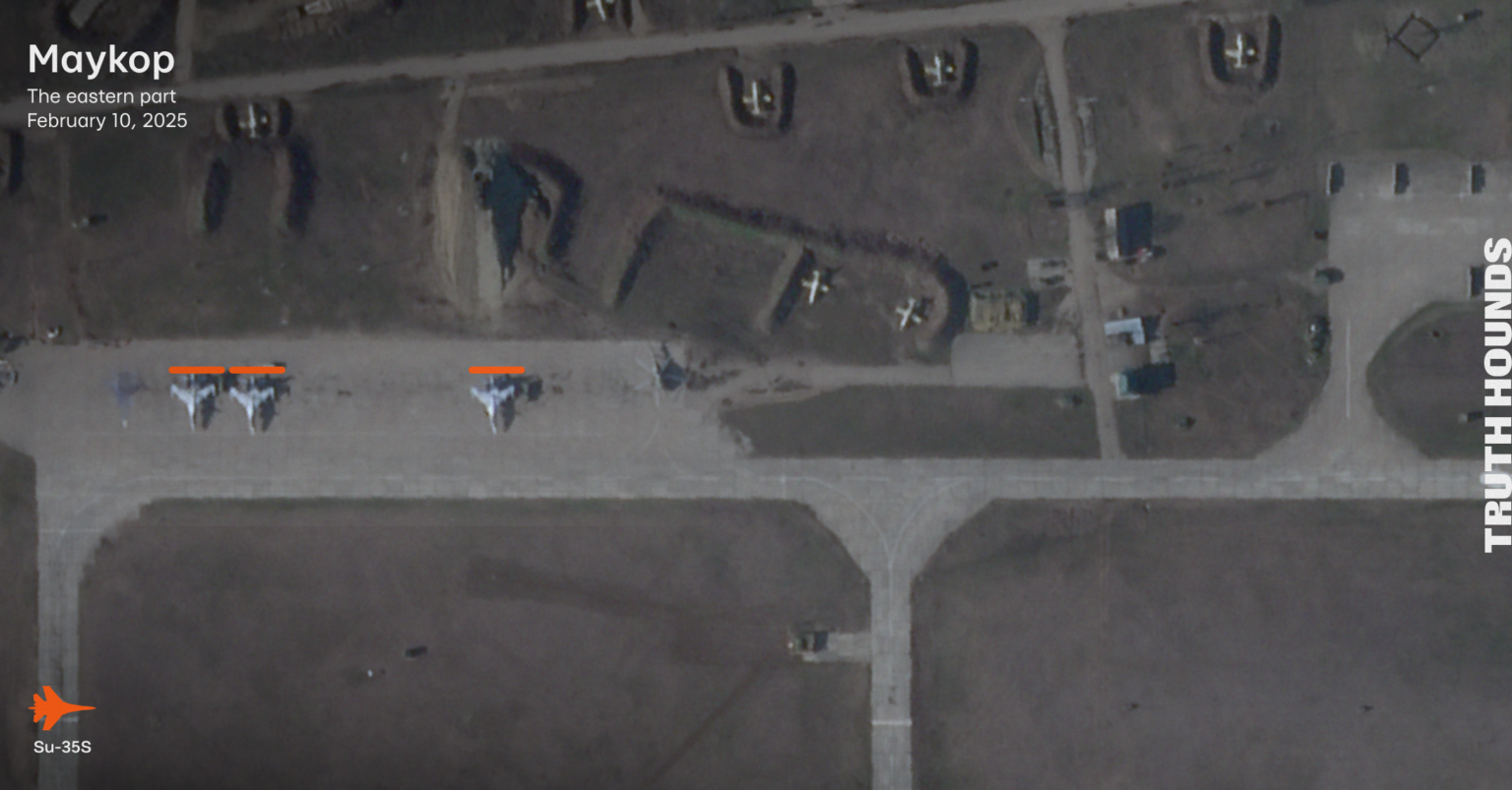
The satellite image of the eastern part of the Maykop airfield shows at least three Su-35S aircraft.
Source: Planet, February 10, 2025
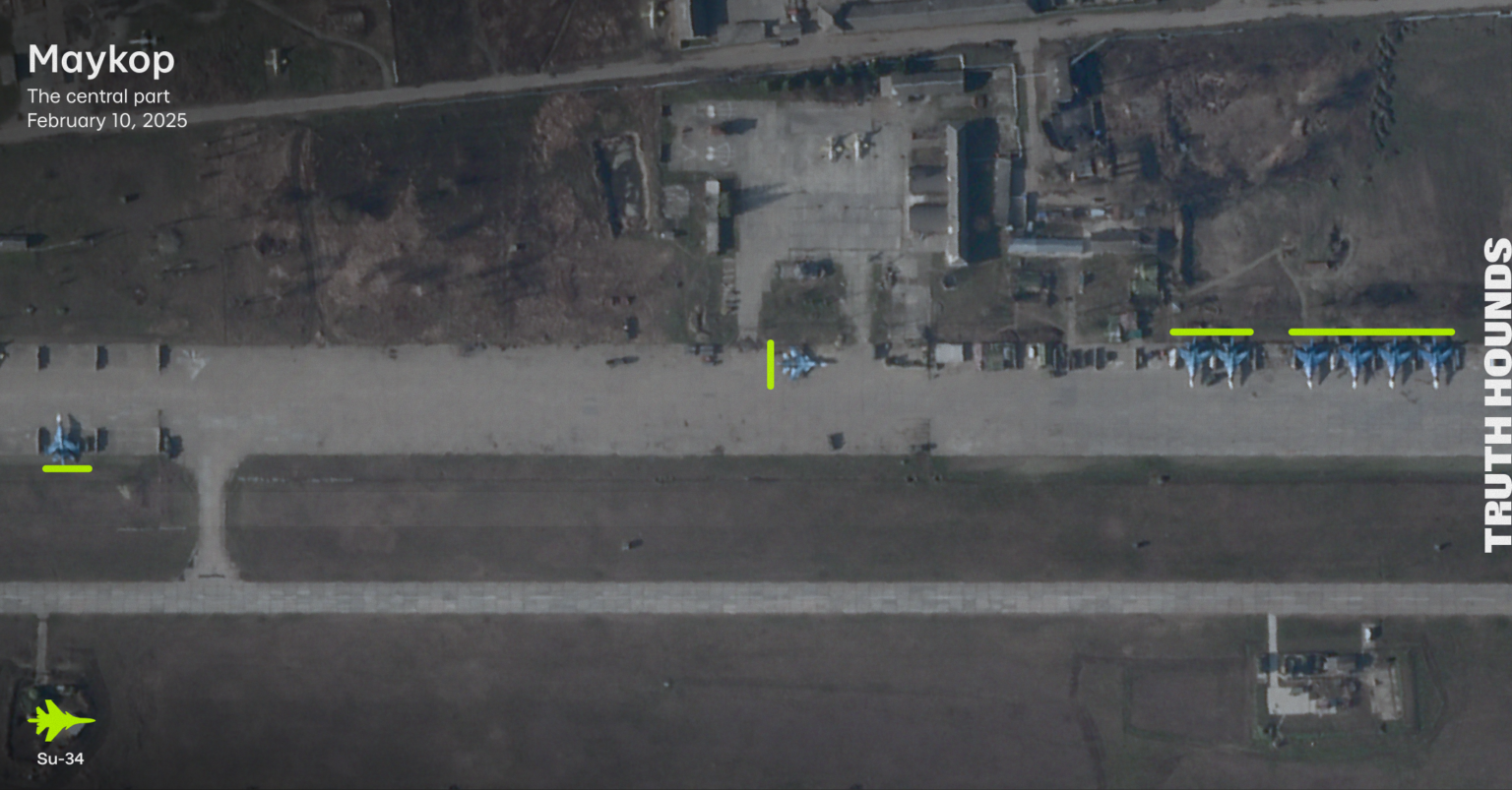
A satellite image of the central part of the Maykop airfield shows at least eight Su-34 aircraft.
Source: Planet, February 10, 2025
The Russian MoD recognized that planes from this airfield were used for attacks, particularly in the Kursk Oblast.[103] Therefore, it is quite possible that the planes from Maykop used Buturlinovka as an advance airfield for further movement towards Sudzha. However, there is not enough data to confirm this. To identify the airfield precisely, we would need data about the takeoff of airplanes from the airfield during February 1, 2025, and this information is not publicly available.
Four Su-34s were stationed at the Mozdok airfield (as of February 2025). It is unknown which unit was based at the Mozdok airfield at that time. However, in mid-2024, aircraft of the 559th Bombardment Regiment were stationed at the airfield.[104]
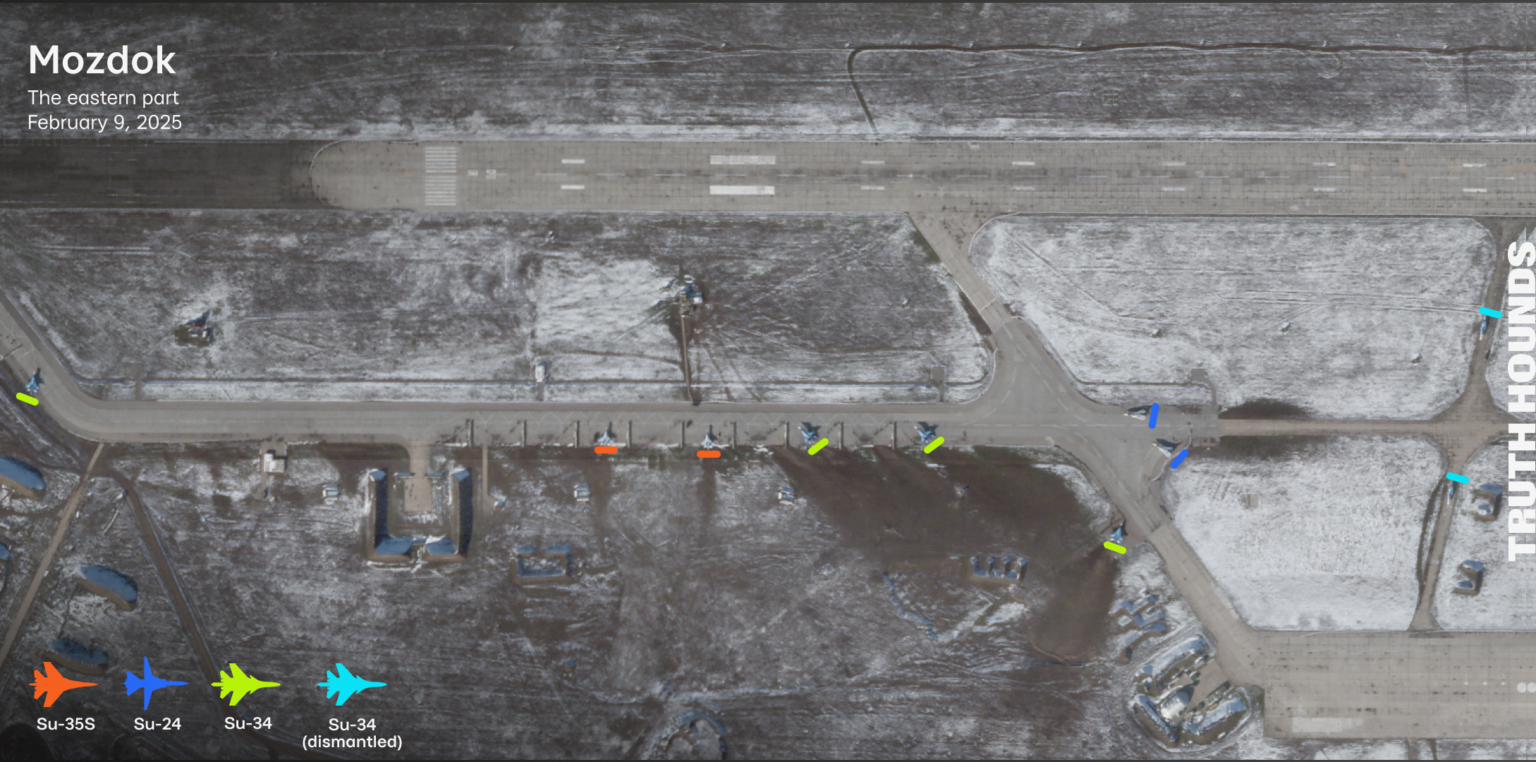
The satellite image of the eastern part of the Mozdok airfield shows at least 4 Su-34 aircraft, two Su-24 aircraft, and two Su-35S aircraft. Two additional dismantled Su-34s are also visible.
Source: Planet, February 9, 2025
If planes from Mozdok or Maykop were involved in the attack on Sudzha, they would need to make a temporary stop at the advance airfield for refueling. This makes it possible that these airfields could have been used for the attack on the boarding school on February 1, 2025.
Thus, the Su-34 that attacked the boarding school would be unlikely to have departed from the Borisoglebsk and Lipetsk airfields. Both airfields are located close enough to the target that the use of an advance airfield would be unnecessary. Instead, it is likely that planes deployed at Marinovka, Savasleyka, Akhtubinsk, Maykop, and Mozdok would have to make a technical landing at the Buturlinovka airfield before attacking Sudzha. Thus, the units deployed at these airfields are the ones that can possibly be involved in the attack on the boarding school in Sudzha, Kursk Oblast, on February 1, 2025.
Analysis of Official Sources and Publications Following the Strike
Oleksii Dmytrashkivskyi, mentioned in the report before, stated almost immediately that the explosion was due to a Russian aerial bomb. But the first one to report the attack as an “airstrike” was local activist and blogger Vladimir Sinelnikov. Vladimir Sinelnikov often criticized local authorities while maintaining an anti-Ukrainian position. When a Russian Telegram channel reported[105] that Sinelnikov was “spreading false information in the interests of another country,” he removed the publication about the air strike. However, references to this post remained in several media.[106] Sinelnikov later restored his original post, where an aerial bomb was named as the cause of the strike.
Approximately 6 hours after the attack, the Ukrainian Air Force denied their involvement. As proof, the Air Force published a snapshot from the Virazh-Planshet app, an automated system for collecting information about the situation in the air.[107] The image shows several reconnaissance UAVs and one Su-34 near Sudzha. Based on the plane’s trajectory, it was heading west towards Sudzha. At a distance of about 57 km from the city, it performed a launch maneuver (marked in the image with a blue line) and turned around. This is a maneuver dictated by the methodological recommendations for the use of UMPK for Su-34 following the drop of an aerial bomb.[108]
At a distance of 46 km from Sudzha, the Virazh-Planshet system began to “see” an aerial bomb approaching the city from the east. The fact that the eastern side of the building was damaged most makes it very likely that the screenshot provided by the Air Force of Ukraine was accurate. The accuracy of the suggested trajectories was also confirmed by the group of experts on Russian missile weaponry and the chain of command during their use.
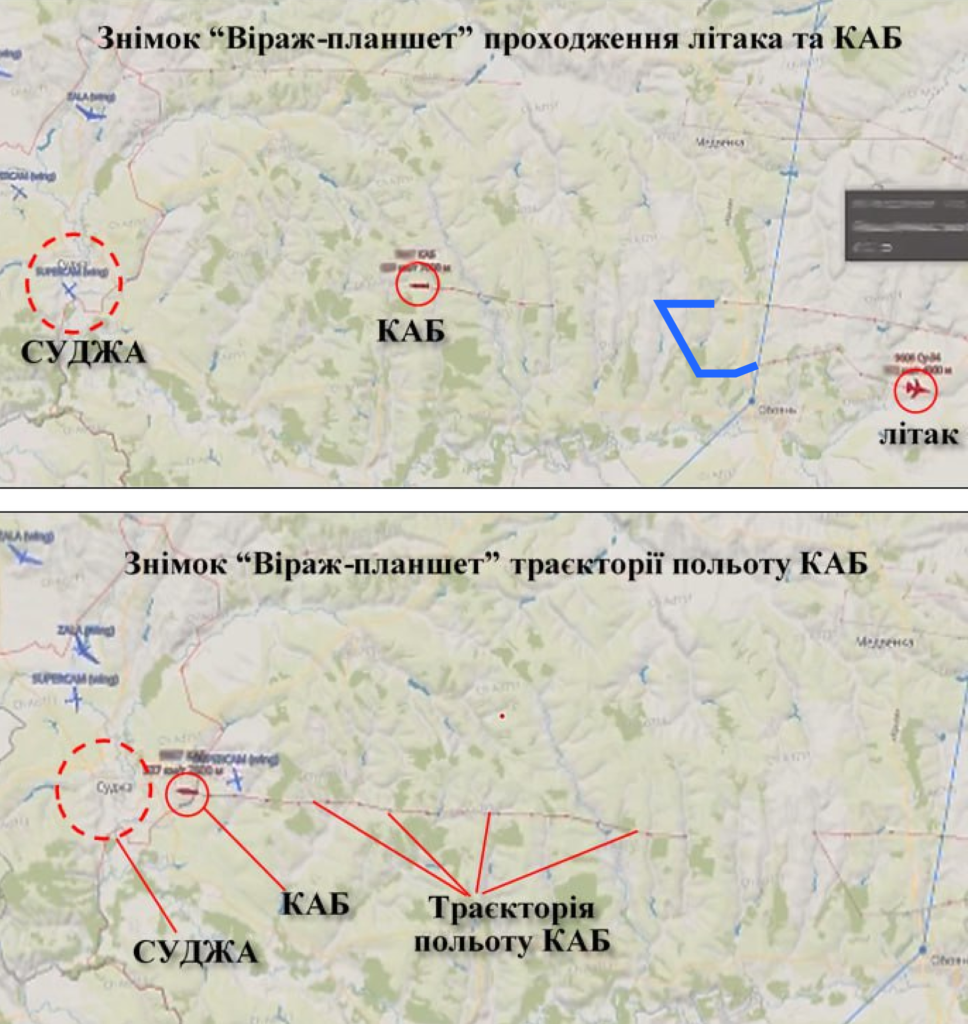
Screenshots from the Virazh-Planshet system with the flight trajectory of a Russian guided aerial bomb launched on February 1, 2025, at about 18:00.[109] The launch maneuver is marked in the image with a blue line.
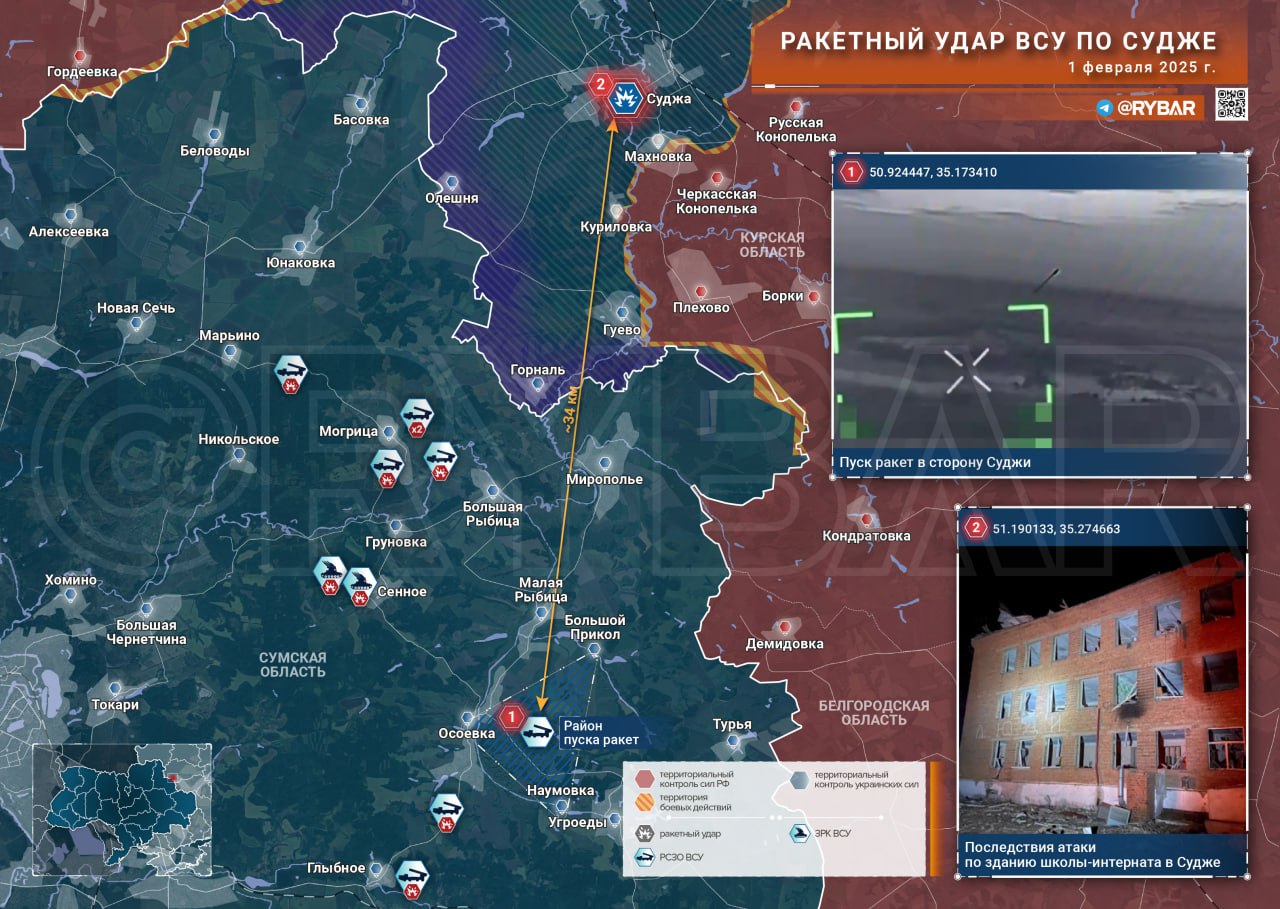
The Russian version of the strike on the boarding school[112]
After that, the “Investigative Committee of Russia” opened a case against the commander of the 19th Missile Brigade of the Armed Forces of Ukraine on the charges of an act of terror.[113]
At the moment of the strike, Sudzha was part of the territory under the purview of the North military group of Russia.[114] It was led by Colonel General Alexander Lapin.[115] In addition to the Colonel General, the hostilities in the Kursk Oblast involved the deputy chief of the Main Military-Political Directorate of the Russian Armed Forces, commander of the Akhmat special unit, Lieutenant General Apti Alaudinov.[116] He actively covered the situation in the region of Sudzha in the media when Akhmat was fighting in this area.
Commenting on the news about the attack, Apti Alaudinov maintained the official version that the school allegedly housed a headquarters of the Ukrainian military, who were hiding behind civilians. However, Alaudinov noted that “the Russian side didn’t hit the boarding school, and even if it did, there shouldn’t have been any civilians there.” He added that, according to his data, civilians were relocated out of the school several days prior.[117]
Apti Alaudinov claimed that he’d had a conversation with the press officer of the temporary military commandant’s office, Oleksii Dmytrashkivskyi, who said that it was cold at the boarding school and the pipes had burst, and that people were moved to other housing. An excerpt of this conversation was published.[118] The conversation took place on January 31, a day before the strike, and Apti Alaudinov received information that there were people at the boarding school, who were cold.
Since the conversation is published only in part, there is room for speculation: perhaps, off-record, Apti Alaudinov was informed of plans to relocate people out of the boarding school; however, it was clearly conveyed that at the moment of the conversation, they were still there. In addition, it appears unlikely that it would be possible to move about a hundred people to other housing within a single day, given the very limited resources available to the Ukrainian temporary military commandant’s office. The presence of civilians in the building at the time of the strike is also confirmed by the statement of the Armed Forces of Ukraine about this strike, which mentions that “civilians were preparing for evacuation.”[119]
Before the strike, Russian officials and media claimed that the AFU set up a “camp”[120] at the boarding school where they held civilians prisoner. In particular, they alleged that people were subjected to psychological violence and filmed for TV stories, claimed the Russian MFA.[121] After the strike, however, the Russian side kept the information about the fate of civilians who remained in Sudzha after the occupation secret. Local activists were outraged by the posts of the Russian blog Rybar, which actively downplayed the quantity of civilians at the Ukraine-controlled territories of the Kursk Oblast.[122]
After Russian control over the territory was restored, the locals who had lived under occupation were interviewed en masse by FSB officers. According to journalists, during these interviews, officers strongly recommended not sharing information about the Russian strikes on Sudzha and the surrounding areas.[123]
The Russian side insists that the strike was made with a HIMARS MLRS missile from the territory of the Sumy Oblast. However, in the published photos and videos, Truth Hounds investigators did not find any debris that could be identified as parts of HIMARS missiles.
After the de-occupation of Sudzha, the Russian side did not publish any evidence of such debris, either. At the same time, previously, the Russian media repeatedly published photos and videos allegedly with fragments of HIMARS missiles.[124],[125] As the main evidence, the Russian side provides a video of launches, which was posted later that night,[126] and messages in the LPR1 monitoring chat, which reports shelling. The chat did indeed warn of missile danger in the area of Sudzha shortly before the strike.
The video shows a launch of one missile and then three more after a cut. Unfortunately, the quality and distance do not allow for geolocating the launch site, let alone determining the direction of movement.
At 17:53 (Kyiv time), the Russian monitoring channel LPR1 was the first one to report a missile threat in the city of Sudzha.[127] Two minutes later, the channel specified that 4 missiles were launched.
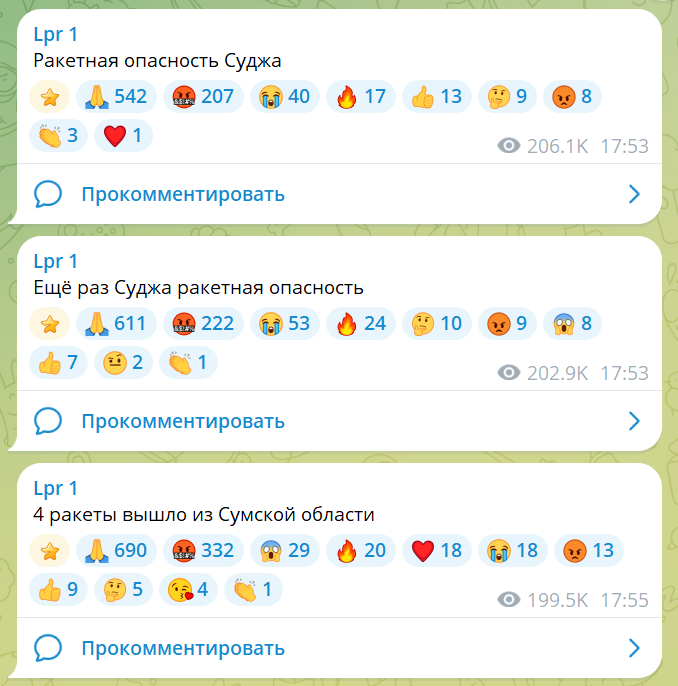
Screenshot from the LPR1 Telegram channel
Based on the messages and the time interval between them, the monitors recorded simultaneous or near-simultaneous launch of 4 missiles. In the video, we only see one, and only after the cut do we see the launch of three more missiles.[128] The video quality and filter change make it impossible to establish that the first and second parts of the video were filmed from the same point. It is also impossible to determine the interval between the launch of the first missile and the three following ones.
GMLRS uses volley fire rather than single fire.[129] The launch interval between the missiles is similar to what we see in the second part of the launch in the video by the Russian Telegram channel.
In documented launches of several ATACMS missiles at once, we see that the tactics involve their simultaneous launch on a joint command for the entire battery, or with minimal delay.[130] Therefore, the video probably indeed features a launch of missiles by the HIMARS system. However, it cannot clearly be tied to information about 4 launches specifically.
In addition, various Russian media provide a number of reasons that they believe indicate the irrelevance of the Ukrainian version.
Impossibility of objective control. According to Russian media, the Ukrainian Defense Forces could not have had the technical means to record objects with such a small radar cross-section (a physical quantity that characterizes the ability of objects to reflect radiation, in this case, the radiation of radars that monitor the situation in the air).[131]
The post notes that for guided aerial bombs, this figure is about 0.015 m². This number was derived by analogy with the American GBU-39 aerial bomb.[132] However, the analogy does not consider that the most common munition used with the UMPK, FAB 500, is significantly longer and more massive than the GBU-39, and the wingspan of the UMPK is larger. The length of the GBU-39 is 1.8 m, and that of a FAB-500 is 2.47 m. The wingspan of a GBU-39 is 1.6 m, and of a UMPK-equipped FAB-500 — 2.5 m.[133] All of this makes a UMPK-equipped FAB more noticeable compared to a GBU-39. The screenshot of the Virazh-Planshet system of the Air Force of Ukraine features not only the plane and the bomb but also several Russian reconnaissance UAVs near Sudzha. These are the ZALA and SUPERCAM UAVs. The radar cross section of these UAVs is unknown. However, for EUCLID, a UAV of the same class, it constitutes 0.017 m². Thus, a UMPK-equipped FAB at best has the same RCS and is effectively more noticeable to radars.
This version is also refuted by the video filmed when the rubble of the boarding school was being cleared. On the night of the tragedy, when some of the civilians were evacuated, a Ukrainian officer from the commandant’s office spoke with the civilians. At the end of the video, he is informed over the radio about the flight of guided aerial bombs,[134] which confirms the ability to detect objects with such an RCS.
Russian planes were not operating on that day because of the weather. Citing the Russian Aerospace Forces, the Russian side claims that the Russian aviation did not carry out combat sorties in this region at all due to the weather conditions, namely, high humidity and cloudiness.[135] However, several hours before the tragedy, the Russian MoD reported strikes by operational-tactical and army aviation on the AFU positions in the villages of the Kursk Oblast and in Sudzha.[136] On the next morning, a Russian news broadcast featured stories about the explosion at the boarding school and the strikes by Russian Aerospace Forces back-to-back.[137] This statement was also refuted by the group of experts on Russian missile weaponry and the chain of command during their use. They indicated that aviation would not operate only in situations when the weather conditions make it physically impossible to operate the plane, take off, or land due to the significant reduction of visibility. The “Guidelines for Meteorological Conditions for the Russian Civilian Aviation,” available in open sources,[138] essentially list conditions when civilian aviation should not operate; however, the official website of the Russian MoD refers[139] to this document in its terminology, which indicates that the analogous military guidelines would be quite similar.
[131] Simply put, they mean that the size of the guided aerial bombs is so small that radars are simply unable to record them as an object and reflect on the screen so they can be tracked and shot down.
The Aftermath of the February 1 Strike
After the strike, the Ukrainian military immediately started working to free people from the rubble.[140] At the time of the attack, there were about a hundred civilians and several officers of the commandant’s office on duty. The strike blocked the main entrance to the shelter; therefore, people were using the side entrance to evacuate. The civilians were taken to a nearby church, where they were provided with first aid.
According to both military and civilian accounts, rescue efforts were complicated by the risk of attack from FPV drones circling overhead.[141] Later, another strong explosion happened near the boarding school, likely from an aerial bomb of which Dmytrashkivskyi warned beforehand, saying, “Quiet, there are aerial bombs flying again.”[142]
In the morning, multiple images showing the aftermath of the strike were published online. Footage in open sources shows 3 bodies, probably 2 women and 1 man. The bodies of two women were in a room to the left of the main entrance. This was the part of the building most affected by the explosion, when the ceiling between the first and second floors collapsed into the room. The fall of the concrete slab was likely the cause of death.[143] The man was also crushed by a slab and buried underneath in the hallway of the left wing on the first (ground) floor.[144]
According to one survivor, her parents died[145] when they were on the first floor. Analysis of open sources indicates these were retirees Anatoly Grigoreyvich Cherkasov and Ludmila Vladimirovna Cherkasova.[146]
The room that ended up collapsing due to the strike.[147]
After the explosion, all people from the dormitory and those who lived in houses nearby were evacuated to the Sumy Oblast, where they were provided with medical assistance. As indicated by the aforementioned sources, people left their homes not only due to the tragic strike on the Sudzha boarding school, but also due to a constant sense of fear caused by systematic strikes by high-capacity and guided aerial bombs and FPV drones targeting civilians.
Such events cannot be considered in isolation. They are part of Russia’s targeted policy of armed aggression and terrorizing the population. Moreover, the attack of the Russian side on the boarding school in Sudzha possibly meets the criteria of a war crime.
In Ukrainian legislation, such acts are punishable under Article 438 of the Criminal Code of Ukraine, which establishes punishment for war crimes. Although the article does not directly single out attacks against civilian objects or civilians, these actions are covered by the phrase “other violations of the laws and customs of war.”[148] IHL classifies such attacks as grave breaches.[149]
The Rome Statute of the International Criminal Court explicitly prohibits:
- Intentionally directing attacks against the civilian population as such or against individual civilians not taking direct part in hostilities (Art. 8(2)(b)(i));[150]
- Intentionally directing attacks against civilian objects, that is, objects which are not military objectives (Art. 8(2)(b)(ii));[151]
- Attacking or bombarding, by whatever means […] buildings which are undefended and which are not military objectives (Art. 8(2)(b)(v)).[152]
If the proceedings are conducted by Ukrainian law enforcement agencies, they will be carried out under Art. 438 of the Criminal Code of Ukraine, taking into account the provisions of the Rome Statute and the Elements of Crimes of the ICC. Since Ukraine has ratified the Rome Statute, its provisions are part of its national legislation and can be directly applied in such cases.[153]
Regardless of the jurisdiction and the bodies that will conduct the investigation, the shelling of the Sudzha boarding school bears the hallmarks of a war crime. Its significance goes far beyond an isolated incident, as it is yet another confirmation of Russia’s systematic practice of deliberate attacks on civilians and civilian facilities.
This case clearly demonstrates that the Russian authorities are ready to sacrifice even the lives of their own citizens in the course of an armed conflict, using indiscriminate or deliberate attacks on civilians as an element of military tactics.
— TH
[148] Criminal Code of Ukraine, Art. 438
[149] Art 85(3)(a) AP I
[150] Art 8(2)(b)(i) RS
[151] Art. 8(2)(b)(ii) RS
[152] Art. 8(2)(b)(v) RS
[153] The Rome Statute of the ICC had already entered into force for Ukraine at the moment of the strike of the boarding school in Sudzha (February 1, 2025), since Ukraine had deposited the instrument of ratification on October 25, 2024, and, under Art. 126 of the Rome Statute, it entered into force on the first day of the following month after a 60-day period, that is, from January 1, 2025 onward (See: CN.440.2024-Eng.pdf; 4012-20; 3909-IX)
Sources
- Al-Khalidi, Suleiman (2024). At least 25 killed as Russian, Syrian jets intensify bombing of Syrian rebel territory. Reuters, URL: https://www.reuters.com/world/least-25-killed-russian-syrian-jets-intensify-bombing-syrian-rebel-territory-2024-12-02/ (accessed: 24.01.2026).
- Davies, Maia; Cooney, Christy (2024). More Russian strikes as Syrian rebels advance after taking Aleppo. BBC, URL: https://www.bbc.com/news/articles/czr7rkzz2gmo (accessed: 24.01.2026).
- UN (2025). Sudan: Rights chief deplores deadly army strikes on North Darfur market. UN News, URL: https://news.un.org/en/story/2025/03/1161571 (accessed: 24.01.2026).
- GC IV Art. 4.
- AP I Art. 50, part 1.
- ICRC Commentary (1987) AP I Art. 50. URL: https://ihl-databases.icrc.org/en/ihl-treaties/api-1977/article-50/commentary/1987 (accessed: 24.01.2026).
- TRO Media / Udar RF po internatu v Sudzhi [@tro.media.news], (01.02.2025). Facebook, URL: https://www.facebook.com/reel/486402210895718 (accessed: 24.01.2026).
- Advance airfield, or forward airfield, is an interim airfield used for refueling and re-arming air units as part of long-ranging or forward operations. Their main function is to provide operational support for aircraft to perform tasks as close as possible to the combat zone.
- Sobenko, Nadiia; Havryliuk, Khrystyna (2025). Zelenskyi: Kurska operatsiia vykonala svoie zavdannia. Media, URL: https://suspilne.media/970955-zelenskij-kurska-operacia-vikonala-svoe-zavdanna/ (accessed: 24.01.2026).
- SYRSKYI / Shoste serpnia – vyznachna data u voiennii istorii nashoi derzhavy [@osirskiy], (06.08.2025). Telegram, URL: https://archive.ph/5turt (accessed: 24.01.2026).
- Hague Regulations 1907 Art. 42.
- 51 of the UN Charter guarantees the inalienable right to self-defense in the event of an armed attack by another state.
- Vishchyk, Maksym (2024). Zbroini Syly Ukrainy na terytorii Rosii – a tak mozhna bulo? Ukrainska pravda, URL: https://www.pravda.com.ua/columns/2024/08/23/7471532/ (accessed: 24.01.2026).
- Zelenskiy / Official / Dlia nykh tse zadovolennia – spaliuvaty [@V_Zelenskiy_official], (26.05.2024). Telegram, URL: https://archive.ph/kK9Bk (accessed: 24.01.2026).
- Bailey, Riley; Harward, Christina; Evans, Angelica; Wolkov, Nicole and Kagan, Frederick W.(2024). Russian Offensive Campaign Assessment, May 26, 2024. Institute for the Study of war, URL: https://www.understandingwar.org/backgrounder/russian-offensive-campaign-assessment-may-26-2024 (accessed: 24.01.2026).
- Hague Regulations 1907 Art. 43.
- FREEDOM (2024). Ukrainska viiskova komendatura pratsiuie v Sudzhi — osnovni zavdannia (VIDEO). URL: https://uatv.ua/uk/ukrayinska-vijskova-komendatura-pratsyuye-v-sudzhi-osnovni-zavdannya-video/ (accessed: 24.01.2026); See also: Matiash, Tania (2024). Ombudsman poiasnyv, dlia choho stvoriuvaty viiskovi komendatury v Kurskii oblasti. LB.UA, URL: https://lb.ua/society/2024/08/15/629598_ombudsman_poyasniv_chogo.html (accessed: 24.01.2026).
- GC IV Art. 14.
- “Safety zones and localities,” generally of a permanent character, [are] established outside the combat zone in order to shelter certain categories of the civilian population, which, owing to their weakness, require special protection (children, old people, expectant mothers, etc.) from long-range weapons, especially aerial bombardment; See: ICRC Commentary (1958) GC IV, to Art. 14. terminology “B.”, URL: https://ihl-databases.icrc.org/en/ihl-treaties/gciv-1949/article-14/commentary/1958.
- Sudzhansky Boarding School. Google Maps, URL: https://maps.app.goo.gl/QPoXs7pSco4N7Fry8 (accessed: 24.01.2026).
- SUDZhA RODNAYa / Sudzha… [@rodnaya_sudzha], (12.01.2025). Telegram, URL: https://archive.ph/CHtUk (accessed: 24.01.2026).
- SUOBOU “Sudzhanskaya shkola-internat” / Torzhestvennaya lineika «Poslednii zvonok-2024» [@shkola_internat_sudzha], (24.05.2024). VK, URL: https://vk.com/shkola_internat_sudzha?w=wall-165172259_1046 (accessed: 24.01.2026).
- Musafirova, Olga; Mustaeva, Sonia (2024). Still here Russians trapped in Ukrainian-occupied Sudzha are making short videos for their families to let them know they’re alive. Novaya Gazeta, URL: https://novayagazeta.eu/articles/2024/11/04/still-here-en
- Terytorialna oborona ZSU | TRO Media / MALENKI LIuDY, YaKI ROZVIaZALY VELYKU VIINU | Premiera | Dokumentalnyi film [@terytorialna.oborona], (15.04.2025). Timecode: 07:31. YouTube, URL: https://youtu.be/SFk7NGYg2YE?t=451 (accessed: 24.01.2026).
- SUDZhA RODNAYa / I yeshchyo: mi evakuirovalis s kotom, i yemu bilo razresheno brodit po karidoram i komnatam [@rodnaya_sudzha], (31.12.2024). Telegram, URL: https://archive.ph/PbEzy (accessed: 24.01.2026).
- Tyshchenko, Kateryna (2025). Russians strike nursing home in Sudzha, killing one person – Ukrainian military commandant’s office. Ukrainska Pravda, URL: https://www.pravda.com.ua/eng/news/2025/01/12/7493156/ (accessed: 24.01.2026).
- ВВС News Ukraine (2025). Sudzha: shcho vidomo pro vluchannia aviabomby v internat iz sotneiu liudei. URL: https://www.bbc.com/ukrainian/articles/c1ezvjvgyg3o (accessed: 24.01.2026).
- Terytorialna oborona ZSU | TRO Media / MALENKI LIuDY, YaKI ROZVIaZALY VELYKU VIINU | Premiera | Dokumentalnyi film [@terytorialna.oborona], (15.04.2025). Timecode: 55:00. YouTube, URL: https://youtu.be/SFk7NGYg2YE?t=3300 (accessed: 24.01.2026).
- Timecode: 28:26. YouTube, URL: https://youtu.be/SFk7NGYg2YE?t=1706 (accessed: 24.01.2026).
- Terytorialna oborona ZSU | TRO Media / Pravda iz sertsia Sudzhi I Bez Ukrainy b ne vyzhyly #tromedia #kurskaoblast #kurskaiaoblast #sudzha [@terytorialna.oborona], (01.01.2025). YouTube, URL: https://www.youtube.com/watch?v=KBMvJbTQuGc (accessed: 24.01.2026). Additionally, there are other videos available, which we can provide upon request.
- TRO Media / Ukrainski viiskovi znovu demonstruiut sylu dobra na Kurshchyni, de rosiiska vlada lyshyla liudei napryzvoliashche [@tro.media.news], (17.01.2025). Facebook, URL: https://www.facebook.com/tro.media.news/videos/525781010504746/ (accessed: 24.01.2026).
- Komanduvannia Povitrianykh Syl ZSU / Air Force Command of UA Armed Forces / Blyzko 18.00 01 liutoho 2025 roku rosiiska aviatsiia zavdala udaru iz zastosuvanniam kerovanoi aviabomby po mistsiu tymchasovoho prozhyvannia tsyvilnoho naselennia [@kpszsu], (01.01.2025). Facebook, URL: https://www.facebook.com/kpszsu/posts/pfbid0c7qUCAgPivZZ4YoKBHdQVsK9TwHBenwEABue 5rY6peY1UWALDnf5qeFWGo7zHawnl (accessed: 24.01.2026).
- Terytorialna oborona ZSU | TRO Media / MALENKI LIuDY, YaKI ROZVIaZALY VELYKU VIINU | Premiera | Dokumentalnyi film [@terytorialna.oborona], (15.04.2025). Timecode: 6:21, 7:23, 59:27. YouTube, URL: https://www.youtube.com/watch?v=SFk7NGYg2YE (accessed: 24.01.2026).
- TRO Media / Ukrainski viiskovi znovu demonstruiut sylu dobra na Kurshchyni, de rosiiska vlada lyshyla liudei napryzvoliashche [@tro.media.news], (17.01.2025). Timecode: 0:32, 1:31, 5:22, 6:43. Facebook, URL: https://www.facebook.com/tro.media.news/videos/525781010504746/ (accessed: 24.01.2026).
- Oleksa Svitliishyi / (photo) [@Svetlyi], (20.12.2024). Facebook, URL: https://www.facebook.com/photo/?fbid=8921803681239855&set=pcb.8921826347904255 (accessed: 24.01.2026).
- Truth Hounds investigators have found other confirmations from open sources, which they are ready to provide upon request.
- Under AP I Art. 43(2), combatants are all participants of the armed forces of the party to a conflict except for medical and religious personnel.
- AP I Arts 50(1) and 51(2)-(3).
- Prosecutor v. Issa Hassan Sesay, Morris Kallon and Augustine Gbao (Trial Chamber I, Special Court for Sierra Leone, Case No. SCSL-04-15-T, 2 March 2009) paras 87–88. URL: https://web.archive.org/web/20240807054603/https:/www.refworld.org/jurisprudence/caselaw/ scsl/2009/en/92027 (accessed: 24.01.2026).
- Ibid.
- Sari, Aurel (2018). The Status of Police in Armed Conflicts, 48 Israel Yearbook of Human Rights, p. 111. URL: https://www.researchgate.net/publication/335003903_The_Status_of_Police_in_Armed_Conflicts (accessed: 24.01.2026).
- Law of Ukraine “On the National Police of Ukraine,” Art. 24, part 4.
- Komanduvannia Povitrianykh Syl ZSU / Air Force Command of UA Armed Forces / Blyzko 18.00 01 liutoho 2025 roku rosiiska aviatsiia zavdala udaru iz zastosuvanniam kerovanoi aviabomby po mistsiu tymchasovoho prozhyvannia tsyvilnoho naselennia [@kpszsu], (01.01.2025). Facebook, URL: https://www.facebook.com/kpszsu/posts/pfbid0c7qUCAgPivZZ4YoKBHdQVsK9TwHBenwEABue5r Y6peY1UWALDnf5qeFWGo7zHawnl (accessed: 24.01.2026).
- Law of Ukraine “On the National Police” of 2 July 2015, No. 580-VIII, Art. 1(2).
- Art. 24, part 4.
- Schmitt, Michael N. (2021). Targeting Dual-Use Structures: An Alternative Interpretation. Lieber Institute, URL: https://lieber.westpoint.edu/targeting-dual-use-structures-alternative/ (accessed: 24.01.2026).
- AP I Art. 50(1).
- Ibid.
- ICRC Commentary (1987), AP I Art. 52. URL: https://ihl-databases.icrc.org/en/ihl-treaties/api-1977/article-52/commentary/1987 (accessed: 24.01.2026).
- Apti Alaudinov «AKhMAT» / AKhMAT SILA — ROSSIYa MOShch BOG YeDIN — ALLAKhU AKBAR! [@AptiAlaudinovAKHMAT], (01.02.2025), Telegram, URL: https://t.me/AptiAlaudinovAKHMAT/7845 (accessed: 24.01.2026).
- Holos Ameryky Ukrainskoiu / Pozashtatnyi korespondent Holosu Ameryky pobuvav u Sudzhi i pospilkuvavsia z mistsevymy [@holosameryky], (28.08.2024). X (Twitter), URL: https://x.com/holosameryky/status/1828892411353084262 (accessed: 24.01.2026).
- Terytorialna oborona ZSU | TRO Media / “Allo, ZSU? Ya znaiu, khto bombyt Sudzhu!” Alaudinov vsikh zdav [@terytorialna.oborona], (11.02.2025). YouTube, URL: https://www.youtube.com/watch?v=ACtSIfvmbjM (accessed: 24.01.2026).
- Ibid.
- SUDZhA RODNAYa / (photo) [@rodnaya_sudzha], (12.01.2025). Telegram, URL: https://archive.ph/iqiXL (accessed: 25.01.2026).
- NgP raZVedka / Blagie vesti s Kurskogo napravleniya [@NgP_raZVedka], (06.01.2025). Telegram, URL: https://archive.ph/I4wUI (accessed: 25.01.2026).
- SINELNIKOV / V zdanie Sudzhanskoi shkoli-internata v 17:54 po moskovskomu vremeni popala aviabomba, soobshchil istochnik, nakhodyashchiisya na meste sobitii [@iz_kurska], (01.02.2025). Telegram, URL: https://web.archive.org/web/20250203034221/https://t.me/iz_kurska/38 (accessed: 25.01.2026).
- SUDZhA RODNAYa / Sudzha… [@rodnaya_sudzha], (12.01.2025). Telegram, URL: https://archive.ph/CHtUk (accessed: 25.01.2026).
- TRO Media / Kreml vdaryv KABom po internatu v Sudzhi, de zhyvut pensionery ta invalidy [@tro.media.news], (15.01.2025). Facebook, URL: https://www.facebook.com/watch/?v=1147504910330996 (accessed: 25.01.2026).
- Karti i strelochki / Rossiiskaya aviatsiya bombit Sudzhu [@arrowsmap], (12.01.2025). Telegram, URL: https://archive.ph/nE1Wt (accessed: 25.01.2026).
- Ibid.
- SvinoREZ / Pit-stop, rebyata! [@PubgWithoutSaving], (16.01.2025). Timecode: 00:16, 00:21. Telegram, URL: https://t.me/PubgWithoutSaving/167 (accessed: 25.01.2026).
- TRO Media / Ukrainski viiskovi znovu demonstruiut sylu dobra na Kurshchyni, de rosiiska vlada lyshyla liudei napryzvoliashche [@tro.media.news], (17.01.2025). Timecode: 02:15, 07:16. Facebook, URL: https://www.facebook.com/tro.media.news/videos/525781010504746/ (accessed: 25.01.2026).
- Ibid.
- SvinoREZ / Pit-stop, rebyata! [@PubgWithoutSaving], (16.01.2025). Telegram, URL: https://t.me/PubgWithoutSaving/167 (accessed: 25.01.2026).
- Stepaniuk Olha (2025). Shcho vidbuvaietsia v Sudzhi: rozpoviv presofitser viiskovoi komendatury. Hromadske Radio, URL: https://hromadske.radio/news/2025/01/31/shcho-vidbuvaietsia-v-sudzhi-rozpoviv-presofitser-viyskovoi-komendatury (accessed: 25.01.2026).
- Meduza (2025). V Sudzhe razrusheno zdanie shkoli-internata, v kotorom nakhodilis mirnie zhiteli. Yest pogibshie i ranenie Ukraina utverzhdaet, chto udar bil nanesen rossiiskoi aviabomboi. V Minoboroni Rossii zayavili o raketnoi atake VSU. URL: https://meduza.io/feature/2025/02/02/v-sudzhe-razrusheno-zdanie-shkoly-internata-v-kotorom-nahodilis-mirnye-zhiteli-est-pogibshie-i-ranenye (accessed: 25.01.2026).
- Oleksa Svitliishyi / Os takyi vyhliad teper maie shkola internat [@Svetlyi], (02.02.2025). Facebook, URL: https://www.facebook.com/Svetlyi/videos/1124639549069512/ (accessed: 25.01.2026).
- My – Ukraina / RF vdaryla RAKETOIu po INTERNATU, shche y DRONAMY pryletily DOBYTY POSTRAZhDALYKh / DMYTRAShKIVSKYI [@weukrainetv], (02.02.2025). YouTube, URL: https://www.youtube.com/watch?v=GwDtyvsM9P4 (accessed: 25.01.2026).
- Terytorialna oborona ZSU | TRO Media / MALENKI LIuDY, YaKI ROZVIaZALY VELYKU VIINU | Premiera | Dokumentalnyi film [@terytorialna.oborona], (15.04.2025). Timecode: 01:21:56. YouTube, URL: https://youtu.be/SFk7NGYg2YE?t=4916 (accessed: 25.01.2026).
- Timecode: 01:22:00. YouTube, URL: https://youtu.be/SFk7NGYg2YE?t=4920 (accessed: 25.01.2026).
- Ibid.
- Heneralnyi shtab ZSU / Sohodni, 1 liutoho, blyzko 17:54 rosiiska aviatsiia zavdala udaru kerovanoiu aviatsiinoiu bomboiu (KAB) po internatu v misti Sudzha Kurskoi oblasti [@GeneralStaffZSU], (01.02.2025). Telegram, URL: https://archive.ph/C3oAk (accessed: 25.01.2026).
- Sheikina, Anastasiya (2025). U granitsi s Rossiei obnaruzhili dva skopleniya lichnogo sostava VSU.RU, URL: https://lenta.ru/news/2025/08/08/u-granitsy-s-rossiey-obnaruzhili-dva-skopleniya-lichnogo-sostava-vsu/ (accessed: 25.01.2026).
- Severnii Veter / INFORMATsIYa OT PVO: UDAR PO SUDZhE NANESEN RSZO “KhIMARS” IZ n.p. MALAYa RIBITsA [@warriorofnorth], (01.02.2025). Telegram, URL: https://archive.ph/tmnIp (accessed: 25.01.2026).
- Minoboroni Rossii / 1 fevralya vooruzhennie sili Ukraini sovershili ocherednoe voennoe prestuplenie, nanesya tselenapravlennii raketnii udar po internatu v gorode Sudzha [@mod_russia], (02.02.2025). Telegram, URL: https://archive.ph/5Nepw (accessed: 25.01.2026).
- Deep State, URL: https://deepstatemap.live/ (accessed: 25.01.2026).
- karta-svo.rf, URL: https://xn--80acvidv.xn—-7sbaj0b2akkg.xn--p1ai/free/?x=3926166.85874&y=6651547.49282&z=11.69185&r=0&l=000000100000001001000111 (accessed: 25.01.2026).
- Serhiy Hayday / Minus 200 rashystiv-“VDVshnykiv”: u Kadiivtsi “pryletilo” v hotel, de z 2014 roku bazuvalysia okupanty [@serhiy_hayday], (26.08.2022). Telegram, URL: https://archive.ph/DcXBS (accessed: 25.01.2026).
- Karti i strelochki / Rossiiskaya aviatsiya bombit rossiiskii gorod Sudzha v Kurskoi oblasti [@arrowsmap], (06.01.2025). Telegram, URL: https://archive.ph/xbuAa (accessed: 25.01.2026).
- NgP raZVedka / Kino – eto luchshee iz dokazatelstv. Sudzha [@NgP_raZVedka], (06.01.2025). Telegram, URL: https://archive.ph/fetbs (accessed: 25.01.2026).
- Povitriani Syly ZS Ukrainy / Air Force of the Armed Forces of Ukraine / Blyzko 18.00 01 liutoho 2025 roku rosiiska aviatsiia zavdala udaru iz zastosuvanniam kerovanoi aviabomby po mistsiu tymchasovoho prozhyvannia tsyvilnoho naselennia [@kpszsu], (01.02.2025). Telegram, URL: https://archive.ph/4fAj9 (accessed: 25.01.2026).
- Ibid.
- Dambiev / Epizod boevogo vileta bombardirovshchika Su-34 dlya naneseniya udarov po pozitsiyam sil kievskogo rezhima v prigranichnom raione Kurskoi oblasti [@ChDambiev], (17.02.2025). Telegram, URL: https://archive.ph/Tvx29 (accessed: 25.01.2026); Kirill Fyodorov / Voina Istoriya Oruzhie / Su-34 koshmarit khokhlov s tekhnikoi v kurskom prigraniche [@warhistoryalconafter], (19.01.2025). Telegram, URL: https://t.me/warhistoryalconafter/203484 (accessed: 25.01.2026); Lampa znan / Su-34 atakuet bomboi FAB-3000 PVD Ukraini, Kurskaya oblast [@LampaInfo], (20.02.2025). YouTube, URL: https://www.youtube.com/watch?v=FrEwhPQb7u8 (accessed: 25.01.2026).
- IgorGirkin / Dokument soderzhit rekomendatsii po primeneniyu aviatsionnoi bombi FAB-500M62 s universalnim modulem planirovaniya i korrektsii [@GirkinGirkin], (20.02.2025). X (Twitter), URL: https://x.com/GirkinGirkin/status/1892434116198748589 (accessed: 25.01.2026).
- Kirill Fyodorov / Voina Istoriya Oruzhie / Su-34 uletaet koshmarit oporniki khokhlov v kurskom prigraniche [@warhistoryalconafter], (13.01.2025). Telegram, URL: https://t.me/warhistoryalconafter/202717 (accessed: 25.01.2026)
- Minoboroni Rossii / Ekipazhi Su-34 nanesli udar po komandnomu punktu i zhivoi sile protivnika [@mod_russia], (01.04.2024), Telegram, URL: https://archive.ph/9JxaQ (accessed: 25.01.2026).
- The Truth Hounds team analyzed high-quality footage of the Buturlinovka airfield from January 13, 2025, to February 17, 2025. What is more, they analyzed low-quality images from the Sentinel-2 satellite from January 22, 2025, to February 8, 2025. All satellite images show no activity of Su-34 bombers.
- Legate, Kristine (2019). FARP: Land, refuel, leave. Air Force, URL: https://www.af.mil/News/Article-Display/Article/1760265/farp-land-refuel-leave/ (accessed: 25.01.2026); Headquarters US Marine Corps (2001). Aviation Ground Support. MCWP 3-21.1. Chapter 7. Forward Arming and Refueling Point Operations. URL: https://www.globalsecurity.org/military/library/policy/usmc/mcwp/3-21-1/ch7.pdf (accessed: 25.01.2026); Warren, Timothy (2024). FARPs Keep Aviation in the Fight. S. Naval Institute, URL https://www.usni.org/magazines/proceedings/2024/january/farps-keep-aviation-fight (accessed: 25.01.2026); 1tv.ru (2023). Spetsoperatsiya. Aerodrom «podskoka». Chasovoi. Vipusk ot 17.09.2023. URL: https://www.1tv.ru/shows/chasovoy/vypuski/specoperaciya-aerodrom-podskoka-chasovoy-vypusk-ot-17-09-2023 (accessed: 25.01.2026); Fighterbomber / Okh, blet, i utro [@bomber_fighter], (23.07.2024). Telegram, URL: https://archive.ph/YRmD4 (accessed: 25.01.2026); Fighterbomber / Segodnya na aerodrome “Aviatorskoe” v 7.23 i 7.27 vipolnila posadku para MiG-29, dozapravilis i vzleteli na minutnom intervale v 8.28 i 8.29 lupit kabami [@bomber_fighter], (20.06.2024). Telegram, URL: https://archive.ph/DFDSK (accessed: 25.01.2026); Kirill Fyodorov / Voina Istoriya Oruzhie / NEIZVESTNIE GEROI [@warhistoryalconafter], (20.07.2024). Telegram, URL: https://archive.ph/gHkao (accessed: 25.01.2026).
- Kozatskyi, Sania (2024). Russian Su-34 Bomber: Existential Threat to Ukraine. Militarnyi, URL: https://militarnyi.com/en/articles/russian-su-34-bomber-existential-threat-to-ukraine/ (accessed: 25.01.2026).
- Truth Hounds (2024). Detailed description of airfields used by the Russian Air Force in 2024. URL: https://dev.truth-hounds.org/wp-content/uploads/2024/12/detailed-description-of-airfields-used-by-the-russian-air-force-in-2024.pdf, pp. 11-12.
- Grier, Peter (2015). Package Q. Air & Space Forces Magazine, URL: https://www.airandspaceforces.com/article/package-q (accessed: 25.01.2026); Leone, Dario (2023). The story of Package Q Airstrike, the largest operational F-16 mission of all time that made USAF realize that big formations weren’t as good as stealthy precision strikes. The Aviation Geek Club, URL: https://theaviationgeekclub.com/the-story-of-package-q-airstrike-the-largest-operational-f-16-mission-of-all-time-that-made-usaf-realize-that-big-formations-werent-as-good-as-stealthy-precision-strikes/ (accessed: 25.01.2026).
- Kirill Fyodorov / Voina Istoriya Oruzhie / PERVII v etom godu OTChYoT o nashei s vami pomoshchi russkoi aviatsii [@warhistoryalconafter], (01.01.2025). Telegram, URL: https://archive.ph/wz9oK (accessed: 25.01.2026).
- Kirill Fyodorov / Voina Istoriya Oruzhie / Ekipazh frontovogo bombardirovshchika Su-34 pozdravlyaet ukrainskikh voennosluzhashchikh s Dnyom Rossii! [@warhistoryalconafter], (12.06.2024). Telegram, URL: https://archive.ph/8m9VS (accessed: 25.01.2026); Kirill Fyodorov / Voina Istoriya Oruzhie / #eksklyuziv “Gromokryak” Su-34 v deistvii! [@warhistoryalconafter], (28.07.2024). Telegram, URL: https://archive.ph/ChQIx (accessed: 25.01.2026).
- Kirill Fyodorov / Voina Istoriya Oruzhie / Russkie poltorashki, kotorie planiruyut ubit mnogo ukrainskikh terroristov [@warhistoryalconafter], (12.08.2024). Telegram, URL: https://archive.ph/KBnkZ (accessed: 25.01.2026).
- Holovne upravlinnia rozvidky (2022). Rosiiski okupanty namahaiutsia prykhovaty uchast u boiovykh diiakh. URL: https://gur.gov.ua/content/rosiiski-okupanty-namahaiutsia-prykhovaty-uchast-u-boiovykh-diiakh.html (accessed: 25.01.2026).
- A detailed analysis of the Marinovka and Morozovsk airfields is provided in section V. Attacks on civilian infrastructure in Kherson with aerial bombs are described in the Controlled Chaos investigation: Truth Hounds (2024). Guided Chaos: How Russian Bombs Destroy Civilians And Infrastructure in Ukraine. URL: https://dev.truth-hounds.org/en/cases/guided-chaos/ (accessed: 25.01.2026).
- Dose Shpiona / Otnositelno udara po aerodromu Morozovsk [@dosye_shpiona], (04.08.2024). Telegram, URL: https://archive.ph/4XRKG (accessed: 25.01.2026); Dose Shpiona / Soderzhimoe sklada aerodroma Morozovsk [@dosye_shpiona], (06.08.2024). Telegram, URL: https://archive.ph/y9v8B (accessed: 25.01.2026).
- Truth Hounds (2024). Guided Chaos: How Russian Bombs Destroy Civilians And Infrastructure in Ukraine. URL: https://dev.truth-hounds.org/en/cases/guided-chaos/ (accessed: 25.01.2026).
- Kataev, Andrei (2020). #6346893. RIA Novosti, URL: https://riamediabank.ru/media/6346893.html (accessed: 25.01.2026); Admin (2016). Vozdushno-kosmicheskie sili vraga Chast 4.com.ua, URL: https://republic.com.ua/article/42382-vozdushno-kosmicheskie-sily-vraga-chast-4.html (accessed: 25.01.2026).
- Aleksandr Pavlov. TimeNote, URL: https://timenote.info/ru/Aleksandr-Pavlov-00.00.1984 (accessed: 25.01.2026).
- Strategic Control / Analiz aerodromu «Savasleika», Nyzhnohorodska oblast stanom na zaraz [@strategicontrol], (13.07.2025). Telegram, URL: https://archive.ph/pnxyI (accessed: 26.01.2026); Strategic Control / Analiz aerodromu «Savasleika», Nyzhnohorodska oblast stanom na zaraz [@strategicontrol], (23.07.2025). Telegram, URL: https://archive.ph/soGCZ (accessed: 26.01.2026); https://t.me/c/2076691019/4217; https://t.me/c/2076691019/3876 ; https://t.me/c/2076691019/3835.
- Kozatskyi, Sania (2024). Russian Su-34 Bomber: Existential Threat to Ukraine. Militarnyi, URL: https://militarnyi.com/en/articles/russian-su-34-bomber-existential-threat-to-ukraine/ (accessed: 26.01.2026).
- IZVESTIYa (2025). Ekipazh Su-34 VKS RF nanes udar po opornomu punktu VSU v kurskom prigraniche. URL: https://iz.ru/1844325/2025-02-24/ekipazh-su-34-vks-rf-nanes-udar-po-opornomu-punktu-vsu-v-kurskom-prigraniche (accessed: 26.01.2026).
- Dose Shpiona / Otnositelno krusheniya Su-34 [@dosye_shpiona], (12.06.2024). Telegram, URL: https://archive.ph/LAUUu (accessed: 26.01.2026); RIA Novosti / Samolet Su-34 VKS Rossii poterpel krushenie v gornoi mestnosti v Severnoi Osetii pri vipolnenii planovogo uchebno-trenirovochnogo poleta, ekipazh pogib, soobshchaet Minoboroni [@rian_ru], (11.06.2024). Telegram, URL: https://archive.ph/aiPSN (accessed: 26.01.2026).
- SINELNIKOV / Soobshchenie o voennom prestuplenii, sovershyonnom v Sudzhe pervogo fevralya, vizvalo burnuyu diskussiyu o storone, vinovnoi v yego sovershenii [@iz_kurska], (12.02.2025). Telegram, URL: https://archive.ph/SxPdU (accessed: 26.01.2026).
- Vazhnie istorii / V Sudzhe aviaudarom razrushena shkola, gde soderzhalis pozhilie i bolnie zhiteli [@istories_media], (01.02.2025). Telegram, URL: https://archive.ph/wjrrT (accessed: 26.01.2026).
- Tsentr operatyvnykh standartiv i metodyky pidhotovky Zbroinykh Syl Ukrainy; Komanduvannia Povitrianykh Syl Zbroinykh Syl Ukrainy (2019). Metodychni rekomendatsii vykorystannia spetsializovanoho prohramnoho zabezpechennia “Virazh-Planshet” pid chas pidhotovky boiovykh obsluh pidrozdiliv zenitnykh raketnykh viisk povitrianykh syl Zbroinykh Syl Ukrainy. URL: https://sprotyvg7.com.ua/wp-content/uploads/2024/11/МЕТОДРЕКОМЕНДАЦІЇ-вІРАЖ-ПЛАНШЕТ.pdf (accessed: 26.01.2026).
- UMPK poriadok prymenenyia y konstruktsyia-Rekomendatsyy-dlia-samoletov-Su-34 (2024). FLIPHTML5, URL: https://fliphtml5.com/pdvau/yqlh/УМПК_порядок_применения_и_конструкция-Рекомендации-для-самолетов-Су-34/2/ (accessed: 26.01.2026).
- Air Force of the Armed Forces of Ukraine / Blyzko 18.00 01 liutoho 2025 roku rosiiska aviatsiia zavdala udaru iz zastosuvanniam kerovanoi aviabomby po mistsiu tymchasovoho prozhyvannia tsyvilnoho naselennia [@kpszsu], (01.02.2025). Telegram, URL: https://archive.ph/4fAj9 (accessed: 26.01.2026).
- Starshe Eddi / 18:56, raion Maloi Ribnitsi Sumskoi oblasti, nasha vozdushnaya razvedka fiksiruet puski Khaimarsov, kotorie poleteli v storonu Kurskoi oblasti, vpolne vozmozhno, chto na dannom video imenno te raketi, chto udarili po Sudzhe [@vysokygovorit], (01.02.2025). Telegram, URL: https://archive.ph/yhUg5 (accessed: 26.01.2026).
- Colonelcassad / Otkuda VSU nanesli udari po Sudzhe — razbor Ribarya [@boris_rozhin], (02.02.2025). Telegram, URL: https://archive.ph/tD5c2 (accessed: 26.01.2026).
- Ibid.
- SK vozbudil delo v otnoshenii ukrainskogo komandira, podozrevaemogo v prichastnosti k udaru po internatu v Sudzhe (2025). Meduza, URL: https://meduza.io/news/2025/02/02/sk-vozbudil-delo-v-otnoshenii-ukrainskogo-komandira-podozrevaemogo-v-prichastnosti-k-udaru-po-internatu-v-sudzhe (accessed: 26.01.2026).
- Nakhimov, Sergei (2026). «Besstrashnie» GrV «Sever» v zone SVO: proiskhozhdenie termina i struktura obedineniya VS RF. Amalnews, URL: https://amalantra.ru/besstrashnyye-grv-sever/ (accessed: 26.01.2026); Volova, Anastasiya (2025). Sudzha vernulas pod kontrol Rossii. Do polnogo osvobozhdeniya Kurskoi oblasti ostalos zachistit ot VSU shest sel.RU, URL: https://lenta.ru/news/2025/03/13/sudzha-vernulas-pod-kontrol-rossii-do-polnogo-osvobozhdeniya-kurskoy-oblasti-ostalos-zachistit-ot-vsu-shest-sel/ (accessed: 26.01.2026).
- Mykhailovych, Andrii (2024). Rosiiany stvoryly uhrupovannia “Pivnich” dlia zakhoplennia trokh oblastei Ukrainy: yaki u nykh mozhlyvosti. Obozrevatel, URL: https://war.obozrevatel.com/ukr/rosiyani-stvorili-ugrupovannya-pivnich-dlya-zahoplennya-troh-oblastej-ukraini-yaki-u-nih-mozhlivosti.htm (accessed: 26.01.2026).
- ru (2025). Apti Alaudinov popal v bolnitsu: chto sluchilos, bilo li pokushenie, zhiv li. URL: https://news.ru/russia/apti-alaudinov-popal-v-bolnicu-chto-sluchilos-bylo-li-pokushenie-zhiv-li (accessed: 26.01.2026); Vochovskii, Robert (2025). Voennii ekspert prokommentiroval konflikt mezhdu «Akhmatom» i Minoboroni. ForPost, URL:https://sevastopol.su/news/voennyy-ekspert-prokommentiroval-konflikt-mezhdu-akhmatom-i-minoborony (accessed: 26.01.2026); BiznesOnline (2025). Alaudinov nazval chislo pogibshikh pri udare VSU po internatu v Sudzhe. URL: https://m.business-gazeta.ru/news/662207 (accessed: 26.01.2026).
- Apti Alaudinov «AKhMAT» / AKhMAT SILA — ROSSIYa MOShch BOG YeDIN — ALLAKhU AKBAR! [@AptiAlaudinovAKHMAT], (01.02.2025), Telegram, URL: https://t.me/AptiAlaudinovAKHMAT/7845 (accessed: 26.01.2026).
- Terytorialna oborona ZSU | TRO Media / “Allo, ZSU? Ya znaiu, khto bombyt Sudzhu!” Alaudinov vsikh zdav [@terytorialna.oborona], (11.02.2025). Timecode: 14:12. YouTube, URL: https://www.youtube.com/watch?v=ACtSIfvmbjM&t=852s (accessed: 26.01.2026).
- Heneralnyi shtab ZSU / Sohodni, 1 liutoho, blyzko 17:54 rosiiska aviatsiia zavdala udaru kerovanoiu aviatsiinoiu bomboiu (KAB) po internatu v misti Sudzha Kurskoi oblasti [@GeneralStaffZSU], (01.02.2025). Telegram, URL: https://archive.ph/C3oAk (accessed: 26.01.2026).
- Koshechkina, Varvara (2025). V MID otreagirovali na popitki Ukraini obvinit Rossiyu v udare po internatu v Sudzhe. RU, URL: https://lenta.ru/news/2025/02/02/v-mid-otreagirovali-na-popytki-ukrainy-obvinit-rossiyu-v-udare-po-internatu-v-sudzhe (accessed: 26.01.2026).
- Redaktsiya saita TASS (2024). MID RF: VSU sozdali podobiya “kontslagerei” v Kurskoi oblasti dlya mirnikh zhitelei. TASS, URL: https://tass.ru/politika/21849621 (accessed: 26.01.2026).
- Liubov Antipina / KAK LOVYaT RIBU V MUTNOI VODE ili komu ne nuzhni mirnie lyudi v okkupatsii v Sudzhanskom raione [@lyubov.prilutskaya], (04.02.2025). VK, URL: https://vk.com/lyubov.prilutskaya?w%3Dwall2574966_20891&sa=D&source=docs&ust=1754332023750764&usg=AOvVaw1dOx9KiZdcWi FAXeYUukIT (accessed: 26.01.2026).
- Liberman, Miri (2025). «FSB nastoichivo prosila ne boltat lishnego». POINT, URL: https://pointmedia.io/story/67e2a933e25aea416748a753 (accessed: 26.01.2026).
- RIA Novosti (2023). Ukrainskie voiska obstrelyali Volnovakhu v DNR iz RSZO HIMARS. URL: https://riamediabank.ru/story/list_298611321/ (accessed: 26.01.2026).
- Predstavitelstvo LNR v STsKK / LPR in JCCC / Posledstviya obstrela vooruzhennimi formirovaniyami Ukraini pos. Karpati (Perevalskii raion, LNR) [@LPR_JCCC], (31.05.2023). Telegram, URL: https://archive.ph/cMyFv (accessed: 26.01.2026).
- Starshe Eddi / 18:56, raion Maloi Ribnitsi Sumskoi oblasti, nasha vozdushnaya razvedka fiksiruet puski Khaimarsov, kotorie poleteli v storonu Kurskoi oblasti, vpolne vozmozhno, chto na dannom video imenno te raketi, chto udarili po Sudzhe [@vysokygovorit], (01.02.2025). Telegram, URL: https://archive.ph/yhUg5 (accessed: 26.01.2026).
- Lpr 1 / Raketnaya opasnost Sudzha [@lpr1_treugolnik], (01.02.2025). Telegram, URL: https://archive.ph/Hrbov (accessed: 26.01.2026).
- Starshe Eddi / 18:56, raion Maloi Ribnitsi Sumskoi oblasti, nasha vozdushnaya razvedka fiksiruet puski Khaimarsov, kotorie poleteli v storonu Kurskoi oblasti, vpolne vozmozhno, chto na dannom video imenno te raketi, chto udarili po Sudzhe [@vysokygovorit], (01.02.2025). Telegram, URL: https://t.me/vysokygovorit/18729 (accessed: 26.01.2026).
- KYIV24 | Telekanal Kyiv / ZSU pokazaly nove video zapusku raketnykh system HIMARS [@kyivchannel], (14.09.2022). Telegram, URL: https://www.youtube.com/watch?v=BsvfTVjblUg (accessed: 26.01.2026).
- Dzheripa, Artyom (2023). Kak zapuskali ATACMS segodnya nochyu – video Zaluzhnogo.NET, URL: https://news.liga.net/politics/video/zapusk-atacms-segodnyashney-nochi-video (accessed: 26.01.2026); Ukrinform / V merezhi pokazaly zapusk ATACMS [@Ukrinform-b2f], (03.11.2023). YouTube, URL: https://www.youtube.com/watch?v=JAT44dbw4j4 (accessed: 26.01.2026).
- Simply put, they mean that the size of the guided aerial bombs is so small that radars are simply unable to record them as an object and reflect on the screen so they can be tracked and shot down.
- Administrator (2024). UPRAVLYaEMAYa VISOKOTOChNAYa AVIABOMBA GBU-39 GLSDB (SShA). Dogs of War, URL: http://www.dogswar.ru/boepripasy/snariady-rakety/9196-ypravliaemaia-vysoko.html (accessed: 26.01.2026).
- Flesh, Serhii (2023). Pro aviabomby z UMPK u tochnykh tsyfrakh. Militarnyi, URL: https://militarnyi.com/uk/blogs/pro-aviabomby-z-umpk-u-tochnyh-tsyfrah/ (accessed: 26.01.2026).
- SUDZhA RODNAYa / Vrag opublikoval novoe video iz shkoli-internata [@rodnaya_sudzha], (02.02.2025). Telegram, URL: https://t.me/rodnaya_sudzha/13033 (accessed: 26.01.2026).
- Severnii Veter / INFORMATsIYa OT PVO: UDAR PO SUDZhE NANESEN RSZO “KhIMARS” IZ n.p. MALAYa RIBITsA [@warriorofnorth], (01.02.2025). Telegram, URL: https://archive.ph/tmnIp (accessed: 26.01.2026).
- Minoboroni Rossii / Svodka Minoboroni Rossii o khode otrazheniya popitki vtorzheniya VSU na territoriyu Rossiiskoi Federatsii v Kurskoi oblasti (po sostoyaniyu na 1 fevralya 2025 g.) [@mod_russia], (01.02.2025). Telegram, URL: https://archive.ph/wwTQM (accessed: 26.01.2026).
- Novosti / Federalnie kanali obvinili VSU v udare po internatu v Sudzhe i tut zhe rasskazali o rossiiskikh bombardirovkakh v Kurskoi oblasti [@agentstvonews], (02.02.2025). Telegram, URL: https://archive.ph/g9WhD (accessed: 26.01.2026).
- Federalnaya sluzhba Rossii po gidrometeorologii i monitoringu okruzhayushchei sredi, Ministerstvo transporta Rossii. Nastavlenie po meteorologicheskomu obespecheniyu grazhdanskoi aviatsii Rossii (NMO GA‑95). URL: http://files.fip.rshu.ru/Новый%20каталог/2/doc/Наставление%20по%20метеорологическому%20обеспечению%20авиации%20 России%20НМО%20ГА-95.pdf (accessed: 26.01.2026).
- Voennii slovar. URL: https://dictionary.mil.ru/folder/123087/item/130323/ (accessed: 26.01.2026).
- Terytorialna oborona ZSU | TRO Media / MALENKI LIuDY, YaKI ROZVIaZALY VELYKU VIINU | Premiera | Dokumentalnyi film [@terytorialna.oborona], (15.04.2025). Timecode: 1:19:00. YouTube, URL: https://youtu.be/SFk7NGYg2YE?t=4740 (accessed: 26.01.2026).
- O’Grady, Siobhán; Khudov, Kostiantyn and Morgunov, Serhiy (2025). Russians evacuated to Ukraine after Kursk shelter bombed. Washington Post, URL: https://www.washingtonpost.com/world/2025/02/12/ukraine-russia-kursk-civilians-sudzha-shelter/ (accessed: 26.01.2026).
- SUDZhA RODNAYa / Vrag opublikoval novoe video iz shkoli-internata [@rodnaya_sudzha], (02.02.2025). Timecode: 04:46. Telegram, URL: https://t.me/rodnaya_sudzha/13033 (accessed: 26.01.2026).
- Terytorialna oborona ZSU | TRO Media / Zruinovanyi internat. Ranok 2 liutoho. #tromedia #sudzha [@terytorialna.oborona], (02.02.2025). Telegram, URL: https://www.youtube.com/watch?v=bo6sQbIXmFU (accessed: 26.01.2026).
- https://t.me/c/1696581499/28719 (accessed: 26.01.2026).
- Meduza (2025). «Mi lyubim nashu stranu i nashego prezidenta» Desyatki rossiyan iz Kurskoi oblasti evakuirovalis v Ukrainu — posle udara po internatu v Sudzhe. Vot ikh istorii i fotografii. URL: https://meduza.io/feature/2025/02/14/my-lyubim-nashu-stranu-i-nashego-prezidenta (accessed: 26.01.2026).
- Ibid.
- Terytorialna oborona ZSU | TRO Media / MALENKI LIuDY, YaKI ROZVIaZALY VELYKU VIINU | Premiera | Dokumentalnyi film [@terytorialna.oborona], (15.04.2025). Timecode: 12:00. YouTube, URL: https://www.youtube.com/watch?v=SFk7NGYg2YE (accessed: 26.01.2026).
- Criminal Code of Ukraine of 5 April 2001, No. 2341-III, Art. 438.
- AP I Art. 85(3)(a).
- RS Art. 8(2)(b)(i).
- RS Art. 8(2)(b)(ii).
- RS Art. 8(2)(b)(v).
- The Rome Statute of the ICC had already entered into force for Ukraine at the moment of the strike of the boarding school in Sudzha (February 1, 2025), since Ukraine had deposited the instrument of ratification on October 25, 2024, and, under Art. 126 of the Rome Statute, it entered into force on the first day of the following month after a 60-day period, that is, from January 1, 2025 onward. See: UN, Depositary Notification C.N.440.2024.TREATIES‑XVIII.10: Rome Statute of the International Criminal Court (Rome, 17 July 1998), Ukraine: Ratification (25 October 2024). URL: https://treaties.un.org/doc/Publication/CN/2024/CN.440.2024‑Eng.pdf (accessed: 26.01.2026); Law of Ukraine “On Amendments to the Criminal Code and the Criminal Procedure Code of Ukraine in Connection with the Ratification of the Rome Statute of the International Criminal Court and Amendments Thereto” of 9 October 2024, No. 4012-IX. URL: https://zakon.rada.gov.ua/go/4012-20 (accessed: 26.01.2026); Law of Ukraine “On the Ratification of the Rome Statute of the International Criminal Court and Amendments Thereto” of 21 August 2024, No. 3909-IX. URL: https://zakon.rada.gov.ua/go/3909-20 (accessed: 26.01.2026).