

Truth Hounds (TH) is a Ukrainian NGO composed of human rights experts dedicated to documenting and investigating war crimes and human rights violations across Ukraine, Eastern Europe, Central Asia, and the Caucasus.

Reporters Without Borders (RSF) works for journalistic freedom, independence and pluralism all over the world. Headquartered in Paris, with 13 bureaus and sections around the world and correspondents in 130 countries, it has consultative status with the United Nations and UNESCO.
Table Of Contents

Truth Hounds compiled this report with the support of the International Renaissance Foundation. Its content is the exclusive responsibility of the authors and does not necessarily reflect the views of the International Renaissance Foundation.

With financial support from the Czech organization People in Need, as part of the SOS Ukraine initiative. The content of this publication does not necessarily reflect their official views.


This document has been produced with the financial assistance of the European Union and National Endowment for Democracy (NED). The contents of this document are the sole responsibility of Truth Hounds and can under no circumstances be regarded as reflecting the position of the European Union and NED.
Also read this study in Ukrainian
Introduction
a) Role of Hotels in Wartime
In peacetime, hotels in Ukraine serve as dynamic social spaces where individuals from diverse geographical, professional, and personal backgrounds converge. Business travellers, tourists, and other visitors create a constantly shifting demographic, usually making it challenging to define a typical hotel guest. However, in the context of armed conflict—particularly in regions affected by active hostilities—this composition undergoes a profound transformation. The presence of journalists, humanitarian workers, and others whose activities are focused on documenting or addressing the challenges posed by the conflict rises sharply, while the number of tourists and business travellers decreases.
For media professionals—local and international alike—hotels become a base of operations, enabling them to document the conflict and report on military developments to their audiences. In this context, hotels assume a critical role for the media, functioning as polychronic spaces that offer not only accommodation but also vital services, basic necessities, and a semblance of security. Utilities include electricity (which can even be supplied by generators in the event of a power cut), water, heat, food, a reasonably reliable WiFi connection, and facilities to broadcast live programmes. Hotel basements are frequently repurposed as improvised shelters during periods of intense shelling or aerial attacks.
While media professionals constitute a prominent population, they are not the only group whose presence in hotels near the frontline has significantly increased. Interviews with numerous hotel employees conducted for this study reveal that guests often include specialists engaged in humanitarian demining, assisting displaced persons, providing medical care and essential supplies, and delivering other critical humanitarian services. Additionally, hotels serve as temporary accommodation for internally displaced persons (IDPs) fleeing from areas which are either occupied or otherwise affected by active hostilities.
At the same time, military personnel may also occasionally stay in hotels. This is usually linked to the role of such places as meeting points for military personnel and their families during short-term leave or service-related weekends. In the course of this study, two primary avenues through which military personnel may be accommodated in hotels were identified: first, through the legal rental of rooms on standard terms in hotels functioning in their usual capacity; and, second, through arrangements whereby hotel owners or administrators allocate space for the use of military personnel.
b) Targeting Hotels: Recurrence Over Time and in Other Wars
History provides numerous examples of hotels being targeted during armed conflicts or attacked as a result of terrorist acts. During armed conflicts, such attacks often spark debates over the presence of military targets in the affected hotels or leave this matter shrouded in secrecy. For instance, during the NATO bombing of Belgrade in 1999, a precision-guided munition hit the Hotel Jugoslavija. NATO claimed that the hotel had been repurposed as the headquarters of Serbian warlord Željko ‘Arkan’ Rajnatović and his paramilitary group, the Serb Volunteer Guard. However, according to eyewitness accounts cited by Human Rights Watch, only the hotel’s casino area was used by military personnel, while the rest of the premises were primarily occupied by government officials and state guests.[1]
Hotel attacks have emerged as a recurring feature in several more recent armed conflicts, with some of the most prominent recent examples reported in Myanmar and Lebanon. In September 2024, the Myanmar military junta’s air force used two 500-lb bombs to attack two hotels in the city of Lashio, carrying out a second bombing a few hours later. The airstrikes resulted in the destruction of hotel buildings and nearby civilian homes.[2] In October 2024, an Israeli airstrike hit a hotel in Hasbaya, southern Lebanon, that was known to accommodate media personnel. The strike killed several journalists including Al-Mayadeen TV cameraman Ghassan Najjar and broadcast engineer Mohamed Reda. Several other journalists and photographers from different media outlets sustained injuries in the same strike.[3]
Beyond attacks linked to military actions, hotels have also been frequently targeted in terrorist attacks[4] due to the inherent logic of such acts, wherein the selected target is often expected to carry significant symbolic value, with the act itself serving a distinct communicative purpose.[5]
Given that many hotels targeted in such attacks across various countries have typically accommodated representatives of international organisations, diplomats, journalists, and foreign nationals—groups that, in many cases, are considered desirable targets by terrorists—these attacks can often be explained by several key factors. First, such individuals may be targeted for what they symbolise, such as foreign influence. Second, their presence ensures significant international media attention, thereby increasing the attackers’ ability to amplify their message to a wide audience. Third, hotels are considered ‘soft targets’, offering minimal security barriers compared to military or government facilities, making them more accessible to attackers.[6] The very nature and function of hotels ensures that at least some of the individuals whom the attackers seek to kill are likely to be inside at the time of the attack.
At the same time, there is a lack of comprehensive research that highlights the specific reasons why hotels are targeted during armed conflicts. This gap can be partly attributed to the fact that unless a hotel is repurposed as a military asset, the motivations behind such attacks are likely to align with those targeting other civilian objects. However, this does not negate the potential presence of additional or even primary motivating factors that stem from the very nature, functions, and clientele of hotels and are closely linked to the specifics of the armed conflict and the ideology of the attacking party, among other elements.
As such, this report addresses the topic of attacks on hotels as they have frequently been targeted in the Russo-Ukrainian war. The victims of these attacks are often foreign nationals, such as journalists, humanitarian workers, and other civilians covering and addressing the conflict. In this context, continued targeting of hotels in Ukraine warrants closer examination.
c) Objectives of the Study
This study aims to examine Russian attacks on hotels that occurred after the beginning of Russia’s full-scale invasion of Ukraine, between 24 February 2022 and 15 March 2025, in order to identify potential rationales behind these strikes, the patterns they exhibit, their broader implications, and to assess their compliance with international humanitarian law (IHL).
To meet these aims, the study pursues the following objectives:
- To document and analyse all verified attacks on hotels in government-controlled areas of Ukraine, with special attention paid to their operational status, guest profiles, and the possible presence of lawful military objectives at the time of the strikes;
- To explore how these attacks have affected media professionals, who constitute one of the most impacted civilian groups, including psychological consequences and the evolution of safety practices in response to growing risks;
- To assess the public narratives and justificatory rhetoric used by Russian authorities, as well as popular media and Telegram sources, to legitimise strikes on hotels, particularly in cases involving media casualties.
- To examine the extent to which these attacks comply with international humanitarian law, by proposing a legal framework for their evaluation, identifying potential violations, and outlining possible legal avenues for viewing these strikes as part of a broader pattern of unlawful conduct.
Particular emphasis is placed on the 24 August 2024 missile strike on the Hotel Sapphire in Kramatorsk, Donetsk Oblast; an attack that resulted in casualties among citizens of the United States, Germany, Latvia, the United Kingdom, and Ukraine.
d) Methodology of the Study
In this study, an attack on a hotel is defined as a strike that either directly hit the hotel building or resulted in a detonation within the maximum possible circular error probable (CEP) of the weapon used, provided that no clearly identifiable military targets were present within this radius. The absence of military objectives is determined based on a combination of witness statements and open-source analysis in cases where the attack was documented by Truth Hounds (TH) field researchers.[7] For incidents not examined through field research, the assessment relies solely on open-source verification of the absence of stationary military objects within the examined radius.
In cases where the type of weapon remains unknown, the assessment is based on the CEP of the least accurate weapon known to have been used in other verified cases. Among the strikes considered in this report, the least accurate weapons used were 5V55 and 48N6 missiles, along with their variations—originally designed as surface-to-air missiles, but later repurposed for use against ground targets, launched from S-300 and S-400 missile systems. When used at their maximum operational range, these missiles can have a CEP of up to approximately 300 metres.[8]
Information on the CEP of various types of weaponry was provided to the authors of this report by a group of experts specialising in the study and analysis of the components and use of Russian weapon systems. Due to security concerns and in accordance with the terms of our collaboration, the names of these experts have not been disclosed.
This study employs a multi-method approach to data collection and analysis to ensure a comprehensive examination of Russian attacks on hotels in Ukraine and their consequences. Specifically, data for this report was gathered through the following methods:
To gain firsthand insights into the circumstances and impact of these attacks, 61 qualitative interviews were conducted with survivors, eyewitnesses, hotel managers, journalists, and other key informants with knowledge of hotel attacks. These interviews were conducted in accordance with the documentation methodology employed by TH and adhered to the Code of Ethical Conduct for Field Researchers.[9] The interviews were conducted during five field missions to the cities of Kramatorsk, Kryvyi Rih, Kharkiv, Pokrovsk, and Zaporizhzhia, as well as through additional interviews conducted outside of field missions. Interviews were conducted inUkrainian, Russian, French, and English and were later analysed and coded. All data was securely stored on a password-protected server accessible exclusively to the research team. To protect the safety of participants, interviewee identities were anonymised upon request.
To understand the broader consequences of these attacks on media professionals, an online survey was distributed among media practitioners covering the armed conflict in Ukraine.[10] The survey assesses the extent to which Russian attacks on hotels have affected their work, particularly in terms of safety concerns, psychological impact, and operational restrictions. The survey was conducted in both English and Ukrainian and remained open for responses from 29 January to 14 March 2025. The survey was then distributed by Ukrainian organisations: the Institute of Mass Information;[11] the Lviv Media Forum;[12] and the Media Development Foundation.[13] It was also shared through the global network of Reporters without Borders (RSF).
A total of 80 responses were received. Information about the respondents’ backgrounds is presented in Section II of this report.
This report examines online open sources, including news reports, official statements, and selected Telegram channels.
Data on attacks on hotels that occurred up to September 2024 was obtained from the TH and RSF monitoring databases, whereas, from September 2024 onward, data was systematically collected by the monitoring team through daily monitoring efforts. This approach reflects the point at which the research team began actively focusing on this issue. Sources included selected national and local media outlets operating from frontline regions of Ukraine, as well as the official pages of local administrative authorities and officials.
Analysis of Russian sources concerning the patterns of coverage of the facts, consequences, and explanations of the causes of such attacks was conducted through the examination of Russian media sources, Telegram channels, and the official website of the Ministry of Defence, utilising two approaches:
(1) The first approach involved conducting search queries on the official website of the Russian Ministry of Defence, Russian state media outlets, and Russian Telegram channels. The selection of media outlets and Telegram channels was based on lists available in TH databases and those provided to the study’s authors by the Ukrainian investigative and independent media outlet Texty.org.ua. These two databases served as the foundation for identifying relevant sources for analysis. The searches were conducted using predefined keywords related to attacks on hotels, ensuring systematic and comprehensive retrieval of relevant content; and
(2) The second approach employed the Ukrainian AI-powered platform Osavul, which enabled an in-depth analysis of how hotel attacks were covered in selected and categorised Russian Telegram channels. The analysis covered the period from 30 December 2023 to 19 March 2025. The Telegram channels analysed included the official channel of the Russian Ministry of Defence, along with additional channels categorised into the following groups (see Annex V for more detail):
- Russian media figures associated with pro-government narratives (five channels);
- Russian media outlets that are fully or partially state-owned or affiliated with state-controlled entities (ten channels);
- Popular pro-Kremlin Russian military bloggers (ten channels); and
- The main anonymous Russian Telegram channels (ten channels)
Open-source intelligence-gathering (OSINT) methods were used—including the analysis of satellite imagery, leaked databases, media reports, social media, and other publicly available information—to investigate attacks examined in this report.
Finally, a structured legal analysis was conducted to assess the attacks in question within the framework of IHL and international criminal law (ICL). The assessment sought to identify potential violations of IHL, consider whether such conduct could amount to international crimes under ICL, and outline the implications for accountability mechanisms.
Limitations of the Study
Despite the study’s comprehensive approach, several limitations should be acknowledged. One of the primary challenges was limited or complicated access to certain attack sites due to ongoing hostilities. This limitation necessitated a reliance on secondary sources and remote data collection methods, which, while valuable, may not provide the same depth of information as direct field research. Additionally, due to the lack of access to occupied territories of Ukraine, the study could not comprehensively analyse the circumstances and implications of attacks that occurred there. In some cases, the study relies significantly on publicly available data, including news reports, government statements, and OSINT methods. While extensive efforts were made to verify and cross-reference information, there remains a possibility of gaps, bias, or inconsistencies in reporting.
Another constraint is the representativeness of both the qualitative interviews and survey responses. While the collected statements provide valuable insights, they may not fully capture the diversity of experiences among affected individuals. One potential issue is self-selection bias in the survey, as participation was voluntary. Without random sampling, respondents may differ systematically from those who did not participate, potentially influencing the findings.
Similarly, the sampling approach for interviews, which partially relied on snowball sampling, may have led to sampling bias, as interviewees were likely to recommend individuals with similar perspectives or experiences. Furthermore, as with any research relying on retrospective accounts, there is a risk of recall bias, where respondents may misremember events, as well as social desirability bias, whereby participants may shape their answers to align with what they perceive to be more acceptable, rather than entirely accurate.
Additionally, researcher bias—though mitigated through standardised protocols—remains an inherent risk in qualitative analysis, as data interpretation is influenced by the perspectives and assumptions of the research team.
Finally, the dynamic nature of the conflict presents an additional constraint. It is possible that information may become available in the future indicating that certain attacks should be excluded from our analysis, in line with our methodological framework. Moreover, as new developments and attacks continue to emerge, the patterns identified in this study may shift over time. While this report presents findings up to mid-March 2025, ongoing research will be necessary to account for evolving trends and their broader implications.
[7] In three of the 31 cases analysed, there are indications in open sources and witness statements that a military object could have been located near the hotels, though our research has been unable to verify such claims. The relevant cases are the attacks of 22 September 2022 and 27 September 2022 on the Sunrise Park Hotel in Zaporizhzhia and the attack of 31 December 2022 on the Hotel Alfavito in Kyiv. Given the unverified nature of the claims and taking into account that these hotels sustained significant damage and direct hits—twice, in the case of the Sunrise Park Hotel—we have judged that, as they stand, these attacks fall within the methodological scope of our report. However, we recognise that further information and examination is necessary in order to have complete certainty of the absence of military objects in these cases. Moreover, while at the time of writing there are no further indications of potential military objects in the vicinity of the hotels analysed, we also recognise that it is possible that future investigations may reveal information that would exclude certain attacks from our methodological framework.
[8] Cases involving Shahed-131 and Shahed-136 drones were excluded from this report due to the difficulty of determining whether the impact was the result of deliberate targeting or caused by deviation following electronic warfare interference.
Executive Summary
Intensification of Attacks on Hotels
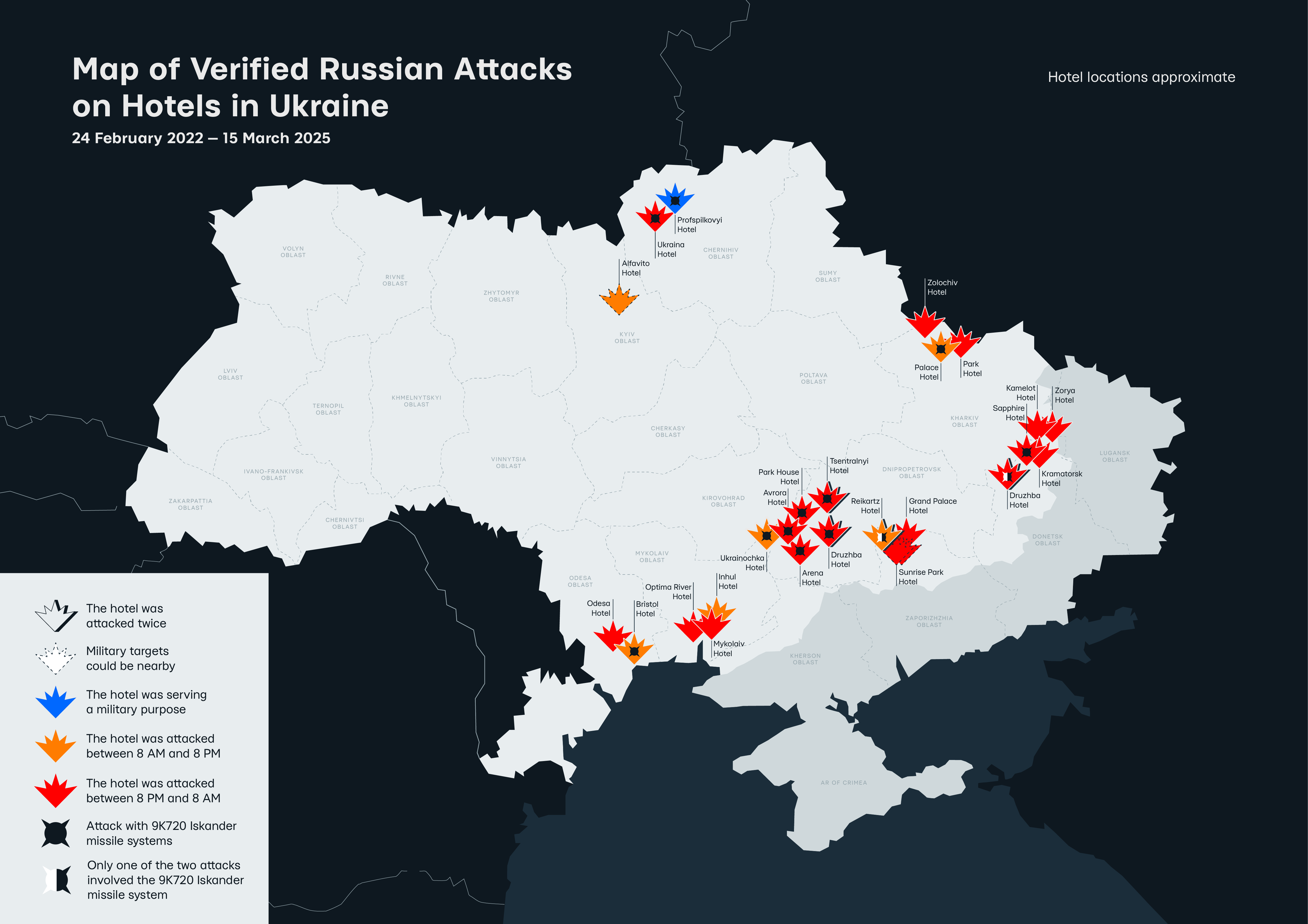
Our study—a joint undertaking between TH and RSF—aims to examine Russian attacks on hotels in Ukraine through an analysis of 31 documented incidents occurring at 25 hotels between 24 February 2022 and 15 March 2025. In so doing, we aim to identify potential rationales behind these strikes, the patterns apparent across the attacks, and their broader implications for media workers, as well as to assess them within the framework of IHL.
The pattern of attacks investigated in this report sheds light on the growing risks faced by media professionals covering the war in Ukraine. Hotel attacks, initially sporadic in 2022 (eight attacks), continued into 2023 and intensified in the latter part of the year, with four of the five attacks occurring after August. This clear pattern became increasingly evident in 2024 (fourteen attacks, of which eleven occurred after August) and continued into early 2025, with four attacks being carried out in two months. This escalation highlights a shift from isolated events to a sustained threat.
Since the onset of Russia’s full-scale invasion of Ukraine, many hotels have adapted their operations in direct response to the conflict. Some have ceased accepting guests for security reasons, while others have refused to host military personnel to avoid any association with military activity. However, our findings suggest that there is no clear correlation between the operating policy of a hotel and the likelihood of it being targeted.
Attacks Resulting in Civilian Casualties, Including Journalists
The majority of the victims of these attacks have been civilians. Among this group, media workers feature prominently, with 25 journalists and other media professionals—one of whom was killed—becoming victims of the attacks analysed.[14] Russia has increasingly targeted hotels known for housing journalists, deliberately striking those with no military presence.
A clear pattern has emerged, with repeated attacks occurring at night, using Russian cruise and ballistic missiles launched from Iskander missile systems, primarily in Ukrainian cities in regions affected by active hostilities and on civilian hotels that do not constitute legitimate military targets. Our analysis therefore suggests that these attacks are neither random nor incidental but are instead part of a broader strategy aimed at discouraging independent reporting from the frontline.
Obstacles to Journalistic Work
As a result, journalists are increasingly forced to reconsider their accommodation choices, shifting away from hotels in favour of alternatives. This limits their ability to operate safely in conflict areas and to perform their vital social function—particularly crucial in times of war. Indeed, 13% of respondents to our survey highlighted that there had been a reduction or complete suspension of assignments to high-risk areas in light of the pattern of attacks, representing a concerning trend that may affect the amount and quality of coverage of Russia’s war in Ukraine. Moreover, this trend has caused significant psychological distress among media professionals. Notably, when asked about the main consequences of these attacks, respondents to our survey cited complicated logistics due to limited access to safe housing (64%) and psychological stress or emotional trauma (44%).[15]
Disinformation Campaigns and False Narratives Used by Russian Sources to Justify These Attacks
These attacks appear to be part of a broader Russian strategy aimed at intimidating journalists and suppressing independent media coverage of Russia’s actions in Ukraine. In an effort to justify its actions under IHL, we have analysed several elements from disinformation campaigns, including false narratives claiming Russia is targeting ‘foreign mercenaries’.
Our study highlights how a range of Russian sources have actively promoted narratives about ‘foreign mercenaries’ allegedly fighting in Ukraine. This label is frequently applied to journalists to legitimise strikes on hotels in near-frontline territories where they usually stay or to portray them as equally lawful and desirable targets as actual combatants. Indeed, our analysis of Russian sources indicates that this narrative, whereby the line between journalists and combatants is deliberately blurred, is actively employed—and potentially initiated—by the Russian Ministry of Defence.
Call to Action: Legal measures
These attacks appear to be part of a broader Russian strategy aimed at intimidating journalists and suppressing independent media coverage of Russia’s actions in Ukraine. In an effort to justify its actions under IHL, we have analysed several elements from disinformation campaigns, including false narratives claiming Russia is targeting ‘foreign mercenaries’.
Our study highlights how a range of Russian sources have actively promoted narratives about ‘foreign mercenaries’ allegedly fighting in Ukraine. This label is frequently applied to journalists to legitimise strikes on hotels in near-frontline territories where they usually stay or to portray them as equally lawful and desirable targets as actual combatants. Indeed, our analysis of Russian sources indicates that this narrative, whereby the line between journalists and combatants is deliberately blurred, is actively employed—and potentially initiated—by the Russian Ministry of Defence.
Recommendations: Protecting press freedom and supporting journalists’ security in war zones
Overall, the situation illustrated in this report raises urgent concerns about press freedom and underscores the need for greater international attention and support for the security of journalists in war zones. Ensuring their safety is not only a matter of personal security, but also a fundamental issue for the transparency and accountability of war reporting. The targeting of journalists has a direct impact on the scale and depth of war reporting, reducing the presence of independent observers who could document potential violations of international law.
section one
I. Overview of the Attacks on Hotels in Ukraine
1. Hotels Adapting to Conflict: Operational Shifts and Guest Profiles
Between 24 February 2022 and 15 March 2025, Russian forces attacked hotels in Ukraine at least 31 times. Hotel attacks first occurred in 2022, with eight attacks recorded. The frequency increased in late 2023, when five attacks took place, of which four occurred after August, showing an identifiable trend. The situation escalated in 2024, which saw fourteen attacks, eleven of them occurring between August and October 2024, marking a peak in intensity. This upward trend continued into early 2025, with four attacks occurring in less than two months. The growing frequency of these attacks since late 2023—and more intensively in the latter half of 2024—suggests a possible evolution in targeting practices, rather than isolated or incidental strikes.
The analysis conducted in this study categorises the attacked hotels into four groups based on their operational status at the time of the strike: (a) hotels that continued to operate under regular conditions; (b) hotels that were open but explicitly refrained from accommodating military personnel; (c) hotels that were entirely closed; and (d) hotels used exclusively as accommodation for military servicemen. Strikes were recorded across all four categories, indicating that hotels with markedly different operational profiles were nonetheless targeted. This suggests that the likelihood of being attacked did not necessarily correlate with the presence of military personnel or the way the hotel was functioning at the time.
a. Hotels Maintaining Standard Operations
Most of the attacks analysed targeted hotels that were fully operational at the time, accommodating guests and providing standard hospitality services. These facilities usually hosted a diverse set of individuals, including journalists, humanitarian workers, business travellers, and displaced residents seeking temporary shelter. Although military personnel occasionally stayed in some of these hotels, their presence was neither substantial nor coordinated. The strikes not only caused extensive damage to the hotels but also resulted in civilian casualties, further fueling concerns that these Russian attacks may be part of a broader strategy of intimidation and disruption.
Hotel Reikartz, Zaporizhzhia (Zaporizhzhia Oblast)
On 10 August 2023, two cruise missiles from an Iskander 9K720 operational-tactical missile system struck the Hotel Reikartz in Zaporizhzhia.[16] According to a hotel employee interviewed by TH, the hotel was commonly used by Ukrainian and foreign journalists, internal displaced persons, humanitarian workers, and representatives of international organisations such as the Red Cross,[17] the International Atomic Energy Agency (IAEA), and the United Nations (UN).[18] The UN’s humanitarian coordinator for Ukraine, Denise Brown, who had previously stayed at the hotel, stated that she was ‘appalled’ by the attack and highlighted that the UN team regularly used the hotel during missions to the city.[19]
It was also established that Ukrainian military personnel periodically stayed at the hotel. According to a hotel employee, most of these individuals were servicemen accompanied by their families, who came for weekends or during leave, as well as those passing through the city and staying overnight. Overall, their share among all hotel guests did not exceed 20–30%.[20]
At the time of the attack, the hotel was fully operational, accepting bookings through platforms like Booking.com and other conventional means.[21] Both a hotel employee and a guest interviewed for this study confirmed that military personnel accounted for no more than one third of the guests present that day.[22] Additionally, a children’s camp was being held on the hotel premises until 6pm,[23] with up to 30 children around the outdoor pool and gathered in the hotel’s conference hall.[24] Guests at the Reikartz were fortunately spared as the missiles struck a car park adjacent to the hotel. However, a 66-year-old woman passing by was killed in the explosion.[25] In total, at least 19 people were injured in the attack, including hotel staff.[26]
This strike was not the first targeting of the Reikartz. On 16 April 2023, two missiles landed approximately 50–70 metres from the building, striking a garden between the hotel and the River Dnipro.[27] At the time of the incident, the hotel accommodated only one guest apart from staff—a soldier who, based on eyewitness accounts, did not hold a command position or rank of operational significance.[28]
[17] In this instance, as well as in subsequent references to the Red Cross, witnesses were unable to determine whether the individuals were representatives of the Ukrainian Red Cross Society or the International Committee of the Red Cross (ICRC). However, in some cases, it was reported that these individuals spoke English, which may indicate that they were affiliated with the ICRC.
[18] Interview with Kpa-51 conducted by TH.
[20] Interview with Kpa-51 conducted by TH.
[21] Ibid; Interview with Kpa-52 conducted by TH.
[22] Interview with Kpa-51 conducted by TH; Interview with Kpa-53 conducted by TH.
[24] Interview with Kpa-51 conducted by TH.
[28] Interview with Kpa-51 conducted by TH.
Hotel in Zolochiv (Kharkiv Oblast)
At night on 6 February 2024, two Russian missiles—probably launched from an S-300 (S-400) missile system—struck the village of Zolochiv in Kharkiv Oblast.[29] One of the missiles directly hit a three-storey building in the heart of Zolochiv, which housed a small hotel consisting of three rooms.
Commenting on the double strike, the owner of the hotel stated that ‘once is accidental, twice is tactical’, referring to what he believed was the deliberate nature of the attack on his property.[30] According to him, at the time of the attack, all three rooms were occupied by a total of three families. Tragically, a two-month-old infant, staying at the hotel with his mother, was killed in the strike. The mother, along with two other female guests, sustained injuries and was hospitalised.
Hotel Bristol, Odesa (Odesa Oblast)
On 31 January 2025, Russian forces struck the Hotel Bristol, located in the historic centre of Odesa, a city in southern Ukraine. The strike injured seven people, including one employee of the hotel.[31] According to Oleh Kiper, head of the Odesa Regional Military Administration, the hotel was hit by a missile, as were several historic buildings nearby. The Ukrainian online media outlet New Voice of Ukraine quoted Kiper, stating that a concrete-piercing missile was used and was deliberately aimed at a civilian hotel.[32] The Bristol was frequently used as lodgings by journalists and diplomats during their assignments to Odesa.[33]
[33] This information comes from a response to our survey.
b. Hotels Refusing to Accommodate Military Personnel
Among the targeted hotels, some enforced a strict policy prohibiting the accommodation of military personnel under any circumstances. In some other cases, hotels did not have an outright ban but still actively monitored their premises to ensure that, even if members of the Armed Forces were staying at the hotel, they did not park military vehicles on the property or appear in uniform while on the grounds. These precautions were implemented to reduce the likelihood of the property being perceived as a potential military objective. However, despite these efforts, some of these establishments were still subjected to attacks.[34]
Hotel Kramatorsk, Kramatorsk (Donetsk Oblast)
On the night of 18 September 2022, a missile struck the Hotel Kramatorsk in the city of Kramatorsk, Donetsk Oblast. Valeriia Karpenko, the hotel director, explained to TH that the hotel had a policy of not accommodating military personnel for security reasons, as it could have posed a risk to civilian safety. She emphasised that from mid-March 2022, when the last journalists left the hotel, the hotel remained empty until the summer. However, during the summer, the administration began receiving requests from people fleeing occupied territories and they provided accommodation for those seeking a place to stay before continuing further into government-controlled territory, as well as for Ukrainian and foreign journalists and volunteers.[35]
‘We had a rule not to house military personnel or individuals wearing military uniform, as this would put people in danger’, she told TH documenters.[36]
The Kramatorsk was struck while only civilians were inside, including a security guard, a hotel manager, a female traveller, a volunteer, and a journalist. The strike injured the female traveller and damaged the building.[37]
[34] This subsection discusses only one documented attack on a hotel that explicitly restricted or prohibited the accommodation of military personnel. While additional hotels with similar policies were identified during the research, they were excluded from this category because they were not operational at the exact time of the strike and were therefore classified under other categories more accurately reflecting their status at the moment of impact.
[35] Interview with Valeriia Karpenko conducted by TH.
c. Hotels Ceasing Operations
Hotel Ukraina, Chernihiv (Chernihiv Oblast)
The Hotel Ukraina in Chernihiv, a city in northern Ukraine, is the earliest hotel strike documented for this report. On the night of 11–12 March 2022, the hotel was partially destroyed by a Russian strike with a 9M723 ballistic missile launched from an Iskander operational-tactical missile system. According to local witnesses and Ukrainian officials, no one was injured in the attack, as the hotel was not functioning during the Russian siege of Chernihiv.[38]
Hotel Druzhba, Pokrovsk (Donetsk Oblast)
On 7 August 2023, the Hotel Druzhba in Pokrovsk, a city in Donetsk Oblast, was struck in a Russian attack. This attack was thoroughly examined in a previous TH report titled Cruelty Cascade, which delves into the Russian tactic of double-tap strikes.[39] The assault on the Druzhba followed this pattern, resulting in a significant toll: 10 people were killed and 93 others were injured.[40]
Once one of the few remaining hotels still operating in the government-controlled part of Donetsk Oblast following the onset of the full-scale invasion, the hotel had become a regular stop for journalists, as confirmed by a statement from the International and European Federation of Journalists (IFJ-EFJ).[41] However, it had been closed for several days prior to the attack. According to TH sources, hotel staff had been alerted that continuing operations had become too risky.
Field research confirmed that the hotel was empty on the day of the attack, though it had been hosting guests some days before.[42] Members of the TH team had stayed overnight at the hotel shortly before the attack. They confirmed that the hotel remained operational and hosted civilians and military, including soldiers and their relatives, volunteers, and members of civil society. No military commanders were visible and there was no apparent evidence suggesting that the hotel or its basement housed a command centre or headquarters for the Ukrainian army,[43] as was later reported by the Russian Ministry of Defence.[44]
Grand Palace Hotel, Zaporizhzhia (Zaporizhzhia Oblast)
On 2 September 2024, a ballistic missile struck the Grand Palace Hotel in Zaporizhzhia, despite the fact that the hotel was no longer in operation. In 2022, the owners provided accommodation to IDPs in the hotel building annex and, in 2023, they moved into it themselves. The annex was later hit by a missile resulting in the deaths of the hotel co-owner’s wife and their eight-year-old son, while he and his 12-year-old daughter sustained severe injuries.[45]
‘Since the beginning of the full-scale invasion, we have not worked as a hotel. Only the pool was open from 1 July until the end of the summer,’ the hotel’s co-owner told TH.[46] The decision to cease operations and not to accommodate civilians or military personnel was a deliberate and principled stance, motivated by security concerns. As he emphasised: ‘I never housed the military; I was afraid of an attack.’ [47]
d. Confirmed Instance of Military Use
Profspilkovyi Hotel, Chernihiv (Chernihiv Oblast)
Following the outbreak of the full-scale war, some hotels were repurposed exclusively or mostly for military use to accommodate servicemen. Among the hotels targeted, only one was confirmed to be used to house military forces: the Profspilkovyi Hotel in Chernihiv, which was attacked on 17 April 2024. Russian cruise missiles launched from an Iskander 9K720 missile system hit the hotel building, causing significant destruction and reportedly killing 18 people and injuring a further 78.[48]
The pro-Kremlin Telegram channel Rybar, which specialises in military analysis, claimed that the hotel was used as a barracks for the 5th Separate Signal Regiment of the Ukrainian Armed Forces. This assertion was supported by photographs showing an injured person in military uniform and army-style bunks visible through the hotel’s windows in images taken immediately after the strike.[49] Ukrainian officials did not comment on the specific details of the incident, stating only that the hotel was not operational at the time of the attack.[50]
The Memorial platform,[51] which commemorates victims of Russia’s war of aggression, both civilians and soldiers, contains an obituary for a soldier from the 5th Separate Signal Regiment who was killed on 17 April in Chernihiv while on active duty.[52] The same platform also features an obituary for a combat medic whose body was recovered from the rubble following the strike on the city on 17 April.[53] It is necessary to highlight that there was only one attack on Chernihiv that day. Information regarding the use of the hotel by military personnel was confirmed by TH sources, who were on site shortly following the strike.
Publications on Russian Telegram channels following this strike represent the only documented instance in which claims regarding the presence of military personnel in a targeted hotel were substantiated with supporting evidence, which differs from the typical approach to commenting on such attacks. The strike was most likely directed at a military target, making it an exception among other known hotel attacks.
2. Media Professionals among the Victims
The frequency of strikes on hotels—despite growing evidence of their minimal military utility—and the fact that such attacks usually occur without any clear link to the presence of military personnel suggest that the range of potential targets in these incidents may extend beyond members of the Armed Forces of Ukraine. It may also include other groups residing in hotels located in areas affected by hostilities, which were outlined in the introduction to this study. In the present report, we focus in detail on one of them: media workers, who have consistently relied on hotels as temporary bases while reporting from the conflict zone.
The instances mentioned below are not exhaustive but represent the most widely reported incidents in which journalists—particularly international media crews—were harmed as a result of attacks on hotels. The presence of foreign media outlets in these cases contributed to greater international visibility and coverage of the events. However, journalists have also faced lesser-known attacks, often under-documented due to limited coverage or access to verifiable information.
For example, the presence of journalists in the attack on the Hotel Kramatorsk, Kramatorsk, on 18 September 2022, became known only due to a passing mention made by the hotel’s owner in interviews, including one she gave to TH. In the case of the Hotel Avrora in Kryvyi Rih, Dnipro Oblast, a respondent to our survey indicated that journalists were staying at the facility at the time of the strike. Similarly, in the Park House Hotel attack in Kryvyi Rih, the presence of foreign media professionals was confirmed, although this information was not widely picked up by the media and appeared only in a limited number of sources. These examples underscore the difficulty of fully tracking all cases where media professionals may have been impacted by such attacks.
As of mid-March 2025, we have identified 25 journalists and media professionals who were among the victims of the attacks analysed—one of whom was killed.
Hotel Alfavito, Kyiv
Wataru Sekita and Norito Kunisue, two journalists from the Japanese newspaper Asahi Shimbun, were staying at the Hotel Alfavito in Kyiv’s city centre when it was struck on 31 December 2022. Mr Sekita, who was outside at the time of the attack, sustained a leg injury and was hospitalised. The other journalist, who stayed inside, remained unharmed.[54] In an interview with Ukrainian online media outlet LIGA.net, the hotel’s deputy director, Lyudmyla Startseva, confirmed that ‘foreigners’ and ‘volunteers’ had been staying at the hotel during the full-scale invasion and that all residents, except for the two Asahi Shimbun journalists, had checked out just before the attack.[55]
Kharkiv Palace Hotel, Kharkiv (Kharkiv Oblast)
Another prominent example is an attack on the five-star Kharkiv Palace Hotel in Kharkiv on 30 December 2023, in which Svitlana Dolbysheva, a local Ukrainian producer, and a security adviser (a British citizen) for the German TV broadcaster ZDF were injured.[56] A ballistic missile directly struck the upper floors of the hotel building. At the moment of the strike, five ZDF team members and The New York Times photographer and local producer, Oleksandra Mykolyshyn, were staying at the hotel together with a small number of other civilian guests.[57]
‘As I opened my room door, I didn’t see the large open lobby as usual, but instead darkness and black smoke. I didn’t know if my colleagues were alive or what was left of this building,’ ZDF journalist Alica Jung said after the attack.[58]
[57] Interview with Oleksandra Mykolyshyn, conducted by TH.
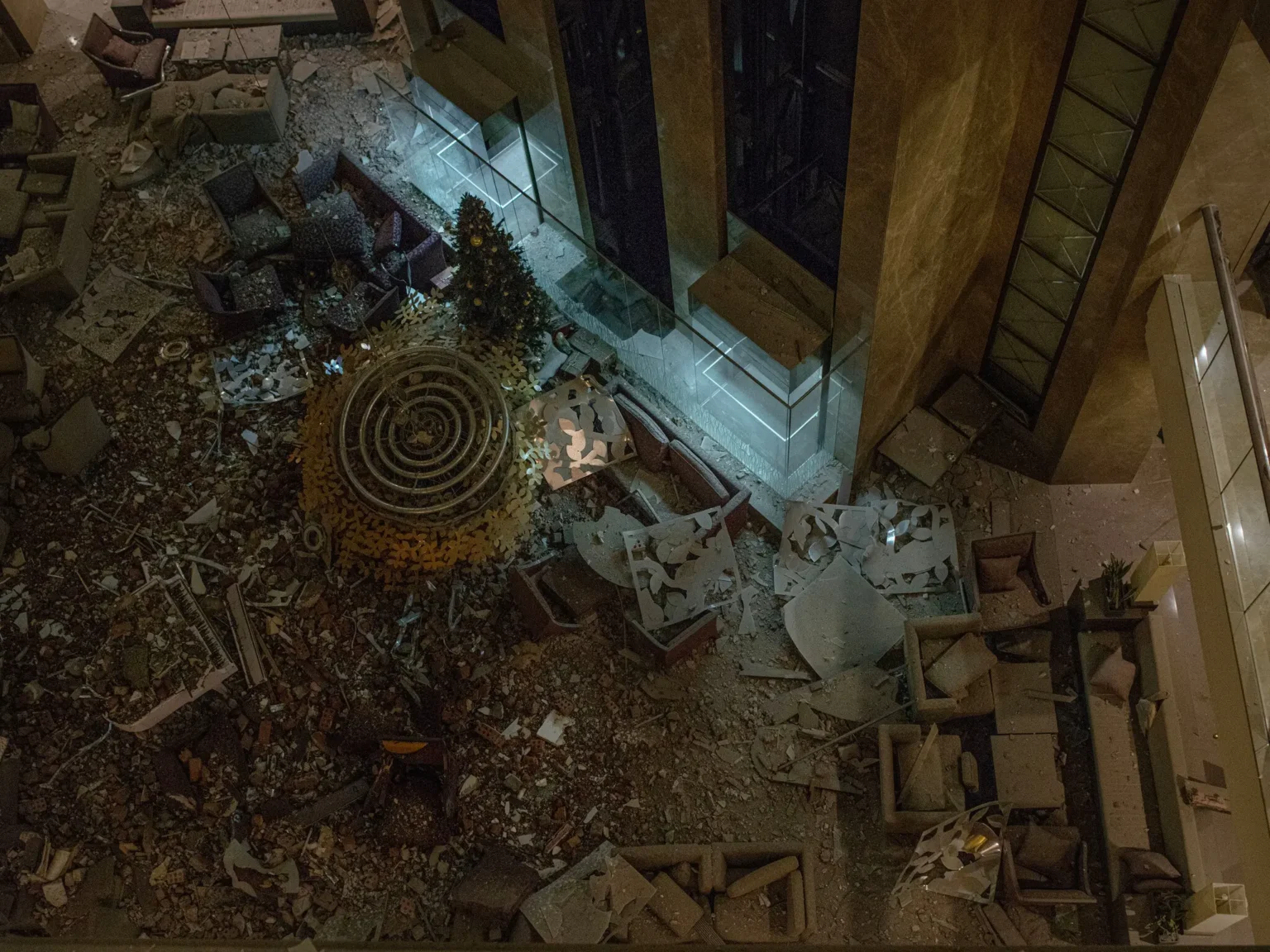
Destroyed interior of the Kharkiv Palace Hotel’s lobby
Photo: Laura Boushnak for The New York Times
Park Hotel, Kharkiv (Kharkiv Oblast)
Just eleven days later, on 10 January 2024, another strike targeted a hotel in Kharkiv. The Park Hotel was hit by two missiles reportedly launched from an S-300 (S-400) system.[59] Reporter Davit Kachkachishvili, working for the Turkish news agency Anadolu, and a local Ukrainian producer for the French TV channel France 2, Violetta Pedorych, who were at the hotel, were injured in the attack, while Turkish photographer Özge Elif Kızıl from Anadolu and two other French journalists from France 2, Anaïs Hanquet and Valérie Lucas, remained physically unharmed.[60] According to a witness interviewed by TH, the hotel had been frequently used by journalists since the beginning of the full-scale invasion and rarely accommodated servicemen.[61]
Hotel Sapphire, Kramatorsk (Donetsk Oblast)
On 24 August 2024, a Russian ballistic missile hit the Hotel Sapphire in the city of Kramatorsk, Donetsk Oblast, where a Reuters team was staying. The attack resulted in the death of Ryan Evans, a British citizen working as a safety adviser for Reuters. This attack is examined in greater detail in Section IV of this report.
Cases Beyond the Scope of our Study
In some cases, journalists staying in hotels were injured as a result of attacks that, according to the methodology of this study, do not fall under the classification of direct attacks on hotels. This is due either to the verified presence of a legitimate military objective in close proximity to the impact site or credible evidence indicating that the hotel itself was not the intended target.
For example, on the evening of 2 January 2023, Russian forces launched a missile strike on the city of Druzhkivka, Donetsk Oblast. The missile hit a section of railway infrastructure located near the Hotel Mann, which could be a potential legitimate military target. As a result of the explosion, Bild correspondent Björn Stritzel sustained injuries, while Paul Gasnier, Héloïse Grégoire, and Théo Palfray, three journalists from French TV channel TMC, who were preparing to go live outside the hotel, were not harmed.[62]
Another incident occurred on 6 October 2023, when a missile struck near the Optima Collection Hotel in Kharkiv. The blast injured two journalists from the Portuguese TV broadcaster RTP, Paulo Jerónimo and José Pinto Dias, as well as their Ukrainian producer Andrii Kovalenko.[63] At the time of the strike, other journalists were also staying at the hotel, which is a known place of accommodation for media workers in the city.[64] However, according to information available to TH and a statement later released by the Security Service of Ukraine following the arrest of a spotter allegedly involved in the incident, the intended target of the strike was a separate facility located approximately 80 metres from the hotel.[65]
3. Kryvyi Rih: An Epicentre of Escalation
An escalation of attacks on hotels occurred between August and October 2024, with Kryvyi Rih in Dnipro Oblast emerging as a focal point of this intensified campaign. Five hotels in the city were targeted by Russian forces over the span of just a few months. This pattern of attacks persisted into early 2025, with at least three additional strikes recorded in February and March.
Hotel Avrora
On the evening of 26 August 2024, a missile struck the Hotel Avrora, resulting in at least four deaths and five wounded.[66] Hotel staff interviewed by TH reported that the hotel often hosted volunteers, journalists and representatives of humanitarian organisations, including deminers, the Red Cross, and the Danish Refugee Council, as well as business travellers, displaced persons, and athletes.[67] Among the visitors were occasionally military personnel who stayed for a few nights.[68]
TH documenters established that, on the night of the strike, 28 individuals were staying at the hotel across 22 rooms. Among them were nine military personnel,[69] some of whom were off duty and accompanied by their partners, as well as a likely officer of the Security Service of Ukraine.[70] However, the mere presence of a small number of off-duty servicemen does not render an object ordinarily and actually used for civilian purposes a legitimate military target. Given that the hotel primarily hosted civilians, as only ten of the 28 guests may be deemed to be military personnel, the strike raises serious concerns about the principle of proportionality under IHL, i.e., whether the expected military advantage outweighed the likely civilian harm.
Hotel Ukrainochka
Only two days later, Russian forces attacked the Hotel Ukrainochka with a 9M723 ballistic missile, injuring nine people, destroying several service stations, and damaging over 230 vehicles.[71] The missile struck an auto service station approximately 40 metres in front of the hotel, which could constitute a circular error or targeting mistake. Witnesses reported no military presence at the site, as the service station primarily catered to civilian vehicles.[72] Hotel staff confirmed that, at the time of the strike, approximately five guests and around fifteen members of staff were present in the hotel, with no military personnel among them.[73]
Hotel Arena
The third hotel attack in Kryvyi Rih occurred on 4 September and targeted the Arena Hotel, which had served as accommodation for circus performers prior to the full-scale invasion and had remained out of operation since then.[74] At the time of the strike, the only individual present in the hotel was the building caretaker. While she did not sustain serious physical injuries, the attack caused her severe psychological trauma.[75] According to her account, there were no military facilities or personnel stationed near the hotel.[76]
[67] Interview with Khv-95 conducted by TH; Interview with Khv-96 conducted by TH; Interview with Khv-97 conducted by TH; Interview with Khv-98 conducted by TH; Interview with Khv-99 conducted by TH.
[69] This information became available to TH after an analysis of the hotel’s guest list provided by one of its employees. An open-source investigation revealed that, as of March 2025, nine of the listed individuals were active-duty military personnel. However it remains unclear whether all of them held that status at the time of the attack.
[72] Interview with Khv-81 conducted by TH; Interview with Khv-82 conducted by TH.
[73] Interview with Khv-83 conducted by TH; Interview with Khv-84 conducted by TH.
[74] Interview with Khv-85 conducted by TH; Interview with Khv-86 conducted by TH.
[75] Interview with Khv-85 conducted by TH.
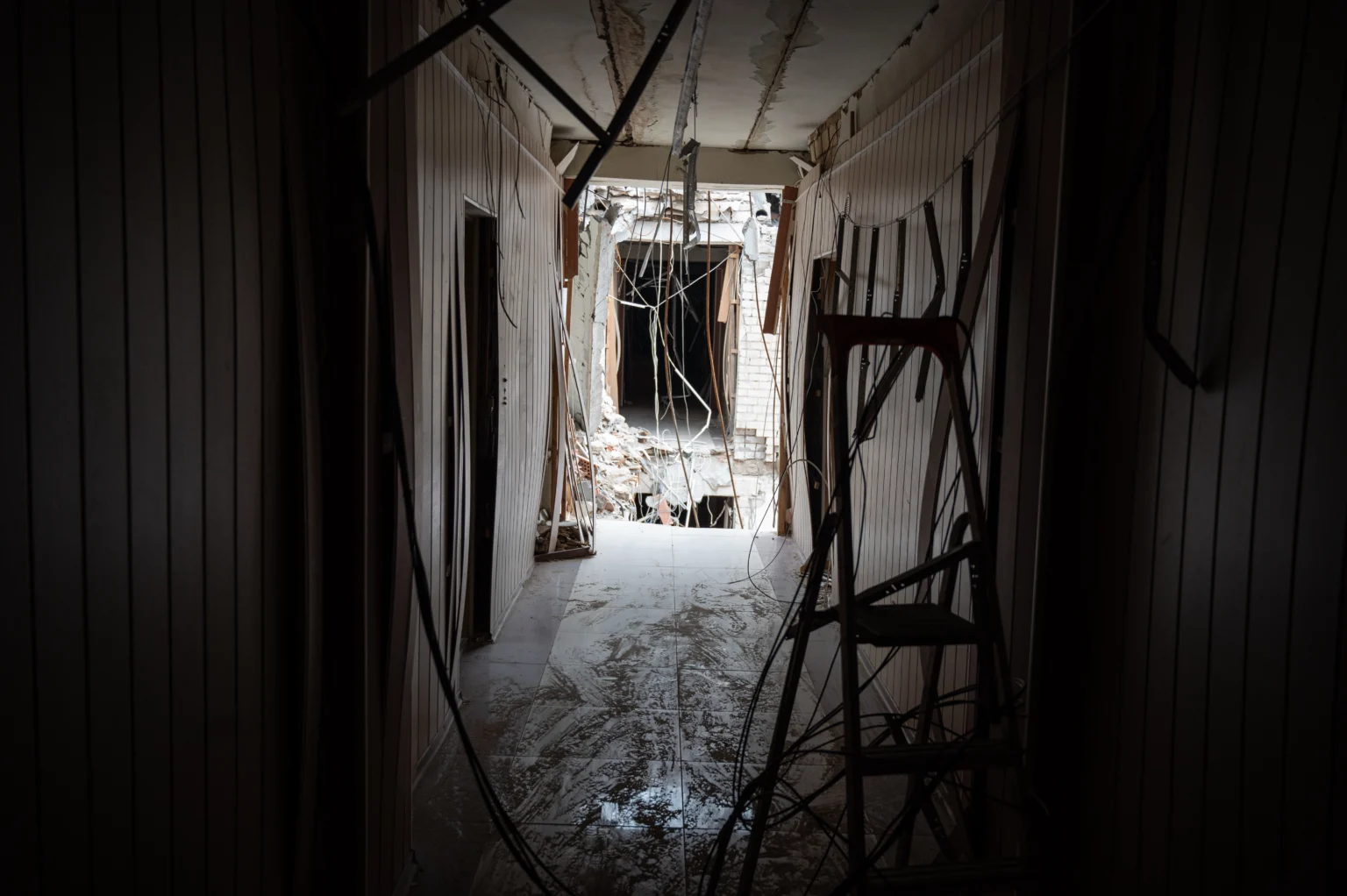
A corridor on one of the floors of the Arena Hotel in Kryvyi Rih
Photo: Truth Hounds
Hotel Druzhba
A little over a month later, on 19 October 2024, Russian forces carried out a double-tap strike on the Hotel Druzhba, injuring a total of 17 people.[77] Hotel employees on shift that day reported in interviews with TH that the hotel housed around 30 guests and up to five staff members at the time of the incident. According to their statements, no military personnel were present among them.[78] Moreover, military personnel rarely stayed at the hotel, with the majority of guests being individuals traveling through the city, given the hotel’s proximity to the bus station.[79] Even though the hotel was non-operational after the first attack, it was hit by a double-tap strike again on 12 March 2025, leaving 15 people injured and killing one woman who was passing by the building.[80]
Tsentralnyi Hotel
The following day, on 20 October 2024, another missile hit the Tsentralnyi Hotel, injuring four people.[81] At the time of the explosion, only an administrator and a security guard were present in the building.[82] According to the hotel manager, the hotel primarily hosted business travelers, journalists, and humanitarian workers, including deminers and representatives of the NGO the International Medical Corps.[83] This same hotel was struck again on 5 March 2025, resulting in 31 injuries and four fatalities[84]. According to Ukrainian President Volodymyr Zelenskyy, a group of humanitarian volunteers from Ukraine, the United States, and the United Kingdom had checked into the hotel shortly before the strike but managed to survive by swiftly taking shelter.[85]
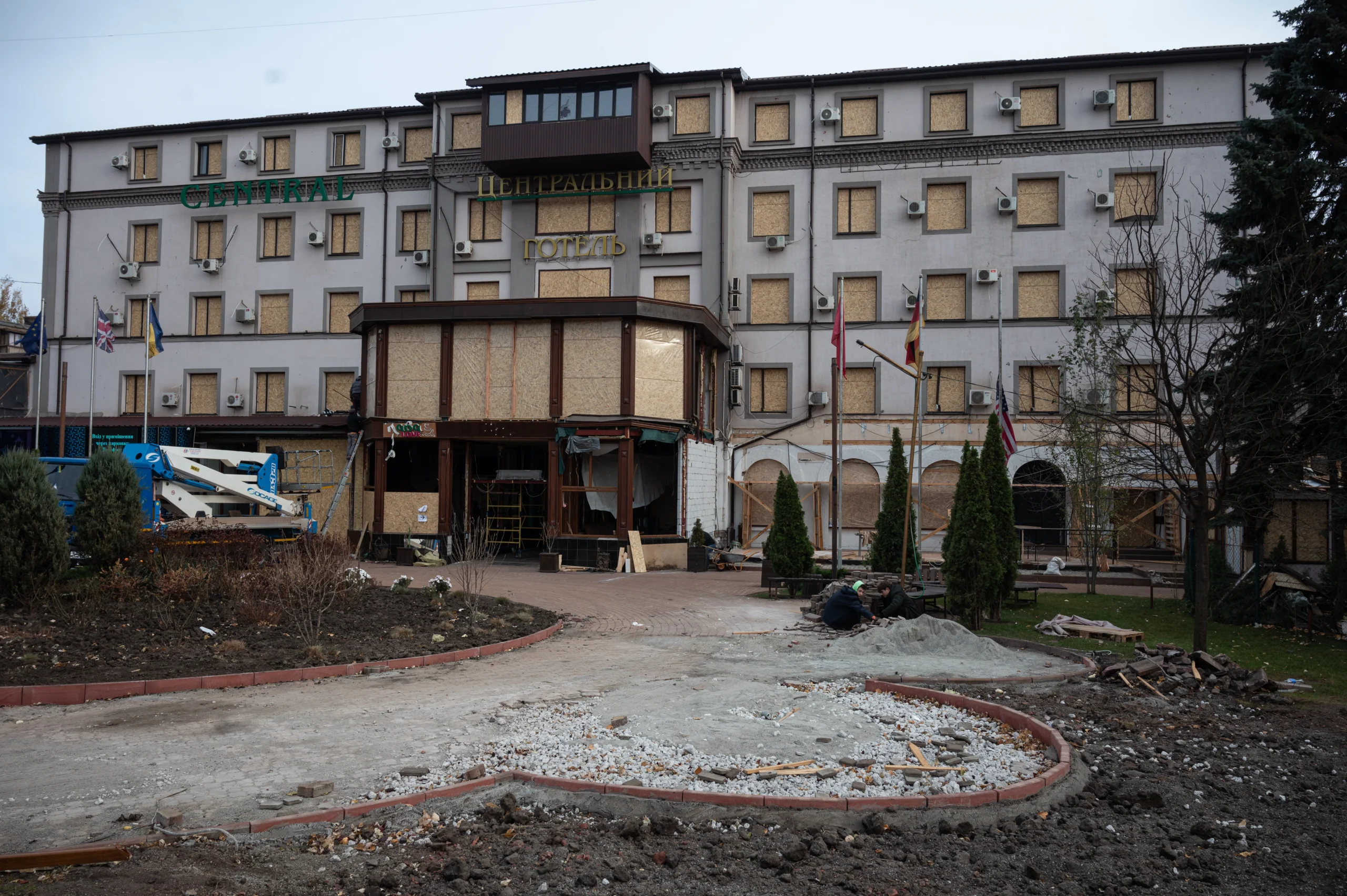
The Tsentralnyi Hotel in Kryvyi Rih, damaged in the first attack
Photo: Truth Hounds
Park House Hotel
In 2025, a missile strike targeted another hotel that had not been attacked the previous year—the Park House Hotel, which was struck by two ballistic missiles on 22 February.[86] The hotel reportedly had around 50 rooms and, according to staff members of the restaurant affiliated with the hotel, following the onset of the full-scale invasion, it had often accommodated foreign nationals. These mainly included representatives of international organisations such as the Red Cross and UNICEF.[87] Danish journalist Matilde Kimer and photographer Lau Svensson, both working for DR, Denmark’s oldest and largest public broadcasting organisation, were staying at the hotel on the night of the attack.
Matilde Kimer described ‘a very powerful explosion that shook the entire building and blew out windows and doors, sending shards of glass flying across the bed’. She also noted that she ‘did not see any men in uniform at our hotel’ that night.[88]
Witnesses described the presence of military personnel at the hotel as ‘isolated instances’, emphasising that they had never stayed there in large numbers. At the time of the strike, they were not aware of any military personnel being present.[89] The attack resulted in one fatality and left at least five individuals injured.[90]
The observed pattern of repeated strikes, precision weapon use, double-tap tactics, and the consistent targeting of hotel sites points to a coordinated effort aimed at both hotel infrastructure and the groups accommodated there.
4. Intensity of Attacks and Recurring Patterns
Over the period analysed (24 February 2022 to 15 March 2025) Russian forces carried out 31 attacks targeting 25 hotels across Ukraine. Though the details of these attacks vary, certain patterns seem to emerge, in particular, the repeated targeting of hotels known to host journalists, humanitarian workers, volunteers, and other civilians.
Geographical pattern: 27 strikes occurred in oblasts experiencing active hostilities
The vast majority of documented attacks (27 out of 31) occurred in regions[91] experiencing active hostilities at the time of the strike. These areas, though typically well beyond the actual frontline, are still typically characterised by the heightened presence of both military forces and civilian groups directly involved in covering or responding to the consequences of the conflict—particularly journalists, humanitarian workers, volunteers, and representatives of international organisations. The sustained presence of such actors in conflict-affected zones is largely driven by their relative proximity to combat zones, the need for rapid response, and the imperative to collect, verify, and communicate information from the ground.
Hotel status pattern: 30 of the 31 attacks targeted hotels without a clear-cut military use
The status of the hotels targeted and, therefore, of the individuals harmed, constitutes another pattern: 30 of the 31 attacks targeted hotels without a clear-cut military use. In only one of the attacks analysed, that of the 17 April 2024 attack on the Profspilkovyi Hotel in Chernihiv, is there supporting evidence of military use of the hotel. In all other cases, the affected hotels had either maintained standard operations by remaining open to a diverse array of guests, of which the vast majority were civilians, had refused to accommodate military personnel, or had ceased operations altogether. The targeting of civilian objects with no confirmed military use and, on the contrary, known use by journalists, humanitarian workers, and other civilians, therefore constitutes a significant shared characteristic of the attacks.
Temporal pattern: 23 strikes occurred between 8:00 pm and 8:00 am
The timing of these attacks reveals a discernible pattern indicative of a calculated approach to targeting hotels. Although the strikes occurred at various times throughout the day and night, 23 of the 31 strikes analysed in this report took place between 8:00 pm and 8:00 am. This reflects the internal timing logic of these attacks and underscores the deliberate intent of the attacker to maximise harm to individuals present inside, as this particular timeframe corresponds with hotels’ typical peak occupancy. Notably, the frequency of nighttime attacks increased significantly between late August and October 2024. During this period, all major strikes that caused significant damage to hotels occurred within the same timeframe, further underscoring a deliberate targeting strategy.
Precise striking pattern: At least 15 attacks involved missiles launched from Iskander 9K720 missile systems
At least 15 attacks were conducted with Russian Iskander 9K720 missile missiles systems: eleven with 9M723 ballistic missiles, and four with 9M727 / 9M728 / 9M729 cruise missiles.
The Russian Federation has employed a variety of weapons in these attacks, including ballistic and cruise missiles. The accuracy of these weapons varies, but some, like missiles launched from the Iskander 9K720 missile system, are known for their high precision. According to a group of experts specialising in the components and operational use of Russian missile systems and who provided technical consultations to TH during the preparation of this report, the deviations of these missiles may vary based on their analysis of combat deployment.
In particular, earlier modifications of 9M723 missiles were observed to deviate by up to 100 metres. Following a technical upgrade implemented in late 2023, the accuracy of these missiles improved significantly and, in most cases, the deviation has been reduced to within minimal margins. However, in some cases a CEP of up to 50 metre has been recorded. As for the cruise missiles launched from Iskander systems, their latest modifications suggest a CEP of approximately 20 metres.[92]
Even 5V55 and 48N6 missiles, along with their variations employed for attacks on ground targets via S-300 and S-400 missile systems, exhibit relatively high accuracy when launched from a distance of approximately 40–45 km, with a CEP of up to 50 metres. However, this level of precision diminishes significantly as the launch distance increases. Specifically, at a range of 45–75 km, the CEP may rise to approximately 150 metres, while at maximum operational range, it can reach up to 300 metres.[93] In order to increase the likelihood of successfully striking a target with such missiles, in certain instances, Russian forces launched multiple missiles of this type almost simultaneously.
5. Ukrainian Attacks on Hotels in the Occupied Territories
Over the same period, the Ukrainian Army has also carried out strikes on hotels in Russian-occupied territories. TH has identified eight such instances involving artillery and missile fire targeting hotels located on territories under the temporary control of Russian forces. In at least four of these cases, available evidence indicates that the hotels were being used for military purposes and would thus qualify as legitimate military objectives under IHL.
One of the most well-known incidents occurred on 11 July 2023, when a missile strike hit the Hotel Duna in the city of Berdiansk, Zaporizhzhia Oblast, killing Russian officer Oleg Tsokov, the deputy commander of Russia’s Southern Military District. According to reports, the hotel was struck by a Storm Shadow missile.[94] Two other notable attacks occurred in Kherson (5 October 2022) and Kadiivka, Luhansk Oblast (11 December 2022). In Kherson, the strike on the Hotel Ninel resulted in casualties among FSB officers and Russian military personnel.[95] In Kadiivka, the attack on the Gostievoi Dom Zhdanova Hotel targeted members of the Wagner Private Military Company (PMC), killing several of them.[96]
Another prominent case was the artillery strike on the Hotel Shesh-Besh in Russian-occupied Donetsk on the evening of 21 December 2022.[97] The shells struck the hotel restaurant during the 59th birthday celebration of Russian politician and former Roscosmos[98] director Dmitry Rogozin. Several high-ranking military figures were reportedly present, including commanders from the 1st Army Corps of the so-called ‘Donetsk People’s Republic’ (‘DNR’), two servicemen known by the call signs ‘Hans’ and ‘Docent’, the so-called ‘prime minister’ of the DNR, Vitalii Khotsenko, and Rogozin himself,[99] all of whom sustained injuries.
Although Rogozin later insisted that he was merely a politician, at the time of the attack, he was serving as the curator of the ‘Tsar’s Wolves’ military group, responsible for testing new military equipment and technology. He arrived in the DNR in November 2022 for this purpose, frequently wearing a military uniform and actively participating in testing alongside soldiers in real combat scenarios.[100] The presence of high-ranking military personnel suggests that the location likely constituted a legitimate military objective under international humanitarian law.
We additionally confirmed four Ukrainian strikes on hotels used by Russian officials, politicians, and specialised workers. One such attack probably targeted the governor of the Russian-occupied Kherson Oblast, Volodymyr Saldo.[101] In these cases, there is insufficient information regarding the presence of Russian military personnel in the hotels, as well as limited clarity on the extent to which targeted individuals were involved in the planning or execution of military operations or in direct cooperation with the Russian Armed Forces. As a result, a conclusive assessment of the lawfulness of these strikes under IHL would require additional evidence, which could not be obtained in the course of this research.
Beyond these confirmed cases, we identified references in open sources to eight additional Ukrainian strikes in which hotels in Russian-occupied territories could have been among the intended targets. However, the absence of reliable information regarding the status of the buildings at the time of the attacks, along with uncertainty about the number and identities of those affected, makes it difficult to conduct any meaningful analysis of these incidents.
Due to the complete lack of access to Russian-occupied territories, which precludes field verification, and the inherent difficulty of independently corroborating open-source information, the assessment of Ukrainian strikes on hotels remains limited. Nevertheless, some preliminary conclusions can still be drawn. All identified Ukrainian attacks took place predominantly in 2022 and, to a lesser extent, in 2023. Unlike the Russian pattern of systematic and repeated strikes against hotels in government-controlled Ukraine, Ukrainian strikes do not exhibit the same degree of regularity or strategic focus on this type of infrastructure.
In at least half of the verified cases (four out of eight) the targeted hotels were clearly used for military purposes and would therefore qualify as legitimate military objectives under IHL. In the remaining four incidents, there was insufficient information to determine whether military personnel were present or whether those targeted had a direct operational role in support of Russian armed forces. However, available information suggests a possible rationale behind the strikes of targeting key figures within the occupying administration or associated power structures. In this sense, the pattern of Ukrainian strikes stands in sharp contrast to that observed in Russian attacks on hotels, which appear to be directed at a different set of groups.
[97] The State Corporation for Space Activities ‘Roscosmos’ is a Russian state-owned corporation responsible for overseeing space flights, managing cosmonautics programmes, and conducting aerospace research.
section two
II. The Impact of Hotel Attacks on Media Workers
1. Growing Perception of Danger among the Media Community
Media professionals, including journalists and local producers, constitute one of the groups most affected by hotel attacks. To better understand the scope of these risks and their impact on journalistic activity, TH and RSF conducted a survey among Ukrainian and international journalists between 29 January and 14 March 2025. Two versions of the questionnaire were distributed: an English-language version titled Survey on Attacks and Risks Faced by Journalists in Ukraine, primarily aimed at international correspondents, and a Ukrainian-language version titled Опитування щодо нападів та ризиків, з якими стикаються журналісти в Україні, directed at local media professionals.
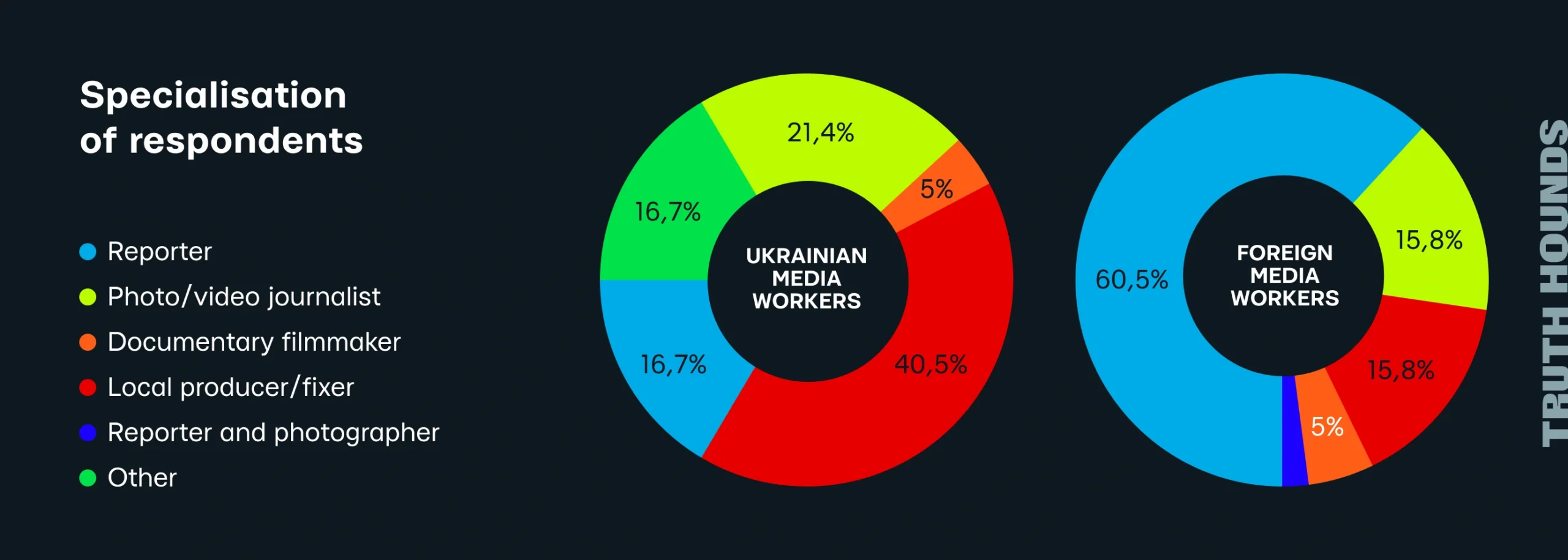
- Among Ukrainian respondents, the majority (41%) work as local producers, followed by 21% who are photo and video journalists, and 17% who are reporters, with the rest engaged in various other roles. 50% work for foreign media outlets mainly from Canada, the United Kingdom, the United States, France, Germany, and Japan, 43% for the Ukrainian media, and the rest are freelancers. 41% reported working near the frontline several times a year, while 45% do so on a monthly basis or more frequently. The remainder never or very rarely work near the frontline.
- Among foreign respondents, the majority (60%) are reporters, while 16% work in photo and video journalism, and 16% as local producers. The remaining respondents fell into the ‘other’ category. Most of them (76%) work with foreign media, while 24% are freelancers. They primarily work with Western media, particularly from Poland, France, the United Kingdom, Ireland, and Germany. Their work near the frontline is slightly less frequent; 51% go to these regions several times a year, 19% do so monthly or more often, and 30% report from there once a year or less.
Outlined below are the key results of the survey:
Accommodation choices seem to have shifted significantly over time:
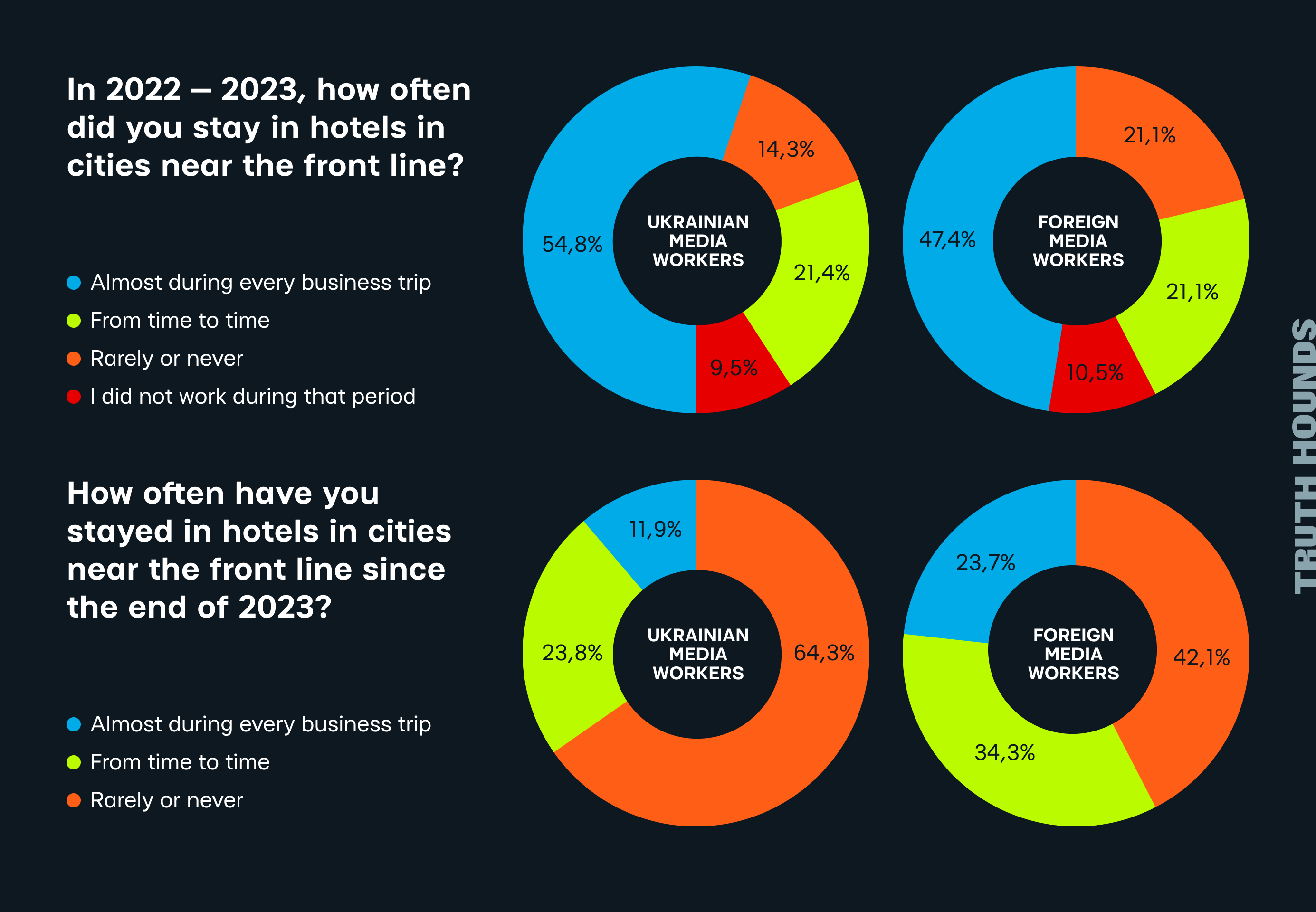
- From 2022-2023, 55% of Ukrainian respondents stayed in hotels in cities near the frontline during almost every field assignment, while 14% did so occasionally, and 21% rarely or never. Since late 2023, the proportion of those rarely or never staying in such hotels has increased to 64%, with only 24% still using them occasionally.
- Regarding foreign respondents, 49% stayed in frontline city hotels during almost every work trip in 2022-2023, while 22% did so occasionally, and another 19% rarely or never. Since late 2023, trust on these hotels has declined, though not as sharply as among Ukrainian journalists; 43% now report rarely or never staying in them, 33% do so occasionally, and 24% continue to stay there regularly.[102]
Both Ukrainian and foreign media workers are well aware of Russian strikes on hotels in frontline areas, though the sources of their information differ slightly:
[102] The survey focused on the period, starting in late 2023, when hotel attacks became more frequent and recognised as a concrete threat.
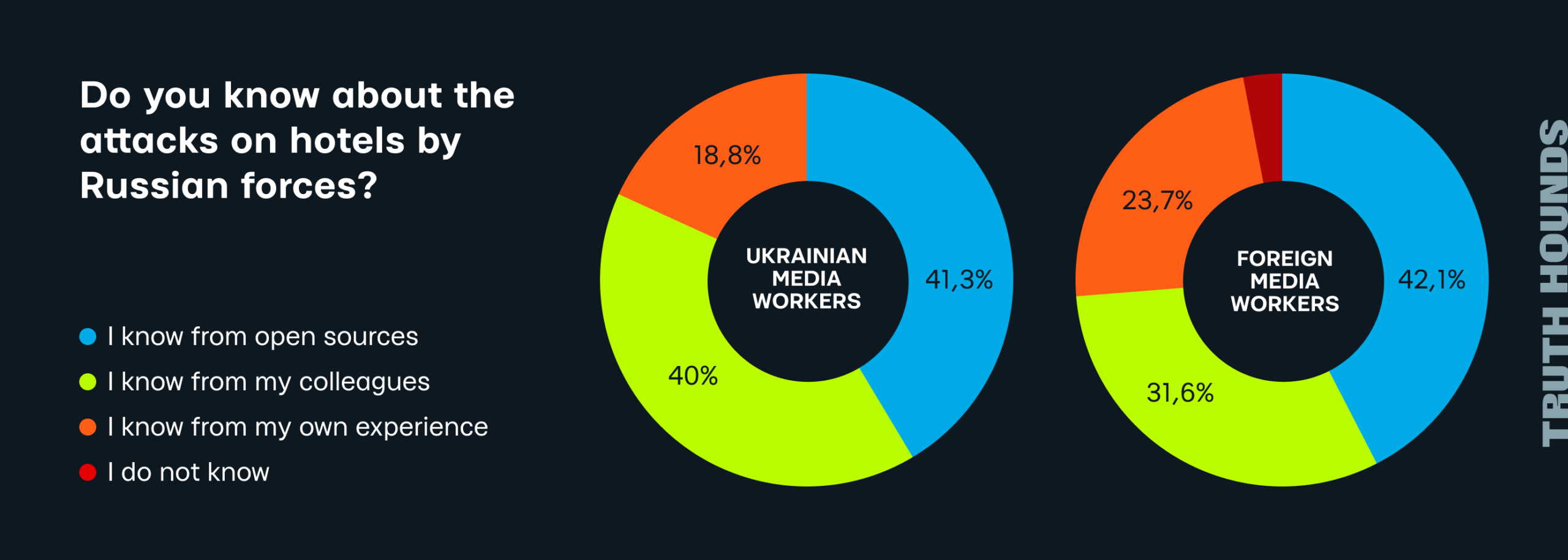
- Ukrainian respondents primarily learn about these attacks from colleagues (40%) and open sources (41%), while 19% have direct personal experience of being attacked.
- Among foreign respondents, 41% rely on open sources, 32% receive information from colleagues, and 25% have encountered these incidents firsthand.
- A majority of Ukrainian respondents (62%) have noticed changes in the frequency or intensity of these attacks in 2024. In comparison, 51% of foreign journalists report observing similar trends.
Alleged reasons for the attacks according to the respondents:
We received a total of 35 responses to this optional question.
- Of the 35 responses received, 18 said they believed that Russia seeks to intimidate journalists and discourage them from covering frontline events. One survey respondent aptly noted that Russia perceives journalists as ‘inconvenient witnesses’;
- Some respondents argue that these strikes are part of a broader strategy to hinder documentation of Russian war crimes and disrupt media coverage. Others specifically refer to the 2023 attack on the Hotel Druzhba in Pokrovsk, Donetsk Oblast, as a turning point, prompting a shift towards smaller, less visible accommodation;
- Several quote a general pattern of Russian forces targeting locations known to host journalists and international organisations, particularly in Donetsk Oblast;
- Ukrainian respondents largely attribute these attacks to Russian efforts to deter journalists, military personnel, and volunteers from staying in frontline hotels. They point out that hotels are prime targets due to their frequent use by military personnel, volunteers, and journalists;
- Foreign respondents have different explanations and express some doubts about whether these attacks specifically target journalists. Some see them as part of a broader pattern of strikes on civilian infrastructure, with hotels being affected alongside other buildings. Others note a pattern of precise strikes on known journalistic lodgings, such as the summer 2024 attack on a hotel in Kramatorsk;
- A few suggest that Russian intelligence may identify certain hotels as sites for foreign fighters or Ukrainian officers, treating journalist and NGO casualties as acceptable collateral damage. Some answered that people in occupied territories or areas affected by active hostilities may be leaking the locations of foreign journalists. Others believe that Russia no longer prioritises maintaining its international reputation, making journalist casualties less of a deterrent.
Journalists with experience covering wars in other countries noted that the dangers in Ukraine are particularly acute. The widespread use of drones, UAVs, and ballistic missiles has transformed the nature of frontline reporting, making movement highly unpredictable and complicating risk assessments. These technologies expand the scope of danger well beyond traditional combat zones. One respondent emphasised that, in Ukraine, ‘death can occur at any time and in any location’, not just on the frontline, but also in residential areas and during daily activities.
These findings indicate a growing perception among both Ukrainian and foreign journalists that hotels near the frontline are becoming unsafe.
2. New Safety Measures to Mitigate the Risks and Sustain War Reporting
The extent to which media professionals have been directly affected by attacks on hotels varies. Among Ukrainian respondents to the survey, 67% report no direct impact, 31% say their colleagues or team members have been affected, and 5% have personally suffered from such attacks.[103]
In contrast, among foreign media workers, 11% reported having been personally targeted, while 22% indicated that colleagues of theirs had been affected by similar incidents.
Ongoing attacks on hotels have affected the ability of journalists to cover the war. Among Ukrainian respondents to the TH and RSF survey, 10% reported a reduction or complete suspension of assignments to high-risk areas, while 69% cited major logistical difficulties, particularly in securing safe accommodation. Similarly, 16% of foreign journalists reported a decrease or termination of assignments in high-risk zones, and 57% highlighted logistical challenges, particularly difficulties in finding secure housing, which hinder their ability to work effectively.
Respondents specifically noted that attacks on hotels have complicated their logistical planning and worsened working conditions in areas near the conflict zone. For instance, one Ukrainian crew, having stayed at a rural hotel in the Kryvyi Rih area in November 2024, later abandoned overnight stays due to poor conditions, instead making exhausting commutes from Dnipro.
Ukrainian respondents described how multiple hotels in Kryvyi Rih where they had previously stayed were now destroyed.
Similarly, local New York Times producer Oleksandra Mykolyshyn told TH: ‘I have stayed in three hotels that no longer exist [due to Russian attacks] – “Druzhba” in Pokrovsk, “Sapphire” and “Kramatorsk” in the city of Kramatorsk.’[104]
At the time of the interview, she did not yet know that the Kharkiv Palace Hotel—where she and her team were present at the moment of the attack—also would not be restored and would remain closed, bringing the total to four.
As a result, a number of official or informal mitigation strategies were put in place:
Guidelines provided by several media outlets suggest that large hotels and accommodation close to military personnel or critical infrastructure should now be avoided. A few respondents noted the existence of ‘red lists’ of high-risk hotels compiled by media security departments. The importance of securing accommodation with bomb shelters is also frequently emphasised. For those renting private apartments, careful selection criteria include being located a significant distance (at least 500 metres) from government buildings, schools, hospitals, railway stations, and energy facilities. Many prefer smaller hotels, opting for rooms on lower floors or even in basements. Others avoid well known hotels frequented by journalists and NGOs, prioritising locations that are less conspicuous.[105]
Many journalists and media outlets have adopted stringent safety measures to mitigate potential dangers by staying under the radar. A lot of them have abandoned the practice of staying in hotels entirely, preferring to rent private apartments.[106] According to the survey respondents, private rental platforms such as Airbnb, Booking.com, or OLX[107] are therefore given preference. Nevertheless, as was noted by Anna Kaliuzhna, a Ukrainian journalist and war correspondent known for having worked at investigative media outlet Bihus.Info, the process of finding an apartment for rent is often more difficult than booking a room in a hotel.[108] In addition, some media workers rely on colleagues or even military contacts for temporary housing, while others seek accommodation in the homes of trusted local residents.[109]
Another widespread approach has been to completely avoid staying overnight in high-risk zones. One survey respondent informed us that he had been instructed to stay at least 100 km from the frontline whenever possible. Some reporters working in Kostiantynivka and Kramatorsk, both cities in Donetsk Oblast, now choose to spend their nights in Dnipro, a city in southeastern Ukraine further from the frontline.
Following the series of attacks on hotels, several media outlets introduced internal restrictions concerning the deployment of their staff to frontline-adjacent areas. In some cases, editorial offices issued complete bans on work in regions close to active hostilities. In others, while short-term assignments in such regions remain permitted, overnight stays are explicitly prohibited. These restrictions, though intended to reduce security risks, have introduced significant logistical challenges for media workers.[110]
Beyond changes in accommodation strategies, media workers have implemented their own security measures. Many avoid dining in restaurants or spending time in places where military personnel congregate, recognising these as potential targets. Some professionals emphasised the importance of blending in, avoiding any behaviour that might draw attention, such as speaking foreign languages loudly in public or displaying press credentials prominently. Additionally, measures such as limiting interactions with strangers and keeping a low profile in public spaces have become standard practice.[111] Among the collected responses, a rule of never lodging in the same place as other media teams to reduce exposure also appeared.
Media professionals noted that traditional safety measures, such as clearly marking press vehicles, can sometimes increase exposure rather than provide protection. Some journalists and local producers explained that their team’s vehicles and protective gear lack the word ‘PRESS’, as security officers explicitly prohibit such markings to avoid making journalists identifiable targets.[112] One of the survey’s respondents confirmed this tactic, explaining that some local producers have advised against wearing ‘PRESS’ patches on helmets and flak vests, as it could make journalists deliberate targets. These remarks further illustrate the possibility that journalists are intentionally singled out in the conflict.
At the same time, some media professionals have adopted contrasting strategies, underscoring the absence of a unified approach to safety among those covering the war. These include consistently marking vehicles with the word ‘PRESS’ to indicate their non-combatant status, as well as deliberately choosing to stay in hotels where other journalists are present. This choice is based on the belief that proximity to colleagues from the same profession can provide an additional layer of safety.[113]
In addition, the use of technology and social media has been adapted to enhance safety in conflict zones. Several respondents mentioned increasing coordination with security teams and maintaining constant communication with safety officers. Many now rely on Ukrainian SIM cards, deactivate tracking features, and switch their devices to airplane mode when near the frontline. Encryption and secure messaging apps, such as Signal, have become essential tools, while some limit their use of social media to avoid revealing their location.[114] Several respondents expressed interest in receiving updated training on digital security, recognising that the nature of war reporting has evolved with advances in technology.
Oleksandra Mykolyshyn, a local producer for the New York Times, said that, to further reduce risk, she and her colleagues adhere to strict operational security measures: they refrain from posting locations or photos on social media while on assignment and do not disclose details of their stories before publication. Some foreign correspondents go even further, using alternative phones and switching SIM cards, often leaving their personal devices in Kyiv to prevent potential tracking. The increased use of electronic surveillance, drones, and cyber threats has added new dimensions to risk management, making continuous adaptation a necessity for those working in the field.[115]
Security preparations differ from one media outlet to another. Some outlets have increased their reliance on security consultants who analyse risks and determine the safest locations for reporters to stay. Other international outlets hire local Ukrainian producers to bolster their security protocols. With a longer presence in the field and often more experience and contacts, they often have a sharper understanding of the danger. A security adviser for French public broadcaster Radio France, Erik Kervellec, explained that their teams covering Ukraine have been working with a local producer since the beginning of the full-scale war.[116]
He explained that ‘part of his mission is to find the safest possible accommodation’, since ‘he has a thorough knowledge of the terrain and the evolving security situation’. He adds that ‘sometimes, this means arranging for our teams to sleep in underground shelters, depending on the situation’.[117]
Oleksandra Mykolyshyn highlighted the necessity of adapting security measures in response to the growing threats confronting journalists reporting on the war in Ukraine. Initially, she travelled with reporting teams to eastern regions, including Kharkiv and Kherson, but as the security situation deteriorated, protocols became significantly stricter. According to her, journalists operating in high-risk areas, such as Sloviansk, a city in Donetsk Oblast, now require armoured vehicles, personal protective equipment against nuclear and chemical threats, bulletproof vests, first aid kits, and secure communications devices such as Starlink. They are often accompanied by security personnel.[118]
However, journalists’ approaches to security protocols and accommodation vary, with many relying on personal experience and networks rather than formal security policies. Freelancers, in particular, make independent decisions based on information from colleagues and local contacts. They also face additional challenges, as they must independently arrange their lodgings, often struggling to find hosts willing to provide the necessary documentation for official reimbursements, something shared by one of our respondents.[119]
According to observations shared by local Ukrainian producers, there appears to be a difference in how Ukrainian and international media outlets, as well as individual journalists, perceive and respond to the specific nature of the war and its evolving context.[120] This becomes particularly noticeable in their respective approaches to changing security conditions. Ukrainian outlets are generally regarded as being more flexible in recognising and addressing emerging risks, while international outlets are sometimes seen as more constrained by institutional procedures, with safety protocols that have shown limited adaptation, even as the number of hotel attacks continues to grow.[121]
[105] Based on responses to the TH and RSF survey collected between 29 January and 14 March 2025; Interview with Stanislav Kozliuk conducted by TH; Interview with Hanna Tsyhyma conducted by TH; Interview with Andrii Kovalenko conducted by TH; Interview with Jrn-23 conducted by TH.
[107] OLX (OnLine eXchange) is an online platform to buy, sell or exchange goods and services.
[109] Based on responses to the TH and RSF survey collected between 29 January and 14 March 2025; Interview with Stanislav Kozliuk conducted by TH.
[110] Interview with Violetta Pedorych conducted by TH.
[111] Based on responses to the TH and RSF survey collected between 29 January and 14 March 2025; Interview with Stanislav Kozliuk conducted by TH.
[112] Interview with Oleksandra Mykolyshyn conducted by TH; Interview with Stanislav Kozliuk conducted by TH.
[113] Interview with Bkf-24 conducted by TH.
[114] Based on responses to the TH and RSF survey collected between 29 January and 14 March 2025; Interview with Stanislav Kozliuk conducted by TH; Interview with Oleksandra Mykolyshyn conducted by TH; Interview with Jrn-23 conducted by TH.
[115] Interview with Oleksandra Mykolyshyn conducted by TH.
[116] Interview with Erik Kervellec conducted by RSF.
[118] Interview with Oleksandra Mykolyshyn conducted by TH.
[119] Based on responses to the TH and RSF survey collected between 29 January and 14 March 2025.
[120] Interview with Jrn-23 conducted by TH; Interview with Stanislav Kozliuk conducted by TH.
[121] Interview with Jrn-23 conducted by TH.
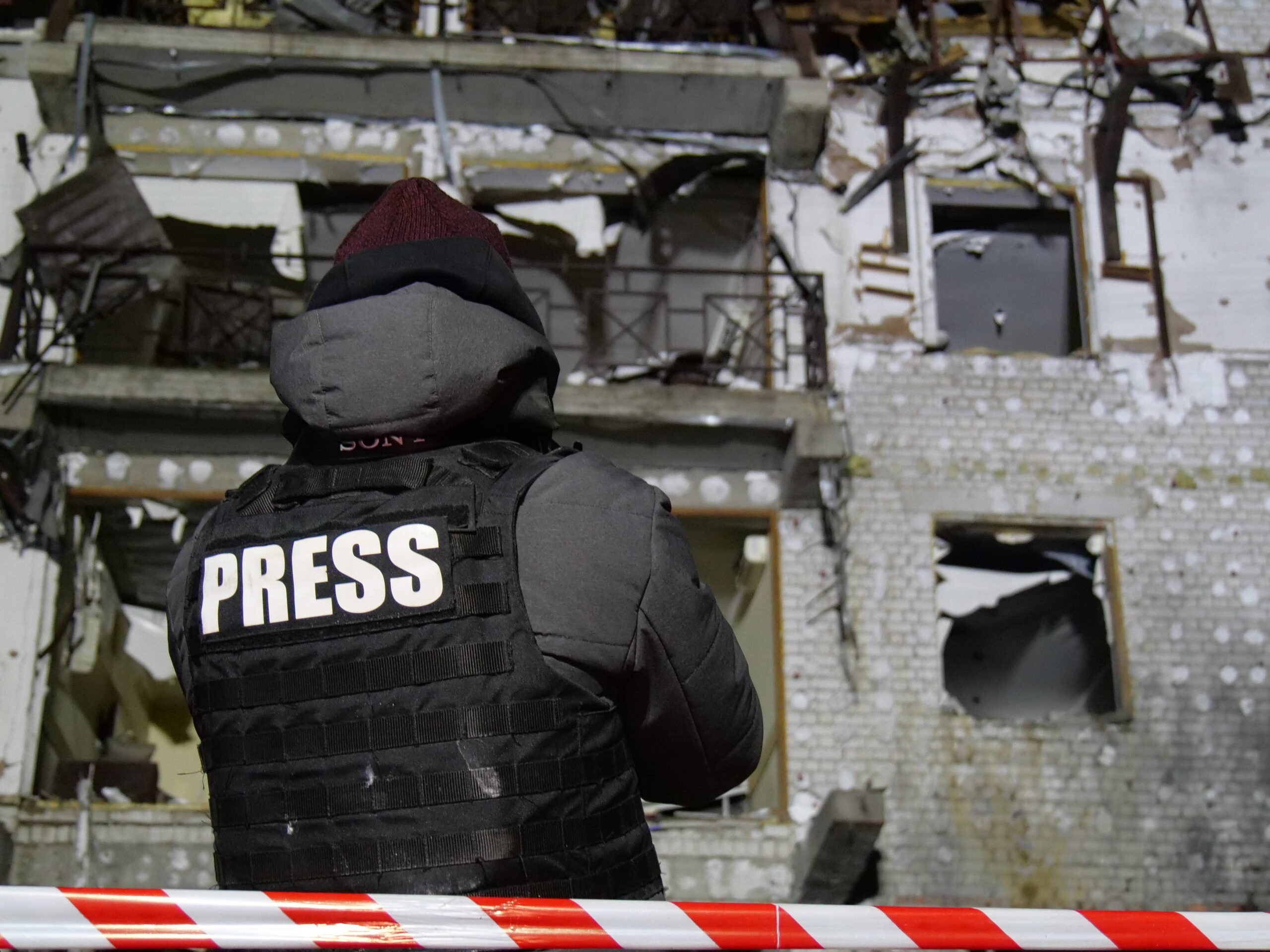
A journalist in front of the Park Hotel, damaged in the January 10, 2024 attack
Photo: Kharkiv Journalists’ Solidarity Center
3. Psychological Effects of These Attacks
Maintaining mental health is essential for media professionals to effectively carry out their work. However, for those covering the war in Ukraine, this has become increasingly challenging, particularly for individuals who have experienced direct attacks or have come to the realisation that they, along with their colleagues, are now among the actively targeted groups.
According to the TH and RSF survey, 52% of Ukrainian respondents highlighted the psychological consequences, mentioning heightened stress levels and emotional trauma caused by the constant threat of being attacked. Among foreign respondents, 35% reported psychological stress and emotional trauma as major consequences of their work under these conditions. These pressures affect journalists’ ability to work effectively, further complicating an already high-risk environment. The persistent psychological strain experienced by media professionals also serves as an additional form of intimidation, potentially deterring them from travelling to or operating near frontline areas.
Among the interviews collected by TH, the experience of one Ukrainian media worker illustrates the lasting psychological impact of missile strikes on hotels. Having covered the war since the early months of the full-scale invasion, she was injured during a missile strike on a hotel used by journalists. Her injuries required hospitalisation for ten days, including five days during which she was unable to walk. While the physical wounds eventually healed, the psychological consequences have proven far more persistent.[122]
She continues to experience phantom pain and vivid sensory flashbacks, recalling the moment of impact, the weight of the debris, the smell of dust, and the fear of being buried under rubble. ‘It’s like a flash in front of my eyes — the pain, crawling on the ground, the smell of dust, the struggle to breathe’, she recounted.[123]
Since the incident, she has actively limited her exposure to risk, avoiding travel outside the capital and distancing herself from field assignments; a marked departure from her prior work. She noted that she had ‘never felt fear like this before’. Her case demonstrates how such attacks can produce long-term psychological harm that not only affects wellbeing but also diminishes professional engagement and the sense of safety in the field.[124]
For some journalists, attacks on hotels have led to a temporary suspension of travel to frontline areas due to psychological factors, with trips even to cities located relatively far from the front increasingly accompanied by an intensified sense of danger.[125] At the same time, there are journalists who continued to travel despite growing fears, feeling that they could not afford to show vulnerability in a highly competitive professional environment. Nonetheless, for many, professional motivation continues to serve as a primary driving force, enabling them to carry on with their work despite the heightened risks.
Overall, the combination of psychological pressure, logistical challenges, and security threats has made war reporting in Ukraine highly difficult. In response, media professionals have been forced to adopt extensive precautionary measures, fundamentally reshaping their work routines in order to continue documenting the war while minimising risks to their personal safety.
Section Three
III. Frequent Narratives Used by Russia to Justify Attacks on Hotels and Intimidate Journalists
As demonstrated in the preceding sections of this report, Russian attacks on hotels display clear indicators of intentionality and a systemic character. Strikes have been carried out regardless of whether hotels were fully occupied by military personnel, hosted only a small number of servicemen among civilian guests, had explicitly refused to accommodate military personnel, or were not operational at the time of the attack. Moreover, these attacks have continued despite the fact that the primary victims are civilians—most notably, journalists, humanitarian workers, and other non-combatants. This consistent pattern underscores the need to examine the underlying motives behind such attacks. A critical element in this inquiry is the analysis of official narratives promoted by the Russian state, as well as the information disseminated through Russian media outlets and Telegram channels, which offer insights into the underlying intentions behind these strikes. This focus on analysing messages in Russian media and Telegram channels is warranted by their close affiliation with state authorities and their alignment with official state narratives (See Annex IV).
1. Russian Ministry of Defence Narratives Regarding Hotel Attacks
To gain further insight into the official justifications for Russian strikes on hotels, several illustrative examples of statements issued by the Russian Ministry of Defence are given below. These examples were identified through targeted keyword searches conducted within the ministry’s official Telegram channel and Russian popular media.
For instance, following the strike on the Hotel Druzhba in Pokrovsk on 7 August 2023, the Russian Ministry of Defence claimed to have destroyed the command post of the Khortytsia Operational-Strategic Group of Ukrainian Ground Forces.[126] Three days later, when two cruise missiles hit the Hotel Reikartz in Zaporizhzhia,[127] the Ministry stated that the strike targeted a temporary base of ‘foreign mercenaries’.[128] As was outlined above, following an on-site investigation and interviews with eyewitnesses, TH documenters collected evidence that directly contradicts these claims.[129]
Similarly, on 31 December 2023, the Russian Ministry of Defence reported a strike on the Kharkiv Palace Hotel, asserting that it had killed ‘representatives of the Defence Intelligence of Ukraine (DIU) and the Armed Forces of Ukraine (AFU), who were directly involved in the planning and execution of the terrorist attack in Belgorod’, a city in southwestern Russia.[130] The ministry also stated that ‘up to two hundred foreign mercenaries were present at the site’.[131] However, witnesses interviewed by TH confirmed that the hotel was functioning normally on the day of the strike, with at least twelve rooms occupied by guests and staff. According to their statements, no military personnel were present there during or prior to the attack.[132]
The information gathered by documenters also refutes the Russian authorities’ claims that a base of ‘foreign mercenaries’ from the American ‘Academi’ PMC had been destroyed in the ‘Kramatorsk area’, in a statement issued immediately after the strike on the Hotel Kramatorsk on the night of 18 September 2022.[133] As previously noted, at the time of the attack, the hotel was in reality occupied exclusively by civilians.
The Russian Ministry of Defence rarely issues official comments following attacks on hotels. When such explanations are provided, they typically frame the strikes as legitimate military actions by asserting that the targeted hotels were used by Ukrainian armed forces, intelligence personnel, or foreign mercenaries. These claims tend to follow two recurring narratives aimed at justifying the attacks and portraying the sites as valid military objectives.
However, certain statements by the Russian Ministry of Defence offer deeper insight into why hotels may be selected as targets. A particularly illustrative example relevant to this study is the statement issued on 5 February 2023 by the Interdepartmental Coordination Headquarters for Humanitarian Response, a body operating under the Russian Ministry of Defence, and published on the ministry’s official Telegram channel.[134] The statement claimed that Ukrainian special services were preparing to stage explosions at a local narcological dispensary, oncology clinic, and city hospital in order to ‘accuse Russia of committing “war crimes”’.[135] According to this narrative, journalists from Western media outlets had been staying at the Hotel Sapphire in Kramatorsk under the supervision of the Security Service of Ukraine, with the purpose of documenting these staged incidents and using them to support calls for increased Western arms deliveries to Ukraine, particularly, long-range missile systems.[136]
Nearly eighteen months later, on 24 August 2024, the Russian Armed Forces struck the same Hotel Sapphire, which, since the beginning of the full-scale invasion, had operated exclusively as accommodation for international journalists. At the time of the attack, a Reuters team was staying at the hotel.[137] This example is particularly revealing, as it indicates that Russian authorities were fully aware of the hotel’s civilian function and its use by international journalists—although not, as suggested by the Russian Ministry, to document staged crimes. It also highlights how independent media outlets, especially foreign, are portrayed in Russian official rhetoric not as impartial observers, but as actors engaged in information warfare, whose reporting is presumed to serve as a tool for discrediting Russia and fabricating evidence of its crimes.
[129] See Sections I.1.a and I.1.c of this report.
[132] Interview with Oleksandra Mykolyshyn conducted by TH; Interview with Uip-58 conducted by TH.
2. Analysis of Comments from Russian Sources and Telegram Channels
Commentary from Russian media, military bloggers, and anonymous Telegram channels provides additional insight into the narratives used to justify strikes on hotels. In line with official messaging from the Russian Ministry of Defence, these sources typically seek to reframe the targeted hotels as lawful military objectives, relying on one of two recurring justifications—either that the hotels were housing Ukrainian military personnel or that they were being used by foreign military personnel, most frequently referred to as ‘foreign mercenaries’. In some cases, both explanations appear simultaneously, reinforcing the portrayal of hotels as legitimate targets.
For the purposes of this research, analysts from the AI-powered platform Osavul conducted an analysis of Russian-language Telegram content covering strikes on Ukrainian hotels between 30 December 2023, and 19 March 2025. Researchers analysed 12,500 Telegram mentions based on keywords such as ‘hotel’ combined with the names of cities where strikes occurred.[138] The timeframe analysed for each incident was limited to the first week following the strike. In addition to this keyword-based analysis, a targeted sample of 35 influential Russian Telegram sources was compiled and divided into four categories: federal media, military bloggers, top pro-Kremlin commentators, and anonymous channels.[139]
Both the broader keyword-based analysis and the focused review of the selected source groups revealed a consistent pattern: the overwhelming majority of Telegram posts disseminated claims suggesting that the targeted hotels were legitimate military objectives. The most frequently cited justification across these narratives was the alleged presence of foreign mercenaries or instructors. This was followed by assertions that the hotels served as temporary deployment sites for the Ukrainian Defence Forces.
Notably, there were no significant differences in how the hotel attacks were covered across the different categories of Telegram channels. This indicates a certain alignment between the narratives promoted by the Russian Ministry of Defence and those circulating in the media and across various Telegram channels.
In addition to the notable overlaps in presenting versions of events, certain rhetorical formulas visible in some Telegram posts reveal additional layers in the portrayal of these attacks, further deepening and expanding the picture that emerges from the analysis of official statements by the Russian Ministry of Defence.
A particularly prominent focus in these narratives is placed on foreign journalists, through which they are conflated with military mercenaries.[140] This is coupled with a deliberate distinction between these groups and the local civilian population. Within this narrative framework, foreign journalists are not perceived as civilians but rather as legitimate targets akin to enemy combatants. In many instances, a distinction between foreign mercenaries and journalists is not maintained. Instead, journalists affected by attacks are promptly labeled as ‘mercenaries’ and targeted hotels are depicted as their ‘operational bases’.
For instance, in response to the attack on the Park Hotel in Kharkiv, the pro-government Telegram channel Zapiski Veterana (‘Veteran’s Notes’),[141] denied that the injured Turkish and Georgian citizens were journalists, instead labeling them as ‘mercenaries’.[142] Similarly, Russian popular military blogger Aleksandr Sladkov claimed on his Telegram channel[143] that 80 French mercenaries were killed in the hotel strike.[144] These assertions were promptly refuted by Turkey’s Anadolu news agency, which confirmed that its journalists were present in the hotel at the time of the strike and that no military personnel were on site.[145] This was further corroborated by Violetta Pedorych, a local producer for France 2, who was staying at the hotel with a French media team and was later interviewed by TH.[146]
Zapiski Veterana went even further, asserting that those affected by the strike were being falsely portrayed as journalists. The post concluded with a warning addressed to foreigners allegedly operating in Ukraine under the guise of security consultants, journalists, medics, or humanitarian workers, urging them to leave the country permanently—otherwise, the message stated, ‘you will be taken away in pieces’.[147]
Another prevalent rhetorical tactic observed in the content analysed is a blurring of the distinction between journalists and combatants, therefore framing media workers as legitimate military targets rather than protected civilians. For example, military blogger Sergey Lebedev,[148] drawing a clear distinction between journalists and civilians.[149]
A similar approach could be observed following the missile strike on the city of Druzhkivka, Donetsk Oblast, on 2 January 2023. While the primary target of the attack appeared to be nearby railway infrastructure, which may constitute a lawful military objective, the strike also caused damage to the MAN Hotel located close to the site. Although this incident is not classified in the report as a direct attack on a hotel, it remains particularly relevant because the presence of foreign journalists among those affected triggered a series of illustrative reactions across Russian Telegram channels.
For example, the Telegram channel Donbas Reshaet (‘Donbas Decides’)[150] alleged that the hotel ‘is used by foreign mercenaries and journalists, the difference between which is almost erased’. [151] The post also mentioned that the attack was confirmed by journalists ‘from the most “yellow” German weekly Bild’.[152] The word ‘yellow’ here indicates the author’s disdain for the Bild journalists.
Notably, even when strikes on hotels known to accommodate journalists did not result in journalist casualties or injuries, the narrative framing these locations as bases for foreign mercenaries persisted, indicating a deliberate disinformation strategy by Russia. Indeed, our research shows that almost all of the investigated attacks on hotels in Kryvyi Rih were accompanied by baseless narratives claiming that the hotels were hosting foreign mercenaries or instructors.[153] This is despite witness testimonies collected by TH directly refuting such claims and reporting, instead, that there were no military personnel or, at least, no significant number of them, nor military equipment or installations in or around the hotels on the days of the attacks.[154] Osavul’s analysis identified 760 posts published in the aftermath of the strike on the Arena Hotel alone, in which Russian Telegram channels framed the attack either as a strike on the headquarters of the 8th Special Operations Forces Regiment or as the elimination of 250 foreign mercenaries, allegedly including French and Romanian air defence specialists.[155] The two most recent attacks on hotels in Kryvyi Rih in March 2025 were no exception to this rhetoric, with claims of Ukrainian and foreign military personnel being present at the sites, despite a lack of evidence.[156] Narratives that surfaced in the Russian media and Russian Telegram channels included that 28 French mercenaries were killed,[157] that the building was occupied by instructors from NATO countries,[158] and that officers of the Armed Forces of Ukraine, members of the Main Intelligence Directorate of the Ukrainian Defence Ministry, and foreign military instructors had checked into the hotel.[159]
Answers from journalists and media workers surveyed by TH and RSF confirmed the above analysis, as many of them described how Russian narratives systematically attempt to justify attacks on hotels by portraying them as military targets rather than civilian spaces. They corroborate our emphasis on a common narrative claiming that these hotels harbour ‘mercenaries’ or ‘military advisers’ instead of independent journalists.[160] These insights illustrate how Russian rhetoric not only seeks to discredit journalists but also fosters an environment where violence and repression against them can be framed as legitimate actions.
[138] ‘Отель’ and ‘гостиница’ in Russian
3. Russian Rhetoric Justifying its Attack on Kramatorsk Resulting in the Killing of a Media Professional
One of the most significant disinformation campaigns by Russian commentators related to the missile attack on the Hotel Sapphire in Kramatorsk on 24 August 2024, which killed Ryan Evans, a safety adviser for Reuters, and injured other civilians.[161]
Commenting on the death of Ryan Evans, Kremlin Spokesperson Dmitry Peskov said: ‘I read information from the agency staff that he was not a journalist, but some kind of safety adviser. So, there is no clarity here yet. I repeat once again: strikes are carried out on military infrastructure or facilities in one way or another related to military infrastructure.’[162] With this comment, Peskov attempted to create a basis to legally justify the strike by implying an association between Reuters’ safety adviser and combatants, an approach similar to the one described earlier.
Additionally, Russian Foreign Ministry spokesperson Maria Zakharova labeled Ryan Evans as a former agent of MI6—a common name for the United Kingdom’s foreign intelligence service—offering no supporting evidence for the claim.[163] This claim was later refuted by Reuters and by Ryan’s father, David Evans.[164]
The prominent pro-Kremlin Telegram channel Dva Mayora (‘Two Majors’),[165] stressed that the ‘eliminated’ Ryan Evans previously served in the British Army.[166] The same post emphasised that Ukrainian Reuters journalist Ivan Lubysh-Kirdey, ‘has been repeatedly awarded state honours of Ukraine and participated in the 2014 “coup d’état”’.[167] Highlighting such biographical details is intended to convince the audience that this Reuters staff member could have been involved in military activities.
On 26 August 2024, Ukrainian independent journalist Denys Kazansky drew attention to another post from the Dva Mayora Telegram channel, which justified the missile strike by claiming that the media workers had ‘illegally crossed Russia’s state border’, referring to their presence in Donetsk Oblast.[168] According to Kazansky, this statement indicates that the attack was deliberate, noting that ‘no one is even trying to pretend that the attack on the Reuters journalists was an accident’. He further described Dva Mayora as a ‘mouthpiece of the Russian Ministry of Defence’, underscoring the channel’s alignment with official Russian military narratives.[169]
That same day, the channel ‘Dva Mayora’ published a post issuing a death threat to Romanian journalist Mircea Barbu, after he reported from Russia’s Kursk Oblast, part of which was occupied by Ukrainian forces during the summer offensive of 2024. The authors argued that ‘criminal cases [against journalists crossing the borders][170] are no longer as effective as Iskander missile defense systems or FAB-500s with the UMPK’ (from Russian, ‘Unified Gliding and Correction Module’). Here, the post refers to the attacks on the Reuters team, using the case of Ryan Evans’ death as a form of deterrence to scare journalists. The post continues, stating that the Reuters ‘journalists’ ‘who strayed into the Donetsk People’s Republic last week have already appreciated the effect of the inevitability of punishment’.[171] Therefore, the attack on Kramartorsk is justified as a stark warning to foreign journalists of the risks of reporting on the conflict, with comments from Dva Mayora such as: ‘the arrogant representatives of the Western world have been shown the principle of the inevitability of punishment in action.’[172]
Despite deliberately blurring the line between foreign journalists and military personnel, the authors of these publications still acknowledge that journalists were among the victims. This contradiction serves a dual purpose. On the one hand, it helps maintain the illusion that the attack was justified by framing the victims as individuals with military ties. On the other, it sends a clear message of intimidation: foreign journalists covering the invasion risk becoming targets. The deaths of journalists killed by Russian weaponry are exploited to underscore the risks of reporting on the war.
TH and RSF have documented the attack on the Hotel Sapphire in Kramatorsk, identifying potential perpetrators involved in the strike as part of our investigation. The findings of this analysis are detailed in the following section of this report.
Section four
IV. Case Study of the Attack on the Hotel Sapphire, Kramatorsk
1. The Circumstances of the Attack
The missile strike on the Hotel Sapphire in Kramatorsk on 24 August 2024 is among the cases documented in which media professionals were directly affected.[173] According to the hotel’s owner, Yuriy Aliyev, since the beginning of Russia’s full-scale invasion in February 2022, the establishment had operated exclusively for media teams and only at the discretion of its management.[174]
The regular presence of journalists was confirmed by a resident of a neighbouring apartment building who told TH: ‘After the full-scale invasion began, in the hotel car park, I sometimes saw cars marked “PRESS” and journalists wearing blue helmets and bulletproof vests with “PRESS” written on them.’[175]
At approximately 10:30 pm on 24 August 2024,[176] the Hotel Sapphire was struck by a Russian 9M723 ballistic missile.[177] At the time of the attack, six members of a Reuters team were staying at the hotel. The strike resulted in the death of Ryan Evans, a British citizen and Reuters safety adviser, and injuries to at least nine other people.
[175] Interview with Ktk-52 conducted by TH.
[176] Interview with Ktk-51 conducted by TH.
[177] Conflicting information exists regarding the exact time of the attack. During a field mission to Kramatorsk, TH documenters obtained CCTV footage capturing the moment the Hotel Sapphire was struck. The timestamp on the footage indicates that the attack occurred at 10:30 pm, whereas official sources report the time of the strike as 10:35 pm. According to the witness who provided the footage, the CCTV system is not connected to the Internet and must be set manually. This is the most likely explanation for the discrepancy between the recorded and officially reported time.
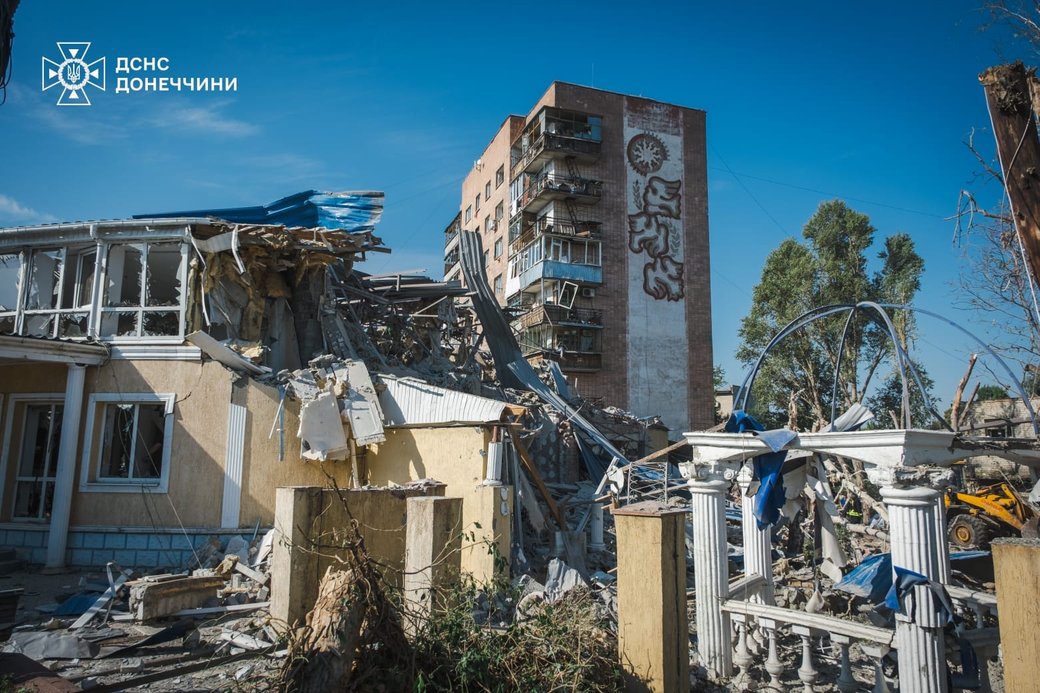
The destruction of the Sapphire Hotel in Kramatorsk
Photo: State Emergency Service of Ukraine
Among the wounded were two members of the Reuters team, who were subsequently hospitalised: American journalist Dan Peleschuk and Ukrainian cameraman Ivan Lyubysh-Kirdey. The latter, who was on the same floor as Ryan Evans, was seriously injured and sustained a traumatic brain injury. Other members of the Reuters team sustained various injuries but were able to evacuate the building through different exits.[178] On the day of the attack, the Reuters team included citizens of the United States, United Kingdom, Germany, Latvia, and Ukraine.[179]
Moreover, several other individuals sustained injuries in the strike, including a Ukrainian soldier, a civilian watchman, and a nearby resident.[180] The soldier, who was not staying at the hotel, was walking along the street next to the building at the moment of impact. Polish volunteer Monika Andruszewska also sustained injuries while traveling by car in the vicinity of the hotel at the time of the attack.[181]
According to an investigation conducted by Reuters, Ryan Evans was staying in a room situated in the northwestern section of the hotel—the area assessed to be the point of impact.[182] The building had a total of 12 rooms, all located on the second floor.[183] Open-source footage documents the aftermath of the strike, showing that both the second and first floors on the side of the building where the missile struck collapsed as a result of the explosion.[184]
In addition to the destruction of the Hotel Sapphire, the attack caused damage to 17 private houses, six multi-storey residential buildings, four businesses, and one administrative building.[185]
Several witnesses reported that there were no military personnel or military equipment near the hotel prior to nor at the moment of the attack.[186] Despite the absence of a military presence, the hotel became a target.
2. Alleged Perpetrators of the Attack
Russian forces in Ukraine are under the strategic command of the United Group of Russian Forces in Ukraine, which is subdivided into smaller operational groupings, each responsible for certain sections of the frontline (Sever, Zapad, Tsentr, Yug, Vostok, and Dniepr). Each of these groupings consists of regular combined arms armies and army corps, often incorporating missile brigades equipped with Iskander systems.
In the case of 9M723 missile launches, the decision to conduct a strike may be made either by the headquarters of a specific Russian grouping of forces or by the United Group of Russian Forces in Ukraine. This depends on several factors, including the location, characteristics, and assessed importance of the intended target.[187]
Groupings of forces are most likely to be responsible for planning and executing strikes against targets of tactical or operational significance within their designated areas of responsibility. Typical targets in such cases include aircraft and helicopters,[188] air defence systems,[189] concentrations of military personnel,[190] and other types of high-value military equipment.[191] These targets are commonly identified through reconnaissance assets, including UAVs, or via agent-based intelligence. The timeframe between target identification and missile launch in these instances generally does not exceed 20 minutes.[192]
However, in certain cases, the decision to employ a 9M723 missile may be taken at the level of the United Group of Russian Forces in Ukraine. Indicators of such centralised decisionmaking include the situating of a target deep in the rear—beyond the immediate operational zone of individual groupings—as well as the nature of the object itself. These may include command posts, ammunition depots, or other fixed infrastructure.[193]
Several factors support the conclusion that the order to strike the Hotel Sapphire most likely originated from the United Group of Russian Forces in Ukraine. First, the characteristics of the hotel as a target align more closely with those typically selected for engagement by the United Group of Russian Forces in Ukraine, rather than with the types of targets usually prioritised by local groupings of forces. Second, striking this particular target provided no operational or tactical advantage to the Yug grouping of forces, which was responsible for this section of the frontline. Finally, when viewed within the broader pattern of strikes on hotels, the attack appears consistent with what is commonly referred to as a strike on a ‘pre-approved target’—a category of objectives typically selected and authorised at the level of the United Group of Russian Forces in Ukraine.
As such, the United Group of Russian Forces in Ukraine, led by Army General Valery Gerasimov, with Colonel General Alexei Kim and Army General Oleg Salyukov as his deputies,[194] was most likely responsible for the attack on Kramatorsk on 24 August 2024. This assessment is consistent with the conclusions reached by Ukrainian investigators. On 20 December 2024, the Security Service of Ukraine announced that it had gathered sufficient evidence to charge Colonel General Alexei Kim with committing a war crime by ordering the strike on civilian infrastructure in Kramatorsk.[195]
The Security Service of Ukraine emphasised that the purpose of the strike was to destroy a building exclusively occupied by civilians, including journalists; an act that constitutes a clear violation of international humanitarian law, which prohibits attacks on objects not serving a military purpose.[196] As a result, Colonel General Alexei Kim has been charged under the Criminal Code of Ukraine; Part 2 of Article 28, Part 2 of Article 437 (Waging an aggressive war), and Part 2 of Article 438 (Violation of the laws and customs of war). In a separate 15-page notice of suspicion, the Security Service of Ukraine detailed the findings of its investigation, stating that the missile strike was carried out ‘with the motive of deliberately killing employees of the international news agency Reuters who were engaged in journalistic activities in Ukraine’.[197] The document, released on the website of the Office of the Prosecutor General, revealed that Kim had received intelligence indicating that Reuters staff were staying in Kramatorsk. It further noted that Kim would have been ‘fully aware that the individuals were civilians and not participating in the armed conflict’.[198]
Reuters, citing Ukrainian intelligence sources, reported that the missile was launched from Russia’s Rostov Oblast.[199] At least three different missile brigades regularly conduct strikes on Ukrainian territory from this area: the 1st Missile Brigade of the 49th Combined Arms Army, the 47th Missile Brigade of the 8th Combined Arms Army, and the 107th Missile Brigade of the 35th Combined Arms Army.[200] Since the strike was, in all likelihood, ordered at the level of the United Group of Russian Forces in Ukraine, any of these brigades could have executed it, irrespective of whether the larger formation to which they belong was actively engaged in operations along that section of the frontline. In the absence of verifiable intelligence from the ground, it remains impossible to identify the specific unit responsible.
In order to avoid compromising the official investigation, not all analytical data and supplementary information collected in the course of this case are disclosed in this report. All relevant materials have been submitted to the competent investigative authorities.
Section five
V. The Attacks on Hotels are War Crimes
Under IHL and international criminal law (ICL), attacks on hotels accommodating civilians, including journalists and humanitarian workers, may constitute grave breaches and war crimes, respectively.
The following criminal classifications are provided for illustrative purposes only. They are without prejudice to any alternative or additional legal characterisations that may be adopted by national courts, international courts, or tribunals exercising jurisdiction over the acts described.
1. The War Crime of Intentional Attacks on Civilians and Civilian Objects
The cardinal rule of IHL is that attacks may only be directed against military objectives. Intentionally directing an attack against civilians or civilian objects is therefore prohibited by both custom and convention.
As such, the Rome Statute of the International Criminal Court of 17 July 1998 defines war crimes as ‘grave breaches of the Geneva Conventions of 12 August 1949’ [201] and ‘other serious violations of the laws and customs applicable in international armed conflict, within the established framework of international law’ [202] and specifically refers to the following as war crimes:
- ‘Intentionally directing attacks against the civilian population as such or against individual civilians not taking direct part in hostilities’ (Article 8(2)(b)(i));
- ‘Intentionally directing attacks against civilian objects, that is, objects which are not military objectives’ (Article 8(2)(b)(ii)); and
- ‘Attacking or bombarding, by whatever means, […] buildings which are undefended and which are not military objectives’ (Article 8(2)(b)(v)).
In this context, the repeated strikes on hotels known to be used predominantly by civilians—journalists, humanitarian workers, displaced persons, and others—may meet the legal standard of these war crimes. The pattern revealed by this report suggests not merely incidental harm but deliberate targeting, further reinforcing the serious nature of the alleged IHL violations.
Journalists, humanitarian workers, and other civilians staying in hotels are protected under IHL. In particular, Additional Protocol I to the Geneva Conventions (AP I) clarifies that journalists working in war zones retain their civilian status and protection ‘provided that they take no action adversely affecting their status as civilians’.[203]
Following the attacks, the Russian Ministry of Defence has occasionally sought to justify hotel strikes by groundlessly alleging the presence of Ukrainian armed forces, intelligence operatives, or foreign mercenaries.[204] In the case of the Hotel Sapphire, however, well before the attack, the Ministry acknowledged the presence of journalists but alleged their coordination with the Security Service of Ukraine to stage events for media coverage aimed at influencing Western military support.[205] However, under IHL, such claims do not affect the civilian status of journalists. There is no ‘intermediate category’ of persons under IHL; individuals are either combatants, who may be lawfully targeted, or civilians, who are protected from direct attack unless—and only for such time as—they directly participate in hostilities.[206] No evidence suggests that the journalists, humanitarian workers or other civilians present in the hotels engaged in such conduct. On the contrary, the available information confirms they were carrying out professional tasks explicitly protected under IHL.
Even assuming the accuracy of the Russian allegations, media activity, including politically charged or advocacy-driven reporting, does not constitute direct participation in hostilities.[207] When differentiating between ‘direct’ and ‘indirect’ participation in hostilities, the International Committee of the Red Cross’s (ICRC’s) Interpretive Guidance on the Notion of Direct Participation in Hostilities emphasised that general war-sustaining activities—such as ‘political, economic or media activities supporting the general war effort (e.g., political propaganda)’—do not meet the required threshold.[208] Similarly, it is affirmed that direct participation is neither synonymous with ‘involvement in’ or ‘contribution to’ hostilities, nor with ‘preparing’ or ‘enabling’ someone else to directly participate in hostilities, but essentially means that an individual is personally carrying out hostile acts which are ‘part of’ the hostilities.[209]
Accordingly, the journalists present at the Hotel Sapphire retained full civilian protection under IHL. The Russian authorities’ awareness of their civilian function, coupled with the decision to target the location nonetheless, supports the conclusion that the strike was both unlawful and deliberate.
As to the nature of the objects targeted, civilian objects are defined negatively; they are all objects which are not military objectives, as established by Article 52(1) of AP I.[210] By contrast, military objectives, under Article 52(2) of AP I, are limited to those objects which, ‘by their nature, location, purpose, or use’, make an effective contribution to military action and whose total or partial destruction, capture, or neutralisation, under the circumstances ruling at the time, offers a definite military advantage.[211] This definition sets a two-pronged test that must be satisfied cumulatively—both contribution and advantage.
In practice, particularly in urban warfare, it is not uncommon for civilian structures to lose their protection and become military objectives due to their use by armed forces.[212] For instance, when combat takes place within a city, buildings may be used for storing weapons, coordinating operations, or launching attacks. In such situations, the building itself becomes integrated into military operations and thus meets the criteria of a military objective. However, any such determination must be made with great care and remain subject to the principle of proportionality; attacks must not cause excessive incidental civilian harm in relation to the concrete and direct military advantage anticipated.[213]
In contrast, outside active combat zones, the threshold for lawfully targeting an originally civilian structure is presumably higher.[214] The military character of any object must be clearly established through credible and reasonable verification and the spatial boundaries of the target precisely identified.[215] In the absence of conclusive evidence, the object must be presumed to be civilian, a presumption explicitly spelled out in Article 52(3) of AP I.[216]
Critically, the mere presence of individuals who are lawful targets, such as combatants, members of organised armed groups, or civilians directly participating in hostilities, does not by itself convert a civilian object into a military objective.[217] For a structure such as a hotel, shop, or government office to lawfully lose its protected status, it must be shown that the individuals present are actively using the structure for military purposes, for example, as a command centre, logistical hub, sniper position, or weapons cache.[218] Absent such use, the building remains a civilian object and an attack on it would be unlawful.
The available evidence on the 24 hotels targeted across different locations in Ukraine[219] demonstrates that these hotels retained their status as civilian objects at the time of the attacks. Except for the single incident involving the Profspilkovyi Hotel in Chernihiv, none of the hotels were shown to have been effectively used for military purposes and there was no substantiated evidence to suggest that they had lost their civilian character. In the absence of credible and reasonable verification establishing a transformation of these hotels into military objectives, they must be presumed to have been civilian objects protected against attack. The following analysis of the Hotel Avrora and the Hotel Sapphire incidents provides more detailed illustrations of these principles.
Regarding the Hotel Avrora attack, Kryvyi Rih, where the hotel was located, is approximately 70 km from the nearest section of the frontline, placing it outside the active combat zone. This geographical context reinforces the necessity of strict verification before any targeting decision is made. Moreover, the mere presence of off-duty servicemen within a civilian object does not in itself render that object a military objective. There were no reasonable grounds to believe, nor any evidence to suggest, that the Hotel Avrora was being used for military purposes.[220] The servicemen in question were present in their private capacity, often accompanied by their partners, and there are no indications that the building had lost its civilian status.[221]
As for the Hotel Sapphire attack, the facts raise even deeper legal concerns. While it was situated somewhat closer to the front, with the nearest reported clashes taking place approximately 25 km from Kramatorsk on the day of the strike,[222] the hotel was still located well outside of any active combat zone.
Consequently, the targeting threshold remained high and any lawful attack required credible and reasonable verification of the hotel’s military use. However, the evidence gathered indicates that there were no servicemen present in the hotel at the time of the strike and no military use of the building has been substantiated.[223] Only one soldier, who was injured in the attack, was reportedly located near the hotel, not inside it.
Russian authorities, notably Kremlin spokesperson Dmitry Peskov, have not claimed that the hotel itself was used for military purposes. Instead, attempts to justify the attack have focused on casting doubt on the civilian status of individual victims, particularly media professionals.[224] This line of argument was further amplified by Russian Telegram channels such as Dva Mayora, which emphasised the prior military experience of Ryan Evans, who was a former British serviceman.[225]
Assuming that the individuals concerned, particularly journalists, all had previous military experience, this does not affect their civilian status at the time of the strike. The notion of a combatant applies only to those who are currently members of armed forces.[226] Once a person is discharged, retires, or otherwise ceases to serve, they revert to civilian status and regain full protection against direct attack.[227]
In conclusion, the pattern of attacks on hotels across Ukraine, including but not limited to the Hotel Sapphire, fails to meet the legal criteria under IHL for the targeting of military objectives. These hotels were not located on or nearby the frontline and in none of the analysed incidents[228] was there substantiated evidence of military use that could justify their classification as military objectives. In the absence of such evidence and given the clear civilian character and predominant use of these facilities, no valid claim has been made that could lawfully override the presumption of civilian protection. As such, these strikes appear to qualify as the war crime of intentionally attacking civilians and civilian objects.
[201] Rome Statute of the International Criminal Court of 17 July 1998, Article 8(a).
[202] Ibid., Article 8(b).
[203] Protocol Additional to the Geneva Conventions of 12 August 1949, and relating to the Protection of Victims of International Armed Conflicts (Protocol I), 8 June 1977, Article 79(2).
[204] See Section III of this Report.
[205] See Section III.1 of this Report.
[206] Protocol I, Article 50(1), Article 51(2,3).
[207] See ICRC, Interpretive Guidance on the Notion of Direct Participation in Hostilities, pages 51-52 on differentiating between direct and indirect participation in hostilities.
[210] Protocol I, Article 52(1).
[216] Protocol I, Article 52(3).
[219] Among the 31 attacks recorded in this report, 30 were directed against hotels that did not present any clear military utility. The only exception was the Profspilkovyi Hotel in Chernihiv.
[220] [221] See Section I.3 of this report.
[223] See Section IV of the Report.
[224] See Section III.3 of the Report.
[228] Excluding the single incident of the Profspilkovyi Hotel in Chernihiv.
2. The War Crime of Terror against a Civilian Population
While the Geneva Conventions and their Additional Protocols do not define the notion of ‘terrorism’, IHL prohibits certain acts commonly understood as terror-related when committed during an armed conflict.[229] In particular, the intentional use of violence to instil fear among civilians is clearly prohibited under customary and treaty law.[230]
With regard to conventional IHL, Article 51(2) of AP I prohibits ‘acts or threats of violence the primary purpose of which is to spread terror among the civilian population’.[231] A parallel provision appears in Article 13(2) of Additional Protocol II to the Geneva Conventions (AP II), applying the same principle to non-international armed conflicts.[232]
With regard to customary IHL, Rule 2 of the ICRC Customary IHL Database similarly provides that ‘acts or threats of violence the primary purpose of which is to spread terror among the civilian population are prohibited’.[233] Moreover, the International Criminal Tribunal for the former Yugoslavia (ICTY) Appeals Chamber, in Galić, affirmed that the prohibition on terrorising a civilian population has attained the status of customary law and imposes individual criminal responsibility for violations.[234] The same was confirmed in Dragomir Milošević, as well as in judgments from the Special Court for Sierra Leone.[235]
Terror, as identified in dictionaries,[236] in its ordinary meaning,[237] and in the jurisprudence of international tribunals,[238] has been equated with ‘extreme fear’. As further elaborated in Dragomir Milošević, acts or threats of violence intended to spread terror must go beyond the fear that is only the accompanying effect of the activities of armed forces in armed conflict: ‘This is a fear calculated to demoralise, to disrupt, to take away any sense of security from a body of people who have nothing […] to do with the combat.’ [239]
Application to the Attacks on Hotels in Ukraine: The Actus Reus
The attacks on the Hotel Sapphire and other hotels outlined in this study[240] demonstrate key features of the crime of terror under IHL. The Galić and Milošević cases have shown that terror can be inflicted not only through indiscriminate or disproportionate attacks but also— and even more clearly—through direct attacks deliberately targeting civilians or civilian objects.[241]
In the case of the strikes on Ukrainian hotels, we are confronted with direct attacks on civilian infrastructure with no discernible military necessity. Our study confirmed:
The use of precision-guided weapons, pointing to deliberate targeting decisions rather than collateral damage;
A sustained pattern of attacks on hotels from 2022 through 2025, evidencing a continued policy despite clear visibility of the civilian consequences; and
The availability of intelligence and post-strike observation which confirms that the Russian Federation had ample opportunity to revise its conduct, yet continued with attacks.
As mentioned in the Introduction, hotels may be viewed as symbolically significant civilian structures as they often accommodate foreigners, humanitarian workers, journalists, and displaced persons. In the Ukrainian context, these hotels now often serve as residences or workplaces for those engaged in humanitarian support, media coverage, and documentation of war crimes.
The intentional targeting of such sites generates extensive psychological trauma and long-term fear among these groups.[242] The evidence suggests that the message projected by these strikes is clear: no civilian is safe, regardless of whether the hotel is mixed-use or civilian-only, fully operational or partially closed.[243]
Certain groups within the civilian population are particularly affected by these attacks. Journalists, volunteers, first responders, and humanitarian workers working near the frontline already face heightened risks, but it is specifically the targeting of their places of rest and shelter—hotels—that amplifies the sense of vulnerability and fear. This pattern directly supports the conclusion that the attacks were designed to instil extreme fear among these professional and vulnerable groups of civilians to deter them from carrying out their essential tasks for the rest of the civilian population and for the public’s right to information.
Establishing Mens Rea: The specific intent to spread terror
General intent: The offender intentionally made the civilian population or individual civilians not taking direct part in hostilities the object of the acts of violence; and
Specific intent: The acts of violence were carried out with the primary purpose of spreading terror among the civilian population.
This specific intent—the hallmark of the crime—may coexist with other motives but must be the principal objective of the attack.[245] It can be inferred from the nature, manner, timing, duration,[246] and site[247] of the attack.
In our study, the deliberate targeting of hotels frequently used by civilians, especially journalists and aid workers, echoes the Galić findings, where targets such as markets, water points, and public transport hubs[248]—all locations known to be frequented by civilians—were used to demonstrate that no one was safe.[249]
The regularity and persistence of these attacks, their symbolic communicative value, and their lack of military justification support the conclusion that they were meant to instill extreme fear and disrupt civilian life and professional functions. This includes dissuading journalists from reporting and scaring away humanitarian workers, consequently deterring essential civilian activities such as humanitarian relief and documentation of the conflict.
The specific intent to spread terror is further reflected in changes in civilian behaviour, including documented avoidance of hotels by media professionals. These behavioural shifts reflect not just fear but the experience of terror as defined in international jurisprudence—extreme fear induced through intentional deprivation of safety.
The cumulative evidence demonstrates that the strikes on hotels in Ukraine meet the threshold for the war crime of acts of terror against a civilian population under customary international law.
[231] Protocol I, Article 51(2).
[232] Protocol II, Article 13(2).
[240] Excluding the single incident of the Profspilkovyi Hotel in Chernihiv.
[242] See Section II.3 of this report.
[243] See Section I.1 of this report.
Conclusions & Recommendations
This report suggests that Russian strikes on Ukrainian hotels are part of a deliberate pattern, not random acts of war. While Ukrainian military personnel may occasionally be present in these establishments, available evidence indicates that they are not present in the hotels for military purposes but rather for private purposes, with the sole exception of the strike on the Profspilkovyi Hotel, Chernihiv, in April 2023. Apart from this isolated case, the investigated hotels remain civilian in nature and, as such, retain their protection under IHL. Even in instances where military personnel are present, their mere shared location does not render an entire building a lawful target. IHL explicitly requires that all feasible precautions be taken to avoid civilian harm and that the anticipated military advantage outweighs expected civilian losses.
Importantly, whether hotels remained operational or closed after the full-scale invasion, no clear correlation exists between a hotel’s status and its safety from attack. Facilities known to accommodate journalists and other conflict responders have not been spared, underscoring the uncertainty surrounding supposedly safe zones for those documenting or assisting during the conflict. The repetition and frequency of the targeting of hotels accommodating journalists and humanitarian workers, despite offering no strategic military utility, indicates that these attacks have broader objectives. Namely, our research suggests that journalists, as well as civilians more broadly, may be considered targets by the Russian military.
The broader consequences of these attacks are grave. Media professionals, who used to be regular guests in Ukrainian hotels, face heightened risks, as do civilians living, working, or simply walking nearby at the time of an attack. Our research shows that these strikes have significantly complicated the logistics of journalism in Ukraine. Locating secure lodgings has become a challenge, with travel becoming more precarious, complex, and costly. The psychological impact is also considerable—media workers report heightened anxiety, trauma, and fear as a result of these attacks.
Russia’s disregard for its obligations under IHL to protect journalists is clear. Instead of upholding these protections, Russian actions suggest a strategy that sees media workers as expendable or even legitimate targets. Our findings, supported by surveys and post-strike media and social media analysis, reveal an alarming trend: Russian narratives actively blur the distinction between journalists and combatants and thereby increasingly portray the former as military actors and, therefore, as legitimate military targets. This not only violates their rights, but undermines the safety of the press at large. Moreover, the consistency and repetition of these narratives suggests a deliberate effort to anchor them in the public consciousness and frame each strike as lawful under IHL, despite lacking evidence.The cumulative effect is the restriction of independent reporting, the suppression of truth, and the entrenchment of disinformation.
Russian communications frequently employ ironic or contradictory narratives. Indeed, on 8 September 2024, the Russian Ministry of Foreign Affairs published a tweet marking the International Day of Journalists’ Solidarity, affirming its commitment to defending press freedom and journalists’ rights while holding accountable those who ‘illegally set rules and punish dissenters’.[250] Such rhetorical gestures are particularly striking given the country’s concurrent record of intimidation, prosecution, and physical targeting of journalists. These statements are emblematic of a broader tactic: claiming to uphold the very norms it actively violates, thereby cultivating a façade of legitimacy on the international stage.
A particularly emblematic case is the attack on the Hotel Sapphire in Kramatorsk on 24 August 2024, which resulted in the death of Reuters staff member Ryan Evans. The case stands not only as a testament to the dangers media professionals face but also as a call for accountability and reinforced protections for all members of journalistic teams. No journalist or media professional who does not take part in hostilities should ever be regarded as a legitimate military target.
As a result, journalists feel they are increasingly perceived by Russia as hostile actors. This framing serves a dual function; it legitimises their targeting while also narrowing the space for independent narratives, potentially creating a chilling effect. By curbing the access of and endangering those who attempt to report from the ground, Russia ensures greater control over the story being told.
Recommendations
Recommendations for the Ukrainian authorities:
- Enhance collaboration with media professionals: Cooperation between the Ukrainian authorities and journalists, media employers, unions, and professional associations should be strengthened to create safer and more sustainable conditions for reporting from conflict zones.
- Ensure legal recognition and protection for all media workers, including local producers, and freelance journalists: Ukrainian media legislation should be updated to explicitly recognise the roles of local media assistants and producers as integral members of journalistic teams, in line with European Union recommendations and European Court of Human Rights practices. Their linguistic skills, cultural competences, regional expertise, and networks are indispensable for both international and domestic reporting. They must be granted the same legal rights, professional status, and protections as journalists covering conflict zones.
Recommendations for the International Criminal Court and the Prosecutor General of Ukraine:
- Prioritise investigations into attacks on journalists and civilians more broadly: Open systematic investigations into attacks on journalists and civilians more generally as a war crime. Attacks on civilian objects are unlawful even in cases where a minority of military personnel were present, given that this alone does not render the target a military objective. As noted above, journalists, as well as humanitarian workers and other civilians who stay in hotels, are protected under IHL by the 1949 Geneva Convention and its additional protocols. AP I specifies that journalists working in war zones are considered civilians as long as ‘they take no action adversely affecting their status as civilians’.[251] As such, it is imperative that the targeting of journalists and civilians more broadly be investigated.
- Maintain the highest level of priority in investigating and prosecuting the perpetrators of these crimes through national judicial mechanisms.
Recommendations for foreign states:
- Prioritise prosecuting crimes against journalists: The United Kingdom, as the home country of media worker Ryan Evans, should initiate legal proceedings on his case. Other countries should also pursue accountability on all jurisdictional grounds—including universal—when crimes against journalists occur. The gravity of crimes against journalists lies in the vital social function of journalism, especially in conflicts. It justifies full prosecutorial priority as per Resolution 2222 and the UNESCO / International Association of Prosecutors Guidelines for Prosecutors on Cases of Crimes Against Journalists (2020).[252]
- Seize the opportunity for judicial cooperation between states: Given the large scale attacks taking place against foreign and local journalists in Ukraine at the hands of Russian forces, the joint effort of the Ukrainian Prosecutor General, the Prosecutor of the International Criminal Court, and other national prosecutors is necessary to shed light on all unlawful attacks and allow effective prosecution of the perpetrators and instigators of the said crimes.
Recommendations for both Ukrainian and international media outlets:
- Increase newsroom funding for safety measures: Newsrooms must allocate specific budgets to cover essential safety resources. Respondents to our survey frequently cited insufficient financial support from news outlets, particularly regarding the ability to hire trusted local producers, security personnel, and drivers, as well as to rent armoured cars. Newsrooms should also ensure that their journalists and media staff have insurance before travelling to war zones. Insurance policies must explicitly cover injuries or fatalities resulting from combat operations.
- Update safety protocols considering the specific characteristics of Russia’s war on Ukraine: Existing international safety protocols for journalists based, for instance, on the wars in Syria and Iraq, must be adapted to reflect the realities on the ground in Ukraine. Tailored security planning with security advisers who have operational experience in Ukraine is essential, given that the frequency and repeated nature of attacks on hotels indicate that journalists and other media workers may be considered a target by the Russian military. Coordination and communication protocols between field teams and central editorial offices must also be revised and improved, ensuring that field teams can make the final decision on their preferred safety measures.
- Introduce mandatory written contracts with local producers: Media organisations must formalise relationships with local producers and drivers through official contracts that clearly define their roles and responsibilities. This not only recognises their professional status but also reinforces the media organisation’s accountability for their safety and rights. In addition, international media should provide hired local staff with protective equipment, full personal first aid kits (IFAKs) and proper first aid training.
- Prioritise safe accommodation for journalists: Given the pattern of targeted strikes, we recommend that journalists use safe accommodation with shelters and do not ignore air alarms. Near the frontline, we recommend not to use hotels. Ukrainian journalists and some international journalists appear to have already adopted this precaution.
- Provide combat zone and first aid training: All media professionals operating in high-risk environments should receive standardised combat awareness and emergency medical training. The training should be completed prior to their first field assignment, with refresher courses conducted at least every six months.
Recommendations for states, media watchdogs, and social media platforms:
- Develop strategies to counter pro-Russian disinformation: Russian narratives justifying the attacks are not exclusively aimed at Russian audiences on Russian-language Telegram channels. These messages are also written in foreign languages in order to reach international audiences. It is therefore important to:
- Promote digital literacy: Support civil society and government fact-checking initiatives and digital literacy programmes to help audiences decode manipulative content.
Annexes
- ANNEX I.
Verified Russian Attacks on Hotels in Ukraine (24 February 2022 – 15 March 2025)
- ANNEX II.
Russia’s Crackdown on Media and Journalists in Ukraine
- ANNEX III.
Legal and Diplomatic Actions as a Means of Intimidation
- ANNEX IV.
The Relationship between the Media and the State in Russia: How Do They Work Together?
- ANNEX V.
List of Telegram channels analysed by Osavul
- ANNEX VI.
Surveys
Acknowledgments
Authors: Roman Koval, PhD student in History, TH Head of Research; Pauline Maufrais, RSF Regional Officer for Ukraine; Vitalii Poberezhnyi, TH Researcher; Kenza Rharmaoui, TH Senior Researcher and Advocacy expert; Anhelina Hrytsei, TH Researcher; Alice Mee, TH Researcher and Advocacy expert; Bohdan Kosokhatko, PhD student in Law, TH Head of Investigations; Vladyslav Chyryk, TH Investigator; and Volodymyr Hryshko, PhD student in International Law, TH Senior Legal Counsel.
Internal Review and Advice: Dmytro Koval, PhD in International Law, TH Co-Executive Director; Oksana Pokalchuk, PhD in Law, TH Co-Executive Director; Antoine Bernard, RSF Advocacy and Assistance Director; Anne Bocandé, RSF Editorial Director; and Nadia El Amrani, RSF Head of Legal Affairs.
External Review: Roman Osadchuk, MPA, Research Fellow, Digital Forensic Research Lab. We deeply appreciate his thoughtful feedback and expert insights, which enhanced the overall quality of this publication.
Interviews were conducted by TH documenters, including Oleksii Starynets, Viktor Barabanov, Olha Vovk, Nataliia Topchii, Oksana Orel, Nikkor, Metin, Dido, under the coordination of Yaroslav Susoiev. Additional interviews and comments were also collected by Pauline Maufrais, RSF.
Monitoring and primary data collection were carried out by the TH team: Olha Vovk, Olya Kulyk, Anhelina Rozumna, Kyrylo Samozdra, and Taksa.
The report was proofread, edited, translated, and prepared for publication by Olena Pashkovska, Matt Smith, Natalia Slipenko, Vasylyna Polianska, and Oksana Riabchun.
The cover image and layout were created by Lera Riezanova, TH designer.
We are deeply grateful to the Institute of Mass Information (IMI), the Lviv Media Forum, and the Media Development Foundation for their support in disseminating the survey among Ukrainian and foreign media workers.
Special thanks go to Oksana Romaniuk, Director of IMI and RSF Correspondent in Ukraine, for her invaluable advice and insightful contribution to the development of the recommendations presented in this report.
Our appreciation also extends to the independent media outlet Texty.org.ua for generously sharing their database of Russian Telegram channels, and to the AI-powered platform Osavul for providing valuable analysis of Russian-language Telegram content related to strikes on Ukrainian hotels.
This report was produced in collaboration with Reporters Without Borders (RSF). RSF endorses only the parts of this report that concern press freedom and media professionals within its mandate.
Sources and Notes
[1] Human Rights Watch (2000). Kosovo: Civilian Deaths in the NATO Air Campaign, D1201, URL: https://www.refworld.org/reference/countryrep/hrw/2000/en/32567 (accessed: 13.04.2025); Baletic, K. (2024). Serbia’s Landmark Hotel Sold to Make Way for Luxury Complex. BalkanInsight, URL: https://balkaninsight.com/2024/03/22/serbias-landmark-hotel-sold-to-make-way-for-luxury-complex/ (accessed: 13.04.2025); Aiano, Z. (2018). Such a Lovely Place Nicolas Wagnières’ Hotel Jugoslavija (2017). The East European Film Bulletin, URL: https://eefb.org/perspectives/nicolas-wagnieres-hotel-jugoslavija-2017/ (accessed: 13.04.2025).
[2] The Irrawaddy (2024). Myanmar Junta Targets Hotels, Civilian Areas in Lashio as Bombing Continues. URL: https://www.irrawaddy.com/news/burma/myanmar-junta-targets-hotels-civilian-areas-in-lashio-as-bombing-continues.html (accessed: 13.04.2025).
[3] A News (2024). Israeli strike targets hotel south of Beirut housing journalists, killing 3. URL: https://www.anews.com.tr/middle-east/2024/10/25/israeli-strike-targets-hotel-south-of-beirut-housing-journalists-killing-3 (accessed: 13.04.2025); RSF (2024). Lebanon: RSF denounces Israeli strike on guesthouse hosting journalists. Reporters without Borders, URL: https://rsf.org/en/lebanon-rsf-denounces-israeli-strike-guesthouse-hosting-journalists (accessed: 13.04.2025).
[4] See for example:
Marriott Hotel, Pakistan, 20.09.2008.
(Gunaratna, R. (2008). The Islamabad Marriott in Flames: The Attack on the World’s Most Protected Hotel. Journal of Policing, Intelligence and Counter Terrorism, 3(2), pp. 99–116. https://doi.org/10.1080/18335300.2008.9686916);
Byblos Hotel, Mali, 07.08.2015.
(BBC News (2015). Mali hotel siege: Several killed in Sevare, four UN workers saved. URL: https://www.bbc.com/news/world-africa-33833363 (accessed: 13.04.2025));
Inter-Continental Hotel, Kabul, Afghanistan, 20.01.2018
(BBC News (2018). Kabul: Gunmen attack Intercontinental Hotel. BBC News, URL: https://www.bbc.com/news/world-asia-42761881 (accessed: 13.04.2025));
DusitD2 Hotel, Nairobi, Kenya, 15.01.2019
(BBC News (2019). Kenya terror attack: What happened during the Nairobi hotel siege? BBC News, URL: https://www.bbc.com/news/av/world-africa-47202313 (accessed: 13.04.2025));
SYL Hotel, Mogadishu, Somalia, 14.03.2024
(Hassan, M. O. (2024). 3 Soldiers, 5 Militants Killed in Al-Shabab Attack on Mogadishu Hotel. VOA News, URL: https://www.voanews.com/a/police-end-al-shabab-attack-on-mogadishu-hotel/7529042.html (accessed: 13.04.2025)).
[5] Polo, S.M.T. (2020). The Quality of Terrorist Violence. Journal of Peace Research 57(2), p. 237.
[6] Wernick, D. A., & Von Glinow, M. A. (2012). Reflections on the Evolving Terrorist Threat to Luxury Hotels: A Case Study on Marriott International. Thunderbird International Business Review, 54(5), p. 735. URL: https://sci-hub.se/https://doi.org/10.1002/tie.21496.
[7] In three of the 31 cases analysed, there are indications in open sources and witness statements that a military object could have been located near the hotels, though our research has been unable to verify such claims. The relevant cases are the attacks of 22 September 2022 and 27 September 2022 on the Sunrise Park Hotel in Zaporizhzhia and the attack of 31 December 2022 on the Hotel Alfavito in Kyiv. Given the unverified nature of the claims and taking into account that these hotels sustained significant damage and direct hits—twice, in the case of the Sunrise Park Hotel—we have judged that, as they stand, these attacks fall within the methodological scope of our report. However, we recognise that further information and examination is necessary in order to have complete certainty of the absence of military objects in these cases. Moreover, while at the time of writing there are no further indications of potential military objects in the vicinity of the hotels analysed, we also recognise that it is possible that future investigations may reveal information that would exclude certain attacks from our methodological framework.
[8] Cases involving Shahed-131 and Shahed-136 drones were excluded from this report due to the difficulty of determining whether the impact was the result of deliberate targeting or caused by deviation following electronic warfare interference.
[9] Truth Hounds (2014). Documentation Methodology (Overview of Basic Principles). URL: https://dev.truth-hounds.org/document/methodology/; Truth Hounds (2023). Code of Ethics for Documenters, URL: https://dev.truth-hounds.org/en/document/code/.
[10] The online survey is available at: https://docs.google.com/forms/d/e/1FAIpQLSf15BRanlKSaU2SCvLUkQ2MdZ0ULhWoS38W
4gDQGMFKzu6OZA/viewform?usp=header (English); https://docs.google.com/forms/d/e/1FAIpQLSdumQciivlmwFC9A6zQuviXeO-kOU38CD1pY24yzU8VuSfxNw/viewform?usp=header (Ukrainian).
[11] The Institute of Mass Information is a Ukrainian NGO dedicated to monitoring freedom of speech and protecting journalists’ rights. URL: https://imi.org.ua/.
[12] The Lviv Media Forum is a Ukrainian NGO bringing together journalists and media experts from Ukraine. URL: https://lvivmediaforum.com/.
[13] The Media Development Foundation is a Ukrainian organisation focused on strengthening independent media. URL: https://www.mediadevelopmentfoundation.org/.
[14] At least seven media professionals sustained severe physical injuries.
[15] The figures given in this subsection represent combined data from the responses of both Ukrainian and foreign media professionals.
[16] Anatolii Kurtiev / Vid uchorashnoho raketnoho udaru u Zaporizh postrazhdalo 19 liudei, sered nykh – chetvero ditei [@kurtievofficial], (11.08.2023). Telegram, URL: https://archive.ph/u1W71 (accessed: 13.04.2025); BBC News Ukraine (2023). Rosiiany vdaryly po hoteliu v Zaporizhzhi. Odna liudyna zahynula, 9 poranenykh. URL: https://archive.ph/5mRfz (accessed: 13.04.2025).
[17] In this instance, as well as in subsequent references to the Red Cross, witnesses were unable to determine whether the individuals were representatives of the Ukrainian Red Cross Society or the International Committee of the Red Cross (ICRC). However, in some cases, it was reported that these individuals spoke English, which may indicate that they were affiliated with the ICRC.
[18] Interview with Kpa-51 conducted by TH.
[19] Deutsche Welle (2023). Ukraine updates: Russian missiles strike hotel used by UN. URL: https://www.dw.com/en/ukraine-updates-august-13/live-66499248 (accessed: 13.04.2025); United Nations Ukraine (2023). This Hotel is the Main Base for UN Staff and Other Humanitarians Serving the People of Zaporizhzhia. United Nations Ukraine, URL: https://ukraine.un.org/en/241286-hotel-main-base-un-staff-and-other-humanitarians-serving-people-zaporizhzhia (accessed: 13.04.2025).
[20] Interview with Kpa-51 conducted by TH.
[21] Ibid; Interview with Kpa-52 conducted by TH.
[22] Interview with Kpa-51 conducted by TH; Interview with Kpa-53 conducted by TH.
[23] Defence of Ukraine / They were targeting children [@DefenceU], (10.08.2023), X (Twitter). URL: https://x.com/DefenceU/status/1689734472046981120/photo/2 (accessed: 13.04.2025).
[24] Interview with Kpa-51 conducted by TH.
[25] Feshchenko, A. (2023). Zhinka z rozhevym manikiurom: shcho vidomo pro zahyblu vnaslidok vorozhoho udaru po Zaporizhzhiu (foto). Glavcom, URL: https://glavcom.ua/country/society/zhinka-z-rozhevim-manikjurom-shcho-vidomo-pro-zahiblu-vid-vorozhoho-udaru-po-zaporizhzhju-foto-948276.html (accessed: 13.04.2025).
[26] DSNS Zaporizhzhia / Zaporizhzhia. U rezultati rosiiskoi raketnoi ataky 10 serpnia zahynula odna liudyna, travmovano 19 osib, z nykh 4 ditei [@gu_dsns_zp], (11.08.2023), Telegram, URL: https://archive.ph/xEqsx (accessed: 25.04.2025); Interview with Za-51, conducted by TH.
[27] Topolnyk, Yu. (2023). V nich na Velykden armiia RF zavdala seriiu raketnykh udariv po Zaporizhzhiu ta oblasti. Shcho vidomo. Suspilne Zaporizhzhia, URL: https://suspilne.media/zaporizhzhia/447159-v-nic-na-velikden-armia-rf-zavdala-seriu-raketnih-udariv-po-zaporizzu-ta-oblasti-so-vidomo/ (accessed: 13.04.2025).
[28] Interview with Kpa-51 conducted by TH.
[29] Cherchenko, A.; Kharkovska, O. (2024). Na moment udaru tam zhyly try simi, – vlasnyk hoteliu u Zolochevi rozpoviv detali ataky. 24 kanal, URL: https://24tv.ua/zolochiv-obstrilyali-zruynovanomu-goteli-bulo-3-simyi-shho-vidomo_n2488696 (accessed: 13.04.2025).
[30] Solodovnik, M.; Hrebinnyk, D. (2024). “Raz — tse vypadkovo, dva — taktyka”: vlasnyk rozbytoho raketoiu RF hoteliu u Zolochevi rozkazav pro udar. Suspilne Kharkiv, URL: https://suspilne.media/kharkiv/678042-raz-ce-vipadkovo-dva-taktika-vlasnik-rozbitogo-raketou-rf-gotelu-u-zolocevi-rozkazav-pro-udar/ (accessed: 13.04.2025).
[31] Shkarlat, K. (2025). What the Bristol Hotel in Odesa looks like after missile attack: Photos emerged. RBC:Ukraine, URL: https://newsukraine.rbc.ua/news/what-the-bristol-hotel-in-odesa-looks-like-1738356161.html (accessed: 13.04.2025); Eichner, I. (2025). Russian missiles hit historic Bristol Hotel, Jewish University of Chabad in Odessa. Ynetnews, URL: https://www.ynetnews.com/article/bjbspyroke (accessed: 13.04.2025).
[32] Hryhorska, N. (2025). Chastyna vsesvitnoi spadshchyny YuNESKO. Rosiiski raketni udary po tsentru Odesy poshkodyly blyzko 15 pam’iatok kultury — foto. New Voice, URL: https://nv.ua/ukr/ukraine/events/gotel-bristol-v-odesi-postrazhdav-vid-raketnoji-ataki-yaki-shche-budivli-poshkodzheno-novini-odesi-50486423.html (accessed: 13.04.2025).
[33] This information comes from a response to our survey.
[34] This subsection discusses only one documented attack on a hotel that explicitly restricted or prohibited the accommodation of military personnel. While additional hotels with similar policies were identified during the research, they were excluded from this category because they were not operational at the exact time of the strike and were therefore classified under other categories more accurately reflecting their status at the moment of impact.
[35] Interview with Valeriia Karpenko conducted by TH.
[36] Ibid.
[37] Ibid.
[38] Rekun, O. (2024). Hotel “Ukraina” v Chernihovi: istoriia budivnytstva, rosiiskyi raketnyi udar ta pochatok demontazhu. Suspilne Chernihiv, URL: https://suspilne.media/chernihiv/647692-gotel-ukraina-v-cernigovi-istoria-budivnictva-rosijskij-raketnij-udar-ta-pocatok-demontazu/ (accessed: 13.04.2025); Viacheslav Chaus/ Chernihivska ODA (OVA) / Pro sytuatsiiu u Chernihovi stanom na sohodni, 12 bereznia [@chernigivskaODA], (12.03.2022), Telegram. URL: https://archive.ph/TD5L3 (accessed: 13.04.2025); Interview with Ch-03 conducted by TH. The siege of Chernihiv lasted from 24 February 2022 until the withdrawal of all Russian forces from the oblast by 4 April 2022.
[39] Truth Hounds (2024). Cruelty Cascade: Examining the Pattern of Russian Double-Tap Strikes in Ukraine. URL: https://dev.truth-hounds.org/en/cases/cruelty-cascade/ (accessed: 13.04.2025).
[40] Ukrinform (2024). Na Donechchyni zatrymaly informatoriv, yaki navodyly vorozhi rakety na Pokrovsk. URL: https://archive.ph/6SiqA (accessed: 13.04.2025).
[41] International Federation of Journalists (2023). Ukraine: Russian missiles repeatedly strike Donetsk journalists’ hotel. URL: https://www.ifj.org/media-centre/news/detail/article/ukraine-russian-missiles-repeatedly-strike-donetsk-journalists-hotel (accessed: 13.04.2025).
[42] Interview with Pkr-132 conducted by TH; Interview with Pkr-456 conducted by TH.
[43] Interview with Pkr-987 conducted by TH.
[44] Ministry of Defence of the Russian Federation / Summary of the Ministry of Defence of the Russian Federation on the conduct of a special military operation (as of August 8, 2023) [@mod_russia], (08.08.2023), Telegram, URL: https://web.archive.org/web/20230813110245/https://t.me/mod_russia/29065 (accessed: 13.04.2024).
[45] Interview with Kpa-61 conducted by TH; Zabozhko, T. (2024). Vybukhy v Zaporizhzhi: u hoteli zahynuly maty z synom, batko z dochkoiu – u likarni. Fakty, URL: https://fakty.com.ua/ua/proisshestvija/20240903-vybuhy-v-zaporizhzhi-2-veresnya-2024-roku-shho-vidomo/ (accessed: 13.04.2025).
[46] Interview with Kpa-61 conducted by TH.
[47] Ibid.
[48] Rekun, O. (2024). Chernihiv obstrilialy raketamy: ye zahybli ta travmovani. Suspilne Chernihiv, URL: https://suspilne.media/chernihiv/725753-cernigiv-obstrilali-raketami-e-zagibli-ta-travmovani./ (accessed: 13.04.2025).
[49] Rybar / Udar VS RF po punktu dislokatsii VSU v Chernigove [@rybar], (17.04.2024), Telegram. URL: https://archive.ph/SXld3 (accessed: 13.04.2025).
[50] Rekun, O. (2024). Chernihiv obstrilialy raketamy: ye zahybli ta travmovani. Suspilne Chernihiv, URL: https://suspilne.media/chernihiv/725753-cernigiv-obstrilali-raketami-e-zagibli-ta-travmovani./ (accessed: 13.04.2025).
[51] The Memorial Platform is an initiative remembering and honouring the victims of Russian aggression managed by the Ukrainian NGO Memorial. Platforma pam’iati, URL: https://www.victims.memorial/ (accessed: 13.04.2025).
[52] Ivan Herashchenko (17.04.2024). Memorial. Platforma pam’iati. URL: https://www.victims.memorial/people/ivan-herashchenko (accessed: 13.04.2025).
[53] Mariia Kotova (17.04.2024). Memorial. Platforma pam’iati, URL: https://www.victims.memorial/people/mariia-kotova (accessed: 13.04.2025).
[54] Hryshyna, D. (2022). Na moment vybukhu v kyivskomu hoteli buly dva yaponski zhurnalisty: detali. Vechirniy Kyiv, URL: https://vechirniy.kyiv.ua/news/76573/ (accessed: 13.04.2025); Pylypenko, Ye. (2023). Yak vyhliadaie zseredyny hotel u Kyievi, kudy pid Novyi rik pryletila rosiiska raketa – video. LIGA.net, URL: https://news.liga.net/ua/kiev/video/kak-vyglyadit-iznutri-otel-v-kieve-kuda-pod-novyy-god-priletela-rossiyskaya-raketa-video (accessed: 13.04.2025).
[55] Pylypenko, Ye. (2023). Yak vyhliadaie zseredyny hotel u Kyievi, kudy pid Novyi rik pryletila rosiiska raketa – video. LIGA.net, URL: https://news.liga.net/ua/kiev/video/kak-vyglyadit-iznutri-otel-v-kieve-kuda-pod-novyy-god-priletela-rossiyskaya-raketa-video (accessed: 13.04.2025).
[56] Jung, A. (2023). ZDF-Team erlebt Angriff auf Hotel in Charkiw. Zdf heute, URL: https://www.zdf.de/nachrichten/politik/ausland/charkiw-hotel-zdf-team-ukraine-krieg-russland-100.html (accessed: 13.04.2025); Ukrainian translator and a British security advisor for ZDF wounded in Russian attack on Kharkiv, (2024). Safety of Journalists Platform, URL: https://fom.coe.int/en/alerte/detail/107640442 (accessed: 13.04.2025).
[57] Interview with Oleksandra Mykolyshyn, conducted by TH.
[58] Jung, A. (2023). ZDF-Team erlebt Angriff auf Hotel in Charkiw. Zdf heute, URL: https://www.zdf.de/nachrichten/politik/ausland/charkiw-hotel-zdf-team-ukraine-krieg-russland-100.html (accessed: 13.04.2025).
[59] Tsomyk, H., Mavrychev, V. (2024). Raketnyi udar po Kharkovu vvecheri 10 sichnia: ye poraneni, sered nykh — inozemni zhurnalisty. Suspilne Kharkiv, URL: https://suspilne.media/kharkiv/658730-raketnij-udar-po-harkovu-vveceri-10-sicna-e-poraneni/ (accessed: 13.04.2025).
[60] Institute of Mass Information (2024). Anadolu journalists are shocked by the Russians’ audacity and say there were no soldiers in the hotel. URL: https://imi.org.ua/en/news/anadolu-journalists-are-shocked-by-the-russians-audacity-and-say-there-were-no-soldiers-in-the-hotel-i58384 (accessed: 13.04.2025); Natsionalna spilka zhurnalistiv Ukrainy (2024). Violetta Pedorych: «Rosiiany svidomo obstriliuiut hoteli, de zupyniaiutsia inozemni zhurnalisty». URL: https://nsju.org/istoriyi/violetta-pedorych-rosiyany-svidomo-obstrilyuyut-goteli-de-zupynyayutsya-inozemni-zhurnalisty/ (accessed: 13.04.2025); Institute of Mass Information (2024). France 2 fixer injured by the Kharkiv hotel strike. URL: https://imi.org.ua/en/news/france-2-fixer-injured-by-the-kharkiv-hotel-strike-i58387 (accessed: 13.04.2025); Özgenç, Т., Raimbekova, А. (2024). Ukrayna’daki savaşı takip eden AA ekibinin kaldığı otel füzelerin hedefi oldu. Anadolu Ajansi, URL: https://www.aa.com.tr/tr/dunya/ukrayna-daki-savasi-takip-eden-aa-ekibinin-kaldigi-otel-fuzelerin-hedefi-oldu/3105608 (accessed: 13.04.2025); Franceinfo (2024). Guerre en Ukraine : deux journalistes de France Télévisions présentes dans un hôtel de Kharkiv bombardé par la Russie. URL: https://www.francetvinfo.fr/monde/europe/manifestations-en-ukraine/guerre-en-ukraine-deux-journalistes-de-france-televisions-presentes-dans-un-hotel-de-kharkiv-bombarde-par-la-russie_6299811.html (accessed: 13.04.2025).
[61] Interview with Krv-61 conducted by TH.
[62] Björn Stritzel / Thanks for all the messages, I am fine, just a cut on the forehead most likely by glass splinter [@bjoernstritzel], (02.01.2023). X (Twitter). URL: https://x.com/bjoernstritzel/status/1609989991861469187 (accessed: 13.04.2025); Frantsuzki zhurnalisty pid chas efiru potrapyly pid obstril na skhodi Ukrainy, (2023). Ukrinform, URL: https://www.ukrinform.ua/rubric-ato/3645712-francuzki-zurnalisti-pid-cas-efiru-potrapili-pid-obstril-na-shodi-ukraini.html (accessed: 13.04.2025).
[63] RSF (2022). The list of journalists fallen victim to the war in Ukraine grows by the day. Reporters without Borders, URL: https://rsf.org/en/list-journalists-fallen-victim-war-ukraine-grows-day (accessed: 13.04.2025); Portuguese film crew comes under Russian fire in Kharkiv, (2023). Mapping Media Freedom, URL: https://www.mapmf.org/alert/30738 (accessed: 13.04.2025).
[64] Interview with Andrii Kovalenko conducted by TH.
[65] Interview with Pwq-07 conducted by TH; Sluzhba bezpeky Ukrainy / SBU zatrymala zradnyka, yakyi misiats tomu naviv «Iskander» na zhytlovi budynky u tsentri Kharkova [@SBUkr], (07.11.2024). Telegram, URL: https://archive.ph/0OJay (accessed: 13.04.2025).
[66] Rudenko, I. (2024). Raketnyi udar po hoteliu Kryvoho Rohu: chetvero zahyblykh, poshukovo-riatuvalnu operatsiiu zavershyly. Suspilne Dnipro, URL: https://suspilne.media/dnipro/823035-raketnij-udar-po-gotelu-krivogo-rogu-cetvero-zagiblih-posukovo-ratuvalnu-operaciu-zaversili/ (accessed: 13.04.2025); DSNS Ukrainy / UPD: kilkist zahyblykh u hoteli Kryvoho Rohu zrosla do chotyrokh [@dsns_telegram], (28.08.2024), Telegram, URL: https://archive.ph/KluyK (accessed: 13.04.2025).
[67] Interview with Khv-95 conducted by TH; Interview with Khv-96 conducted by TH; Interview with Khv-97 conducted by TH; Interview with Khv-98 conducted by TH; Interview with Khv-99 conducted by TH.
[68] Ibid.
[69] This information became available to TH after an analysis of the hotel’s guest list provided by one of its employees. An open-source investigation revealed that, as of March 2025, nine of the listed individuals were active-duty military personnel. However it remains unclear whether all of them held that status at the time of the attack.
[70] Interview with Khv-96 conducted by TH; Kaliuzhna, S. (2024). Vnaslidok raketnoho udaru po hoteliu v Kryvomu Rozi zahynuv eksochilnyk Cherkaskoi derzhavnoi administratsii. Suspilne Cherkasy, URL: https://suspilne.media/cherkasy/823177-vnaslidok-raketnogo-udaru-po-gotelu-v-krivomu-rozi-zaginuv-eksocilnik-cerkaskoi-derzavnoi-administracii/ (accessed: 13.04.2025).
[71] Serhii Lysak / Dnipropetrovska ODA (OVA) / Vybukhovoiu khvyleiu ta ulamkamy u Kryvomu Rozi poshkodzheni ponad 230 avto [@dnipropetrovskaODA], (28.08.2024). Telegram, URL: https://archive.ph/Va4hf (accessed: 13.04.2025); HKR / Moment vcherashnego udara popal na kameru nablyudeniya [@hyevuy_k_r], (29.08.2024). Telegram, URL: https://archive.ph/gsdHk (accessed: 13.04.2025).
[72] Interview with Khv-81 conducted by TH; Interview with Khv-82 conducted by TH.
[73] Interview with Khv-83 conducted by TH; Interview with Khv-84 conducted by TH.
[74] Interview with Khv-85 conducted by TH; Interview with Khv-86 conducted by TH.
[75] Interview with Khv-85 conducted by TH.
[76] Ibid.
[77] Serhii Lysak / Dnipropetrovska ODA (OVA) / Vybukhovoiu khvyleiu ta ulamkamy u Kryvomu Rozi poshkodzheni ponad 230 avto [@dnipropetrovskaODA], (28.08.2024). Telegram, URL: https://archive.ph/Va4hf (accessed: 13.04.2025); Kosarinova, A.; Shostak, V. (2024). Viiska RF dvichi atakuvaly Kryvyi Rih: shcho vidomo. Suspilne Dnipro, URL: https://suspilne.media/dnipro/861735-u-krivomu-rozi-prolunali-vibuhi-so-vidomo-4/ (accessed: 13.04.2025).
[78] Interview with Khv-87 conducted by TH; Interview with Khv-88 conducted by TH; Interview with Khv-89 conducted by TH.
[79] Interview with Khv-87 conducted by TH.
[80] Balistychna raketna ataka – udar po hoteliu «Druzhba». Kryvyi Rih: zahybli, poraneni, znyshcheni budynky, (2025). Pershyi miskyi.KR, URL: https://one.kr.ua/releases/23768 (accessed: 13.04.2025).
[81] Serhii Lysak / Dnipropetrovska ODA (OVA) / Dnipropetrovshchyna 26 serpnia 10.24 [@dnipropetrovskaODA], (28.08.2024). Telegram, URL: https://archive.ph/MWvHJ (accessed: 13.04.2025); Nezhyhai, I.; Zabozhko, T. (2024). Vybukhy u Kryvomu Rozi: sered chotyrokh postrazhdalykh – 12-richna divchynka. Fakty, URL: https://fakty.com.ua/ua/proisshestvija/20241021-vybuhy-u-kryvomu-rozi-20-zhovtnya-2024-roku-shho-vidomo/ (accessed: 13.04.2025).
[82] Interview with Khv-91 conducted by TH.
[83] Ibid; Interview with Khv-92 conducted by TH.
[84] Serhii Lysak / Dnipropetrovska ODA (OVA) / Troie liudei zahynuly u Kryvomu Rozi cherez nichnu raketnu ataku — choloviky ta zhinka [@dnipropetrovskaODA], (07.03.2025), Telegram, URL: https://archive.ph/EepjI (accessed: 13.04.2025); ZAPOROZhSKII FRONT / Nochyu VS RF nanesli massirovannii udar s primeneniem ballisticheskikh raket i Geranei po n.p. Yuzhnoe Odesskoi oblasti, a takzhe po Krivomu Rogu [@ZA_FROHT], (06.03.2025), Telegram, URL: https://archive.ph/VC9X3 (accessed: 13.04.2025).
[85] Malenko, A. and Hunder, M. (2025). Russian missile kills four, wounds dozens in Ukraine’s Kryvyi Rih. Reuters, URL: https://www.reuters.com/world/europe/russian-missile-attack-kills-two-injures-seven-ukraines-kryvyi-rih-2025-03-05/ (accessed: 13.04.2025).
[86] Interview with Kh-93 conducted by TH; Interview with Kh-94 conducted by TH.
[87] Ibid.
[88] DR (2025). Matilde Kimer sov på ukrainsk hotel, hvor russisk missil slog ned i nat. URL: https://www.dr.dk/nyheder/udland/matilde-kimer-sov-paa-ukrainsk-hotel-hvor-russisk-missil-slog-ned-i-nat#!/ (accessed: 13.04.2025).
[89] Interview with Khv-93 conducted by TH; Interview with Khv-94 conducted by TH.
[90] Kosarinova, A. (2025). Rosiiski viiska zavdaly raketnoho udaru po Kryvomu Rohu: shcho vidbuvaietsia na mistsi ataky. Suspilne Dnipro, URL: https://suspilne.media/dnipro/955025-rosijski-vijska-zavdali-raketnogo-udaru-po-krivomu-rogu-so-vidbuvaetsa-na-misci-ataki/ (accessed: 13.04.2025).
[91] Oblasts are the main administrative unit in Ukraine.The country’s territory is divided into 24 oblasts, along with the Autonomous Republic of Crimea and two cities with special status, Kyiv and Sevastopol.
[92] Interview with Expert-042 conducted by TH.
[93] Ibid.
[94] Gregory, J. (2023). Ukraine: Russian general reported killed in attack on Berdyansk hotel. BBC, URL: https://www.bbc.com/news/world-europe-66171638 (accessed: 13.04.2025).
[95] Landay, J. and Balmforth, T. (2023). Insight: How a band of Ukraine civilians helped seal Russia’s biggest defeat. Reuters, URL: https://www.reuters.com/world/europe/how-band-ukraine-civilians-helped-seal-russias-biggest-defeat-2023-02-09/ (accessed: 13.04.2025).
[96] Radio Svoboda (2023). Udary po Berdiansku vbyvaiut rosiiskykh heneraliv? Shcho vidomo pro naslidky vybukhiv v okupovanomu misti. URL: https://www.radiosvoboda.org/a/novyny-pryazovya-udary-berdyansk-duna-zahibel-henerala/32503619.html (accessed: 13.04.2025); Rybar / Problema s gibelyu (https://t.me/notes_veterans/10785) zamkomanduyushchego voiskami Yuzhnogo voennogo okruga generala Tsokova dazhe ne v tom, chto u protivnika eto poluchilos [@rybar], (11.07.2023). Telegram, URL: https://t.me/rybar/49577 (accessed: 13.04.2025); Sovina, M. (2022). Stalo izvestno o nakhozhdenii boitsov ChVK «Vagner» v gostinitse LNR vo vremya udara. Lenta RU, URL: https://lenta.ru/news/2022/12/11/vagnera/ (accessed: 13.04.2025); ZSU vdaryly po bazi “Vahnera” u Kadiivtsi, u rashystiv velychezni vtraty, (2022). Slovianski vidomosti, URL: https://slavinfo.dn.ua/novosti/novosti-ukrainy/zsu-vdarili-po-bazi-vagnera-u-kadijivtsi-u-rashistiv-velichezni-vtrati (accessed: 13.04.2025); Didenko, M. (2022). Explosions rock hotel in occupied Kherson, rumored to quarter FSB officers. The New Voice of Ukraine, URL: https://english.nv.ua/nation/explosions-heard-at-kherson-hotel-rumored-to-quarter-fsb-agents-ukraine-news-50274716.html (accessed: 13.04.2025); ASTRA / V okkupirovannom Khersone nochyu razbombili gostinitsu [@astrapress], (05.10.2022). Telegram, URL: https://archive.ph/R2cAT (accessed: 13.04.2025).
[97] Sheikina, A.; Sovina, M. (2022). Dmitriya Rogozina ranili pri obstrele Donetska so storoni VSU. Lenta RU, URL: https://lenta.ru/news/2022/12/22/rogozzin/?ysclid=m3wxcv50ug790821828 (accessed: 13.04.2025); Sprinchak, V. (2022). Deputat GD soobshchil, chto pri obstrele gostinitsi v Donetske pogib odin chelovek. TASS, URL: https://tass.ru/proisshestviya/16658465 (accessed: 13.04.2025).
[98] The State Corporation for Space Activities ‘Roscosmos’ is a Russian state-owned corporation responsible for overseeing space flights, managing cosmonautics programmes, and conducting aerospace research.
[99] ROGOZIN / Vchera v 19:45 bil obstrelyan motel pod Donetskom, gde mi prozhivali poslednyuyu nedelyu [@rogozin_do], (22.12.2022). Telegram, URL: https://archive.ph/QXL66 (accessed: 13.04.2025).
[100] Marchenko, R. (2022). Rogozin v Donbasse stal glavoi gruppi «Tsarskie volki». Sekret firmi, URL: https://secretmag.ru/news/rogozin-na-donbasse-stal-glavoi-gruppy-carskie-volki-11-11-2022.htm (accessed: 13.04.2025).
[101] Vladimir Saldo / V proshluyu pyatnitsu, 9 iyunya, po prestupnomu prikazu Budanova… [@SALDO_VGA], (15.06.2023). Telegram, URL: https://archive.ph/x96rw (accessed: 13.04.2025).
[102] The survey focused on the period, starting in late 2023, when hotel attacks became more frequent and recognised as a concrete threat.
[103] Since respondents could select multiple answers, the combined percentage exceeds 100%.
[104] Interview with Oleksandra Mykolyshyn conducted by TH.
[105] Based on responses to the TH and RSF survey collected between 29 January and 14 March 2025; Interview with Stanislav Kozliuk conducted by TH; Interview with Hanna Tsyhyma conducted by TH; Interview with Andrii Kovalenko conducted by TH; Interview with Jrn-23 conducted by TH.
[106] Informatsiina sluzhba NSZhU (2024). U hotel – lyshe v krainomu razi: yak zminylysia protokoly bezpeky zhurnalistiv, yaki pratsiuiut na pryfrontovykh terytoriiakh. Natsionalna spilka zhurnalistiv Ukrainy, URL: https://nsju.org/novini/u-gotel-lyshe-v-krajnomu-razi-yak-zminylysya-protokoly-bezpeky-zhurnalistiv-yaki-praczyuyut-na-pryfrontovyh-terytoriyah/ (accessed: 13.04.2025).
[107] OLX (OnLine eXchange) is an online platform to buy, sell or exchange goods and services.
[108] Informatsiina sluzhba NSZhU (2024). U hotel – lyshe v krainomu razi: yak zminylysia protokoly bezpeky zhurnalistiv, yaki pratsiuiut na pryfrontovykh terytoriiakh. Natsionalna spilka zhurnalistiv Ukrainy, URL: https://nsju.org/novini/u-gotel-lyshe-v-krajnomu-razi-yak-zminylysya-protokoly-bezpeky-zhurnalistiv-yaki-praczyuyut-na-pryfrontovyh-terytoriyah/ (accessed: 13.04.2025).
[109] Based on responses to the TH and RSF survey collected between 29 January and 14 March 2025; Interview with Stanislav Kozliuk conducted by TH.
[110] Interview with Violetta Pedorych conducted by TH.
[111] Based on responses to the TH and RSF survey collected between 29 January and 14 March 2025; Interview with Stanislav Kozliuk conducted by TH.
[112] Interview with Oleksandra Mykolyshyn conducted by TH; Interview with Stanislav Kozliuk conducted by TH.
[113] Interview with Bkf-24 conducted by TH.
[114] Based on responses to the TH and RSF survey collected between 29 January and 14 March 2025; Interview with Stanislav Kozliuk conducted by TH; Interview with Oleksandra Mykolyshyn conducted by TH; Interview with Jrn-23 conducted by TH.
[115] Interview with Oleksandra Mykolyshyn conducted by TH.
[116] Interview with Erik Kervellec conducted by RSF.
[117] Ibid.
[118] Interview with Oleksandra Mykolyshyn conducted by TH.
[119] Based on responses to the TH and RSF survey collected between 29 January and 14 March 2025.
[120] Interview with Jrn-23 conducted by TH; Interview with Stanislav Kozliuk conducted by TH.
[121] Interview with Jrn-23 conducted by TH.
[122] Interview with Mwn-11 conducted by TH.
[123] Ibid.
[124] Ibid.
[125] Interview with Lhc-35 conducted by TH.
[126] Minoboroni Rossii / Svodka Ministerstva oboroni Rossiiskoi Federatsii o khode provedeniya spetsialnoi voennoi operatsii (po sostoyaniyu na 8 avgusta 2023 g.) [@mod_russia], (08.08.2023). Telegram, URL: https://web.archive.org/web/20230812021948/https://t.me/mod_russia/29063 (accessed: 13.04.2025).
[127] Anatolii Kurtiev / Vid uchorashnoho raketnoho udaru u Zaporizhzhi postrazhdalo 19 liudei, sered nykh – chetvero ditei [@kurtievofficial], (11.08.2023). Telegram, URL: https://archive.ph/u1W71 (accessed: 13.04.2025); Rosiiany vdaryly po hoteliu v Zaporizhzhi. Odna liudyna zahynula, 9 poranenykh, (2023). BBC News Ukraine, URL: https://archive.ph/5mRfz (accessed: 13.04.2025).
[128] Zvezdanews / V raione Zaporozhya porazhen punkt vremennoi dislokatsii inostrannikh naemnikov, soobshchili v MO RF [@zvezdanews], (11.08.2023). Telegram, URL: https://archive.ph/XQNvE (accessed: 13.04.2025).
[129] See Sections I.1.a and I.1.c of this report.
[130] Minoboroni Rossii / Vchera VSU nanesli udar s ispolzovaniem reaktivnikh sistem zalpovogo ognya po gorodu Belgorod, v rezultate kotorogo pogibli mirnie zhiteli, v tom chisle deti [@mod_russia], (31.02.2024). Telegram, URL: https://archive.ph/TmQe7 (accessed: 13.04.2025).
[131] Ibid.
[132] Interview with Oleksandra Mykolyshyn conducted by TH; Interview with Uip-58 conducted by TH.
[133] Minoboroni Rossii / Svodka Ministerstva oboroni Rossiiskoi Federatsii o khode provedeniya spetsialnoi voennoi operatsii na territorii Ukraini (18.09.2022 g.) [@mod_russia], (18.09.2022). Telegram, URL: https://archive.ph/Qs2iV (accessed: 13.04.2025); “Suma zbytkiv velychezna i z bahatma nuliamy”: vlasnytsia hoteliu “Kramatorsk” rozpovila pro naslidky raketnoho udaru, (2022). Kramatorsk Post, URL: https://www.kramatorskpost.com/suma-zbitkiv-velicezna-i-z-bagatma-nulyami-vlasnicya-gotelyu-kramatorsk-rozpovila-pro-naslidki-raketnogo-udaru_84872 (accessed: 13.04.2025).
[134] Minoboroni Rossii / Srochnoe zayavlenie Mezhvedomstvennogo koordinatsionnogo shtaba Rossiiskoi Federatsii po gumanitarnomu reagirovaniyu na Ukraine [@mod_russia], (05.02.2023). Telegram, URL: https://archive.ph/94nA6 (accessed: 13.04.2025).
[135] Ibid.
[136] Ibid.
[137] Balmforth, T.; Dysa, Yu. (2024). Russian forces fired missile that killed Reuters safety adviser, Ukraine says. Reuters, URL: https://www.reuters.com/world/europe/russian-forces-fired-missile-that-killed-reuters-safety-adviser-ukraine-says-2024-09-27/ (accessed: 13.04.2025); Interview with Ktk-51 conducted by TH.
[138] ‘Отель’ and ‘гостиница’ in Russian.
[139] A list of the channels analysed per category can be found in Annex V.
[140] Narratives about ‘foreign mercenaries’ are omnipresent. Even in cases involving foreign nationals who are indeed fighting on the side of Ukraine, the characterisation as ‘mercenaries’ is misleading. Foreign nationals serving in the Ukrainian Armed Forces receive the same financial support as Ukrainian citizens, as stipulated in Article 21-3 of Ukraine’s Law on Military Duty and Military Service. Those who do not sign a contract with the Armed Forces may join volunteer battalions, which offer no financial compensation. Hence, they do not meet the definition of ‘mercenaries’, which are described as those who participate in a conflict without being part of a country’s official armed forces, typically recruited by third parties in exchange for monetary compensation.
[141] A Telegram channel with more than 335,000 subscribers, regularly commenting on the war and sharing the ‘reflections of an ordinary Russian man’; ZAPISKI VETERANA [@notes_veterans], Telegram, URL: https://t.me/notes_veterans.
[142] ZAPISKI VETERANA / 10.01.2024 v g. Kharkove porazhen “Park-Otel”, v kotorom razmeshchalis “inostrannie spetsialisti”, kotorikh tam bit sovsem ne dolzhno [@notes_veterans], (11.08.2024), Telegram, URL: https://archive.ph/gt2D4 (accessed: 13.04.2025).
[143] The Telegram channel of Alexander Sladkov, titled ‘Sladkov+’, and followed by over 848,000 users, is actively engaged in commenting on the war and regularly shares pro-war narratives; Sladkov+ [@sladkov_plus], Telegram, URL: https://t.me/Sladkov_plus.
[144] Sladkov+ / Polkovnik Alekhin dlya «Sladkov +» [@sladkov_plus], (17.01.2024). Telegram, URL: https://archive.ph/U33kb (accessed: 26.04.2025).
[145] VoxCheck Team (2024). FALSE: At the “Park Hotel”, which was shelled by Russia, foreign mercenaries were staying. Vox Ukraine, URL: https://voxukraine.org/en/false-at-the-park-hotel-which-was-shelled-by-russia-foreign-mercenaries-were-staying (accessed: 13.04.2025).
[146] Interview with Violetta Pedorych conducted by TH.
[147] ZAPISKI VETERANA / 10.01.2024 v g. Kharkove porazhen “Park-Otel”, v kotorom razmeshchalis “inostrannie spetsialisti”, kotorikh tam bit sovsem ne dolzhno [@notes_veterans], (11.08.2024). Telegram, URL: https://archive.ph/gt2D4 (accessed: 13.04.2025).
[148] Sergey Lebedev runs the Telegram channel ‘Лохматый Z Николаев, Сергей Лебедев’ (Lokhmaty Z Nikolaev, Sergey Lebedev), with the letter ‘Z’ symbolising his support for Russia’s war on Ukraine. Through this channel, which has over 34,000 subscribers, he regularly comments on developments related to the ongoing invasion. In Russian sources, Lebedev is often described as ‘the coordinator of the pro-Russian Nikolaev resistance’. According to the Security Service of Ukraine, Lebedev also worked as a freelance correspondent for the Russian federal news agency RIA Novosti; Лохматый Z Николаев, Сергей Лебедев [@L0HMATIY] Telegram, URL: https://t.me/L0HMATIY.
[149] Lokhmatii Z Nikolaev, Sergei Lebedev / Dobrii den, Sergei! Kanal “Ze-Rada” pishet [@L0HMATIY], (18.10.2022). Telegram, URL: https://archive.ph/121K5 (accessed: 13.04.2025).
[150] A Telegram channel specialising in news from the Donetsk and Luhansk oblasts, whose profile photo features a combination of the Russian flag and the flags of the self-proclaimed ‘Luhansk and Donetsk People’s Republics’, visually reinforcing the ideological alignment conveyed through its content. The channel has over 49,900 subscribers; Donbass reshaet [@donbassr], Telegram, URL: https://t.me/donbassr.
[151] Donbass reshaet / Stali izvestni podrobnosti o rossiiskom raketnom udare po tselyam VSU v Druzhkovke [@donbassr], (03.01.2023). Telegram, URL: https://archive.ph/ueEwU (accessed: 13.04.2025).
[152] Ibid.
[153] On the Hotel Avrora attack, see: Dva maiora / Krivoi Rog, Ukraina [@dva_majors], (27.08.2024), Telegram, URL: https://archive.ph/ZaeRa (accessed: 13.04.2025); Kirill Fyodorov / Voina Istoriya Oruzhie / Tem vremenem podekhali kadri iz Krivogo Roga — udar bil nanesyon po otelyu “Avrora” v kotorom razmeshchalis inostrannie instruktori VSU [@warhistoryalconafter], (27.08.2024). Telegram, URL: https://archive.ph/F3P7e (accessed: 13.04.2025); On the Hotel Druzhba attack, see: Colonelcassad / V Krivom Roge nakrili inostrannikh spetsialistov po REB [@boris_rozhin], (21.10.2024). Telegram, URL: https://archive.ph/Asvz7 (accessed: 13.04.2025); Ukraina.ru / VS RF zachishchayut Sudzhu, ukrainskim shkolnikam zapreshchayut govorit po-russki, a vo Lvove nachali boyatsya gazovikh trub [@ukr_2025_ru}, (12.03.2025), Telegram, URL: https://archive.ph/toXzs (accessed: 26.04.2025); On the Tsentralnyi Hotel attack, see: Voenkor Kotenok / Zelenskii de-fakto priznal likvidatsiyu zapadnikh nayomnikov/instruktorov vo vremya udara po gostinitse v Krivom Roge [@voenkorKotenok], (06.03.2025). Telegram, URL: https://archive.ph/wkVRI (accessed: 26.04.2025); ARKhANGEL SPETsNAZA / Ob udarakh VS RF po Krivomu Rogu [@rusich_army], (21.10.2024). Telegram, URL: https://archive.ph/i8fbo (accessed: 26.04.2025); ZAPOROZhSKII FRONT / Nochyu VS RF nanesli massirovannii udar s primeneniem ballisticheskikh raket i Geranei po n.p. Yuzhnoe Odesskoi oblasti, a takzhe po Krivomu Rogu [@ZA_FROHT], (06.03.2025). Telegram, URL: https://archive.ph/VC9X3 (accessed: 13.04.2025); On the Arena Hotel attack, see: Reportyor Rudenko V / Proshedshaya nedelya nadolgo zapomnitsya kievskomu rezhimu i yego zapadnim «druzyam» sokrushitelnimi poteryami ne tolko na Donetskom napravlenii fronta, no i rezultativnimi visokotochnimi udarami po voennim obektam [@RtrDonetsk], (06.09.2024), Telegram, URL: https://archive.ph/roeRE (accessed: 26.04.2025); RIA Novosti / Proshedshaya nedelya zapomnitsya kievskomu rezhimu i yego zapadnim “druzyam” poteryami ne tolko na donetskom napravlenii, no i visokotochnimi udarami po voennim obektam, soobshchil visokopostavlennii voennii istochnik [@rian_ru], (06.09.2024). Telegram, URL: https://archive.ph/4J38T (accessed: 26.04.2025); On the Park House Hotel attack, see: Ukraina.ru / Po informatsii ot mestnikh zhitelei v Krivom Roge raketi prileteli v restoran “Priroda” i v otel vozle, soobshchaet Iznanka [@ukr_2025_ru], (22.02.2025). Telegram, URL: https://archive.ph/Xfqkd (accessed: 26.04.2025).
[154] Interview with Khv-71 conducted by TH ; Interview with Khv-89 conducted by TH; Interview with Khv-91 conducted by TH.
[155] Reportyor Rudenko V / Proshedshaya nedelya nadolgo zapomnitsya kievskomu rezhimu i yego zapadnim «druzyam» sokrushitelnimi poteryami ne tolko na Donetskom napravlenii fronta, no i rezultativnimi visokotochnimi udarami po voennim obektam [@RtrDonetsk], (06.09.2024). Telegram, URL: https://archive.ph/roeRE (accessed: 26.04.2025); RIA Novosti / Proshedshaya nedelya zapomnitsya kievskomu rezhimu i yego zapadnim “druzyam” poteryami ne tolko na donetskom napravlenii, no i visokotochnimi udarami po voennim obektam, soobshchil visokopostavlennii voennii istochnik [@rian_ru], (06.09.2024). Telegram, URL: https://archive.ph/4J38T (accessed: 26.04.2025); Colonelcassad / Kombinirovannaya ataka po obektam protivnika [@boris_rozhin], (04.09.2024). Telegram, URL: https://archive.ph/k2CQl (accessed: 26.04.2025).
[156] Kirill Fyodorov / Voina Istoriya Oruzhie / Novie udari VS RF po Ukraine [@warhistoryalconafter], (06.03.2025). Telegram, URL: https://archive.ph/CH6B3 (accessed: 13.04.2025); ZAPOROZhSKII FRONT / Nochyu VS RF nanesli massirovannii udar s primeneniem ballisticheskikh raket i Geranei po n.p. Yuzhnoe Odesskoi oblasti, a takzhe po Krivomu Rogu [@ZA_FROHT], (06.03.2025). Telegram, URL: https://archive.ph/VC9X3 (accessed: 13.04.2025); Kirill Fyodorov / Voina Istoriya Oruzhie / V Krivom Roge zafiksirovan ocherednoi prilet po gostinitse «Druzhba», ranee soobshchalos, chto v dannom komplekse baziruyutsya naemniki [@warhistoryalconafter], (12.03.2025), Telegram, URL: https://archive.ph/I8yqP (accessed: 26.04.2025).
ата звернення: 31.08.2024); Минобороны России / «С боевой мощью данной бомбы нельзя не считаться» [@mod_russia], (14.07.2024), Telegram, URL: https://t.me/mod_russia/ Минобороны России / «С боевой мощью данной бомбы нельзя не считаться» [@mod_russia], (14.07.2024), Telegram, URL: https://t.me/mod_russia/41020 (Дата звернення: 31.08.2024) (Дата звернення: 31.08.2024); Минобороны России / Экипаж истребителя-бомбардировщика Су-34 уничтожил скопление живой силы и техники противника на Купянском направлении [@mod_russia], (26.02.2024), Telegram, URL: https://t.me/mod_russia/36055 (Дата звернення: 31.08.2024).
[157] Koshkin, V. (2025). Stalo izvestno o gibeli 28 frantsuzov pri udare “Iskandera” po Krivomu Rogu. RG.RU, URL: https://rg.ru/2025/03/06/stalo-izvestno-o-gibeli-28-francuzov-pri-udare-iskandera-po-krivomu-rogu.html (accessed: 13.04.2025).
[158] Operatsiya Z: Voenkori Russkoi Vesni / Nanesyon moshchnii udar po gostinitse v Krivom Roge [@RVvoenkor], (05.03.2025). Telegram, URL: https://archive.ph/ZC7R6 (accessed: 26.04.2025).
[159] Koshkin, V. (2025). Razrushennuyu posle udara “Iskandera” gostinitsu v Krivom Roge snyali na video. RG.RU, URL: https://rg.ru/2025/03/06/razrushennuiu-posle-udara-iskandera-gostinicu-v-krivom-roge-sniali-na-video.html (accessed: 13.04.2025).
[160] Based on responses to the TH and RSF survey collected between 29 January and 14 March 2025.
[161] RSF (2024). Ukraine: RSF condemns Russian attack leaving two Reuters staff injured and one killed. URL: https://rsf.org/en/ukraine-rsf-condemns-russian-attack-leaving-two-reuters-staff-injured-and-one-killed (accessed: 13.04.2025).
[162] TASS (2024). Kremlin questions status of Reuters employee killed in Kramatorsk. URL: https://tass.com/politics/1833895 (accessed: 13.04.2025).
[163] Extrait de la conférence de presse de Maria Zakharova, porte-parole du Ministère des Affaires étrangères de la Fédération de Russie, Moscou, 28 août 2024 (2024). Le Ministère des affaires étrangères de la Fédération de Russie, URL: https://mid.ru/fr/foreign_policy/news/1966922/ (accessed: 13.04.2025).
[164] Balmforth, T.; Dysa, Yu. (2024). Russian forces fired missile that killed Reuters safety adviser, Ukraine says. Reuters, URL: https://www.reuters.com/world/europe/russian-forces-fired-missile-that-killed-reuters-safety-adviser-ukraine-says-2024-09-27/ (accessed: 13.04.2025); Interview with David Evans conducted by TH.
[165] Dva Mayora is an anonymous Russian Telegram channel with more than 1,229,000 subscribers that shares commentary, operational updates, and narratives related to the war in Ukraine; Dva mayora [@dva_majors]. Telegram, URL: https://t.me/dva_majors
[166] Dva mayora / V Kramatorske (DNR, Rossiya) unichtozhen sotrudnik Reuters [@dva_majors], (26.08.2024). Telegram, URL: https://archive.ph/DGF4z (accessed: 13.04.2025).
[167] The portrayal of the Maidan revolution, or Revolution of Dignity, as a ‘coup d’état’ orchestrated by the West is a narrative frequently endorsed by Russian officials and commentators. For example, Sergei Lavrov, the Minister of Foreign Affairs of the Russian Federation, remarked that ‘there is no independence left for Ukraine. Even before the 2014 coup, American and British advisers were present’. Similarly, Maria Zakharova, the Russian Foreign Ministry spokesperson, claimed that ‘in February 2014, skilled provocateurs, guided by American and European instructors, led crowds into street protests’. This characterisation of the events as a ‘state coup’ disregards the historical context of a popular uprising against undemocratic actions, is factually untrue, and is contradicted by the democratic developments that followed in Ukraine.
For more detail, see: Hybrid Warfare Analytical Group (2024). Verified. 10 years of Revolution of Dignity. RUSpropaganda Rhetoric, debunked. Ukraine Crisis Media Center, URL: https://uacrisis.org/en/verified-10-years-of-revolution-of-dignity-ruspropaganda-rhetoric-debunked (accessed: 13.04.2025); Dva mayora / V dopolnenie k informatsii Uvazhaemikh Dvukh maiorov ob unichtozhenii zhurnalista Reuters … [@dva_majors], (26.08.2024). Telegram, URL: https://archive.ph/nAm7h (accessed: 13.04.2025).
[168] Denys Kazanskyi / Populiarnyi rosiiskyi militari-kanal «Dva maiora» vyznav, shcho Rosiia navmysno vdaryla po zhurnalistam ahentstva Reuters u Kramatorsku [@den.kazansky], (26.08.2024). Facebook, URL: https://archive.ph/Jr0kI (accessed: 26.04.2025).
[169] Ibid.
[170] See Annex III.
[171] Dva mayora / Ocherednoi predstavitel strani NATO narushil Gosudarstvennuyu granitsu Rossiiskoi Federatsii [@dva_majors], (28.08.2024). Telegram, URL: https://archive.ph/GRWu9 (accessed: 26.04.2025).
[172] Dva mayora / V Kramatorske (DNR, Rossiya) unichtozhen sotrudnik Reuters [@dva_majors], (26.08.2024). Telegram, URL: https://archive.ph/DGF4z (accessed: 13.04.2025).
[173] Balmforth, T. and Dysa, Yu. (2024). Russian forces fired missile that killed Reuters safety adviser, Ukraine says ; Donetska oblasna prokuratura / Vnaslidok raketnoho obstrilu Kramatorska zaznaly poranen dvoie tsyvilnykh [@Donetsk_obl_prokuratura], (25.08.2024), Telegram, URL: https://archive.ph/G27CC (accessed: 13.04.2025).
[174] Balmforth, T. and Dysa, Yu. (2024). Russian forces fired missile that killed Reuters safety adviser, Ukraine says.
[175] Interview with Ktk-52 conducted by TH.
[176] Interview with Ktk-51 conducted by TH.
[177] Conflicting information exists regarding the exact time of the attack. During a field mission to Kramatorsk, TH documenters obtained CCTV footage capturing the moment the Hotel Sapphire was struck. The timestamp on the footage indicates that the attack occurred at 10:30 pm, whereas official sources report the time of the strike as 10:35 pm. According to the witness who provided the footage, the CCTV system is not connected to the Internet and must be set manually. This is the most likely explanation for the discrepancy between the recorded and officially reported time.
[178] Reuters (2024). Reuters journalist in critical condition after strike on Ukraine’s Kramatorsk. URL: https://www.reuters.com/world/europe/reuters-journalist-critical-condition-after-strike-ukraines-kramatorsk-2024-08-26/ (accessed: 13.04.2025).
[179] Institute of Mass Information (2024). RSF condemns the Russian strike on the Kramatorsk hotel that killed a Reuters employee. URL: https://imi.org.ua/en/news/rsf-condemns-the-russian-strike-on-the-kramatorsk-hotel-that-killed-a-reuters-employee-i63227 (accessed: 13.04.2025).
[180] Balmforth, T.; Dysa, Yu. (2024). Russian forces fired missile that killed Reuters safety adviser, Ukraine says.
[181] Świat (2024). Atak Rosjan na Kramatorsk. Wśród rannych jest Polka. Polsatnews, URL: https://www.polsatnews.pl/wiadomosc/2024-08-25/atak-rosjan-na-kramatorsk-wsrod-rannych-jest-polka/ (accessed: 13.04.2025); Monika Andruszewska / Moja pierwsza osobista krew przelana za Ukrainę – akurat w Dzień Niepodległości [@monikandruszewska], (25.08.2024). Facebook, URL: https://archive.ph/oJAMl (accessed: 27.04.2025).
[182] Balmforth, T.; Dysa, Yu. (2024). Russian forces fired missile that killed Reuters safety adviser, Ukraine says.
[183] Interview with Ktk-51 conducted by TH.
[184] Donbass Realii / Voiska RF nochyu udarili po gostinitse v Kramatorske – raneni dva cheloveka, yeshche odin nakhoditsya pod zavalami, soobshchayut v prokurature [@donbassrealii], (25.08.2024). Telegram, URL: https://archive.ph/21XIC (accessed: 13.04.2025); Ladyka, O. (2024). Rosiiany zruinuvaly hotel “Sapfir” u Kramatorsku: pid obstril potrapyly inozemni zhurnalisty. Kramatorsk Post, URL: https://www.kramatorskpost.com/rosiyani-zruinuvali-gotel-sapfir-u-kramatorsku-pid-obstril-potrapili-inozemni-zurnalisti_86744 (accessed: 13.04.2025).
[185] Vadym Filashkin / Donetska ODA (OVA) / 1 liudyna zahynula i 6 poraneni — taki ostatochni naslidky vchorashnoho udaru po Kramatorsku [@VadymFilashkin], (25.08.2024). Telegram, URL: https://archive.ph/AEFKP (accessed: 27.04.2025).
[186] Interview with Ktk-51 conducted by TH.
[187] Truth Hounds (2024). Cruelty Cascade: Examining the Pattern of Russian Double-Tap Strikes in Ukraine. Section 3.1.
[188] IZNANKA / Korotko o sostoyanii aviaparka VSU [@The_Wrong_Side], (03.07.2024). Telegram, URL: https://archive.ph/csvek (accessed: 27.04.2025).
[189] IZNANKA / Predstavlyaem Vashemu vnimaniyu kadri unichtozheniya diviziona S-300 VSU zapadnee g.Pokrovsk (DNR) [@The_Wrong_Side], (09.03.2024). Telegram, URL: https://archive.ph/Sp9Oe (accessed: 27.04.2025); IZNANKA / Utochnenie po udaru OTRK «Iskander» zapadnee Pokrovska [@The_Wrong_Side], (09.03.2024). Telegram, URL: https://archive.ph/3Z9go (accessed: 27.04.2025).
[190] Albul, S. (2023). Na Zaporizkomu napriamku Rosiia vdaryla «Iskanderom» po skupchenniu biitsiv 128-i bryhady. LB.UA, URL: https://lb.ua/society/2023/11/04/582783_zaporizkomu_napryamku_rosiya.html (accessed: 13.04.2025).
[191] Truth Hounds (2024). Cruelty Cascade: Examining the Pattern of Russian Double-Tap Strikes in Ukraine. Section 3.1.
[192] Ibid; DIMMI (2023). Kompleks 9K720 Iskander – SS-26 STONE. Military Russia, URL: http://militaryrussia.ru/blog/topic-816.html (accessed: 13.04.2025).
[193] Truth Hounds (2024). Cruelty Cascade: Examining the Pattern of Russian Double-Tap Strikes in Ukraine. Section 3.1.
[194] Gerasimov Appointed Top Commander In Reshuffle Of Leaders Overseeing Russian Forces In Ukraine, (2023). Radio Free Europe Radio Liberty, URL: https://archive.ph/EuQ5H (accessed: 13.04.2025).
[195] Sluzhba bezpeky Ukrainy / SBU zaochno povidomyla pro pidozru rosiiskomu heneralu, yakyi viddav nakaz udaryty «Iskanderom» po znimalnii hrupi Reuters [@SBUkr], (20.12.2024). Telegram, URL: https://archive.ph/ruCIa (accessed: 27.04.2025).
[196] Romanenko, V. (2024). Ukraine’s Security Service identifies Russian general who ordered attack on Kramatorsk that killed Reuters journalist – photo. Ukrainska Pravda, URL: https://www.pravda.com.ua/eng/news/2024/12/20/7490022/ (accessed: 13.04.2025).
[197] Reuters staff (2024). Ukraine says Russian general deliberately targeted Reuters staff in August missile strike. URL: https://www.reuters.com/world/china/ukraine-names-russian-general-suspect-missile-strike-that-killed-reuters-safety-2024-12-20/ (accessed: 13.04.2025).
[198] Povidomlennia pro pidozru ta povistky pro vyklyk Kima O.R. na 23.12.2024, 24.12.2024 y 25.12.2024 (z perekladom rosiiskoiu), (2024). Ofis Heneralnoho prokurora, URL: https://www.gp.gov.ua/ua/posts/povidomlennya-pro-pidozru-ta-povistki-pro-viklik-kima-or-na-23122024-24122024-i-25122024-z-perekladom-rosiiskoyu (accessed: 13.04.2025).
[199] Balmforth, T.; Dysa, Yu. (2024). Russian forces fired missile that killed Reuters safety adviser, Ukraine says.
[200] Ibid.
[201] Rome Statute of the International Criminal Court of 17 July 1998, Article 8(a).
[202] Ibid., Article 8(b).
[203] Protocol Additional to the Geneva Conventions of 12 August 1949, and relating to the Protection of Victims of International Armed Conflicts (Protocol I), 8 June 1977, Article 79(2).
[204] See Section III of this Report.
[205] See Section III.1 of this Report.
[206] Protocol I, Article 50(1), Article 51(2,3).
[207] See ICRC, Interpretive Guidance on the Notion of Direct Participation in Hostilities, pages 51-52 on differentiating between direct and indirect participation in hostilities.
[208] Ibid.
[209] Ibid., referring to Report DPH 2004, p. 10 and Report DPH 2005, pp. 21, 27, 30, 34.
[210] Protocol I, Article 52(1).
[211] Ibid., Article 52(2).
[212] ICRC, (1987). Commentary on the Additional Protocols, para. 1953, in “Commentary on Protocol Additional to the Geneva Conventions of 12 August 1949 (Protocol I)”. International Humanitarian Law Databases, URL: https://ihl-databases.icrc.org/en/ihl-treaties/api-1977/article-51/commentary/1987 (accessed: 13.04.2025).
[213] Ibid., para 1953.
[214] Ibid., para 1954.
[215] Ibid.
[216] Protocol I, Article 52(3).
[217] Schmitt, M. N. (2021). Targeting Dual-Use Structures: An Alternative Interpretation. Lieber Institute West Point, URL: https://lieber.westpoint.edu/targeting-dual-use-structures-alternative/ (accessed: 13.04.2025).
[218] Ibid.
[219] Among the 31 attacks recorded in this report, 30 were directed against hotels that did not present any clear military utility. The only exception was the Profspilkovyi Hotel in Chernihiv.
[220] See Section I.3 of this report.
[221] Ibid.
[222] DeepStateMap, live conflict map of Ukraine, relevant date of comparison: 26 August 2024. URL: https://deepstatemap.live/en#11/48.7004781/37.5004578 (accessed: 13.04.2025).
[223] See Section IV of the Report.
[224] See Section III.3 of the Report.
[225] Ibid.
[226] Protocol I, Article 43(2): “Members of the armed forces of a Party to a conflict (other than medical personnel and chaplains covered by Article 33 of the Third Convention) are combatants, that is to say, they have the right to participate directly in hostilities.”
[227] Dinstein, Y. (2022). The Conduct of Hostilities under the Law of International Armed Conflict, 4th ed. Cambridge: Cambridge University Press, 2022. p. 47.
[228] Excluding the single incident of the Profspilkovyi Hotel in Chernihiv.
[229] Jodoin, S. (2007). Terrorism as a War Crime. International Criminal Law Review, Vol. 7, pp. 77-1157. URL: https://ssrn.com/abstract=1498677.
[230] Ibid.
[231] Protocol I, Article 51(2).
[232] Protocol II, Article 13(2).
[233] ICRC Customary IHL Database, Rule 2. Violence Aimed at Spreading Terror among the Civilian Population. URL: https://ihl-databases.icrc.org/en/customary-ihl/v1/rule2.
[234] Prosecutor v. Stanislav Galić, Case No. IT-98-29-A, Appeals Chamber, Judgement, 30 November 2006, para. 90. See also Jodoin, “Terrorism as a War Crime,”, stipulating: “Whether one agrees with the reasoning adopted by the majority in the Appeals Chamber judgment, the fact remains that the Galic case itself constitutes an important element of practice to be considered in examining whether acts of terror are penalized under customary international law.”
[235] Prosecutor v. Dragomir Milošević, Case No. IT-98-29/1-T, Trial Chamber, Judgement, 12 December 2007, para. 877; Prosecutor v. Moinina Fofana and Allieu Kondewa, Case No. SCSL-04-14-A, Appeals Chamber, Judgement, 28 May 2008, para. 351; Prosecutor v. Alex Tamba Brima et al., SCSL-2004-16-T, Trial Chamber, Judgement, 20 June 2007, para. 668.
[236] Fenrick, W. J., (1997). Attacking the Enemy Civilian as a Punishable Offense. Duke Journal of Comparative & International Law, Vol. 7, no. 3, p. 561.
[237] Vienna Convention on the Law of Treaties, Article 31. See also Prosecutor v. Dragomir Milošević, Case No. IT-98-29/1-T, Trial Chamber, Judgement, 12 December 2007, para. 884, referring to Oxford English Dictionary, 2nd ed., 1989: “‘Terror’, in its ordinary meaning, denotes “the state of being terrified or greatly frightened; intense fear, fright or dread” or the “action or quality of causing dread; terrific quality or terribleness.”
[238] Prosecutor v. Stanislav Galić, Case No. IT-98-29-T, Trial Chamber, Judgement, 5 December 2003, para 137; Prosecutor v. Dragomir Milošević, Case No. IT-98-29/1-T, Trial Chamber, Judgement, 12 December 2007, para. 883. See also Prosecutor v. Moinina Fofana and Allieu Kondewa, Case No. SCSL-04-14-A, Appeals Chamber, Judgement, 28 May 2008, para. 350.
[239] Prosecutor v. Dragomir Milošević, Case No. IT-98-29/1-T, Trial Chamber, Judgement, 12 December 2007, para. 885.
[240] Excluding the single incident of the Profspilkovyi Hotel in Chernihiv.
[241] Prosecutor v. Stanislav Galić, Case No. IT-98-29-A, Appeals Chamber, Judgement, 30 November 2006, para. 104.
[242] See Section II.3 of this report.
[243] See Section I.1 of this report.
[244] Prosecutor v. Stanislav Galić, Case No. IT-98-29-T, Trial Chamber, Judgement, 5 December 2003, para. 133; Prosecutor v. Stanislav Galić, Case No. IT-98-29-A, Appeals Chamber, Judgement, 30 November 2006, para. 100; Prosecutor v. Dragomir Milošević, Case No. IT-98-29/1-T, Trial Chamber, Judgement, 12 December 2007, paras. 875, 878.
[245] Paredi, L. (2015). The War Crime of Terror: An Analysis of International Jurisprudence. ICD Brief 11 (June 2015). pp. 14–15. ICD, URL: https://www.internationalcrimesdatabase.org/upload/documents/20150610T161554-Laura%20Paredi%20ICD%20Brief_final.pdf
[246] Prosecutor v. Stanislav Galić, Case No. IT-98-29-T, Trial Chamber, Judgement, 5 December 2003, para. 72, stipulating: “Where the special intent, or mens rea, cannot be proven directly, it may be “inferred from the nature, manner, timing, frequency and duration of the shelling and sniping of civilians.”
[247] Paredi, L. (2015). The War Crime of Terror: An Analysis of International Jurisprudence. ICD Brief 11 (June 2015), p. 15.
[248] Ibid.
[249] Prosecutor v. Stanislav Galić, Case No. IT-98-29-T, Trial Chamber, Judgement, 5 December 2003, para. 593.
[250] Prosecutor v. Stanislav Galić, Case No. IT-98-29-T, Trial Chamber, Judgement, 5 December 2003, para. 593.
[251] Additional Protocol I, Chapter III, article 79 §2.
[252] UNESCO (2020). Guidelines for prosecutors on cases of crimes against journalists. URL: https://unesdoc.unesco.org/ark:/48223/pf0000375138_ukr.
[253] RSF (2024). RSF launches The Propaganda Monitor, an investigative project on the geopolitics of propaganda. URL: https://rsf.org/en/rsf-launches-propaganda-monitor-investigative-project-geopolitics-propaganda (accessed: 13.04.2025).
[254] RSF (2024). European Media Freedom Act encourages the use of JTI as benchmark for identifying reliable news media. URL: https://rsf.org/en/european-media-freedom-act-encourages-use-jti-benchmark-identifying-reliable-news-media (accessed: 13.04.2025); RSF (2024). RSF’s five recommendations on combating foreign interference in the EU’s information space. URL: https://rsf.org/en/rsf-s-five-recommendations-combating-foreign-interference-eu-s-information-space (accessed: 13.04.2025).