

In this report, Truth Hounds experts analyse how Russia has tried to justify the necessity of launching its invasion and how it instructs its military forces regarding goals, principles, and methods of warfare.
Supported by:

From the very beginning, the Russian Federation’s fresh wave of armed aggression against Ukraine has been accompanied by various violations of international humanitarian law (IHL), repeatedly reported by Truth Hounds and other organisations, such as Human Rights Watch and Amnesty International.
The latter, in a note published even before 24 February, noted: “The history of [Russian] military interventions, whether in Ukraine or Syria, or a military campaign on its own territory in Chechnya, is marked by blatant disrespect of the IHL. The Russian military has repeatedly violated the laws and customs of war without protecting civilians, having directly attacked them. Russian forces have carried out indiscriminate attacks, using illicit weapons, and sometimes deliberately attacking civilians, which constitutes a war crime”.
Regrettably, Russia’s recent military conduct has proven true to form. Truth Hounds collected evidences indicating the possible commission of almost all war crimes listed in the Statute of the International Criminal Court (ICC) by the Russian military.
The extent and typology of violations of international humanitarian law by Russian forces suggests the existence of systemic reasons for such a total disregard for the laws and customs of war.
Russian military interventions
Since the collapse of the Soviet Union, Russia has launched military interventions both in the former Soviet states and, subsequently, in other countries. One of the first cases of the Russian Armed Forces being used abroad was to intervene in the armed conflict on the territory of the Republic of Moldova between the Republic of Moldova and the so-called “Transnistrian People’s Republic”. During the acute phase of the conflict in 1992, the Russian army, then stationed in Transnistria, provided support to non-governmental armed groups in the Transnistria region and, in some cases, was directly involved in the armed conflict.
The full-scale use of Russian armed forces took place for the first time during the First Russian-Chechen War in 1994-1996. In September 1999, the second
phase of this war began. The Russian Federation described the involvement in Chechnya as “a counter-terrorist operation” led by representatives of the Federal Security Service (FSB) and the Ministry of the Interior (MIA), engaging
internal troops, the Special Rapid Response Unit (SOBR) of the riot police, and special forces of the Ministry of Justice.
Specific military units involved included the 63rd Separate Motorised Rifle Battalion, the 9th Separate Tank Battalion, and the 108th Intelligence Battalion.3 As noted in reports by human rights organisations and in the decisions of the European Court of Human Right (ECtHR), the war in Chechnya was accompanied by the commission of war crimes and crimes against humanity by the military and law enforcement agencies of the Russian Federation.
Russia launched another military intervention in Georgia in 2008. The active phase of the armed confrontation between the forces of Russia, Abkhazia, and
South Ossetia on the one hand and Georgia on the other lasted for little more
than a week.
On 16 August 2008, the President of Georgia and the President of the Russian Federation, with the mediation of the President of France, signed a ceasefire agreement. It was expected that the Russian military would return to the positions they held on 6 August 2008, while Russian troops would be involved in ensuring security until international observers were deployed to the region. However, international observers were denied access to Abkhazia and South Ossetia and on 26 August 2008, Russia recognised the “independence” of the two self-declared republics, leaving behind a military contingent of around 7,600 personnel. Despite the short duration of the active phase of the conflict, the ICC took an interest in the events of August 2008 and the subsequent occupation of Georgia, recognising Russian violations of the laws and customs of war. Among the crimes committed by the Armed Forces of the Russian Federation, the following were registered by the ICC:
- the crimes against humanity of murder and forcible transfer of persons; and
- the war crimes of attacks on civilians, premeditated killings, deliberate attacks by peacekeepers, and destruction and looting of property.
In September 2015, Russia intervened in the Syrian Civil War. As in the case of the war in Chechnya, the official basis for Russia’s participation was the “fight against terrorism”. After receiving permission from the Federation Council, the President of the Russian Federation stated: “… The only way to combat international terrorism […] is to act in advance to fight and destroy militants and terrorists in the territory they have already captured. It is well known that the terrorist organisation is the so-called “Islamic State”. […] There are thousands of people who joined the “State” from European countries, as well as from Russia and post-Soviet countries. You don’t need to be an expert to understand that if they succeed in Syria, they will inevitably come to Russia.”
The war in Syria has been marked, inter alia, by massive human rights violations, “scorched earth tactics”, systematic air strikes on civilian targets. Among the weapons used in attacks that damaged civilian targets were Caliber, Point-U, and Iskander missiles and Iskander missiles. In addition, Russia used unguided aerial projectiles, such as high-explosive fragmentation bombs. With regards to the involvement of the armed forces in the war, Russian Defense Minister Sergei Shoigu said that the Russian Armed Forces had pursued the goals of gaining significant combat experience for 48,000 servicemen and of testing military equipment.
In addition to regular units of the Russian Armed Forces, Russia deployed representatives of the private military company Wagner to Syria. According to certain sources, it may have been involved in the commission of war crimes and other violations of international humanitarian law in Syria, such as killings of civilians, destruction of cultural heritage, illegal trading of antiques, and participation in the redistribution of natural resources (oil).
Military doctrine of the Russian Federation and public explanations of the goals of Russia’s full-scale invasion of Ukraine
In 2021, Russia approved a new military doctrine. This is important for understanding the motivation and incentives for its suspected war crimes in Ukraine including, as it represents a collection of the official views of the state regarding acceptable and desirable methods and means of warfare for Russian Federation forces.
Last year, the Russian Federation and the Republic of Belarus adopted a joint military doctrine, marking a milestone in the merging of the two countries’ armed forces. This joint doctrine established the Republic of Belarus’s commitment to taking part in the invasion on the side of Russia.
military doctrine, marking a milestone in the merging of the two countries’ armed forces. This joint doctrine established the Republic of Belarus’s commitment to taking part in the invasion on the side of Russia.
The foundation of the Russian military doctrine is a list of factors that may lead to the launching of a military intervention. Among them are bases that can be interpreted as attempts to change the values and models of the country, namely: discrediting culture, religion, and civilisation, falsifying history, and contributing to the violation of spiritual and moral ties of related nations.
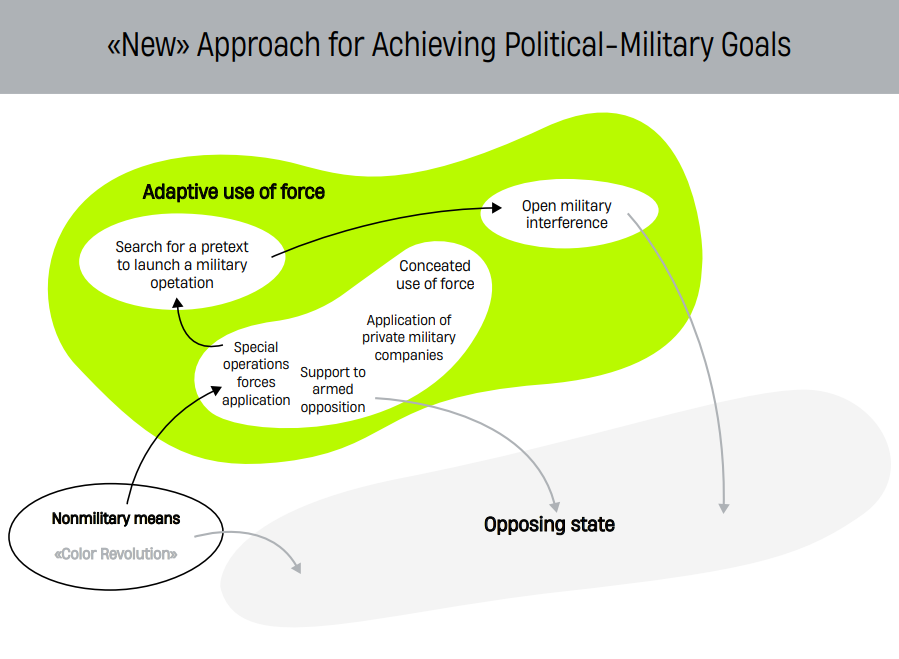
Approach to “hybrid” warfare proposed by Gerasimov
It is believed that General Gerasimov is primarily responsible for the development of the modern military doctrine of the Armed Forces of the Russian Federation. He proposed the concept of “hybridity” in modern warfare. Instead of seeking out a “reason” to launch a military intervention, “subjects” who need protection are created.
The decision to launch a full-scale invasion of Ukraine was to be made on the basis of this new doctrine being triggered. In his speech, President Putin further clarified that the basis for the so-called “special operation” (the term Russia uses for its aggression against and invasion of Ukraine) is Section 7, Article 51 of the UN Charter, i.e. the right to self-defence. The stated goals of the operation were “demilitarization” and “denazification”. While, in his speech, the President Putin did not explain what these terms meant, RIA-Novosti, a government-controlled media outlet, published an article entitled “What Should Russia Do with Ukraine” in which сampaign manager Tymofiy Sergeytsev explained the intentions of top Russian officials, stating: “… Denazification will play the role of de-Ukrainisation at the same time […] War criminals and active Nazis must be punished in an exemplary manner with demonstration. […] Further denazification of this mass of the population consists in re-education, achieved by ideological repression (suppression) of Nazi attitudes and strict censorship, not only in the political sphere, but, also, necessarily, in the sphere of culture and education.”
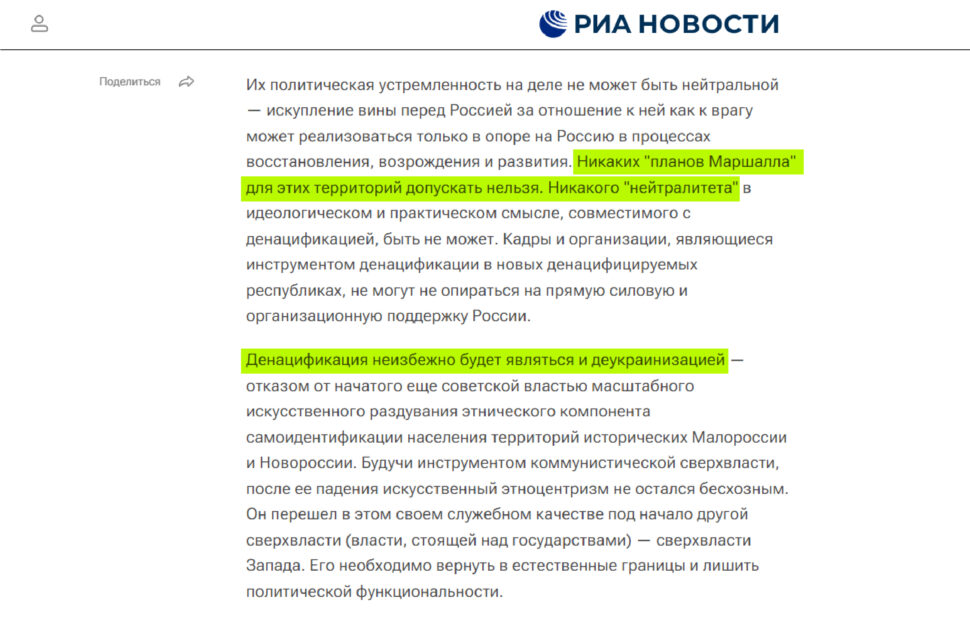
The article “What Should Russia Do with Ukraine”
Screenshot of the article from the site “RIA Novosti”
The extremely ideological provisions of the Russian military doctrine, which depend on the specific interpretation of the authorities, as well as their implementation in pursuit of the goals of the Russian Armed Forces prior to their invasion of Ukraine, prove that the Russian military has been geared towards the cruel treatment of the civilian population since the invasion’s outset. Such behavior is justified by a fictional denazification of the population of Ukraine and Russia’s desire to reeducate it. One of the concrete legal steps that is supposed to protect the military from any responsibility for actions in Ukraine is the decriminalization of the crime of looting through changes to the Russian Criminal Code.
Statutes of the Armed Forces of the Russian Federation and their possible role in the commission of violations of IHL
As noted above, in previous military interventions waged by the Russian Federation, violations of IHL have not gone unnoticed by international courts. Thus, in the Isayev v. Russia case, the ECtHR drew attention to the wording of the Field Statute of the Armed Forces, which, among other things, contained the following wording: “The commander’s determination to defeat the enemy must be firm and implemented without hesitation. Shame on the commander who, fearing responsibility, does not act or does not use all his strength, means, and opportunities to win the battle.”
Likewise, the Combat Statute of the Land Forces orients the Russian military to achieve its goals as follows: “… The commander’s decision to defeat the enemy must be firm and unhesitatingly completed. Inaction, failure to use all the means and opportunities to succeed, indecision, and passivity lead to defeat…”.
According to the statement of the plaintiffs in the first six cases of Chechnya v. Russia in the ECtHR, such provisions in the Field Statute could have guided the Russian military to undertake disproportionate attacks during the war. The statement rightly notes the need for the appropriate orientation of the Armed Forces of the Russian Federation towards complying with the principle of proportionality in the relevant statutes.
The Combat Statute of the Land Forces of the Russian Federation also focuses on compliance with orders (including those that are consciously illegal). Namely, it states that subordinates must obey the orders of their commanders without question Discussion (criticism) is inadmissible and non-compliance with the order of a commander is a crime in the framework of the military service.
Following the launch of Russia’s military intervention in Syria, the Russian Defence Ministry announced changes to the combat statutes, taking into account the experience of Syria. While most documents related to the functioning of the Russian Armed Forces are of limited access, there are references to certain provisions in open sources, enabling analysis of specific issues.
For example, despite Russia’s participation in “Protocol III to the Convention on the Prohibition or Restriction of the Use of Certain Conventional Weapons Which May Be Deemed to Be Excessively Harmful or Indiscriminate”, the Field Charter of the Armed Forces of the Russian Federation gave a special place to the use of anti-personnel and anti-transport mines during their operations. While the mentioned Protocol does not include a total ban on the use of anti-personnel or other mines, it does significantly restrict their use, especially in conditions where it is impossible to use mines with certainty against combatants of the opposing side of the conflict.
Another example is that according to the above statute, an important aspect of Russia’s tactical units are mechanised flamethrowers that should be used in the breakage of bunkers, clearing of light infantry, as well as in general military operations in urban or mountainous areas. It should be noted that such guidelines are directly contrary to the obligations of the Russian Federation under Protocol III of the above Convention, as it does not allow the use of incendiary weapons against military installations surrounded by civilian objects and those protected by natural objects (forests).
During the Russian Federation full-scale invasion of Ukraine,22 the Russian Armed Forces used thermobaric weapons alongside “traditional” artillery. This type of weapon can be described as one of the most powerful, as thermobaric charges use oxygen to create a higher temperature than a conventional projectile. A blow from such a projectile has worse consequences than from conventional artillery. When it comes to damage inflicted on people, these charges are lethal in close to 100% of case, as the shockwave causes injuries which in most cases are incompatible with life, while conventional shelters are incapable of withstanding such shockwaves. The explosive mixture penetrates buildings like an aerosol, while the explosion bears similar features to that caused by a domestic gas explosion, destroying buildings from the inside.
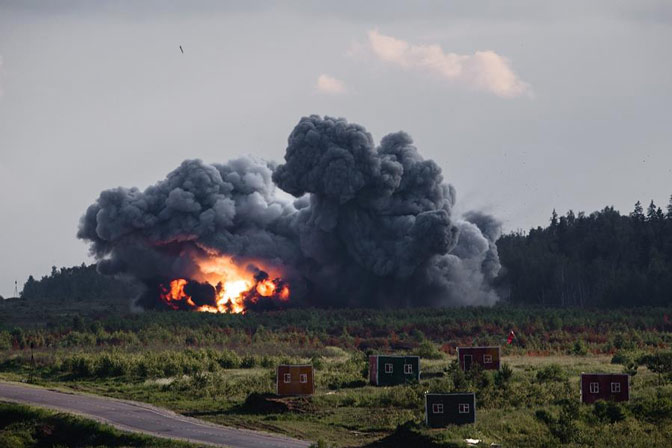
The consequences of a ТОС-1 Solntsepek
The protracted tradition of ignoring international law in the founding documents of the Russian military has led to high-ranking military representatives being involved in crimes committed during several Russian-initiated wars.
The cases of General Turchenyuk and Andrey Serdyukov are only two examples of this trend. In the case of General Turchenyuk, he was spotted in Crimea – where the practice of enforced disappearances and torture has become widespread – and is responsible for seven civilians going missing from the village of Stari Atagi (in the Chechen Republic) during his service in the 138th Separate Motorised Rifle Brigade in 2000.
In the case of Colonel-General Andriy Serdyukov, he participated in two of Russia’s Chechen campaigns and is currently serving in the war against Ukraine.
Conclusions
This brief overview of the political and legal documents of the Russian Armed Forces demonstrates a certain level of pre-programming of the Russian military towards possible violations of IHL. Available information on the guiding documents of the Russian military suggests that there is not enough focus on compliance with IHL. While this conclusion does not absolve the guilt of the direct perpetrators of war crimes, it demonstrates the systemic nature of problems related to the Russian military’s compliance with the laws and customs of war.