

Drafting this report and developing our approach to the legal qualification of the missile strike on Kramatorsk and Bilenke that occurred on 27 June 2023 has become one of the most complicated projects throughout the entire history of our work since 2014.
This report has been prepared with the financial support of

There are several reasons for this. Firstly, it was the first time we have investigated an episode bearing the typical characteristics of a war crime which killed a documenter from the Truth Hounds team – Viktoriia Amelina. This fact in itself served as an additional motivator for us to establish the truth about this attack, narrow down the circle of possible perpetrators, and provide an unbiased legal qualification in spite of our grief for our dear departed colleague. Furthermore, we believe that this is a rather unique case in the fact that it demonstrates the limitations of international humanitarian (IHL) and criminal law (ICL), sometimes described as the problem of the binary nature of ICL.
Understanding these difficulties and challenges and following long consultations, our team has agreed upon a position that reflects the available information to the highest degree and offers a substantiated and dynamic interpretation of international law.
A Brief Overview
On the evening of 27 June 2023, Russian forces launched an almost simultaneous double missile attack on the city of Kramatorsk and the adjacent village of Bilenke in Donetsk Oblast. The attack resulted in the deaths of 13 people and injuries to 60 more. Among the dead was Truth Hounds documenter and member of PEN Ukraine Viktoriia Amelina.
Considering the nature of the damage to the premises of the Ria Lounge in Kramatorsk, the characteristics of the crater in Bilenke and the projectile fragment located therein, statements from eyewitnesses, and other specific characteristics of the attack, Truth Hounds were able to prove that the Russian Armed Forces carried out this attack using Iskander-K cruise missiles.
The established facts indicate that the missiles were launched from a southeasterly direction in relation to the affected localities, an area of responsibility for the Southern Military District of the Russian Armed Forces. There are only four units in this area armed with Iskander missile systems. However, having analysed their locations and the areas of hostilities at the moment of the attack, the list of potential perpetrators was narrowed down to a single unit — the 47th Missile Brigade of the 8th General Troops Army of the Russian Armed Forces, under the command of Colonel Vitaliy Bobyr.
Russian military command and Russian propagandists reported on the attack on Kramatorsk and Bilenke as a successful operation to destroy ‘foreign mercenaries’ and the leadership of a brigade of the Ukrainian Armed Forces. These statements resonate with the numerous attempts of Russia’s propagandists to generate an atmosphere of hostility and intolerance towards the Ukrainian military. They essentially claim that the very fact of their presence is a threat to the civilian population. This report consistently refutes such claims and narratives.
Despite the presence of Ukrainian military personnel in the Ria Lounge that evening, this attack should be qualified as a war crime in the form of an indiscriminate attack. Given the significant destructive power of cruise missiles used against a facility located in a densely populated area of a big city and considering the lack of control over the target, we concluded that the attacker was aware of the circumstances and did not intend to avoid the excessive damage that could be – and eventually was – caused by the attack.
In addition to the publicly available version of this report, a second version was prepared that was intended for Ukrainian law enforcement agencies and which has already been shared with them. The purpose of creating two versions is to avoid the potential dissemination of sensitive information that provides additional clarity about the circumstances of the crime and to provide the investigative agencies with evidence in the most fulsome manner possible.
Methodology
The information contained in this report was collected through the interviewing of witnesses and survivors, analysing publicly available data, open-source intelligence (OSINT) investigations, and studying the practice of international humanitarian and criminal law. To ensure the high quality and consistency of the documenting process, the Truth Hounds team practiced strict adherence to the developed methodology, closely following the handbook on war crimes documentation[1] and the code of ethical work[2] with witnesses and survivors. The handbook contains the description of IHL violations and international crimes (using the legal framework of the Geneva Conventions and Protocols to the Rome Statute of the International Criminal Court), the characteristics of war crimes, and instructions for the proper collection of various types of evidence and interviewing witnesses and survivors. It also offers advice on protecting the scene and preserving data which may be important at later stages of investigation and provides practical information about the capturing of photo and video evidence of the consequences of shelling attacks. All surveys were conducted strictly in line with the ‘do no harm’ principle, with all due respect shown to respondents’ possible trauma. The first eyewitness accounts were collected remotely as soon as the day following the attack. In total, the documenters surveyed 22 people — eyewitnesses and survivors — five of whom were interviewed during the authors’ field mission to Kramatorsk and Bilenke on 1-5 August 2023. Some eyewitnesses, including former employees of the Ria Lounge, had not previously been interviewed. In addition, the sites of the strikes were studied during the mission, with photo and video records taken.
During the subsequent stage of the investigation, all the data obtained from eyewitnesses and survivors was analysed and compared to obtain the most reliable account of the events.
In addition to the information gathered during the field mission and the remote interviewing of eyewitnesses and survivors, Truth Hounds investigators used data from open sources, making use of a variety of tools to search for, identify, and verify said information. In addition, the tactical and technical characteristics of the entire range of missiles used by the Armed Forces of Russia, information about the movement of their units, and satellite images from Planet, Maxar, and Google Earth were also analysed. We also used Paliscope software, which uses artificial intelligence to process large amounts of data, PimEyes facial recognition software, and bots that can find personal information about specific individuals. These tools helped us to establish and confirm the authenticity of the circumstances we identified, determine the type of weapon used, localise the approximate missile launch site, and identify the unit which carried out the attack, as well as the commander who issued the order to attack. In order to establish the type of missile used and the potential location of its launch, we performed mathematical calculations using the parameters of distance, the speed of sound, and the characteristics of the missiles.
Using the entire range of these tools and the volume of data, Truth Hounds investigators considered all possible versions of the circumstances of the incident, eventually settling on the one that was the most substantiated.
Location, Circumstances, and Consequences of the Incident
On the evening of 27 June 2023, the Armed Forces of the Russian Federation carried out two missile strikes on the city of Kramatorsk, Donetsk Oblast. The first missile hit a pizza restaurant, the Ria Lounge, at 45A Vasylia Stusa Street (coordinates: 48.73549693666086, 37.5868373429989) at 19:29 EEST (UTC+3).[3] According to the State Emergency Service of Ukraine, as of 29 June 2023, the missile strike on the Ria Lounge killed 12 individuals and injured 60 more.[4] On 1 July 2023, our colleague and member of PEN Ukraine Viktoriia Amelina died in Mechnykov Hospital in Dnipro due to life-threatening injuries sustained as a result of the missile strike.[5] Thus, the number of victims increased to 13 people. The diner itself and the Zolotyi Vik jewelry store located next door were completely destroyed, while the blast wave damaged the Kramatorsk Hotel and high-rise residential buildings in the vicinity.
The second missile struck the intersection of Sofiivska Street and Bieliayeva Street in the town of Bilenke, close to the northeastern suburbs of Kramatorsk (coordinates: 48.76085580957159, 37.61154031923462) — at 19:30. Five people were injured due to the strike.[6] Civilian houses within a 50-metre radius of the blast were either destroyed or significantly damaged, with minor damage to objects recorded at a distance of up to 200 metres from the impact point.
The distance between the impact points of the two missiles was about 3.5 km, with the interval between explosions being around one minute.[7] This latter fact indicates that the missiles were launched almost simultaneously.
Satellite images, photos and videos published online, and footage recorded by Truth Hounds showing the damage to the restaurant in Kramatorsk show the exact point of the strike (see Images 2–4).
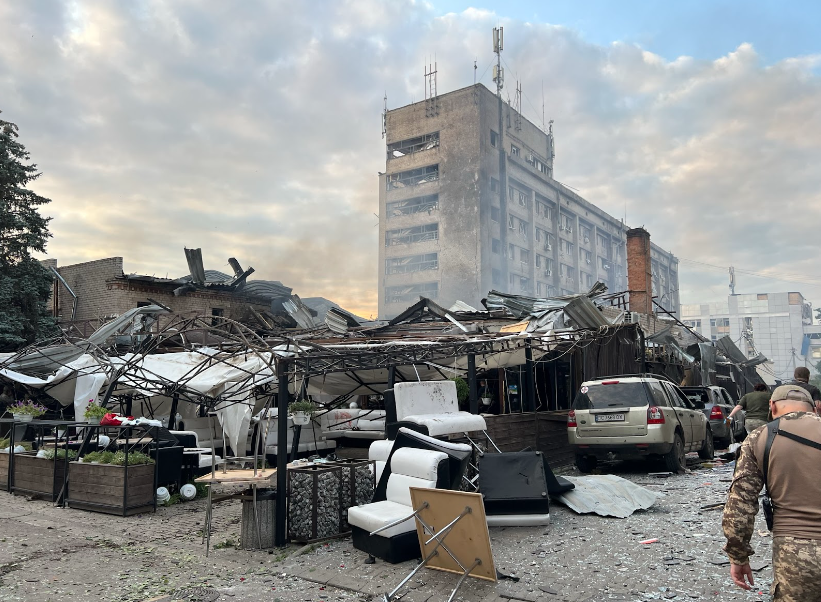
Aftermath of the missile strike on Kramatorsk
Photo taken at 19:48 on 27 June 2023. Provided to Truth Hounds by journalist Anastasia Taylor-Lind
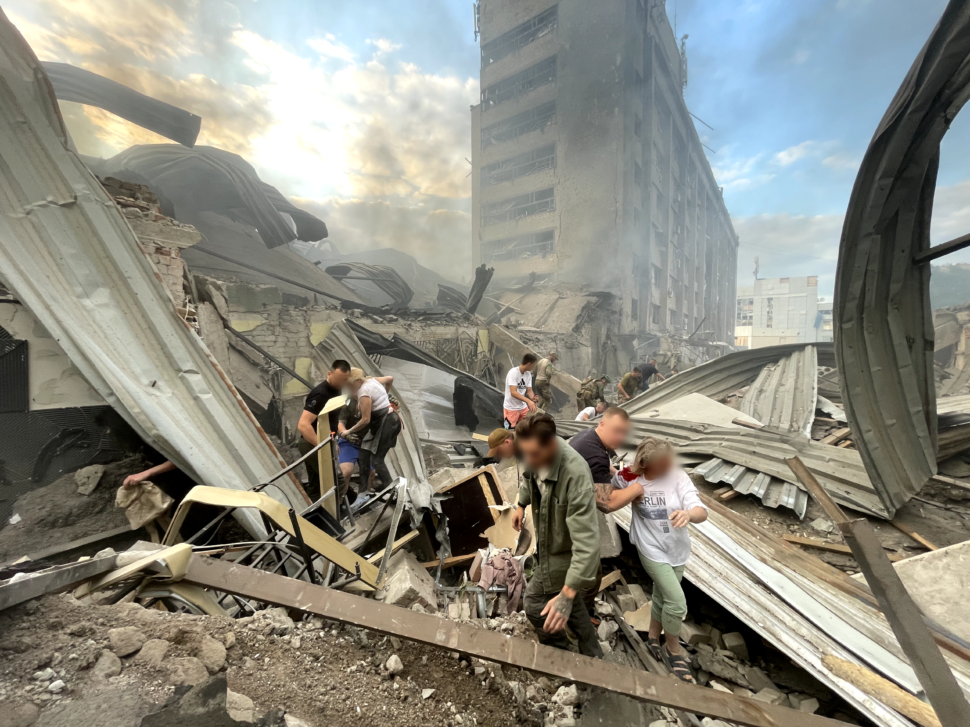
Aftermath of the missile strike on Kramatorsk
Photo taken on at 19:37 27 June 2023. Provided to Truth Hounds by journalist Wojciech Grzedzinski
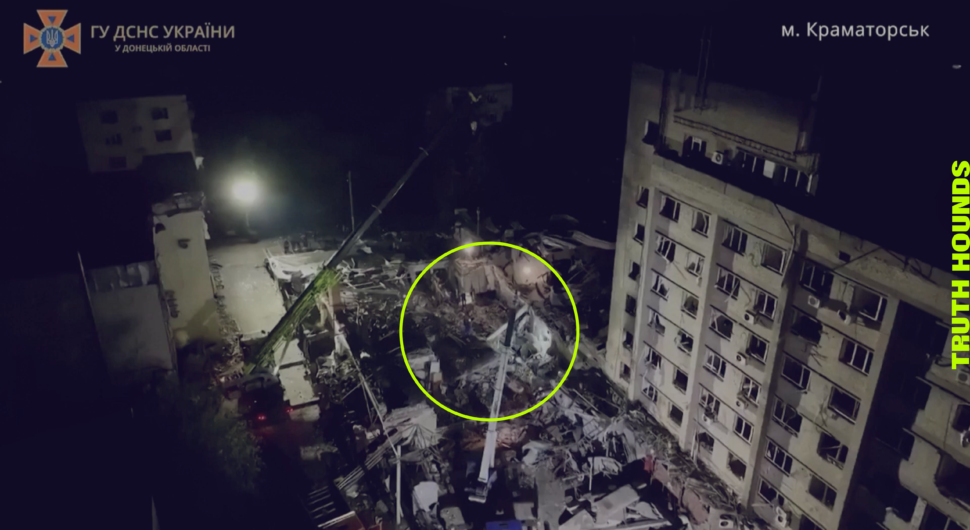
A frame from a video published by the State Emergency Service of Ukraine. The green circle in the photo marks the impact point of the missile which struck Kramatorsk[8]
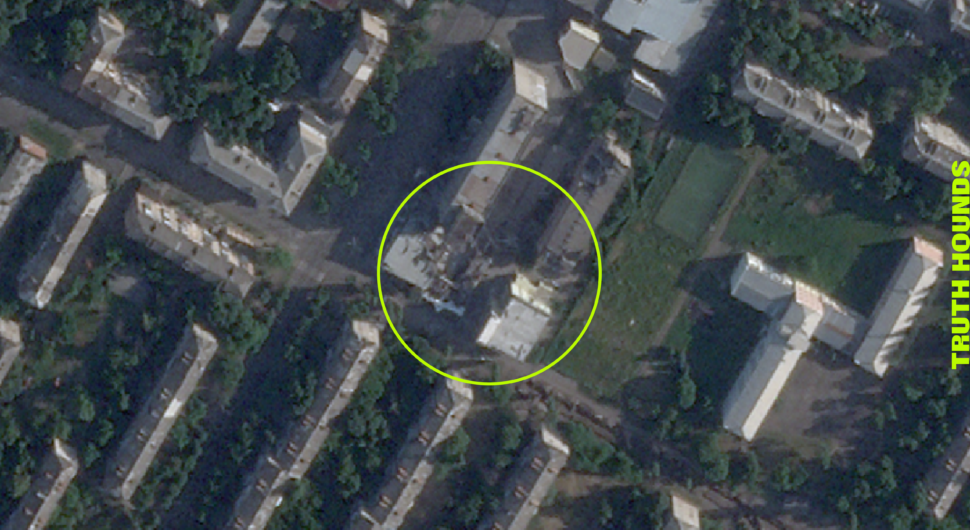
The impact point of the missile strike on Kramatorsk
Satellite image by Planet from 5 July 2023
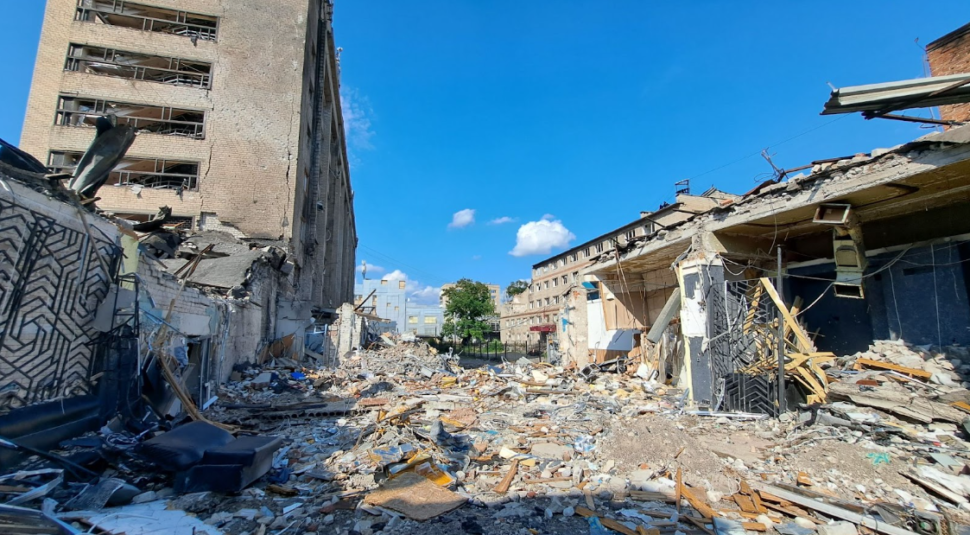
Aftermath of the missile strike on Kramatorsk
Photo taken by Truth Hounds documenters on 2 August 2023
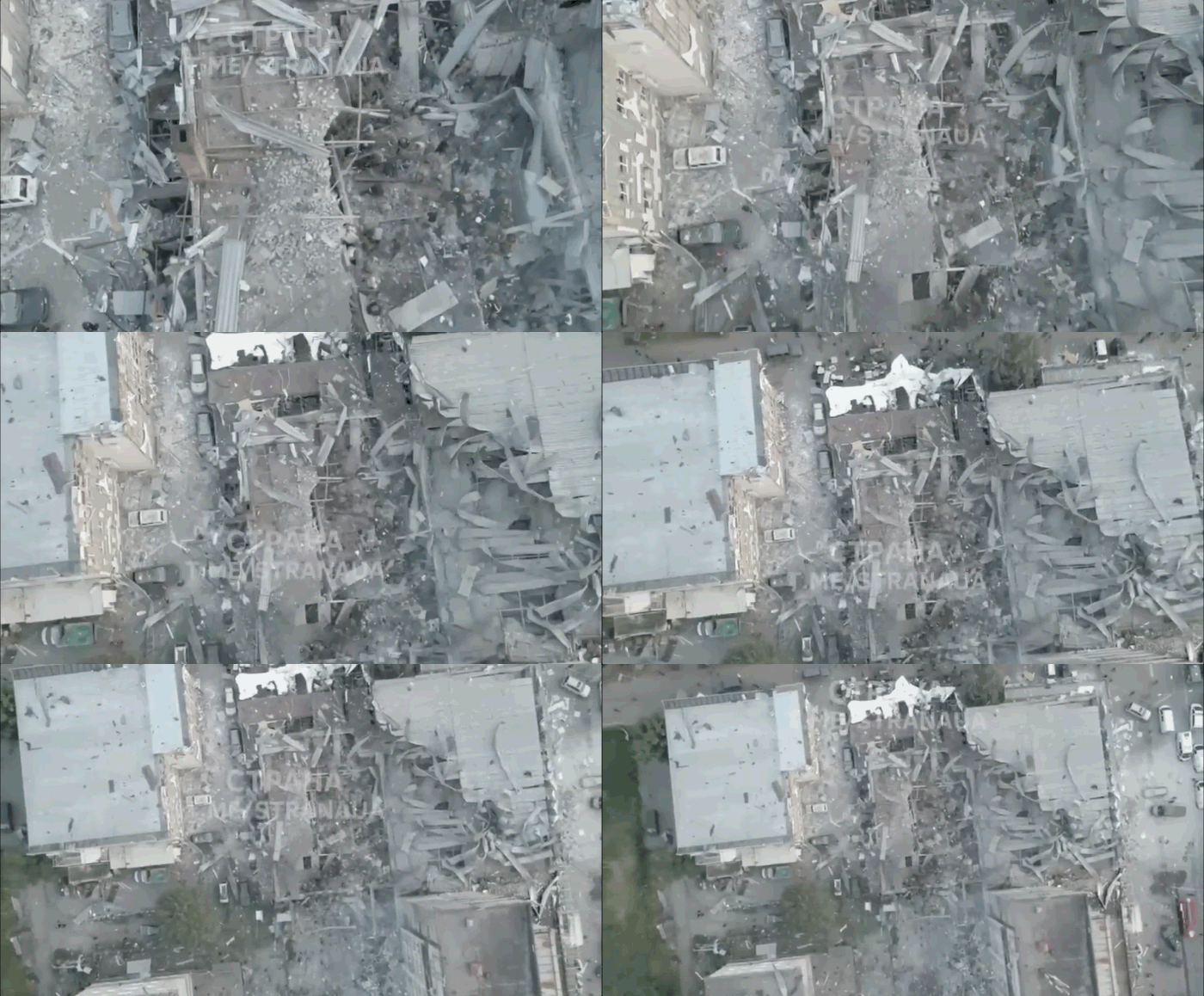
Source: StranaUA
The exact location of the strike on Bilenke — the intersection of Sofiivska Street and Bieliayeva Streets — was confirmed to Truth Hounds documenters by the locals. They also indicated that the crater in asphalt was filled as soon as the following day. New road covering was put on top almost immediately, since this intersection is among the busiest in the town.[10]
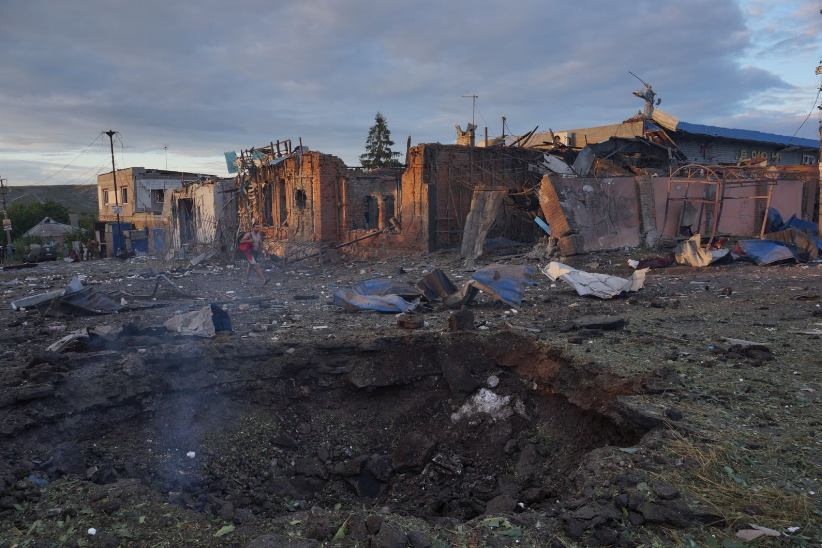
The aftermath of the strike in Bilenke
Photo taken at 20:28 on 27 June 2023. Provided to Truth Hounds by journalists from the Kramatorsk Post
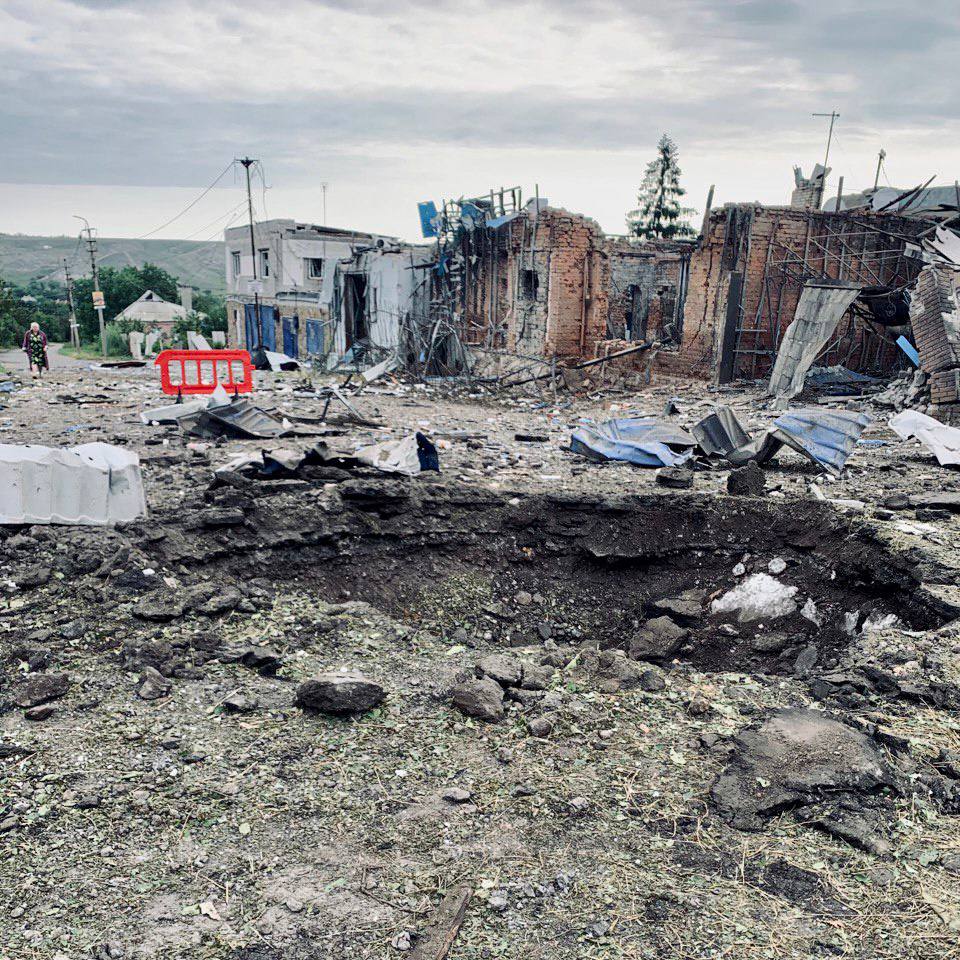
Notably, the workers who repaired the road following the strike laid the new asphalt in such a way that the ‘patch’ essentially followed the contour of the crater itself. Due to this fact, Truth Hounds documenters were able to establish that the crater was oval in shape, with its longer diameter being 5.5 metres.
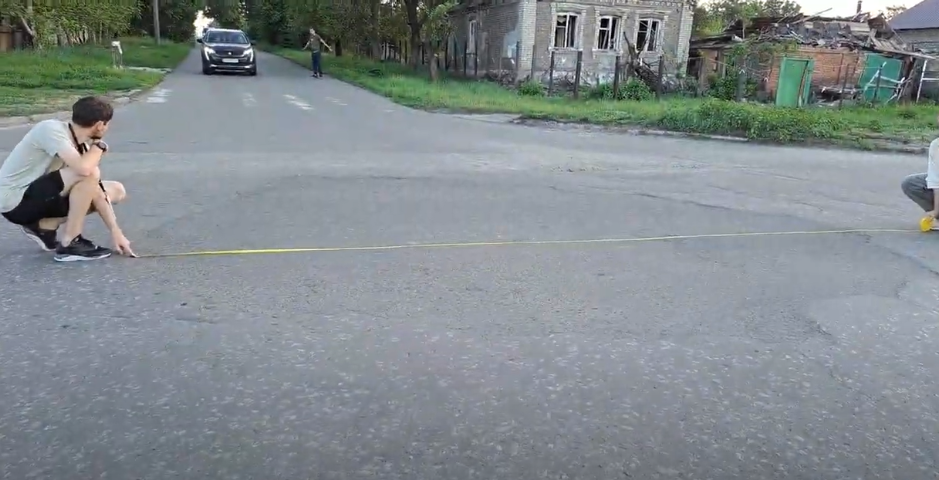
A frame shows, Truth Hounds documenters recording the parameters of the residual contour of the crater in Bilenke
A frame from a video filmed by Truth Hounds on 2 August 2023
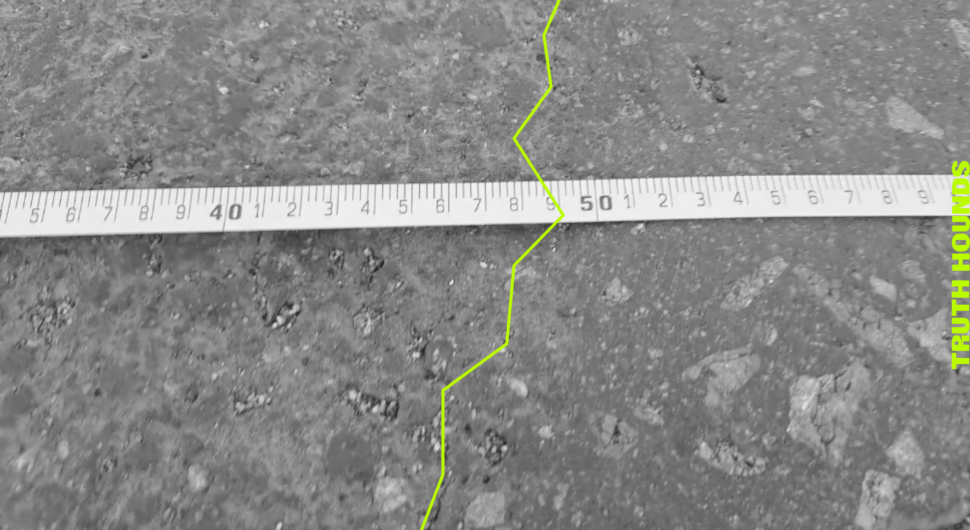
The diameter of the crater in Bilenke is recorded as 5.5 metres
A frame from a video filmed by Truth Hounds on 2 August 2023
Type of Weapon
The most likely version of events is that the attack on Kramatorsk and Bilenke was carried out using missiles of the Iskander-K type. This is indicated by a number of features specific to this type of missile.
However, we consider it to be first necessary to debunk versions of events involving the use of other weapon types, such as those which, in the ‘fog of war’, were voiced at various points by Ukrainian officials and representatives of government structures. In his daily video address on 27 June 2023, President of Ukraine Volodymyr Zelenskyy claimed that the attack was carried out with the use of an S-300 anti-aircraft missile system.[11] The same claim was repeated by the National Police of Ukraine.[12] The use of an air defence system (this time, an S-400) was also reported in a message from the Centre for Strategic Communication and Information Security,[13] later shared by Operational Command North.[14] It claimed that the Defence Forces of Ukraine used a HIMARS multiple rocket launcher to destroy ‘the very S-400’ which carried out the strike on Kramatorsk on 27 June 2023.
Both versions appear to be extremely unlikely. When S-300 air defence systems are equipped for attacks on ground targets, it is usually with 5V55 and 48N6 missiles, whose warhead payloads weigh approximately 130 and 145 kg, respectively. The S-400 system can also launch new guided 48N6DM anti-aircraft missiles with surface-to-surface capabilities and a 180-kg warhead.[15] The mass of such a warhead would not allow these missile types to cause destruction similar to what was observed following the strike on Kramatorsk and Bilenke on 27 June 2023.
The nature of the destruction of the Ria Lounge and adjacent buildings does not support a version of the attack involving the use of an S-300 or S-400 system. Neither of these systems make use of missiles equipped with penetrating warheads capable of effective destruction of fortified structures or buried targets. The building that housed the Ria Lounge had stable concrete floors and thus would not suffer significant destruction if struck with a missile not equipped for effective penetration of this material. This fact can be illustrated by making reference to the aftermath of the S-300 missile attack on a residential building in Mykolaiv on 23 October 2022. The photo below shows that the damage caused to the brick building that was struck is not as significant as the consequences of the attack on Kramatorsk. Additionally, brick as a material is less resistant by comparison to the concrete used in the Ria Lounge.
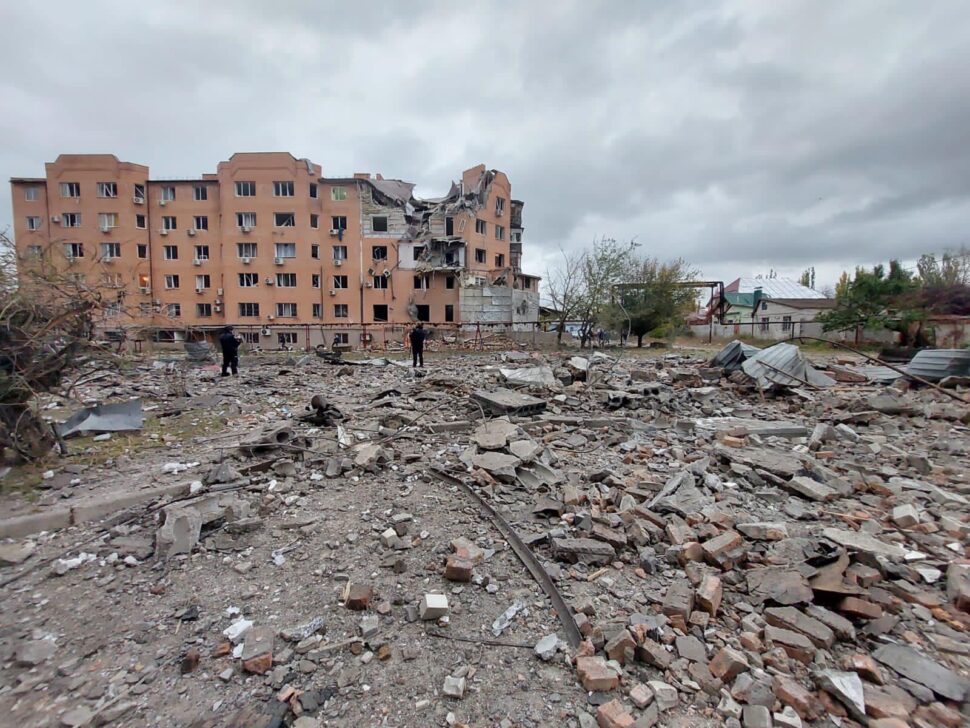
The aftermath of an S-300 air defence missile striking a residential building in Mykolaiv on 23 October 2022.[16]
The accuracy of such missiles is low, even when targeting stationary ground objects.[17] This is primarily due to the weak adaptability of missiles for firing at such targets, as well as the fact that they can only be controlled as long as there is communication between the missile and a radar station. The distance this is possible depends on specific conditions, but cannot exceed 40 km. Subsequently, the missile follows a ballistic trajectory by inertia.[18]
The launchers themselves are usually not moved closer than 20–30 km from the frontline in order to secure them against being detected and destroyed by enemy artillery. The distance from the point of impact in Kramatorsk to the frontline — even to the closest possible Russian positions at the time — was roughly 25 km. Thus, a strike from an S-300 or S-400 system would have to have been made from a distance of at least 45–55 km, which would significantly decrease the chances of the building being hit — though it was precisely this building that was being targeted, according to Russian statements.[19]
It follows from the above that the combat characteristics of the anti-aircraft guided missiles used with S-300 and S-400 systems do not fit with the actual consequences of the attack on Kramatorsk.
Additionally, we must note that an attack on Kramatorsk and Bilenke using air-launched cruise missiles is just as unlikely. At the time of the attack, no strategic bombers were recorded in Russian airspace. There was also no threat of Russia’s tactical aviation being used. This is in line with information from the official Telegram channel of the Air Force of the Armed Forces of Ukraine, which uploaded no messages about such threats prior to the attack.
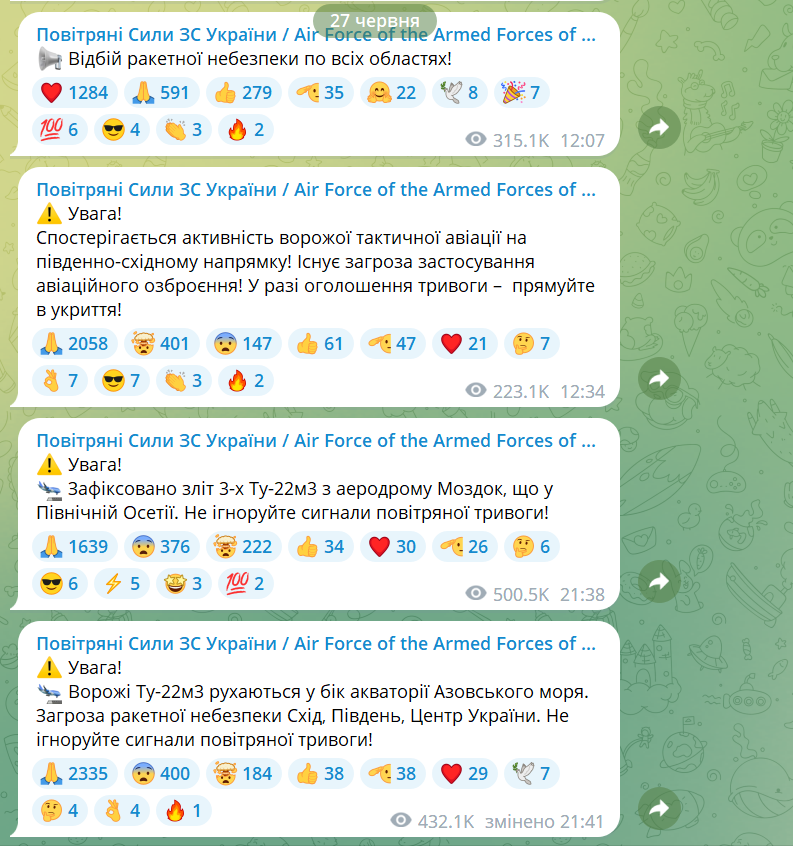
A screenshot of messages posted to the official Telegram channel of the Air Force of the Armed Forces of Ukraine ahead of the attack on 27 June 2023.[20]
Similarly, we can conclude that sea-launched cruise missiles could not have been used since, on 27 June 2023, there were no messages shared even about the threat of such a possibility.
Thus, we can eliminate the versions of the attack on Kramatorsk and Bilenke on 27 June 2023 which suppose the use of S-300 and S-400 air defence missiles, multiple rocket launchers, and air- or sea-launched cruise missiles.
In view of the above, we should rather analyse the version of events which supposes the use of surface-to-surface missiles launched from an Iskander missile system. We compared the characteristics of the two types of missiles used for this system: the Iskander-K cruise missile and the Iskander-M ballistic missile. Notably, the day after the tragic incident, the Office of the Prosecutor General of Ukraine reported that the strike on the centre of Kramatorsk was carried out with an Iskander-M missile.[21] Later, this statement was repeated by the spokesman of the Air Force of the Armed Forces of Ukraine, Yurii Ihnat.[22] To begin the comparison, let us consider the main combat characteristics of the Iskander-K and Iskander-M missiles. The illustrations below display their main characteristics.
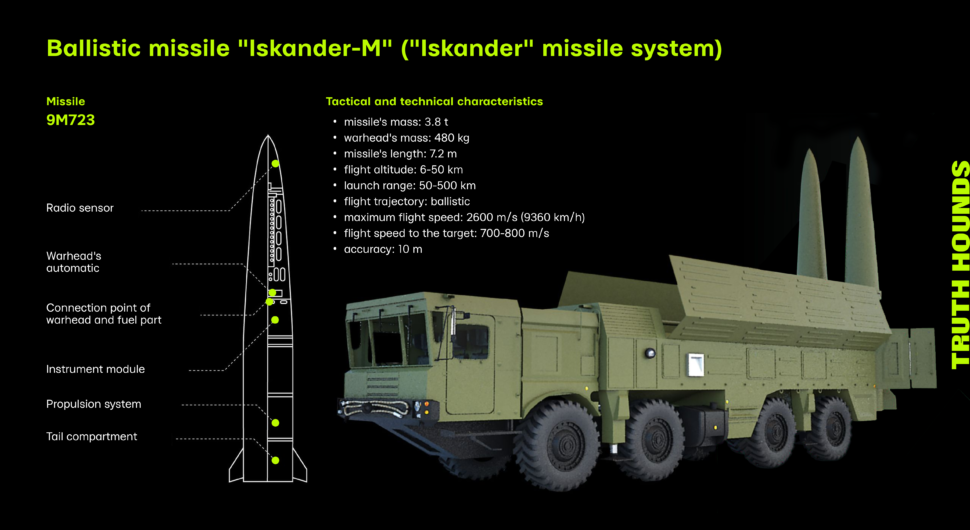
Combat characteristics of the Iskander-M ballistic missile
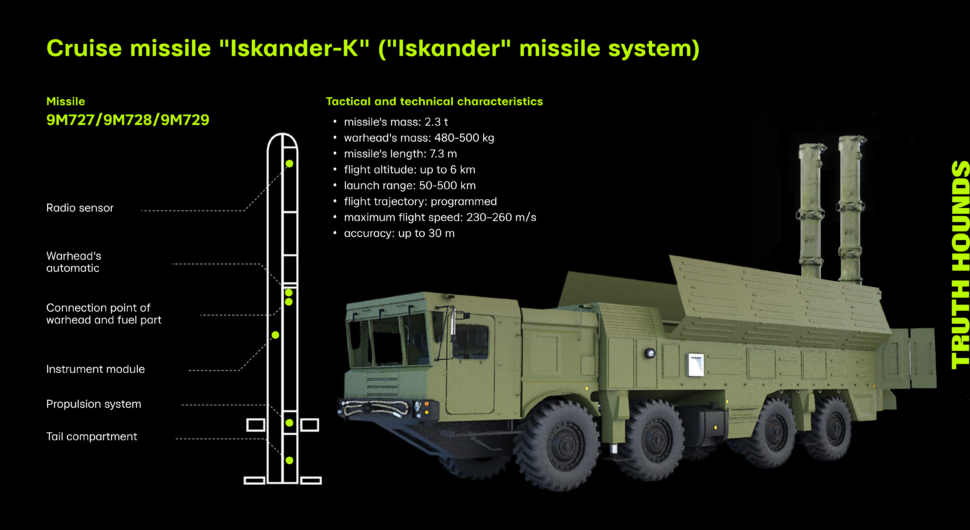
Combat characteristics of the Iskander-K cruise missile
Both missiles are used to strike targets at long distances, but they belong to different missile types and have different properties. The most significant difference is that the Iskander-M is a ballistic missile, while the Iskander-K is a cruise missile. This crucial difference points to a number of inherent characteristics that can be used to clearly distinguish between these missile types and thus establish, with a high degree of accuracy, which of them was used in each specific case.
In the following sections, we will consider the specific characteristics of these missiles in more detail and compare this information with the testimonies provided by eyewitnesses and other facts established during the investigation.
Trajectory
The Iskander-M is a ballistic missile launched from an Iskander missile system. It is equipped with a solid-fuel rocket engine that works only in the initial stage of flight, after which the rocket moves along a ballistic trajectory by inertia. In the active phase of the flight, the ballistic missile is powered by the engine, which essentially pushes it to the maximum height and turns off after its fuel runs out. Afterwards, the missile essentially falls on its target in an uncontrolled free fall mode, hitting its target almost vertically. The approach speed of the Iskander-M missile can reach 800 m/s, more than double the speed of sound (343 m/s). This means that eyewitnesses would perceive a strike by this missile as a sudden explosion without the prior sound of a missile in flight. The sound would only be heard after the strike. At that level of approach speed, the missile would also be impossible to track visually or even observe in the final stage of its flight.
The Iskander-K is a cruise missile that is also launched from an Iskander system. It flies along a predetermined trajectory, also being able to do so at ultra-low altitudes with the use of radio-electronic means of protection. It is easy to see in the sky, since its speed is significantly lower than that of its ballistic counterpart — 230-260 m/s.
During the attack on 27 June 2023, one of the eyewitnesses interviewed by Truth Hounds observed the flight of the missile for two seconds and its subsequent strike on the intersection in Bilenke.[23] Another eyewitness who was on the terrace of the Ria Lounge at the time of the strike also saw the missile flying above and, a moment later, heard a loud explosion from the back part of the restaurant.[24] The use of Iskander-M missiles would make such testimonies impossible, since it is too fast to be visible to the naked eye.
Note
There is often one more type of Iskander missile used for classification of this weapon — “quasi-ballistic”. Moving to the target on a ballistic trajectory, quasi-ballistic missiles are able to correct their course at the final points of the trajectory due to the nature of their construction (see illustration below).
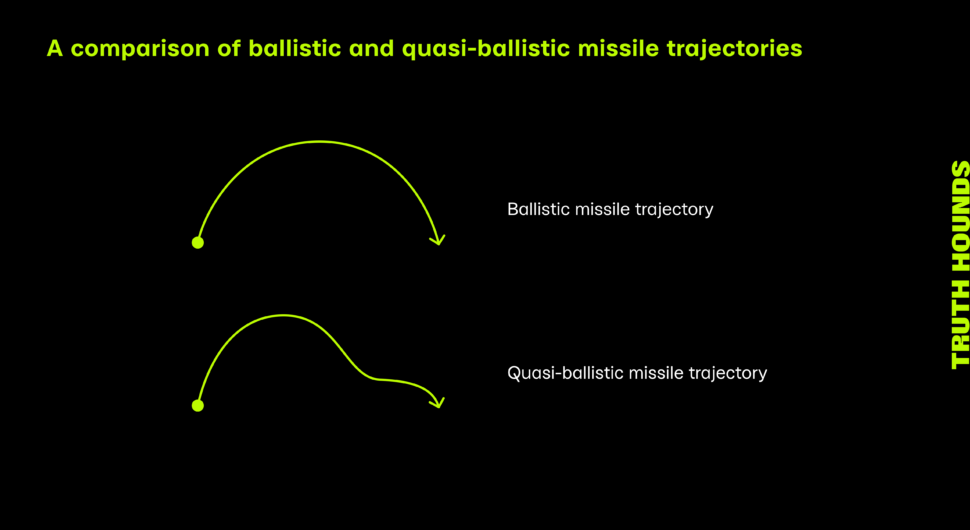
A comparison of ballistic and quasi-ballistic missile trajectories
The existence of a quasi-ballistic Iskander missile is not a fact but is rather shrouded in multiple myths and suppositions. For example, most Russian sources claim that a certain modification of the Iskander-M missile can change its trajectory throughout its flight, including when approaching the target. They claim this allows the missile to manoeuvre and protects it from interception by air defence, helping it to achieve a precise strike on its target.[25]
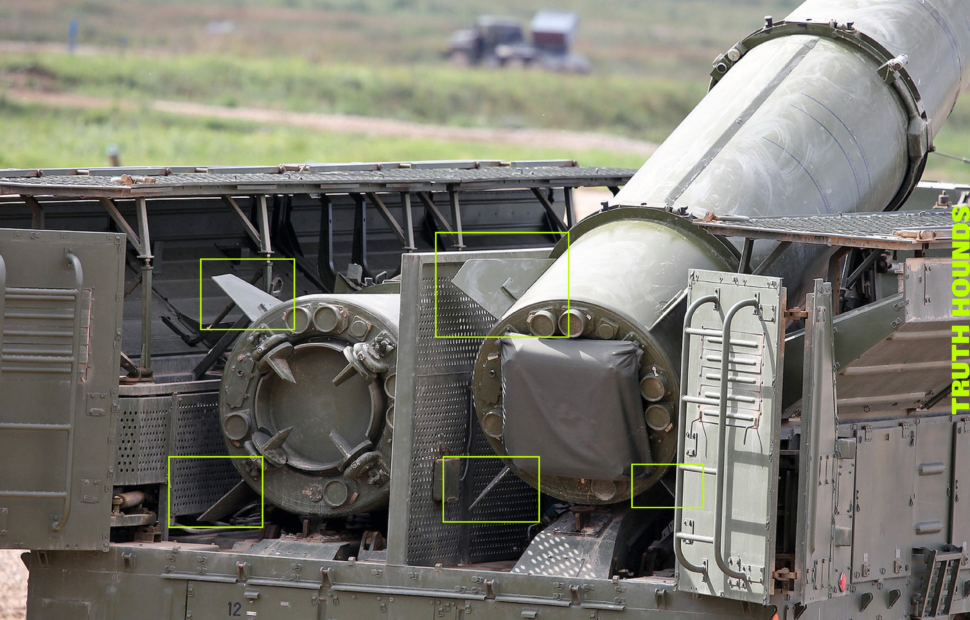
Other experts hold the opposite opinion and deny the possibility of any manoeuvring once the active part of the flight is over (or after the acceleration stage, when the missile has just been launched). This is due to the fact that the Iskander-M has a single-stage engine (with no other modifications) that only works during the acceleration stage, and regular gas rudders that only manoeuvre the missile while the engine is in operation. At the peak point of the flight, the engine shuts off and the missile then moves towards its target along a classic parabolic trajectory.
The image below illustrates this latter idea. Looking carefully at the tail stabilisers, it becomes evident that they cannot perform any additional manoeuvring, since they are an integral part of the missile body and cannot change their position.[26]
Sound
The Iskander-K missile is equipped with a cruise turbojet engine and, therefore, during flight, it emits a sound similar to the roar of a jet aircraft. The sound of any ballistic missile, including the Iskander-M, is different while approaching its target, since the missile engine no longer works at this stage of its flight. As mentioned above, the speed of this missile while approaching the target makes it impossible for a person to hear its flight before it reaches the surface.
The witnesses interviewed by Truth Hounds noted that they heard a sound similar to the roar of a jet plane prior to the explosion. This is how it was described by one of the witnesses who was in the Ria Lounge at the time of the attack:
‘Suddenly, I heard the engine of a missile. I thought it was a cruise missile because this is the one you can hear. I’ve heard this sound many times in the Donbas. In fact, I heard a missile that morning being launched from the Ukrainian side, so this sound was very familiar to me […] It sounded like a jet engine, like a fighter jet.’[28]
Another witness said he was sitting on the terrace of the diner and heard a sound similar to that of an aeroplane:
‘The sound was like a roar, like some kind of deep whistling. The sound of a strike. Perhaps similar to the sound of an aeroplane. Like something enormous is flying nearby.’[29]
Another person present at the diner at the moment of the strike also confirmed that he heard a sound similar to the roar of an aeroplane before the explosion:
‘I heard the roar of a jet engine, like an aeroplane, like a fighter jet — and then this rumble. And, basically, that was it.’[30]
The timeline of the attack was described in the same manner by witnesses who were not inside or next to the Ria Lounge building at the time of the attack — that the explosion was preceded by a sound similar to the roar of a jet plane:
‘I was in the house and I heard this jet sound and then the explosion itself. So I fell on the floor next to the wall — what else could I do? I didn’t really know where the strikes were.’[31]
Another witness who was at home during the missile strike, 400 metres from the diner, heard the missile fly past her house:
‘I heard the missile flying right overhead. It was like a fighter jet.’[32]
Thus, regarding this component, the testimony of witnesses of the attack on Kramatorsk fully corroborate the testimony related to the attack on Bilenke that was shared with Truth Hounds documenters. Having heard the explosion, one of the witnesses in Kramatorsk went outside to see what was happening. At that moment, he saw the flight of the second missile which struck Bilenke:
‘An aeroplane-type sound, slightly quieter than an aeroplane. Well, this is typical of a cruise missile.’[33]
To obtain additional information corroborating the type of missile that struck Kramatorsk, we can use information from one of the witnesses about the time between the missile flying past her home and the moment of the explosion — between five and six seconds. Her house is located 400 metres from the Ria Lounge. The maximum approach speed of an Iskander-K missile to its target is 260 m/s. Cruise missiles usually approach the target at a speed slightly lower than the maximum. Apparently, the witness also heard the sound of the missile at least 100 meters before it flew over her house. Thus, this distance would be covered by such a missile in three to four seconds. Since the speed of sound is 331 m/s, the sound of the explosion would carry to the witness in one or two seconds. This fits with the testimony. As such, calculations performed based on the testimony of the witness correspond to the combat characteristics of an Iskander-K missile.
Crater
To identify the weapon type, an important factor is also the crater formed as a result of its detonation, as well as the nature and scale of destruction caused by the explosion. Craters formed after a strike on an even ground surface, asphalt, or other dense surface without gaps are best suited for analysis. The shape and size of such craters provide the most accurate understanding of the weapon used.
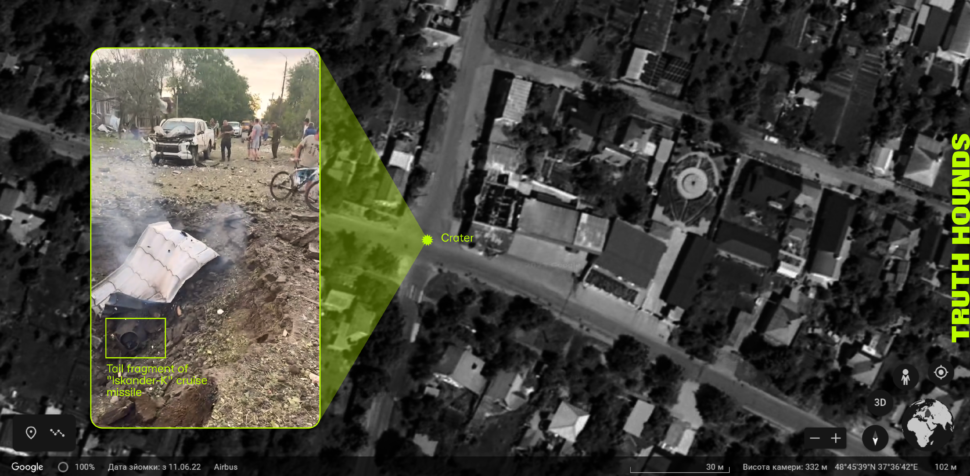
The missile used to attack Bilenke struck the asphalt covering on the intersection of Sofiivska Street and Bieliayeva Street. During the field mission, Truth Hounds documenters took measurements of the crater’s residual contour and determined that the crater was oval in shape and that its elongated part had a diameter of 5.5 metres. This crater shape indicates that the missile struck the target at an acute angle.
This is also corroborated by one of the witnesses of the missile flight in Bilenke:
‘The missile flew at a height of 50–60 metres and then “landed” at an angle.’[34]
The oval shape of the crater is precisely characteristic of a cruise missile, since ballistic missiles usually hit their target at a near-right angle, forming a crater that is more round in shape.
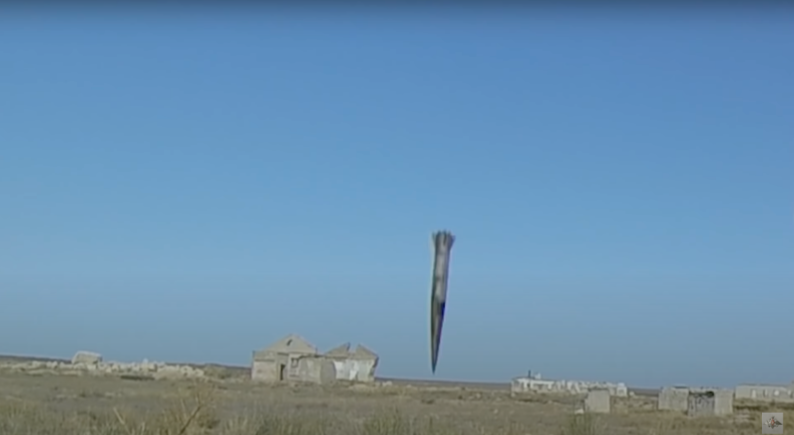
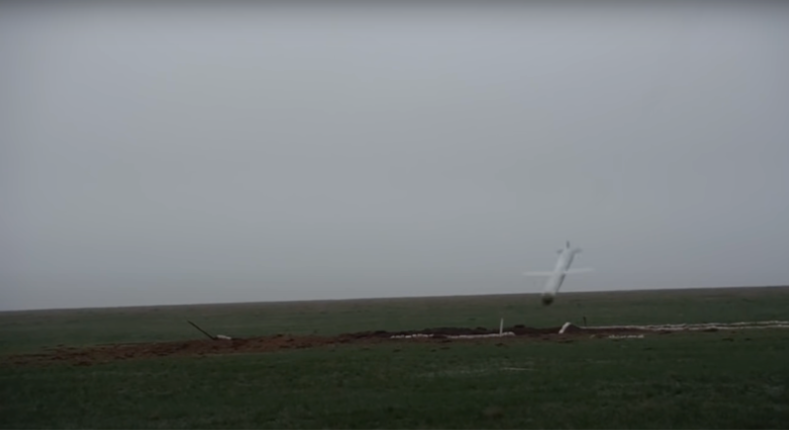
Since the crater was filled the day following the attack, it was impossible to obtain precise measurements of its depth. However, we used photos depicting the aftermath of the strike on Bilenke published by a local newspaper, the Kramatorsk Post, to compare with attacks involving Iskander-K missiles previously documented by Truth Hounds.
Based on the photographs published by the newspaper, we can establish that the crater is less than two metres deep. A crater of a similar shape and size was recorded by Truth Hounds during a July 2023 field mission to Pervomaiskyi, Kharkiv Oblast, which was attacked by an Iskander-K cruise missile[37] on 4 July 2023. The comparison is all the more telling since the missile used in Pervomaiskyi also struck asphalt. On that occasion, the documenters measured the depth of the crater, establishing it to be 1.6 metres. Hence, the similar depth and shape of both craters indicates that the same missile type — an Iskander-K — was used in both cases.
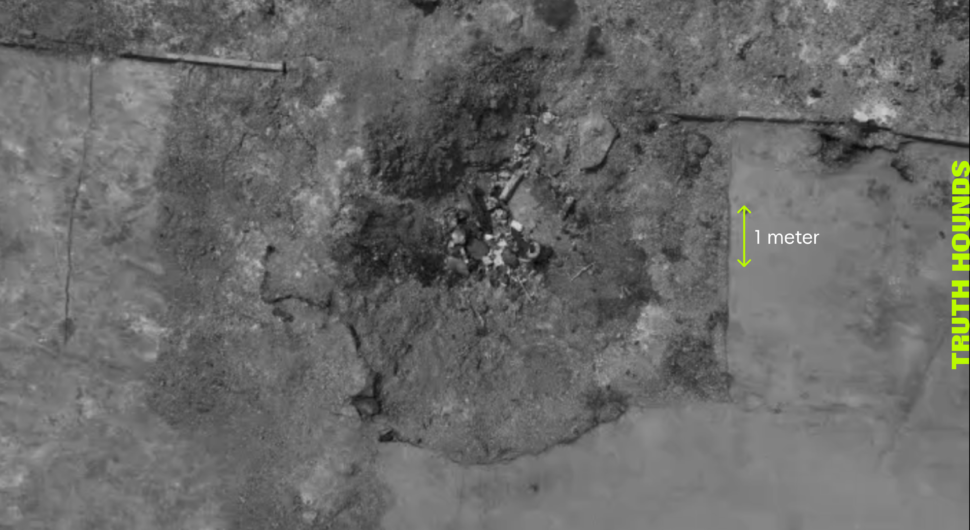
A frame from a video recording made by Truth Hounds on 18 July 2023, showing the crater caused by an Iskander-K missile strike on Pervomaiskyi, Kharkiv Oblast
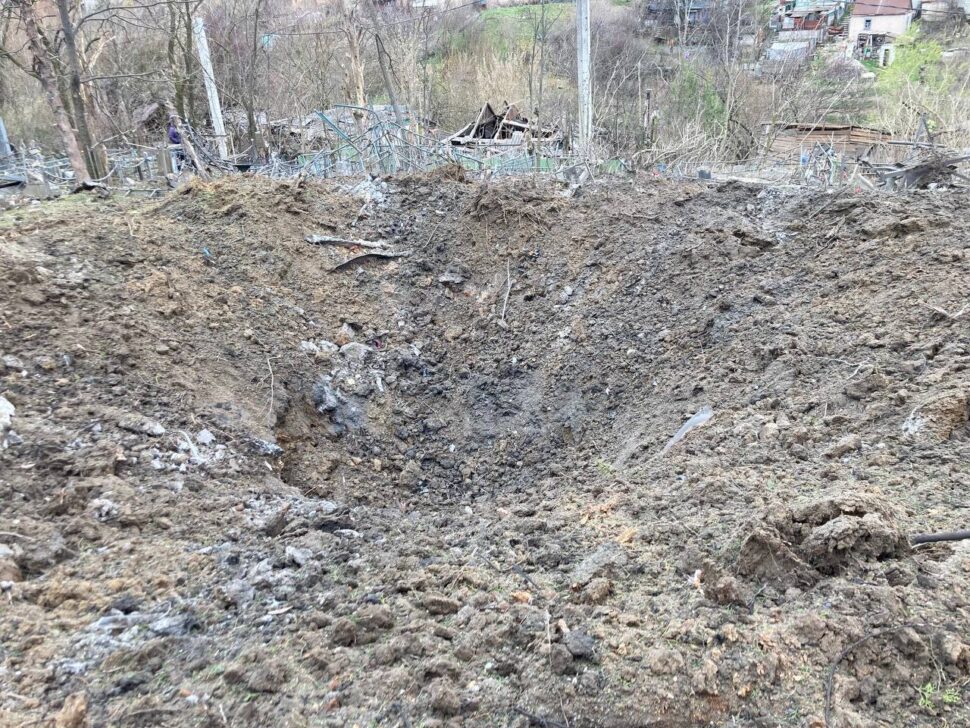
The greater speed and mass (3.8 vs 2.3 tonnes) of an Iskander-M provide for a distinctively larger impulse at the moment of impact. Thus, the crater and destruction from such a missile would be more significant than what was observed in Bilenke. The photo below shows the aftermath of the impact of an Iskander-M missile in Zaporizhzhia on 31 March 2023. Despite the fact that the missile struck earth rather than asphalt, the difference between the scale of ruptures and destruction is so significant that the role of the surface material is minimal.
The fact that the missile fired at Kramatorsk struck a building makes it impossible to speculate about the shape and depth of the crater. However, the missile strike caused significant internal destruction to the building of the Ria Lounge and damaged both the Kramatorsk Hotel and the jewellery store next door to the Ria Lounge, as well as caused major damage to other buildings (see animation below). Since the missile hit a building with empty spaces, rather than a dense monolithic object, it would be hard to determine the precise type of the missile only based on the nature of the damage. However, as in the case of Bilenke, we can compare the aftermath of the attack on Kramatorsk on 27 June with other incidents involving the two types of missiles.
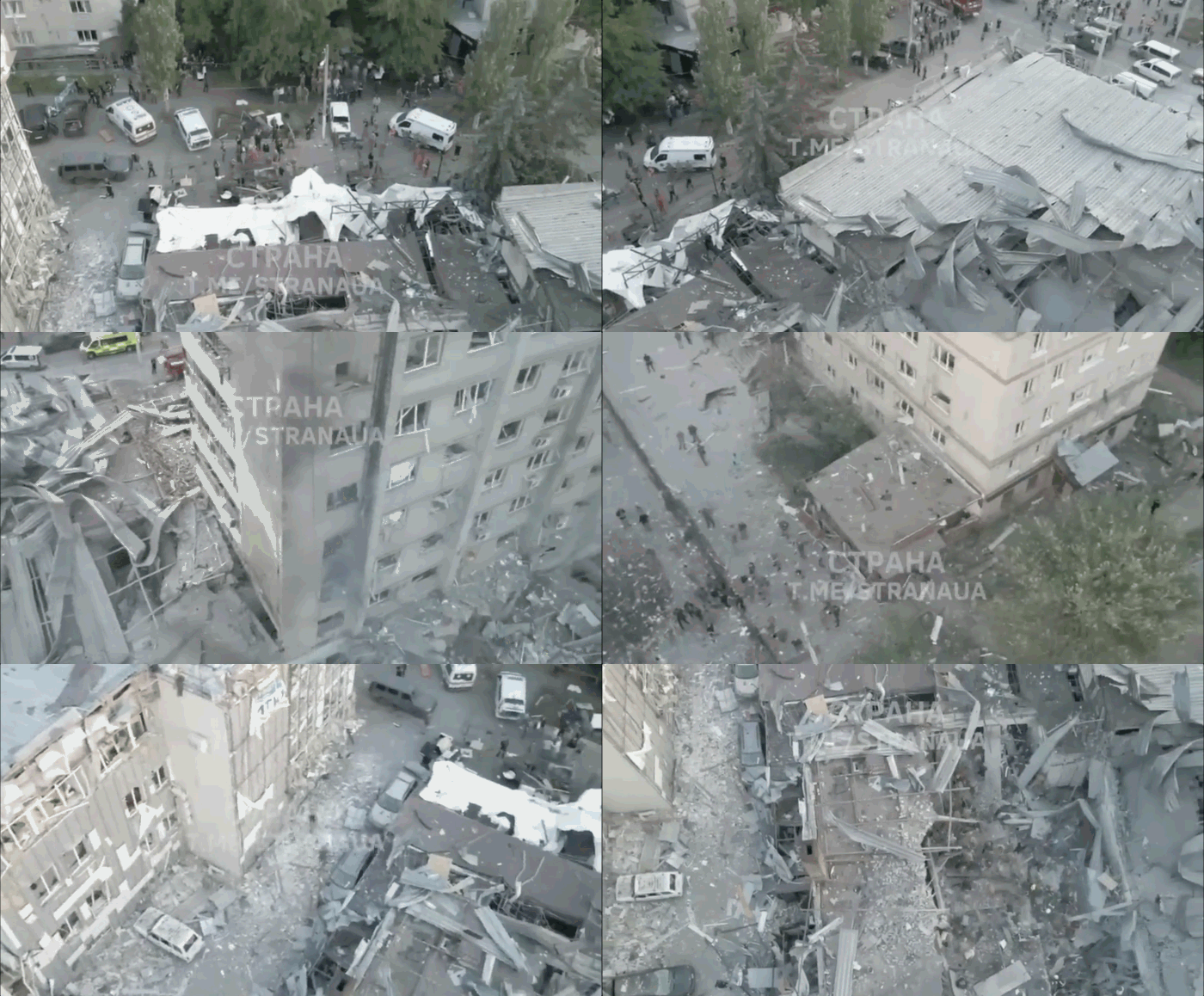
Source: StranaUA
First, we can turn to the shelling of Kramatorsk itself in the early hours of 2 February 2023. The investigation found that, on that occasion, the Russian military used an Iskander-K cruise missile which hit a residential building (see photo below). The scale of destruction is quite comparable to that caused by the shelling of the city in June.
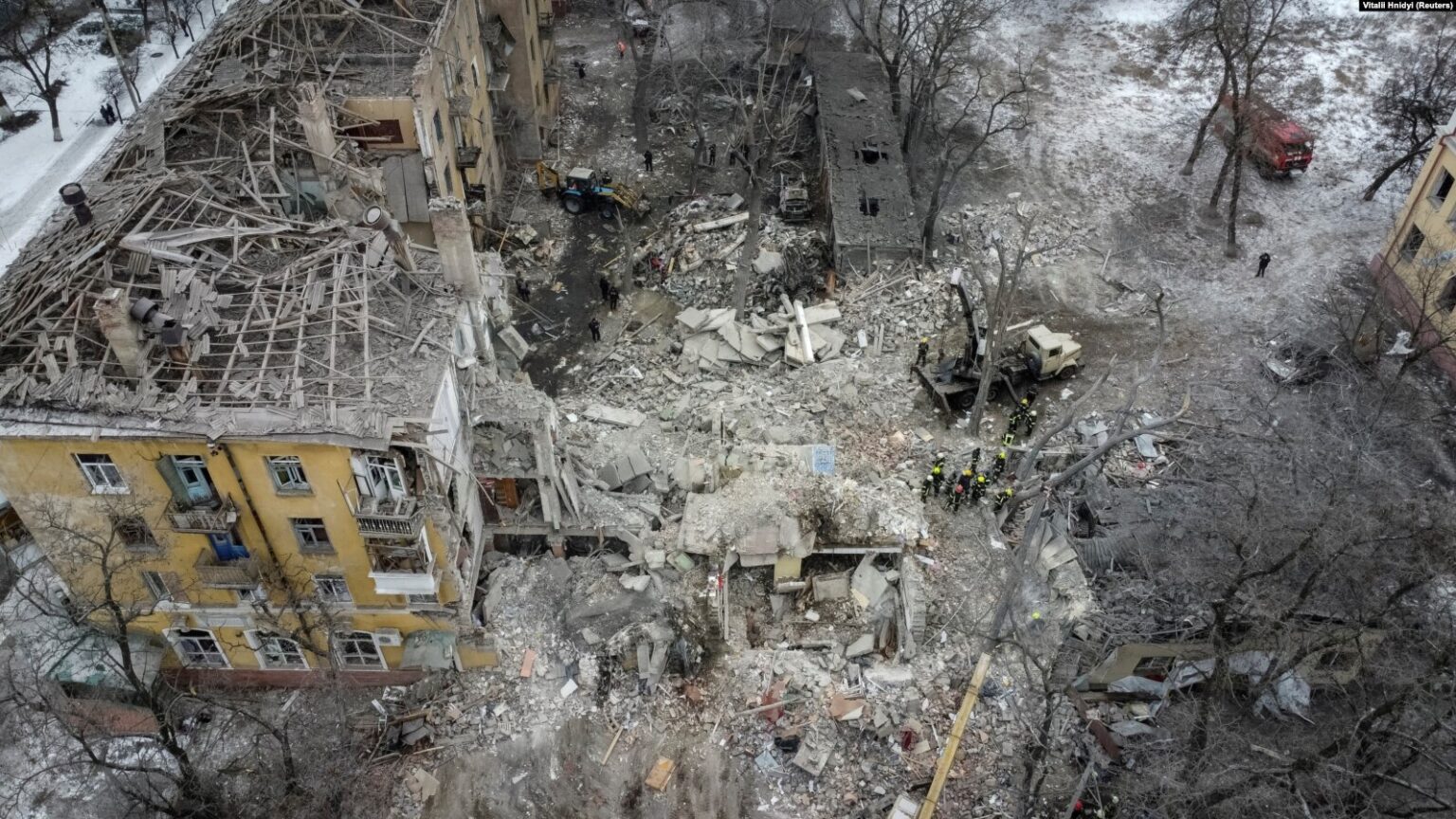
Aftermath of an Iskander-K missile hitting a residential building in Kramatorsk on 2 February 2023.[40]
The destruction resulting from the February and June shelling of the city using Iskander-K missiles was much lower than when its ballistic counterpart was used. For example, on 21 July 2022, Russian troops attacked Kramatorsk School № 23 with an Iskander-M missile. The photos below show the aftermath of that attack.
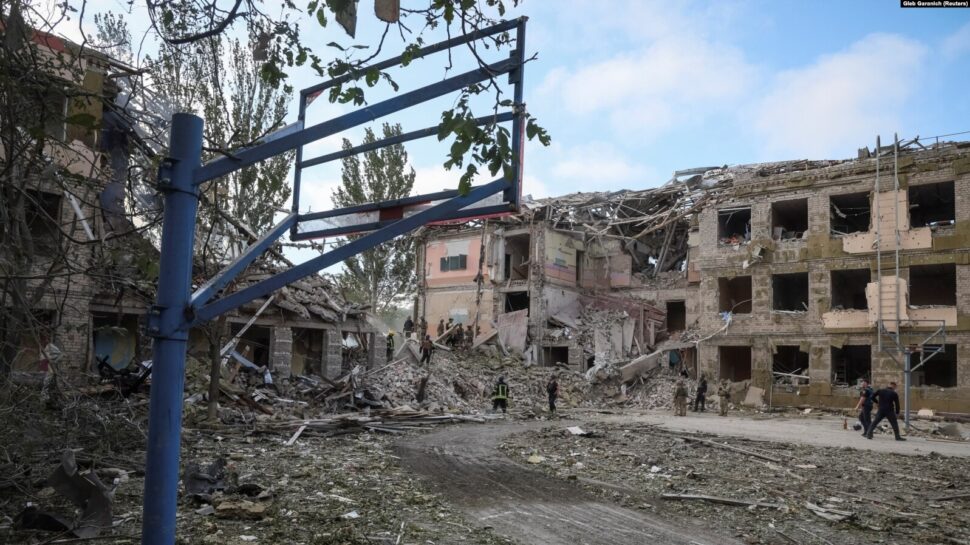
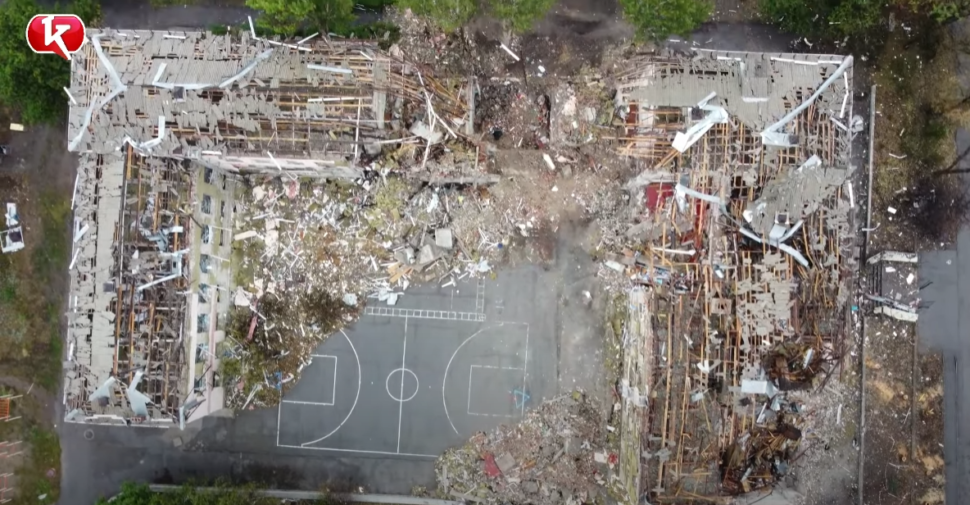

Source: Pavlo Kyrylenko
Naturally, when such comparisons are drawn, it is necessary to take into account the construction features of the buildings in question: the type of structure, the materials used for construction, etc. When an Iskander-K missile hit a residential building in Kramatorsk, at least four floors were destroyed in two sections. It should be noted that this building was mostly made from brick, which is more susceptible to destruction than concrete structures (as in the case of the Ria Lounge).
As for the attack on Kramatorsk School № 23 using an Iskander-M missile, at least three floors in four sections of the building ended up being destroyed. The photos show that the general destruction is much more significant compared to the strike on the residential building in Kramatorsk on 2 February 2023 and on the Ria Lounge on 27 June 2023. This provides an additional illustration of the destructive capacity of the Iskander-M and Iskander-K missiles.
Thus, comparing the consequences of the attacks on Kramatorsk and Bilenke on 27 June 2023 with episodes involving Iskander-M ballistic missiles, we can conclude that the latter cause more destruction and form larger craters. However, comparison with incidents we investigated when Iskander-K missiles were used reveals that the attacks had very similar aftermaths. This analysis leads us to believe that the attack on 27 June 2023, was carried out by the Russian Armed Forces with an Iskander-K cruise missile. At this stage, we can eliminate the version of events which supposes the use of an Iskander-M ballistic missile.
Debris
What further corroborates the version of events which supposes the use of an Iskander-K cruise missile is the fragments found on the site of the strike on Bilenke. A typical element of Iskander-K missiles is a characteristic rear end, namely a ring of the missile’s exhaust nozzles with installed rotation lifts of the four planes of the bar.[44] It is often the first large missile fragment to be found at an impact site.
For example, a large fragment, together with a part of the hull and an identical engine, was found at the site of a shelling attack on Merefa, Kharkiv Oblast, which took place on 18 March 2022. On that occasion, Conflict Intelligence Team pointed out that one of the fragments bore the inscription ‘9М728’, while photos from the impact site showed a fragment similar to the rear part of the R-500/9М728 cruise missile used with Iskander systems.[45]
Below are photos of the rear ends of Iskander-K cruise missiles found and identified at the sites of missile attacks across Ukraine.
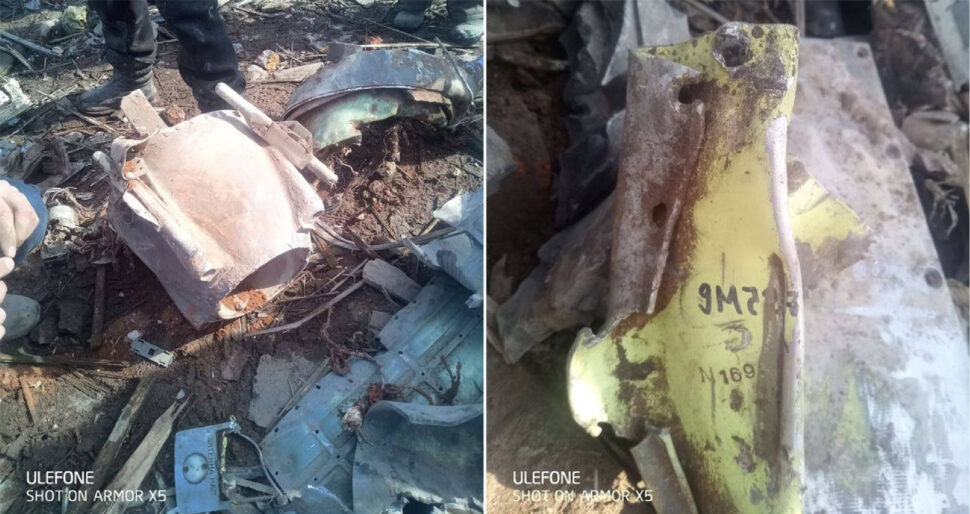
Characteristic debris and inscriptions of Iskander-K missiles found at a shelling site in Merefa, Kharkiv Oblast.[46]
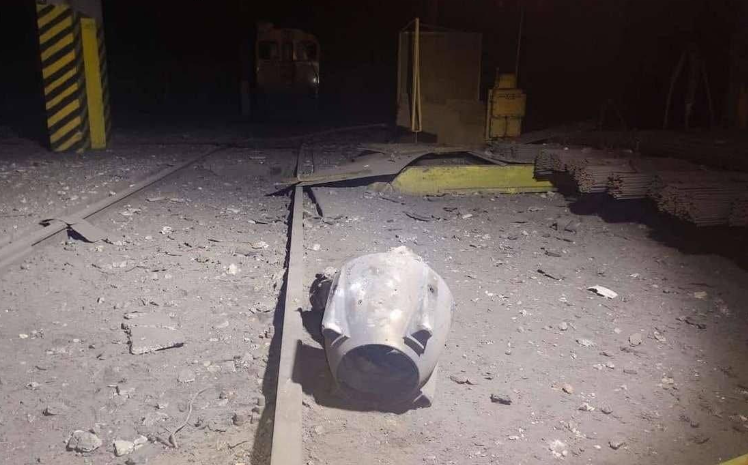
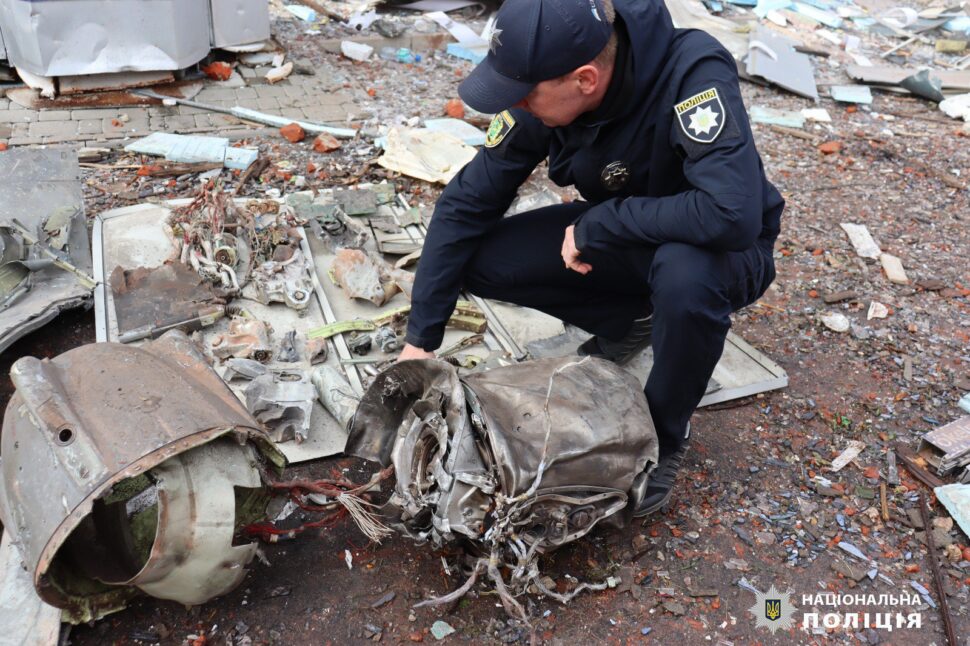
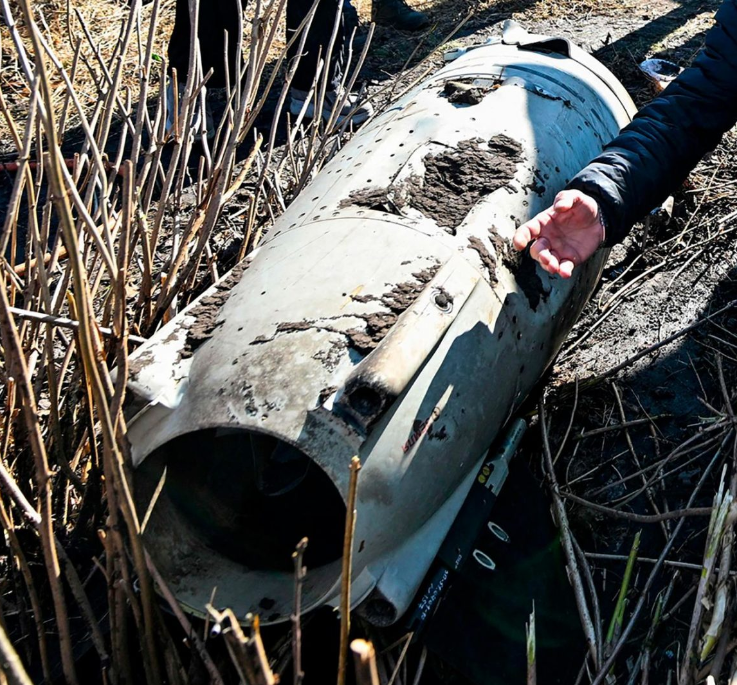
Open sources and materials obtained by Truth Hounds documenters from eyewitnesses to the attack on Kramatorsk on 27 June 2023, contain no photos or videos featuring fragments of the missile from its impact site at the Ria Lounge. However, Truth Hounds analysts obtained high-resolution photographs of the impact site in Bilenke from journalists from the Kramatorsk Post.[50] They show a fragment of the missile in the crater.
The comparative illustration below shows that the rear end found in Bilenke is identical to the ones previously observed at impact sites following shelling by Iskander-K missiles.
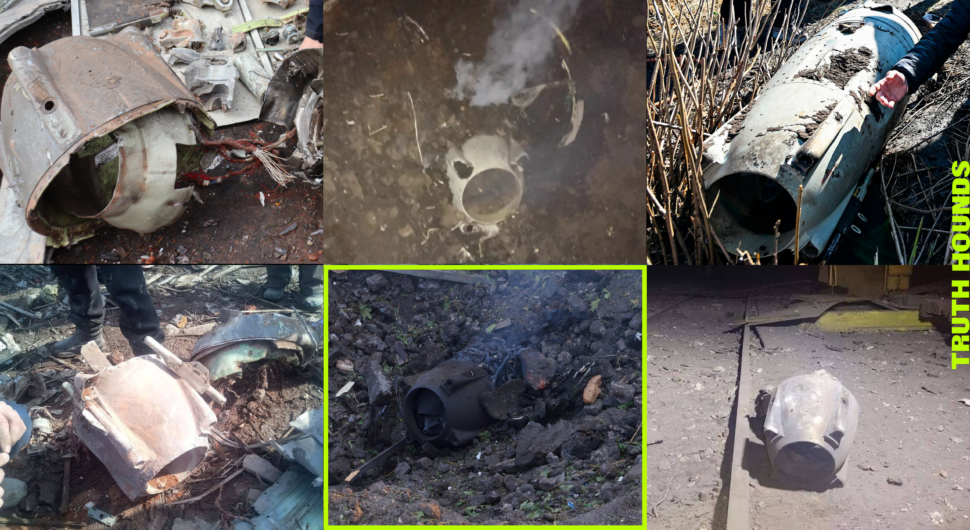
A comparative table of fragments of Iskander-K missiles. The fragment found in Bilenke is marked with a green square
Due to the lack of similar debris at the impact site in Kramatorsk, the weapon used cannot be identified with the same certainty. However, a combination of other characteristics, including a characteristic missile flight sound, the fact of its visibility while it approached its target, and the nature of the destruction caused, gives us every reason to believe that both Kramatorsk and Bilenke were attacked with Iskander-K cruise missiles.
Direction of the Strike
The next logical step to identify the perpetrators of the attack is to establish the direction from which the strikes on Kramatorsk and Bilenke were carried out. To this end, we analysed three types of data:
- Eyewitness testimonies;
- The contours and shapes of the craters; and
- The nature of the damage and location of debris.
At the same time, it is important to remember that Iskander-K cruise missiles can change their trajectory and manoeuvre while flying to the target.
One of the eyewitnesses (Witness Kr-000) told Suspilne journalists that he observed the missile himself because, at the moment of its flight, he was sitting outside next to his building at 53 Bohdana Khmelnytskoho Street in Kramatorsk:[52]
‘It was flying from over there — I thought a plane [points southward]. One second — and an explosion.’
During the field mission to Kramatorsk and Bilenke, Truth Hounds documenters once again spoke with eyewitnesses to the flights of both missiles. Taking into account their locations at that moment and testimony regarding the direction of the flights, we developed an illustrated map indicating the vector of the missiles’ flights.
Two unrelated witnesses living on Parkova Street in Kramatorsk[53] confirmed they saw the missile flying over their street towards the Ria Lounge. This was also confirmed by another witness who was on Aktiubynska Street at the time.[54]
The eyewitness who observed the flight of the missile in Bilenke said the following:[55]
‘The missile was flying from the direction of Bakhmut, Horlivka. The sound was similar to an aeroplane, maybe a bit quieter… I’m sure it was a cruise missile. The missile flew at an altitude of about 50–60 metres and then it started “landing” at an angle.’
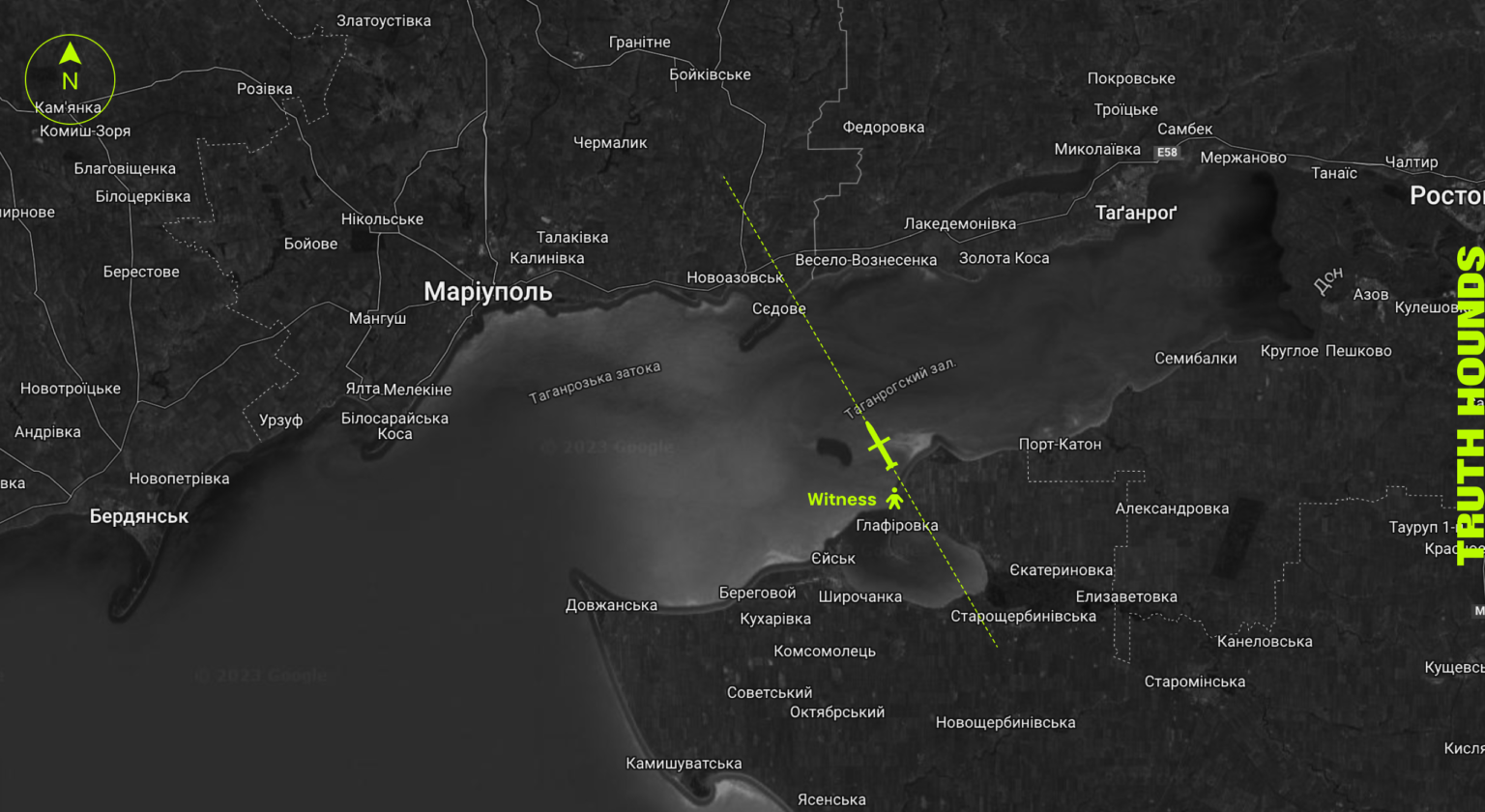
With the help of this testimony, we can establish the route of the missiles while approaching the target in Kramatorsk and Bilenke. Specifically, the testimony indicates that both missiles were moving from a southerly/southeasterly direction. As such, we can outline the potential sector where the Iskander launch systems were located — to the south and southeast of Kramatorsk.
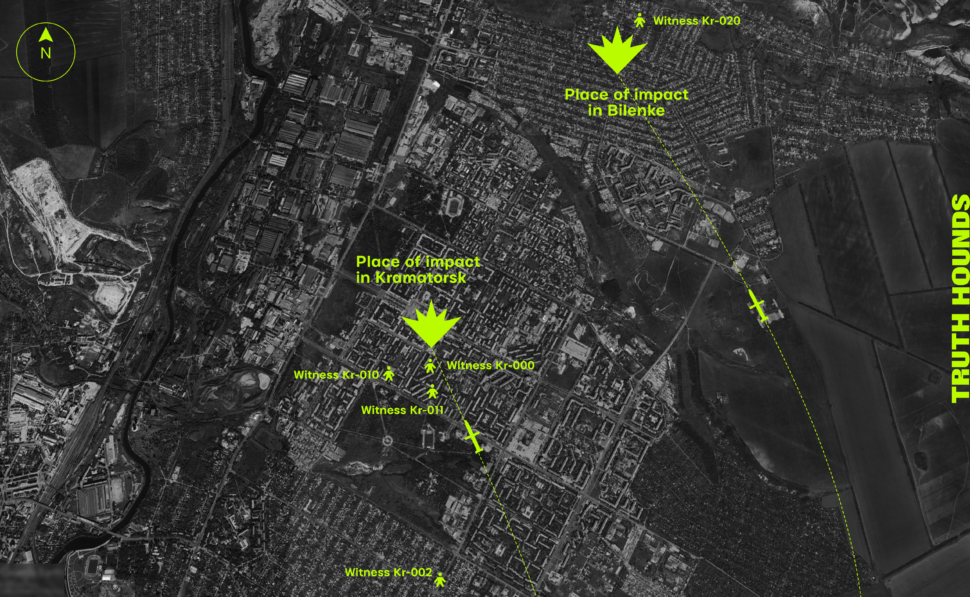
The directions of the approaches can also be established based on the configuration of the craters formed by the detonation of the warheads. The premises of the Ria Lounge are a ‘skeletal structure’ with monolithic reinforced concrete columns and monolithic flooring blocks. In technical and engineering terms, the Ria Lounge and the adjacent Kramatorsk Hotel are parts of one building constructed in 1957.[57] This is why the damage and destruction at both establishments are identical.
It should be noted that when a missile strikes a building, there is no ‘classical’ crater in an inverted conic shape, which makes establishing the vector of fire more difficult. However, even in complex residual ruptures resulting from a strike on a structure with spaces, there are certain indicators that can be used to establish the direction of the strike. Firstly, the scale and nature of destruction should be assessed, aspects which are easy to observe on surveillance footage taken by a drone.

Source: Rutube
The video shows the point where the missile entered the building. It is marked with a circle in the stills below. When a projectile strikes a surface at an acute angle and detonates, the blast wave usually spreads in the opposite vector to the direction of approach. If there is a wall or another vertical obstacle near the impact point, the wave will change its trajectory upon hitting it and will travel upward. The stills illustrate that the edges of the roof covering of the building next door are bent upward as a result of the blast wave and the roofing sheets themselves look as if they were first lifted and then fell ‘inside’ the building. The damage from the side of the approach is different: one can observe the uneven edges of the floors, some of which have fallen. We have also added an illustration that shows the mechanics of how the described damage occurred.
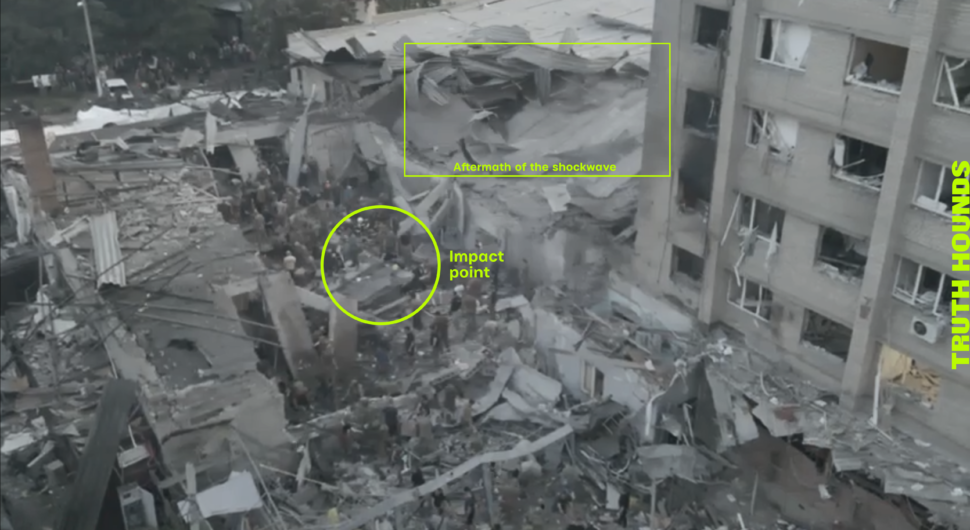
A still frame from footage taken by a drone, showing an angled aerial view of the point of impact of the missile and characteristic damage to the roof caused by the blast wave.[59]
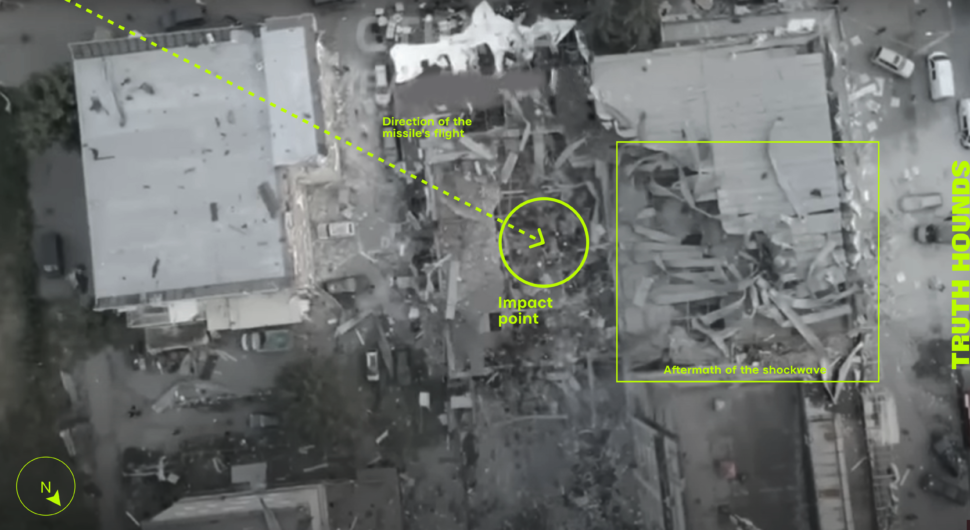
A still frame from footage taken by a drone, showing an angled aerial view of the point of impact of the missile and characteristic damage to the roof caused by the blast wave.[60]
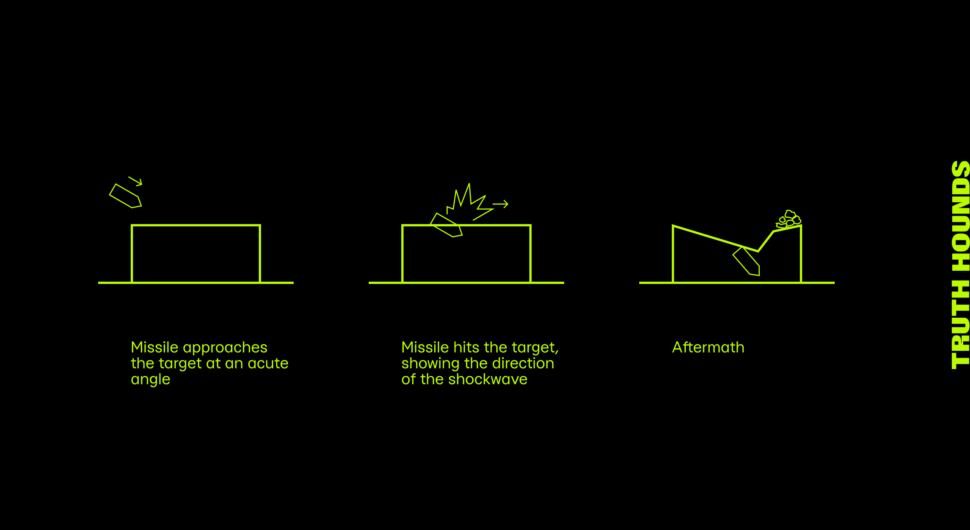
Mechanics of damage resulting from a missile strike at an acute angle. Idea borrowed from DeepState[61]
This analysis provides an additional confirmation of the direction from which the missile was flying: south/southeast. As for the missile that struck Bilenke, we can again refer to the testimony of an eyewitness cited above:
‘The missile was flying from the direction of Bakhmut, Horlivka. The sound was like an aeroplane, maybe a little lighter… I’m sure it was a cruise missile […] The missile flew at a height of 50–60 metres and then “landed” at an angle.’[62]
In addition to the direct indication of the direction of the flight, this testimony is also valuable because it contains mention of the missile approaching the target ‘at an angle’. As explained above, cruise missiles usually strike their target at an acute angle, forming an oval crater. In this case, the major axis of the oval will repeat the line along which the missile was moving in the final phase of its flight. Photos and videos taken by the Truth Hounds documenters at the strike site in Bilenke show that the major axis of the oval runs in the southeast-northwest direction. This indicates that the blow was delivered from one of these directions.
Based on what the eyewitness cited above said about the missile approaching from the direction of Bakhmut or Horlivka, which are located to the southeast of Kramatorsk, we can conclude that both missiles were launched from a southeasterly direction.
Estimated Sector of Missile Launch
The next logical step in the investigation is to narrow down the sector from which the missiles could potentially be launched. To accomplish this, we have to focus on the combat characteristics of Iskander-K missiles and calculate the speed of missile flight. Using this analysis, we identified which units of the Russian Army were equipped with an Iskander system and where these units (and, thus, the missile launch systems) were located on the day of the strikes on Kramatorsk and Bilenke. Having received a geographically defined sector of the probable launch, we compared it with information on the location of military units and thus eventually localised the approximate launch site, identifying the most likely perpetrators of the attack.
The maximum possible distance of the missile launch site from the impact point can be calculated using the arrival time and the speed of a specific type of missile.
On 27 June 2023, the air alert in Kramatorsk ended at 19:14[63] (following the conclusion of the air threat). Thereafter, air reconnaissance equipment switched from enhanced monitoring mode to regular mode (or was redeployed). At 19:29, eighteen minutes following the end of the air alert — a sufficient time for people to leave shelters — the explosion in the Ria Lounge took place.
Knowing the peculiarities of Ukrainian air defence, the Russian Armed Forces often resort to the most unpredictable and unexpected strikes, launching missiles after the suspension of air alerts. This tactic is used to maximise the number of victims. Russian troops carried out attacks in a similar manner on Mykolaiv,[64] Kharkiv,[65] Kherson,[66] and other Ukrainian cities. In each of the listed cases, the main victims of the attack were civilians or civilian objects.
In view of this, we can consider the earliest possible time of the missile launch to be 19:14 (27 June 2023) — after the end of the air alert, when air defence tracking systems switched from enhanced to regular mode. Considering the fact that the missile hit Kramatorsk at 19:29, the maximum time it could spend in flight unnoticed by Ukrainian anti-aircraft systems would be 15 minutes. The usual speed of an Iskander-K missile is 250 m/s (15 km/minute). Therefore, the maximum flight distance of the missile from the launch point to the impact point in this case would be 270 km.
Given that the missiles approached their targets from the southeast and taking account of the established maximum possible distance to the launch platform, the launch site of the two Iskander-K missiles can be narrowed to either somewhere in the occupied part of Ukraine’s Donetsk Oblast or in Russia’s Rostov Oblast or Krasnodar Krai.
We can confidently assert that the missiles could not have been launched from an area closer than 100 km to the southeast of Kramatorsk and Bilenke. This would mean bringing the Iskander missile systems to critically dangerous locations, where they could become an easy target for Ukrainian forces. Their use from areas deeper into the temporarily occupied part of Donetsk Oblast is also unlikely. This is due to the fact that an entire division equipped with Iskander missile systems was destroyed after its attempted deployment to Chernihiv Oblast in March 2022,[67] as well as because Ukraine articulated its position that it would not be able to strike these systems on Russian territory using the long-range systems provided by its allies. By comparison, in June 2023, spokesman for the Air Force of the Armed Forces of Ukraine Yurii Ihnat said that Ukraine would strike these systems if they were deployed on the temporarily occupied territories.[68] Therefore, using Iskanders from the territory of Russia itself presents a much safer option for the Russian military.
The distance from Kramatorsk to Ukraine’s southeastern border with Russia is approximately 140 km. Using this distance in the formula used for the above calculations, we find that the missiles fired at Kramatorsk could not have reached the targets in less than 9 minutes.
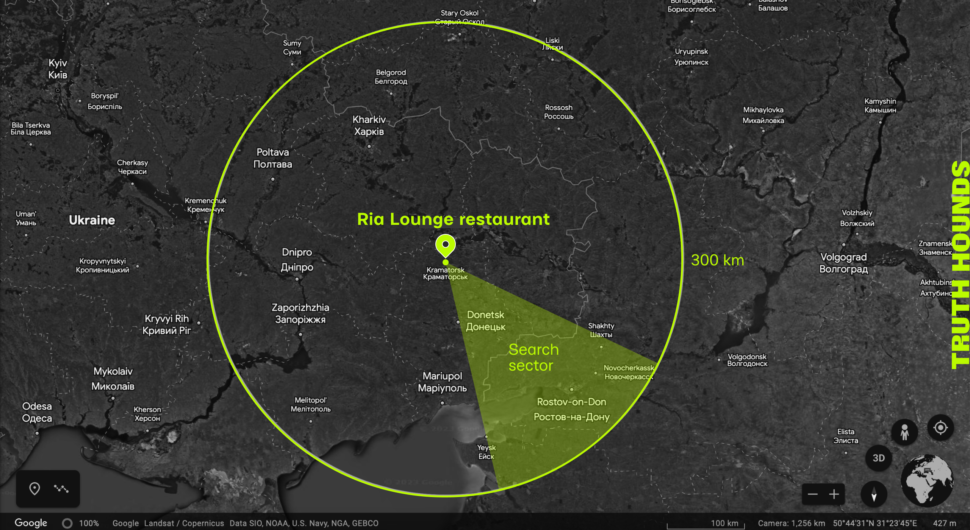
Search area of the Iskander missile system used to launch missiles on Kramatorsk and Bilenke
Searching for the Unit responsible for the Attack
Having identified the type of weapon used in the attack, as well as the approximate launch area of the two Iskander-K missiles, we can focus on identifying the Russian military units equipped with this type of missile. In the Russian Armed Forces, such military units are missile brigades, part of the combined arms armies of various units of the Russian Armed Forces.
There is no comprehensive information available from open sources regarding the specific missile brigades participating in Russia’s full-scale war on Ukraine. However, in the period from January to February 2022, the open-source intelligence (OSINT) community counted at least 60 Iskander missile systems brought to the borders of Ukraine to support the Russian invasion.[69] Messages regarding the participation of certain missile brigades in attacks on Ukrainian territory occasionally appear on the official Telegram channel of the Russian Ministry of Defence. For example, there are publications concerning shelling conducted using Iskander systems by brigades belonging to the Western Military District,[70] Southern Military District,[71] Eastern Military District,[72] and Central Military District.[73]
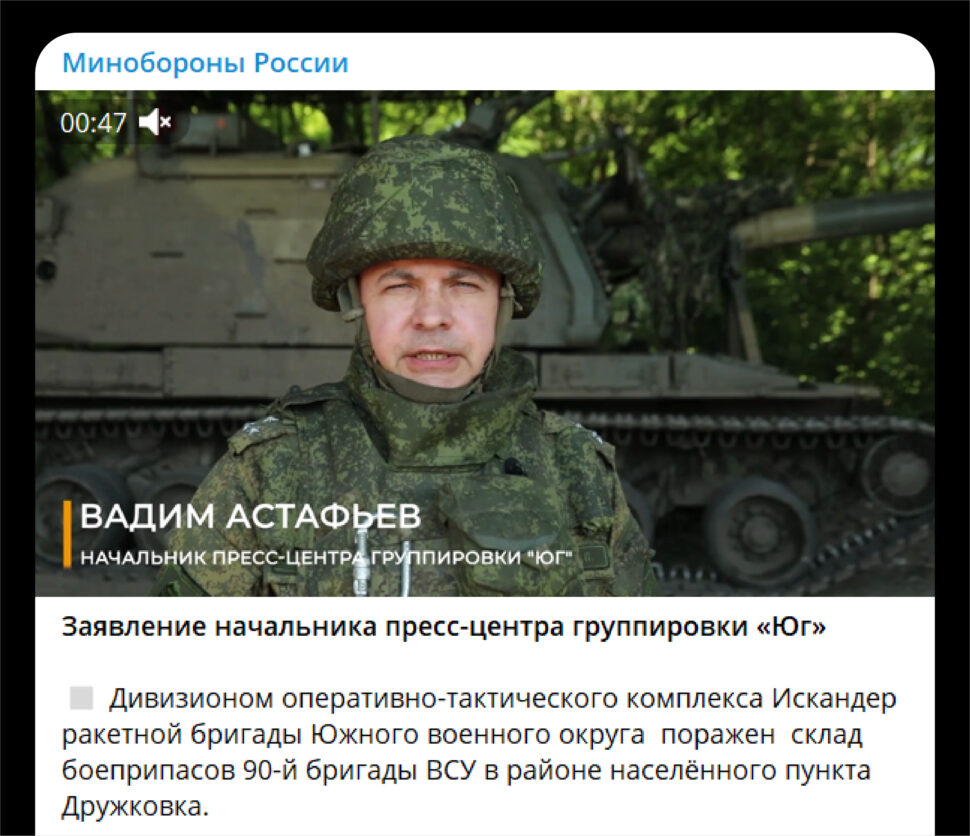
Example of such publication
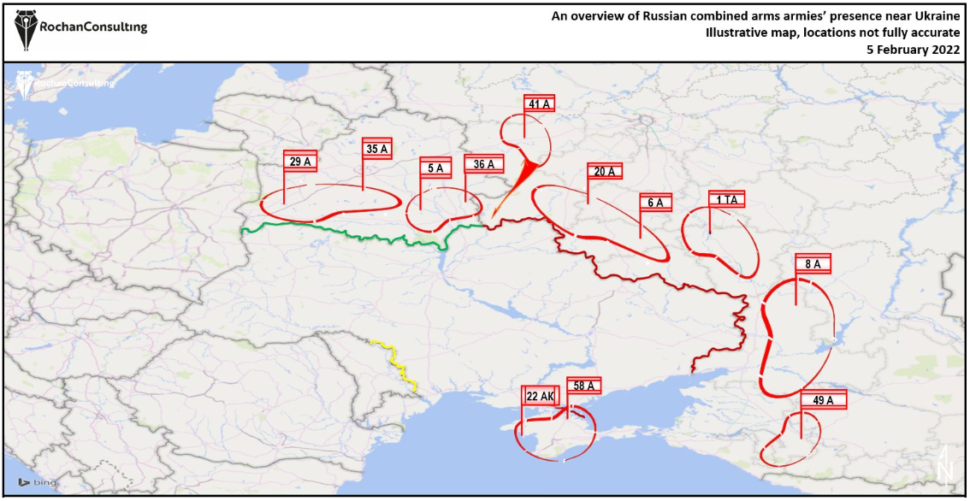
Deployment of the combined arms armies of the Russian Federation prior to Russia’s full-scale invasion of Ukraine.[74]
Mentions of the combat engagement of Russian missile brigades armed with Iskanders in specific areas also occasionally appear in other sources. For example, on 24 July 2023, the head of the press centre of Russia’s ‘West’ Military Group reported that the group’s missile forces carried out two ‘Iskander-M’ strikes on Honcharivske, Chernihiv Oblast.[75]
As of 26 February 2023, at least 44 units equipped with the missile system had been actively engaged during Russia’s full-scale invasion of Ukraine, while another 60 units were in operational reserve.
All five groups of troops participating in the temporary occupation of Ukrainian territories include a certain number of missile brigades. Below, we illustrated the operating areas of each group, the units they are composed of, and the number of missile systems at their disposal. Information presented in the images was obtained from the sources incorporated in the footnote.[76] [77]
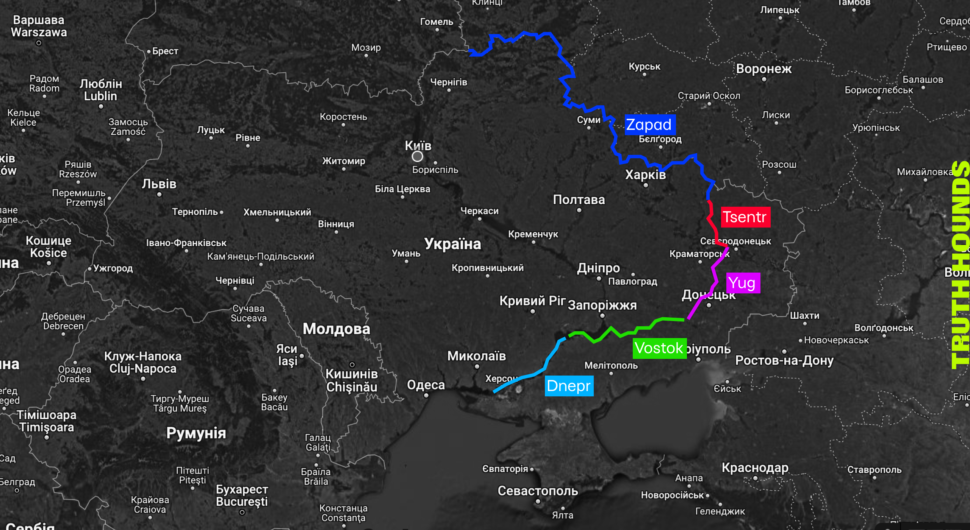
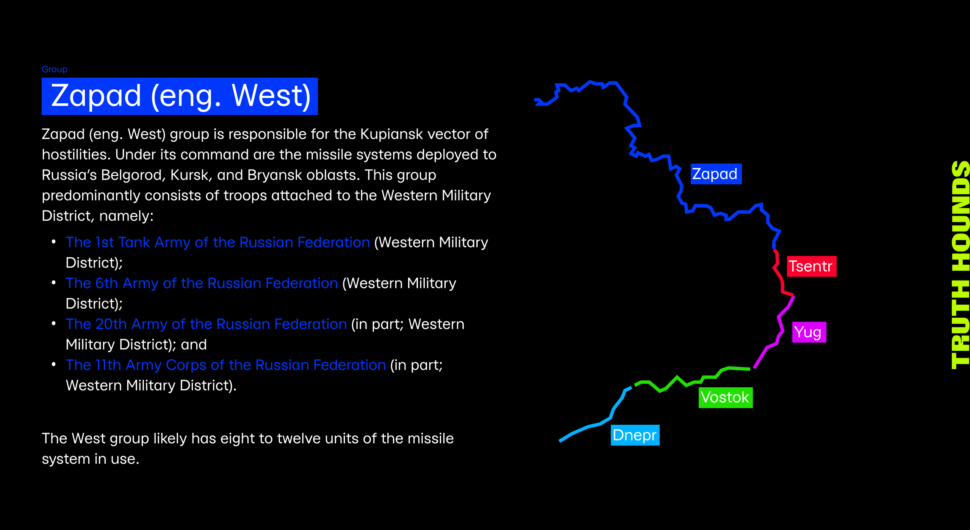
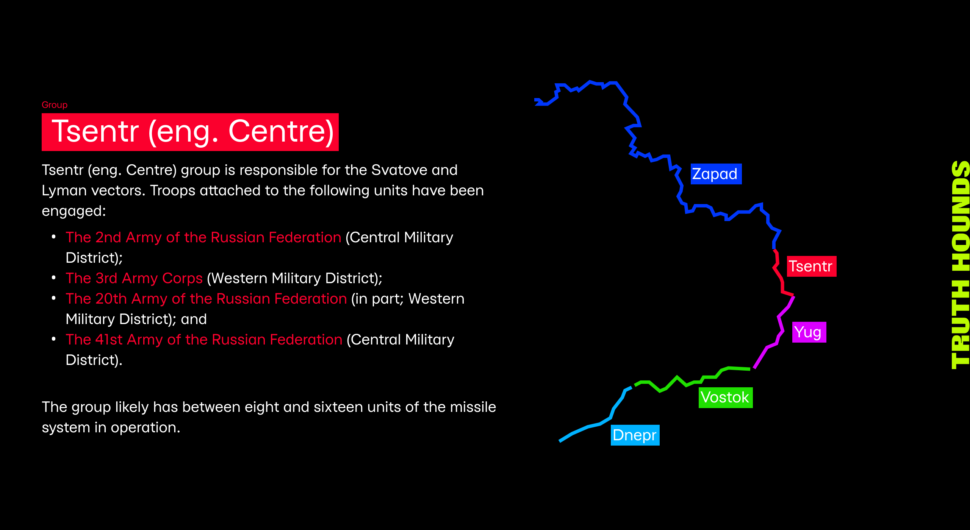
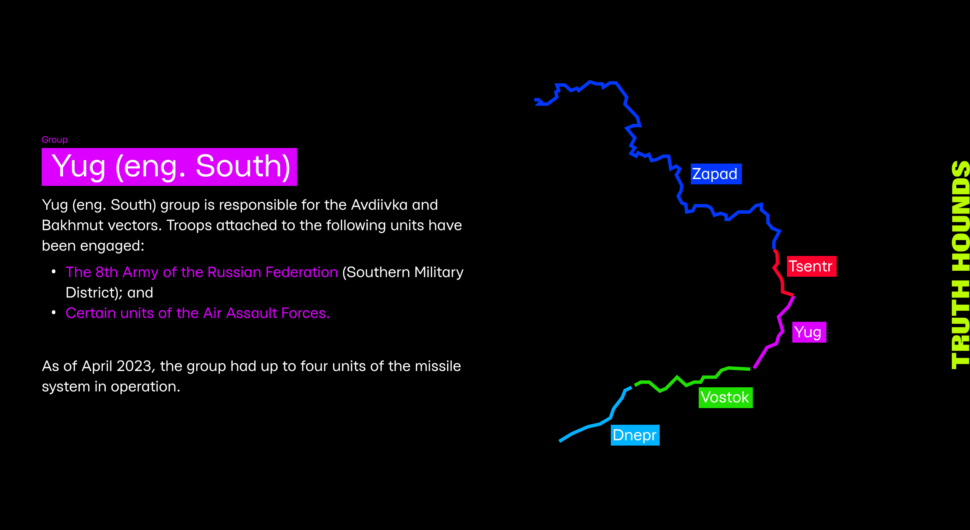
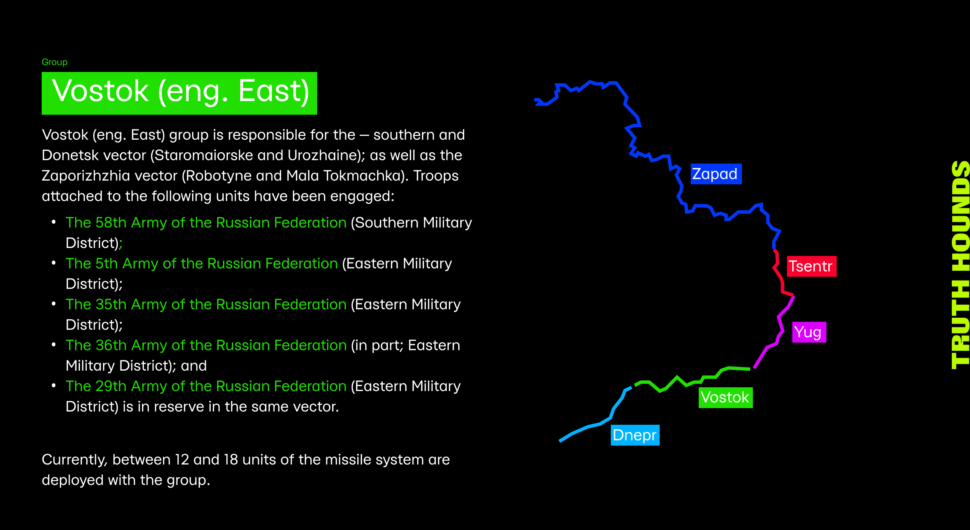
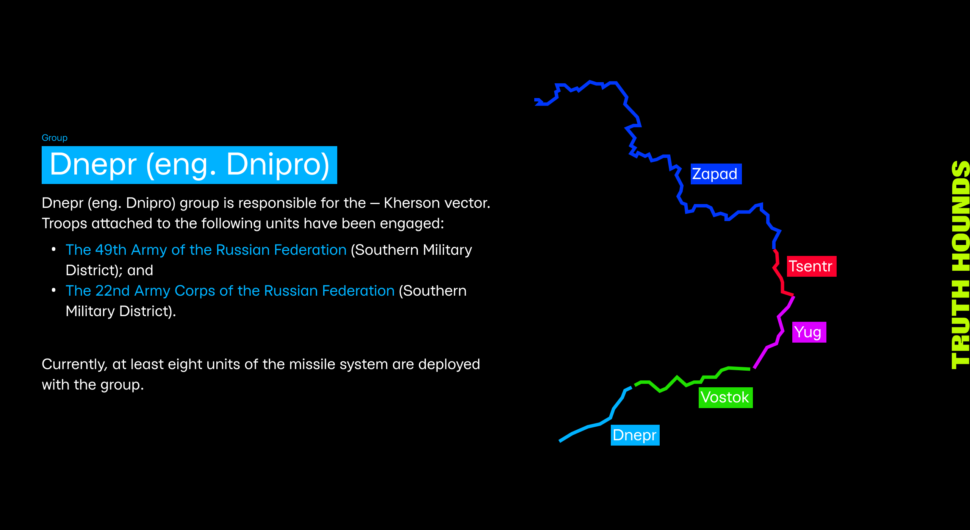
It should be noted that in order to strike Ukraine, Iskander missile systems were frequently moved not only significantly far from their locations of permanent deployment, but also further from some parts of the frontline than to others. This results in a need to analyse the involvement of each of the aforementioned missile brigades in hostilities on the territory of Ukraine, ascertain their locations of deployment, routes, and timelines of movement. By going through these steps, Truth Hounds investigators established that most of them could not have been involved in the missile attack on Kramatorsk on 27 June 2023 or that their involvement would be highly unlikely. This is based on the following facts:
- The identified missile brigades were and/or are currently responsible for a different vector of attack against Ukraine;
- As a result of the offensive actions of the Ukrainian Army, the specific formation of Russian troops supported from the air by missile brigades had been defeated by the Defence Forces of Ukraine; and/or
- Active hostilities in Ukraine had ceased.
For example, the 119th Rocket Brigade, belonging to the 41st Army of the Russian Federation, was responsible for the Chernihiv vector at the beginning of the full-scale invasion.[78] Later, the army was to the Kharkiv vector and, as of June 2023, it was responsible for the Svatove-Kreminna line.[79] The last known location of the Iskander systems operated by the 119th Rocket Brigade, as of February 2022, was the city of Yelnya in Russia’s Smolensk Oblast.[80]
The 448th Rocket Brigade, which belongs to the 20th Army of the Russian Federation, has been shelling Ukraine from the north — specificially from Russia’s Kursk and Oryol oblasts — since the very beginning of the full-scale invasion.[81] As of June 2023, it is partially present in Luhansk Oblast (operating up to eight missile launchers).[82]
The 152nd Rocket Brigade of the 11th Army Corps is deployed in the same direction.[83] Back in the summer of 2022, the Armed Forces of Ukraine successfully eliminated the head of the brigade’s command post.[84] Later, during its counteroffensive in Kharkiv Oblast, the Defence Forces of Ukraine successfully captured servicemen belonging to the 152nd Rocket Brigade, proving the vector and engagement of this brigade in the armed conflict.[85]
Since 24 February 2022, the 20th Guards Rocket Brigade, as part of the 5th Army of the Russian Federation, actively participated in offensive operations against Ukraine, first in the northern vector and then in the Kharkiv vector.[86] Later, almost the entire army was redeployed to the temporarily occupied part of Donetsk Oblast for defensive actions in the areas of Velyka Novosilka and Staromlynivka.[87] In the fall of 2022, one Russian serviceman gave thanks for the assistance of volunteer to the units on behalf of the 305th Artillery Brigade and the 20th Guards Rocket Brigade, essentially corroborating the participation of the 20th Guards Rocket Brigade in the armed conflict.[88] As of the summer of 2023, the 305th Artillery Brigade was located near Staromlynivka, Donetsk Oblast.[89] At the same time, there was no information available regarding the presence of the 20th Guards Rocket Brigade in the same area. However, taking into account the fact that, in June 2023, the entire 5th Army of the Russian Federation conducted combat operations in the area of the administrative border of the temporarily occupied parts of the Zaporizhzhia and Donetsk oblasts, we can assume that, most likely, the 20th Guards Rocket Brigade is located in that area. This is further explained by the fact that each of the Russian armies (joint military units) has only one missile (rocket) brigade armed with Iskander missile systems. According to Russia’s military doctrine, in most cases, they are tied to the location of the army, since they are indispensable for the entire military contingent. Thus, using information about the area of responsibility of a specific combined arms army, we can obtain an approximate idea of the area where certain missile brigades were operating.
As for Russian units defeated by the Ukrainian army, one such example is the 1st Tank Army, engaged in the offensive in the Lysychansk-Sievierodonetsk vector, with the participation of the 112th Guards Missile Brigade.[91] In September 2022, following the Ukrainian Army’s successful counteroffensive in Kharkiv Oblast, most units of the 1st Tank Army were defeated and were redeployed for recovery. A similar situation arose with the 20th Army of the Russian Federation, which included the 448th Rocket Brigade, which was defeated near Lyman in September 2022.
The 117th Rocket Brigade was part of the 35th Army of Russian Federation, which had advanced on Kyiv via Chernihiv Oblast. However, after being defeated in the spring of 2022, it was relocated to the Kharkiv vector. In the summer of the same year, official sources in Ukraine, as well as Western experts, reported the complete destruction of the 35th Army.[92]
The same occurred with the 36th Army of the Russian Federation, which included the 103rd Rocket Brigade, which had advanced from the north towards Chernihiv.[93] In March 2022, the deputy commander of the headquarters of the 103rd Rocket Brigade was eliminated,[94] while the remnants of the 36th Army, defeated in the north of Ukraine, were redeployed to the eastern vector.[95] However, in the autumn of 2022, they were defeated again in their new operating area.[96] Currently, the 36th Army is trying to hold the lines in the areas of Novodonetske and Staromaiorske in Donetsk Oblast, as well as the village of Pryiutne in Zaporizhzhia Oblast. There is currently no information available on the operation of the 103rd Rocket Brigade.
Russian missile brigades which completely ended their participation in the war on Ukraine include, in particular, the 3rd Missile Brigade of the 29th Army of the Russian Federation, which had advanced on Kyiv in February-March 2022.[97] Subsequently, the unit was relocated to the south of Ukraine, as confirmed by reports of the destruction of the Army’s command points in the Zaporizhzhia vector.[98] The online publication Texty reported on the deployment of the 3rd Missile Brigade.[99] The 29th Army is currently in reserve in the Zaporizhzhia vector. Therefore, it is unlikely that the 3rd Missile Brigade is actively involved in the armed conflict at present, even if its precise location is currently unknown.
By excluding the aforementioned brigades from the list of potential perpetrators of the strike on Kramatorsk and Bilenke and using the information about the southeasterly direction of the missiles’ approach, we can narrow the list down to four units armed with Iskander systems, namely: the 1st Guards Rocket Brigade, the 12th and 47th Missile Brigades, and a separate division of the 22nd Army Corps.
All of these units belong to the Southern Military District of the Russian Army, though they are attached to different groups of troops. The area of responsibility of this district in Russia’s war against Ukraine is Ukraine’s southern and eastern regions. Below is information on the four indicated units:
- The 1st Guards Rocket Brigade (Military Unit № 31853) belongs to the 49th Army of the Russian Federation, which is involved in the defence of the temporarily occupied parts of Kherson Oblast. The brigade itself is stationed near the village of Molkino, Krasnodar Krai;
- The 12th Missile Brigade (Military Unit № 25788) belongs to the 58th Army of the Russian Federation, which operates in the Zaporizhzhia vector. The brigade is stationed in the city of Mozdok, North Ossetia. The deputy commander is Kamil Amirov;[100]
- The 47th Missile Brigade (Military Unit № 52453)belongs to the 8th Army of the Russian Federation, which operates in the Donetsk vector. The brigade is stationed in the city of Korenovsk, Krasnodar Krai. The commander is Colonel Vitaliy Bobyr;[101].
- A separate missile division belonging to the 22nd Army Corps is located in the temporarily occupied Autonomous Republic of Crimea, Ukraine.[102]
This information has been obtained from open sources. At the time of publication, all four units were operating in the indicated vectors.
Narrowing the list down to four units brings us closer to identifying the perpetrators of the attack on Kramatorsk and Bilenke. We can immediately eliminate the possibility of a strike by the forces of the separate missile division within the 22nd Army Corps located in Crimea, since, geographically, it is southwest of Kramatorsk, while all the witnesses and established facts point to the missiles coming from the southeast. A version of events which supposes that the two Iskander-K missiles that struck Kramatorsk and Bilenke on 27 June 2023 were launched from Crimea and programmed to change their trajectory while approaching their targets seems unlikely. Such a scenario would contradict the above calculations which find a maximum distance of 270 km between the launch site and the points of impact, since the distance between Kramatorsk and the coast of Crimea is over 370 km.
In addition, considering the presence of Russian units armed with Iskander missile systems closer to the targets (which will be explained further), this scenario appears illogical, since the longer missiles are in the air, the greater the chance of them being detected and intercepted by air defence systems.
The 49th Combined Arms Army of the Russian Southern Military District,[103] which includes the 1st Guards Rocket Brigade, was also responsible for combat operations in the south of Ukraine, namely in the Kherson and Mykolaiv vectors. Therefore, its involvement in the shelling on 27 June 2023 can also be disproved.
It is known that the majority of Iskander systems that strike southern Ukraine are located in Crimea, particularly in Dzhankoi Raion.[104] These attacks are most likely carried out by the joint forces of the separate missile division of the 22nd Army Corps, with the additional engagement of Iskander missile systems located in Crimea and operated by the 1st Guards Rocket Brigade of the 49th Combined Arms Army of the Russian Federation. A missile battery consisting of two Iskander launchers and two missile loaders was spotted in the temporarily occupied Crimea a week before the February 2022 invasion.[105]
We were able to establish that before the beginning of the full-scale invasion, at least one division of the 1st Guards Rocket Brigade of the 49th Army of the Russian Federation was relocated to the military base Kapustin Yar in Astrakhan Oblast for training. This is confirmed by official statements by the Russian Ministry of Defence.[107] Of course, it cannot be ruled out that some of these Iskander systems were later transported to Crimea to support the Russian troops in the Kherson vector, for which the 49th Army was and remains responsible.[108]
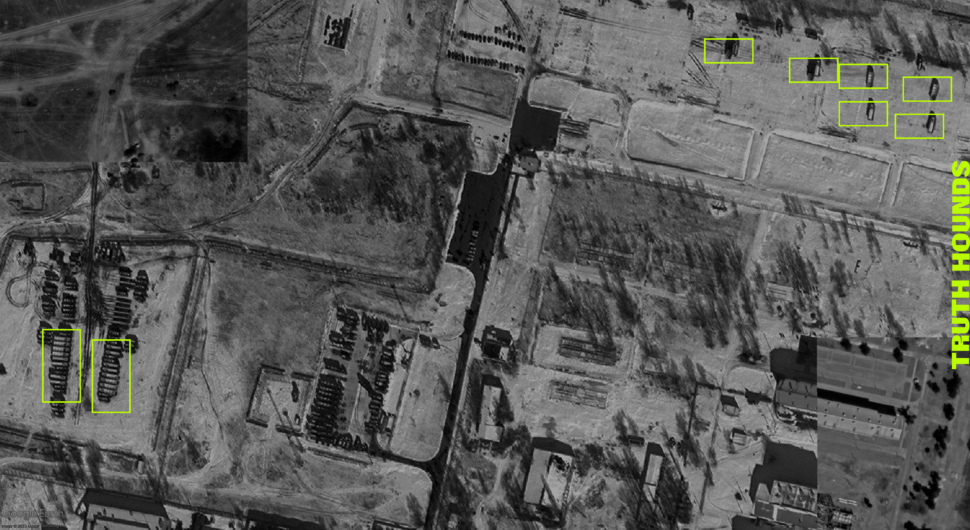
A satellite image of the Kapustin Yar military base on 14 February 2022. It shows at least three divisions of Iskanders, two of which belong to the military unit permanently stationed at Kapustin Yar.[109]
Satellite images of Kapustin Yar from 14 February 2022 also confirm the presence of at least one additional division of self-propelled Iskander missile launch systems. At the same time, their number at the military base in Molkino, Krasnodar Krai, where the 1st Guards Rocket Brigade is stationed, is not significant; images from 2022-2023 show only one self-propelled launch system and one Iskander loader.
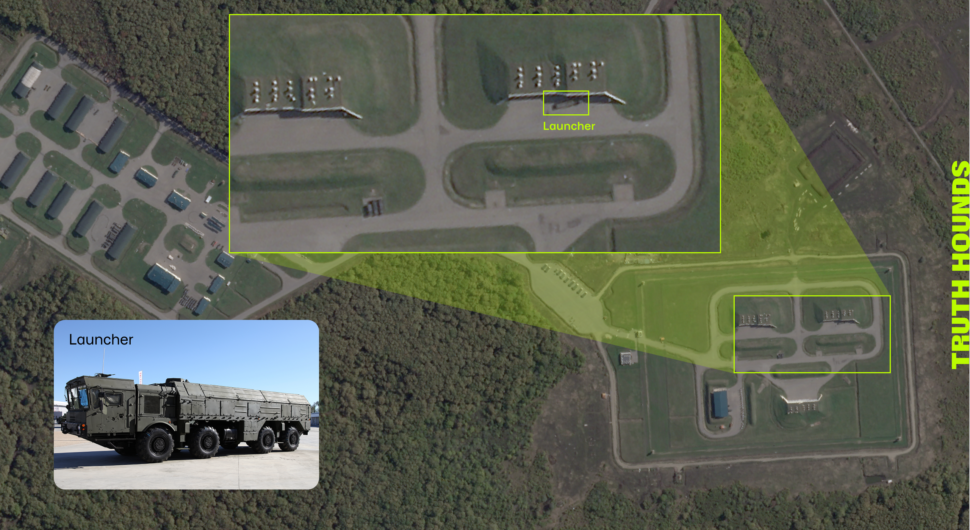
Military base of the 1st Guards Rocket Brigade of the 49th Army of the Russian Federation (Molkino, Krasnodar Krai). One Iskander launch unit can be seen next to the hangar. Photo by: Planet, 15 October 2022
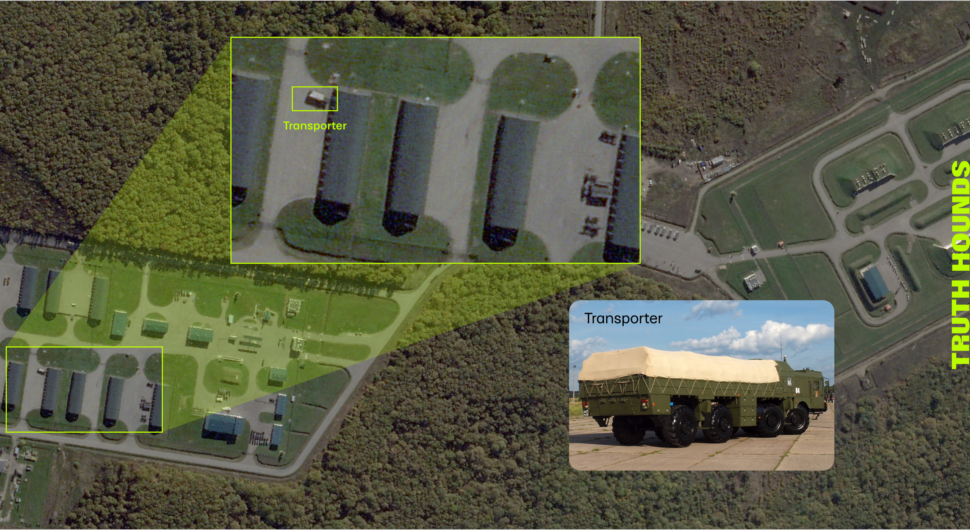
Military base of the 1st Guards Rocket Brigade of the 49th Army of the Russian Federation (Molkino, Krasnodar Krai). One Iskander loader can be seen next to the hangar. Photo by: Planet, 22 October 2022
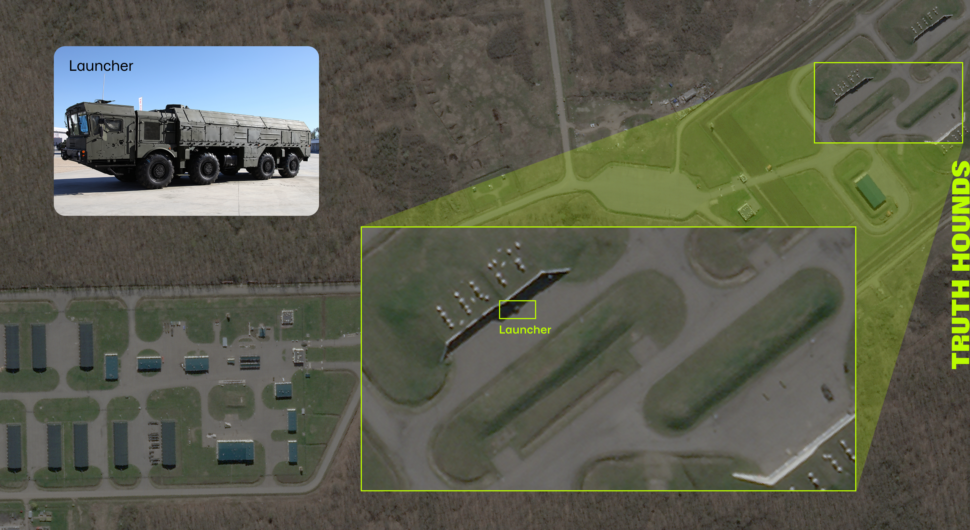
Military base of the 1st Guards Rocket Brigade of the 49th Army of Russia (Molkino, Krasnodar Krai). You can see an Iskander launch unit leaving the hangar. Photo by: Planet, 01.04.2023
Missiles being fired at Kramatorsk and Bilenke from the area where the 1st Guards Rocket Brigade is stationed seem unlikely for the same reasons as the launch from Crimea. What is more, it makes little sense to launch any Iskanders from the area of Molkino at targets in Ukraine. Firstly, the distance to the frontline alone is almost 400 km (the declared maximum range of Iskanders being 500 km). Secondly, the Russian military has more convenient Iskander launch sites, namely in Crimea, Rostov Oblast, or at another base in Krasnodar Krai — in the city of Korenovsk (47th Brigade) — located closer to Ukraine.
The area of responsibility of the 58th Army of the Russian Federation, along with its 12th Missile Brigade, is the Zaporizhzhia vector, with its headquarters located in the occupied city of Melitopol.[110] There is information available in open sources that in the summer of 2022, several Iskander launch units were spotted near Pryazovsk, Zaporizhzhia Oblast.[111] The UA Control Map from Project Owl OSINT shows the location of the 12th Missile Brigade — along with other units of the 58th Army — in support of the attack in the Zaporizhzhia direction.[112] As already noted, missile brigades belonging to a specific army normally operate in the same vector as all of its other units. For this reason, the involvement of the 12th Missile Brigade in the attack on Kramatorsk and Bilenke seems unlikely. In addition, the operational area of the brigade does not fit with the flight trajectory of the missiles that struck Kramatorsk and Bilenke.
The location of permanent deployment of the 12th Missile Brigade is the city of Mozdok in North Ossetia. Satellite images show that, as of the end of June 2023, at least one missile division (with four self-propelled Iskander launchers) of the 12th Missile Brigade was stationed there. It can still be argued that Iskander missiles from this base were not launched at Ukraine, since the distance between Mozdok and the frontline (750 km) exceeds the maximum flight distance of these missiles (500 km).
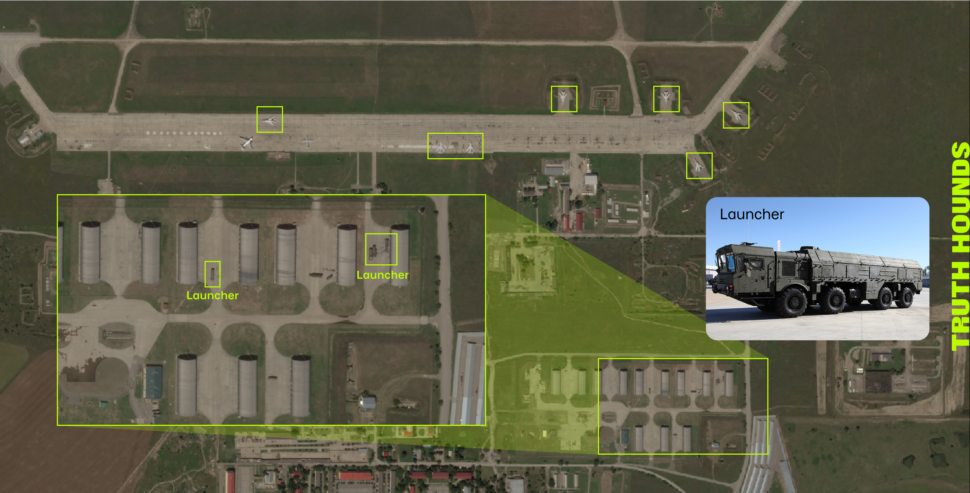
Planet satellite image from 21 June 2023, showing the military base of the 12th Missile Brigade (Mozdok, North Ossetia), with at least four Iskander launchers visibile, as well as seven Tu-22M3s
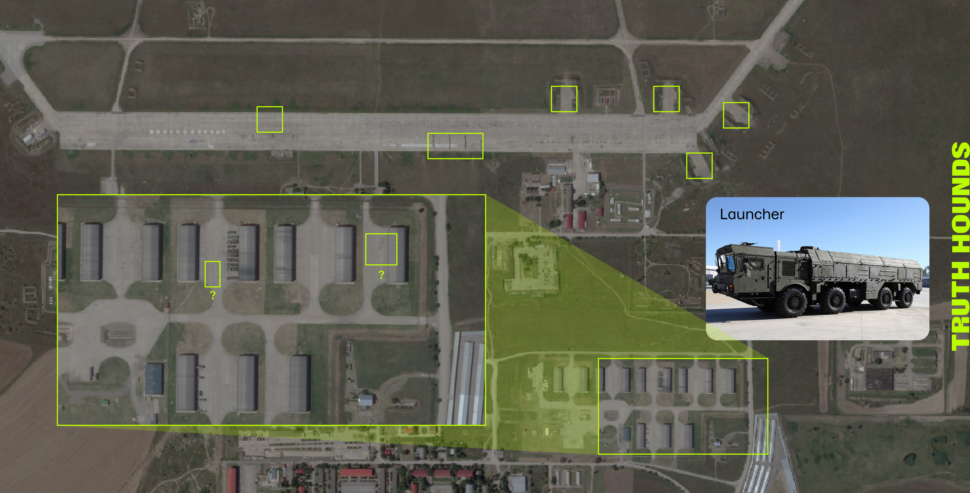
Planet satellite image from 7 July 2023, showing the military base of the 12th Missile Brigade (Mozdok, North Ossetia). No Iskander is visible
Thus, by checking the likelihood of involvement of various missile brigades of the Russian Armed Forces in the attack on Kramatorsk and Bilenke, we can arrive at the conclusion that the most likely version of events is that it was carried out by the 47th Missile Brigade of the 8th Guards Combined Arms Army of Russia. The following facts corroborate this version.
First, numerous publications on the official channels of the Russian Ministry of Defence indicate that it was units of the 8th Army who were responsible for the Donetsk vector. For example, on 4 June 2023, the official Telegram channel of Russia’s Ministry of Defence published a video with a report from the spokesman of the South group (which includes the 8th Army), responsible for hostilities in the Bakhmut and Avdiivka vectors. It said that an Iskander division of a missile brigade of the Southern Military District carried out a successful strike on an ammunition depot of the Armed Forces of Ukraine near Druzhkivka, Donetsk Oblast (less than 10 km from Kramatorsk).[113] This was preceded by a report that, in April 2023, missile units belonging to the South group attacked the city of Kostiantynivka (15 km from Kramatorsk).[114]
Second, the United States Congress published data about the 8th Combined Arms Army forces concentrated near the eastern borders of Ukraine prior to the invasion of February 2022.[115] According to their data, armed units of Russian proxies from the so-called ‘Donetsk People’s Republic’ (‘DNR’) were also under the command of the 8th Army. This is consistent with the testimony about the Ukrainian informant in Kramatorsk, who, according to the Security Service of Ukraine, was adjusting fire on the Ria Lounge. It is likewise consistent with the fact that his point of contact was a Russian military servant located on the territory occupied by the ‘DNR’.[116]
47th Missile Brigade of the 8th Army of the Russian Federation
All units of the 8th Army of the Russian Federation involved in the armed conflict are located in the areas of the cities of Donetsk, Avdiivka, and Mariinka, namely: the 1st Donetsk Army Corps, 20th Motorised Rifle Division, 150th Motorised Rifle Division, and 238th Artillery Brigade, which operates within the same military unit together with the 47th Missile Brigade.[117]
The brigade is permanently stationed in Korenovsk, Krasnodar Krai. It is armed with at least 12 Iskander self-propelled missile launchers, which constitutes three missile divisions with two batteries in each. A missile battery consists of two self-propelled launchers and two loaders. Russia’s Deputy Minister of Defence Alexey Krivoruchko reported that the brigade had 12 missile launchers at its disposal. Back in August 2021, he published information that an (at the time) unspecified unit would receive a new brigade set of Iskanders (12 launchers).[118] At the end of 2021 and in early 2022, it was identified that the 12 Iskanders had been supplied to the 47th Missile Brigade.[119]
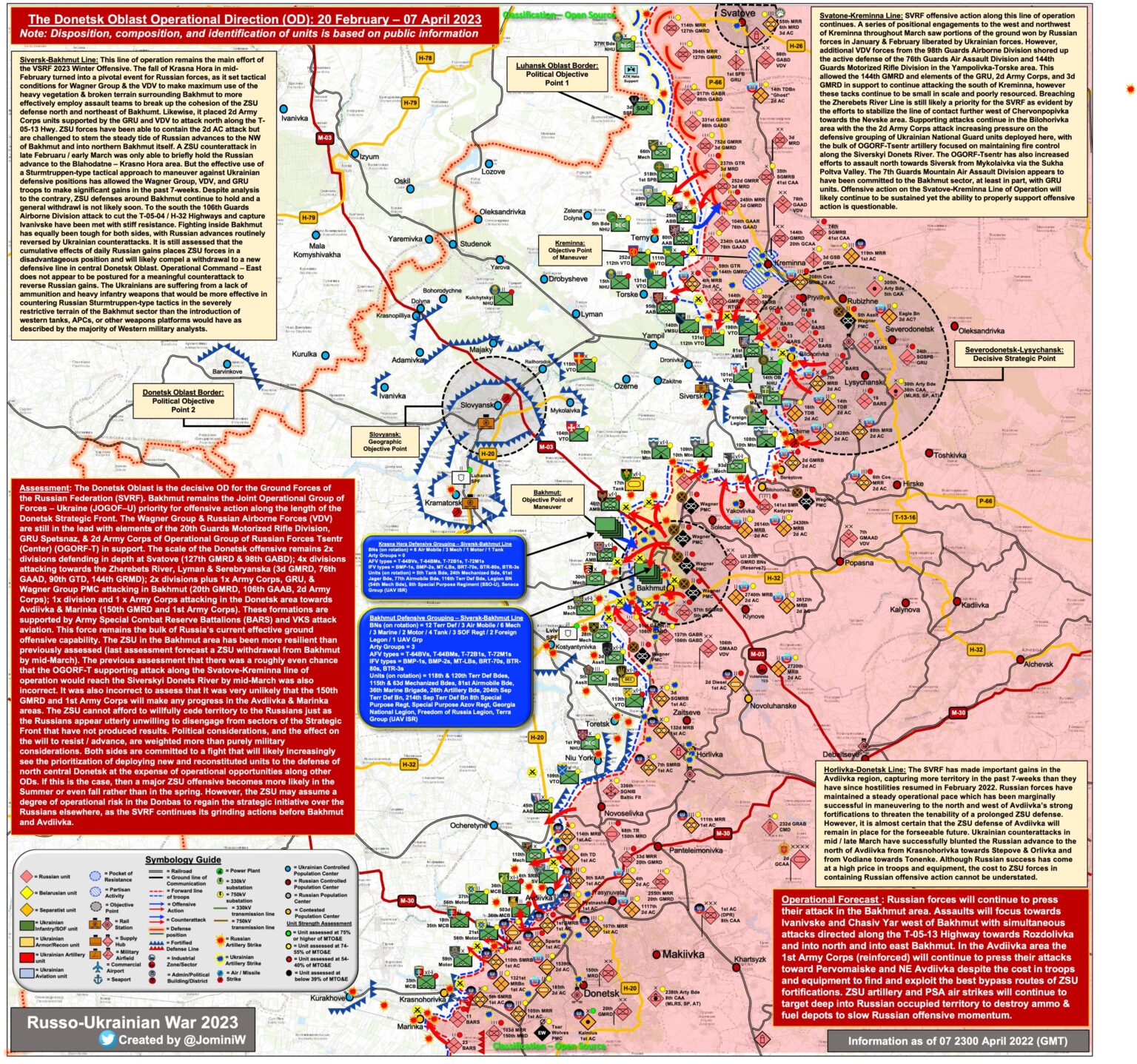
Units of the Russian and Ukrainian Armed Forces in the Donetsk and Luhansk oblasts as of April 2023. Author: Twitter account @JominiW
Additional evidence of the brigade’s participation in hostilities against Ukraine is indicated by:
- The fact that the three missile divisions were not fully present at the deployment site simultaneously; and
- The presence of the brigade in Rostov Oblast, which would make logistical sense in order to provide missile support of the 8th Army in the Donetsk vector.
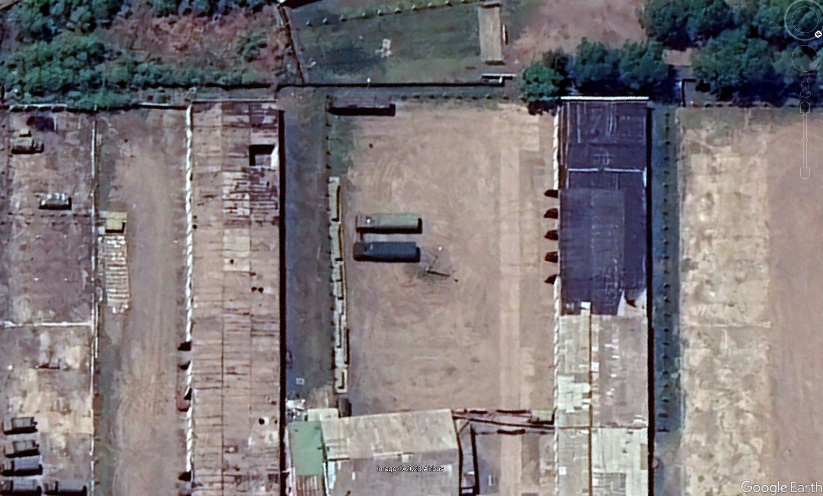
Analysing satellite images of the 47th Brigade’s military base, we can track the location and transportation of Iskander systems. Google Earth images taken in November 2022 show the location of at least eight 9T250 loaders, which transport two additional missiles for 9P78-1 Iskander launchers. This means that the other four loaders available to the brigade are placed in hangars or are deployed to areas of hostilities.
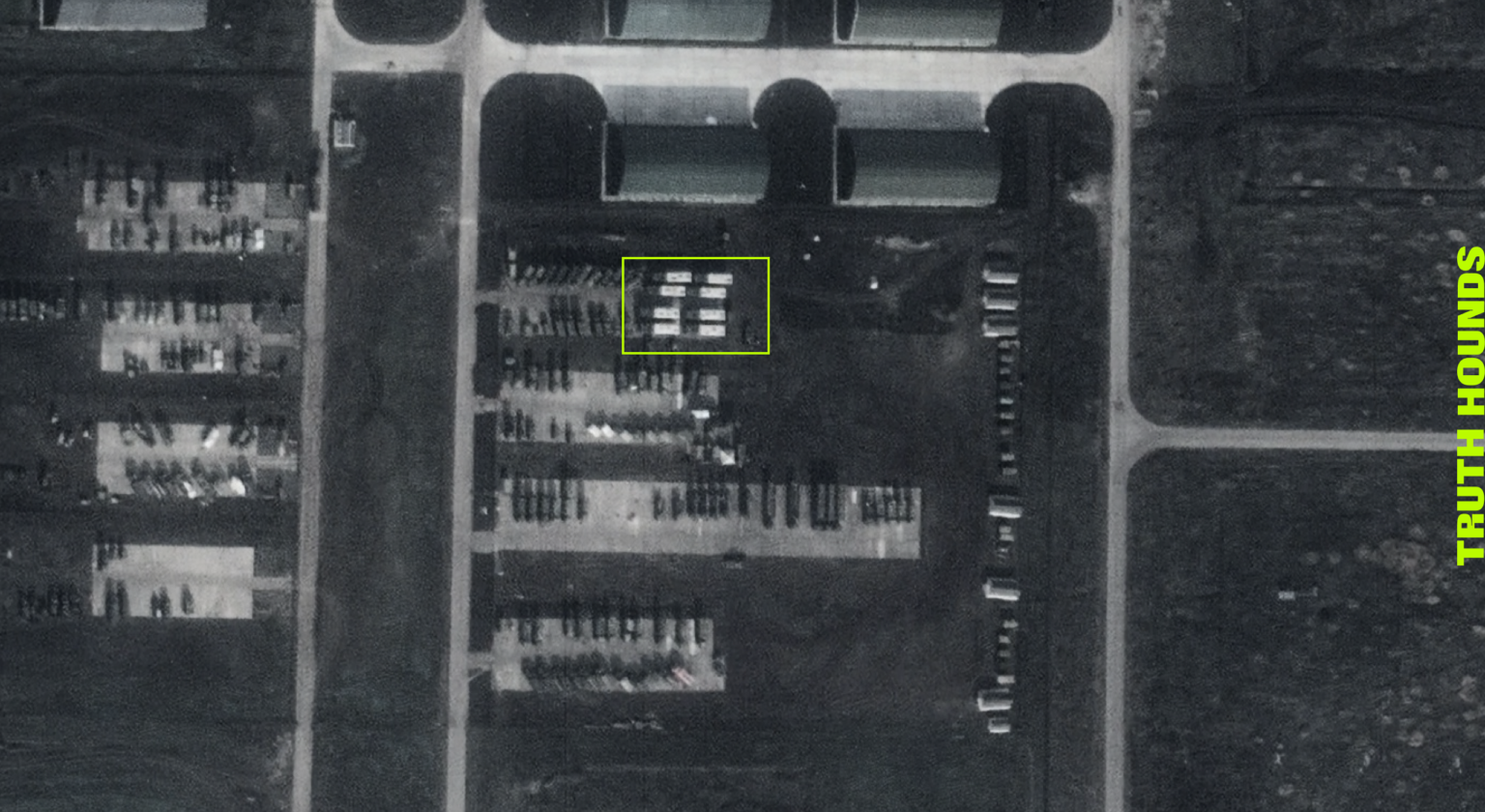
A Google Earth image from 16 November 2022 showing the location of Iskander loaders
The first scenario is also corroborated by multiple messages about the presence of the 8th Army in the operational vector to which the 47th Missile Brigade belongs. Hene, it also disposed of four Iskander systems and thus four loaders[120].
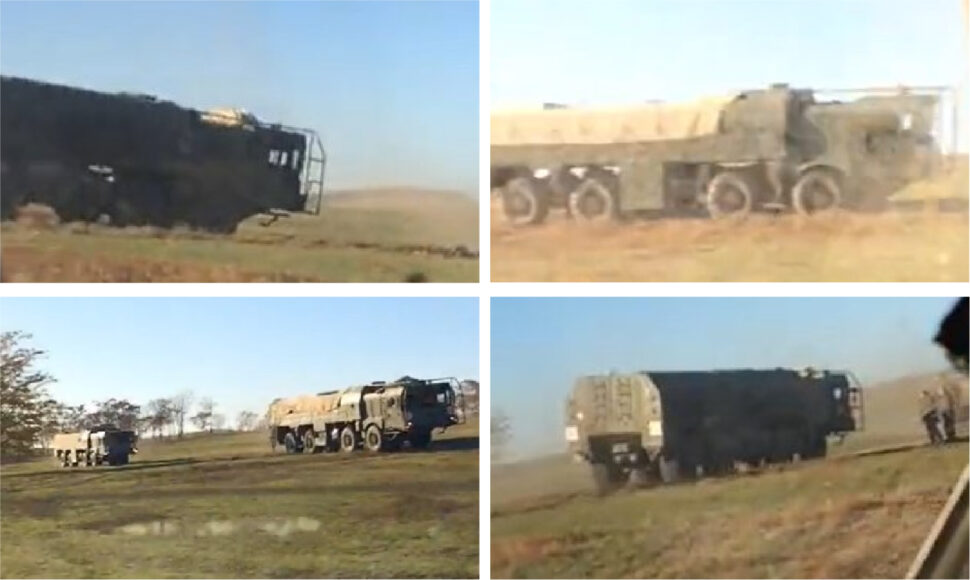
A Maxar image from 7 June 2023 shows a significantly smaller amount of equipment. There is only one 9T250 loader in plain view. As soon as 28 June 2023 (the day following the attack on Kramatorsk and Bilenke), there were already two 9P78-1 Iskander launchers on the territory of the base, as well as one 9T250 loader. A satellite image from 2 July 2023 no longer shows this equipment. We remind you that one brigade has at least 12 9P78-1 Iskander launchers, as well as at least 12 9T250 loaders. In footage from June and July, we see only a handful of units of this equipment out of the possible 24. This indicates that the Iskanders were being actively moved and used and that the base is used to replenish the arsenal and fuel.
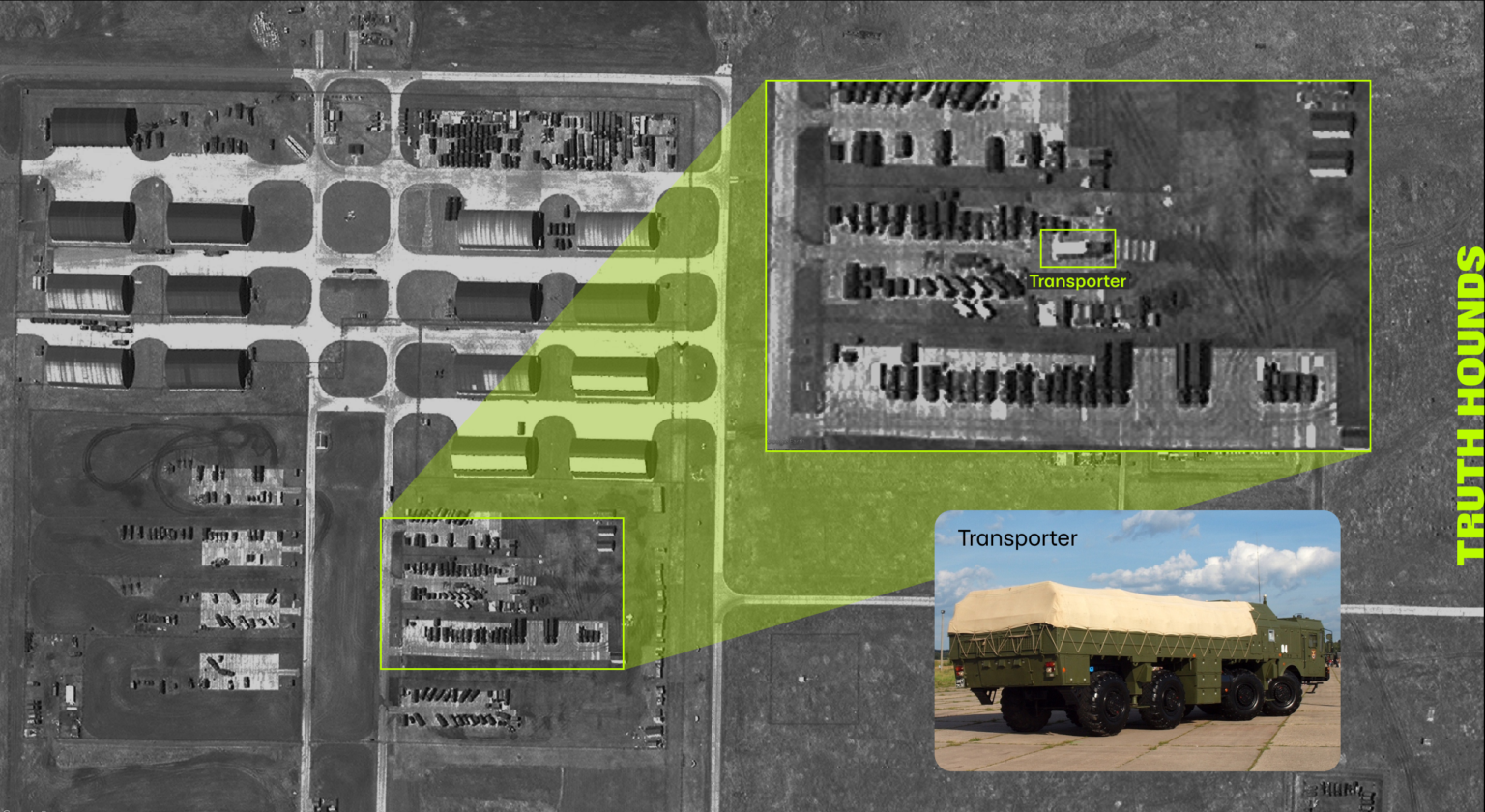
Maxar satellite image from 7 June 2023, showing the deployment location of the 47th Missile Brigade, Korenovsky Garrison
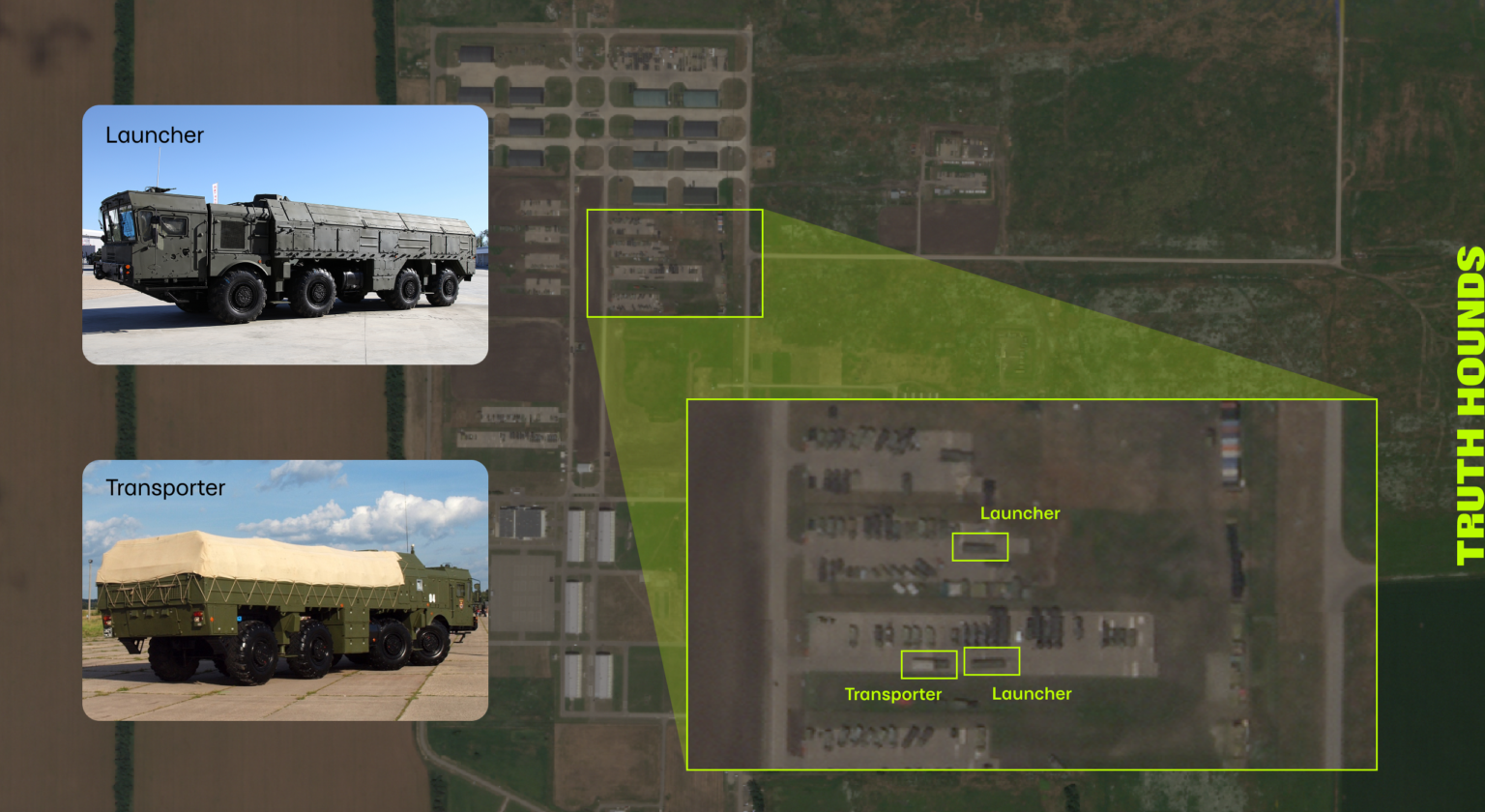
Planet satellite image from 28 June 2023, showing the deployment site of the 47th Missile Brigade, Korenovsky Garrison
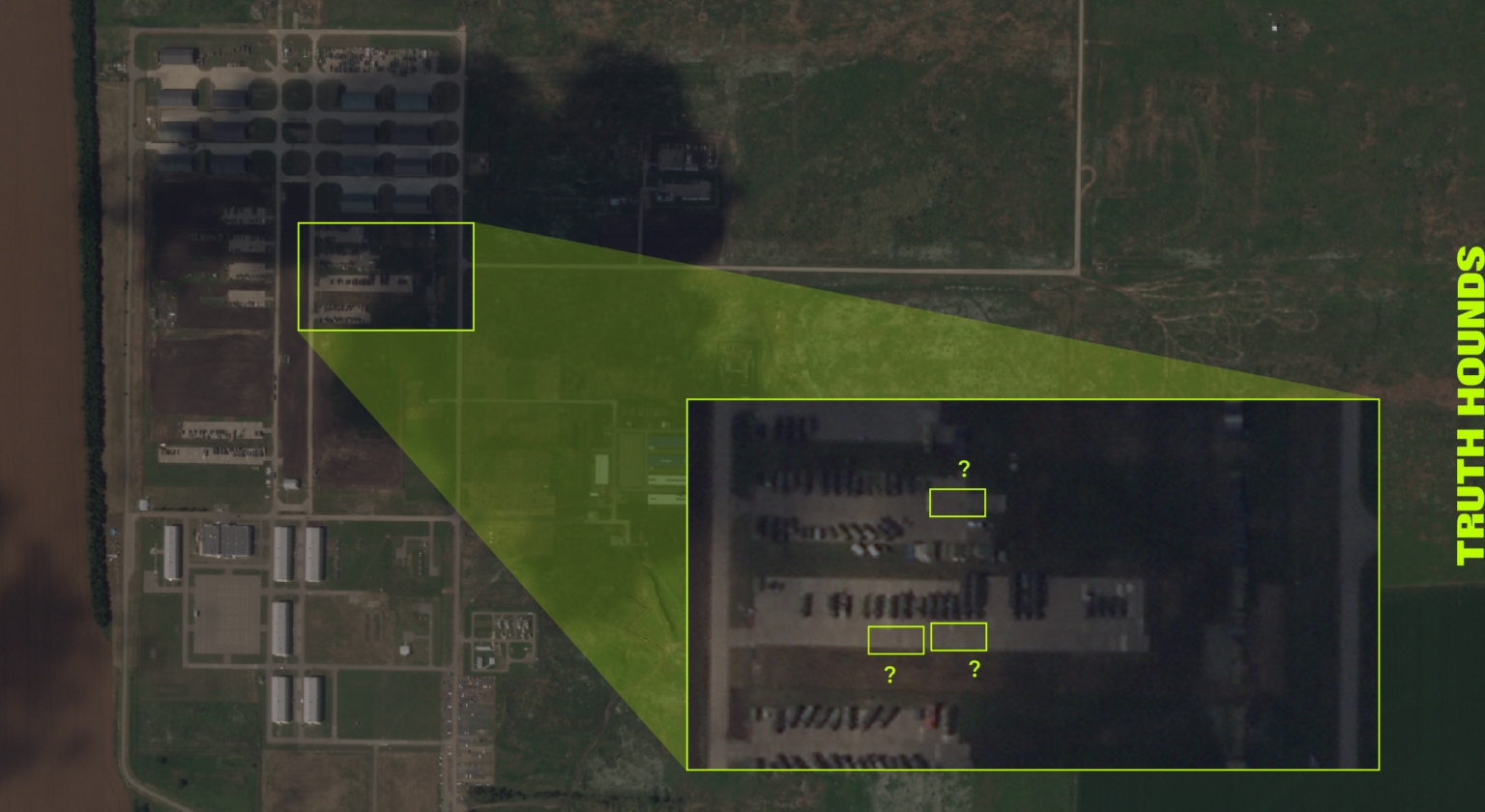
Planet satellite image from 2 July 2023, showing the deployment site of the 47th Missile Brigade, Korenovsky Garrison
Of course, there is the possibility that a certain amount of equipment may be stored in hangars or in other permanent storage places. However, active movement at the base and missile attacks that were being launched at the territory of Ukraine in late June and in July (see section Pattern) give every reason to believe that this brigade’s Iskander systems were actively involved in hostilities rather than stored in hangars or shelters.
In July 2022, the military equipment forum ARMY 2022 was held near Taganrog, Rostov Oblast (coordinates: 47.31776499862844, 39.01115016726307), where, among other military equipment, Iskander systems were featured.[121] At the time, the Russian Ministry of Defence said that the event was organised by the 8th General Arms Army of the Southern Military District of Russia.[122] This is corroborated by photos published after the event which featured Iskander launchers and loaders with the licence plates ‘9934 TT 21’[123] and ‘9946 TT 21’,[124] respectively.
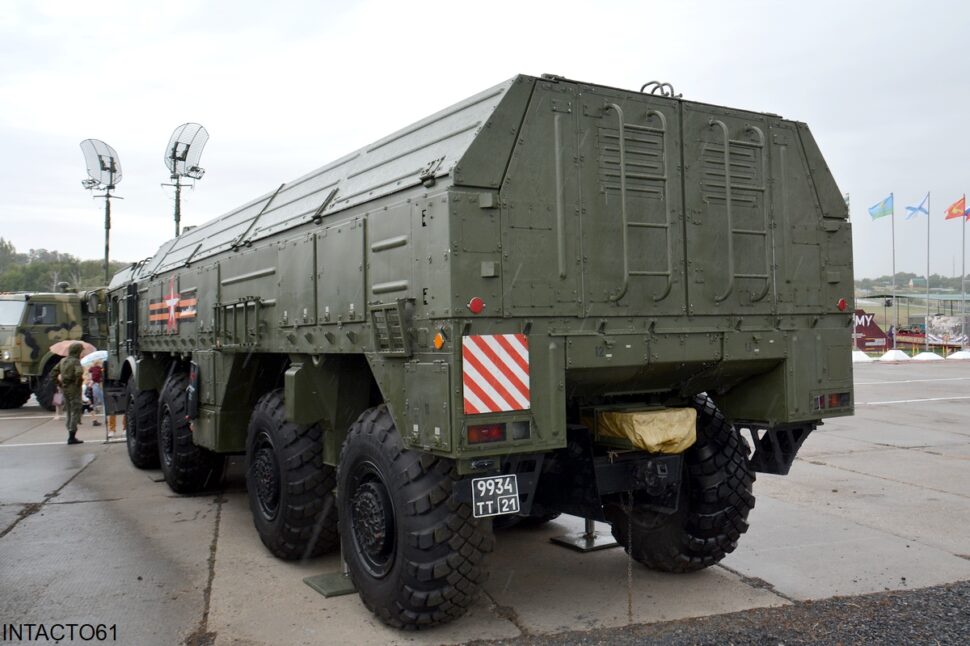
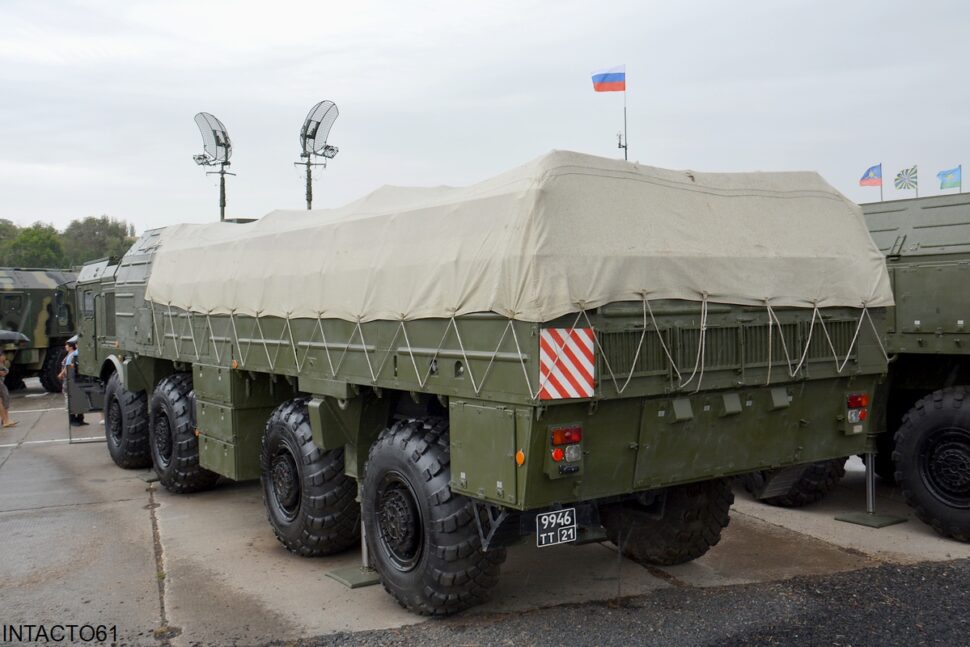
The last two digits on these Russian military licence plates indicate the military district. The number 21 indicates that this equipment belongs to the Southern Military District.[127] The first two digits of the license plate indicate a specific military unit. Licence plates beginning with ‘99’ indicate the 47th Missile Brigade of the 8th Army of the Russian Federation. We also know that the licence plates of vehicles belonging to the 12th Missile Brigade of the 58th Army of the Russian Federation begin with 31 (e.g., 3143 TT 21 or 3144 TT 21),[128] while the equipment of the 1st Guards Rocket Brigade of the 49th Army of Russia bears licence plates beginning with 23 (e.g., 2379 TT 21 or 2384 TT 21).[129]
Open sources have also documented cases of missiles being launched at Ukraine from Krasnodar Krai.[130] For example, on 24 February 2022, a video was published online featuring a cruise missile flying in the direction of Donetsk Oblast. It was filmed near Severnoye, 20 km from Yeysk.[131]
The flight of an Iskander-K missile in the direction of Donetsk Oblast on 24 February 2022
Thus, the information analysed in this section provides every reason to believe that the attack on Kramatorsk and Bilenke on 27 June 2023 was most likely carried out by the 47th Missile Brigade of the 8th Army of Russia.
Probable Perpetrator
Armament Calculations
One missile brigade includes at least three missile divisions, that is, 12 Iskander launchers. A division consists of two missile batteries with two launchers each. In total, the entire missile brigade disposes of 51 units of equipment,[132] namely:
- 12 9P78-1 self-propelled launchers (manning detail — three persons);
- 12 9Т250 loaders (manning detail — two persons);
- 11 9S552 command and staff vehicles (manning detail — four persons);
- 14 support machines for personnel in the field;
- One regulation and maintenance vehicle (manning detail — two persons); and
- One point of information preparation (manning detail — two persons).
Commands to launch missiles are issued directly to self-propelled missile launchers from a command vehicle manned by four people, headed by a section chief with the rank of lieutenant up to captain.[133] It is he who gives the order to launch a missile to the military personnel manning the self-propelled launcher. The section chief of the command vehicle is often the commander of the battery.[134] He, in turn, receives the order from the division commander (lieutenant colonel) and the commander of the 47th Brigade itself (colonel).[135] It should also be understood that an order regarding the launch of a missile can be issued not only from the command vehicle but also from the senior missile commanders stationed at control points.[136]
A launcher crew consists of three people: the section chief, the driver mechanic, and the driver. The section chief issues the order to launch the missile from the launcher itself. His rank is usually from junior lieutenant up to captain.[137] The other two crew members rank from corporal to senior sergeant.[138]
Truth Hounds investigators identified the commander of the 47th Missile Brigade of Russia (Military Unit № 52453) as Vitaliy Veniaminovich Bobyr.
To legally qualify the actions of the perpetrators of the crime, it is necessary to establish a clear understanding of the staff structure of the military unit in question, the number of military personnel therein, the principles of subordination, and the procedures for issuing and following orders.
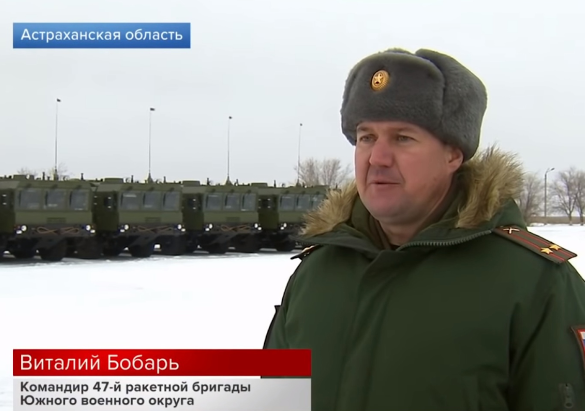
Commander of the 47th Brigade (Military Unit № 52453), Colonel Vitaliy Veniaminovich Bobyr[139] (his surname is misspelled in the news broadcast).
Vitaliy Veniaminovich Bobyr
Date of birth: 6 February 1983
Address of residence: 36 Atamanskaya Street, Novocherkassk 346410, Rostov Oblast, Russia
Phone numbers: +79678072136; +79370985001; +79286400634; +79034642266; and +79663697383
Personal tax number: 343801596659
Individual insurance account number: 14212001881
Email: vitalbob1983@mail.ru
Domestic passport: № 1804 351163, issued on 12 February 2004 by the Uryupin District Police Department of Volgograd Oblast № 342041
Passport issuance date: 12 February 2004
Car licence plates: О434ТН34; and Е660МР134
It should be noted that the place of residence indicated for Colonel Bobyr coincides with the headquarters of the 8th Combined Arms Army of Russia.[140]
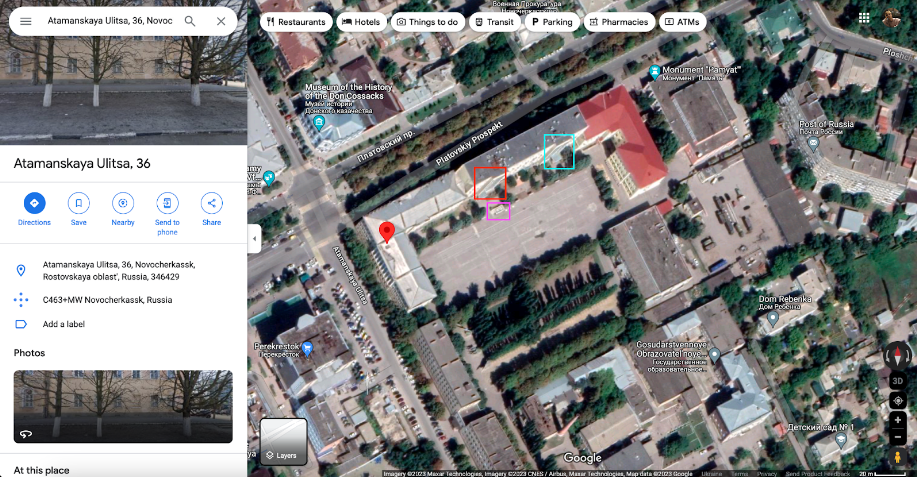
Colonel Bobyr’s place of residence – 36 Atamanskaya Street, Novocherkassk, Rostov Oblast
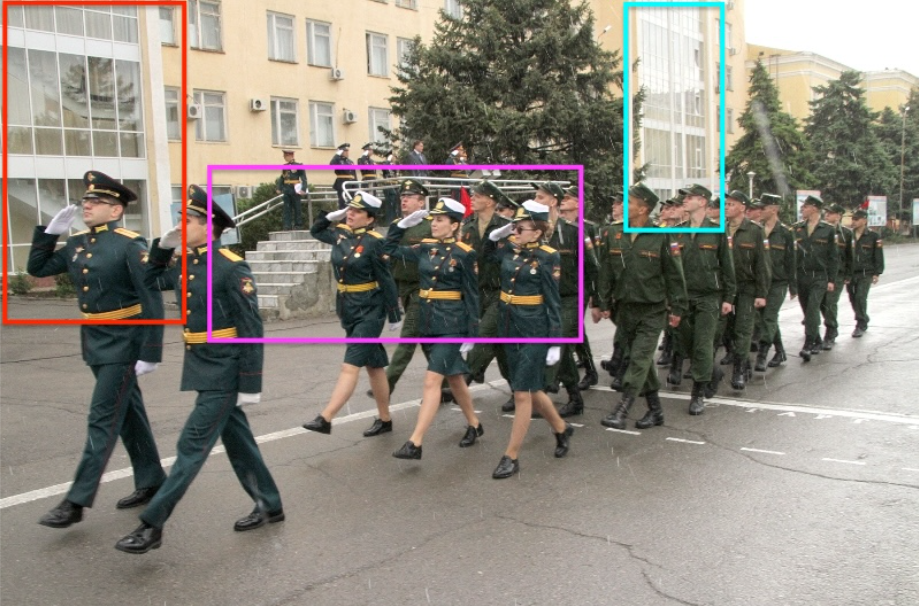
The headquarters of the 8th Combined Arms Army of the Russian Federation in Novocherkassk, Rostov Oblast.[141]
Truth Hounds investigators identified the commander of the 2nd Missile Division of the 47th Missile Brigade as Colonel Ruslan Alimovich Petrosov.[142]
Russian Propaganda Narratives and Debunking
‘Foreign mercenaries’
On 27 June 2023, at around 19:30, Russian Telegram channels and media outlets published information about so-called ‘foreign mercenaries’ wounded and killed as a result of the attack. In particular, this was reported by Colonelcassad and[143] Rybar,[144] among others.[145] According to these channels, there were ‘mercenaries’ close to the impact site, including: Alex Gallant,[146] Arnaud De Decker, Nick Duckworth,[147] and three citizens of Colombia.
In fact, none of the individuals listed above could in any way be described as a ‘mercenary’. Truth Hounds investigated the digital trail of each of them and also took a statement from Nick Duckworth, who was actually in the Ria Lounge at the time of the attack.
Nick Duckworth is in fact a volunteer[148] who assists frontline medical brigades and works for the NGO Safe Passage 4 Ukraine.[149] He told Truth Hounds documenters that he did have friends in the military, but he personally did not in any way participate in the hostilities, something further confirmed by the materials published on his Facebook page.[150]
Arnaud De Decker is a Belgian journalist who writes about the environment, migration, and human rights.[151] Based on his Twitter publications and an interview with the BBC,[152] Arnaud had indeed been in the Ria Lounge on the day of the attack, but had left 10 minutes prior to the missile strike.
Alex Gallant is a civilian (humanitarian) security specialist, as indicated by his Facebook posts,[153] LinkedIn profile,[154] Instagram photos, and tweets.[155] It was on Twitter that Alex said, on 28 June 2023, that he had not been in Kramatorsk for three weeks as of that moment.[156] As part of his activities, Alex worked with Ukrainian volunteer Yuliia Skladana multiple times.
This fact became the starting point of an entire new round of the Russian propaganda, whose aim seemed to be to find a scapegoat for the attack, sow discord in Ukrainian society, and undermine the work of volunteers. One Russian Telegram channel presented an algorithm that was allegedly used to determine the coordinates for a strike on a ‘military site’. The published fragment claims that the cause of the attack was that, on her Instagram page, Yuliia tagged ‘NATO instructors’ in Kramatorsk.[157]
Immediately following the attack, both official and unofficial Russian sources began publishing messages about yet another successful use of Russia’s missile weaponry and the destruction of all the designated targets. Below is a breakdown of Russian narratives about the attack on Kramatorsk and Bilenke.
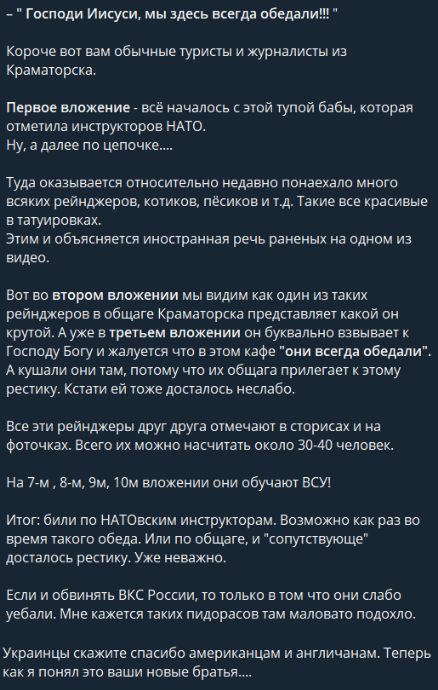
Algorithm allegedly used to identify the target of the strike.[158]
[Translation]
“- “Lord Jesus, we always dined here!!!!”
Here are ordinary tourists and journalists from Kramatorsk.
It all started with this stupid woman who tagged NATO instructors. Well, further down there is the chain…..
It turns out that a lot of different rangers, kitties, puppies and other pussies came here relatively recently. Everyone is so beautiful, with tattoos.
This explains the foreign speech of the wounded in one of the videos.
In the second attachment we see how one of these rangers in the Kramatorsk dorm showing how cool he is. And the third attachment, he literally cries out to the Lord God and complains that “they always had lunch” in this cafe.
And they ate there because their dorm is adjacent to this restaurant. By the way, it also had a hard time.
All these rangers tag each other in stories and photos, 30-40 people in total.
On the 7th, 8th, 9th, 10th attachment they teach the Armed Forces of Ukraine!
Result: we targeted NATO instructors. Perhaps just during a lunch. Or in the dorm that was close to the restaurant. It doesn’t matter anymore. If you blame the Russian Aerospace Forces, it’s only because theystroke poorly. It seems to me that not enough of these fagots that have died there. Ukrainians say thank you to the Americans and the British. Now, if I am not wrong, these are your new brothers…..”
In fact, Alex Gallant and Yuliia Skladana work as a team and both claim they were not in the Ria Lounge on the day of the attack. What is more, they left Kramatorsk together three weeks before the incident.[159]
Moreover, the ‘dorm’ which is allegedly ‘adjacent to the restaurant’ is actually the Kramatorsk Hotel, which has only functioned to a limited extent since the beginning of the full-scale invasion. This was confirmed to Truth Hounds documenters by the hotel’s director, Valeriia Karpenko. According to her, the shelling of the hotel on 27 June 2023 was the third since the full-scale invasion. She noted that, since February 2022, the hotel only provided occasional accommodation to internally displaced persons (IDPs) and volunteers. At the same time, the hotel administration banned accommodation for military personnel or people wearing military uniforms since this could put locals in danger.[160]
Truth Hounds documenters also visited the area next to the hotel and recorded that it was unusable for accommodation on account of its condition resulting from previous instances of shelling.
Among the Colombian citizens mentioned by the Russian media were actually writer Hector Abad, former High Commissioner for Peace of Colombia Sergio Jaramillo, and journalist Catalina Gomez. These individuals have no connection to the military and arrived in Ukraine as part of the Aguanta Ucrania project (‘Hold tight, Ukraine!’), which aims to support Ukraine and raise awareness of the war in Latin American countries. Even some Russian channels recognised that these people were not military personnel or foreign mercenaries.
“I was in Kramatorsk because I was writing a report about two Colombians [Sergio Jaramillo and Hector Abad] and Viktoriia Amelina. They launched a campaign in Latin America together with writers, intellectuals, politicians, activists, human rights defenders, explaining why we needed to support Ukraine,” said Catalina Gomez to the documenters.
Debunking Russian narratives about the Ukrainian military and military equipment at the site of the attack
On 28 June 2023, press secretary to the Russian President Dmitriy Peskov claimed once again, in connection with the attack on Kramatorsk, that Russia exclusively targeted military objects.[161]
The following day, the Russian Ministry of Defence issued an official statement regarding the attack on Kramatorsk. The statement said that, on the day of the attack, the rank and file, officers, and generals of the 56th Motorised Infantry Brigade of the Armed Forces of Ukraine and foreign instructors were present at the Ria Lounge.[162] This statement was widely shared by the Russian media.[163]

A screenshot from the website of the Russian Ministry of Defence, 29 June 2023
[Translation] “According to updated information, as a result of a high-precision strike on 27 June (2023) in the city of Kramatorsk of the Donetsk People’s Republic at the temporary deployment point of the 56th separate motorized brigade of the Ukrainian Armed Forces, two generals participating in a staff meeting, up to 50 officers of the armed forces of Ukraine, as well as up to 20 foreign mercenaries and military personnel were killed”.
The 56th Motorised Infantry Brigade itself refuted the statement that its soldiers were killed in the attack. For example, on 30 June 2023, the official Facebook page of the brigade posted a comment indicating that the Russians were ‘sincerely rejoicing about the imaginary destruction of the command during the missile strike’.[164] The account of the brigade also periodically publishes pictures featuring the command.[165] One serviceman belonging to the brigade also refuted the allegations about the death of his fellow brigade members on his personal Facebook page.
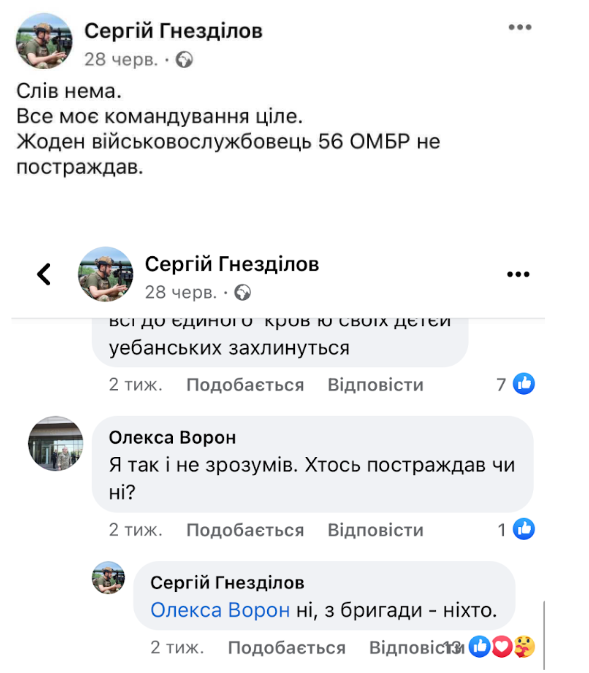
A screenshot from the Facebook page of a soldier serving in the 56th Motorised Infantry Brigade
[Translation]
“Serhyi Hnezdilov: I have no words. All my commanders are safe and sound. Not a single military officer of the 56 brigade got hurt.
Oleksa Vorron: I didn’t get it. Did anyone get hurt?
Serhyi Hnezdilov: noone from our brigade”.
At the moment when the Russian MoD issued its statement about the attack on Kramatorsk, the number of victims killed in the attack (both military and civilians) was 11, but, within several days, it had increased to 13. Among these individuals, two were military personnel: a combat paramedic of the 1st Assault Battalion of the 3rd Separate Assault Brigade, Artem Sukhovii, and volunteer soldier attached to the International Legion, former US Marine Ian Tortorici (callsign: ‘Frank’).
Witnesses surveyed by Truth Hounds, who were at the scene of the attack at the moment of impact or immediately following it, also reported the prevalence of civilians among the victims. The vast majority of them declared that there were significantly fewer military personnel among the dead. For example, a paramedic who arrived at the scene of the incident seven minutes after the explosion and spent over four hours there said the following:
‘As for the victims, most of them are civilians. If not all of them. I cannot say exactly. Even though there were quite a few soldiers in the establishment. I did not see a single military serviceman under the rubble. I didn’t witness something like that.’[166]
Another witness said:
‘I remember that 10–15 people were carried out on stretchers, but it was unclear whether they were killed or wounded. There were maybe two military among these 10–15 people. One was definitely alive because he was propping himself up on his elbows on the stretcher. I think the other one was also alive.’[167]
Eyewitness accounts also refute the official Russian narratives about approximately 70 Ukrainian soldiers alone killed in the attack. They attest that in all the aboveground premises of the restaurant, there were about 40–50 clients, while the numbers of civilians and military personnel among them were roughly equal. However, one of the interviewed clients of the restaurant[168] believed that the number of military personnel killed in the attack was greater and that this fact had been concealed at the official level:
‘As far as I know, twelve civilians and one soldier died. But I think there were more soldiers killed. These are my own calculations because there were many soldiers in the diner, so there must be more casualties among them. In addition, from sources I cannot divulge, I know that the official death toll will not include a definite number of military personnel.’
The day after the attack, Russian propagandist began spreading a video published by the medical evacuation and humanitarian aid organisation Project Konstantin, filmed by the project founder Peter Fouché several hours after the strike.[169] In the video, he says that Ukrainian soldiers are all over the place under the rubble. It should be noted that this conclusion is impossible to draw based on the published footage alone. As soon as two days following the attack, Project Konstantin made a statement apologising for the premature conclusions drawn on the site and criticising the use of the video by Russian propaganda.[170]
On 29 June 2023, representative of the Russian MFA Maria Zakharova confirmed the statement made by Peskov, claiming that the strike on Kramatorsk was an attack on a military object. She also highlighted an alleged ‘planned provocation’ by the writer – and our colleague – Viktoriia Amelina, who, according to Zakharova, deliberately put the Colombians present in danger.[171] In response, President of Colombia Gustavo Petro said that his country would send a note of protest to Russia for attacking ‘three defenceless citizens of Colombia and thus violating the rules and customs of war’.[172] In response, the Russian Embassy in Colombia said that Kramatorsk ‘has been turned into an operational military and logistical centre’, which is ‘not the best place to try Ukrainian cuisine’.[173]
Unlike the attack on Kramatorsk, the strike on Bilenke was almost ignored, both by official Russian sources and by propagandists and military correspondents. One media source mentioned the shelling of the Laguna Café, a former sauna in Bilenke which occasionally hosted private events as of 2023. However, the publication erroneously stated that the café is located in Kramatorsk.[174]
As for the presence of military equipment close to the Ria Lounge and strike site in Bilenke on the day of the attack, the witnesses interviewed by Truth Hounds unanimously said that they had seen no movement or concentration of equipment close to the strike sites. Notably, only civilian vehicles, as well as pickup trucks and Jeeps used by the military for transportation, were damaged during the attack.
In order to identify the military personnel at the scene, Truth Hounds collected a large number of photos from open sources and obtained some from eyewitnesses to the incident. To analyse the photos available, the investigators used AI algorithms which identified characteristic facial features and combined similar ones to avoid double counting.
After identifying all the individuals who helped to clear up the rubble at the Ria Lounge, Truth Hounds investigators employed facial recognition software (PimEyes). This tool analyses the facial features present in a given photo and finds matches with images on social media, in the media, messenger apps, and so on. Having received 70 photo matches, the analysts studied every social media profile and publication featuring these people one by one. The identified individuals included police officers, former soldiers who served in Ukraine’s ‘Anti-terrorist Operation’ (ATO), members of the border guard service, evacuation personnel, and the friends of military personnel. However, not a single active military serviceperson was identified.
Legitimate Military Targets
Truth Hounds documenters surveyed ten eyewitnesses and survivors who were in the Ria Lounge at the moment of the attack or arrived at the scene shortly thereafter. These individuals were regular guests at the restaurant with various professions: journalists, volunteers, paramedics, etc. Their testimonies regarding the presence of the military at the restaurant, the routine of the establishment, and the portrait of an average guest largely coincided and did not indicate either an unusually high concentration of military personnel at the diner on that day or the presence of people who could be identified as members of the command of units of the Armed Forces of Ukraine.
One of the witnesses said:
‘[In the Ria Lounge,] I did not see high-level command. Of course, I saw civilians, as usual, but I also saw numerous military people — also a usual situation. They did not have weapons. They were just young guys who went there to have dinner. This is a very common thing in the Ria Lounge. That’s reality.’[175]
Below are a few more quotes from the testimony of the restaurant guests from that night:
‘On the night of the strike, there was a young couple [in the restaurant] who arrived right before the missile strike. The man was wearing a military uniform, the woman was wearing civilian clothes, and they had a stroller with a young child. I assumed it was this military serviceman’s wife who probably came to Kramatorsk to visit him.’[176]
‘I think there are usually even more military personnel there, but not on that day. I mean, there were quite a few military there, but also civilians, like I said, made up about half the clients.’[177]
‘Most military personnel looked as usual. For example, they could be dressed in uniform military pants and a t-shirt. On 27 June — when I was in Ria — the ratio of military to civilians was about 60 to 40 per cent. That was the situation on the summer terrace. But when I went inside to use the bathroom, the situation was the same. I did not notice any meetings, gatherings, a greater concentration of the military. Their appearance also did not indicate that they may have been the command.’[178]
All ten interviewees confirmed that the military were present on the premises, but indicated that they had no weapons, and that their uniforms and appearances did not indicate that they were part of foreign armed forces or the military command of the Armed Forces of Ukraine. The witnesses also noted that the military personnel looked like regular guests who went to have dinner at the pizza place together with their civilian friends or acquaintances. Those who had lived in Kramatorsk for a certain time and attended this establishment multiple times added that they had observed this situation in the Ria Lounge multiple times. In general, this coexistence of the military and civilians is characteristic of Kramatorsk, since the city is located close to the frontline and has a high presence of people in military uniforms throughout.
To establish all the circumstances of the incident in the most objective manner possible, Truth Hounds also interviewed five former employees of the Ria Lounge, who were at work on the day of the attack. The interviews yielded the following. On 27 June 2023, military personnel belonging to one unit of the Armed Forces of Ukraine, including members of its command, stayed in the Ria Lounge diner for a long time in an organised manner. In order to prevent the use of this information for propaganda purposes or to discredit the military personnel of the unit, we have decided to avoid mentioning the name of this unit in the public version of our investigation. However, the full version of this account has been handed to Ukrainian law enforcement.
According to the interviews with employees of the restaurant, we established the following:
- On 27 June 2023, military personnel belonging to a unit of the Armed Forces of Ukraine were in the Ria Lounge celebrating the birthday of a serviceman belonging to this unit. The waiter who served the party claimed that it was the birthday of a member of the command: ‘I don’t know the name of the man who was celebrating his birthday. I heard that it could be the commander of some battalion.’[179] Truth Hounds investigators later showed the witness several photos similar to the description of soldiers from the identified brigade and the interviewee recognised the man celebrating his birthday in one of the photos.The party took place in a special room in the basement of the establishment, which is unofficially referred to as ‘the pub’. According to the staff, this place regularly hosted celebrations and parties, which were often booked by the military.
- The event was planned a month before the birthday itself and the managers of the restaurant were aware of this information.
- The celebration was divided into two parts: the first guests were supposed to arrive at 13:00 and the second group was supposed to arrive at 19:00. In both cases, the groups were supposed to be 20 individuals each. However, not all the witnesses agreed that the second group of military personnel, who were supposed to arrive in the evening, showed up at all.
- At the same time, a parallel celebration was supposed to be held in Bilenke in the local establishment the Laguna, located at the intersection of Beliayeva Street and Sofiivska Street, ten metres from the impact point of the second missile.
- Three of the interviewed restaurant employees indirectly testify that the birthday party included members of the unit’s command. However, they could not provide names or other identifying data. One of the interviewees mentioned that the importance of the guests could be deduced from the fact that the director of the restaurant personally went to greet the military, which he did not normally do.[180]Restaurant manager Artur (killed in the attack) and director Dmytro (who refused to speak with Truth Hounds documenters) were aware of the possibility of an attack on the restaurant. However, neither of them told this to the other employees or took any measures to protect the staff and guests. A former employee of the establishment,[181] who heard this from the police, said the following:
‘On the day of the attack, in the morning, Artur, the administrator, talked to representatives of law enforcement, who warned him there was going to be a strike. No evacuation measures were taken and that’s why what happened happened. There were many questions about why we didn’t leave.’[182]
As part of our field mission, Truth Hounds documenters verified that the restaurant’s basement remained intact and virtually undamaged. Hence, the people who may have been present there at the moment of the attack would not have suffered serious injuries. At the same time, documenters recorded drops of blood on the hardwood floor of the basement. They were later found to come from a wounded civilian brought to the basement for medical care. This is confirmed by a video made available to Truth Hounds.
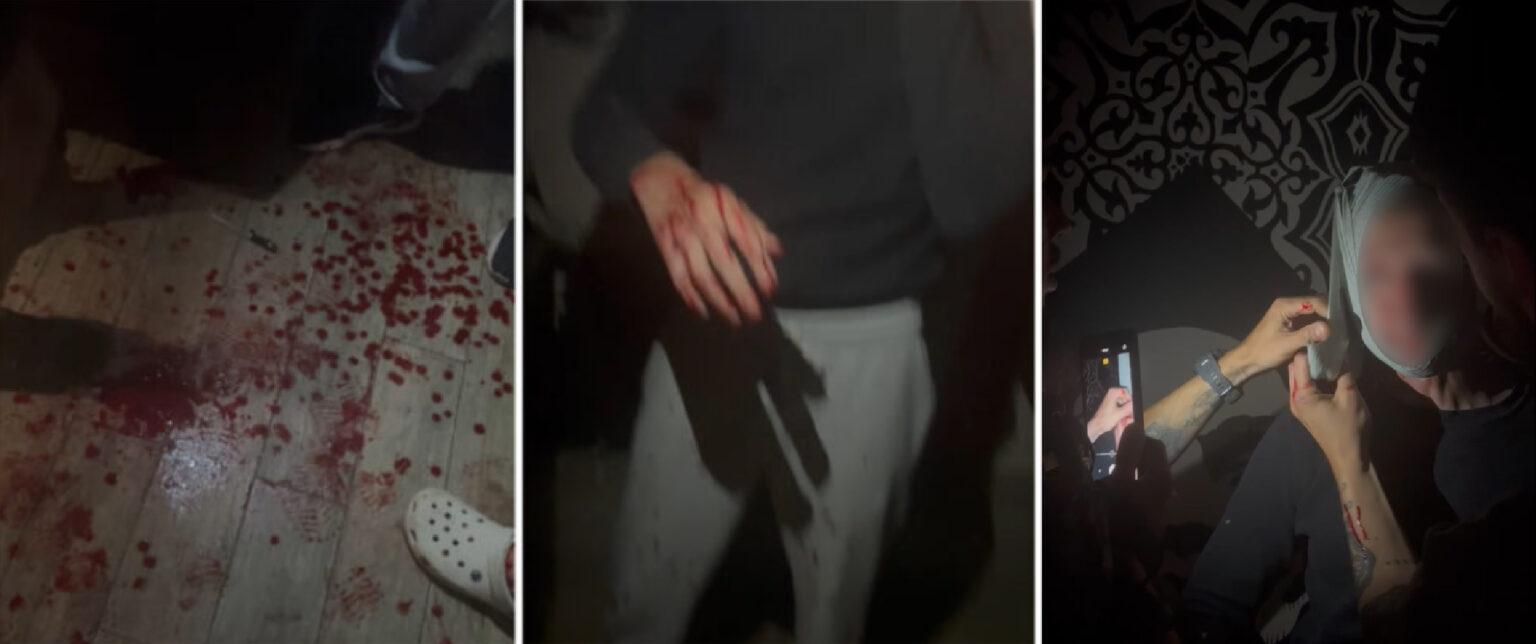
A screenshot from a video provided to Truth Hounds by a witness
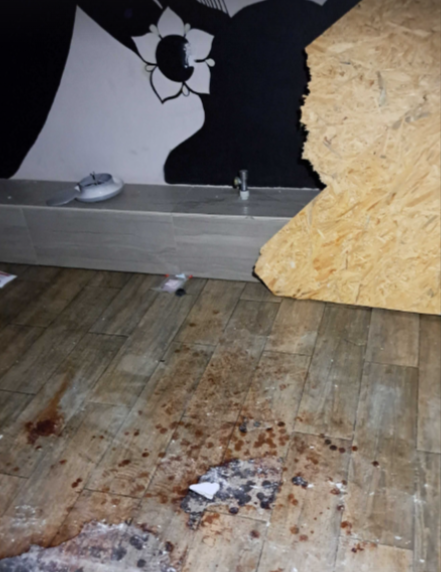
A screenshot from a video taken by Truth Hounds documenters
during our field mission
Examining the ‘pub’, the documenters did not find direct confirmation of a party, but there were several empty bottles for alcoholic beverages on site. The basement also appeared to be cleared of the consequences of the explosion, although eyewitness testimony and a video made in the first few minutes following the strike indicate that the location was covered in rubble and dust.
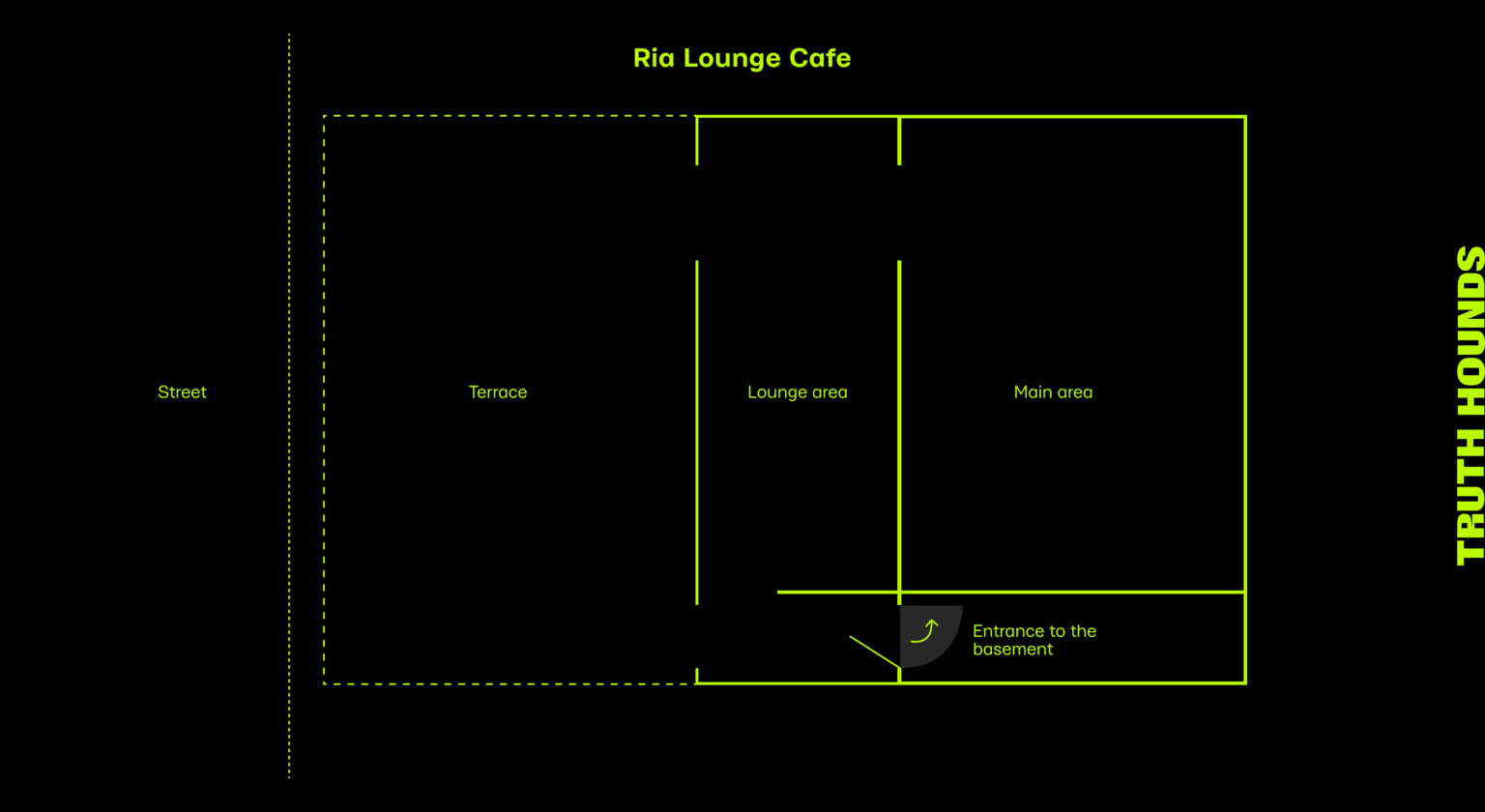
A room plan of the Ria Lounge
In Bilenke, there are residential buildings located at the intersection of Sofiivska Street and Bieliayeva Street. They are home to civilians and there are no military objects nearby. It is also where the Laguna is located — the sauna which burned down at the end of 2019 and was later partially restored — as well as the car maintenance station and a gym of the same name.
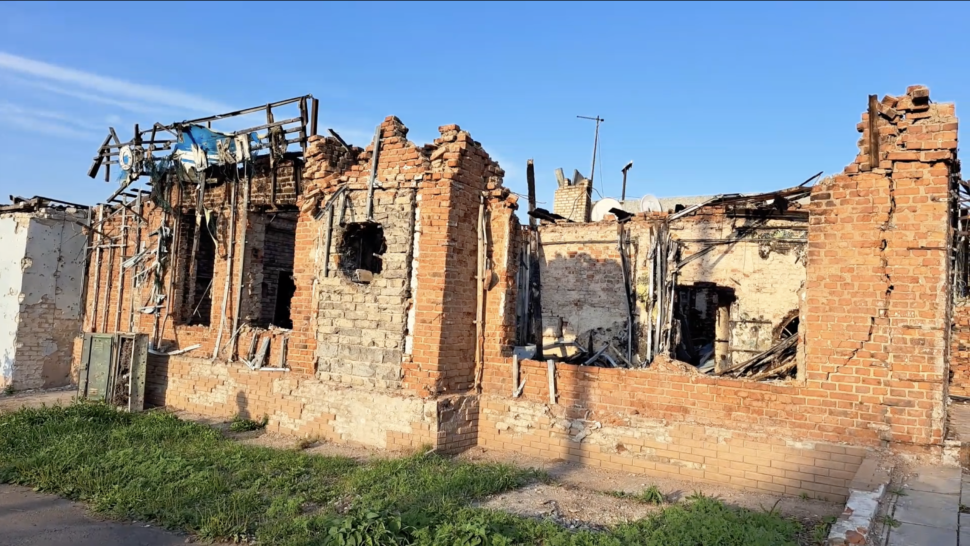
The aftermath of the strike on Bilenke, showing the remnants of the Laguna sauna. Photo taken by Truth Hounds documenters on 2 August 2023
The premises of the Laguna sauna following the missile strike. Photo taken by Truth Hounds documenters on 2 August 2023
‘Tags’ and Informants
Four of the witnesses to the attack who reside in Kramatorsk, interviewed by Truth Hounds, shared information about so-called ‘tags’ in the city, particularly: on the Ria Lounge and in Bilenke. In this context, a ‘tag’ is to be understood as information about the geographic coordinates of a specific site or location which local informants send to the Russian military for the latter to plan and carry out strikes.
Witnesses provided the following information about the restaurant:
‘We have heard about the tag, everyone knows it, but we also know that, for example, the central store is also tagged. It’s scary to go there. We know it, but it’s just that somebody said it, well, I can say things, too. But we don’t know when to expect a strike.’[183]
‘All the military knew there would be a strike on that day […] There was actually a tag on this place and it was known about a month before – maybe five weeks. It was known there had to be a strike there. Everyone in the military and otherwise knew about it. And the mayor also knew; he always knows everything. We were looking at him — if he attended the establishment, we believed there would be no strike. Also, we assumed that even if there was a tag, we should take into account that those Russians are not good at this and will miss the target.’[184]
‘We were told there was a tag here a whole month before the strike.’[185]
The documenters received similar information about tags in Bilenke. This is what one witness said:
‘There were tags in Bilenke which the ruscists were supposed to use for strikes, but there were no tags in Laguna — there were none at 100 metres around Laguna. I also know there was a suspect here, that he was feeding the Russians information about Laguna, but I don’t know what happened next.’[186]
We should additionally highlight the story about the detention of an informant close to the Ria Lounge which was published by the press service of the Security Service of Ukraine the day after the attack.[187] It was reported that Security Service counter-intelligence detained a man who had adjusted Russian fire on Kramatorsk and turned out to be an agent of the ‘Main Directorate of the General Staff of the Russian Armed Forces (better known as the GRU)’ sent back into operation. The report also indicated that on 27 June 2023, he was tasked with finding out whether the diner was in operation and to make a covert recording of the attendees and the cars parked nearby. Thereafter, the suspect sent the footage to Russian military intelligence. Among other things, in a video published on the same day, an individual with his face blurred, indicated as ‘the informant’, states that he shared information with a Russian military serviceperson located on the territory of the so-called ‘DNR’.[188] We remind you that units from the ‘DNR’ were under the command of the 8th Army, which also includes the 47th Missile Brigade, which was equipped with Iskanders. There is another important detail in the ‘informant’s’ statement: he claims that, at 17:00, he went to the Ria Lounge on an assignment, where he recorded the situation and the circumstances, sent the media file to the Russians and went home, where he learned about the attack on the diner that took place at 19:29. Such a major interval between the time of filming and the time of the attack, as well as the fact that the informant was at home at the time of the strike, indicates that the attackers were not able to control the target of the attack. Likewise, it is noteworthy that the suspect informed the attackers about the significant number of civilians, including children, among the attendees at the moment of filming.
Pattern
After the strike on Kramatorsk and Bilenke, the Russian military intensified its use of Iskander-K cruise missiles. Within a week of the strike, they used this type of missile to attack Ukrainian cities three more times. For example, as soon as 30 June 2023, they struck a school in the village of Serhiivka, Donetsk Oblast, which resulted in two civilian deaths and six injured civilians, as well as the complete destruction of the school itself.[189] Again, after the attack, the Russian Ministry of Defence claimed that the strike was carried out against command points of the Ukrainian ‘Donetsk’ operational and tactical group.[190] However, footage from the body cams of police officers who arrived at the site of the strike clearly shows that only civilians were found under the rubble.[191] According to eyewitnesses, there were 12 civilians in the school prior to the strike: administrative staff, teachers, and technical staff of the school.[192]
The next strike using Iskander cruise missiles was carried out by the Russian military on a residential area in Pokrovsk, Donetsk Oblast, on 3 July 2023. The attack resulted in one casualty, while eight private homes and an infrastructure object were damaged.[193]
On 4 July 2023, Iskander-K missiles were used to shell the city of Pervomaiskyi, Kharkiv Oblast.[194] This attack merits more attention, as its pattern is most similar to the strike on Kramatorsk.
That day, a missile struck the car park of a high-rise building between buildings № 10 and № 8 in the 6th neighbourhood of the city. According to official data, 43 people suffered light and moderate injuries, including 12 children.[195] There were no military facilities in the vicinity of the strike. However, local residents associate this shelling with the memorial service for fallen soldier Oleh Fadieienko (callsign: ‘Malysh’) from the Kraken Special Unit of the Chief Intelligence Directorate of the Ministry of Defence. The unit’s chief of staff Kostiantyn Nemichev expressed a similar opinion.[196]
The time and place of the ceremony were known in advance — 13:00 on 4 July 2023, in the square next to Khimik BC.[197] The Russians could assume that there would be a significant presence of Ukrainian military personnel at the event, including members of the unit command. This enabled them either to prepare for the attack carefully and strike the target precisely at a specific time using precise coordinates or to give up on the attack if any assessment of its consequences entailed disproportionate harm to the civilian population. The attack did take place, but the high-precision Iskander-K cruise missile hit a car park 900 metres from the site of the ceremony, 30 times its maximum margin of error. The strike itself took place half an hour after the announced time of the memorial service and was carried out with a cruise missile, which significantly complicated control over the target for the attacker (considering the relatively low speed of the missile and the nature of the event, which entailed movement of potential targets from the memorial ceremony to the cemetery for burial and later to the venue of the memorial dinner).
After the attack, Russian channels published information that the strike targeted the Zodiac Café (located some tens of metres from the impact point), where the personnel of the Kraken unit allegedly planned to hold the memorial dinner.[198] Another widely spread statement was that the leadership of the unit was killed in the strike. However, photos taken by Truth Hounds documenters demonstrate that this building is currently not fit for any ceremonies or even regular personal meetings. Local residents also confirmed that the café had been closed for several years.
These facts illustrate a lack of proper planning and execution of the attack, once again proving the complete indifference of the Russian Armed Forces towards the potential civilian victims of their missile strikes.
The Zodiac Café in Pervomaiskyi, Kharkiv Oblast. Photo taken by Truth Hounds documenters on 20 June 2023.
The Zodiac Café in Pervomaiskyi, Kharkiv Oblast. Photo taken by Truth Hounds documenters on 20 June 2023
We believe that these attacks may illustrate the emergence of a new tactic of the Russian Armed Forces: attempts to destroy the command of the Ukrainian military remotely, one by one. However, as the examples of Kramatorsk and Pervomaiskyi illustrate, on account of careless planning and execution, this tactic is failing to accomplish its goals, with the primary victims of these attacks being civilians. Against this backdrop, the Russian media spread narratives aimed at generating an atmosphere of hostility and intolerance towards the Ukrainian military, alleging that their very presence elsewhere besides the frontline and military facilities consistutes a threat to the civilian population.
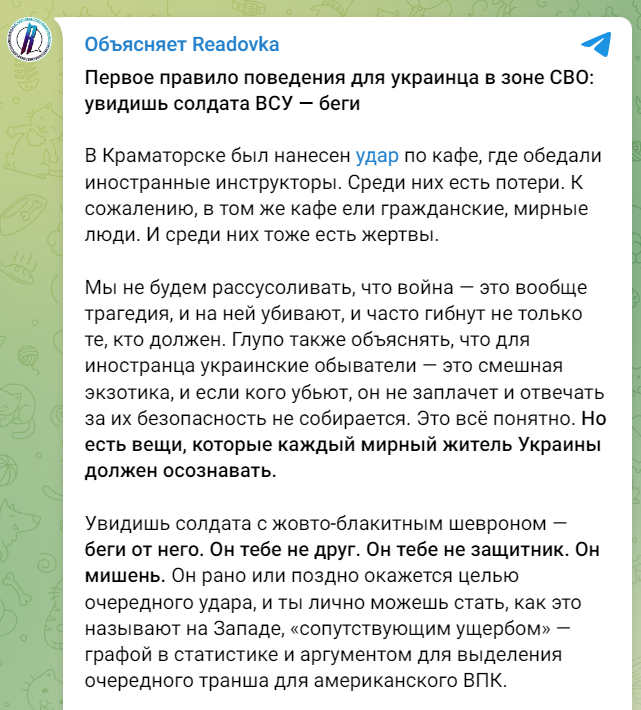
An example of a publication meant to stoke public intolerance/hostility towards the Ukrainian Army from the Readovka Explains Telegram channel.[199]
[Translation] “Readovka explains:
The first rule of conduct for a Ukrainian in the Special military operation zone: if you see a Ukrainian Armed Forces soldier – run.
In Kramatorsk, a cafe was attacked where foreign instructors were having lunch. There are losses among them. Unfortunately, civilians, peaceful people, were eating in the same cafe. And among them there are victims too. We will not go on and on about the fact that war is generally a tragedy, and people get killed, and often not only those who should die. It is also needless to explain that for a foreigner all Ukrainian inhabitants are a funny exotic thing, and if someone is killed, the foreigner will not cry and is not going to be responsible for their safety. This is all clear.
But there are things that every civilian in Ukraine should be aware of.
If you see a soldier with a yellow and black chevron, run away from him. He’s not your friend. He is not your protector. He’s a target. Sooner or later, he will be the target of the next strike, and you personally can become, as they call it in the West, “collateral damage” – a column in statistics and an argument for allocating the next tranche for the American military-industrial complex”.
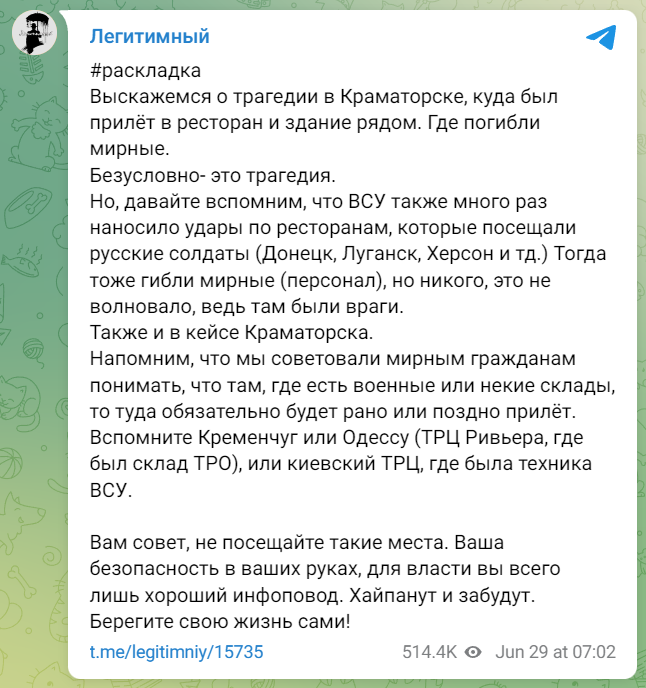
An example of a publication meant to stoke public intolerance/hostility towards the Ukrainian Army from the Legitimny Telegram channel.[200]
[Translation] “Legitimnyi
#layout
Let’s speak about the tragedy in Kramatorsk, where there was a strike to a restaurant and a building nearby. And where civilians died. Of course this is a tragedy.
But, let’s remember that the Ukrainian Armed Forces also struck many times at restaurants visited by Russian soldiers (Donetsk, Lugansk, Kherson, etc.). That time civilians (staff) also died, but no one cared, because there were enemies there.
Also in the Kramatorsk case.
Let us recall that we advised civilians to understand that where there are military men or certain warehouses, there will definitely be an air attack there sooner or later. Remember Kremenchuh or Odessa (Riviera shopping center, where there was a Territorial defense forces warehouse), or the shopping center in Kyiv, where there was Territorial defense forces equipment.
This is a piece of advice to you: do not visit such places. Your safety is in your hands; for the authorities you are just a newsbreak. They’ll get hyped and forget.
Take care of your own life!”
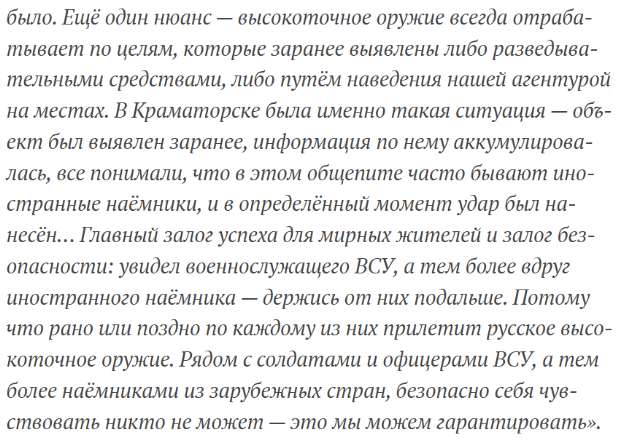
An example of a publication meant to stoke public intolerance/hostility towards the Ukrainian Army from a quote by Reserve Lieutenant Colonel Roman Shkurlatov for EurAsia Daily.[201]
[Translation] “Another nuance is that high-precision weapons always work against targets that have been identified in advance either by reconnaissance means or by targeting our agents on the ground.
In Kramatorsk there was exactly this situation – the object was identified in advance, information on it was accumulated, everyone understood that foreign mercenaries often visited this restaurant, and at a certain moment there was a strike… The main key to success for civilians and a guarantee of safety: if you see a serviceman of the Armed Forces of Ukraine, and even a foreign mercenary, stay away from them. Because sooner or later Russian high-precision weapons will attack each of them. No one can feel safe next to soldiers and officers of the Armed Forces of Ukraine, and especially mercenaries from foreign countries, that we can guarantee”.
After the attack on Pervomaiskyi, Russian troops continued to increase the number of strikes using the Iskander system. The list below details all the incidents known to Truth Hounds that occurred between 4 July 2023 and 16 October 2023.
On 10 July 2023
The Russian Army used Iskander-M missiles to attack Mykolaiv[202]
On 13 July 2023
Russia struck Mykolaiv Oblast with Iskander-M missiles, which were launched from the Dzhankoi area of Crimea.[203]
On 6 September 2023
One Iskander-M ballistic missile was intercepted over Kyiv Oblast.[225]
On 8 September 2023
Russia used Iskander missiles twice: there was a strike by an Iskander-K missile on Kryvyi Rih (73 people were injured and one killed); and an Iskander-M missile strike on Zaporizhzhia (one person was injured).[226]
On 16 September 2023
Russian troops used three Iskander-K missiles to strike Kharkiv, injuring five people.[227]
On 3 October 2023
Russia used one Iskander-K missile during a large-scale air attack[230].
On 7 October 2023
On 16 October 2023
Russian troops used one Iskander-M missile during a nighttime combined attack[234].
Legal qualification
Going back to the ‘binary’ of ICL, to which we referred at the beginning of this report, we should note that when events are assessed through the lens of ICL, there are only two possible answers to the question of whether a war crime (or any other international crime) has been committed: ‘yes’ and ‘no’. Sometimes, some of these responses depend on a fact not fully established due to ‘fog of war’, on a minimal discrepancy in eyewitness testimony, on an imperfect legal stance of the prosecution or defence, on the peculiarities of phrasing of a certain war crime, where elements can be interpreted in a broader or narrower way, etc. Due to this binary nature of ICL, legal qualification does not necessarily mean that the absolute truth is established or that the blame for the deaths of civilians is placed on a specific party of an armed conflict — or, conversely, that it absolves it from responsibility.
Although IHL and ICL are indifferent to the identity of the instigator in an armed conflict (these two domains of international law set symmetrical requirements on the party that initiated the conflict and the party under attack), this indifference does not apply to the entire scope of international law. Article 2(4) of the United Nations (UN) Charter unequivocally prohibits the use of force or the threat of force against the territorial integrity or political independence of any state. Violation of this prohibition in the form of using force against another state contrary to international law constitutes an act of aggression as defined in Resolution № 3314 of the UN General Assembly (‘Definition of aggression’). Paragraph 70 of General Comment № 36 of the UN Human Rights Committee regarding the right to life indicates that ‘[s]tate parties engaged in acts of aggression as defined in international law, resulting in deprivation of life, violate ipso facto Article 6 of the [International Covenant on Civil and Political Rights]’.[235] In other words, the aggressor state is responsible for all deaths related to the armed conflict it initiated. Today, there is a near-unanimous stance of the various countries of the world that recognises that Russia is the party which used armed force against Ukraine, unprovoked. This provides reasonable grounds to believe that Russia is responsible for the deaths of any individuals in connection with the armed conflict. Of course, deaths resulting from Russia’s attack on the Ria Lounge in Kramatorsk are not an exception.
This previous remark highlights the fact that, regardless of the characteristics of the attack on the Ria Lounge according to ICL, the responsibility for its consequences — lives lost — rests fully with Russia.
Let us consider further how the attack on the restaurant can be assessed based on IHL and ICL.
Immediately after the attack on the Ria Lounge, the Russian Ministry of Defence claimed that the target was a military object, namely the ‘temporary command point of the 56th Motorised Infantry Brigade’. According to Article 52 of the Protocols to the Geneva Conventions, ‘military objectives are limited to those objects which by their nature, location, purpose, or use make an effective contribution to military action and whose total or partial destruction, capture or neutralization, in the circumstances ruling at the time, offers a definite military advantage.[236] In case of doubt whether an object which is normally dedicated to civilian purposes […] is being used to make an effective contribution to military action, it shall be presumed not to be so used’.[237] The definition contains two elements that have to be cumulatively met to reach a conclusion about whether a certain object constitutes a military target:
- the object, by its nature, purpose, or use, must make an effective contribution to military action; and
- total or partial destruction, capture, or neutralisation of the object must offer a definite military advantage.
The second element prevents parties to the conflict from an excessively broad interpretation of a military object. Among other things, it states that the military advantage from the attack on the target should be concrete and tangible, rather than hypothetical and speculative:[238] ‘it is not legitimate to launch an attack which only offers potential or indeterminate advantages’.[239] This element also implies a certain degree of significance of the object to the war effort of the party that designates it as a military object.
Thus, the presence of military personnel in a civilian building close to the frontline most likely turns this building into a military object. However, the presence of a military serviceman traveling home on a holiday in a civilian train car should not make the entire train a legitimate target. The same logic should apply to civilian facilities attended by military servicepeople (hair salons, cafés, clothing and footwear shops, etc.) in cities removed from the frontline or in the streets of such cities more generally. A state involved in an armed conflict, particularly a prolonged one, cannot fully separate military and civilian lives, since these individuals will inevitably run into each other in public transport, dining establishments, places of recreation, etc. This statement applies to a greater extent considering the growing numbers of the population drafted to the armed forces of a state at war.
Article 58 of the Additional Protocol suggests that parties should avoid locating military objectives within or near densely populated areas. Indeed, setting up a weapons depot, a stronghold, or a similar object in a densely populated area would contradict the recommendation of Article 58. However, situational presence of the military in a certain area of a city or in a dining or entertainment establishment normally does not constitute a violation of Article 58 of the Additional Protocol.
These considerations combined with prior research by Truth Hounds provides certain grounds to believe that the Ria Lounge should not be considered a military object under IHL. Indeed, the diner was a popular location for visitors of various social groups: Kramatorsk locals, employees of charitable and humanitarian organisations, domestic and international journalists, and some military personnel temporarily or permanently deployed in Kramatorsk. Witnesses interviewed by Truth Hounds indicated that the diner was not used (at least on the day of the attack) as a command point or a dining place exclusively for the military.
However, more in-depth interviews with eyewitnesses demonstrated that the percentage of customers belonging to the military on the day of the attack was high; the majority of the interviewees agreed that Ukrainian soldiers constituted about a half of the total number of guests at the Ria Lounge on the day of the strike. In addition, two celebratory events for the military were scheduled at the diner on the day of the attack. Considering that Russia could be aware of the celebrations, we can assume that Russia had grounds to consider the Ria Lounge a legitimate target.
However, IHL does not only prohibit attacks targeting civilian objects. Article 51 of the Additional Protocol also prohibits indiscriminate attacks, which ‘may be expected to cause incidental loss of civilian life, injury to civilians, damage to civilian objects, or a combination thereof, which would be excessive in relation to the concrete and direct military advantage anticipated’. Violation of this provision may constitute a war crime under Article 8(2)(b)(iv) of the Rome Statute of the International Criminal Court: ‘Intentionally launching an attack in the knowledge that such attack will cause incidental loss of life or injury to civilians or damage to civilian objects or widespread, long-term and severe damage to the natural environment which would be clearly excessive in relation to the concrete and direct overall military advantage anticipated.’
To qualify the attack on the Ria Lounge as disproportionate under Article 8(2)(b)(iv) of the Rome Statute, two specific characteristics of this type of crime should be established in addition to the general elements of war crimes connected with the attack:
- The attack was such that it was likely to cause accidental death or injury to civilians, damage to civilian objects, or cause widespread, long-term, and serious damage to the natural environment — and such death, injury, or damage was of such a degree as to be clearly excessive in relation to the concrete and direct military advantage anticipated; and
- The attacker was aware that the attack would cause accidental death or injury to civilians, damage to civilian objects, or widespread, long-term, and serious damage to the natural environment — and that such death, injury, or damage would be clearly excessive in relation to the concrete and direct military advantage anticipated.
The element of disproportionality has been studied by international criminal courts multiple times, often in rather ambiguous terms, in the context of the potential commission of a war crime.[240] However, such studies pertained to the use of artillery weapons. The nature of artillery is that the object against which it is used is struck almost immediately. This allows the attacker to control the target. In addition, the detonation of one artillery projectile has a relatively small damage zone.
Unlike artillery projectiles, ballistic and cruise missiles (similarly to aircraft glide bombs):
- have a significantly larger impact area compared to artillery shells or, for instance, tank fire; and
- can be launched from distances of tens or even hundreds of kilometres from their target.
Commenting on the first peculiarity, the Independent Commission of Inquiry on the 2014 Gaza Conflict established by the UN Human Rights Council said that, in densely populated areas, weapons with such a broad destruction zone (the report concerns GBU-32/MK-82, 10001b, GBU-31/MK-84, and 20001b bombs which form a crater at their impact point of up to 15 metres in diameter) prevent their operators from adequately discerning civilians and civilian objects vs. military targets.[241] The Commission noted that the use of powerful munitions incapable of discerning between civilian and military targets will almost certainly constitute an indiscriminate attack by default.
The Commission drew its conclusions based on cases involving the use of aerial bombs dropped from aircraft located in the vicinity of an attack. Hence, the time between the release of the bomb and the impact was quite short.
Ballistic and cruise missiles have a similar impact area (at least a few dozen metres for Iskander-K missiles). However, they are launched from a relatively distant location from the target. In other words, quite a long time elapses between the launch of the missile and its strike on the target. This is especially true of cruise missiles that fly at relatively low speeds of 230–260 m/s and require more time to reach their target. In the case of the attack on Kramatorsk on 27 June 2023, the time between the launch and the strike on the Ria Lounge was between 9 and 15 minutes. Accordingly, the use of such missiles against moving targets (e.g., enemy military) does not give the attacker certainty that the target would remain in place at the time of the strike. The ability to have control over the target in this case depends on the distance from which the missile is launched. If the distance is relatively short (the missile flight takes several minutes), control is still available, but at greater distances (over 5–10 minutes of flight duration), the attacker has no control over the target. In any case, the longer the missile’s approach time, the less control they have over the target. An additional factor that should be taken into account while determining control over the target is a missile threat warning system. In countries where such a system does not function or functions poorly, even a long flight time may not necessarily deprive the attacker of control. Conversely, in countries with rapid warnings about a possible missile launch, control over the target is lost more quickly.
Investigating control over the target makes sense when the weapons employed create the risk of an indiscriminate attack. The use of a ‘kamikaze’ drone with a small amount of explosive matter on board does not create this risk by default. Using a missile with a significant impact area, on the other hand, requires studying control over the target.
Control over the target also involves an aspect of predicting whether civilians would be present on the site of the attack.[242] The longer the missile’s approach time, the less ability the attacker has to foresee the number of civilians affected by the attack.
The above does not call into question the possibility to use ballistic or cruise missiles in an armed conflict in general. There are quite a few scenarios where such weapons can be used legitimately:
- Missiles are used against a stationary military target or a dual-purpose object (a bridge, an ammunition depot, a parking area for military equipment, etc.);
- The missile is used from a close range (the flight time is up to several minutes, where the probability of hitting even a moving target is quite significant). However, comments made by the Independent Commission of Inquiry on the 2014 Gaza Conflict should be heeded regardless;
- The missile is used against the location of permanent deployment of mobile military forces (a dormitory, a base, or a camp for military personnel of a party to the conflict); or
- The missile is used against a state which does not have the means of detecting such missiles and, thus, the targets of the attack cannot intentionally leave the impact area in time in anticipation of the attack.
None of these scenarios reflects what took place in Kramatorsk during the attack on the Ria Lounge. As demonstrated in this report, the missile flight took approximately 15 minutes. The targeted facility was located in a densely populated area of a large city used by both civilians and the military. The only targets who could be legitimately attacked were Ukrainian military personnel. This leads us to the conclusion that the perpetrators of the attack against Kramatorsk did not have control over the target.
Given the large impact area of cruise missiles and the lack of control over the target by attackers, the attack on the Ria Lounge was indiscriminate in its nature. This conclusion eliminates the need to study the other component of a war crime in the form of an indiscriminate attack, namely, the attacker’s awareness of the excessive harm caused. The very fact of using a cruise missile illustrates that the attacker was aware of the potential excessive harm that could be (and was) caused by the missile and did not take measures to avoid it.
T—H
Sources
[1] Methodology of documentation, Truth Hounds, May 22, 2014. Available at: https://dev.truth-hounds.org/document/methodology/ (accessed June 28, 2023).
[2] Code of Ethics for documenters,Truth Hounds, May 22, 2014. Available at: https://dev.truth-hounds.org/en/document/code/ (accessed June 28, 2023).
[3] Testimony of Kr-015.
[4] The State Emergency Service of Ukraine (@dsns_telegram) post to Telegram channel, June 29, 2023, https://t.me/dsns_telegram/18212 (accessed July 3, 2023).
[5] Truth Hounds post to Facebook, July 3, 2023, https://www.facebook.com/truthhounds/posts/pfbid0w
S9jGrU6DETejvQbwD4XTSqbPcfuJzR6nSuXnebpRkVCKUxTBL8EoZDHP5HWJr25l (accessed July 3, 2023).
[6] “Raketnyi udar po Kramatorsku: u selyshchi Bilenke poshkodzheno budynky, ye poraneni”, novosti.dn, June 27, 2023, https://novosti.dn.ua/news/353016-raketnyj-udar-po-kramatorsku-u-selyshhi-bilenke-poshkodzheno-budynky-ye-poraneni (accessed July 3, 2023); Kramatorskpost post to Instagram, June 28, 2023, https://www.instagram.com/p/CuCxiJmtXZY/?utm_source=ig_embed&utm_campaign=loading (accessed July 3, 2023).
[7] Hrabovska V., “Zhinka plakala y krychala, bo ne znala, shcho z donkoiu: zhakhlyvi detali udaru Rosii po Kramatorsku”, 24TV, June 27, 2023, https://24tv.ua/obstril-kramatorska-27-chervnya-2023-roku-yaki-naslidki-vorozhogo_n2343046 (accessed July 3, 2023).
[8] “UDAR po KRAMATORSKU: yak riatuvalnyky rozbyraly zavaly u tsentri mista”, YouTube, uploaded by NEWS.LIVE, June 28, 2023, https://www.youtube.com/watch?v=_ciHIM8prgk (accessed July 3, 2023). Timecode: 00:00.
[9] https://drive.google.com/file/d/1uvFNhYkUcFOw4JR6a8fJ6vkUm0SbU3K-/view?usp=drive_link
[10] Testimony of Kr-020.
[11] “Volodymyr Zelenskyi vechirnie zvernennia 27 chervnia 2023”, YouTube, uploaded by POHLIaD, June 27, 2023, https://www.youtube.com/watch?v=TYyGA9b9IIM (accessed July 3, 2023).
[12] National Police of Ukraine (@UA_National_Police ) post to Telegram channel, June 27, 2023, https://t.me/UA_National_Police/12598 (accessed July 3, 2023).
[13] SPRAVDI (@spravdi) post to Telegram channel, July 13, 2023, https://t.me/spravdi/31454?single (accessed July 17, 2023).
[14] OK Pivnich (@ok_pivnich1) post to Telegram channel, July 15, 2023, https://t.me/ok_pivnich1/3882 (accessed July 17, 2023).
[15] “Rosiia zastosuvala po Kyievu rakety ZRK S-400 – Zaluzhnyi”, Militarnyi, January 14, 2023, https://mil.in.ua/uk/news/rosiya-zastosuvala-po-kyyevu-rakety-zrk-s-400-zaluzhnyj/ (accessed July 10, 2023); Rashysty perekhodiat do masovoho vykorystannia ZRK S-300 dlia udariv po mistakh: chy ye zakhyst, Defense Express, July 9, 2022, https://defence-ua.com/minds_and_ideas/rashisti_perehodjat_do_
masovogo_vikoristannja_zrk_s_300_dlja_udariv_po_mistah_chi_je_zahist-8096.html (accessed July 9, 2023).
[16] “S-300 – u piatypoverkhivku: naslidky nichnykh obstriliv Mykolaieva”, Army Inform, October 23, 2022, https://armyinform.com.ua/2022/10/23/s-300-u-pyatypoverhivku-naslidky-nichnyh-obstriliv-mykolayeva/ (accessed July 10, 2023).
[17] Burda V. “«S-300» ta «S-400»: yak rosiia obstriliuie ukrainski mista z kompleksiv PP”, Chas.News, January 16, 2023, https://chas.news/current/s-300-s-400-yak-rosiya-obstrilyue-ukrainski-mista-z-kompleksiv-ppo (accessed July 10, 2023).
[18] “RF pochala byty z S-400 raketamy 48N6DM po mistakh: zvidky biut, zahroza ta protydiia”, Defence Express, January 15, 2023, https://defence-ua.com/video/rf_pochala_biti_z_s_400_raketami_48n6dm_po_mistah_zvidki_bjut_zagroza_ta_protidija-123.html (accessed July 10, 2023).
[19] “Svodka Ministerstva oboronyi Rossiyskoy Federatsii o hode provedeniya spetsialnoy voennoy operatsii (po sostoyaniyu na 28 iyunya 2023 g.)”, Ministry of Defense of the Russian Federation, June 28, 2023, https://function.mil.ru/news_page/country/more.htm?id=12471577@egNews (accessed July 10, 2023).
[20] Air Force of the Armed Forces of Ukraine (@ kpszsu) post to Telegram channel, June 27, 2023, https://t.me/kpszsu/2878 (accessed July 3, 2023); Naalsio (@naalsio26) post to Twitter, July 10, 2023, https://twitter.com/naalsio26/status/1678509115331473408 (accessed July 10, 2023).
[21] “Prokurory spilno zi slidchymy SBU vstanovliuiut prychetnykh do obstrilu tsentru Kramatorska – rozpochato rozsliduvannia”, Prosecutor General’s Office of Ukraine, June 28, 2023, https://www.gp.gov.ua/ua/posts/prokurori-spilno-zi-slidcimi-sbu-vstanovlyuyut-pricetnix-do-obstrilu-centru-kramatorska-rozpocato-rozsliduvannya (accessed July 3, 2023).
[22] “Udar po Kramatorsku, ymovirno, buv zavdanyi balistychnoiu raketoiu Iskander-M — Ihnat”, Hromadske Radio, June 30, 2023, https://hromadske.radio/news/2023/06/30/udar-po-kramatorsku-ymovirno-buv-zavdanyy-balistychnoiu-raketoiu-iskander-m-ihnat (accessed July 3, 2023).
[23] Testimony of Kr-020.
[24] Testimony of Kr-016.
[25] Tsyigikalo N. “Skazanie ob «Iskandere», ili Kak rabotaet takticheskiy raketnyiy kompleks”, Naked Science, May 2, 2021, https://naked-science.ru/article/tech/raketa-iskander (accessed July 10, 2023).
[26] Zghurets S. “OTRK “Iskander”: vsi “nadzdibnosti” z katehorii shou-zbroi”, Defense Express, March 23, 2022, https://defence-ua.com/weapon_and_tech/otrk_iskander_vsi_nadzdibnosti_z_kategoriji_shou_zbroji-6581.html (accessed July 10, 2023).
[27] Zghurets S. “OTRK “Iskander”: vsi “nadzdibnosti” z katehorii shou-zbroi”, Defense Express, March 23, 2022, https://defence-ua.com/weapon_and_tech/otrk_iskander_vsi_nadzdibnosti_z_kategoriji_shou_zbroji-6581.html (accessed July 10, 2023).
[28] Testimony of Kr-008.
[29] Testimony of Kr-016.
[30] Testimony of Kr-001.
[31] Testimony of Kr-010.
[32] Testimony of Kr-011.
[33] Testimony of Kr-020.
[34] Testimony of Kr-020.
[35] “Puski raket OTRK «Iskander-M» na poligone Saryi-Shagan v ramkah SKShU «Tsentr-2019»”, YouTube, uploaded by Ministry of Defense of the Russian Federation (@user-in9ut2zu6e), July 19, 2023, https://www.youtube.com/watch?v=N94PWLLCNeA (accessed July 19, 2023).
[36] “Boevoy pusk kryilatoy raketyi OTRK «Iskander-M» na poligone Kapustin Yar”, YouTube, uploaded by Ministry of Defense of the Russian Federation (@user-in9ut2zu6e), April 18, 2016, https://www.youtube.com/watch?v=qTqTG6Na1xM (accessed July 19, 2023).
[37] Romanenko, Valentyna. “Russia strikes Pervomaiskyi with Iskander missile, injuring more than 40 – Prosecutor’s Office”, Ukrainska Pravda, July 4, 2023, https://www.pravda.com.ua/eng/news/2023/07/4/7409831/ (accessed July 10, 2023).
[38] Kramatorsk City Council (@kramatorsk_rada) post to Telegram channel, June 29, 2023, https://t.me/kramatorsk_rada/13033 (accessed July 3, 2023).
[39] Анатолій Куртєв (@kurtievofficial) post to Telegram channel, March 31, 2023, https://t.me/kurtievofficial/9792 (accessed July 17, 2023); “Iskander-M” zastosuvaly rosiiany dlia udaru po Zaporizhzhiu — naslidky (VIDEO)”, FREEDOM, April 4, 2023, https://uatv.ua/uk/iskander-m-zastosuvaly-rosiyany-dlya-udaru-po-zaporizhzhyu-naslidky-video/ (accessed July 17, 2023).
[40] “Udar «Iskanderom» po zhytlovomu budynku Kramatorska: naslidky (fotosvidchennia)”, Radio Svoboda, February 2, 2023, https://www.radiosvoboda.org/a/foto-kramatorsk-iskander-naslidky/32252771.html (accessed July 17, 2023).
[41] “Rosiiski viiska zruinuvaly shkolu v Kramatorsku, odna liudyna zahynula – OVA”, Radio Svoboda, July 22, 2022, https://www.radiosvoboda.org/a/news-rosiiski-viiska-udar-po-kramatorsku/31954269.html (accessed July 17, 2023); “Okupanty 21 lypnia vdaryly po Kramatorsku “Iskanderamy”, poshkodyly 85 pryvatnykh budynkiv – holova Donetskoi OVA”, GORDON, July 22, 2022, https://gordonua.com/ukr/news/war/okupanti-21-lipnja-vdarili-po-kramatorsku-iskanderami-poshkodili-85-privatnih-budinkiv-golova-donetskoji-ova-1618205.html (accessed July 17, 2023).
[42] “Znyshchena rosiianamy shkola u Kramatorsku: video z vysoty ptashynoho polotu”, YouTube, uploaded by Kramatorsk Post, July 29, 2022, https://www.youtube.com/watch?v=vymsz1s5wSY (accessed July 3, 2023).
[43] https://drive.google.com/drive/u/1/folders/1sgeZY1iGHIFd1XAi4Q6d-4XcBDRytDlN
[44] Metodychni rekomendatsii shchodo identyfikatsii krylatykh raket: [uklad. D. V. Ramshov, O. M. Surkov, Ye. O. Bondarenko ]. Kyiv, 2022. Available at: https://sprotyvg7.com.ua/wp-content/uploads/2023/03/%D0%9C%D0%B5%D1%82%D0%BE%D0%B4.%D1%80%D0%B5%D0%BA.-%D0%86%D0%B4%D0%B5%D0%BD%D1%82%D0%B8%D1%84.-%D1%80%D0%B0%D0%BA%D0%B5%D1%82.pdf
[45] Conflict Intelligence Team (@CITeam) post to Telegram channel, March 18, 2022, https://t.me/CITeam/2413?single (accessed July 17, 2023).
[46] Conflict Intelligence Team (@CITeam) post to Telegram channel, March 18, 2022, https://t.me/CITeam/2413?single (accessed July 17, 2023).
[47] Voennyiy Osvedomitel (@milinfolive) post to Telegram channel, December 5, 2022, https://t.me/milinfolive/94062 (accessed July 17, 2023).
[48] (@police_kh_region) post to Telegram channel, October 6, 2023 https://t.me/police_kh_region/21315?single (accessed October 7, 2023).
[49] CIT (@CITeam_ru) post to Twitter, March 18, 2022, https://twitter.com/CITeam_ru/status/1504794062624337921/photo/1 (accessed July 17, 2023).
[50] Kramatorsk Post. Available at: https://www.kramatorskpost.com/
[51] (@kramatorskpost) post to Instagram, June 28, 2023, https://www.instagram.com/p/CuCxiJmtXZY/?utm_source=ig_embed&utm_campaign=loading (accessed July 3, 2023).
[52] “Rosiiska armiia obstriliala Kramatorsk raketamy “Iskander”: naslidky raketnoho udaru”, YouTube, uploaded by Suspilne Donbas, June 28, 2023, https://www.youtube.com/watch?v=g8FqQsBbaFE (accessed July 3, 2023).
[53] Testimony of Kr-010; testimony of Kr-011.
[54] Testimony of Kr-002.
[55] Testimony of Kr-020.
[56] Available at: https://earth.google.com/earth/d/1LEAnf_0xwhH2XHnLQnxv-go9epxMNmx2?usp=sharing
[57] Testimony of Kr-004.
[58] https://drive.google.com/file/d/1MfEKk0P2kBG2eGJtit0Eo8UlFEP_G9wm/view?usp=drive_link.
[59] “Video posledstviy raketnogo udara po restoranu ‘Ria Lounge’ s naemnikami v Kramatorske”, RuTube, uploaded by RUS, June, 2023, https://rutube.ru/video/bc2b2c128e043d7b1a07d9f67026129c/ (accessed July 15, 2023).
[60] “Posledstviya raketnogo udara po tsentru Kramatorska. Video s drona”, YouTube, uploaded by (@YasnoPonyatnoUA), June 28, 2023, https://www.youtube.com/watch?v=iguUkFsNrvk (accessed July 15, 2023).
[61] Idea borrowed from DeepState UA. Available at: https://t.me/DeepStateUA
[62] Testimony of Kr-020.
[63] Povitriana Tryvoha (@air_alert_ua) post to Telegram channel, June 27, 2023, https://t.me/air_alert_ua/49587 (accessed July 3, 2023).
[64] “U Mykolaievi pislia vidboiu povitrianoi tryvohy prolunaly vybukhy: ye zhertvy”, Podrobnosti, July 29, 2022, https://podrobnosti.ua/2453408-u-mikolav-pslja-vdboju-povtrjano-trivogi-prolunali-vibuhi.html (accessed July 17, 2023).
[65] Baibak A. “Voroh vdruhe za dobu vdaryv po Kharkovu: na mistsi vluchannia vynykla pozhezha, ye postrazhdali”, 24 TV, July 16, 2023, https://24tv.ua/harkovi-prolunali-potuzhni-vibuhi-pislya-vidboyu-trivogi_n2354138 (accessed July 17, 2023).
[66] Myhal M. “U Khersoni pislia tryvohy lunaly vybukhy: mistsevi zhyteli povidomliaiut pro vluchannia”, Glavcom, January 19, 2023, https://glavcom.ua/country/incidents/u-khersoni-pislja-trivohi-lunali-vibukhi-mistsevi-zhiteli-povidomljajut-pro-vluchannja–902980.html (accessed July 17, 2023).
[67] “ZSU znyshchyly na Chernihivshchyni odrazu dyvizion OTRK “Yskander” rashystiv”, Defense Express, March 10, 2022, https://defence-ua.com/news/zsu_znischili_na_chernigivschini_odrazu_divizion_otrk_iskander_rashistiv-6357.html (accessed July 17, 2023).
[68] Bohdanok O. “Ukraina ne bude byty po punktakh dyslokatsii “Iskanderiv” na terytorii RF — Ihnat”, Suspilne News, June 1, 2023, https://suspilne.media/493696-ukraina-ne-bude-biti-po-punktah-dislokacii-iskanderiv-na-teritorii-rf-ignat/ (accessed July 17, 2023).
[69] OSINTtechnical (@Osinttechnical) post to Twitter, February 1, 2022, https://twitter.com/Osinttechnical/status/1488622337792614407 (accessed July 17, 2023).
[70] Ministry of Defense of the Russian Federation (@mod_russia) post to Telegram channel, September 14, 2022, https://t.me/mod_russia/19827 (accessed July 17, 2023).
[71] Ministry of Defense of the Russian Federation (@mod_russia) post to Telegram channel, June 4, 2023, https://t.me/mod_russia/27081 (accessed July 18, 2023).
[72] Ministry of Defense of the Russian Federation (@mod_russia) post to Telegram channel, October 14, 2022, https://t.me/mod_russia/20830 (accessed July 18, 2023).
[73] “Raschetyi operativno-takticheskogo raketnogo kompleksa «Iskander-M» Tsentralnogo voennogo okruga prodolzhayut vyipolnyat boevyie zadachi v zone spetsialnoy voennoy operatsii”, Ministry of Defense of the Russian Federation, https://structure.mil.ru/structure/forces/ground/structure/tank/address/more.htm?id=12442340@egNews (accessed July 17, 2023); Ministry of Defense of the Russian Federation (@mod_russia) post to Telegram channel, October 21, 2022, https://t.me/mod_russia/21064 (accessed July 18, 2023).
[74] Konrad Muzyka – Rochan Consulting (@konrad_muzyka) post to Twitter, February 5, 2022, https://twitter.com/konrad_muzyka/status/1490030000376098824 (accessed on July 17, 2023).
[75] Ministry of Defense of the Russian Federation (@mod_russia) post to Telegram channel, July 24, 2023, https://t.me/mod_russia/28569 (accessed July 26, 2023).
[76] Zvиздец Мангусту (@zvizdecmanhustu) post to Telegram channel, February 26, 2023, https://t.me/zvizdecmanhustu/525 (accessed July 17, 2023);
Ministry of Defense of the Russian Federation (@mod_russia) post to Telegram channel, May 11, 2023, https://t.me/mod_russia/26489 (accessed July 17, 2023); Zvиздец Мангусту (@zvizdecmanhustu) post to Telegram channel, July 8, 2023, https://t.me/zvizdecmanhustu/1006 (accessed July 17, 2023);
Zvиздец Мангусту (@zvizdecmanhustu) post to Telegram channel, July 8, 2023, https://t.me/zvizdecmanhustu/1006 (accessed July 17, 2023);
Zvиздец Мангусту (@zvizdecmanhustu) post to Telegram channel, August 14, 2023, https://t.me/zvizdecmanhustu/1109 (accessed August 15, 2023);
Zvиздец Мангусту (@zvizdecmanhustu) post to Telegram channel, August 14, 2023, https://t.me/zvizdecmanhustu/1109 (accessed August 15, 2023); Zvиздец Мангусту (@zvizdecmanhustu) post to Telegram channel, July 9, 2023, https://t.me/zvizdecmanhustu/1010 (accessed July 17, 2023);
Ministry of Defense of the Russian Federation (@mod_russia) post to Telegram channel, June 28 2023, https://t.me/mod_russia/28691 (accessed July 17, 2023);
Zvиздец Мангусту (@zvizdecmanhustu) post to Telegram channel, July 15, 2023, https://t.me/zvizdecmanhustu/1022 (accessed July 17, 2023);
Zvиздец Мангусту (@zvizdecmanhustu) post to Telegram channel, July 15, 2023, https://t.me/zvizdecmanhustu/1022 (accessed July 17, 2023);
Zvиздец Мангусту (@zvizdecmanhustu) post to Telegram channel, June 25, 2023, https://t.me/zvizdecmanhustu/948 (accessed July 17, 2023);
Zvиздец Мангусту (@zvizdecmanhustu) post to Telegram channel, March 30, 2023, https://t.me/zvizdecmanhustu/638 (accessed July 17, 2023); Zvиздец Мангусту (@zvizdecmanhustu) post to Telegram channel, May 24, 2023, https://t.me/zvizdecmanhustu/814 (accessed July 17, 2023);
Ministry of Defense of the Russian Federation (@mod_russia) post to Telegram channel, July 28, 2023, https://t.me/mod_russia/28688 (accessed August 31, 2023);
Ministry of Defense of the Russian Federation (@mod_russia) post to Telegram channel, July 28, 2023, https://t.me/mod_russia/28688 (accessed August 31, 2023);
Mashovets K. “Okupanty na pivden kynuly rezervy, a shcho ZSU?”, OBOZ.UA, July 5, 2023, https://war.obozrevatel.com/ukr/okupanti-na-pivden-kinuli-rezervi-a-scho-zsu.htm (accessed July 17, 2023);
Mashovets K. “Okupanty na pivden kynuly rezervy, a shcho ZSU?”, OBOZ.UA, July 5, 2023, https://war.obozrevatel.com/ukr/okupanti-na-pivden-kinuli-rezervi-a-scho-zsu.htm (accessed July 17, 2023);
Zvиздец Мангусту (@zvizdecmanhustu) post to Telegram channel, June 29, 2023, https://t.me/zvizdecmanhustu/970 (accessed July 17, 2023); Zvиздец Мангусту (@zvizdecmanhustu) post to Telegram channel, August 19, 2023, https://t.me/zvizdecmanhustu/1127 (accessed August 21, 2023);
Mashovets K. “Komanduvannia viisk rf ukripliuie oboronu na Krymskomu napriamku, – koordynator IS”, sprotyv.info, March 4, 2023, https://sprotyv.info/analitica/komanduvannya-vijsk-rf-ukriplyu%d1%94-oboronu-na-krimskomu-napryamku-koordinator-is/ (accessed July 17, 2023);
Mashovets K. “Okupanty na pivden kynuly rezervy, a shcho ZSU?”, OBOZ.UA, July 17, 2023, https://war.obozrevatel.com/ukr/okupanti-na-pivden-kinuli-rezervi-a-scho-zsu.htm (accessed July 17, 2023);
Zvиздец Мангусту (@zvizdecmanhustu) post to Telegram channel, April 28, 2023, https://t.me/zvizdecmanhustu/732 (accessed July 17, 2023).
[77] Persikov A. “Kreml soobschil, chto Putin posetil gruppirovku voysk «Dnepr». Ranshe ee ne suschestvovalo — po versii britanskoy razvedki, strukturu sozdali iz-za bolshih poter”, VotTak, April 20, 2023, https://vot-tak.tv/novosti/20-04-2023-gruppirovka-vojsk-dnepr (accessed July 17, 2023).
[78] Kononenko O. (red.) “«Yak pobyti sobaky»: komanduvach 41-yi armii RF zaiavyv, shcho vykhid z Ukrainy bude velycheznoiu hanboiu — audio”, NV, July 13, 2022, https://nv.ua/ukraine/events/komanduyushchiy-41-y-armii-rf-zayavil-chto-uhod-iz-ukrainy-budet-pozorom-novosti-ukrainy-50256219.html (accessed July 17, 2023); 41-ya obschevoyskovaya armiya. Available at: https://war-proekt.media/base/voiska/41-obshhevoiskovaya-armiya/ (accessed July 17, 2023).
[79] Kasiian V. “Pid chas sproby forsuvaty Siverskyi Donets Rosiia vtratyla 485 z 550 viiskovykh 74 bryhady, – ISW”, LB.UA, May 16, 2022, https://lb.ua/society/2022/05/16/516982_pid_chas_sprobi_forsuvati_siverskiy.html (accessed July 11, 2023).
[80] Bowen, Andrew S.. Russian Military Buildup Along the Ukrainian Border, Congressional Research Service, February 7, 2022, https://crsreports.congress.gov/product/pdf/IN/IN11806 (accessed July 17, 2023).
[81] Naalsio (@naalsio26) post to Twitter, April 28, 2023, https://twitter.com/naalsio26/status/1519493030453157888 (accessed July 10, 2023).
[82] Zvиздец Мангусту (@zvizdecmanhustu) post to Telegram channel, October 5, 2023, https://t.me/zvizdecmanhustu/1282 (accessed October 9, 2023); Zvиздец Мангусту (@zvizdecmanhustu) post to Telegram channel, July 16, 2023, https://t.me/zvizdecmanhustu/1026 (accessed July 17, 2023).
[83] Jomini of the West (@JominiW) post to Twitter, April 7, 2023, https://twitter.com/JominiW/status/1644436088323289088/photo/ (accessed July 17, 2023).
[84] Chernyahovsk Glavnyiy (@glavche) post to VKontakte, July 2, 2022, https://vk.com/wall-179925326_202713 (accessed July 17, 2023).
[85] Maria Avdeeva (@maria_avdv) post to Twitter, September 8, 2022, https://twitter.com/maria_avdv/status/1567837153652051969 (accessed July 17, 2023).
[86] “Boi u Kyivskii oblasti rozpochalysia pislia vtorhnennia viiskovykh rosiiskoi federatsii v Ukrainu 24 liutoho 2022 roku…”, Truth Hounds, https://dev.truth-hounds.org/wp-content/uploads/2022/05/truth-hounds-25-04-2022-1.pdf (accessed July 17, 2023); Bowen, Andrew S.. “Russian Military Buildup Along the Ukrainian Border”, Congressional Research Service, February 7, 2022, https://crsreports.congress.gov/product/pdf/IN/IN11806 (accessed July 17, 2023).
[87] “RF narazhaie sebe na «ryzyky po vsii Yevrazii», stiahuiuchy viiska zvidusil do Ukrainy – rozvidka Brytanii”, Radio Svoboda, July 6, 2023, https://www.radiosvoboda.org/a/news-ukraina-viiska-z-usiiei-rosii-rozvidka-brytanii/32491426.html (accessed July 17, 2023); Abishev I. “Rossiya pyitaetsya ostanovit ukrainskoe nastuplenie vvodom rezervov. Chto proishodit na frontah”, BBC News Russia, July 7, 2023, https://www.bbc.com/russian/articles/cjrq498pl0jo (accessed July 17, 2023).
[88] Voin DV (@voin_dv) post to Telegram channel, November 24, 2022, https://t.me/voin_dv/598 (accessed August 14, 2023).
[89] Romanov Лайт ] (@romanov_92) post to Telegram channel, July 30, 2023, https://t.me/romanov_92/40780 (accessed August 23, 2023); Zvиздец Мангусту (@zvizdecmanhustu) post to Telegram channel, August 25, 2023, https://t.me/zvizdecmanhustu/1153 (accessed August 28, 2023); Zvиздец Мангусту (@zvizdecmanhustu) post to Telegram channel, August 10, 2023, https://t.me/zvizdecmanhustu/1097 (accessed August 28, 2023).
[90] ben-reuter (@benreuter_IMINT) post to Twitter, July 17, 2023, https://twitter.com/benreuter_IMINT/status/1680945375098687488 (accessed July 17, 2023).
[91] Barash Yu. “Porazka v Ukraini 1-yi tankovoi armii Rosii: yak take vzahali mohlo statysia”, Defense Express, September 19, 2022, https://defence-ua.com/minds_and_ideas/porazka_v_ukrajini_1_ji_tankovoji_armiji_rosiji_jak_take_vzagali_moglo_statisja-8966.html (accessed July 17, 2023).
[92] Zubkova, Daria. “AFU Defeated 35th Combined-Arms Army Of Russia In Izium – Yermak”, Ukrainian News, June 22, 2022, https://ukranews.com/en/news/861069-afu-defeated-35th-combined-arms-army-of-russia-in-izium-yermak (accessed July 17, 2023); Stepanenko, Kateryna; Clark, Mason; Barros, George. “Russian Offensive Campaign Assessment, June 3”, Institute for the Study of War & The Critical Threats Project 2022, June 3, 2022, https://www.understandingwar.org/backgrounder/russian-offensive-campaign-assessment-june-3 (accessed July 17, 2023).
[93] “Yaki pidrozdily ZS RF okupuvaly Chernihivshchynu. Vtorhnennia rosiiskykh viisk na terytoriiu Chernihivskoi oblasti (2022)”, Truth Hounds. Available at: https://dev.truth-hounds.org/wp-content/uploads/2022/08/truth_hounds_chernihiv-.pdf (accessed July 11, 2023); Bowen, Andrew S.. Russian Military Buildup Along the Ukrainian Border, Congressional Research Service, February 7, 2022, https://crsreports.congress.gov/product/pdf/IN/IN11806 (accessed July 17, 2023).
[94] InformNapalm (@informnapalm) post to Telegram channel, March 16, 2023, https://t.me/informnapalm/4450 (accessed August 18, 2023).
[95] Chupak M.S. “ZSU vdruhe rozbyly pidrozdil rosiiskykh kativ: u 36 zahalnoviiskovii armii znachni vtraty”, 24 TV, October 15, 2022, https://24tv.ua/zsu-vdruge-rozgromili-36-zagalnoviyskovu-armiyu-rosiyi_n2178560 (accessed July 17, 2023).
[96] Chupak M.S. “ZSU vdruhe rozbyly pidrozdil rosiiskykh kativ: u 36 zahalnoviiskovii armii znachni vtraty”, 24 TV, October 15, 2022, https://24tv.ua/zsu-vdruge-rozgromili-36-zagalnoviyskovu-armiyu-rosiyi_n2178560 (accessed July 17, 2023).
[97] 29-ya obschevoyskovaya armiya. Available at: https://war-proekt.media/base/voiska/29-obshhevoiskovaya-armiya/ (accessed July 17, 2023); Bowen, Andrew S.. “Russian Military Buildup Along the Ukrainian Border”, Congressional Research Service, February 7, 2022, https://crsreports.congress.gov/product/pdf/IN/IN11806 (accessed July 17, 2023).
[98] Pravda Gerashchenko (@Pravda_Gerashchenko) post to Telegram channel, March 11, 2022, https://t.me/Pravda_Gerashchenko/3477 (accessed August 18, 2023).
[99] Hubashov D. “Orda. Struktura rosiiskoi armii ta pidrozdily, zalucheni v Ukraini”, TEXTY.ORG.UA. Available at: https://texty.org.ua/d/2022/orcs-army-structure/ (accessed July 19, 2023).
[100] “Den pamyati zaschitnikam Rodinyi”. Vremya. Sobyitiya. Dokumentyi, May 13, 2021, http://xn—-dtbegghdehagnwec3cgs.xn--p1ai/tinybrowser/2021_/vsd_-18_ot_13.05.21.pdf (accessed July 18, 2023).
[101] “Raketnoe soedinenie YuVO poluchilo brigadnyiy komplekt raketnogo kompleksa “Iskander-M “”, ТАСС, January 18, 2023, https://tass.ru/armiya-i-opk/13477605 (accessed July 18, 2023).
[102] “Press-sluzhba Yuzhnogo voennogo okruga. Dislotsirovannyiy v Kryimu armeyskiy korpus YuVO usilyat raketnyim divizionom”, Ministry of Defense of the Russian Federation, January 14, 2022, https://function.mil.ru/news_page/country/more.htm?id=12403469@egNews (accessed July 17, 2023).
[103] “Rossiyskaya armiya sosredotachivaetsya vozle Kieva, Harkova i Mariupolya – Genshtab”, InterFax Ukraine, March 8, 2022, https://ru.interfax.com.ua/news/general/809182.html (accessed July 19, 2023); DeepState Map from April 2022. Available at: https://deepstatemap.live/#8/46.868/34.689 (accessed July 10, 2023).
[104] Monitoring (@monitorwarr) post to Telegram channel, July 13, 2023, https://t.me/monitorwarr/13040 (accessed August 8, 2023); monitoring (@monitorwarr) post to Telegram channel, July 23, 2023, https://t.me/monitorwarr/13427 (accessed August 8, 2023); monitoring (@monitorwarr) post to Telegram channel, July 20, 2023, https://t.me/monitorwarr/13290 (accessed August 8, 2023).
[105] Rob Lee (@RALee85) post to Twitter, February 15, 2022, https://twitter.com/RALee85/status/1493411342316888068 (accessed July 17, 2023).
[106] Rob Lee (@RALee85) post to Twitter, February 15, 2022, https://twitter.com/RALee85/status/1493411342316888068 (accessed July 17, 2023).
[107] “Press-sluzhba Yuzhnogo voennogo okruga. Raschetyi OTRK «Iskander-M» 49-y obschevoyskovoy armii YuVO vyipolnyat boevyie strelbyi na poligone Kapustin Yar”, Ministry of Defense of the Russian Federation, January 24, 2022, https://function.mil.ru/news_page/country/more.htm?id=12404972@egNews (accessed July 17, 2023); Andreas Lipschitz (@lipschz) post to Twitter, May 7, 2023, https://twitter.com/lipschz/status/1523033712690331648 (accessed July 17, 2023).
[108] “Rossiyskaya armiya sosredotachivaetsya vozle Kieva, Harkova i Mariupolya – Genshtab”, InterFax Ukraine, March 8, 2022, https://ru.interfax.com.ua/news/general/809182.html (accessed July 19, 2023); DeepState Map from April 2022. Available at: https://deepstatemap.live/#8/46.868/34.689 (accessed July 10, 2023).
[109] Kollektsioner bayanov (@altyn73) post to LiveJournal, January 20, 2022, https://altyn73.livejournal.com/1468711.html? (accessed July 19, 2023).
[110] “Rossiyskaya armiya sosredotachivaetsya vozle Kieva, Harkova i Mariupolya – Genshtab”, InterFax Ukraine, March 8, 2022, https://ru.interfax.com.ua/news/general/809182.html (accessed July 19, 2023); “RF narazhaie sebe na «ryzyky po vsii Yevrazii», stiahuiuchy viiska zvidusil do Ukrainy – rozvidka Brytanii”, Radio Svoboda, July 6, 2023, https://www.radiosvoboda.org/a/news-ukraina-viiska-z-usiiei-rosii-rozvidka-brytanii/32491426.html (accessed July 17, 2023); DeepState Map from April 2022. Available at: https://deepstatemap.live/#8/46.868/34.689 (accessed July 10, 2023).
[111] Viiskovyi Vishchun (@vishun_military) post to Telegram channel, July 31, 2022, https://t.me/vishun_military/2093 (accessed August 7, 2023).
[112] Ukraine Control Map, Project Owl OSINT (@projectowlosint). Available at: https://www.google.com/maps/d/u/0/viewer?mid=180u1IkUjtjpdJWnIC0AxTKSiqK4G6Pez&ll=47.04456181971394%2C36.52491529453367&z=9
[113] Ministry of Defense of the Russian Federation (@mod_russia) post to Telegram channel, June 4, 2023, https://t.me/mod_russia/27081 (accessed July 18, 2023).
[114] Ministry of Defense of the Russian Federation (@mod_russia) post to Telegram channel, April 24, 2023, https://t.me/mod_russia/25889 (accessed July 18, 2023).
[115] Bowen, Andrew S.. “Russian Military Buildup Along the Ukrainian Border”, Congressional Research Service, February 7, 2022, https://crsreports.congress.gov/product/pdf/IN/IN11806 (accessed July 17, 2023).
[116] Security Service of Ukraine (@SBUkr) post to Telegram channel, June 28, 2023, https://t.me/SBUkr/8782 (accessed July 3, 2023).
[117] Jomini of the West (@JominiW) post to Twitter, April 7, 2023, https://twitter.com/JominiW/status/1644436092119052291 (accessed July 17, 2023); Jomini of the West (@JominiW) post to Twitter, April 7, 2023, https://twitter.com/JominiW/status/1644436106283216927 (accessed July 17, 2023); DeepStateMap, available at: https://deepstatemap.live/#11/48.0106/37.7772 (accessed July 10, 2023); Poulet volant (@Pouletvolant3) post to Twitter, July 19, 2023, https://twitter.com/Pouletvolant3/status/1681701624153092098/photo/4 (accessed July 19, 2023).
[118] “Yak Rosiia zastosuie novyi 14-y bryhadnyi komplekt OTRK “Yskander-M”: analiz Defense Express”, Defense Express, August 31, 2021, https://defence-ua.com/army_and_war/jak_rosija_zastosuje_novij_14_j_brigadnij_komplekt_otrk_iskander_m_analiz_defense_express-4641.html (accessed July 19, 2023).
[119] “Raketnoe soedinenie YuVO poluchilo brigadnyiy komplekt raketnogo kompleksa “Iskander-M””, ТАСС, January 20, 2022, https://tass.ru/armiya-i-opk/13477605 (accessed July 18, 2023).
[120] Zvиздец Мангусту (@zvizdecmanhustu) post to Telegram channel, March 30, 2023, https://t.me/zvizdecmanhustu/638 (accessed July 17, 2023); Zvиздец Мангусту (@zvizdecmanhustu) post to Telegram channel, May 24, 2023, https://t.me/zvizdecmanhustu/814 (accessed July 17, 2023).
[121] “Tseremoniya otkryitiyavoenno-tehnicheskogo«ARMIYa–2022»v Rostovskoy oblasti”ARMY–2022″in the Rostov region”, YouTube, uploaded by Info Den.rf, August 25, 2022, https://www.youtube.com/watch?v=S-m7nLbugRA (accessed July 17, 2023).
[122] “Press-sluzhba Yuzhnogo voennogo okruga. V Rostovskoy oblasti sostoyalos otkryitie foruma «ARMIYa-2022» na territorii «Sambekskih vyisot»”, Ministry of Defense of the Russian Federation, August 19, 2022, https://function.mil.ru/news_page/country/more.htm?id=12434400@egNews (accessed July 17, 2023).
[123] Military vehicle. 9934 тт 21, PlatesMania, August 22, 2022. Available at: https://platesmania.com/ru/nomer19767140 (accessed July 17, 2023).
[124] Military vehicle. 9946 тт 21, PlatesMania, August 22, 2022. Available at: https://platesmania.com/ru/nomer19767194 (accessed July 17, 2023).
[125] Military vehicle. 9934 тт 21, PlatesMania, August 22, 2022. Available at: https://platesmania.com/ru/nomer19767140 (accessed July 17, 2023).
[126] Military vehicle. 9946 тт 21, PlatesMania, August 22, 2022. Available at: https://platesmania.com/ru/nomer19767194 (accessed July 17, 2023).
[127] 21 region chernyiy voennyiy nomer. Severo-Kavkazskiy voennyiy okrug (SKVO)(s 4.10.2010 Yuzhnyiy voennyiy okrug), NOMERA.Available at: https://nomerrus.ru/vn21.html (accessed July 17, 2023).
[128] Kurilchenko A. “Hirurgicheskaya tochnost: raschetyi OTRK «Iskander» unichtozhili klyuchevyie punktyi uslovnogo protivnika v gorah Severnogo Kavkaza”, Zvezda, March 3, 2021, https://tvzvezda.ru/news/202131346-XYZ2x.html (accessed July 17, 2023).
[129] Vehicle registration plates of Russia. тт 21 МЗКТ 7930, PlatesMania. Available at: https://platesmania.com/ru/gallery.php?gal=ru&nomer=TT+21&markaavto=196&model=5550 (accessed July 17, 2023).
[130] “Pusk raketyi OTRK «Iskander-M» s territorii Krasnodarskogo kraya…”, RuTube, 2021, https://rutube.ru/video/121f208835e6f341ab39f96d4a08b12d/ (accessed July 17, 2023); Hoje no Mundo Militar (@hoje_no) post to Twitter, February 24, 2022, https://twitter.com/hoje_no/status/1496798472632078342 (accessed July 17, 2023).
[131] Военный Осведомитель (@milinfolive) post to Telegram channel, February 24, 2022, https://t.me/milinfolive/76522 (accessed July 7, 2023).
[132] “Yak Rosiia zastosuie novyi 14-y bryhadnyi komplekt OTRK “Yskander-M”: analiz Defense Express”, Defense Express, August 31, 2021, https://defence-ua.com/army_and_war/jak_rosija_zastosuje_novij_
14_j_brigadnij_komplekt_otrk_iskander_m_analiz_defense_express-4641.html (accessed July 19, 2023).
[133] Ministry of Defense of the Russian Federation (@mod_russia) post to Telegram channel, November 2, 2022, https://t.me/mod_russia/21419 (accessed August 8, 2023); Ministry of Defense of the Russian Federation (@mod_russia) post to Telegram channel, June 14, 2022, https://t.me/mod_russia/16741 (accessed August 8, 2023).
[134] Ministry of Defense of the Russian Federation (@mod_russia) post to Telegram channel, November 2, 2022, https://t.me/mod_russia/21419 (accessed August 8, 2023).
[135] “9 Maya v Korenovske. Zaehali k Fede. #9maya #paradpobedyi #izgermaniivrossiyu”, YouTube, uploaded by Iz Germanii v Rossiyu TV, May 10, 2022, https://www.youtube.com/watch?v=tXYI2VvDbmk (accessed July 3, 2023). Timecode: 05:08.
[136] “Komandno-shtabnaya mashina 9S552 OTRK “Iskander””, Novosti VPK, August 8, 2023, https://vpk.name/library/f/kshm-9c552.html (accessed August 8, 2023).
[137] Ministry of Defense of the Russian Federation (@mod_russia) post to Telegram channel, October 3, 2022, https://t.me/mod_russia/20482 (accessed August 8, 2023); Ministry of Defense of the Russian Federation (@mod_russia) post to Telegram channel, November 2, 2022, https://t.me/mod_russia/21419 (accessed August 8, 2023).
[138] Ministry of Defense of the Russian Federation (@mod_russia) post to Telegram channel, May 15, 2023, https://t.me/mod_russia/26573 (accessed August 8, 2023); Ministry of Defense of the Russian Federation (@mod_russia) post to Telegram channel, April 18, 2022, https://t.me/mod_russia/14479 (accessed August 8, 2023).
[139] “Raketnoe soedinenie YuVO poluchilo brigadnyiy komplekt raketnogo kompleksa “Iskander-M””, ТАСС, January 20, 2022, https://tass.ru/armiya-i-opk/13477605 (accessed July 18, 2023); “Zamministra Krivoruchko: Suhoputnyie voyska poluchili tri komplekta «Iskander-M» v IV kvartale 2021 god”, Zvezda, January 20, 2022, https://tvzvezda.ru/news/20221201318-Zexc8.html (accessed July 18, 2023); Sergienko T. “V Korenovskom garnizone otmetili Den raketnyih voysk i artilleri”, Korenovskie Vesti, November 19, 2022, https://korvesti.ru/novosti/obshchestvo/14064-v-korenovskom-garnizone-otmetili-den-raketnykh-vojsk-i-artillerii (accessed July 18, 2023); Kollektsioner bayanov (@altyn73) post to LiveJournal, January 20, 2022, https://altyn73.livejournal.com/1468711.html? (accessed July 19, 2023); Voennyiy Osvedomitel (@milinfolive) post to Vkontakte, January 20, 2022, https://vk.com/wall-123538639_2133761 (accessed July 19, 2023).
[140] “Administratsiya g. Novocherkassk. V Novocherkasske proshlo torzhestvennoe postroenie lichnogo sostava 8 obschevoyskovoy armii”, BEZFORMATA, May 9, 2020, https://novocherkassk.bezformata.com/listnews/lichnogo-sostava-8-obshevojskovoj-armii/83861208/ (accessed July 19, 2023).
[141] “Administratsiya g. Novocherkassk. V Novocherkasske proshlo torzhestvennoe postroenie lichnogo sostava 8 obschevoyskovoy armii”, BEZFORMATA, May 9, 2020, https://novocherkassk.bezformata.com/listnews/lichnogo-sostava-8-obshevojskovoj-armii/83861208/ (accessed July 19, 2023).
[142] “9 Maya v Korenovske. Zaehali k Fede. #9maya #paradpobedyi #izgermaniivrossiyu”, YouTube, uploaded by Iz Germanii v Rossiyu TV, May 10, 2022, https://www.youtube.com/watch?v=tXYI2VvDbmk (accessed July 3, 2023). Timecode: 05:08.
[143] Colonelcassad (@boris_rozhin) post to Telegram channel, June 28, 2023, https://t.me/boris_rozhin/90655 (accessed July 3, 2023).
[144] Рыбарь (@rybar) post to Telegram channel, June 28, 2023, https://t.me/rybar/49115 (accessed June 28, 2023).
[145] “Rossiya nanesla udar po mestu dislokatsii inostrannyih naemnikov v Kramatorske”, News Front, June 28, 2023, https://news-front.info/2023/06/28/rossija-nanesla-udar-po-mestu-dislokacii-inostrannyh-naemnikov-v-kramatorske/ (accessed July 3, 2023).
[146] (@NeoficialniyBeZsonoV) post to Telegram, June 28, 2023) http://web.archive.org/web/20230629012139/https://t.me/NeoficialniyBeZsonoV/26958 (accessed July 3, 2023).
[147] TrackANaziMerc (@TrackAMerc) post to Telegram channel, June 28, 2023, https://t.me/TrackAMerc/5951 (accessed July 6, 2023).
[148] Nick Duckworth post to Facebook, June 21, 2023, https://www.facebook.com/permalink.php?story_fbid=pfbid02M9WJ2ZJtDSgVDDpp
MUeNMNGq9BDKC8uxmtnNKeTXfvhir7xLELzYDkN6hLdxXAxKl&id=100083153703868 (accessed July 17, 2023).
[149] Nick Duckworth post to Facebook, June 16, 2023, https://www.facebook.com/permalink.php?story_fbid=pfbid02mZ5zWJYVuQncCBxHYEip2
TJXqffaGQKxaa5dd2VdTyLJc5d9zqdZqdXqwjc8FU2Sl&id=100083153703868 (accessed July 17, 2023).
[150] Nick Duckworth, Facebook account. Available at: https://www.facebook.com/profile.php?id=100083153703868
[151] Arnaud De Decker, Twitter account. Available at: https://twitter.com/arnauddedecker
[152] “Kramatorsk: Russian missile strike hits restaurants in Ukrainian city”, BBC News, June 28,2023, https://www.bbc.com/news/world-europe-66031342 (accessed July 3, 2023).
[153] Alex Gallant – Universal Guardian, Facebook account. Available at: https://www.facebook.com/gallant.uacademy/
[154] Alex Gallant, Linkedin account. Available at: https://www.linkedin.com/in/alex-gallant-ugt1/?originalSubdomain=ca
[155] Yulia Skladana, Instagram account. Available at: https://instagram.com/yula_skladana?igshid=MzRlODBiNWFlZA==
[156] Alex Gallant – Universal Guardian (@gallant_academy) post to Twitter, June 28, 2023, https://twitter.com/gallant_academy/status/1674052958684684289?t=tkV9glZO5jivh4FR0NXLBg&s=19 (accessed July 3, 2023).
[157] Yulia Skladana, Instagram account. Available at: https://instagram.com/yula_skladana?igshid=MzRlODBiNWFlZA==
[158] Поздняков 3.0 post to Telegram channel, June 28, 2023, https://t.me/c/1732054517/20533 (accessed July 3, 2023).
[159] Yulia Skladana (@YulaSkladana) post to Twitter, June 28, 2023, https://twitter.com/YulaSkladana/status/1674152997020917760 (accessed July 3, 2023).
[160] Testimony of Kr-004.
[161] Vasileva N. “Peskov zaveril, chto RF nanosit udaryi tolko po voennoy infrastrukture Kieva”, Parlamentskaya gazeta, June 28, 2023, https://www.pnp.ru/politics/peskov-zaveril-chto-rf-nanosit-udary-tolko-po-voennoy-infrastrukture-kieva.html (accessed July 5, 2023).
[162] “Departament informatsii i massovyih kommunikatsiy Ministerstva oboronyi Rossiyskoy Federatsii. Svodka Ministerstva oboronyi Rossiyskoy Federatsii o hode provedeniya spetsialnoy voennoy operatsii (po sostoyaniyu na 29 iyunya 2023 g.)”, Ministry of Defense of the Russian Federation, June 29, 2023, https://archive.ph/tawKn#selection-1241.0-1244.0 (accessed July 3, 2023).
[163] “Inostrannyih naemnikov unichtozhili v kafe Kramatorska odnim udarom”, RuTube, uploaded by Telekanal 360 i Mihail Onuvrienk, June-July, 2023, https://rutube.ru/video/21ee807842dd04ad43c5c74173fef42a/ (accessed Augugst 2 2023).
[164] 56th Motorized Brigade post to Facebook, June 29, 2023, https://www.facebook.com/permalink.php?story_fbid=pfbid0wa66YN7P94fTC8C
G5TJSsk1Z1yDbr3QVSQsMfydUsJ3qpHobcjmrhYWVXjzYrqpql&id=208539159547322 (accessed August 27, 2023).
[165] 56th Motorized Brigade post to Facebook, June 29, 2023, https://www.facebook.com/permalink.php?story_fbid=pfbid0wa66YN7P94fTC8C
G5TJSsk1Z1yDbr3QVSQsMfydUsJ3qpHobcjmrhYWVXjzYrqpql&id=208539159547322 (accessed August 27, 2023); 56th Motorized Brigade post to Facebook, August 25, 2023, https://www.facebook.com/permalink.php?story_fbid=pfbid0B4qfnF6pqXFR67Jgp8A
Mibzsm8vwBHpczSMHerzkXAMzEnpXtVDviMBEntkNesJal&id=100070114513646 (accessed August 27, 2023).
[166] Testimony of Kr-011.
[167] Testimony of Kr-016.
[168] Testimony of Kr-022.
[169] Project Konstantin (@KonstantinTeam) post to Twitter, June 28, 2023, https://twitter.com/KonstantinTeam/status/1673957061636366337 (accessed July 10, 2023).
[170] Project Konstantin (@KonstantinTeam) post to Twitter, June 30, 2023, https://twitter.com/KonstantinTeam/status/1674714941922631680 (accessed July 10, 2023).
[171] Zhukova D. “V MID Rossii sozhaleyut o ranenii treh grazhdan Kolumbii v Kramatorske”, Parlamentskaya gazeta, June 29, 2023, https://www.pnp.ru/politics/v-mid-rossii-sozhaleyut-o-ranenii-trekh-grazhdan-kolumbii-v-kramatorske.html?ysclid=ljhg03pr5p880450843 (accessed July 5, 2023).
[172] Gustavo Petro (@petrogustavo) post to Twitter, June 28, 2023, https://twitter.com/petrogustavo/status/1674124410016485390 (accessed July 10, 2023).
[173] Lozovenko, Tetiana “Colombia to send note of protest to Russia over attack on civilians in Kramatorsk, Russia claims they owe it to themselves”, Ukrainska Pravda, June 29, 2023, https://www.pravda.com.ua/eng/news/2023/06/29/7409076/ (accessed July 3, 2023).
[174] “”Zdes krugom soldatyi pod zavalami”. Opublikovano video posledstviy udara VS Rossii po Kramatorsku”, Alternativa, June 29, 2023, https://web.archive.org/web/20230917154245/https://alternatio.org/events/all/item/120532-zdes-krugom-soldaty-pod-zavalami-opublikovano-video-posledstviy-udara-vs-rossii-po-kramatorsku (accessed July 3, 2023).
[175] Testimony of Kr-015.
[176] Testimony of Kr-008.
[177] Testimony of Kr-001.
[178] Testimony of Kr-011.
[179] Testimony of Kr-017.
[180] Testimony of Kr-003.
[181] Testimony of Kr-003.
[182] Testimony of Kr-003.
[183] Testimony of Kr-018.
[184] Testimony of Kr-021.
[185] Testimony of Kr-003.
[186] Testimony of Kr-020.
[187] “SBU zatrymala koryhuvalnyka rosiiskoho raketnoho udaru po Kramatorsku (video)”, Security Service of Ukraine, June 28, 2023, https://ssu.gov.ua/novyny/sbu-zatrymala-koryhuvalnyka-rosiiskoho-raketnoho-udaru-po-kramatorsku (accessed July 3, 2023).
[188] “SBU zatrymala navidnyka udaru Rosii po Kramatorsku”, YouTube, uploaded by POHLIaD, June 28, 2023, https://www.youtube.com/watch?v=JRFMeIJk3dA&t=31s (accessed July 3, 2023).
[189] General Staff of the Armed Forces of Ukraine post to Facebook, July 1, 2023, https://www.facebook.com/GeneralStaff.ua/posts/pfbid02VshJCPnUtbpyVWZTjG6iZoLzN9DaiZbGrN7YfmKqDq
K4nXcuxPxCoKSEfFJ2fxwSl (accessed July 3, 2023).
[190] Ministry of Defense of the Russian Federation (@mod_russia) post to Telegram channel, July 1, 2023, https://t.me/mod_russia/28000 (accessed July 3, 2023).
[191] ‘Serhiivka obstril”, YouTube, uploaded by the National Police in the Donetsk region, June 30, 2023, https://www.youtube.com/watch?v=KqRQxmXpSVw&embeds_referring_euri=https%3A%2F%
2Fsuspilne.media%2F&source_ve_path=Mjg2NjY&feature=emb_logo (accessed July 3, 2023).
[192] Kozlova D., Zhelezniak H. “Viiska RF obstrilialy shkolu u Pokrovskii hromadi: ye zahybli ta poraneni”, Syspilne News, June 30, 2023, https://suspilne.media/519237-vijska-rf-obstrilali-selo-u-pokrovskij-gromadi-e-zagibli-
poraneni-pid-zavalami-skoli-perebuvae-zinka/ (accessed July 3, 2023).
[193] “Viddil komunikatsii politsii Donetskoi oblasti. Dvi liudyny zahynuly, troie poraneni – naslidky rosiiskykh obstriliv na Donechchyni”, The Main Department of the National Police in Donetsk Region, July 3, 2023, https://dn.npu.gov.ua/news/dvi-liudyny-zahynuly-troie-poraneni-naslidky-rosiiskykh-obstriliv-na-donechchyni?fbclid=IwAR0MSF68gHt_I-2XlMgFaTLHKs6jtlPscwEgSeAiLzDr4aDvsG49hUI-AKc (accessed July 5, 2023).
[194] “Raketnyiy udar po Harkovskoy oblasti: bolee 40 postradavshih, v tom chisle deti”, BBC News Russia, July 4, 2023, https://bbc.in/43jeHSu (accessed July 5, 2023).
[195] Олег Синєгубов (@synegubov) post to Telegram channel, July 4, 2023, https://t.me/synegubov/6586 (accessed July 5, 2023).
[196] NEMICHEV (@natsionalKharkiv) post to Telegram channel, July 4, 2023, https://t.me/natsionalKharkiv/6137 (accessed July 5, 2023).
[197] Tsomyk H. “”Buv zhorstokym do vorohiv ta oporoiu dlia pobratymiv”: na Kharkivshchyni proshchatymutsia zi zakhysnykom Olehom Fadieienkom”, Suspilne News, February 2, 2023, https://suspilne.media/520117-buv-zorstokim-do-vorogiv-ta-oporou-dla-pobratimiv-na-harkivsini-prosatimutsa-zi-zahisnikom-olegom-fadeenkom/ (accessed July 3, 2023).
[198] Colonelcassad (@boris_rozhin) post to Telegram channel, July 4, 2023, https://t.me/boris_rozhin/91256 (accessed July 5, 2023).
[199] Ob’yasnyaet Readovka (@readovkaru) post to Telegram channel, June 28, 2023, https://archive.md/VyDq9#selection-137.0-137.18 (accessed July 3, 2023).
[200] Legitimnyiy (@legitimniy) post to Telegram channel, June 29, 2023, https://archive.md/NYlFk (accessed July 3, 2023).
[201] Karpenko M. “Vizg posle udara v Kramatorske dokazyivaet, chto popali kuda nado — ekspertyi”, EADaily, June 28, 2023, https://archive.ph/SizCW (accessed July 3, 2023).
[202] Monitoring (@monitorwarr) post to Telegram channel, July 10, 2023, https://t.me/monitorwarr/12939 (accessed July 17, 2023).
[203] Monitoring (@monitorwarr) post to Telegram channel, July 13, 2023, https://t.me/monitorwarr/13040 (accessed July 17, 2023).
[204] Monitoring (@monitorwarr) post to Telegram channel, July 20, 2023, https://t.me/monitorwarr/13290 (accessed July 20, 2023).
[205] Strilets L., Zabozhko T. “Udar po Odesi ta oblasti: zahynuv okhoronets, sered poranenykh – dytyna”, Fakty, July 20, 2023, https://fakty.com.ua/ua/proisshestvija/20230720-vybuhy-prolunaly-v-odesi/ (accessed July 20, 2023).
[206] Air Force of the Armed Forces of Ukraine (@ kpszsu) post to Telegram channel, July 23, 2023, https://t.me/kpszsu/3543 (accessed July 24, 2023).
[207] Sobenko N., Pryshchepa Ya. “Masovanyi raketnyi udar po Odesi. Yak reahuiut u sviti”, Suspilne News, July 23, 2023, https://suspilne.media/534791-masovanij-raketnij-udar-po-odesi-ak-reaguut-u-sviti/ (accessed July 24, 2023).
[208] Pecheniuk A. “V Dnipri otsinyly naslidky udaru RF “Iskanderamy”: masshtaby ruinuvan znachni”, UNIAN, July 29, 2023, https://www.unian.ua/war/dnipro-prilit-stalo-vidomo-pro-naslidki-ataki-po-mistu-28-lipnya-2023-novini-dnipra-12344262.html (accessed July 29, 2023).
[209] Pecheniuk A. “V Dnipri otsinyly naslidky udaru RF “Iskanderamy”: masshtaby ruinuvan znachni”, UNIAN, July 29, 2023, https://www.unian.ua/war/dnipro-prilit-stalo-vidomo-pro-naslidki-ataki-po-mistu-28-lipnya-2023-novini-dnipra-12344262.html (accessed July 29, 2023).
[210] “Zelenskyi: Rosiiany atakuvaly Kryvyi Rih «Iskanderamy» z krymskoho Dzhankoia”, Hromadske Radio, July 31, 2023, https://hromadske.radio/news/2023/07/31/zelenskyy-rosiiany-atakuvaly-kryvyy-rih-iskanderamy-z-dzhankoia (accessed August 1, 2023).
[211] Monitoring (@monitorwarr) post to Telegram channel, July 31, 2023, https://t.me/monitorwarr/13617 (accessed August 1, 2023).
[212] “Naslidky udaru RF po Zaporizhzhiu: fotosvidchennia”, Radio Svoboda, August 11, 2023, https://www.radiosvoboda.org/a/foto-zaporizhzhya-obstril/32543719.html (accessed August 11, 2023).
[213] Matiash T. “Rosiiany atakuvaly Zaporizhzhia “Iskanderom”, – Natspolitsiia”, LB.UA, August 10, 2023, https://lb.ua/society/2023/08/10/569556_rosiyani_atakuvali_zaporizhzhya.html (accessed August 11, 2023).
[214] “Naslidky udaru RF po Zaporizhzhiu: fotosvidchennia”, Radio Svoboda, August 11, 2023, https://www.radiosvoboda.org/a/foto-zaporizhzhya-obstril/32543719.html (accessed August 11, 2023).
[215] Monitoring (@monitorwarr) post to Telegram channel, August 12, 2023, https://t.me/monitorwarr/13922 (accessed August 14, 2023).
[216] Luhova Yu. “Voroh vdaryv po Kryvomu Rozi raketamy «Iskander», v nyztsi oblastei oholoshuvalas povitriana tryvога”, Fakty, August 12, 2023, https://fakty.ua/424267-vrag-udaril-po-krivomu-rogu-raketami-quot-iskander-quot-v-ryade-oblastej-obyavlyalas-vozdushnaya-trevoga (accessed August 14, 2023).
[217] Rekun K. “Tsentr Chernihova obstrilialy rosiiany: ye zahybli ta poraneni”, Suspilne News, August 19, 2023, https://suspilne.media/554273-centr-cernigova-obstrilali-rosiani-e-zagibli-ta-poraneni/ (accessed August 19, 2023).
[218] Yudina T. “Ne «balistyka», a «Iskander-K» – Ruvin pro obstril vystavky droniv u Chernihovi”, UNN, August 25, 2023, https://www.unn.com.ua/uk/news/2043440-ne-balistika-a-iskander-k-ruvin-pro-obstril-vistavki-droniv-u-chernigovi (accessed August 25, 2023).
[219] Monitoring (@monitorwarr) post to Telegram channel, August 19, 2023, https://t.me/monitorwarr/14134 (accessed August 21, 2023).
[220] Monitoring (@monitorwarr) post to Telegram channel, August 22, 2023, https://t.me/monitorwarr/14163 (accessed August 23, 2023).
[221] Monitoring (@monitorwarr) post to Telegram channel, August 22, 2023, https://t.me/monitorwarr/14163 (accessed August 23, 2023).
[222] “U Povitrianykh sylakh ZSU rozpovily, chym i zvidky Rosiia vnochi atakuvala Ukrainu”, Radio Svoboda, August 24, 2023, https://www.radiosvoboda.org/a/news-ataka-rf-povitryani-syly/32562579.html (accessed August 24, 2023).
[223] “U Povitrianykh sylakh ZSU rozpovily, chym i zvidky Rosiia vnochi atakuvala Ukrainu”, Radio Svoboda, August 24, 2023, https://www.radiosvoboda.org/a/news-ataka-rf-povitryani-syly/32562579.html (accessed August 24, 2023); Monitoring (@monitorwarr) post to Telegram channel, August 24, 2023, https://t.me/monitorwarr/14199 (accessed August 25, 2023).
[224] “Raketnyi udar RF po Dnipru: poraneni 7 liudei, ye ruinuvannia”, Radio Svoboda, August 24, 2023, https://www.radiosvoboda.org/a/news-udar-dnipro-poraneni/32562546.html (accessed August 25, 2023).
[225] Monitoring (@monitorwarr) post to Telegram channel, September 6, 2023, https://t.me/monitorwarr/14455 (accessed September 6, 2023).
[225] Monitoring (@monitorwarr) post to Telegram channel, September 8, 2023, https://t.me/monitorwarr/14497 (accessed September 11, 2023).
[227] Serhii Bolvinov post to Facebook, September 16, 2023, https://www.facebook.com/100002276907245/posts/pfbid02rMcc1C8MnB48nV5wwaz6ESq9rXNFsWE1A6Fcv7uw
4dPmkBaj8offkRGSUbr7WQPl/ (accessed September 26, 2023).
[228] Monitor (@war_monitor) post to Telegram channel, September 26, 2023, https://t.me/war_monitor/10622 (accessed September 26, 2023).
[229] Monitor (@war_monitor) post to Telegram channel, September 29, 2023, https://t.me/war_monitor/10672 (accessed September 29, 2023).
[230] Monitor (@war_monitor) post to Telegram channel, October 3, 2023, https://t.me/war_monitor/10805 (accessed October 3, 2023).
[231] Monitor (@war_monitor) post to Telegram channel, October 5, 2023, https://t.me/war_monitor/10840 (accessed October 5, 2023).
[232] Ihor Klymenko | МВС (@Klymenko_MVS) post to Telegram channel, October 12, 2023, https://t.me/Klymenko_MVS/383 (accessed October 12, 2023).
[233] Monitor (@war_monitor) post to Telegram channel, October 7, 2023, https://t.me/war_monitor/10888 (accessed October 9, 2023).
[234] Monitor (@war_monitor) post to Telegram channel, October 16, 2023, https://t.me/war_monitor/11096 (accessed October 16, 2023).
[235] General comment No. 36, Human Rights Committee (3 September 2019). International Covenant on Civil and Political Rights. Available at: https://docstore.ohchr.org/SelfServices/FilesHandler.ashx?enc=6QkG1d%2FPPRiCAqhKb7yhsrdB0H1l5979OVGGB%2BWPAXhNI9e0rX3cJImWwe%2FGBLmVrGmT01On6KBQ
gqmxPNIjrLLdefuuQjjN19BgOr%2FS93rKPWbCbgoJ4dRgDoh%2FXgwn (accessed October 9, 2023).
[236] Article 52(2) – General protection of civilian objects. Protocol Additional to the Geneva Conventions of 12 August 1949, and relating to the Protection of Victims of International Armed Conflicts (Protocol I), 8 June 1977. Available at: https://ihl-databases.icrc.org/en/ihl-treaties/api-1977/article-52
[237] Article 52(3) – General protection of civilian objects. Protocol Additional to the Geneva Conventions of 12 August 1949, and relating to the Protection of Victims of International Armed Conflicts (Protocol I), 8 June 1977. Available at: https://ihl-databases.icrc.org/en/ihl-treaties/api-1977/article-52
[238] Waldemar Solf, ‘Article 52’, New Rules for Victims of Armed Conflicts: Commentary on the Two 1977 Protocols Additional to the Geneva Conventions of 1949, at 326.
[239] Yves Sandoz, Christophe Swinarski, Bruno Zimmerman (eds), Commentary on the Additional Protocols, ICRC, Geneva, 1987, para. 2024.
[240] The Prosecutor v. Gotovina et al. (Trial judgment) – Vol. 2, IT-06-90-T, International Criminal Tribunal for the former Yugoslavia (ICTY), 15 April 2011. Available at: https://www.refworld.org/cases,ICTY,4da835062.html
(accessed 19 February 2023), para 1910; Prosecutor v. Ante Gotovina and Mladen Markac, IT-06-90-A, International Criminal Tribunal for the former Yugoslavia (ICTY), 16 November 2012. Available at: https://www.refworld.org/cases,ICTY,50acffdd2.html (accessed 19 February 2023), para 82.
[241] Independent Comm’n of Inquiry on the 2014 Gaza Conflict, UN Doc. A/HRC/29/CRP.4, T 215 (June 24, 2015)
[242] Israel Ministry of Foreign Affairs, “Salah Shehadeh-Special Investigatory Commission”, February 27, 2011. Available at: https://www.gov.il/en/Departments/news/spokeshchade270211 , paras. 1, 6, 7, 8, 10-14.