
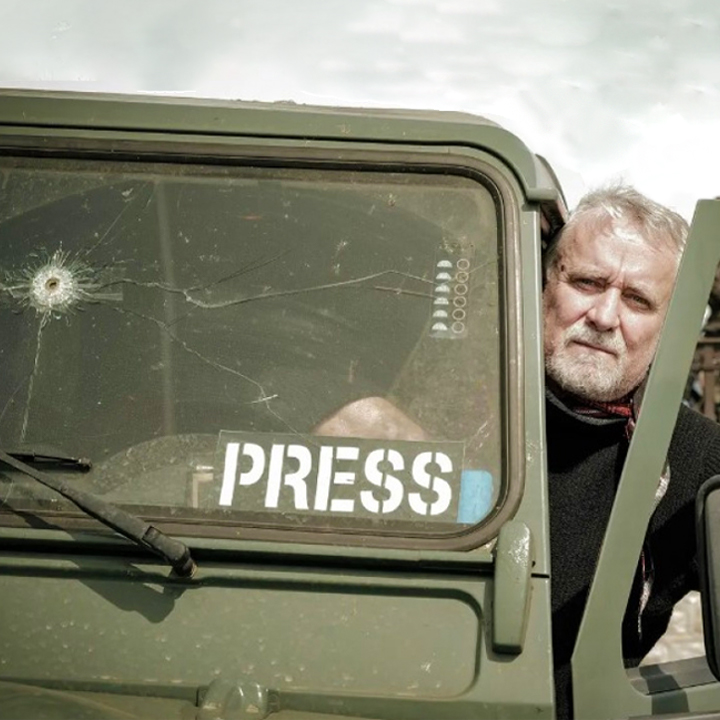
In August 2022, Truth Hounds, together with Civitas Maxima, sent a submission to the Office of the Attorney General of Switzerland regarding the attack on Mr. Guillaume Briquet, a Swiss journalist who was attacked by Russian forces in March 2022 near Vodiano-Loryne, Mykolaiv Oblast.
In addition to Ukraine, TH documents international crimes and other human rights violations in other countries of the Eurasian region. Over the past nine years, TH has sent documentation missions to Armenia, Azerbaijan, Belarus, Georgia, Kazakhstan and Tajikistan or consulted civil society organizations on the documentation of human rights violations.
During this period, TH has made numerous submissions to the International Criminal Court, and provided analytical reports to domestic investigative bodies, including the General Prosecutor’s Office of Ukraine, international organizations and think tanks.
We managed to find convincing arguments that this attack can be considered as a war crime. We also identified the Russian unit most likely responsible for this attack.
In March 2023, it became known that the Office of the Attorney General of Switzerland had opened an investigation into this attack.
Truth Hounds (hereinafter – TH) is Truth Hounds is a team of human rights specialists that has been documenting and investigating international crimes in situations of armed conflict since 2014. The TH team’s experience extends to more than 200 documentation missions on the ground accompanied by analytical work intended to identify individuals suspected of serious human rights violations and to establish links between incidents and suspects.
Factual Сonsiderations
Context: The armed conflict in Ukraine
As stated in the report of the Office of the Prosecutor of the International Criminal Court on preliminary examination activities, the international armed conflict between the Russian Federation and Ukraine in eastern Ukraine has existed since 14 July 2014 at the latest . Even before that, since at least 26 February, the Russian Federation has occupied the Crimean peninsula.
The Russian Federation further intensified the low-intensity armed conflict in eastern Ukraine at the end of February. Since at least 5 a.m. on 24 February, Russian armed forces have openly invaded Ukraine simultaneously from the south (Kherson and Mykolaiv regions), the north (Kyiv regions, Chernihiv and Sumy) and the east (Donetsk regions, Luhansk and Kharkiv).
In the first two weeks, the Russian army advanced in all directions, but apparently without achieving its immediate objectives. Large parts of Ukrainian territory have fallen under the control of the Russian Federation, including areas north of Crimea. On 7 March, the Ukrainian General Staff reported that 17 battalion tactical groups (BTGs) were operating around Kherson. Some were used to control the city and the region, while others were supposed to safeguard further advances. For example, two BTGs were focused on the attack on Mykolaiv, two were moving up the Southern Bug towards Voznesensk, one was assigned to the planned future advance on Odessa, four were operating north towards Zaporizhia, and three were designated to support the Mariupol operation.
The early days of the conflict have already been marked by reports of numerous violations of IHL, including, but not limited to, the targeting of civilians and civilian property, looting, treacherous killings, misuse of the protective emblem of the Red Cross, misuse of enemy military insignia and uniforms, use of human shields, etc.
After the initial wave of alleged war crimes, Russian Federation forces continued to carry out attacks that resulted in civilian deaths, injuries and destruction of civilian property. The extensive destruction caused to residential areas in several cities, the destruction of highly protected civilian property such as hospitals, schools and immovable cultural property, the numerous instance of repeated artillery strikes on the same civilian property, and the use of indiscriminate weapons in urban areas all suggest that civilians and civilian property targeted by the Russians were often intentional.
Harm to protected persons
The Geneva Conventions of 1949 and more explicitly Additional Protocol I clearly require that attacks must be directed only at military objects and against combatants. Civilians, as well as civilian objects, should, as a general rule, be excluded from potential targets of attack.
Even greater protection is afforded by customary and conventional IHL to specific categories of civilians who are either more vulnerable to the consequences of armed conflict or who perform a special and important function in society, such as religious personnel, medical personnel, persons wearing a distinctive emblem, humanitarian relief personnel, women, children and journalists.
Since the beginning of the new iteration of the armed conflict on the territory of Ukraine, Ukrainian media, non-governmental organizations, and officials have publicly accused Russia of attacking religious personnel, medical personnel, people wearing the distinctive sign, humanitarian personnel, women and children with artillery, aerial bombs, missiles, automatic weapons, physical and psychological violence, enforced disappearances and other means.
On numerous occasions, representatives of the Russian armed forces have continued attacks despite clear and visible signs of non-participation of civilians in the armed conflict. In the Kyiv region, the armed forces of the Russian Federation have reportedly carried out attacks on vehicles marked “children”. Some of the conversations intercepted by Ukraine’s security service suggest that the Russian Federation army was ordered to shoot civilians.
Journalists are another specially protected category of civilians who have been targeted by Russian forces. From the first weeks of the conflict, TH has documented attacks on reporters, photojournalists, citizen journalists and others. International media also raised the alarm to draw attention to the issue of targeting of journalists by Russian forces. From 24 February 2022 to 8 March 2022, 7 reporters were killed and 11 injured as a result of shooting. These figures have continued to rise. The Institute of Mass Information reports 22 journalists killed as of 29 March 2022.
According to the RSF report, “In the north of the country, in Irpin, a suburb of Kyiv, a film crew of the pan-Arab channel Al-Araby TV, based in London, also experienced Russian shooting during a report on Sunday 6 March. Correspondent Adnan Can and fellow cameraman Habip Demirci were shot at in their car as they hung a white flag and press signs on their vehicle. Stranded in the besieged city, the two journalists had to hide in the homes of local residents.
A few days earlier, on February 28, a Russian commando shot at a team from the British news channel Sky News that was on its way to Butcha, a suburb of Kyiv. Stuart Ramsay, the leader of the team of five, including four Britons and a Ukrainian journalist, was wounded by a shot while two bullets were stopped by cameraman Richie Mockler’s bulletproof vest. After identifying themselves by shouting their status as journalists and realizing that the shooting continued despite their press vests, the team had to abandon their vehicle and run to safety.
In Makariv, a suburb of Kyiv, Czech reporters Vojtech Bohac and Majda Slamova of the Voxpot media, driving with two Ukrainian colleagues from Central TV, were luckier in a similar incident on 3 March and escaped unharmed. They managed to escape in their vehicle after being shot at by Russian soldiers armed with AK-47 assault rifles, according to their media outlet.
In addition to firing live ammunition at journalists, the Russian army bombed telecommunication towers to prevent the broadcasting of Ukrainian channels and media. At least four towers were targeted by strikes in Kyiv, Korosten, Lyssychansk and Kharkiv. In total, more than 32 TV channels and several dozen radio stations went off the air as a result of the strikes. One of them killed a cameraman from the local channel Kyiv Live TV, Evgeny Sakun, who was present at the time of the strike in Kyiv, in circumstances that RSF is currently investigating. Ukraine is ranked 97th out of 180 countries in RSF’s 2021 World Press Freedom Index. Russia is ranked 150th.”
In southern Ukraine, Lithuanian documentary filmmaker Mantas Kvedaravicius was killed by Russian forces as he tried to leave Mariupol, Reuters reported, citing the Ukrainian defence ministry. His vehicle was hit by a missile. Kvedaravicius died in hospital. According to Lithuanian media reports, Kvedaravicius was in captivity and had a broken arm.
Attack on Swiss journalist Guillaume Briquet
On 6 March 2022, press photographer Guillaume Briquet was ambushed by a Russian commando.
He was driving his Land Rover Defender with Geneva license plates, the 4X4 was marked with 1m20 “press” signs on both sides, the hood and roof. He was driving from Kirovohrad to Mykolaïv, 30 km from Mykolaïv he passed a Ukrainian checkpoint, 4 km later his vehicle was pierced in four places. He was shot twice on the driver’s side and twice on the passenger’s side. Mr. Briquet was injured in the head and arm by broken glass.
According to Guillaume Briquet, after he was shot, he got out of his car with his hands in the air and shouted “journalist, journalist”. He was pulled off the road by soldiers who told him they were Russians. They picked his pockets, stole 3,000 euros in cash and his passport. Then they emptied his vehicle: a computer, a camera, a hard drive, a memory card, as well as his food and water were stolen. Mr. Briquet said that there were 15 soldiers in total and that all of them spoke English.
According to Mr. Briquet, they are professionals trained for this type of special mission. He had to show his press card, and prove that he was a journalist, they asked to see some of his work, and one of the soldiers told him “You are not a journalist, you are a spy”. Mr. Briquet is convinced that without a press card and without being able to prove with pictures that he was a field journalist, he would have been shot . After the incident, the local authorities took him to hospital and told him that the soldiers were a group of saboteurs of the Russian army’s inner lines and that they were special forces of the Russian army also called “spetsnaz”.
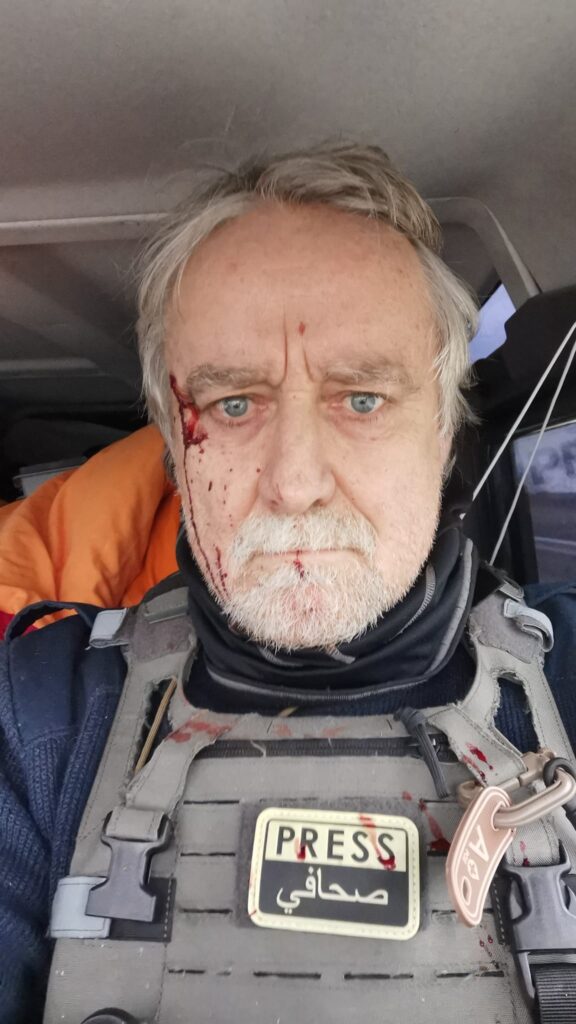
Press photographer Guillaume Briquet was
ambushed by a Russian commando
Photo: Guillaume Briquet Facebook
Mr. Briquet explained that the commando knew he was a journalist. He said that when they shot at him, part of the team was behind the vehicle, 3 or 4 people had binoculars and the person who fired had a rangefinder. According to Briquet: “There is no doubt that they knew, in view of the many ‘press’ signs on the car, as well as an inscription in Russian ‘Swiss journalist’ on a Swiss…”. Mr. Briquet believes that the reason the press is targeted is to send a message that this war should not be covered.
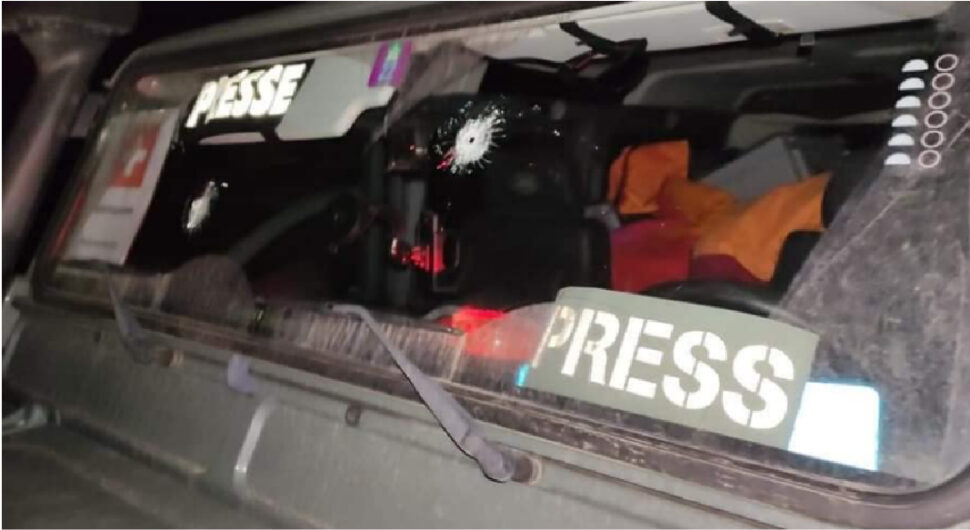
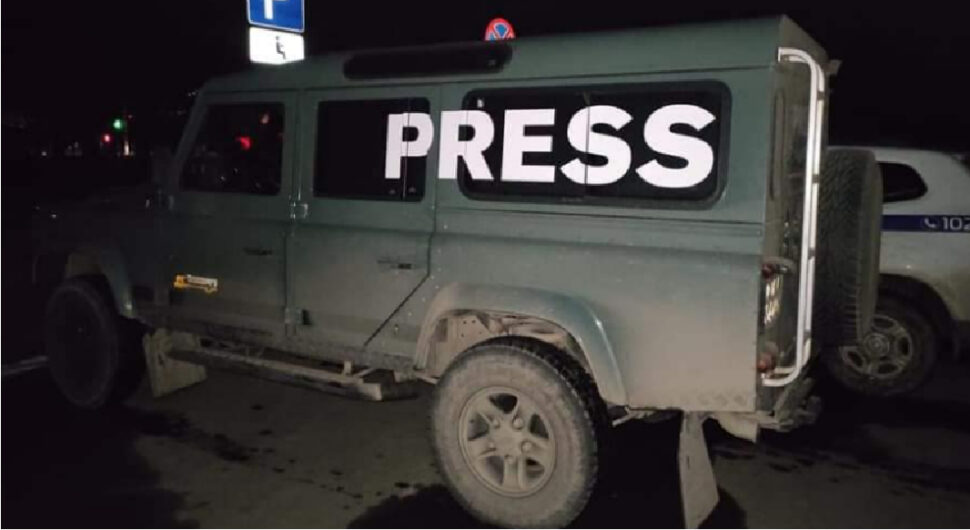
Guillaume Briquet’s Land Rover Defender
Photo: National Police of Ukraine
Authors
The large-scale invasion of Ukraine on 24 February was probably for the sake of regime change and the complete occupation of Ukraine. To this end, the army of the Russian Federation was divided, and each side had its own area of responsibility: Kyiv Axis, Donbas Axis, Kharkiv Axis, and Kherson/South Axis.
Due to its location and geographical proximity to temporarily occupied Crimea, the Russian military used the Kherson region to advance towards southern Ukraine. In addition to the above-mentioned units, the following units were also spotted in the area: 7th Guards Mountain Air Assault Division, 10th Independent Special Forces Brigade, 56th Guards Air Assault Regiment, 127th Independent Reconnaissance Brigade, 34th Independent Motor Rifle Brigade, 22nd Army Corps. All the above military units were stationed in the localities of the Kherson region, in the area of responsibility of the Armed Forces of the Russian Federation preparing for an offensive on Mykolaiv and Odessa.
From 5 to 7 March 2022, Russian forces operating in northern Crimea continued to spread their efforts along multiple axes of advance. According to Ukrainian General Staff data, of the 17 battalion battle groups (BTGs) operating in the vicinity of Kherson, two were focused on Mykolaiv, two were moving up the southern axis towards Vosnesensk, one was assigned to the planned advance on Odessa, four were operating north towards Zaporizhzhia, and three were supporting the Mariupol effort.
The incident with Mr. Briquet occurred in the area of responsibility of the Kherson/South axis of the Armed Forces of the Russian Federation on the road from Kropyvnytskyi (former name: Kirovograd) to Mykolaiv on 6 March. As Mykolaiv airport is located on this road, Russian forces attempted to control part of it in order to secure access to the airport.
Guillaume Briquet said in his interview that he was attacked by well-trained Russian soldiers. After the incident, Ukrainian police officers took him to hospital and told him that the soldiers were part of the Russian army’s special forces, also known as “spetsnaz”, which were responsible for sabotage.
The Institute for the Study of War (hereafter ISW) and residents of Kherson described some of the Russian military present in the city as professionals (with the appearance and behaviour of “spetsnaz”). According to the reports, the behavior of these units was different from that of other Russian troops.
Of the list of Russian units present in the Kherson region, two fit the definition of ‘spetsnaz’:
- the 7th Mountain Air Assault Division of the Guards and
- the 10th Independent Special Forces Brigade.
The 7th Guards Mountain Air Assault Division (military unit No. 61756) was involved in combat in the Mykolaiv region in March 2022. It belongs to the Southern Military District of the Russian Armed Forces. Since 2021, it has been based in Feodosia, Crimea. The soldiers of this brigade have combat experience in Syria.
The 10th Independent Special Forces Brigade (military unit No. 51532) is often referred to as the ‘spetsnaz’ of the Main Intelligence Directorate. Like the 7th Guards Mountain Air Assault Division, it belongs to the Southern Military District of the Russian armed forces. The capture of Mykolaiv and its region was its area of responsibility.
In early March, 10 military personnel who arrived in the town of Mykolaiv as members of a sabotage and reconnaissance group were captured by the Ukrainian armed forces. One of the captured saboteurs states in a video that he belongs to the military unit No. 51532.
All the open-source information presented above suggests that the ‘spetsnaz’ referred to by Mr. Briquet belonged to the 10th Independent Special Forces Brigade or, less likely, the 7th Guards Mountain Air Assault Division.
Legal concerns
Competence Switzerland
The Swiss authorities can deal with crimes committed in Ukraine, whether as war crimes, crimes against humanity and/or acts of genocide, in application of the principle of universal jurisdiction and Art. 264m CP.
This provision does require the presence of the perpetrator in Switzerland. Nevertheless, the absence of the perpetrator does not prevent the opening of a preliminary investigation (CR CP II-Maleh, Art. 264m N 16). It is also known that the Office of the Attorney General of Switzerland has already taken preliminary steps in relation to crimes committed in Ukraine. We therefore assume that the facts set out in this report may be the subject of a preliminary investigation aimed in particular at determining the identity of the perpetrators.
With regard more specifically to the offences of which Mr.Guillaume Briquet was a victim, the fact that he is a Swiss citizen creates an additional connection on the basis of Art. 7 (1) and (2) a contrario (passive personality principle). This provision requires that ‘the perpetrator is in Switzerland or is handed over to Switzerland because of this act‘ (emphasis added). In the presence of a victim of Swiss nationality, the prosecuting authority may not only open a preliminary investigation but may and must (Art. 7 CPP) open formally the instruction (cf. CR CP I-Henzelin Art. 7 CP N 7a) and thus take the necessary steps, in particular by way of mutual legal assistance and extradition, to ensure the ‘handing over’ of the author to Switzerland.
In particular, a request for mutual legal assistance from the Ukrainian authorities will make it possible to obtain information in their hands on the organization charts of the 10th Independent Special Forces Brigade and the 7th Guards Mountain Air Assault Division, as well as on the possible presence in the hands of the Ukrainian authorities of prisoners of war from these two groups. Their identification will allow, depending on the circumstances, to proceed to the collection of testimonies or to the identification of authors likely to be prevented, either by their direct involvement or in their capacity of hierarchical superiors (see below).
Legal qualification
The attack on Mr. Briquet must be interpreted in the first instance as a war crime of attempted murder (Article 264c para. 1(a) CP). Since Mr. Briquet enjoyed the protection conferred to civilians by international humanitarian law, the attack also fulfilled the constituent elements of Article 264d a. 1 of the Criminal Code.
It also appears that, far from being an isolated act, the attack on Mr. Briquet is part of the systematic perpetration of attacks against the civilian population, which unfortunately forms an integral part of the strategy pursued by the Russian forces. The characterization as crimes against humanity must therefore also be taken into account (cf. in particular Art. 264a para. 1 let. a and let. f CP).
Finally, and given the systematic nature of the attacks on journalists and civilians in general, any superior officer of the initial perpetrators must also be considered a potential perpetrator under Art. 264k CP. The systematic nature of the offences is in fact an important indicator of the knowledge of superiors of crimes committed by their subordinates (RC CP II-Jakob/Scalia, Art. 264k N 32 and ref. cited nbp 92). It should be remembered that several superiors in the chain of command may be liable under this provision for the same crime (RC CP II-Jakob/Scalia, Art. 264k N 14, and ref. cit.).
This confirms the imperative need to determine the identity and status of the officers of the 10th Independent Special Forces Brigade and the 7th Guards Mountain Air Assault Division.
It should be noted, subsidiarily, that all offences under Swiss general criminal law are applicable on the basis of Article 7 para. 1 of the Criminal Code, with the only exception of the control of double criminality under Ukrainian law, for which we are at your disposal if necessary.