Read in Ukrainian
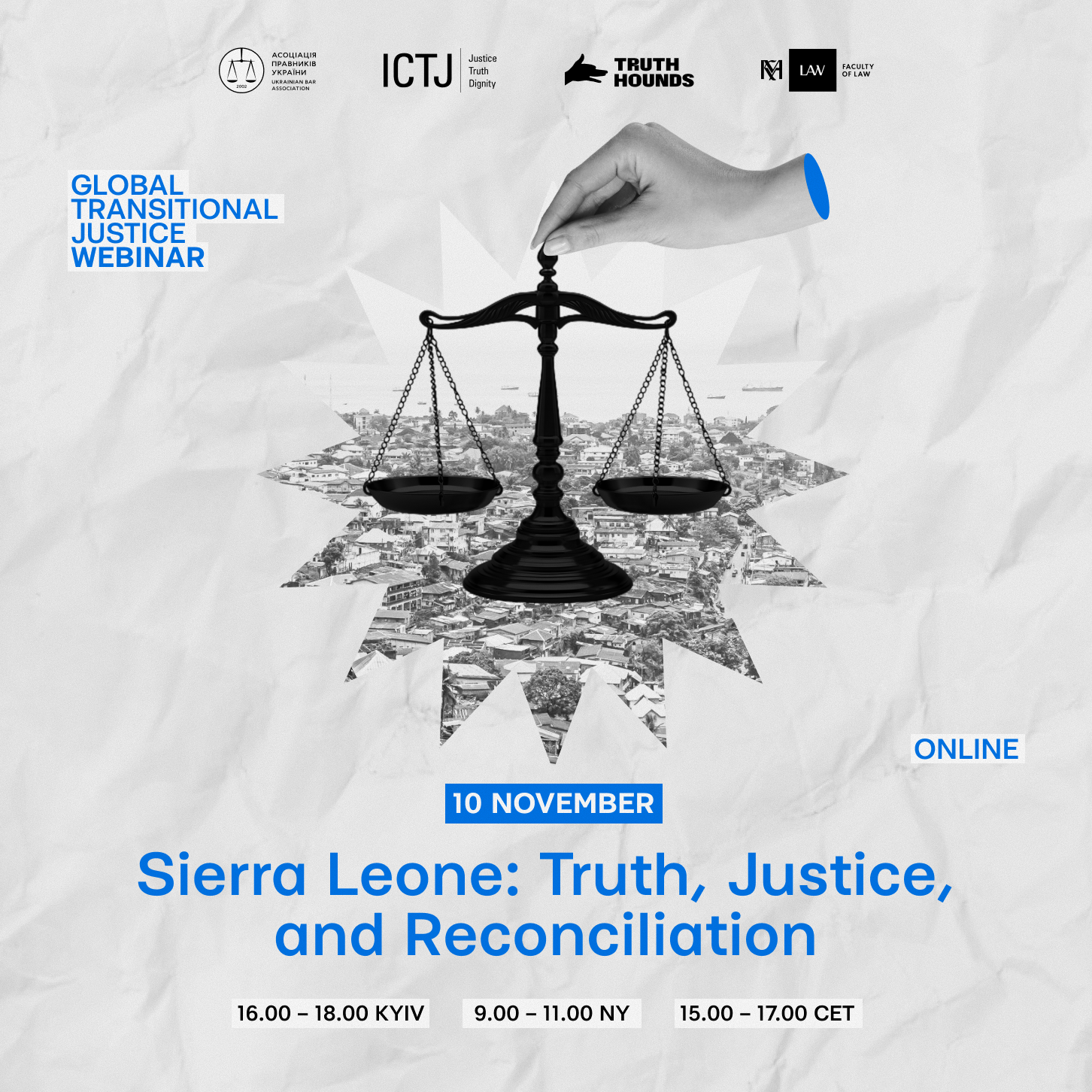
Join the webinar about Sierra Leone’s transitional justice process. Sierra Leone adopted a range of transitional justice measures, including the establishment of the Truth and Reconciliation Commission, the Special Court for Sierra Leone, as well as limited compensation programs and institutional reforms.
Questions for discussion:
- How was the balance between truth and accountability pursued in Sierra Leone’s transitional justice process, and what lessons can be drawn from it?
- Did the use of amnesty provisions, such as those in the Lomé Peace Accord, undermine justice or contribute to ending the conflict?
- To what extent did weak and politicized institutions hinder the pursuit of truth and justice in Sierra Leone?
- How did socio-economic inequalities, youth marginalization, and regional disparities contribute to fueling the conflict and sustaining the insurgency?
- What approaches were taken in Sierra Leone to manage public expectations around transitional justice, and were they effective?
- How did storytelling, public acknowledgment, and cultural expressions of memory—through the TRC, community hearings, and other initiatives—contribute to healing and reconciliation?
Speakers:
Moderators:
- Kateryna Busol, Legal Advisor, International Center for Transitional Justice
- Inna Liniova, Director of the Human Rights Institute, Ukrainian Bar Association
Co-organizers:
- Human Rights Institute of the Ukrainian Bar Association (UBAHRI),
- International Center for Transitional Justice (ICTJ),
- National University of Kyiv-Mohyla Academy,
- Truth Hounds