
Read in Ukrainian
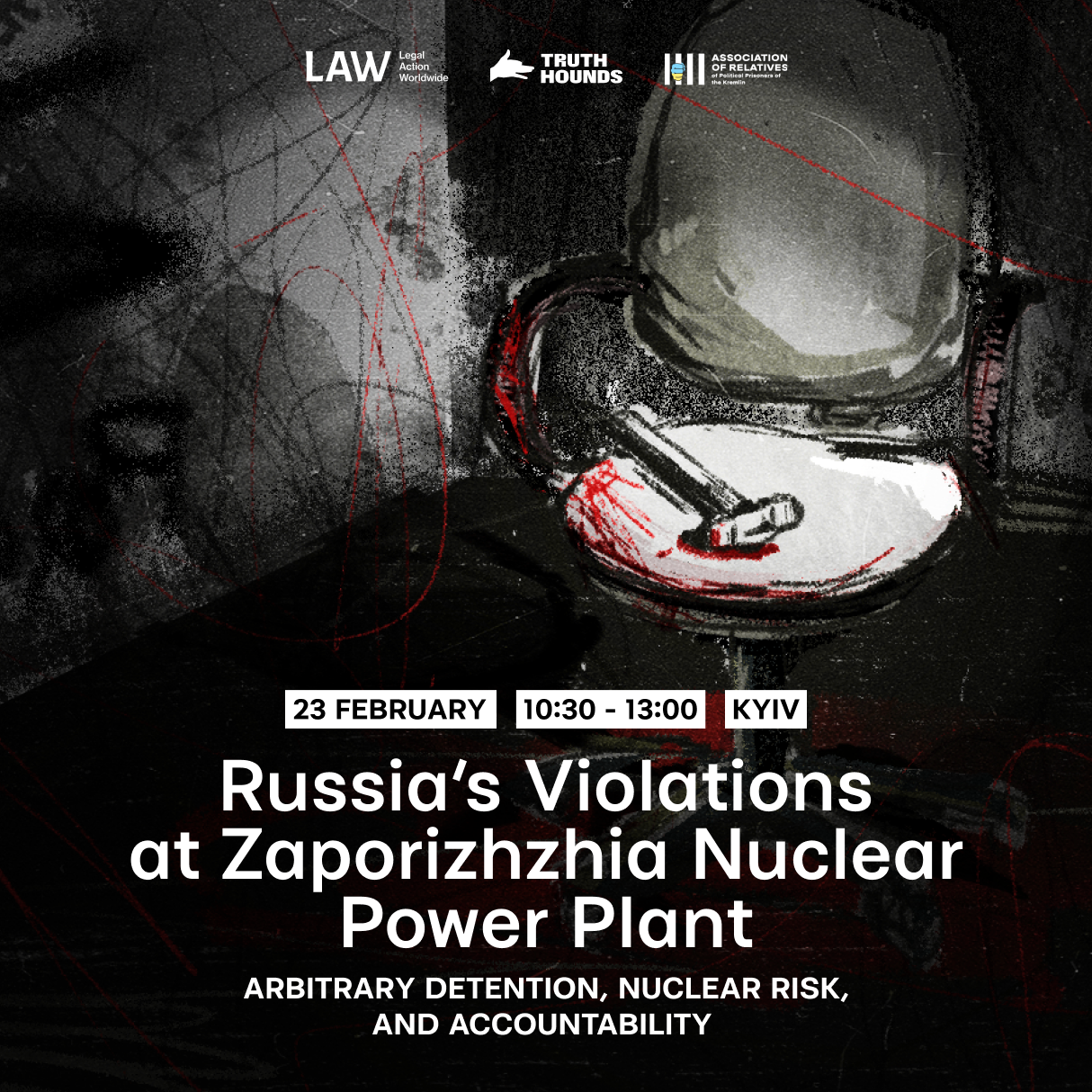
Recent trilateral discussions have addressed the question of control over the Zaporizhzhia Nuclear Power Plant, including proposals for potential shared management of the facility. At the same time, discussions focused on electricity distribution and control of the facility have largely overlooked the situation of plant personnel and civilian residents of Enerhodar who have been arbitrarily detained.
Russian forces have arbitrarily detained Ukrainians on a colossal scale since the beginning of the full-scale invasion. Russia detains civilians without legal basis, holds them incommunicado, subjects to torture and ill-treatment, denies access to legal counsel, and prosecutes in proceedings that fail to meet fundamental fair trial guarantees. POWs are tortured in detention and charged with fabricated criminal offences. These practices constitute grave violations of international humanitarian law and international human rights law. International accountability mechanisms, including the Working Group on Arbitrary Detention (UNWGAD) can play a crucial role in addressing such violations.
Beyond the serious human rights violations, Russia’s occupation of the Zaporizhzhia Nuclear Power Plant (ZNPP) poses massive nuclear security concerns. As Truth Hounds conclude in our report, “the risks of nuclear disaster at the ZNPP remain real and demonstrate Russia’s fundamental disregard for well-established international norms on nuclear safety and security. The occupation’s coercive recruitment of plant personnel and the broader climate of fear in and around the ZNPP violate the International Atomic Energy Agency’s (IAEA) “Seven Indispensable Pillars of Nuclear Safety and Security”, especially the principle that staff must operate free from undue pressure.”
The event aims to:
- Advocate for the immediate release of all ZNPP employees.
- Highlight broader patterns of arbitrary detention by Russia and illustrate what constitutes unlawful and arbitrary detention under international law.
- Demonstrate the potential of accountability mechanisms, including UN Working Groups and other UN Treaty Bodies.
- Draw attention to the risks to nuclear safety and international security, and how in this case the risks are inseparable from human rights considerations.
- Increase understanding among diplomatic missions and international organizations of accountability pathways, including the role and impact of the UNWGAD; encourage sustained engagement.
Read in Ukrainian