
Read in Ukrainian
This report has been prepared by Truth Hounds based on 39 in-depth interviews with survivors and witnesses of short-range drone attacks, three expert interviews with specialists in UAV technologies and alert systems, and analysis of open-source data and monitoring materials.
Executive Summary
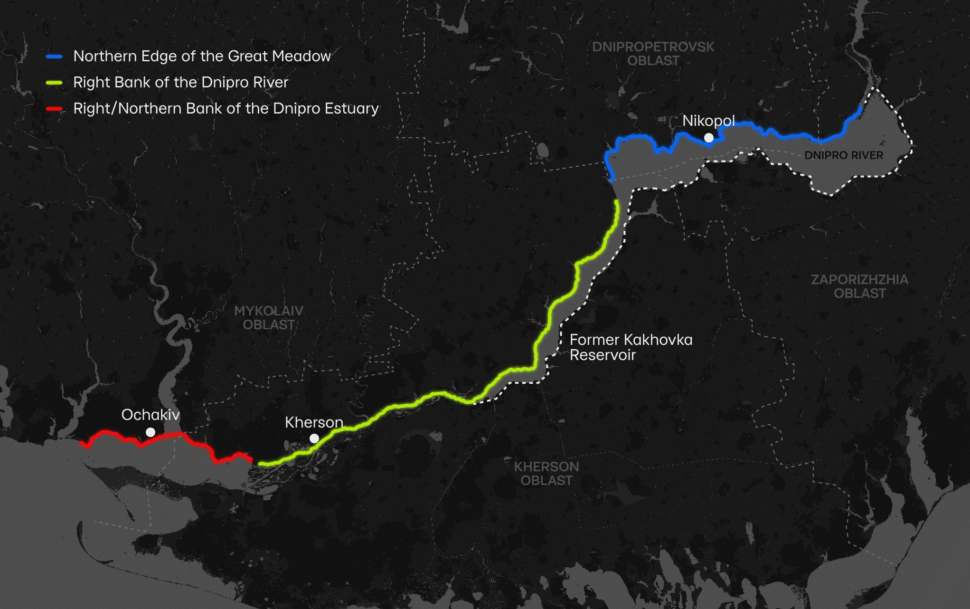
The study focuses on the use of short-range drones by Russian forces against civilians and civilian objects in the Lower Dnipro region of southern Ukraine. This area forms a roughly 400-kilometer section of the frontline where Ukrainian-controlled territory lies directly opposite Russian-occupied territory, separated by the Dnipro River and the Dnipro Estuary. Hostilities here are generally less intense than in other parts of the front, and between 20% to 50% of the pre-war population still resides in many settlements. At the same time, according to the UN Human Rights Monitoring Mission in Ukraine, this region records some of the highest numbers of civilian casualties from drone attacks in Ukraine.
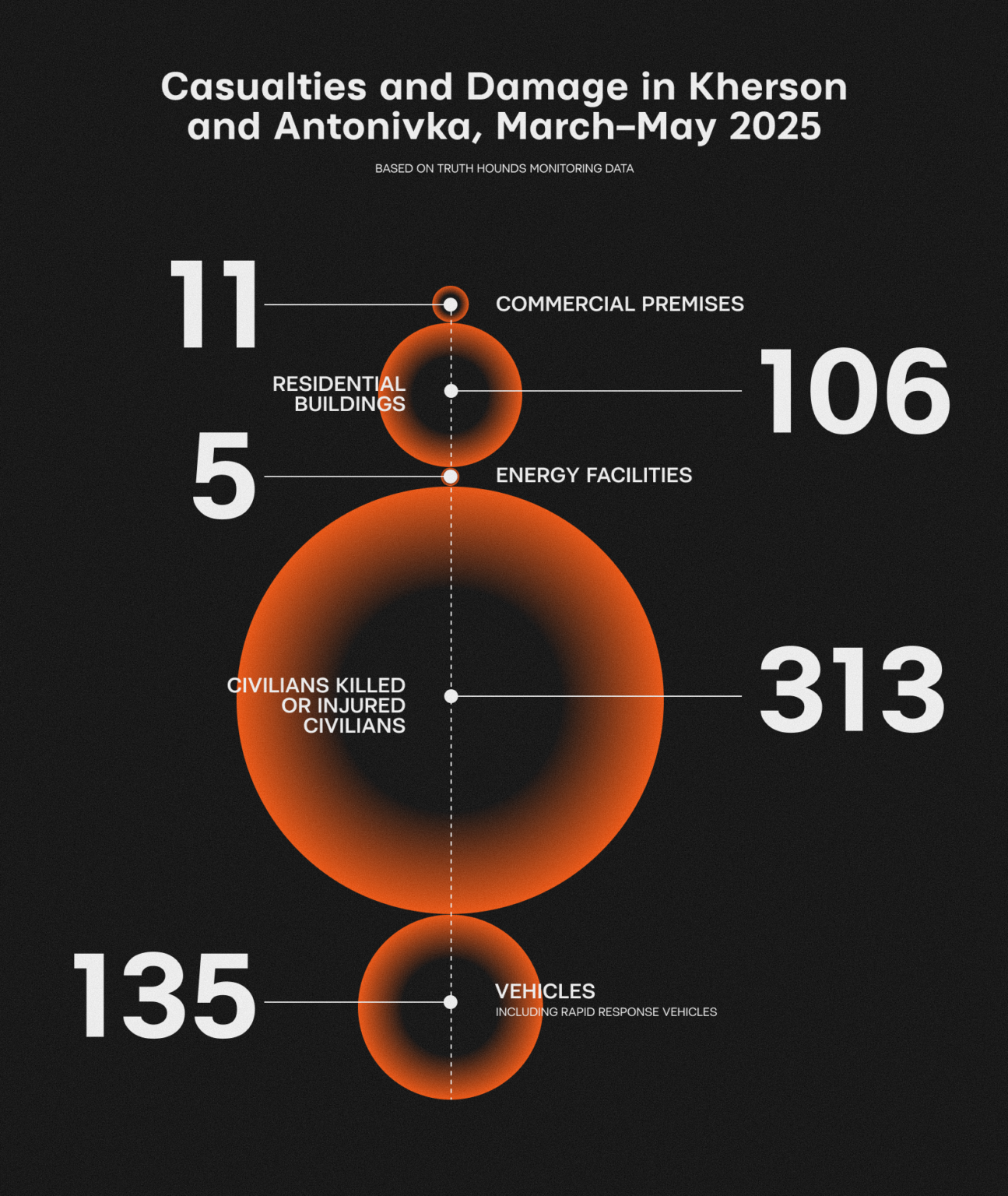
For example, in March 2025 alone, the city of Kherson was undergoing about 600-700 drone attacks per week, and between March and May of the same year, at least 313 civilians, 135 vehicles (including emergency services vehicles), and 106 residential buildings in the city were affected by drone attacks. In the Nikopol raion of Dnipropetrovsk oblast, the average number of attacks by kamikaze drones and munitions-drop drones recorded between September 2024 and March 2025 was 459 attacks a month.
Despite the relative simplicity of short-range drones, their accuracy, maneuverability, and speed have turned them into a weapon capable of executing high-precision strikes. At the same time, the results of this study indicate that drones are increasingly used not for selective attacks on military targets but as a tool of arbitrary violence or intentional attacks on civilians.
For human rights defenders and investigators, such drones have created new challenges in proving the intentionality of attacks, as this requires knowledge of the technical features of UAVs with skills in identifying the behavior of drones during a controlled attack and during operator control loss. The report collects these indicators as practical guidelines for investigators and analysts; not as sufficient proof but rather as additional data helping to assess the intentionality of each specific attack more accurately. It also enabled Truth Hounds researchers to carry out additional analysis of recorded incidents and to improve their own approaches to documenting drone attacks.
The study has found that Russian attacks against civilians are systematic and have become a consistent element of Russian forces’ tactics in this territory. The pattern of attacks, including regular attacks against civilians, strikes on civilian vehicles, first responders, medics, and volunteers, indicates that the Russian military disregards the principle of distinction and, in many cases, deliberately targets civilians and civilian facilities.
Analysis of messages from Russian Telegram channels, particularly those related to certain units and military personnel, confirms that such attacks are part of a practice legitimized in Russia’s own military narrative. These channels have designated coastal areas about 2.5 km inland along the Dnipro, which is within the strike area of Russian drones, as a “red zone”. Russian sources have repeatedly emphasized that any transport and individuals spotted by a drone in the red zone will be attacked. This insistence that any movement is perceived as a legitimate target, essentially justifies systematic violations of international humanitarian law. This behavior indicates that the Russians are deliberately turning areas near the frontline into a space with no right to life, where the idea of protecting civilians has lost its force before the Russian military’s imperative to attack without question everything within this territory.
The consequences of numerous attacks on energy facilities, rescue and medical teams, vehicles carrying food for the local population, volunteers, utility workers, public transport, the locals, and their property go beyond the lives of victims and material destruction. They intensify the atmosphere of fear, hinder access to basic services and vital resources, disrupt the logistics of humanitarian assistance, and make daily life unbearable. Ultimately, this causes forced migration and the gradual depletion of communities — the social and economic degradation of territories that are under constant threat.
The fact that the tactics of the Russian forces remain unchanged over a relatively long period despite the information available on massive civilian casualties leads us to the conclusion that these actions constitute a method of terrorizing the civilian population.
As discussed in Section 6, the attacks examined in the study constitute serious violations of international humanitarian law, including repeated violations of the principle of distinction and a failure to take adequate precautionary measures in attack. In addition, the attacks may potentially constitute war crimes, particularly deliberate attacks against civilians and civilian facilities (Art. 8(2)(b)(i-ii) of the Rome Statute) and the crime of terror, found in customary international law. Given their prolonged, systematic, and widespread nature, these actions also may potentially constitute crimes against humanity, including murder and the forcible transfer of population (Art. 7(1)(a) and (7)(1)(d) of the Rome Statute). Short-range drone operators’ real-time control over and live visual feed from their weapons provides a strong indication of their intent in targeting. At the same time, public rhetoric and the inaction of the Russian command indicate that not only the direct perpetrators, but also their commanders should be brought to justice.
The report also examines how drone attacks have forced civilians and local authorities to develop practices to protect themselves from these threats. Many communities have gradually developed their own warning, shelter, and response systems, combining official measures with initiatives by residents themselves. Studying these practices could provide useful guidance for communities that are just beginning to face a similar threat in other armed conflicts where drone use is likely to become more widespread.
The increasing use of short-range drones against civilians requires an immediate response from the global community not only to IHL violations connected with the use of drones against civilians in Ukraine, but also to the very need to develop a technological, regulatory, and security response to the challenges that arise from the transformation of armed conflicts, where unmanned aerial systems have a growing impact on the nature of warfare and threat to the civilian population.
Read in Ukrainian
Truth Hounds compiled this report with the support of donors:

Truth Hounds compiled this report with the support of the International Renaissance Foundation. Its content is the exclusive responsibility of the authors and does not necessarily reflect the views of the International Renaissance Foundation.

With financial support from the Czech organization People in Need, as part of the SOS Ukraine initiative. The content of this publication does not necessarily reflect their official views.
Recommendations
1. For Ukrainian law enforcement bodies
- Take into account this report’s findings and the proposed approaches to the legal qualification of drone attacks on civilians and civilian objects, particularly the possibility of viewing them as crimes against humanity in the context of the widespread and/or systematic nature of the committed attacks;
- Strengthen the interaction between law enforcement agencies, military structures, and civil society organizations to exchange evidence-based materials related to drone attacks and to improve mechanisms of recording and documenting these crimes and bringing the perpetrators to justice.
2. For local administrations and Lower Dnipro Region communities
- Share and implement effective prevention and protection practices against drone attacks on civilians based on the experience of communities where these systems have already proven effective. Create local alert systems with the use of mobile apps, chats, and loudspeakers;
- Equip public places with small-capacity shelters with sturdy doors and basic first aid supplies, which will allow civilians to reach a safe place more quickly in the event of a drone threat and, as necessary, provide first aid to the injured;
- Scale the installation of anti-drone nets on roads and beyond;
- Conduct regular trainings for the local population, emergency service workers, and volunteers regarding the rules of conduct during drone attacks;
- Organize awareness campaigns for civilians regarding the importance of maintaining clear and distinct appearances between civilians and combatants (including through choice of clothing and vehicles), while at the same time not discouraging the use of personal protective equipment.
3. For the Government of Ukraine
- Provide workers of emergency services working within the reach of short-range drones with special detectors to receive early alerts of threats;
- Promote improved coordination between the emergency services and the Armed Forces of Ukraine for the purpose of early warning of threats in airspace and protection of personnel;
- Ensure and monitor high-quality training of emergency service workers regarding the rules of conduct during drone attacks, taking into account technical innovations.
4. For law enforcement and criminal justice actors of foreign countries
- Investigate cases of drone attacks, particularly ones affecting the citizens of the respective country and/or when the suspect is located in its territory, falls within the national jurisdiction through the passive citizenship principle or through the principle of universal jurisdiction.
- Provide Ukrainian law enforcement agencies with technical, evidentiary, expert, and analytical support in investigating crimes related to the use of drones against civilians.
5. For governments of foreign countries
- Provide financial and technical support to Ukrainian communities in restoring damaged infrastructure, including rescue and rapid response equipment, and allocate funds for training emergency services and civilians;
- Allocate financial resources to Ukraine for the development and procurement of systems for protecting against, detecting, and neutralizing drones;
- Promote the implementation of compensation programs, particularly within the International Compensation Mechanism for Ukraine;
- Strengthen sanctions against companies that supply drone components and drones to Russia.
6. For international intergovernmental and non-governmental organizations
- Study and share the experience of communities in the Lower Dnipro region with respect to protection against drones, which may be helpful in regions where similar threats are only emerging;
- Support community initiatives aimed at informing, educating, and supporting civilians psychologically in areas subject to constant drone attacks;
- Begin preparations for legal interpretation and prevention, protection of civilians from drone threats, and development of the regulatory framework at the highest international level (or specifying / refining the existing regulatory framework) regarding the procedure and restrictions of drone use in conflicts;
- Support law enforcement with evidence collection, disseminate methods and best practices of investigating drone attacks on civilians, with the goal of deterring or preventing further attacks due to the threat of criminal prosecution.
Truth Hounds compiled this report with the support of the International Renaissance Foundation. Its content is the exclusive responsibility of the authors and does not necessarily reflect the views of the International Renaissance Foundation.
With financial support from the Czech organization People in Need, as part of the SOS Ukraine initiative. The content of this publication does not necessarily reflect their official views.