

Summary
Truth Hounds’ investigation sheds light on the connection between Russian armed forces and the death of Ukrainian children’s writer Volodymyr Vakulenko.
The initiative to investigate his murder during Russia’s occupation of parts of Kharkiv Oblast came from the writer Victoria Amelina, who performed important work within the Truth Hounds team in terms of collecting and analysing materials and who was later killed in a Russian missile attack on Kramatorsk.
Information uncovered by Truth Hounds indicates that Russia was indeed interested in the murder of the writer, while it was individuals representing the so-called ‘Luhansk People’s Republic’ (LNR) who were the actual perpetrators. Information received from local residents confirms that the Russian military took a keen interest in Vakulenko and were searching for him. An analysis of video footage allegedly showing Vakulenko’s abduction by the Russian military, combined with other evidence, confirms these suspicions. There is also reason to believe that Russia’s special services may have been involved in the abduction of the Ukrainian writer.
Truth Hounds’ findings confirm the need for further investigation into this case in order to establish a more complete understanding of the circumstances of Vakulenko’s abduction and death and to bring the perpetrators to justice.
Acknowledgements
We wish to express our sincere gratitude to our colleagues at the Clooney Foundation for Justice, founded by George and Amal Clooney, for their valuable cooperation.
We would also like to thank filmmaker Amanda Bailly for the valuable materials that she contributed to our investigation.
Special thanks also go to philanthropist Howard Graham Buffett for providing one of the photographs featured in the report.
Your contribution and commitment to justice is invaluable to us.
Contents
Introduction
This report is the result of a year and a half of work by Truth Hounds to document and investigate the unlawful detention, torture, and killing of civilians in Izium and Kapytolivka, Kharkiv Oblast during the occupation of these settlements by Russian forces.
The story of the investigation begins with the discovery of the diary of Volodymyr Vakulenko, a Ukrainian children’s writer and resident of Kapytolivka, by Truth Hounds documentary filmmaker and writer Victoria Amelina. During the occupation of the town, Vakulenko had recorded its chronology, his observations, and his experiences on 35 handwritten pages and, shortly before his abduction, buried the diary beneath a cherry tree in his parents’ garden. Our colleague then discovered it on 24 September 2022. At that time, Volodymyr’s fate remained unknown. Only at the end of November did DNA testing confirm the fact of his death.
It was Victoria Amelina who initiated Truth Hounds’ investigation and helped collect materials, search for, and interview witnesses. She repeatedly visited Kapytolivka with a team of fellow documentary filmmakers. With her assistance, Volodymyr’s diary was published and presented at the Book Arsenal in Kyiv in June 2023. A week after the presentation, on 27 June 2023, Victoria was killed in a Russian missile attack on Kramatorsk. Her contribution to the investigation was a valuable part of this work, which was completed after her death.
It is known that the Investigative Department of the Kharkiv Oblast National Police has served war crimes suspicion notices on four servicemen of the 4th Company of the 4th Battalion of the 204th Rifle Regiment of the so-called LNR Mobilisation Reserve. However, the information collected and analysed leads us to conclude that the persons who ordered the murder of the writer could have been representatives of the Russian Armed Forces, the National Guard of the Russian Federation (hereafter, ‘Rosgvardia’), or Russian special services and not illegal armed groups of the so-called LNR.
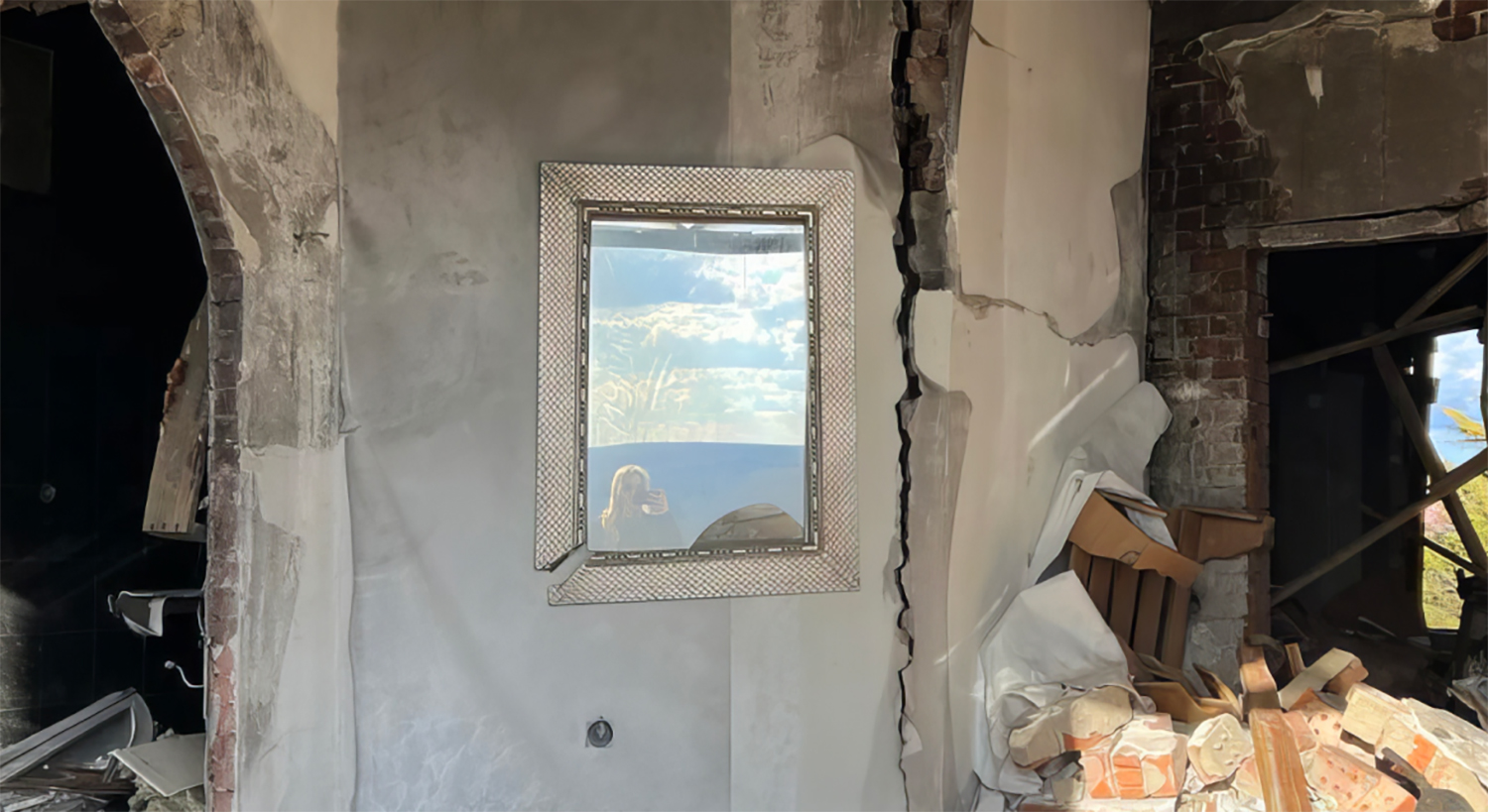
In the mirror of a destroyed home in Izium, Kharkiv Oblast, Victoria Amelina can be seen photographing the consequences of Russia’s occupation during a documentation mission.
Source: Victoria Amelina, Truth Hounds, September 2022.
The main purpose of this publication is to draw attention to the involvement of Russians in the persecution and murder of the Ukrainian writer Volodymyr Vakulenko and to encourage further investigation into his case.
The investigation is based on materials collected by Truth Hounds during field missions and information obtained through open-source intelligence-gathering (OSINT).
The organisation joined forces with the Security Service of Ukraine’s (SSU) Kharkiv Regional Investigation Department and the Kharkiv Regional Prosecutor’s Office to investigate the case. This resulted in two weeks of close cooperation between representatives of Truth Hounds and investigators from the SSU’s Kharkiv Regional Investigation Department. Seven responses were also provided to written requests from Ukrainian law enforcement agencies to identify specific units of the Russian Armed Forces and individuals suspected of war crimes. Truth Hounds has also established a partnership with the Clooney Foundation for Justice and jointly submitted information to the German Prosecutor’s Office about the deliberate killing of four civilians in Kapytolivka.
Events in Izium and Kapytolivka: Occupation, torture chambers, mass killings
The village of Kapytolivka and the town of Izium, Kharkiv Oblast, where the events described in the investigation took place, have been under Russian occupation for almost six months – since 7 March and 1 April 2022, respectively. As a result of the Slobozhansk counter-offensive, the Ukrainian Armed Forces de-occupied both settlements on 10-11 September 2022.
Following the de-occupation, a mass grave was discovered in a pine forest on the outskirts of Izium, from which 447 bodies were exhumed, at least 414 of which were civilian. The body of Volodymyr Vakulenko was found in Unmarked Grave № 319. The circumstances of his abduction and murder, which are investigated in this report, go back to the very beginning of the occupation. For this reason, the contextual information detailed below relates to events which took place in March-May 2022.
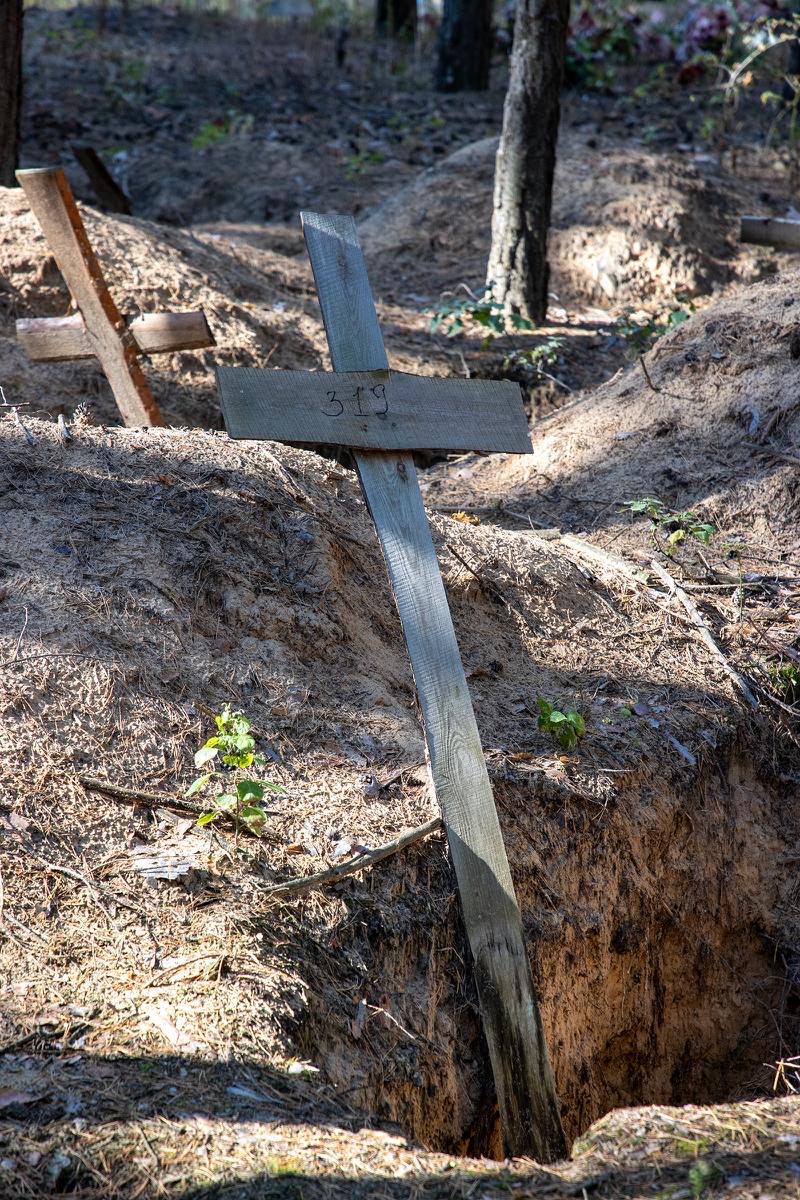
A cross from the grave of Volodymyr Vakulenko at the mass grave site near the town of Izium, Kharkiv Oblast.
Source: Howard G. Buffett, 18 September 2023.
Kapytolivka
Kapytolivka is a village in the Izium district of Kharkiv Oblast which had been home to approximately 1,500 people before Russia’s full-scale invasion of Ukraine. The settlement lies adjacent to the eastern outskirts of the town of Izium.
From the beginning of the full-scale invasion of 24 February 2022 until Russia’s occupation of the area on 7 March 2022, the village experienced almost daily artillery shelling and air raids, which left residents without electricity, gas, and communication with the outside world throughout early March.1
On 7 March, the first convoy of Russian armoured vehicles passed through the streets of Kapytolivka, marking the beginning of the occupation of the village. Russian soldiers immediately took up residence in the premises of Kapytolivka’s school,2 a nearby kindergarten,3 and several private houses.4 In one of them, at 37 Tsentralna Street, the Russians later set up a headquarters that functioned until the end of the summer of 2022.5 Most Russian equipment was stationed on the grounds of the Izium Bakery Plant6 in the north of the village.7
1 Witness K-2221; Witness K-1004.
2 Coordinates: 49.196234, 37.339640.
3 Coordinates: 49.196209, 37.340842.
4 Witness K-2200.
5 Witness K-1739.
6 Coordinates: 49.198920, 37.343643.
7 Witness K-7001; Witness K-0301.
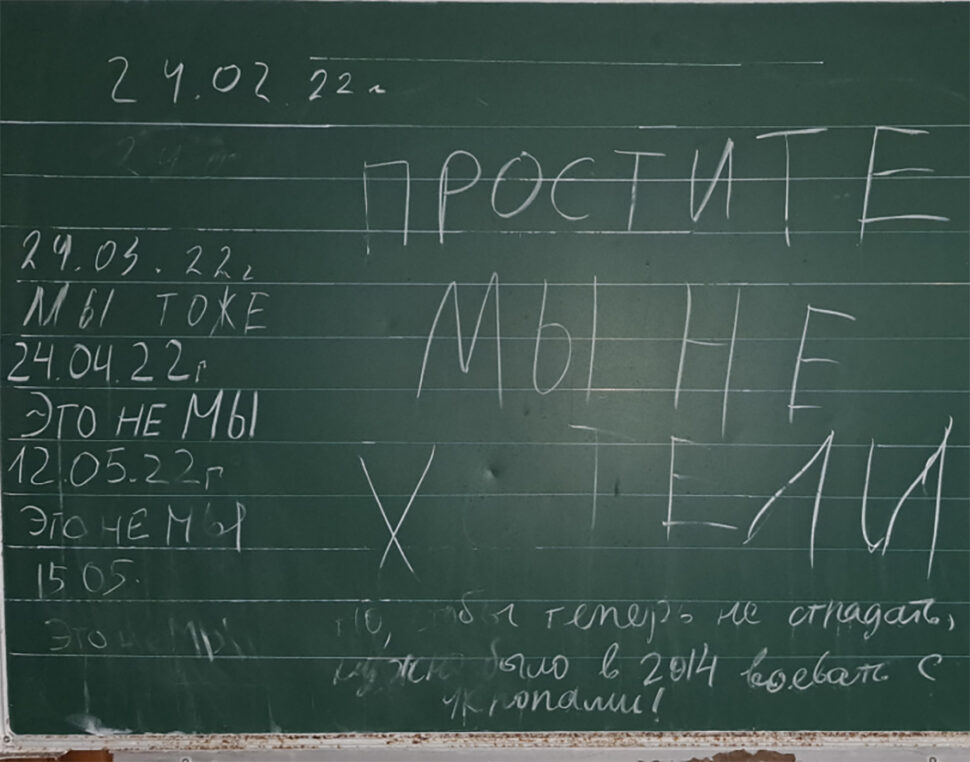
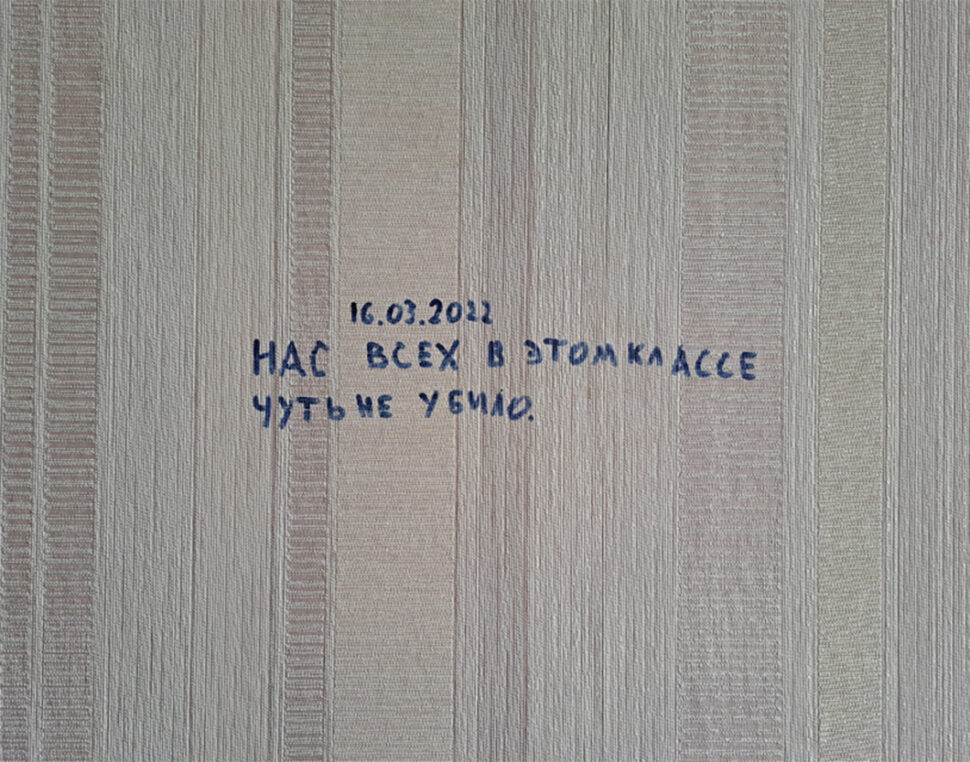
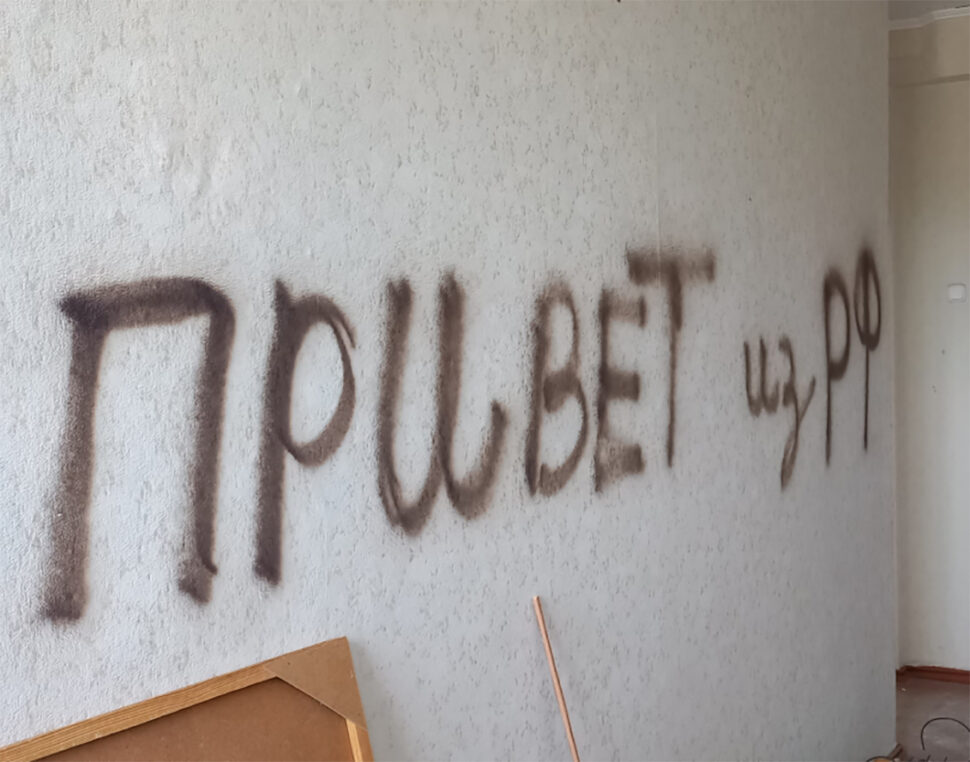
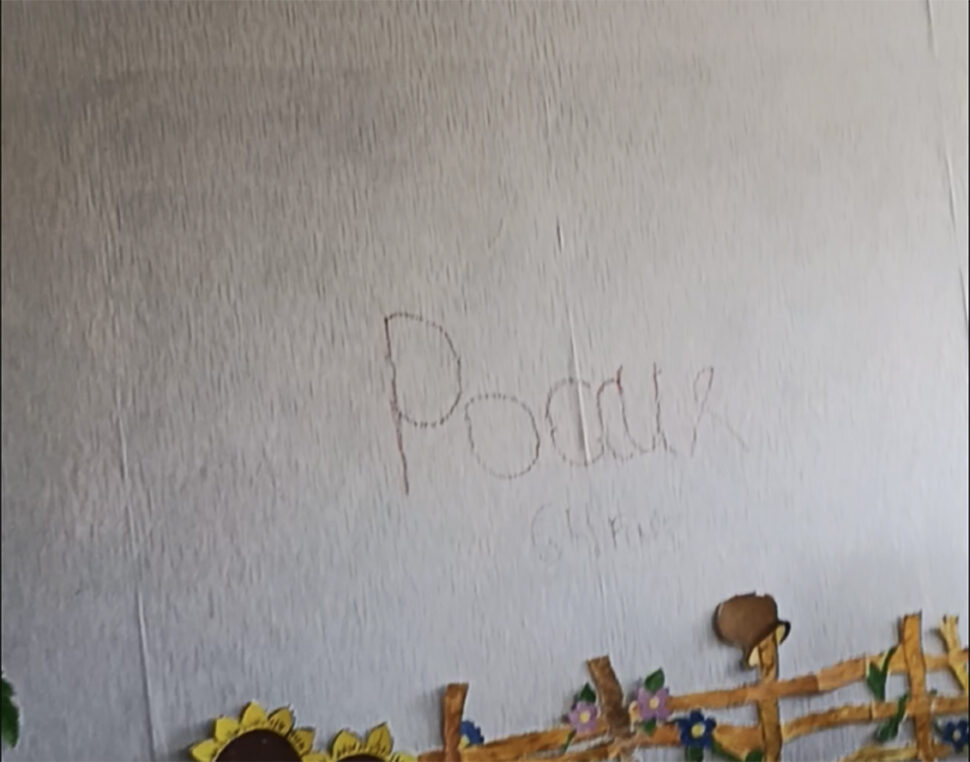
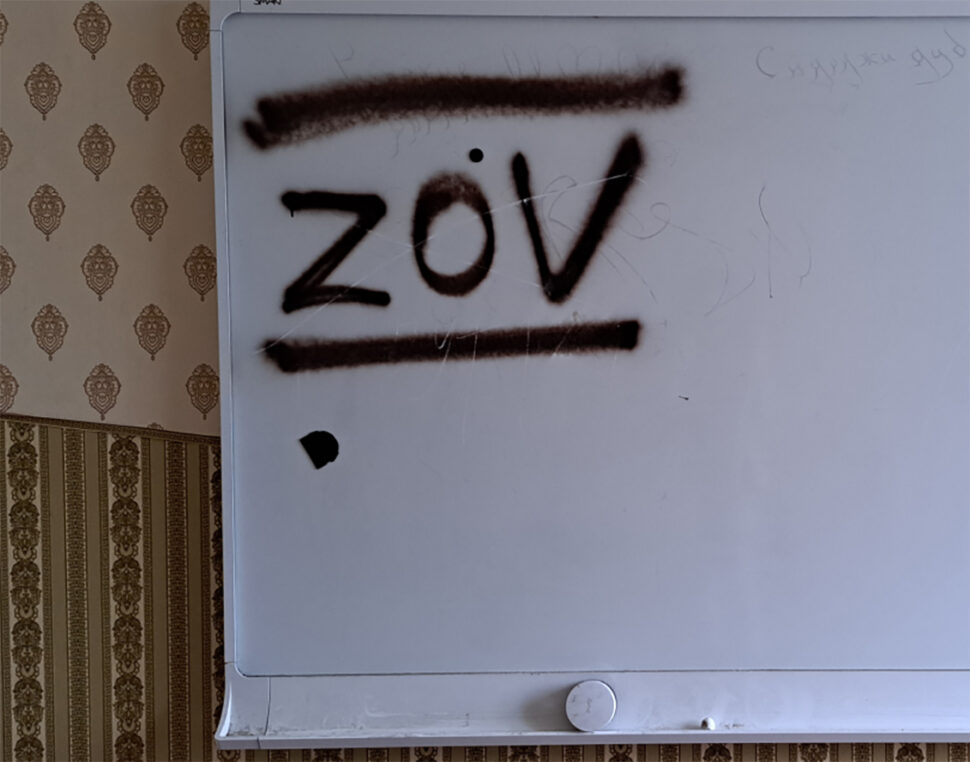
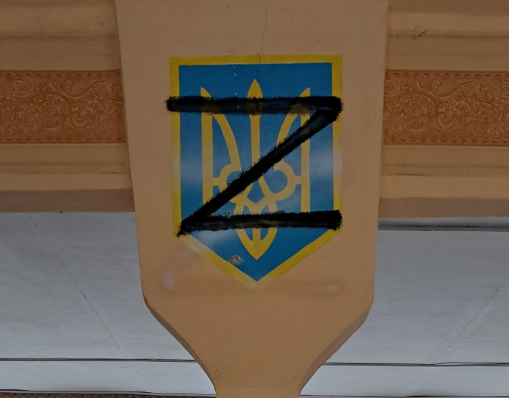
An inscription left by the Russian military in Kapytolivka school.
Source: Truth Hounds, April 2023.
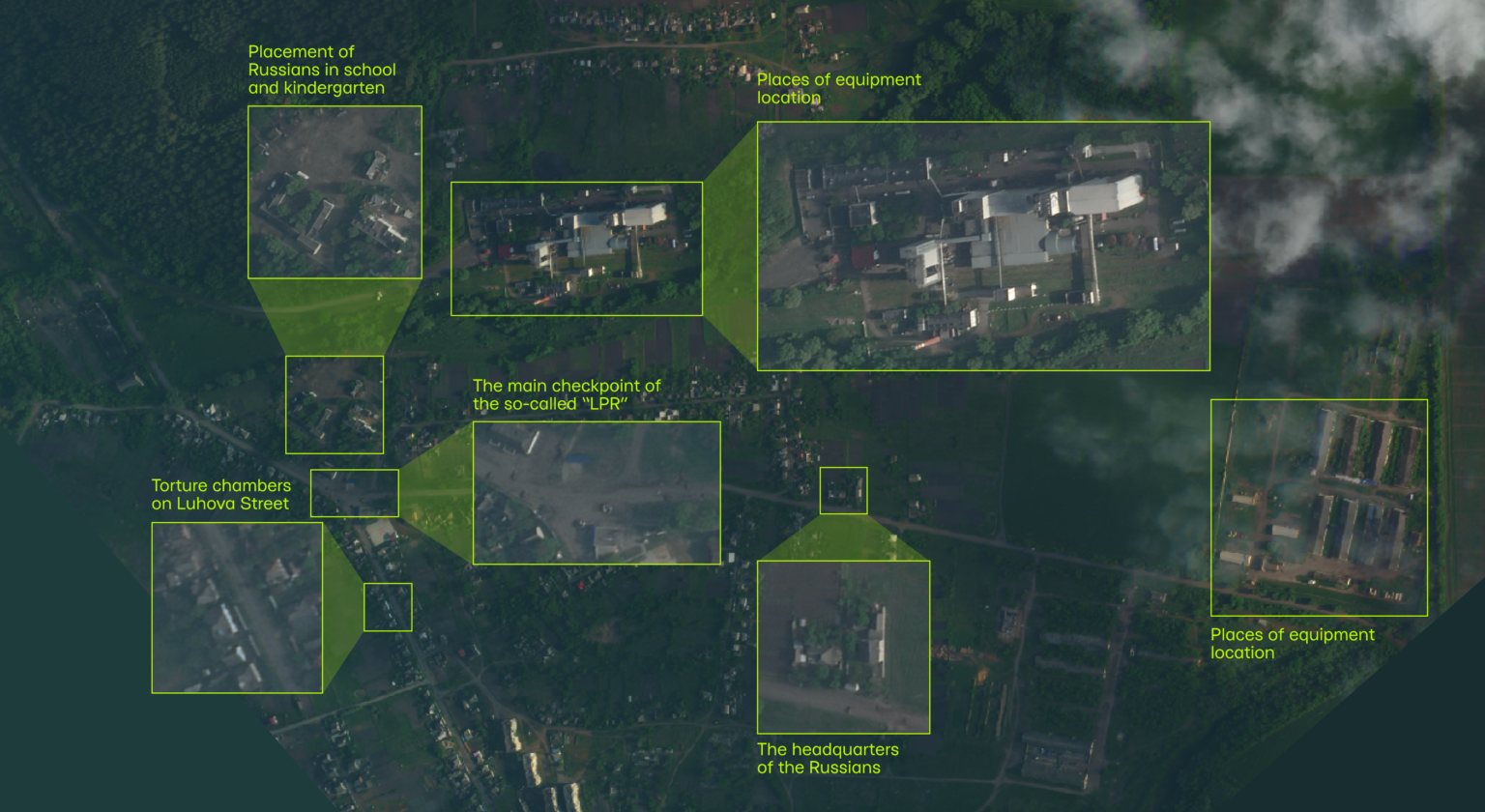
A satellite image showing the main locations in Kapytolivka where the Russian military and so-called LNR forces were stationed.
Source: Planet Labs, 15 May 2022.
A few days after the Russians arrived, the so-called LNR military also entered the village (NB: the official integration of the illegal armed groups of the so-called LNR and ‘Donetsk People’s Republic’ into the structure of the Russian Armed Forces took place only in February 2023).They took up residence mostly in private houses on Luhova Street and set up a checkpoint8 near the central store at the intersection of Tsentralna Street and Luhova Street.9
Civilian hostages were held in the basement of the house at 14 Luhova Street, while several dozen so-called LNR soldiers were stationed in neighbouring houses. Truth Hounds was told about this by residents of Kapytolivka, both witnesses who lived nearby and a victim who was held there.10 On the night of 5-6 April 2022, the Ukrainian Armed Forces conducted an artillery strike on this and neighbouring buildings.
8 Witness K-8623; Witness K-1004.
9 Coordinates: 49.195216, 37.340588
10 Witness K-8623; Witness K-7001; Witness K-2321; Witness K-1739.
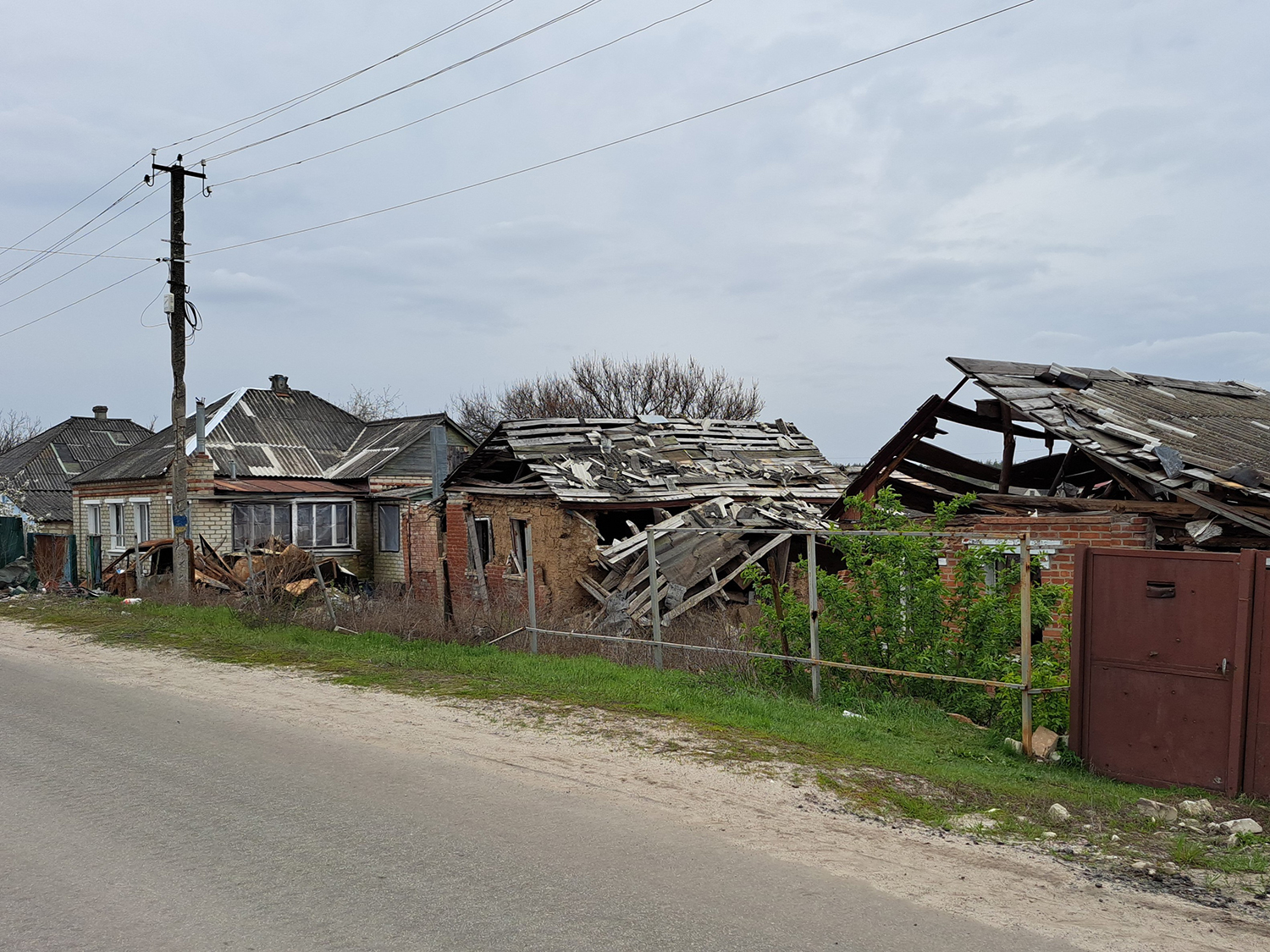
The location on Luhova Street in Kapytolivka where the so-called LNR military set up a torture chamber. The buildings were destroyed as a result of shelling
by the Ukrainian Armed Forces.
Source: Truth Hounds, April 2023.
Truth Hounds documentary filmmakers were able to see with their own eyes the conditions in which prisoners were forced to live. Specifically, prisoners were held in a cramped, damp, and cold room measuring 3 m2 and located 2 m underground, without ventilation, and where an adult of average height could not stand upright. On various occasions, up to four people were held in this place at the same time. In addition to this chamber, there was a so-called ‘execution pit’ in the yard – a place where the occupiers took prisoners to simulate executions.11
11 Witness K-8623.
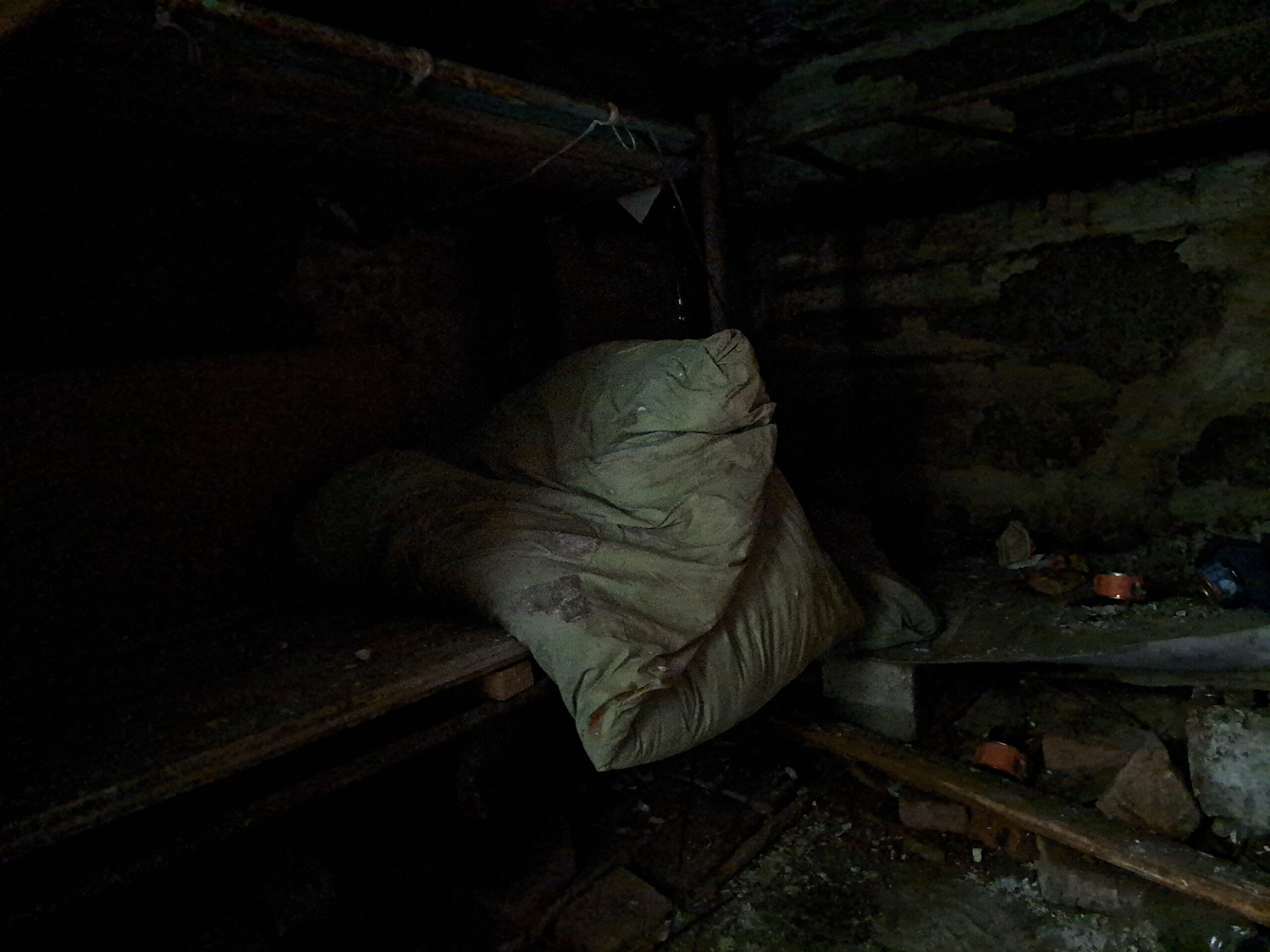
The basement at 14 Luhova Street, Kapytolivka where civilians were illegally detained and tortured during Russia’s occupation of the area.
Source: Truth Hounds, 20 April 2023
Occupying forces in Kapytolivka
It is known that in March-May 2022, most of the Russian military personnel in Kapytolivka belonged to the 488th Motorised Rifle Regiment and the 856th Guards Self-Propelled Artillery Regiment, both part of the 144th Motorised Rifle Division of the 20th Combined Arms Army of the Western Military District. Local residents reported that a large number of tanks, artillery pieces, and multiple-launch rocket systems passed through the village and were permanently stationed there. Witnesses interviewed by Truth Hounds claimed to have spotted representatives of the Russian Federal Security Service (FSB) and Rosgvardia in the village.12
At the same time, the so-called LNR soldiers belonged to the 204th Rifle Regiment of the 2nd Army Corps. The Investigative Department of the National Police of Ukraine in Kharkiv Oblast clarified that individuals belonging to the 4th Company of the 4th Battalion of this regiment were also present in Kapytolivka. Documents found in one of the former headquarters of the occupyin forces in Izium suggest that the remainder of the 204th Regiment, including its commander, Colonel Dmytro Oleksandrovych Proydysvit, was based in the city itself. Publicly available videos show that, in April 2022, at least the 1st Company of the 3rd Battalion of the 204th Regiment was located in the village of Kamianka, Izium District, while some individuals belonging to the 1st, 2nd, 4th, and 5th battalions of the same regiment were in Izium itself.
12 Witness K-7001; Witness K-8623; Witness K-0102.
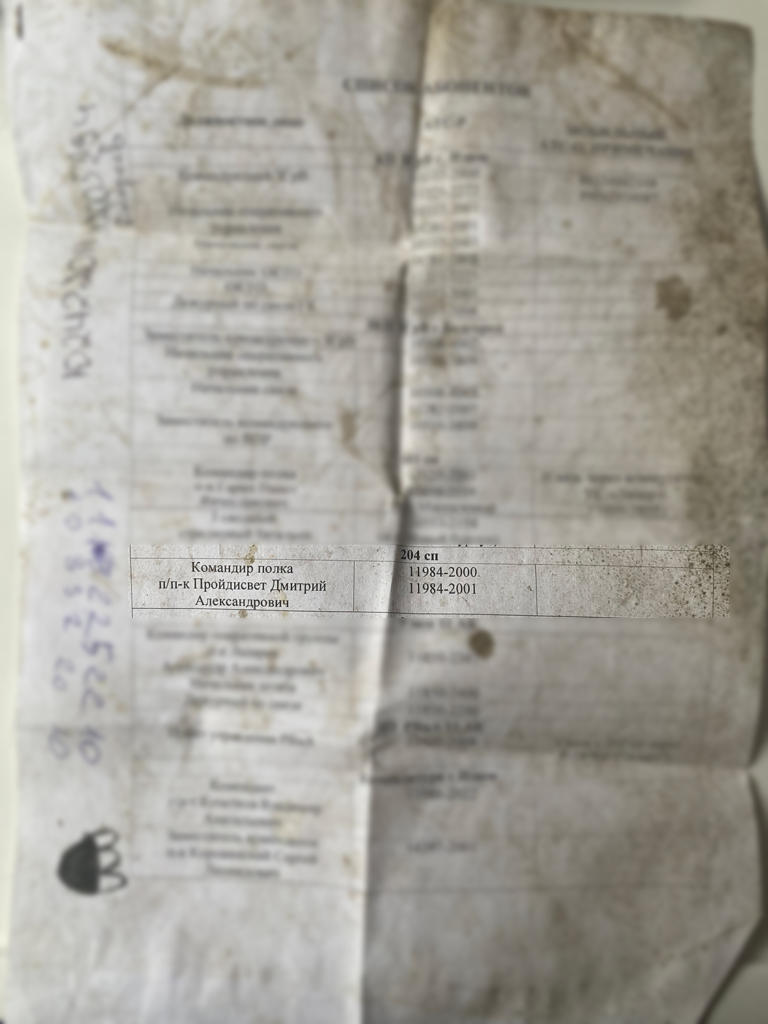
A list of military phone numbers found by Clooney Foundation for Justice documenters in the premises of Izium School № 2.
Source: Clooney Foundation for Justice, 2023.
Izium
Izium is a town in Kharkiv Oblast, a district centre lying on the two banks of the Siverskyi Donets River. Before Russia’s full-scale invasion of Ukraine, it was home to around 50,000 people.
From the first days of the invasion, Russian forces began conducting air strikes on residential buildings and critical infrastructure. For example, gas distribution hubs and electrical substations were destroyed,13 leaving local residents without gas, electricity, and mobile communications.14 During the first ten days of March, the Russian military seized Izium’s left bank and, between 24 March and1 April, also seized the right bank.15
The occupying authorities in Izium created an atmosphere of terror among the civilian population, which was reinforced by the operation of a network of illegal detention facilities where people were subjected to torture and ill-treatment. As a result of field missions, investigators from Truth Hounds and The Docket (an international crime investigation initiative created by the Clooney Foundation for Justice) identified 12 places of detention in the city. They were located in two private houses in Izium, in the buildings of the former State Automobile Inspectorate,16 the district police department, a water utility, a veterinary clinic, an optical and mechanical plant, the railway house of culture and city railway clinic,17 and Schools № 2, 6, and 12.
13 Witness K-8623; Witness L-0808.
14 WitnessK-1004.
15 WitnessS-1302.
16 Witness K-2200.
17 WitnessK-7001.
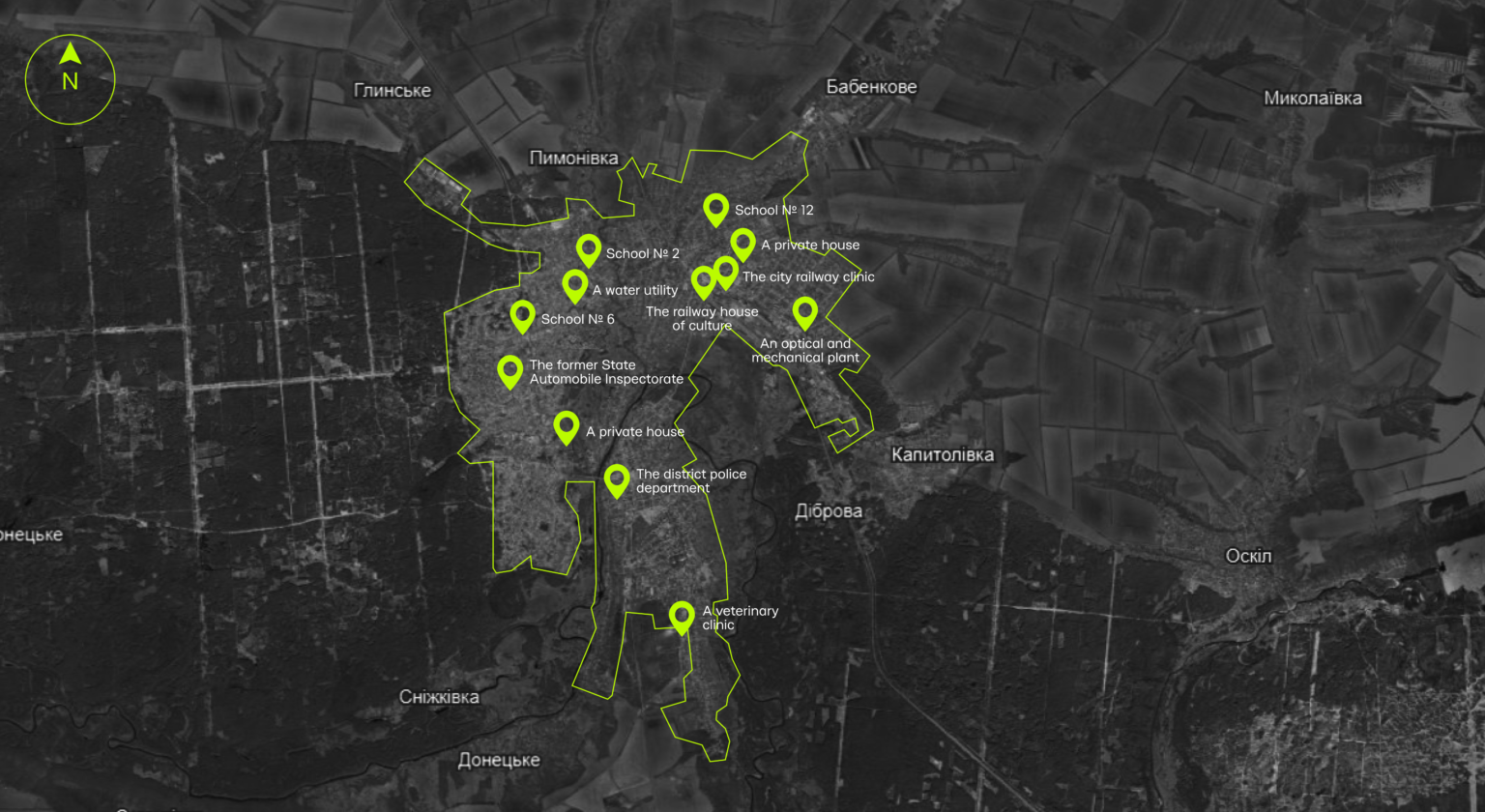
A map of Izium highlighting places where residents were illegally detained and tortured.
Source: Truth Hounds
Occupying forces in Izium
As Russian troops gained a foothold in various parts of the cities, they were joined (and sometimes replaced) by soldiers of the so-called LNR. Some of the witnesses interviewed claimed that these individuals belonged to the aforementioned 204th Regiment of the so-called LNR.18 Information about the deployment of this unit in Izium is confirmed by intercepts published on the official YouTube channel of the Defence Intelligence of Ukraine. In addition, independent investigators from the Centre for Information Resilience also point to the presence of this regiment in Izium in the spring of 2022.
For further understanding of the arguments presented in this investigation, it is important to note that key roles in the management of the city and decisionmaking belonged to Russian units. It was they who were stationed in the seized administrative buildings and set up commandants’ offices. At the same time, representatives of the so-called Luhansk and Dontesk People’s Republics (L/DNR) were mostly on duty at checkpoints.19 Even police functions in Izium were entrusted to specially seconded police units from the Russian Federation. It was they who conducted a search of the apartment of Ukrainian soldier Vitalii Smoliarov,20 who will be discussed in more detail below. Eyewitnesses to the Russian occupation of Izium also point to the subordination of representatives of the so-called L/DNR to Russian units that gave them orders.21
The 1st Guards Tank Army, specifically:
- The 2nd Guards Motorised Rifle Division, namely the 1st Motorised Rifle Regiment and the 1st Tank Regiment;
- The 4th Guards Tank Division, namely the 13th Tank Regiment and the 324th Motorised Rifle Regiment; and
- Two or three armoured personnel carriers of the 47th Armoured Division;
The 20th Guards Combined Arms Army, specifically:
- Units belonging to the 144th Guards Motorised Rifle Division; and
- The 237th Tank Regiment, the 752nd Motorised Rifle Regiment, and the 252nd Motorised Rifle Regiment of the 3rd Motorised Rifle Division;
The 35th Guards Combined Arms Army, specifically:
- The 38th Separate Motorised Rifle Brigade; and
- The 64th Separate Motorised Rifle Brigade;
The 36th Combined Arms Army, specifically:
- The 5th Separate Tank Brigade; and
- The 37th Separate Motorised Rifle Brigade;
The Coastal Troops, specifically:
- The 68th Army Corps; and
- The 11th Army Corps;
The 4th ‘Kantemir’ Guards Tank Division, namely the 423rd Guards Motorised Rifle Regiment;
The 35th Combined Arms ‘Red Banner’ Army, specifically:
Approximately 12-13 battalion tactical groups were operating in the Izium area. Later, they became part of the ‘Izium’ grouping of troops, which also included the above-mentioned units.
18 Witness S-1302
19 Witness S-1302.
20 Witness L-0808.
21 Witness K-222.
Izium School № 2
Among the places of illegal detention in Izium mentioned in the previous section, this investigation will focus on Izium School № 2.22 It was in the basement of the school that a torture chamber for detainees was set up, while the Russian military commandant’s office was located on the floors above.
The Russian military occupied the school on 12 March 2022.23 They immediately set up checkpoints around its perimeter and denied residents access to the grounds. Witnesses reported that many different types of military equipment were seen entering the school yard, including tanks, armoured personnel carriers, and communications vehicles. In addition, the Russians set up a military hospital on the school premises, where they also brought the bodies of dead soldiers. A separate room was allocated as a warehouse for looted property.24
Various units of the Russian Armed Forces and other Russian military structures were stationed at the school simultaneously. According to a witness who, on the orders of the Russians, had to bring the bodies of their dead soldiers to the school, special forces and the commandant’s office were located on the second and third floors of the building.25
22 Coordinates:49.220997, 37.268345
23 Witnes Y-1122.
24 Witnes S-1302.
25 Witnes S-1302.
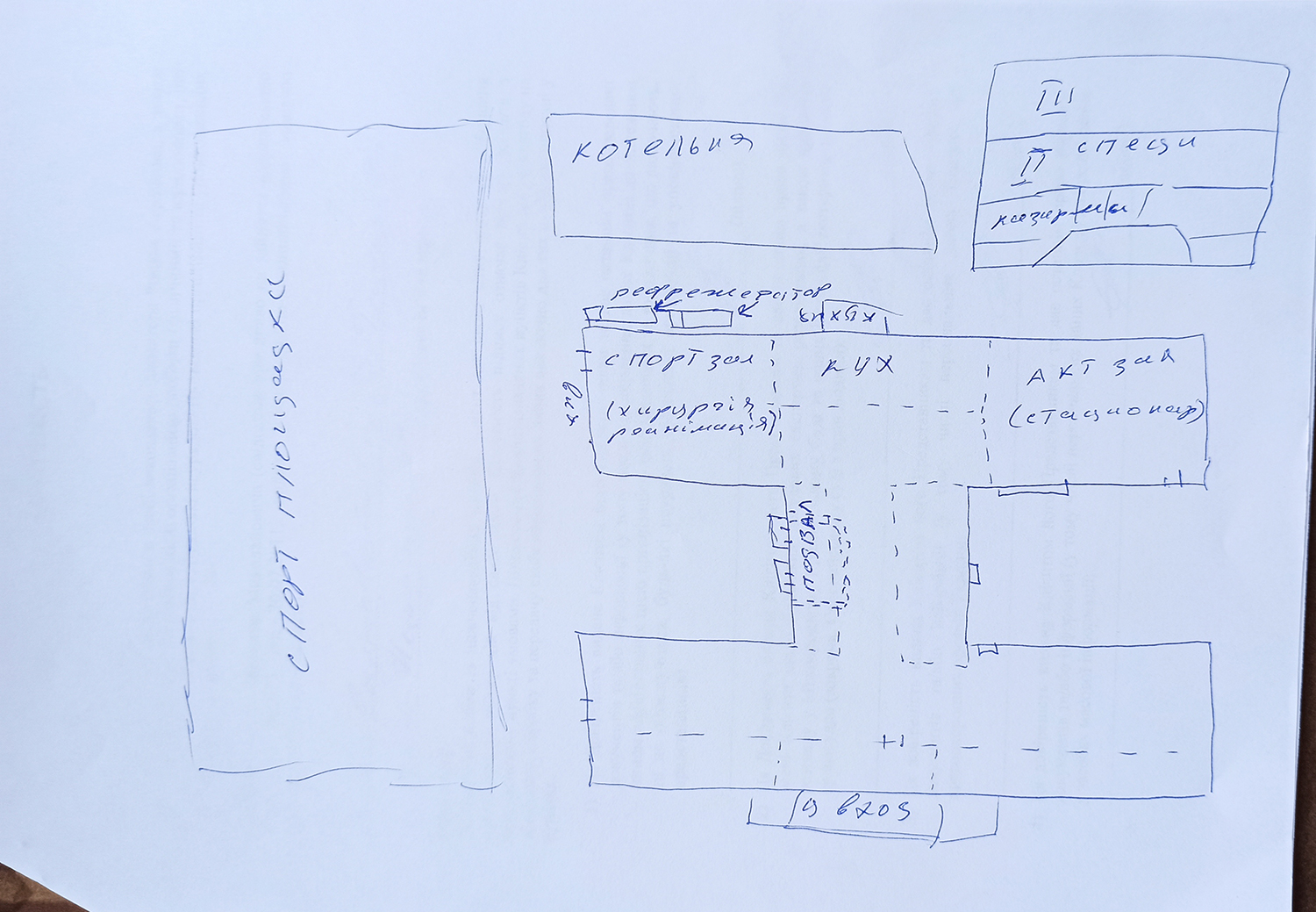
A schematic representation of Izium School № 2 drawn by a resident who was held in the basement during the occupation, with the basement torture chamber, the military hospital, and the locations of Russian forces marked on it.
Source: Truth Hounds.
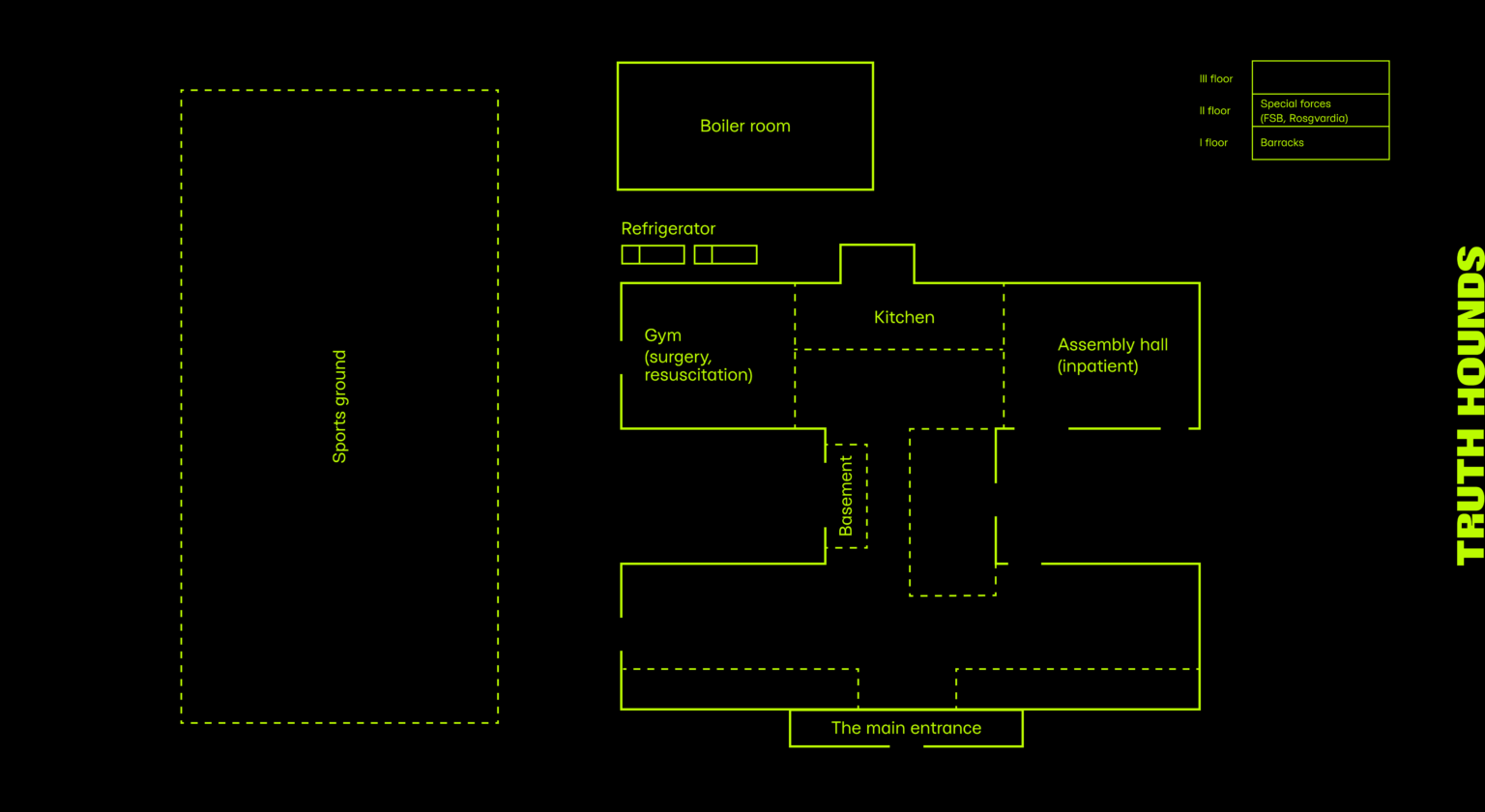
A schematic representation of Izium School № 2.
Source: Truth Hounds.
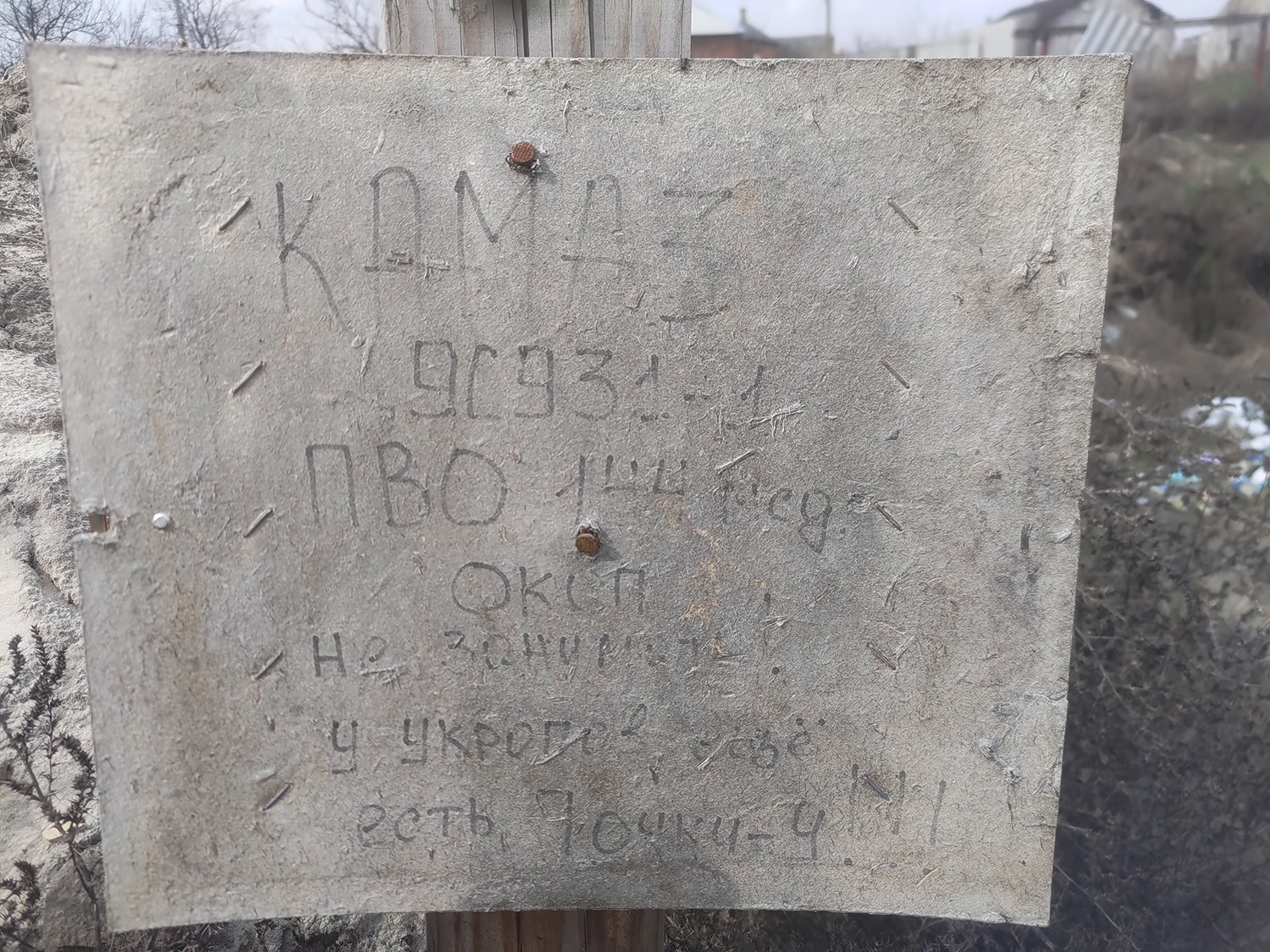
A plaque commemorating the 144th Guards Motorised Rifle Division on the grounds of Izium School № 2.
Source: Truth Hounds, 25 March 2023.
People were kept blindfolded in the basement and were strictly forbidden from communicating with one other. One victim described the actions of the Russian military who imprisoned and tortured him to Truth Hounds as follows:
‘There were still people in the basement, but I don’t know how many. There were screams, breathing. There was a regime of silence, you couldn’t talk. You were sitting in a bag with your hands tied. If the Russians heard anything from you, they would physically beat you. I was with a bag on my head the whole time I was there.
At some point, someone took me to a workshop in the basement. They started interrogating me. During the interrogation, they beat me. They also electrocuted me, tied one part of the wire to my tongue and the other to my nipple and started to turn the current. They also beat my kidneys. They interrogated me for about an hour and a half, maybe longer. The Russians interrogated me, asking for information about me, my purpose of coming, asking about the positions of the Ukrainian Armed Forces and the buried weapons.’26.
26 Witness S-1302.
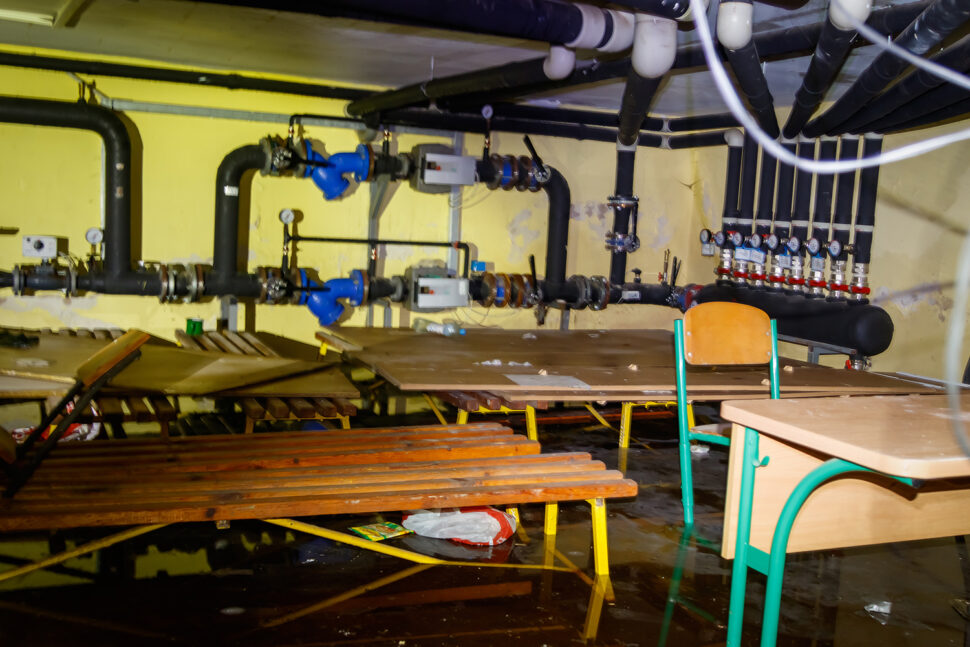
A workshop in the basement of Izium School № 2 where Russians illegally detained and tortured civilians and prisoners of war.
Source: Truth Hounds, 25 March 2023.
Residents of Kapytolivka also said that their fellow villagers were taken to Izium School № 2.27
In the course of clarifying all the circumstances surrounding the torture chamber in the school, we discovered that Ukrainian prisoners of war, including individuals from the 95th Separate Airborne Brigade and the 93rd Separate Mechanised Brigade, were also held in the basement alongside civilians. Truth Hounds has documents and others materials that show that, for a long time, the prisoners of war were subjected to physical and psychological abuse. There is also evidence of their transfer to the territory of the Russian Federation, where they were held captive for some time. It is known that some prisoners of war were released as a result of an exchange between Ukraine and the Russian Federation.
On 25 June 2022, the Ukrainian Armed Forces fired a HIMARS system at Izium School № 2, killing several dozen Russian military personnel, including career officers, and destroying a large amount of equipment.
27 Witness K-2200; Witness K-1739; Witness K-2271.
The aftermath of the Ukrainian Armed Forces’ strike on the deployment of the Russian military at Izium School № 2 in June 2022.
Source: The Dumskaya.Net YouTube channel.
Circumstances of the murder of Volodymyr Vakulenko according to the investigation
The Investigative Department of the Main Department of the National Police of Ukraine in Kharkiv Oblast found that, on 22 March 2022, at least four members of the so-called LNR with the call signs ‘Lev’, ‘Udod’, ‘Akademik’, and ‘Kirian’ arrived at the house where Volodymyr Vakulenko was staying (25 Peremohy Street, Kapytolivka). They conducted searches, seized books, and took the writer’s rucksack. Volodymyr Vakulenko Jr and his son Vitalii (born in 2008) were taken to the place of permanent deployment of the so-called LNR forces at 14 Luhova Street. They were detained there for several hours, with Volodymyr beaten, interrogated, and ordered not to disappear or run away.
On 24 March, Volodymyr Vakulenko was taken from his home for the second time. He was put in a white minibus without side doors and driven towards Izium.
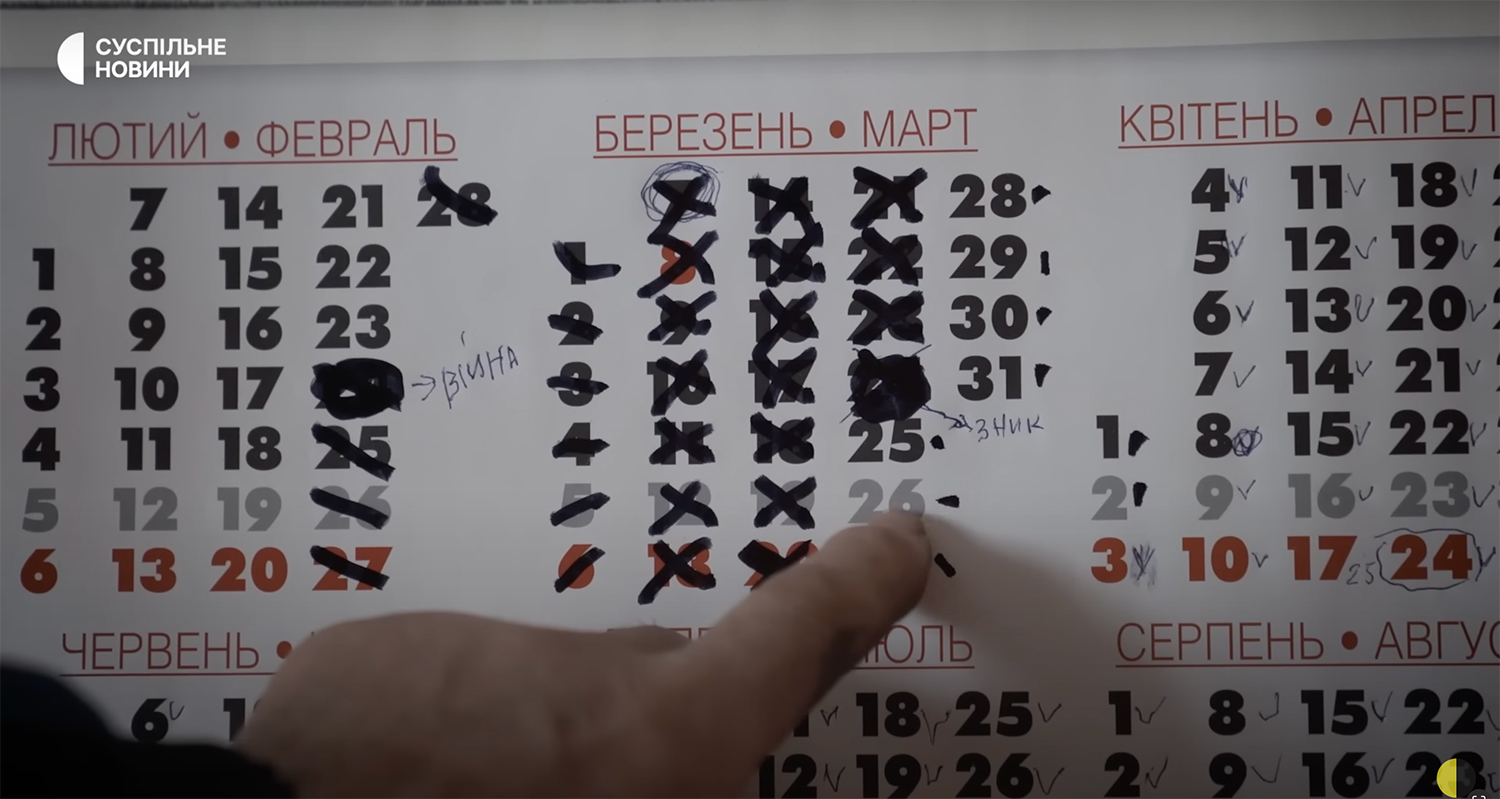
Volodymyr Vakulenko’s father’s calendar, in which he marked the days of the war and the date his son disappeared.
Source: Freezeframe from a video by Suspilne.
Since then, Volodymyr has not been seen alive, and his whereabouts have remained unknown. On 12 May 2022, a man’s body was found near the road connecting Kapytolivka and Izium. Due to the decomposition of the body’s tissues, he could not be identified immediately. Before being identified, the body was in Unmarked Grave № 319 at the mass grave site near Izium. Through the efforts of Suspilne investigative journalists and law enforcement agencies, it was established that the body was that of Volodymyr Vakulenko. His body was exhumed and DNA testing confirmed his identity.
According to the official investigation, the same people were involved in the imprisonment and murder of Volodymyr Vakulenko, namely four soldiers of the 4th Company of the 4th Battalion of the 204th Rifle Regiment of the Mobilisation Reserve of the so-called LNR of the 2nd Army Corps of the 8th Combined Arms Army of the Southern Military District of the Russian Armed Forces.
Two of them have been identified for certain – the commander of the abovementioned company, Vladislav Vladimirovich Neskorodiev (callsign ‘Lev’) and his subordinate, a machine gunner belonging to the same company, Serhii Anatoliyovych Udodenko (nicknamed ‘Udod’).
According to the investigation, it was Neskorodiev who had the criminal intention to detain and kill the writer, and Udodenko carried out this intention by shooting Vladimir with two 9 mm bullets from a Makarov pistol.
It is believed that Vakulenko died on the spot from his wounds. The document goes on to say that the writer’s body was found in a ditch at the side of the road Izium-Kapytolivka road. However, there is no mention of how the body arrived there or who brought it.
It should be noted that the abovementioned individuals are also suspected of the illegal detention, torture, and murder of other victims in Kapytolivka, namely Ivan Shabelnyk, Leonid Taran, and Yurii Kavun. Their bodies, which bore signs of torture and wounds caused by firearms, were found in the forest on the outskirts of the village.
Signs of Russian involvement in the murder of Volodymyr Vakulenko
While assessing various theories of Volodymyr Vakulenko’s disappearance and murder, Truth Hounds investigators found signs of the involvement of the Russian Armed Forces and/or the country’s special services. However, public reports of the official investigation do not suggest their potential involvement.
Volodymyr Vakulenko on the territory of Izium School № 2
On 3 April 2022, the Russian Telegram channel ‘Starshe Eddy’ published a video in which three people dressed in Russian Armed Forces uniforms take a blindfolded civilian out of a ‘Tiger’ armoured vehicle at an unnamed location. Beforehand, they remove rare and antique weapons from the same vehicle. The caption to the video states that the man was detained in Kapytolivka.
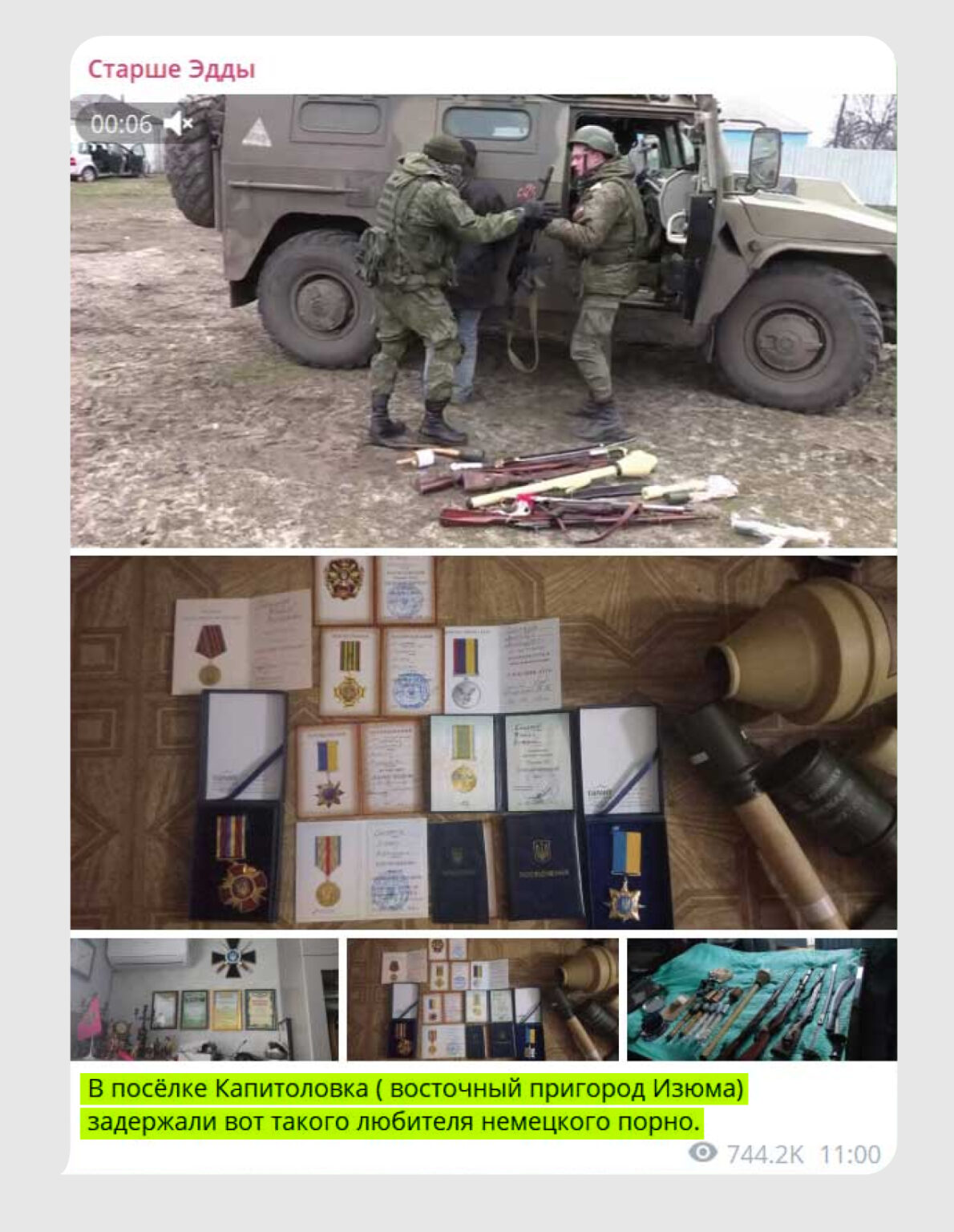
A screenshot of the post on the ‘Starshe Eddy’ Telegram channel showing that a person was detained in the village of Kapytolivka.
We have localised the place where the video was recorded, identified the owner of the weapon, and ascertained enough facts to confirm that the individual shown in the video is Volodymyr Vakulenko.
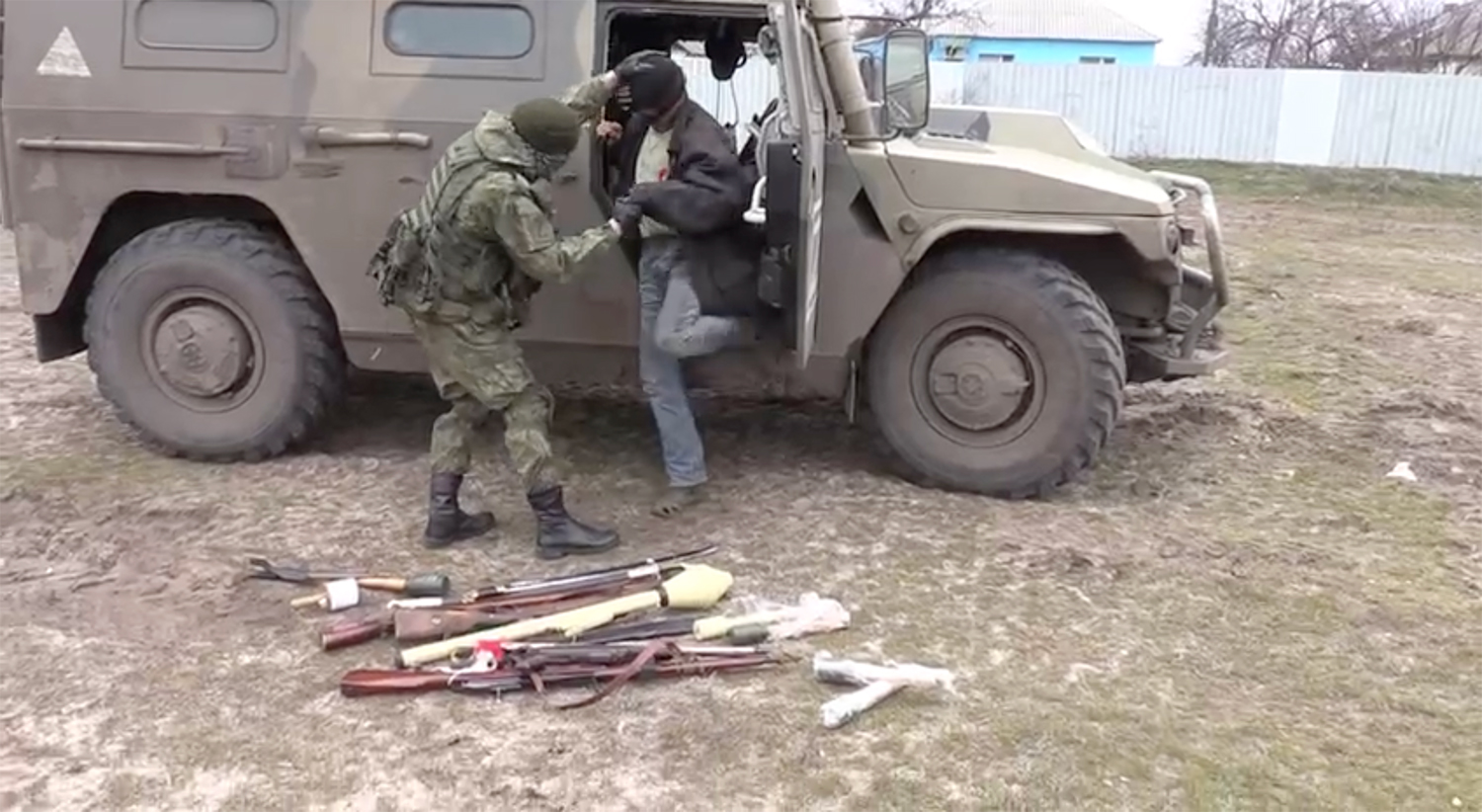
A screenshot from a video showing a detained man being taken out of a Tiger armoured vehicle.
The location of the video
The video was filmed on the grounds of Izium School № 2, located at 12 Ivan Myroshnychenko Street.28 This is indicated by a number of identifying features, such as the positioning of the buildings, the fence, and the type of roofs seen in the background of the video (these elements are highlighted on the screenshot shown below).
28 Coordinates: 49.221334, 37.267294
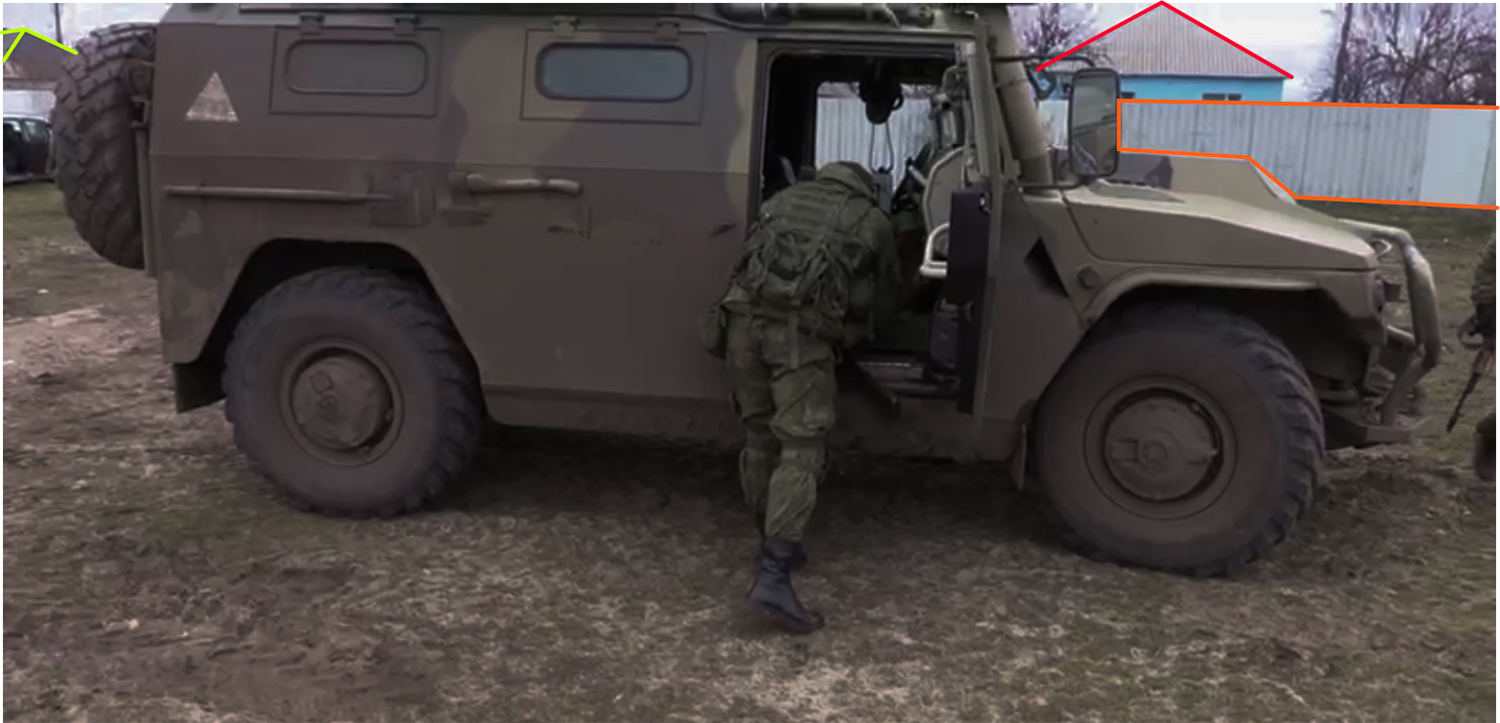
Screenshot of the Tiger video with location markings.
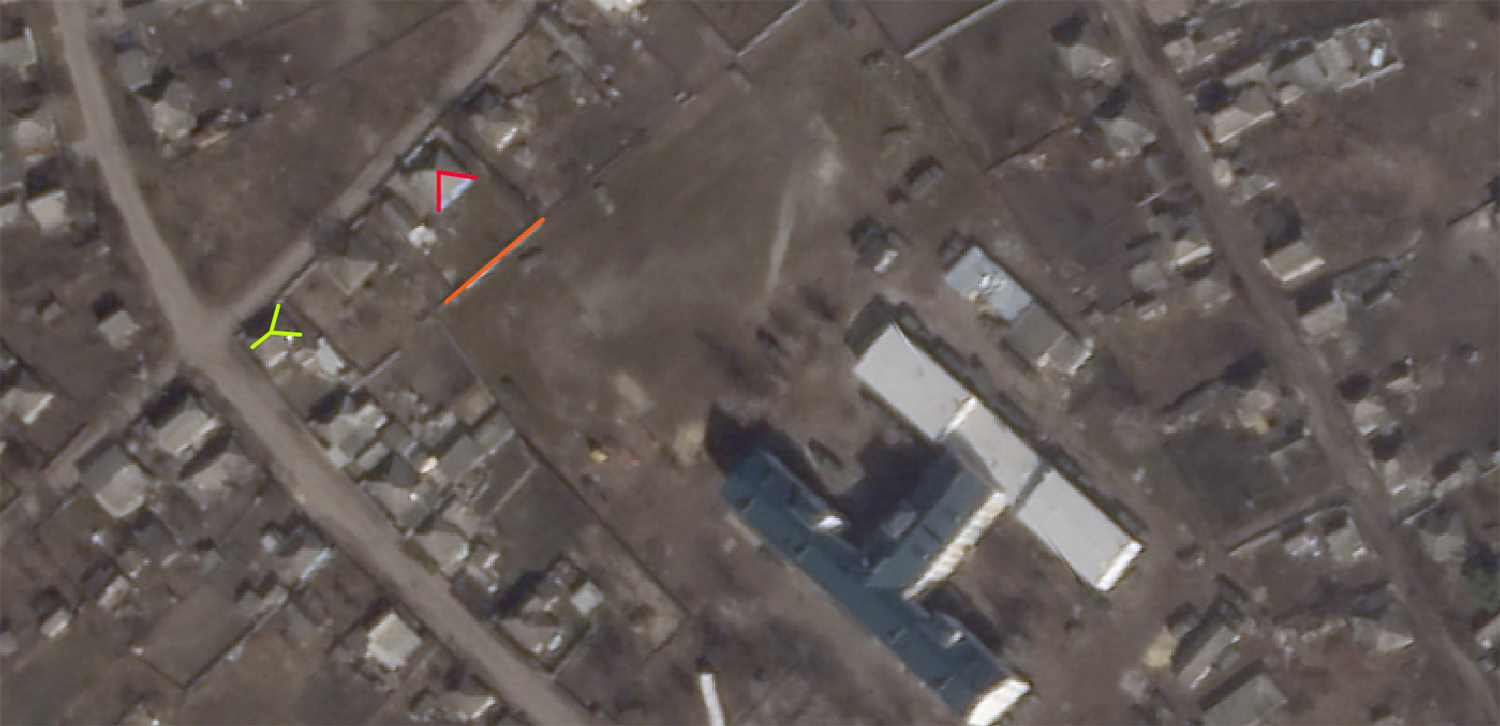
The grounds of Izium School № 2 with the markings of objects that correspond to those in the video.
Source: PlanetLab, 20 March 2022.
A satellite image of the area from 25 March 2022 clearly shows all of the above elements and their location and shape match those seen in the video. The photo also shows the distinctive blue colour of the exterior cladding of the building, which matches the colour of the building in the video.
To be sure that the filming took place near Izium School № 2, Truth Hounds documenters visited the schoolyard during a field mission to the area. The image below shows the objects that appear in the video of the detainee and that are marked on the satellite image, namely a house with a pyramidal roof, the wall of a blue building, and a long light metal fence in front of it.
Video from the grounds of Izium School № 2.
Source: Truth Hounds, March 2023.
As for the date of the video, it is impossible to establish for certain, as the original was published on Telegram, which does not store video metadata. However, it can be assumed that 12 March 2022 is the earliest possible date for the filming, as that was the day Russian troops seized the school. However, satellite photos from the same date show snow in the schoolyard, while the video does not. In addition, photos from 13 March 2022 show no snow. Therefore, it is possible to establish the time period within which the video could have been captured – between 13 March and 3 April 2022 (the day the video was published).
Given that the last abduction of Volodymyr Vakulenko took place on 24 March, it could indeed have been Vakulenko seen in the video.
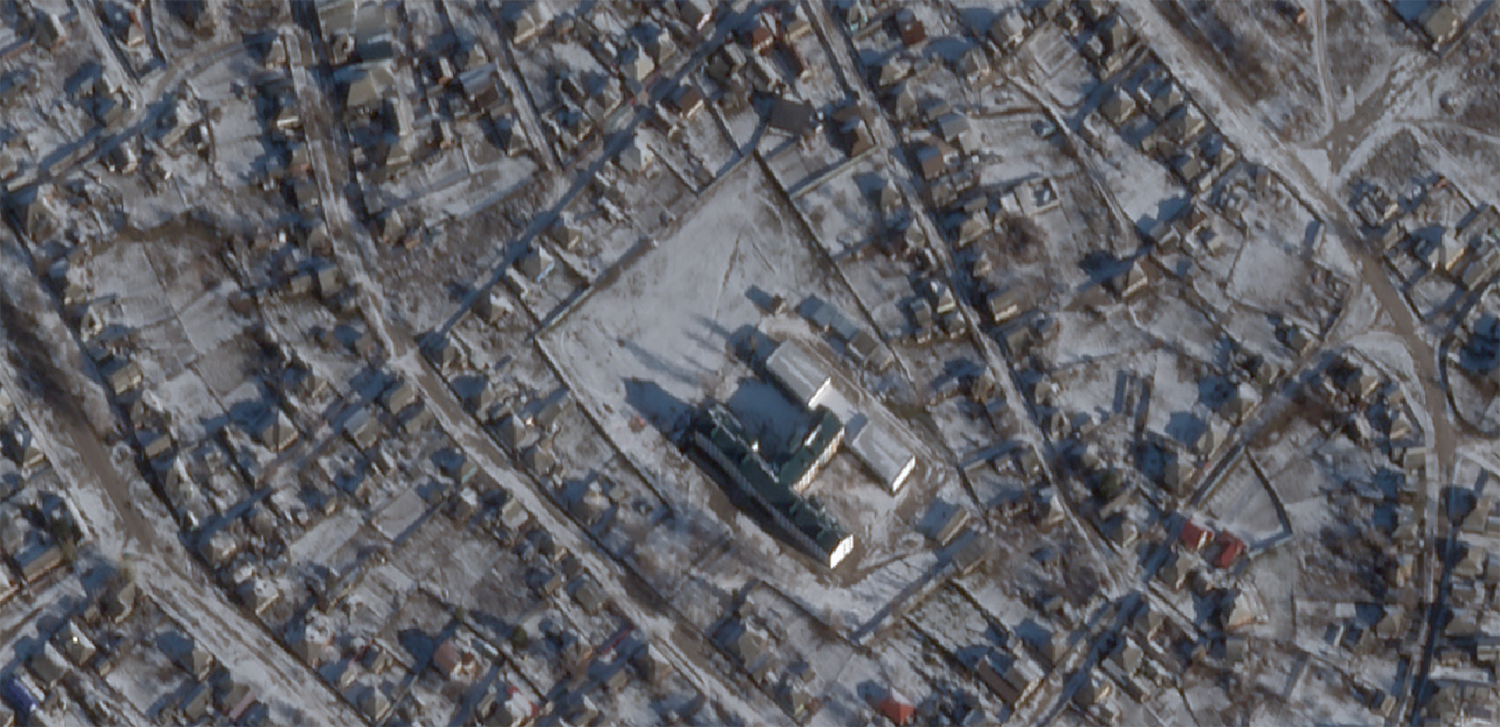
A satellite image from 12 March 2022 showing snow on grounds of Izium School № 2.
Source: PlanetLab.
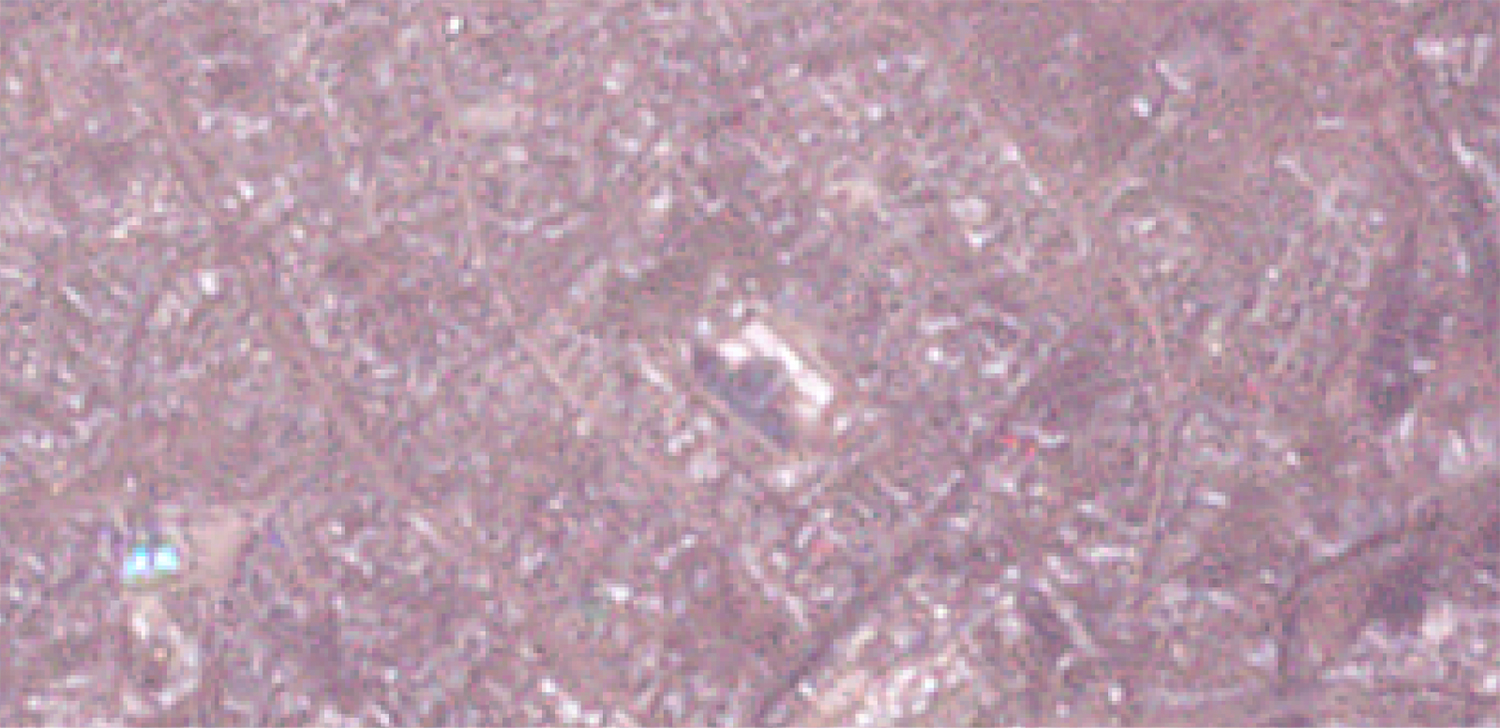
A satellite image from 13 March 2022 showing no snow in the same area.
Source: PlanetLab.
Who owns the weapons seen in the video?
The video focuses on an antique weapon, probably dating back to the Second World War, which the military officer in the video takes out of the car before dragging the detainee out. With this gesture, the Russians apparently intended to evidence their own propaganda narrative that there are ‘Nazis’ living in Ukraine.
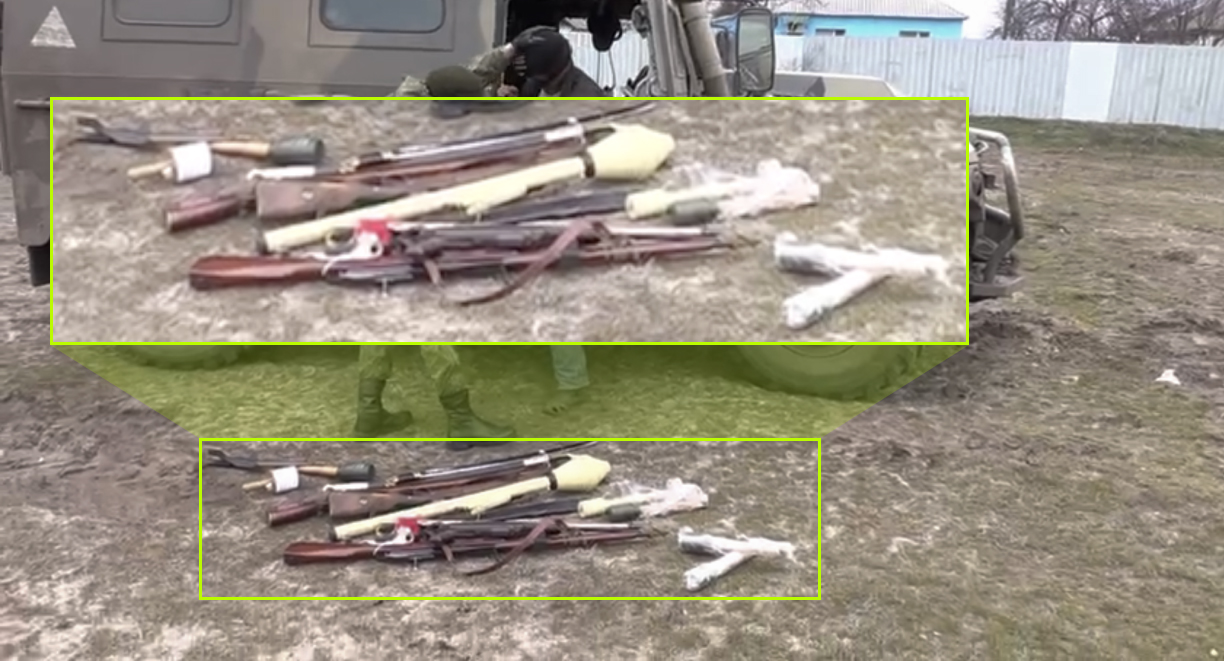
Antique weapons seen in the video, brought to the grounds of Izium School № 2.
Despite the Russian Telegram channel’s attempts to link the weapons shown in the video to the detainee in order to make him look like a ‘Nazi’ from Kapytolivka, Truth Hounds analysts found that the guns and hand grenades did not actually belong to the man in the video. They were probably dummies or museum pieces from a private collection rather than functioning weapons.
Along with the video, the Telegram channel ‘Starshe Eddy’ published photos of documents signed with the name of Vitalii Viktorovych Smoliarov. Next to them, one can see the same antique weapons removed from the Tiger by the soldier in the video. This, according to the authors of the publication, should lead to the conclusion that the detained person in the video is Vitalii Smoliarov.
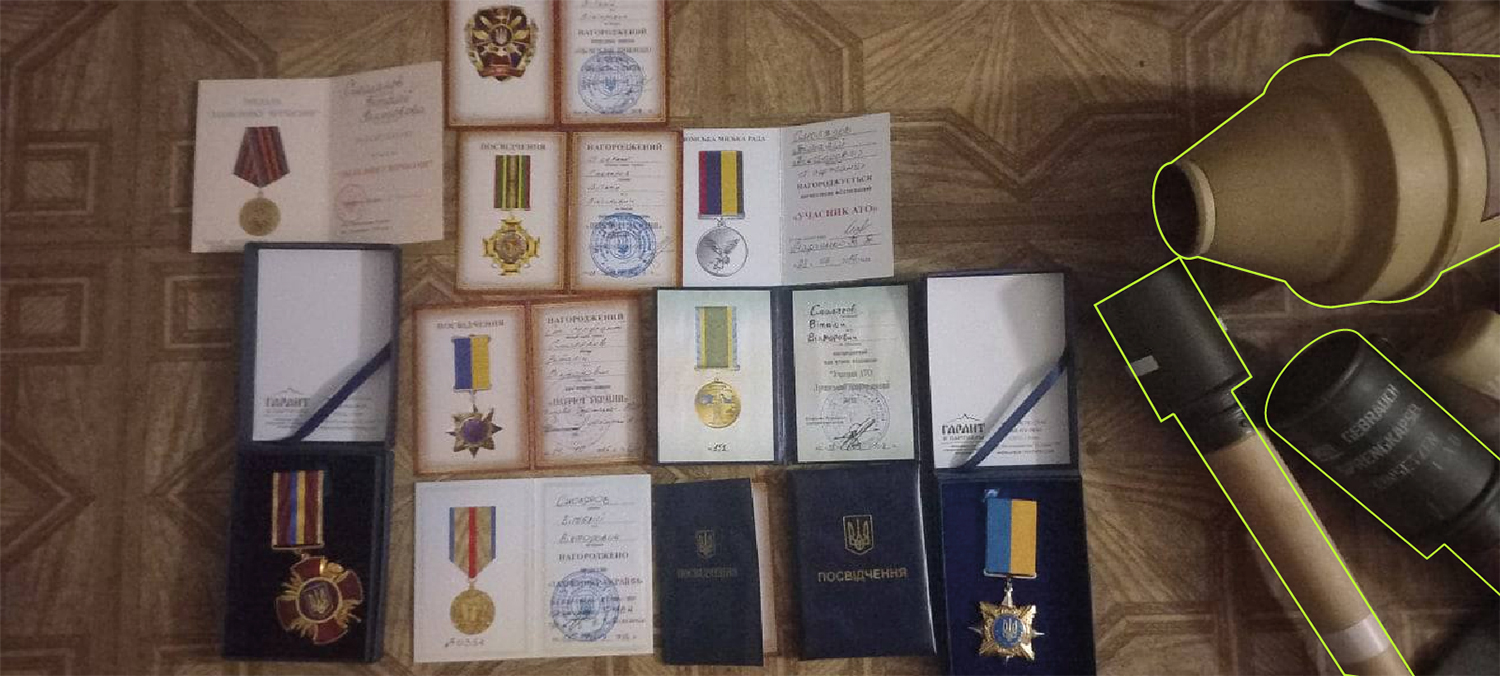
A photo published by the Telegram channel, with the weapons that appear in the video next to Smoliarov’s documents highlighted.
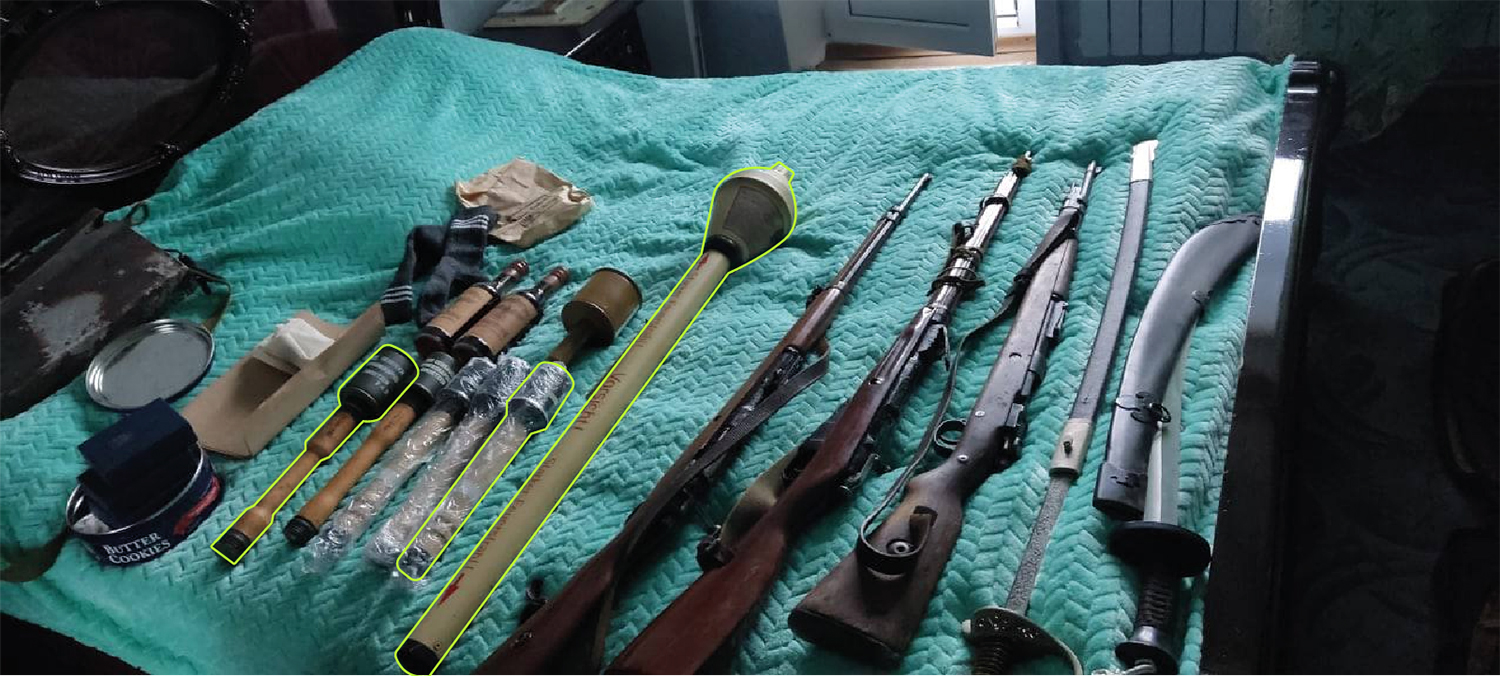
Weapons from the apartment of local resident Vitalii Smoliarov identical to those shown in the video with the detainee (below).
We analysed this theory and found that Vitalii Smoliarov, the villager from whose home the weapons were stolen, was already dead at the time of the video. His relatives claim that Smoliarov participated in Ukraine’s anti-terrorist operation (ATO) in 2014-2015 and joined the armed forces on the first day of the full-scale invasion. He was killed by a Russian air strike on 9 March 2022 during the battle for the town of Izium. Since the video of the Tiger detainee could not have been filmed before 13 March 2022, it is impossible that Smoliarov appears in it.
Moreover, from open sources, Truth Hounds analysts found photos of Vitalii Smoliarov in which it is noticeable that he has a different build and height from the person seen in the video.
A freezeframe from the Telegram video, clearly showing that the detainee has a different build from that of Vitalii Smoliarov.
The theft of the weapons shown in the video
Prior to the full-scale invasion, Vitalii Smoliarov was a collector of antique weapons from the Second World War, a member of a re-enactment club, and had official permission to store his collectibles.29 After the occupation of Kapytolivka, the Russian military showed great interest in Vitalii and his flat was searched 12 times.30 According to witnesses, the individuals who searched the flat mostly belonged to the Russian Armed Forces and wore distinctive military uniforms, while some wore black uniforms. It is difficult to establish the affiliation of this latter group with a specific military unit. It is likely that they could have belonged to Rosgvardia or the FSB, who often do not wear any insignia.31
One witness recalled the burglarising of Smoliarov’s flat as follows:
‘Several pieces of military equipment, including a green armoured car with the letter “Z” on the bonnet, drove up to the entrance, from which six people in black uniforms, heavy bulletproof vests, balaclavas and helmets with visors got out and headed for Vitalii Smoliarov’s flat. After knocking down the front door to Smoliarov’s flat with a sledgehammer, the men in black began to take out replicas of rare weapons, Vitalii’s military uniform and historical military uniforms for re-enactments, as well as documents. The men in black also spoke with a very distinct Russian (Moscow) accent.’32
Residents of Kapytolivka described this story in local Telegram channels, such as in the post seen below.
29 Witness K-0301.
30 Witness K-0301.
31 Witness L-0808.
32 Witness L-0808.
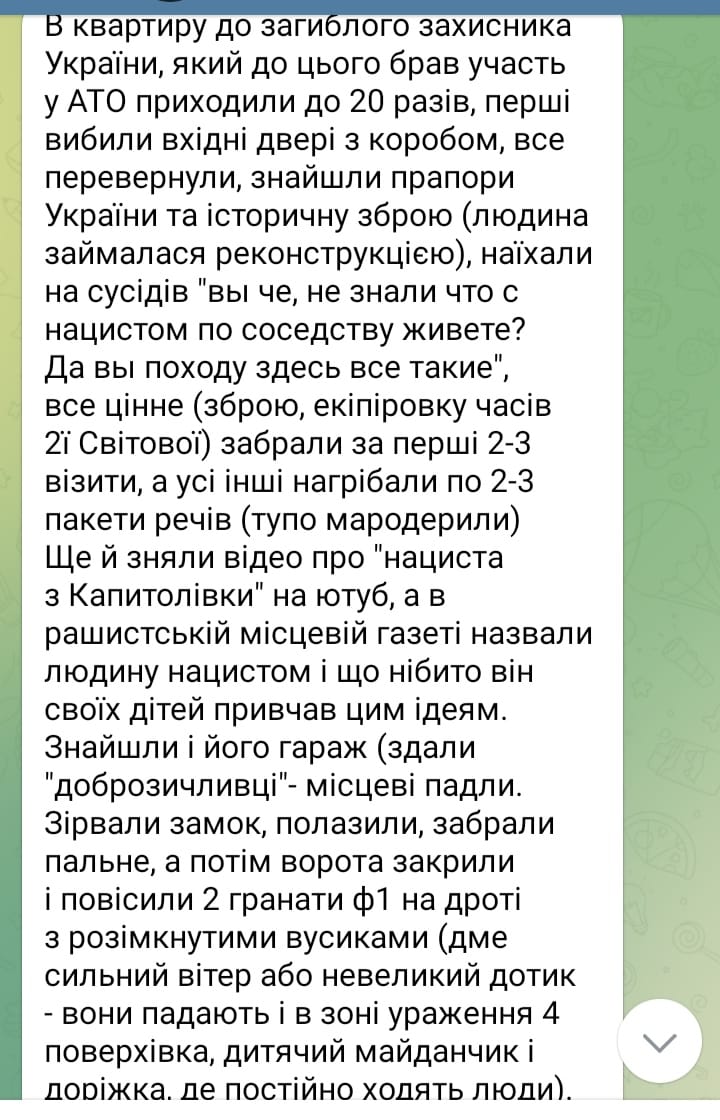
A screenshot of a comment on a post about the abduction of people from Kapytolivka.
Of all the information provided by witnesses to the robbery, the most noteworthy is that the first search, during which the antique weapons were taken, was conducted by individuals belonging to the Russian Armed Forces who used a white minibus with a broken door to move around.33
An eyewitness stated:
‘Around the end of March – beginning of April 2022, a white passenger minibus with an open or broken side door drove up (later this car was constantly driving around the village). Six people of Slavic appearance, wearing dark green uniforms of the Russian Armed Forces, helmets, and speaking distinct Russian got out. Approximately two days later, between 13:00 and 14:00, the same white minibus arrived, and this time, it seems, fewer individuals from the Russian Armed Forces got out, but they were the same as the last time. They conducted a second search in Smoliarov’s flat.’34
It is important to emphasize that it was in this white bus with a broken side door that Volodymyr Vakulenko was taken away for the last time on 24 March 2022.
33 Witness L-0808.
34 Witness L-0808.
Identification of the detained civilian from the video
Based on an analysis of the location and date of the video, we suspected that the person in the video was Vakulenko, especially given the man’s slender build and his detention in Kapytolivka, which was explicitly stated by the video’s author. However, we sought to confirm this suspicion by seeking out additional evidence.
The moment where the detainee appears on the video.
The first factor that indicates that the video shows Volodymyr is his jumper, which he often wore at literary events and which, according to his family, was one of his favourite items of clothing. Photos and videos from open sources clearly show that the jumpers have common features: a triangular neckline, red detailing, and blue lettering.
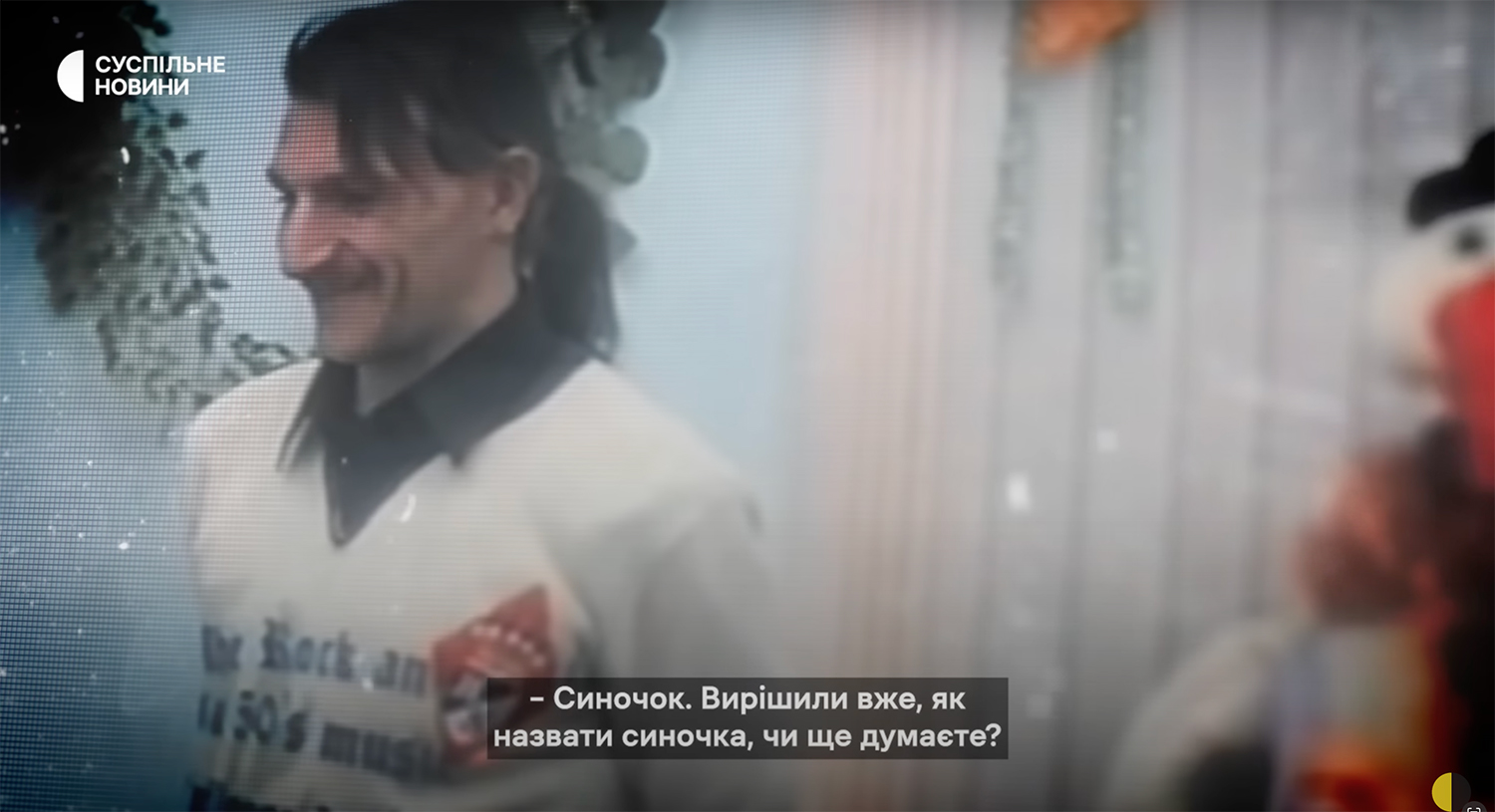
Volodymyr Vakulenko wearing a jumper in a freezeframe from an investigative documentary by Suspilne.
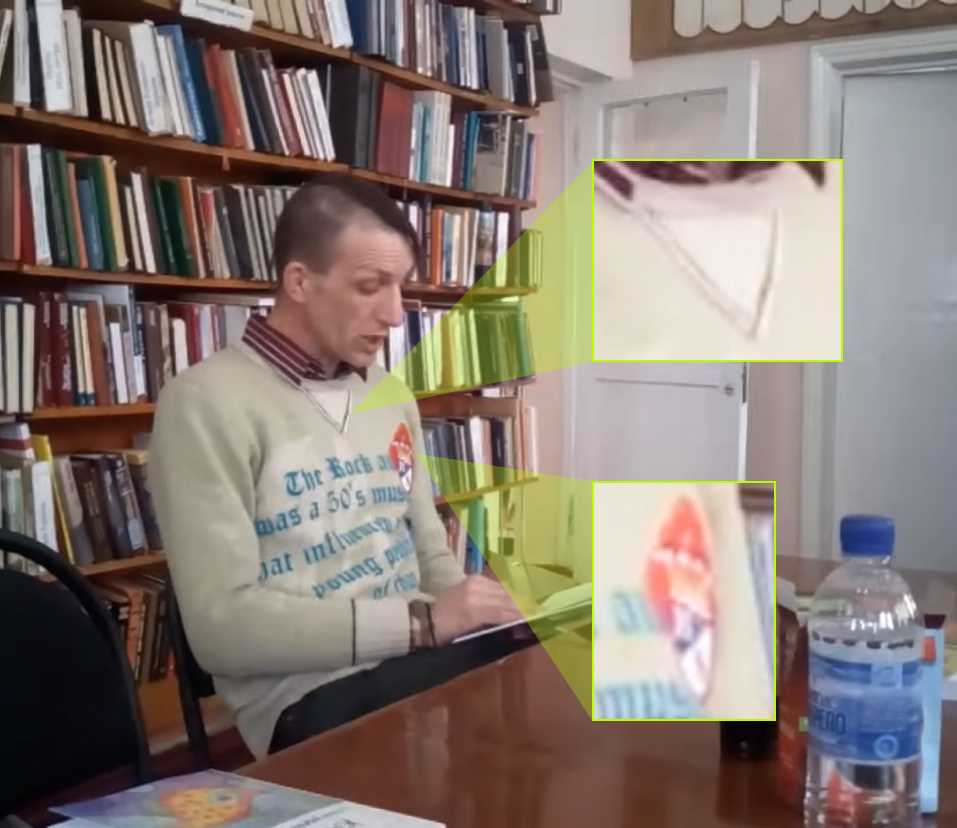
An archival video showing Volodymyr Vakulenko reciting poetry in his favourite jumper. The markings indicate the elements that are present on the clothing of the detained man seen in the video.
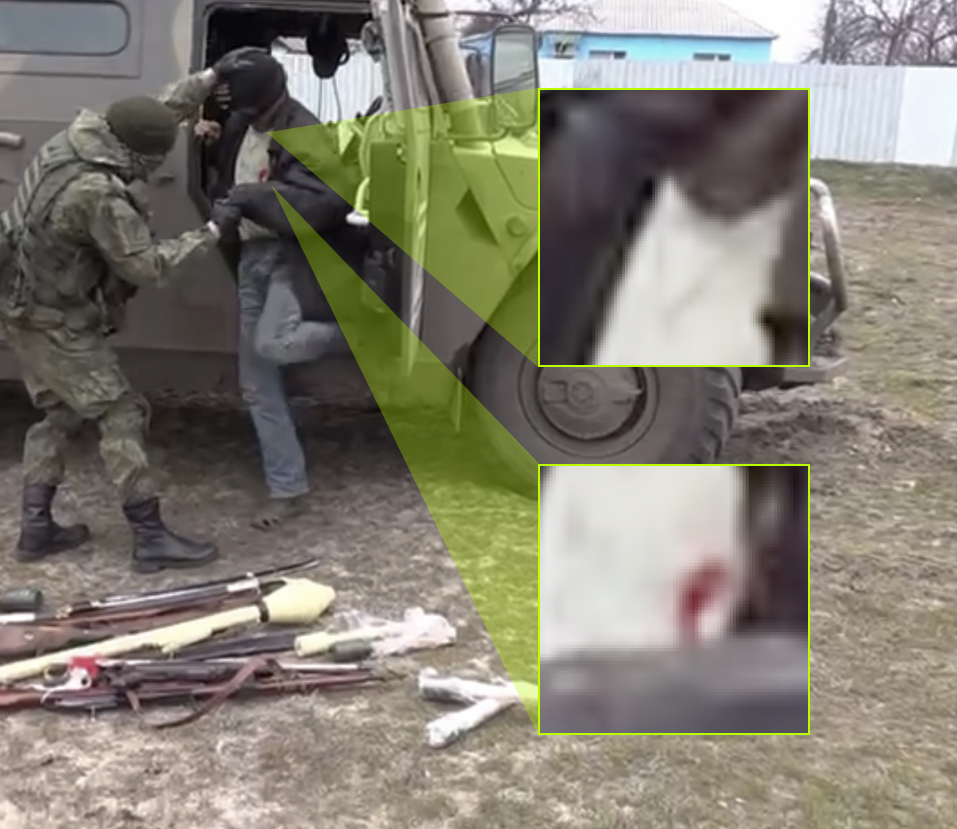
The clothing of the person being taken out of Tiger on the grounds of Izium School № 2 bears details of a jumper often worn by Volodymyr Vakulenko.
The triangular neckline of the sweater in the neck area and the red detail in the heart area are clearly visible in the three photos above. The only element that we cannot unambiguously identify due to the poor quality of the video is the blue lettering in the centre and along the jumper in the stomach area. However, the video shows some blue lettering in the same area of the jumper.
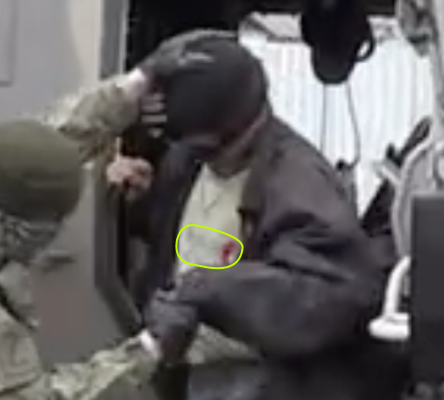
On the clothing of the person being taken out of the Tiger, inscriptions are visible in the same place as on Volodymyr Vakulenko’s jumper.
A photograph of Volodymyr Vakulenko’s corpse and a freezeframe from a video of the morgue’s examination of his belongings clearly show that, on the day of his death, he was wearing the same jumper as during his second detention by Russian occupying forces. Although the jumper has lost some of its appearance over time, the red detail and letters can confirm that it is the same item.
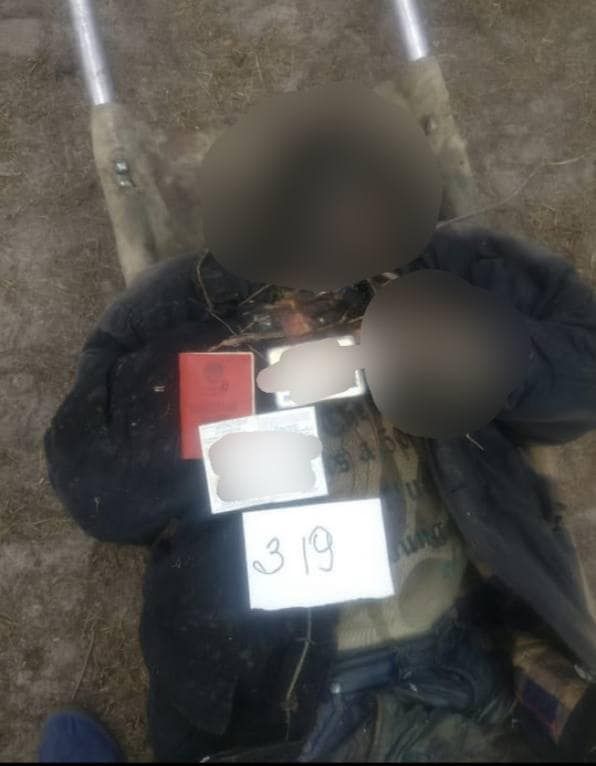
A photo of Volodymyr Vakulenko’s body, which was found on 12 May 2022 on the side of the road between Izium and Kapytolivka.
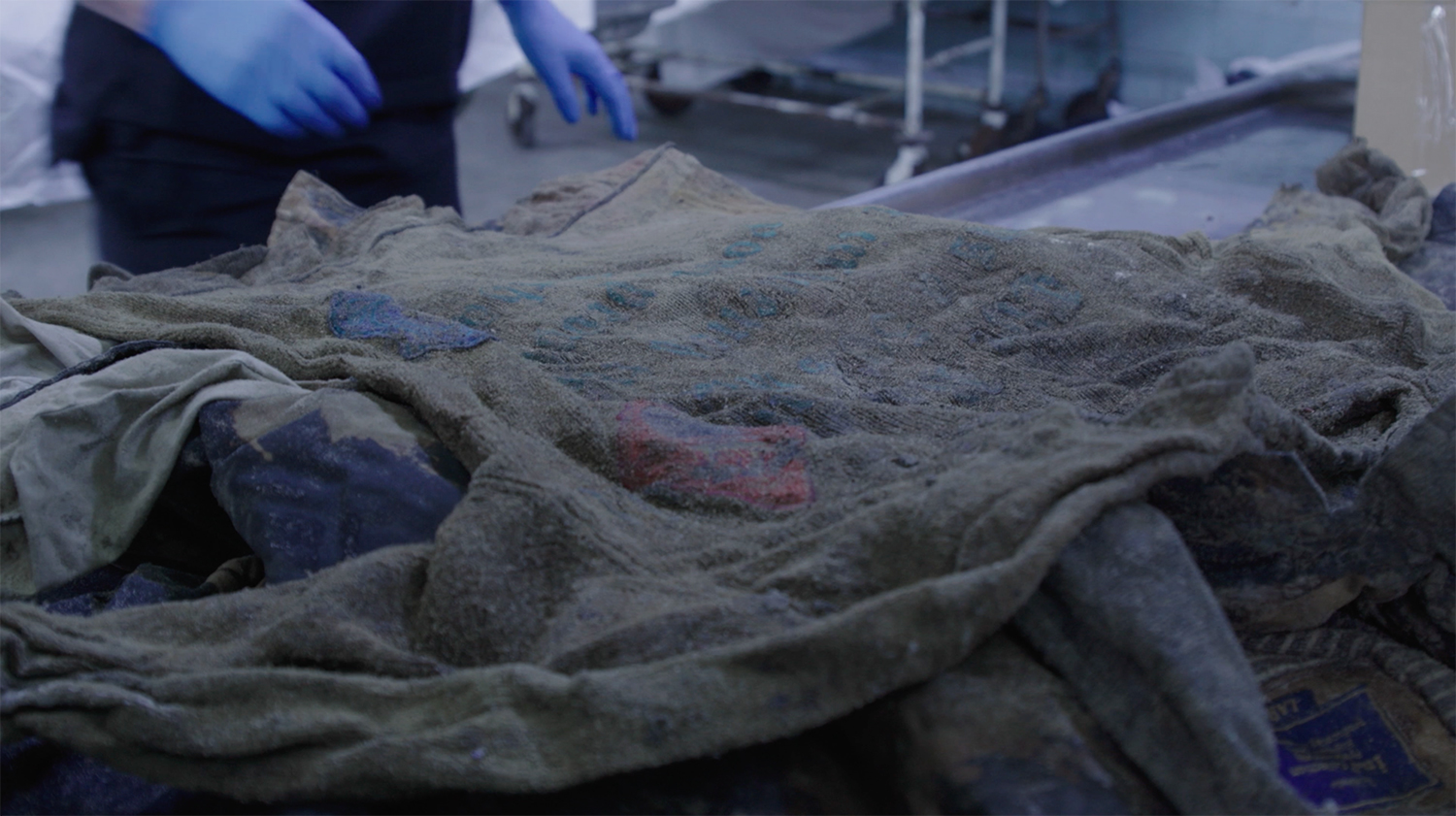
In the morgue, a red detail and blue letters are visible on the dead Volodymyr Vakulenko’s jumper.
Source: freezeframe from a video by Amanda Bailly, 2022.
Shoes of the civilian in the video
According to his mother, Volodymyr Vakulenko was taken away ‘wearing only slippers and a jumper, when he was cooking on the tagan’. The description matches the clothing and outwearr worn by the detainee in the video.
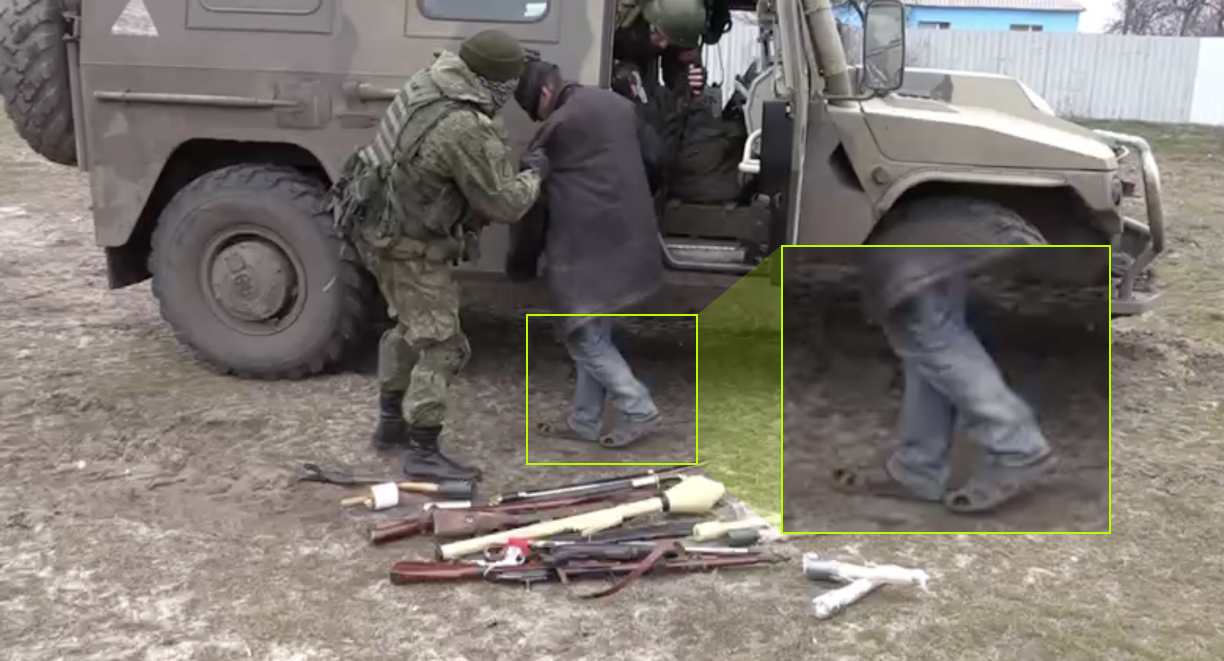
The person who was taken out of the Tiger was wearing slippers, coincides with description given by Volodymyr Vakulenko’s mother.
The build and height of the civilian from the video
Volodymyr Vakulenko, as can be seen from the photographs, had a slender build and was of medium height. According to his family, he stood at 172 cm (5 ft 8 in) tall.
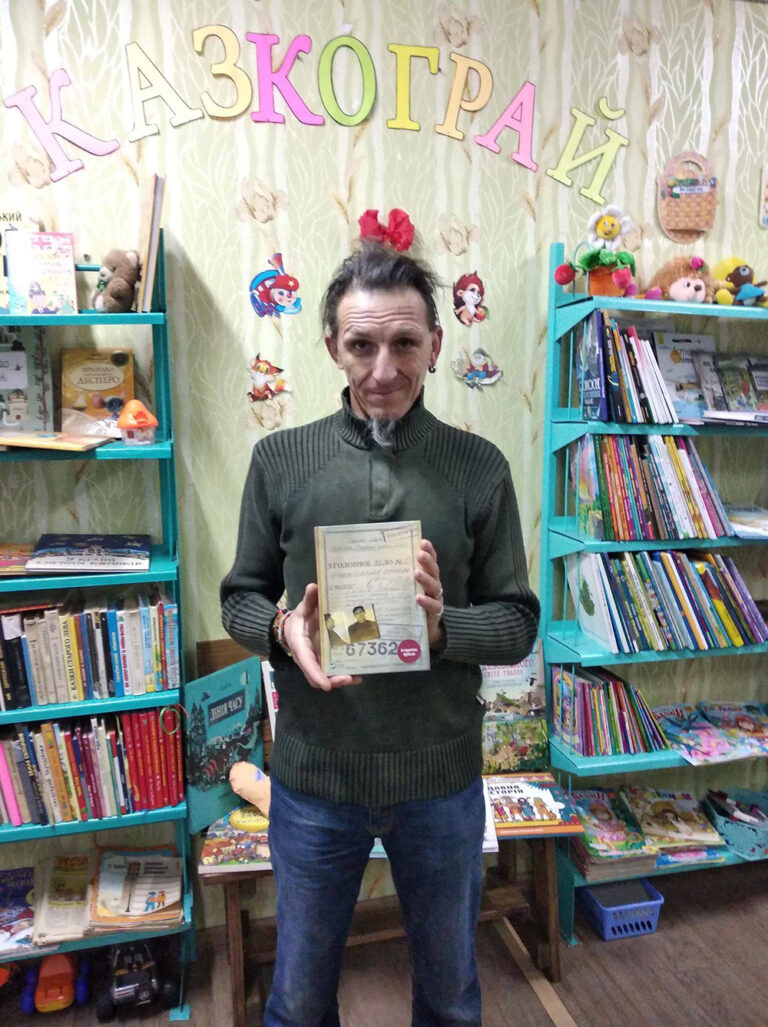
Given the known heights of the Tiger seen in the video and Vakulenko, we can confirm that it is he who is in the video. The detained man is taken out of the Tiger and placed close to its side. It can be clearly seen that in this position, the detainee can barely reach the top of his head to the lower frame of the car window. The diagram below shows an armoured vehicle and a human silhouette scaled to fit the 20 cm grid. From this we can ascertain that the person stood next to the Tiger is approximately 172-173 cm tall (including hat and shoes). Bringing together all of the available data, we can conclude that the man in the video matches the description of Volodymyr Vakulenko.
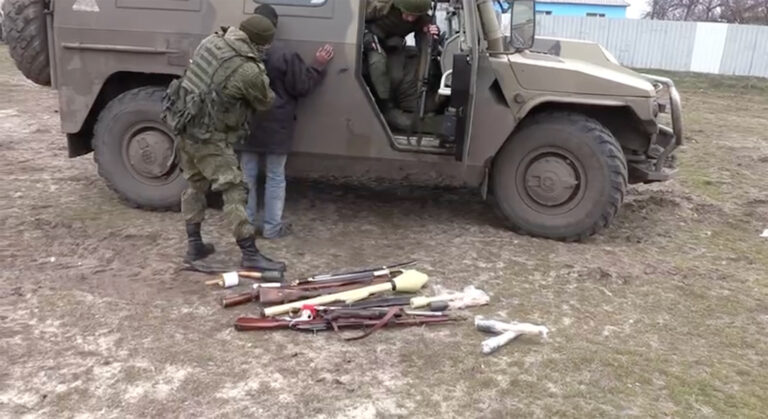
A freezeframe from the Telegram video where the detainee is standing close to the Tiger.
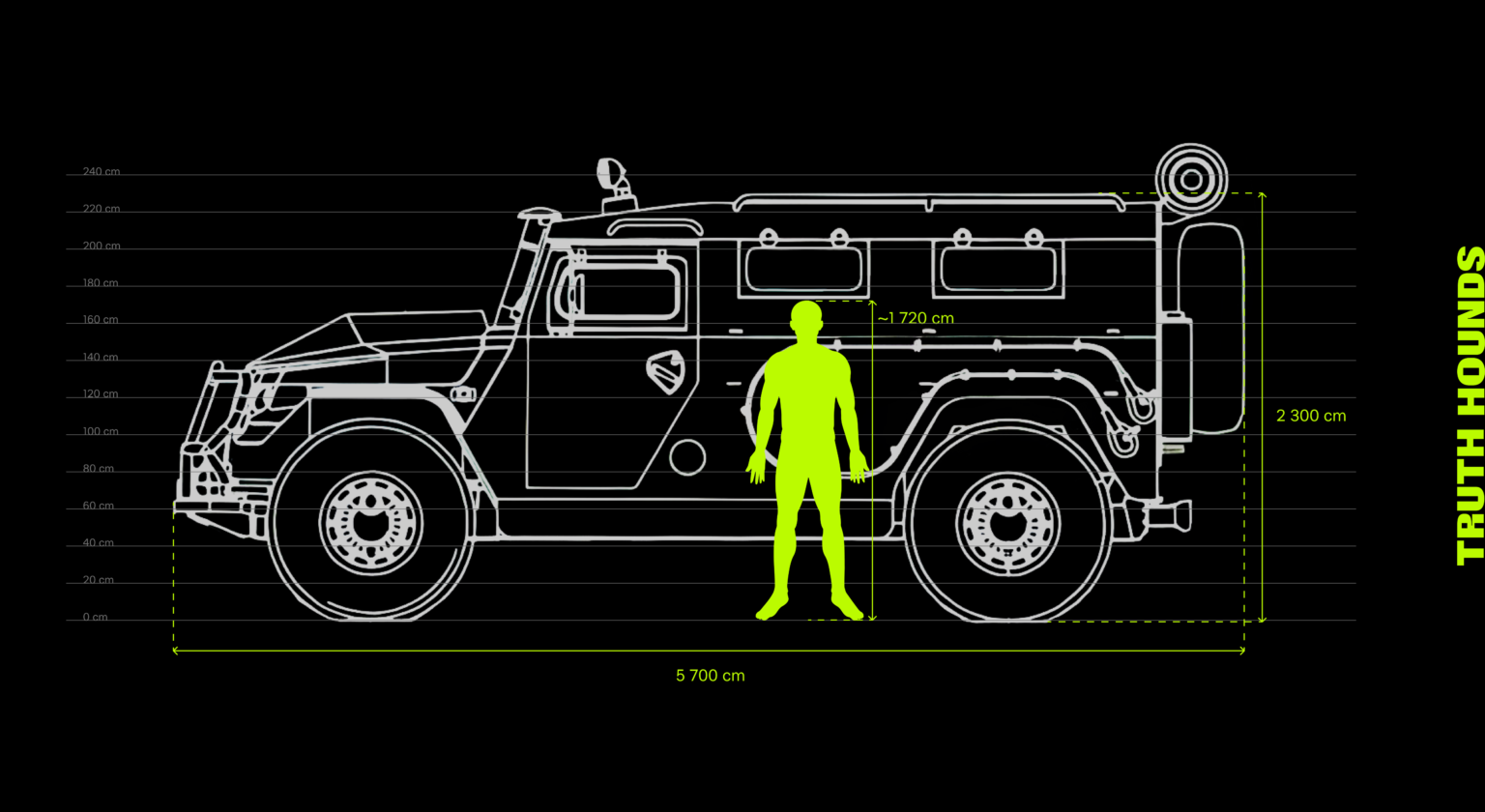
The diagram shows a Tiger armoured vehicle and the silhouette of the person from the video. The dimensions of the armoured vehicle are taken from open sources.
Source: Truth Hounds.
This statement is supported not only by the testimony of Volodymyr’s relatives, but also by residents of Kapytolivka. The clothing and physique of the man in the video appear to be characteristic of Vakulenko.
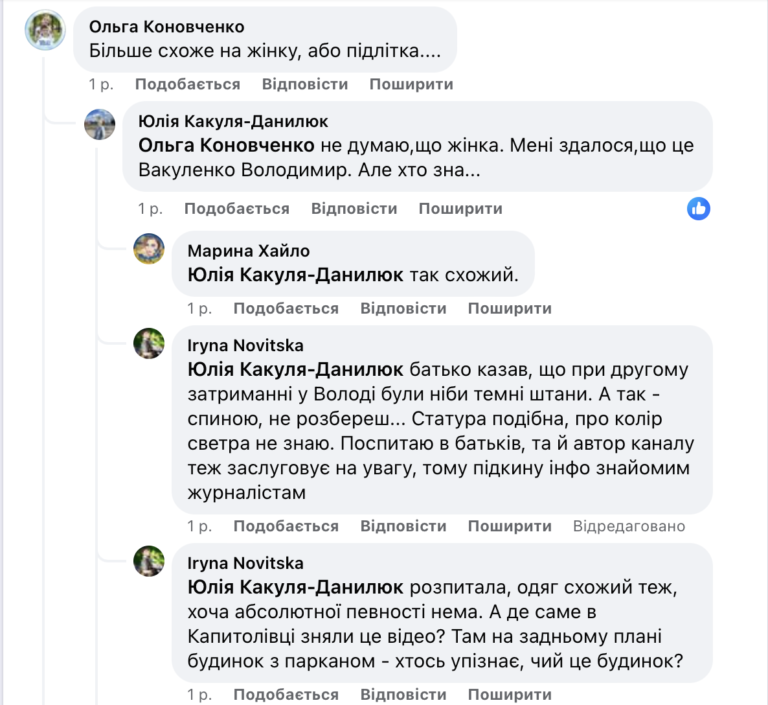
In Facebook comments under the video of the Tiger, locals discuss the similarities between the detainee and Volodymyr Vakulenko.
A number of factors – shoes, clothing, physique, height, and the mention that the person in the video is from Kapytolivka – give reason to believe that the video shows Volodymyr Vakulenko, who was taken from his home by occupying forces on 24 March 2022 and brought to the grounds of Izium School № 2 between March 24 and April 3.
Having established that it was probably Volodymyr Vakulenko who was brought to the school, Truth Hounds investigators identified the type of vehicle that brought him and determined which units could have been behind his detention.
Type of armoured vehicle in the video
Although the video does not show the vehicle in its entirety, some of its details are captured and exhibit features that allow us to determine its type. This makes it possible to narrow down the range of units and identify individuals who could have used the vehicle, including those present in the analysed video.
One of the characteristic features of the Tiger armoured vehicle shown in the video is its humped body shape, which can be clearly seen in the freezeframe below. After comparing it to other Tiger variants used by the Russian Army (see the infographic below), Truth Hounds concluded that the video shows a ‘Tiger-M’ armoured vehicle. A comparison is outlined below.
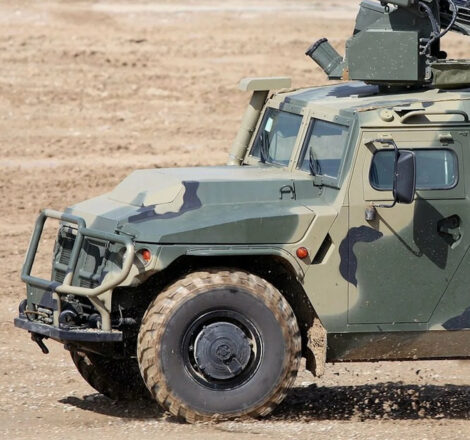
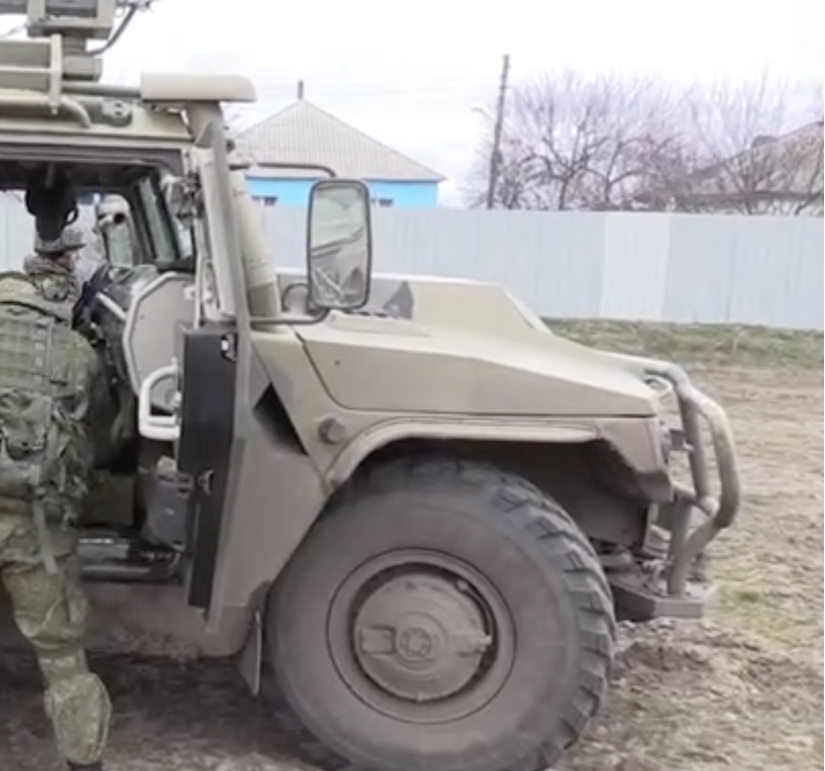
A comparison of the front body of a typical Tiger-M (left) with the armoured vehicle shown in the video with the detainee (right).
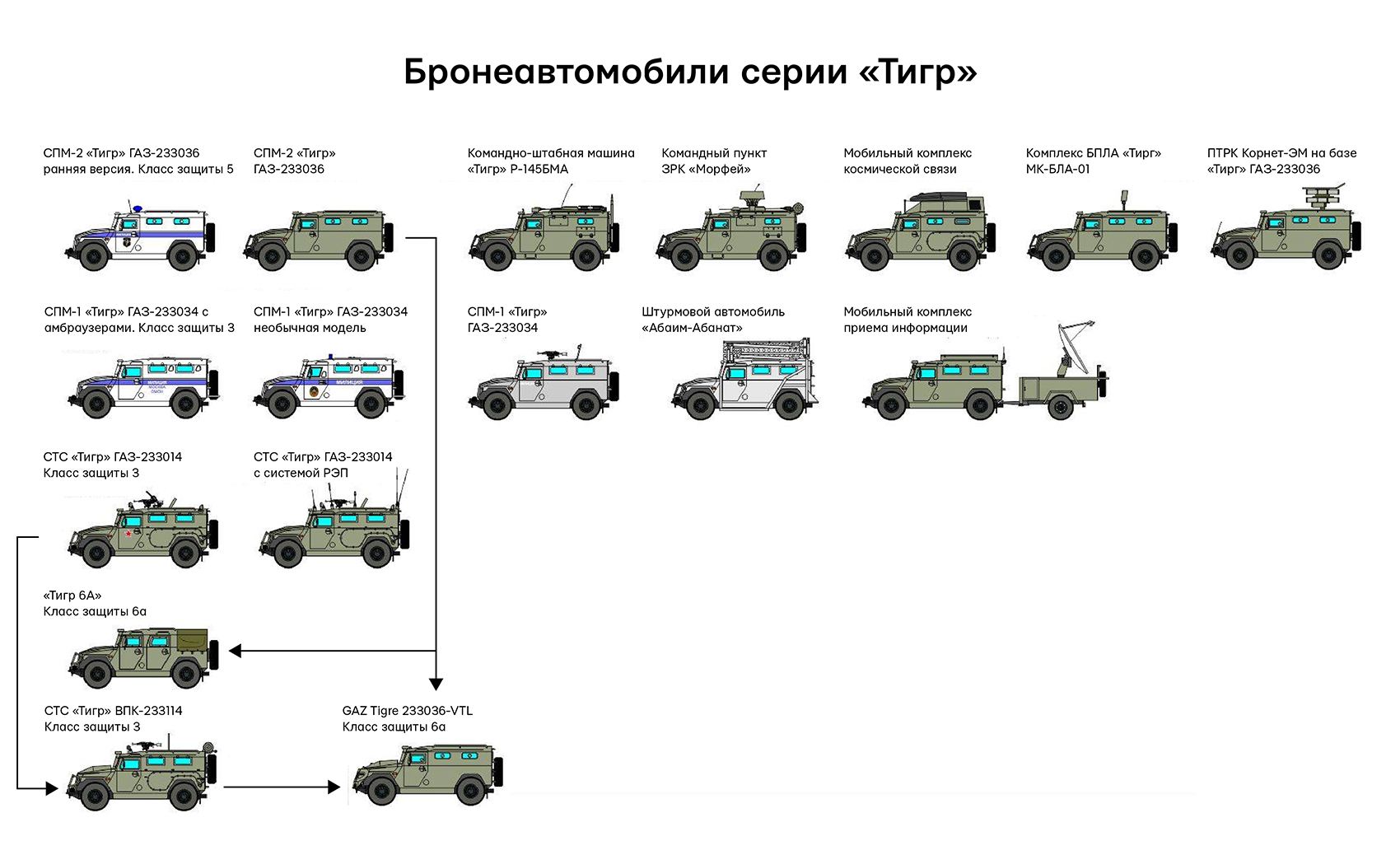
An infographic about the Tiger series of armoured vehicles.
The first identifying feature of the Tiger-M is the aforementioned humped body shape, which is unique to this variant among the entire Tiger line.
Another important distinguishing feature of the Tiger-M is its roof-mounted machine gun. However, the analysed video shows a different type of equipment. After studying photos and videos from open sources with similar Tiger variants, we concluded that it could be a loudspeaker mount.
As it turns out, the Tiger-M is also used for loudspeaker, radio, and television broadcasting in combat areas. For this purpose, it is equipped with a ‘Yazykoved’ system with a loudspeaker on the roof. Such vehicles can be seen in photos and videos in almost all major cities in the temporarily occupied territories of Ukraine, including Mariupol, Melitopol, and, earlier, in Izium.
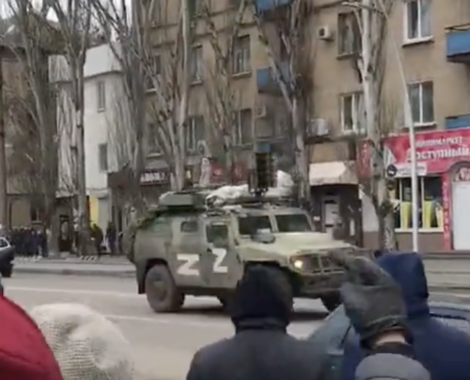
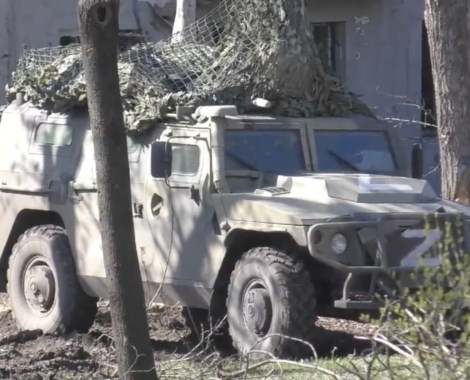
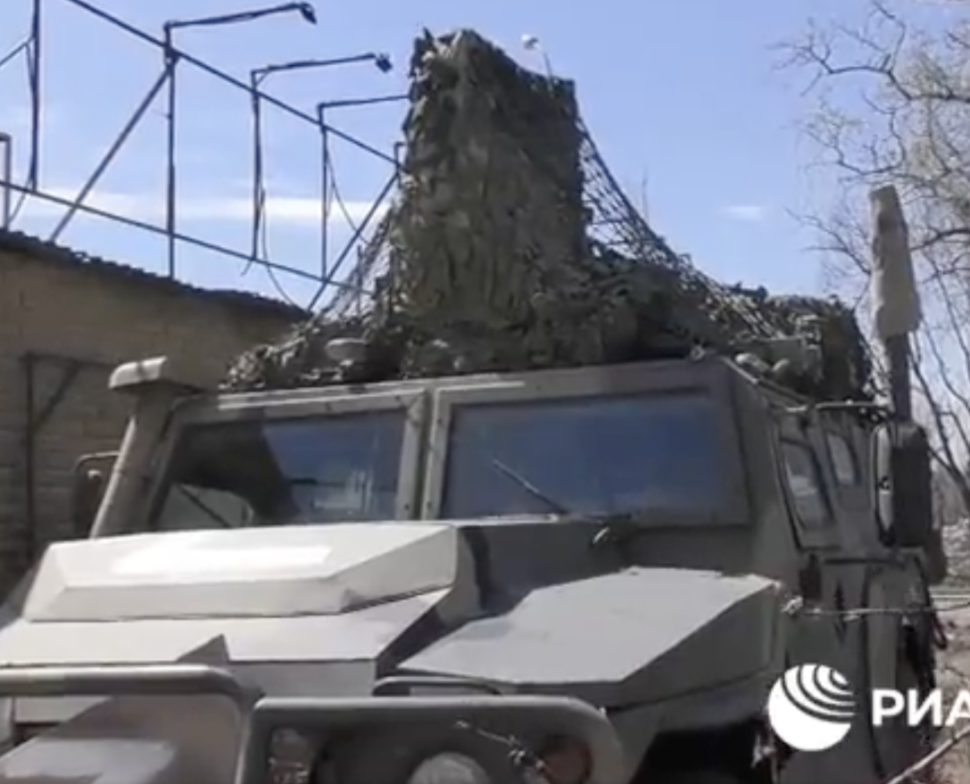
Thanks to these findings, we can compare the appearance of a Tiger-M seen in Kherson Oblast which featured a roof-mounted loudspeaker with the armoured vehicle seen in the video of the detainee in Izium. It is clearly visible that the details of the equipment on the roofs of both vehicles are almost identical. Therefore, it can be concluded that it was a Tiger-M with a roof-mounted loudspeaker that was pictured in the grounds of Izium School № 2.
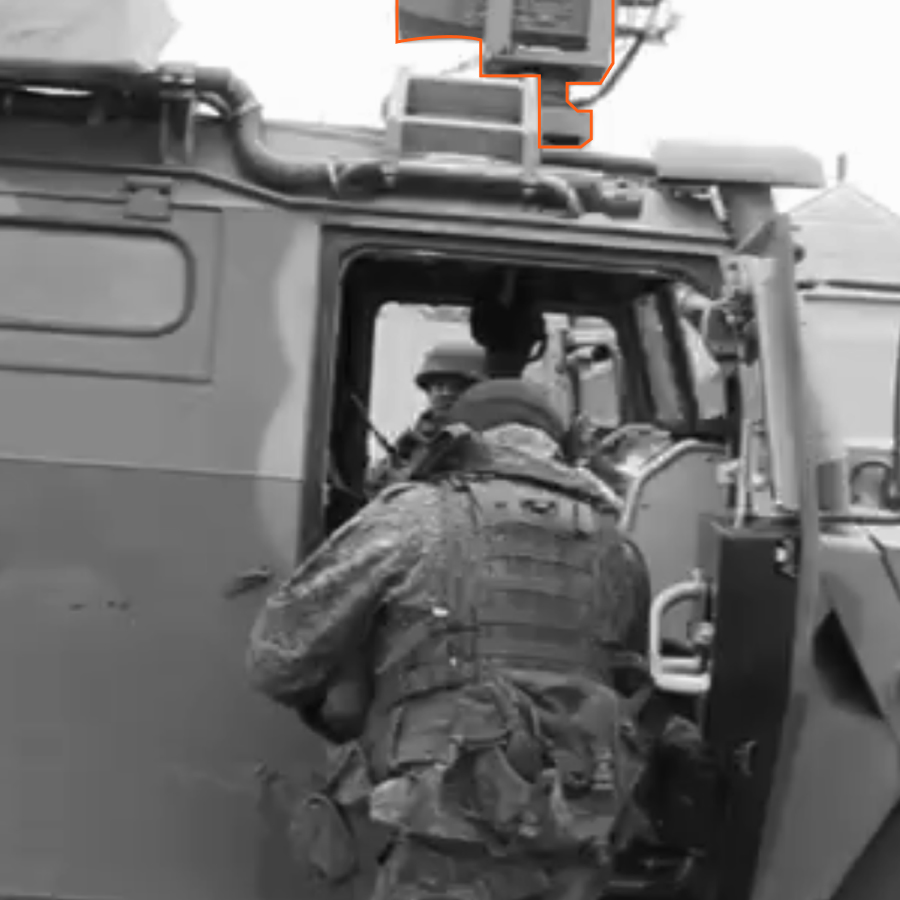
A freezeframe from the video filmed on the grounds of Izium School № 2 showing a Tiger-M with a roof-mounted loudspeaker.
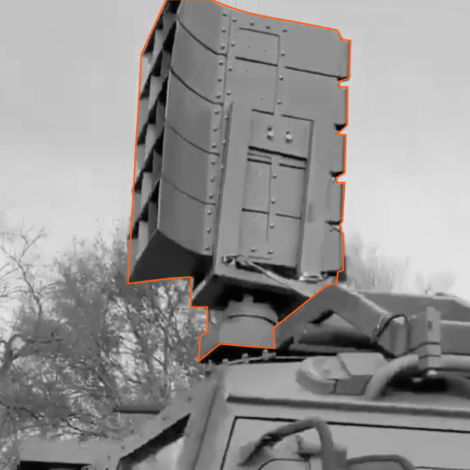
An identical Yazykoved system mounted on a Tiger-M in Kherson Oblast.
This conclusion allows us to narrow down the search for a vehicle of this variant among videos filmed in Izium at the beginning of the occupation. In some of them, one can indeed see a Tiger-M with a loudspeaker mounted on the roof. In addition, footage shows soldiers traveling in this vehicle.
Another important detail helped to get closer to identifying the Tiger from the video. The ‘Starshe Eddy’ Telegram channel, which published the video showing Vakulenko, had reposted a story about occupied Izium from the ‘Mash’ Telegramm channel the day before. In its first few frames, one can see a certain element inside the Tiger which is specific to the vehicle in the video showing the detainee (in other cases of Tiger-Ms equipped with a loudspeaker, investigators could not identify such a detail).
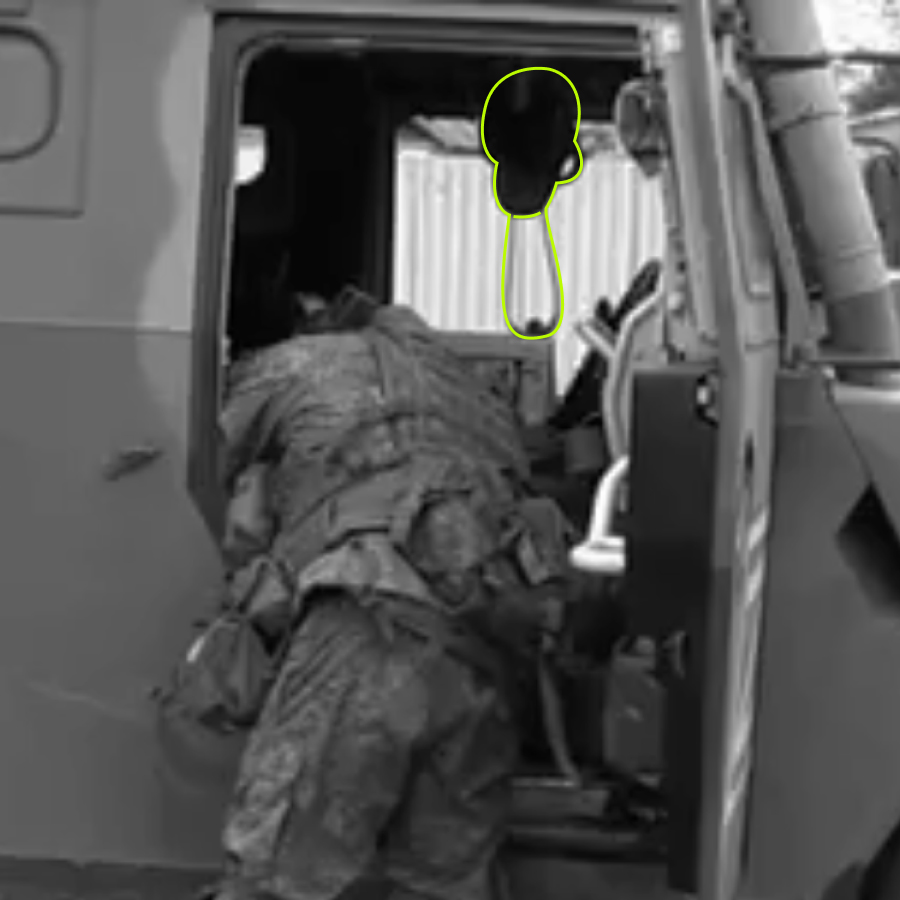
A freezeframe of the vehicle that carried Volodymyr Vakulenko which shows a distinctive detail in the interior.
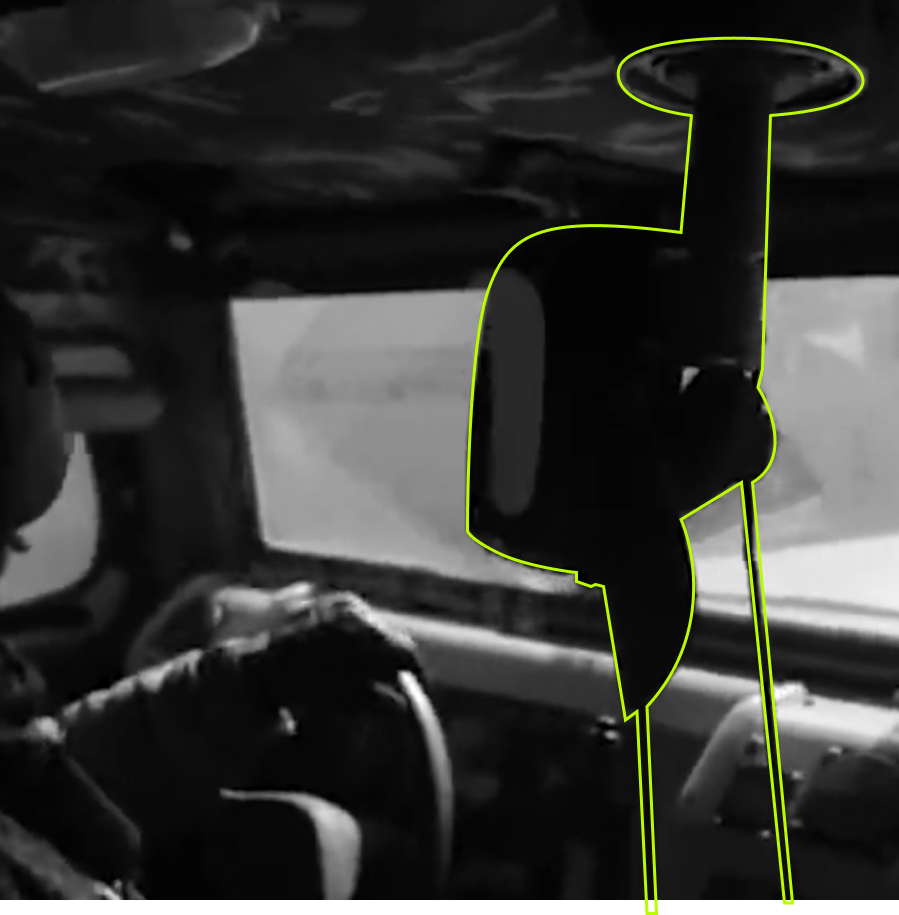
A vehicle with a similar element in the cabin in the video from the ‘Mash’ Telegram channel, which was published the day before the video showing Volodymyr Vakulenko.
In addition, another shot of the same video by the ‘Mash’ Telegram channel shows a Yazykoved system on the roof of the Tiger-M which is partially visible in the video showing Volodymyr Vakulenko.
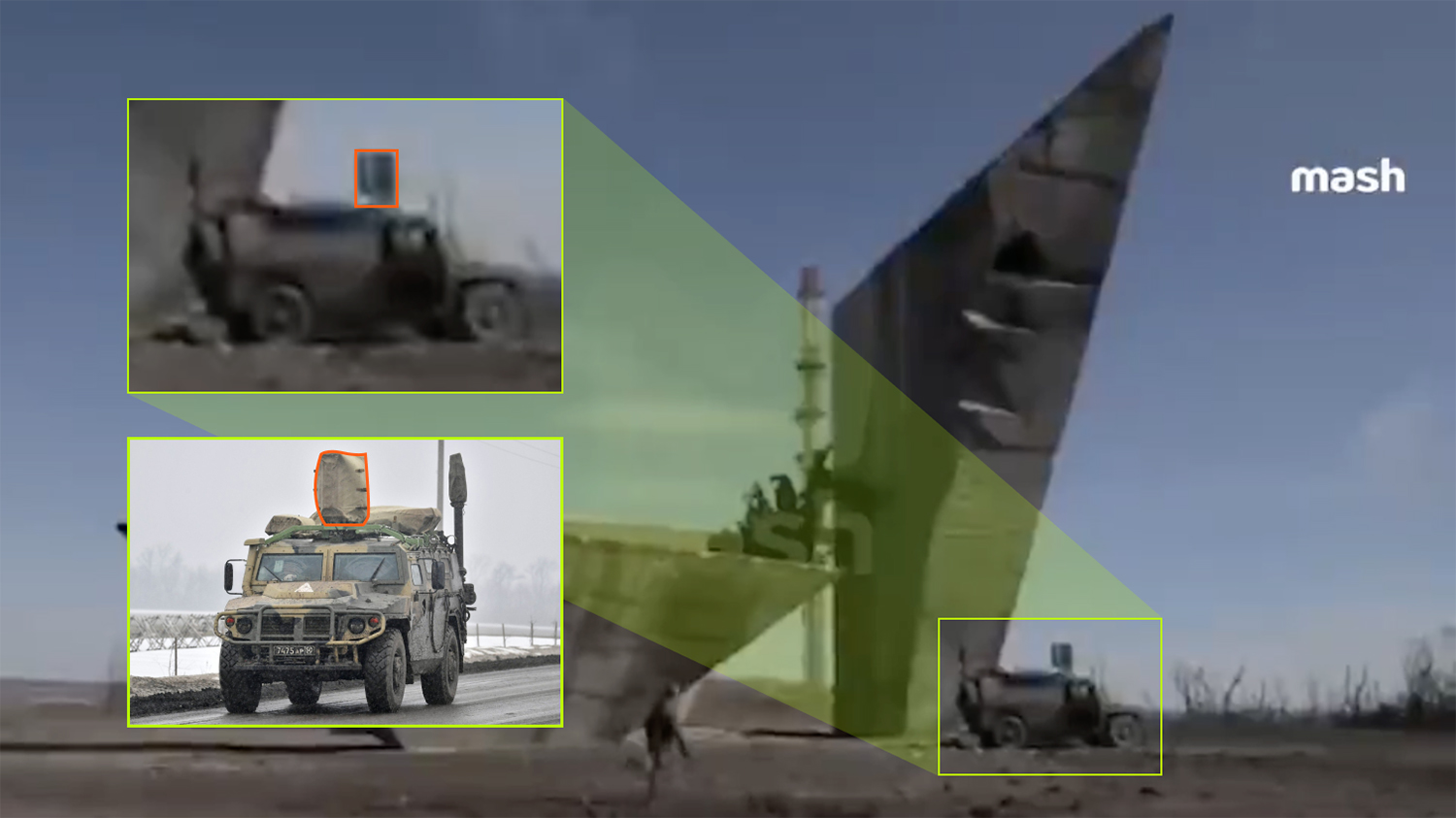
A Tiger-M with a Yazykoved system, in which Volodymyr Vakulenko was probably brought to Izium School № 2.
Similar Tiger-M armoured vehicles equipped with Yazykoved systems were also seen in other videos by Russian news channels. Although it cannot be said whether one of them appears in the video near the school in Izium, it is still possible, since this is the variant of the Tiger-M most often used by Russian military correspondents.
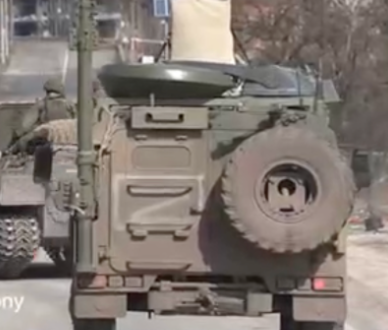
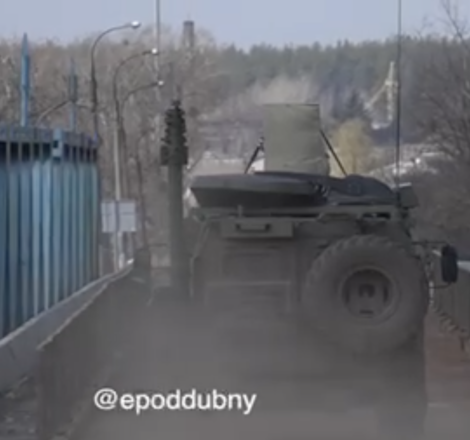
Freezeframes from videos from other Russian propagandists which show a Tiger-M in Izium equipped with a Yazykoved system, seen in videos from other Russian propagandists.
In fact, this type of armoured vehicle began to appear very frequently in the videos of Russian military correspondents / propagandists in late March and early April, around the same time as Volodymyr Vakulenko’s second abduction.
The type of vehicle identified gives grounds to believe that Russian special services could have been involved in the abduction of the Ukrainian writer, as Tiger-Ms equipped with Yazykoved systems are used by special units of the Russian Armed Forces / Rosgvardia.
Military personnel in the video of the Tiger-M on the grounds of Izium School № 2
The video shows three servicemen of the Russian Armed Forces, accompanied by a voiceover from the cameraman. Two of the servicemen in the frame are likely to be members of the so-called L/DNR forces. This is indicated by the St George’s ribbons they are seen wearing, which, according to witnesses in Izium, were worn only by individuals belonging to these groups.35 Moreover, their equipment looks to be of much worse quality than that of the soldier who receives the assault rifle. This coincides with the testimonies of eyewitnesses who said that the L/DNR soldiers were equipped more poorly than the regular Russian Armed Forces.36
35 Witness S-1302.
36 Witness S-1302.
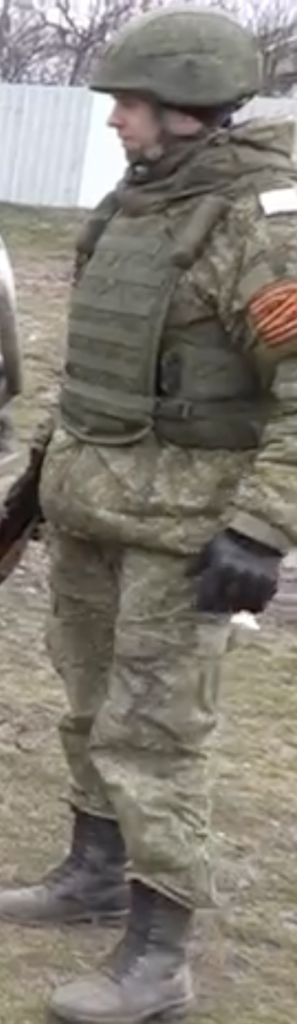
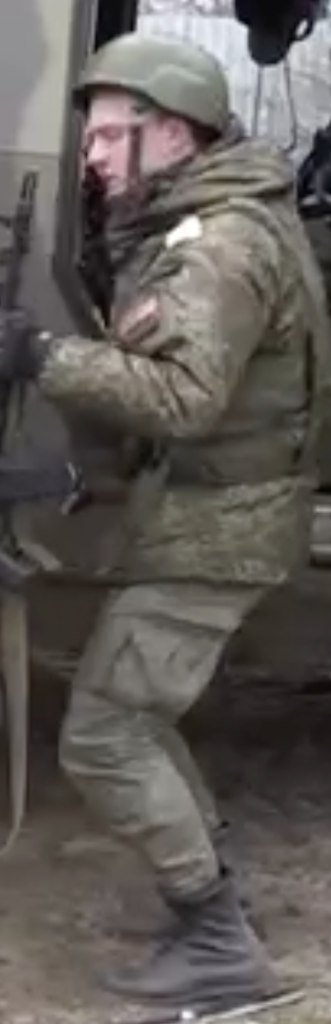
Serviceman № 1 and serviceman № 2.
The poor quality of the video does not allow for facial recognition, so, unfortunately, it was not possible to identify these two soldiers.
As for the third soldier, who most likely belongs to the Russian Armed Forces / Rosgvardia, he is much better equipped, with a personal knife attached to his uniform near his collarbone, and a distinctive ‘arafatka’ scarf covering his face.
Truth Hounds were able to obtain more information about the individual in the video. He also appears in other videos of a similar format, showing the neighbourhood of Izium to Russian military propaganda correspondents.
Moreover, the same serviceman who led Vakulenko out of the Tiger-M was driving the Tiger-M in a video from 2 April 2022.
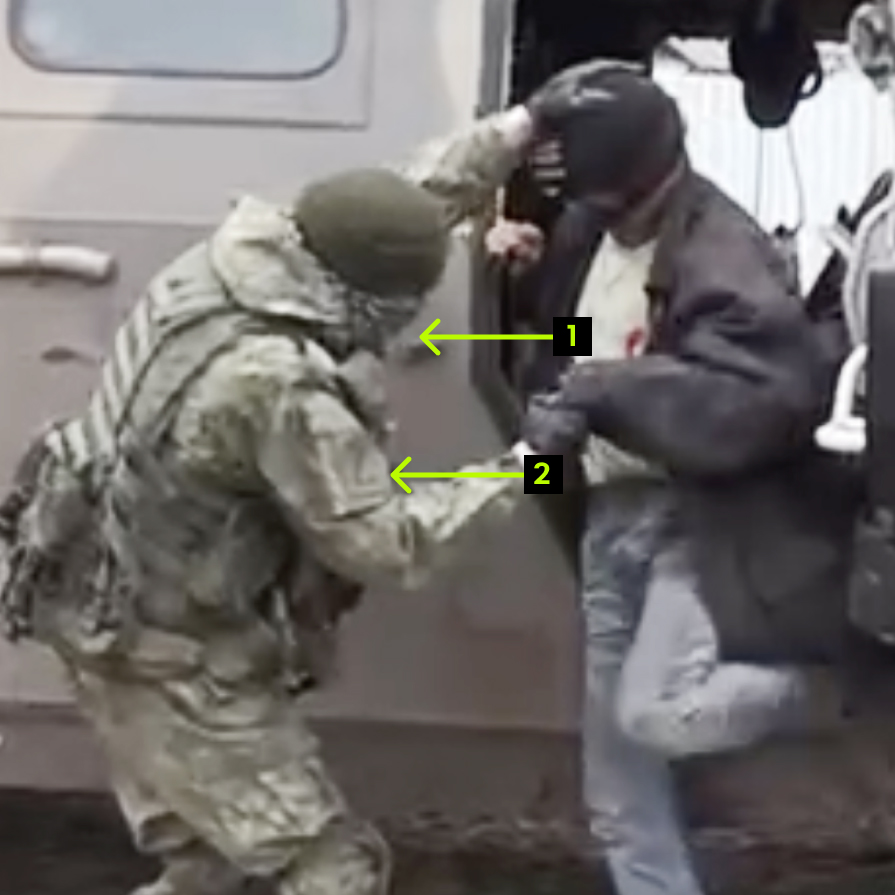
A freezeframe from the video showing Volodymyr Vakulenko, showing (1) a characteristic black and white scarf and (2) a ‘Z’ patch.
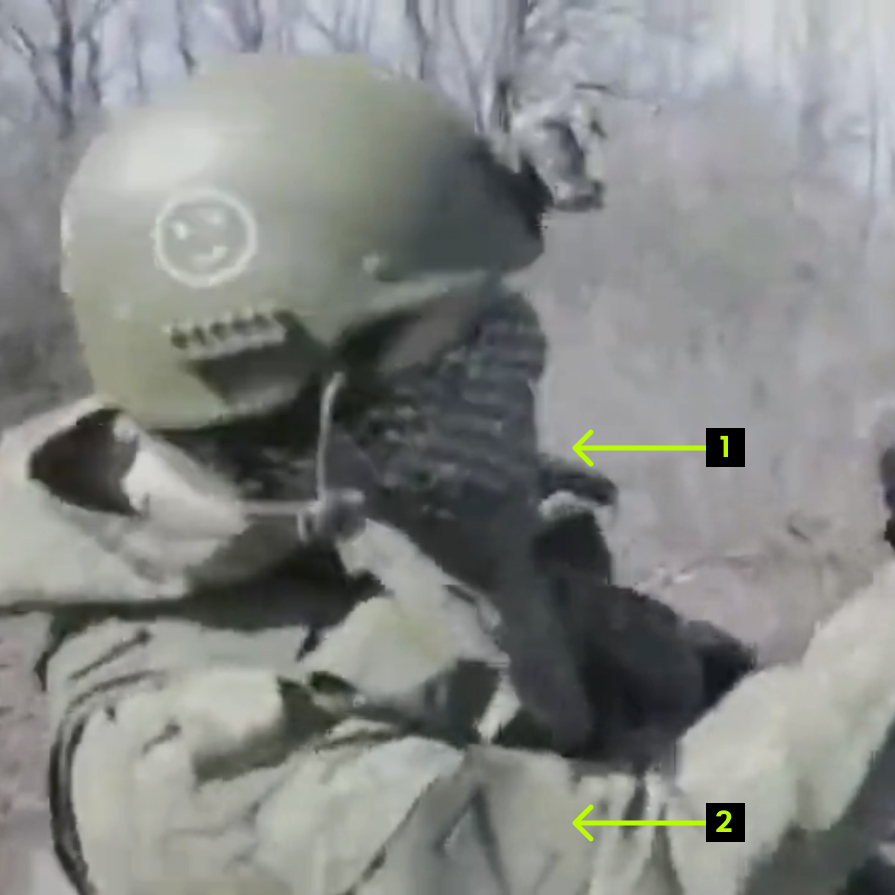
A freezeframe from a video from the ‘Mash’ Telegram channel, showing (1) a characteristic black and white scarf and (2) a ‘Z’ patch.
The same ‘journalist’ in the arafatka scarf has repeatedly appeared in videos posted to the ‘Starshe Eddy’ channel, as well as those of Russian military correspondents, in particular, on the ANNA News channel (in a broadcast from 17 March 2022 which featured a report about Izium).
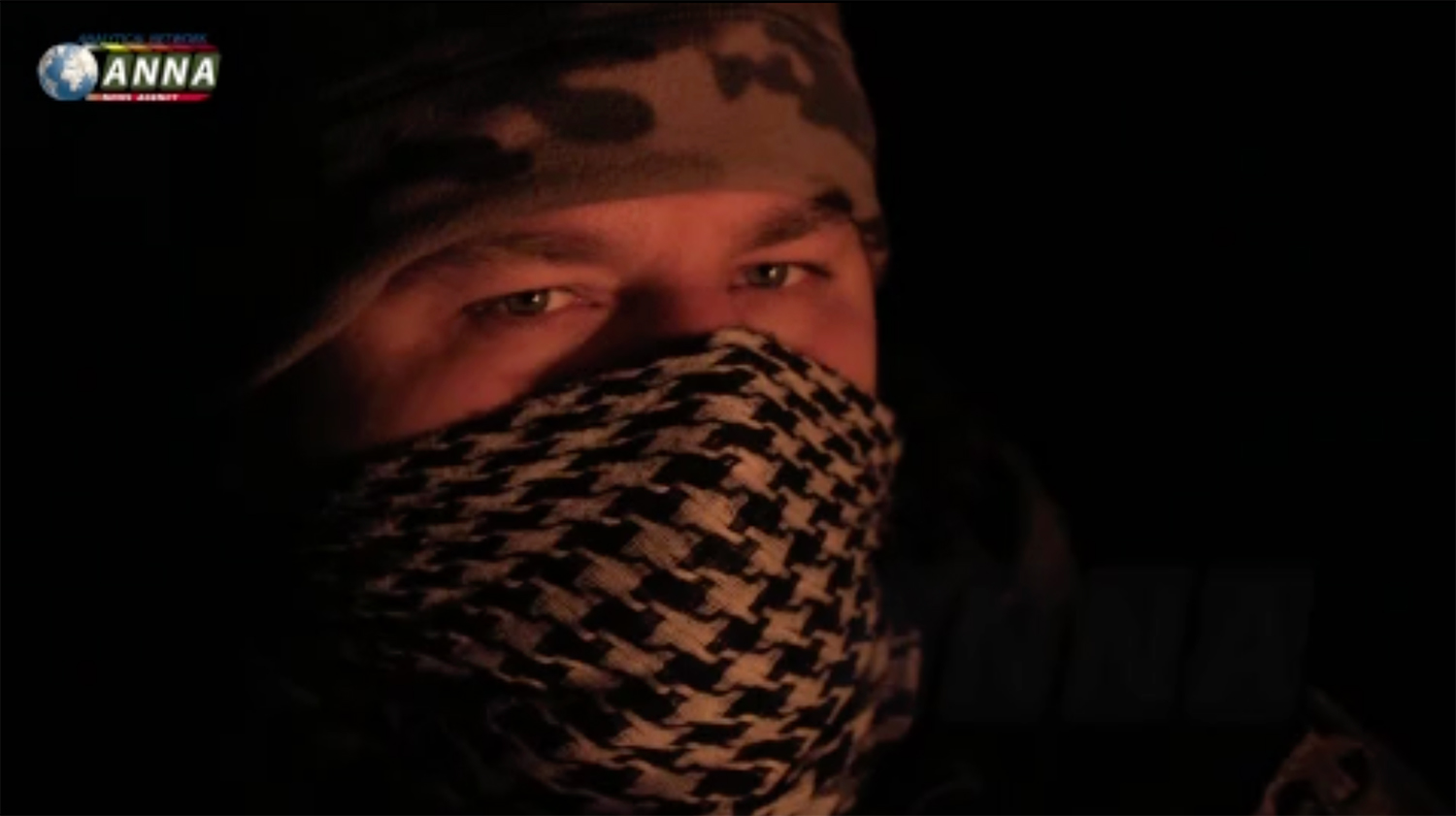
A typical scarf worn by a Russian soldier.
Source: ANNA News, 17 March 2022.
Later, on 23 March 2023, his photo – probably captured in Izium – reappeared in posts published on ‘Starshe Eddy’. In the caption, the author noted: ‘Weekdays of war, Izium frontline’.
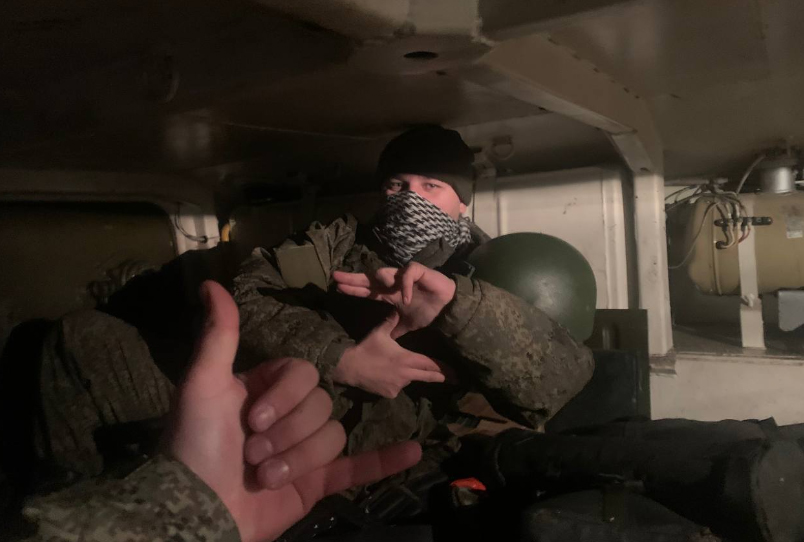
A photo of a Russian soldier with a similar scarf posted to the ‘Starshe Eddy’ Telegram channel on 23 March 2022.
In this photo, the servicemen depicted are seen sitting in an MT-LB, carrying a small number of weapons, which can be seen in further photos from the post.
Another characteristic feature of this soldier is an assault rifle, which he has with him in several videos, including the video from Izium School № 2. Using these materials, analysis by Truth Hounds investigators found that it is highly likely that his weapon belongs to the ‘200’ series of ‘AKs’. In this case, it was an AK-200.
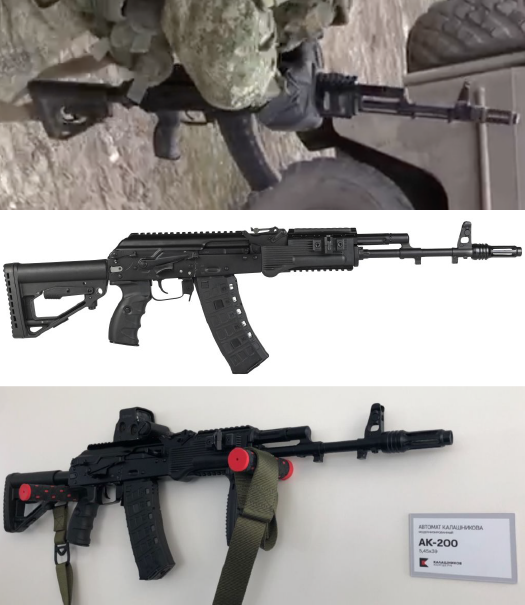
The AK-200 seen in the video and photos of AK-200s available from open sources.
The AK-200 has been widely used by Rosgvardia since 2019. In fact, according to open-source information, the AK-200 is used domestically only by Rosgvardia. Such limited domestic use is explained by the fact that this model was primarily developed for export to third countries. Though the AK-200 has not officially been adopted by the Russian Armed Forces, negotiations with the Russia’s defence ministry are underway.
Moreover, Tiger-M armoured vehicles are also in service with Rosgvardia, an additional argument in favour of the possibility that the soldier seen could have belonged to Rosgvardia.
Based on eyewitness accounts, as well as posts on ‘Starshe Eddy’, it can be concluded that individuals belonging to Rosgvardia were present in the area of Kapytolivka and Izium. Residents of Izium also reported that ‘special forces’ 38 were stationed on the second floor of Izium School № 2, which generally indicates the presence of Rosgvardia.
Due to limited resources and information, Truth Hounds investigators were unable to complete the identification of the soldier, but did find indications that suggest that Russian special services were involved in the detention of Volodymyr Vakulenko.
38 Witness Y-1122
The cameraman of the video showing a detainee in Kapytolivka
We also found that the cameraman of the abovementioned Telegram video had most likely already filmed Russians in Kapytolivka on 16-17 March 2022. On that occasion, another Russian serviceman was telling him how his tank was hit on Tsentralna Street in Kapytolivka. This conclusion can be made by comparing the voiceover in both videos.
Unfortunately, we specialist comparative voice analysis cannot be performed on this occasion, as the available fragments are too short for such a comparison. However, one can verify the similarity of the voices by listening to the audio tracks below.
The search for Vakulenko by the Russian military
The probable involvement of Russians in the abduction and murder of Volodymyr Vakulenko is also indicated by the information provided to us by local residents with regards to the active interest of members of the Russian Armed Forces showed in Volodymyr.
For example, witness K-0301 reported that one morning in late March 2022, he had a meeting with a Russian soldier with the callsign ‘Ufa’. The soldier drove up to the witness’s house in an armoured vehicle similar to the Tiger from the video analysed above and introduced himself as a colonel in the Russian Army. The officer stated that he ‘knew everything’ about the witness’s identity and offered him the chance to ‘serve Mother Russia’. When the witness refused, he asked about another local resident, Vitalii Smoliarov, a Ukrainian military officer and weapons collector. He also mentioned Volodymyr Vakulenko, noting that he was interested in the Vakulenko who ‘was on the Maidan’ (NB: Volodymyr Vakulenko was a participant in the protests which took place in Kyiv during Ukraine’s Revolution of Dignity).39
A soldier referred to as ‘Ufa’ was also mentioned in the testimonies of other residents of Kapytolivka. It is known that from the beginning of Russia’s occupation until April 2022, he lived in a house at 37 Tsentralna Street and served as the commandant of the settlement.40 Later, he allegedly moved to the village of Snizhkivka, but at least until the summer of 2022, he was seen periodically in Kapytolivka.41
After interviewing five witnesses, Truth Hounds investigators learned that the soldier with the callsign ‘Ufa’ was named Aleksandr Aleksandrovich. He was born on 30 May, was approximately 45 years old, was around 190 cm tall, and had short brown hair. He had the rank of colonel, commanded artillery, and drove a two-door Tiger around Kapytolivka. He also said that he had fought in Syria and Chechnya, lived in St Petersburg for a period of time, and had three sons.42
In the first section, we mentioned that, in March 2022, only one artillery unit was based in Kapytolivka – the 856th Self-Propelled Artillery Regiment (Military Unit № 23857). At the time, the Defence Intelligence of Ukraine published a list of its personnel, including positions, names, and dates of birth of the servicemen listed. The regiment’s commander was Colonel Aleksandr Aleksandrovich Melnikov (born on 30 May 1978). This information leads us to believe that he is the colonel of the unit, known as ‘Ufa’, about whom witnesses told us.
In an attempt to confirm this assumption, we collected and analysed information about Colonel Melnikov found in a number of databases. As a result, we learned that Melnikov worked at the Mikhailovska Military Artillery Academy in St Petersburg and later served in the 9th Guards Artillery Brigade (Military Unit № 02561), based in the city of Luga, Leningrad Oblast. The information found coincides with the details that ‘Ufa’ told locals in Kapytolivka about himself. In particular, the number of sons he had and the fact that he lived in St Petersburg.
Truth Hounds also managed to find photographs of Melnikov. The photo below was taken in 2021 during a Victory Day celebration in the village of Polniki near the city of Pochep, where the 856th Regiment was stationed. This event was also captured in a video posted to YouTube, which shows that Colonel Melnikov is about 190 cm tall.
39 Witness K-0301.
40 Witness K-1739.
41 Witness K-6529.
42 Witness K-6529; Witness K-1739; Witness K-0301; Witness K-7001; Witness K-2271.
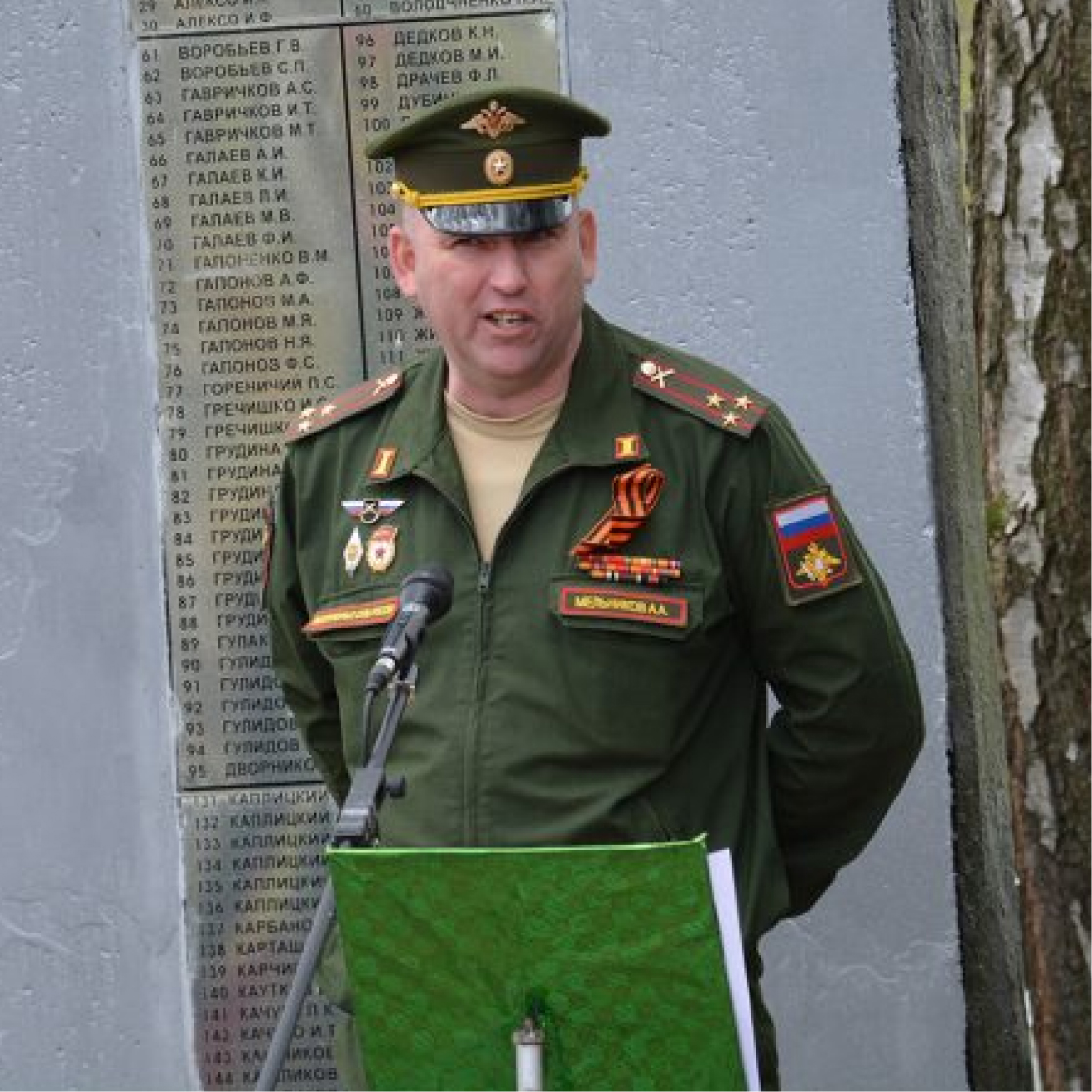
Thus, it can be argued that Melnikov is the Russian colonel with the callsign ‘Ufa’ who was in Kapytolivka in the spring of 2022.
Earlier, thanks to the efforts of the investigative journalism agency Slidstvo.Info, the Kharkiv-based independent media platform Gvara Media, and the Kharkiv Anti-Corruption Centre, many other members of the 856th Regiment were also identified, though its commander was not among them.
According to the testimonies of some locals from Kapytolivka, ‘Ufa’ tried to persuade them to cooperate with the Russian Armed Forces, threatening them with physical violence in case of refusal, and also ordered his subordinates to beat civilians, at which he was present.43
Currently, there is no direct evidence of Melnikov’s involvement in the illegal detention or murder of Volodymyr Vakulenko, but the very fact that he was sought after indicates that the senior officers of the Russian Armed Forces who were present in Kapytolivka were looking for Volodymyr and were aware of his beliefs. It should be noted that FSB also knew a lot about Volodymyr Vakulenko. One of Volodymyr’s relatives reported that an individual belonging to the FSB with whom he had to communicate while leaving the occupied territory knew the exact address of Vakulenko’s residence in Lviv, the date of his second marriage, and information about his sons and friends.44
This awareness by the military and intelligence services indicates that the Russians had a dossier on Volodymyr, most likely due to his active pro-Ukrainian position. The persecution of people with similar positions fits into a pattern of behaviour by the Russian military in occupied territories of Ukraine, particularly in Izium and Kapytolivka. Local residents interviewed by Truth Hounds spoke of Russian-initiated ‘Nazi searches’ that were accompanied by intimidation of civilians and groundless accusations of Nazism. A striking example is the case of some drunken Russian soldiers who staged a demonstration shooting in a basement in Kapytolivka with several dozen civilians present in an attempt to force them to confess to adhering to a Nazi ideology.45 Witnesses also reported the burning of Ukrainian textbooks by the Russian military on the grounds of Izium School № 2.46
In addition, the only survivor of the Luhova Street torture chamber told Truth Hounds that he remembers the words of some so-called LNR soldiers who spoke of ‘a Russian colonel who will look at them all and decide what to do with them’47 (referring to civilians held in the torture chamber who were found dead after the village was de-occupied, namely Ivan Shabelnyk, Leonid Taran, and Yurii Kavun). This detail confirms the hierarchical command superiority of the Russian Armed Forces over the units of the so-called L/DNR and also indicates that the fate of local prisoners depended on the decisions of Russian officers. However, it does not mean that the order to kill Volodymyr Vakulenko or any of the other civilians held in Kapytolivka was given by Colonel Melnikov.
Melnikov told one witness we interviewed that the ‘severely beaten’ Ivan Shabelnyk was being held by Russian intelligence officers at Izium School № 2 and he could not help to release him because he had no influence on them.48 Moreover, we have no information to suggest that Melnikov was ever stationed at the school.
As for the Russian military’s leadership over individuals in Kapytolivka belonging to the so-called LNR, this fact is confirmed by both local residents’ testimonies and Truth Hounds’ extensive documentary experience.
For example, locals noted that ‘the Russians were in charge in Kapytolivka’ and that the so-called LNR soldiers were more likely to perform patrolling and checkpoint duties.49 There was also a case of direct threats from a Russian officer to a so-called LNR soldier ‘Lev’.50 In addition, one local resident was taken to Izium by an ‘LNR-er’ with the callsign ‘Bulbash’, in his own words, ‘to the superiors, to the office’. Then he was brought to the barrier at the entrance of Izium School № 2, where he was handed over to the Russians.51 Truth Hounds documented signs of similar hierarchical dependence in other regions of Ukraine. For example, in Mala Oleksandrivka, Kherson Oblast52 and in Verbivka, Kharkiv Oblast.53
43 Witness K-1739; Witness K-7001.
44 Witness K-4917.
45 Witness K-2200.
46 Witness Y-1122.
47 WitnessK-8623.
48 Witness K-2271.
49 Witness K-2221; Witness K-8623.
50 Witness K-1739.
51 Witness K-1739.
52 WitnessM-1231.
53 Witness Vr-8423.
Conclusions
The totality of the established facts indicates that Russian military and/or special services were most likely involved in the unlawful detention and murder of Ukrainian writer Volodymyr Vakulenko.
Testimonies from residents of Kapytolivka indicate that high-ranking representatives of the Russian Armed Forces and special services were interested in Vakulenko. His biography, activities, and beliefs were well known to Russian officers and they were actively looking for him.
In addition, OSINT analysis confirms that the detained civilian shown in the video discussed above is Volodymyr Vakulenko and that there are Russian military personnel next to him. The video itself was filmed on the grounds of Izium School № 2, where the Russian military and special services were stationed and where a torture chamber was set up.
We are aware that, according to the Criminal Procedural Code of Ukraine, the video in question cannot serve as evidence in the case, as the criteria for evidence are not met in this case. In particular, any visual elements of a person’s appearance, such as clothing, accessories, or other elements, cannot be decisive for identification and, therefore, the official investigation is unable to expertly identify the detainee.
However, the facts presented in this investigation convincingly demonstrate that the investigation into the murder of Volodymyr Vakulenko should not be stopped and limited to the conclusions already available.
At the same time, we see grounds to look at the killings of civilians in Kapytolivka through a broader lens, considering them not as isolated cases of unrelated incidents, but as a planned campaign of the physical destruction of individuals with a pronounced pro-Ukrainian position, embodying the enactment of Vladimir Putin’s call for the ‘denazification’ of Ukraine.