
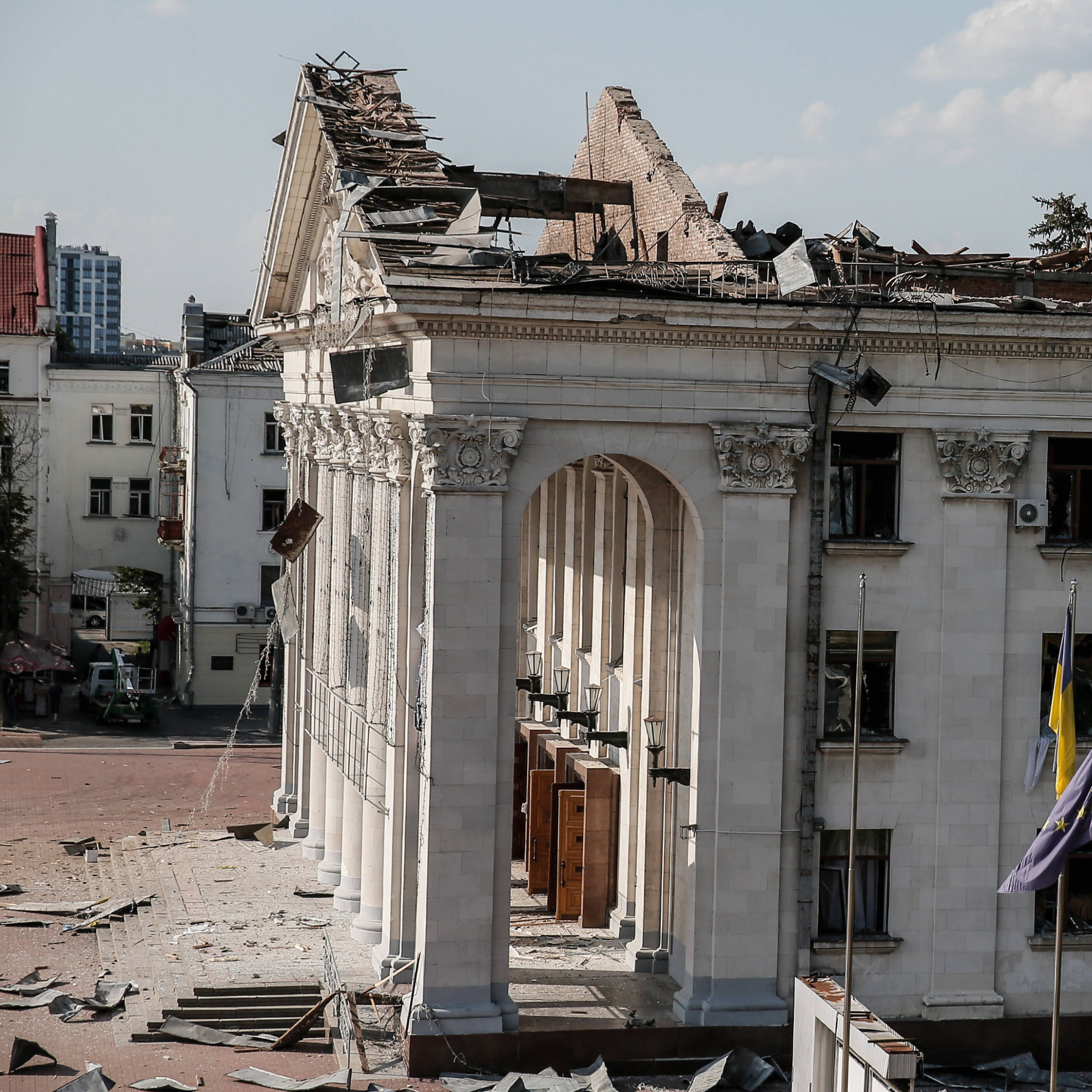
On August 19, around 11:30 a.m., the Russians launched a missile attack on the Drama Theater in Chernihiv. As a result of the strike, 7 people have been killed and 180 sustained various injuries. This attack has once again enhanced the Ukrainians’ demand for justice and the identification of those responsible for the attacks that kill civilians and destroy civilian infrastructure.
Public information available today does not yet allow us to certainly qualify it as a violation of international humanitarian law of failure to take precautions or a war crime of an attack which clearly has excessive incidental consequences for the civilian population and civilian objects.
International humanitarian law regulates the process of planning, conducting an attack, and assessing its consequences. Thus, in particular, Article 57 of Additional Protocol I requires the parties to an armed conflict to take precautions to protect the civilian population and civilian objects. This should be taken into account when choosing the means and methods of attack, the type of weapon, and assessing the status of the target. It is forbidden to use weapons that can lead to excessive losses among the civilian population. At the same time, IHL measures are designed to avoid only damage that is disproportionate to the obtained military superiority.
In our opinion, the legal analysis of the shelling of Chernihiv on August 19 should focus on the assessment of the proportionality of the attack – whether the incidental loss of civilian life, injury to civilians, and damage to civilian objects were excessive to the concrete and direct military advantage anticipated. For this, it is necessary to collect and analyse the following facts:
- the probable target of the attack and what information did the Russian military have to determine it as a target;
- type of weapon used and its ability to achieve the intended goal;
- duration of the missile’s approach to the target;
- time of the attack;
- type of warhead (intended place of missile detonation);
- patterns of similar attacks of the Russian Federation, etc.;
Conducting open data research, Truth Hounds analysts conclude that the Russians used the Iskander-K cruise missile for the attack on Chernihiv, rather than its ballistic counterpart, as claimed by the Office of the Prosecutor General.
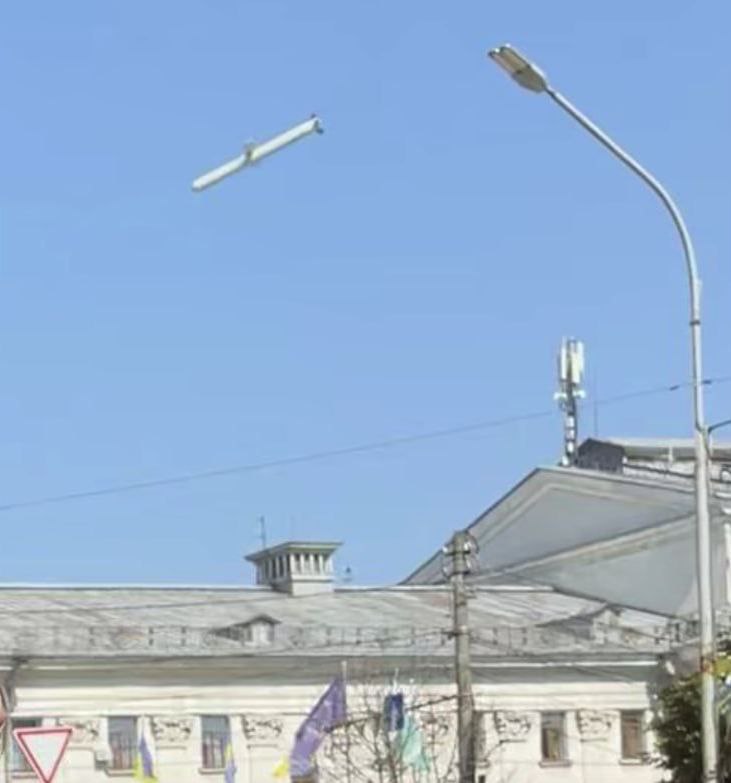
Missile over Chernihiv
Photo: Security Service of Ukraine
This is directly evidenced by:
- the missile’s fins;
- а distinctive sound, similar to the roar of a jet plane, which is explained by the presence of a turbojet engine in the design of the Iskander-K missile (On the contrary there is a solid-fuel engine in the ballistic version of the Iskander-M, that works only at the initial stage of the flight, and then the missile moves by inertia).
In addition, the very existence of eyewitness testimony, photo, and video recording of the missile’s flight indicates that it flew at a subsonic operating speed and low altitude, which does not match the characteristics of a ballistic missile. At the same time, this information indicates a significantly longer (in comparison with a ballistic missile) approach time to the target, which simplifies the tracking of this type of missile by air defense radar systems and the announcement of an air alert. On August 19, 2023, an air alert was announced in Chernihiv at 11:20 a.m. The missile hit the theater at 11:28 a.m. The participants of the event, who were undoubtedly the main target of the attack, had 8 minutes to move to the shelter. The choice of a cruise missile, which is much slower than a ballistic one, dramatically reduced the chances of achieving the goal of destruction of UAV samples and killing of event participants.
The missile hit the theater at 11:28. The drone forum started at 10:00 AM and was apparently supposed to last until 4:00 PM, as that is an average duration for such events. CCTV recordings from Krasna Square in Chernihiv show that the concentration of civilians was unusually high for 11 o’clock on Saturday. Due to the fact that on August 19 Ukraine celebrates the Feast of Transfiguration, some civilians attend the morning church service on this day. Therefore, at the time of the attack, numerous people were on the street, returning from church. The event was supposed to continue for at least 3 hours after the attack. So if an attacker, intending to hit a military target, took measures to protect civilians, he would choose a time to attack when the least number of them are near the target. It is obvious that this was not done.
The Office of the Prosecutor General of Ukraine preliminary declared that the detonator of the missile warhead was set to explode above the object. This statement can be substantiated by the fact that residents found 1-cm striking cubic-shaped metal elements at a distance of up to 700 meters from the site of the explosion. This setting of the detonator allows hitting objects and people located around the direct target of the attack. Four of the seven dead as a result of the attack were outside the drama theater building, and local authorities reported 76 destroyed buildings. Due to these facts, we can assume that the Russian military intended to cause as much damage as possible to the civilians and civilian objects.
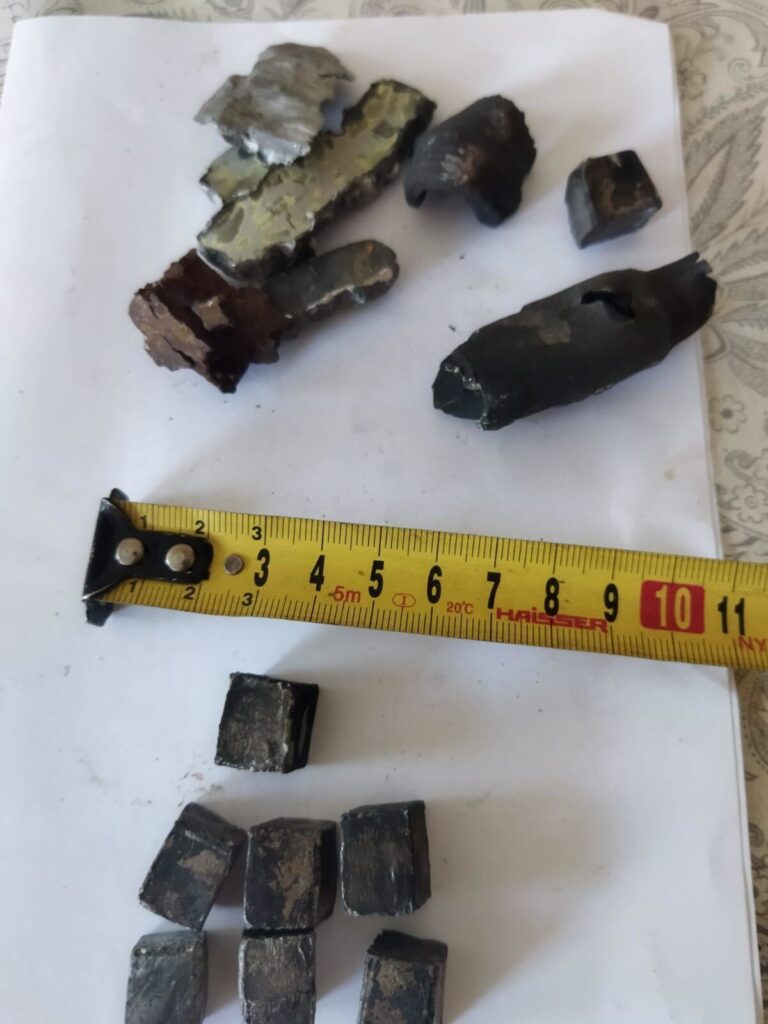
1-cm striking cubic-shaped metal elements
Photo provided by eyewitness
Along with all IHL discussions, it’s essential to note that the Russian Federation is responsible for the committed attack: more lives taken and cultural objects destroyed. Without Russia committing an act of aggression (or a crime of aggression, when we are talking about the leadership of the Russian Federation), the festive Saturday morning in Chernihiv would not have been covered in blood.