
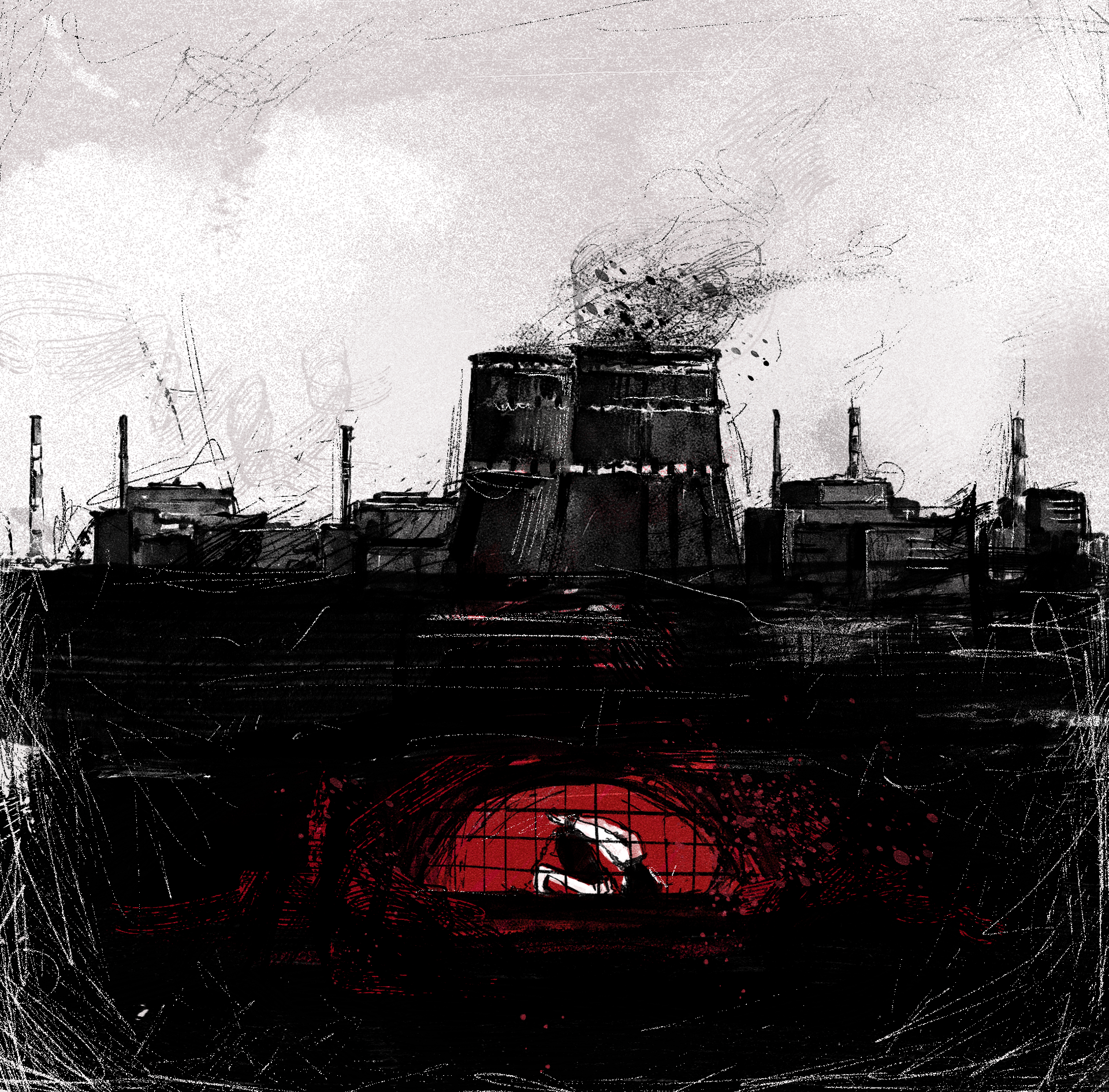
The Zaporizhzhia Nuclear Power Plant (“ZNPP”) is Europe’s largest nuclear facility with 6 reactors and a nominal capacity of 6000 megawatt. It was constructed and commissioned between 1980 and 1996 near Enerhodar in Zaporizhzhia Oblast of Ukraine. Before the start of the full-scale Russian invasion of 24 February 2022, this massive power plant, operated by approximately 11 thousand employees, brought light and energy to millions of households throughout Ukraine and in Hungary, Poland, Moldova, Romania, Slovakia, and Belarus. Now, light needs to be shed on the events that turned ZNPP into a scene of apparent war crimes and crimes against humanity.
The research is also available in Ukrainian.
Rosatom State Atomic Energy Corporation (“Rosatom”) is the Russian Federation’s atomic energy corporation that took control of ZNPP no later than March 11, 2022.
This report raises awareness of the horrific events at the ZNPP, analyzes the evidence within the context of applicable laws and establishes that:
- Rosatom’s control of ZNPP is in breach of international treaty obligations;
- Rosatom has aided and abetted the execution of war crimes and crimes against humanity in breach of international humanitarian, criminal and human rights law prohibiting torture and inhuman treatment;
- Rosatom has breached its responsibilities to respect human rights as outlined in the United Nation (UN) Guiding Principles on Business and Human Rights, the Organization for Economic Cooperation and Development (OECD) Guidelines for Multinational Enterprises and the UN Global Compact; and
- Entities doing business with Rosatom must take sustainability into account including expectations relating to environmental, social and governance (ESG) initiatives and legal requirements and the impact of their business strategies on their reputational and legal risks; and
- Rosatom must be held accountable through calls to action directed at the international community and entities that conduct business with Rosatom.
Truth Hounds would like to sincerely thank the War Crimes Accountability Working Group of the Ukrainian-Canadian Bar Association, as well as Olga Kosharna and Andriy Kobolyev for their immense contribution to this work.

The author of the illustrations: Katryn Tsibere
Background: Invasion And Occupation
On February 24, 2022, the Russian Federation launched a full-scale invasion of Ukraine, dramatically escalating the ongoing international armed conflict between Ukraine and Russia, which began with the Russian invasion of Ukraine in Over the course of the first week of the 2022 full-scale invasion, the Russian Federation occupied a significant portion of the Zaporizhzhia region. By February 27th, 2022, Russian military forces had reached Enerhodar, the town where ZNPP is located. Russian troops began an assault on ZNPP late in the day on March 3rd, 2022, and captured the nuclear facility by the early morning of March 4th, 2022. The Russian occupying forces continue to control ZNPP as of the date of publication of this report.
No later than March 11th, 2022, Rosatom employees arrived at ZNPP in order to take operational control of the plant. On March 12th, 2022, the Russian military units who were occupying the Plant declared that the power plant was “now a Rosatom station.” Truth Hounds has conducted extensive interviews and received eyewitness reports outlining the details of this initial period of Russian military control of the ZNPP facility from March 12th to 15th, 2022. According to eyewitness reports, during this initial period Rosatom employees, in direct collaboration with officers of the Federal Security Services of the Russian Federation (“FSB”) began a coordinated campaign of “talking with ZNPP employees”. Specific Rosatom employees such as Oleg Romanenko are named by eyewitnesses as directly participating in this coordinated effort by the Russian occupying forces and Rosatom employees. These “talks” were a coordinated attempt at:
- Intimidating existing ZNPP staff, inclusive of demands to report to the Russian military and Rosatom employees on the situation at ZNPP and in its structural departments;
- Making “recommendations” to cooperate with the occupying Russian military/Rosatom power structure; and
- Pressuring existing ZNPP staff to sign new labour contracts with Rosatom.
On October 5th, 2022, Russian President Vladimir Putin signed a decree unlawfully appropriating the nuclear plant as Russian state property. Rosatom established a joint-stock company (“JSC”), Zaporozhye NPP Operational Organisation, registered in Moscow, to manage the occupied ZNPP. A representative for Rosatom said the JSC’s duties “include overseeing the reliable operation of the plant’s power units while giving absolute and unconditional priority to safety regulations.”
Investigation and Evidence
Overview
Most of the evidence and documentation was collected by Truth Hounds during interviews with victims and witnesses. Summaries of selected witness statements are provided below. For security reasons, some of the witness’ and victims’ names have been replaced by numeric codes and identifying details have been removed. All evidence is stored in a secured database and may be provided to law enforcement authorities upon request, and with the consent of the witnesses and victims.
Eyewitnesses have provided Truth Hounds with clear, unequivocal descriptions of torture and other crimes, inclusive of, but not limited to aggravated assaults and vicious beatings, strangulation and suffocation, electric torture, forcing victims to dig their own graves, mock executions, threats of rape of victims and their relatives, and keeping detainees in overcrowded chambers with no food, water, or fresh air.
Truth Hounds has conducted extensive research and collected verifiable eyewitness accounts of the events at ZNPP. Those witnesses describe how from of the joint Russian military and Rosatom occupation of both Enerhodar and ZNPP up until the date of publication of this report, the Russian occupying forces have established a systematic, widespread campaign of abductions, torture, and murder of ZNPP staff and Enerhodar residents.
According to the Mayor of Enerhodar Dmytro Orlov, it is estimated that since March 2022, approximately one thousand (1000) individuals have been detained and tortured or mistreated in this network of torture chambers in Enerhodar. At least one person, a ZNPP staff member named Andriy Honcharuk who worked as a diver at the plant, is confirmed to have been tortured to death.
At ZNPP, employees are being abducted straight out of their workplaces, they are taken to be interrogated or tortured by FSB officers, often with the full participation and knowledge of Rosatom employees or agents. Witnesses interviewed by Truth Hounds report that while Rosatom’s staff do not generally directly participate in acts of torture, they are fully aware of the practice of torture, and that “without their knowledge” the torture “wouldn’t have been possible.”
This report is based on direct and circumstantial evidence, which includes:
- Testimonial evidence;
- Photographic and documentary evidence;
- Digital evidence; and
- Secondary sources, such as reports by human rights organizations, news and media sources.
Selected Witness Summaries And Accounts
Based on the evidence obtained by Truth Hounds, the conduct of the Russian occupying forces at ZNPP is highly likely to qualify as war crimes of torture or inhuman treatment and a crime against humanity of torture. This report presents summaries of a few selected statements out of dozens collected by Truth Hounds, which have been anonymised for the security of the victims. However, Truth Hounds are ready to provide full statements to law enforcement agencies upon the victims’ and witnesses
Truth Hounds investigators have interviewed victims of Russian abuses. They have reported that at least the following practices have been used by the Russian agents:
- Severe beatings;
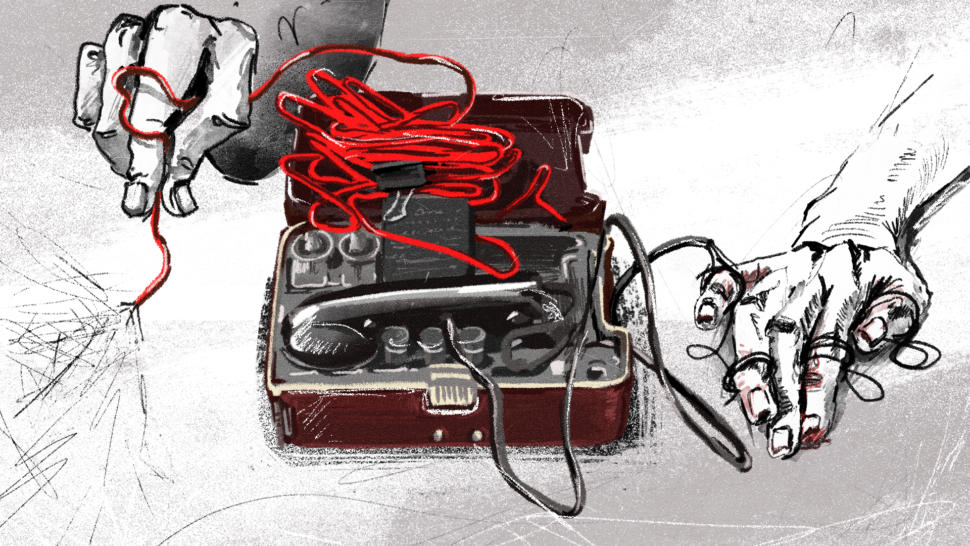
- Electric shocks from TA-57 “Tapik” military field phone and megohmmeter (insulation resistance tester);
- Strangulations and suffocations;
- Mock executions;
- Being forced to dig their own graves;
- Threats of rape against themselves and their relatives; and
- Detention in inhuman conditions, in overcrowded small cells (dozens of people in a cell, designated for two or four inmates), without access to food (unless brought to them by friends or relatives), water, fresh air or sanitation.
These accounts have been corroborated by international media investigations, such as the Wall Street Journal, who have also collected firsthand accounts from senior managers, employees and contractors of detention, torture and coercive threats to work for Russia’s state nuclear company. Truth Hounds also possess photo, audio and video evidence, corroborating the statements of witnesses and victims.
Forty-nine-49-year-old Plant contractor Volodymyr Zhayvoronok’s harrowing account of his experience is illustrative of the degree of severity of treatment by the Russian occupying Volodymyr reported that he was repeatedly struck with rifle butts. His fingernail was pulled off by interrogators. He was kept in captivity for 53 days. The length of the illegal detention, coupled with the illegal treatment Volodymyr experienced, carries the hallmarks of torture and/or inhuman or degrading treatment.
The horrors happening at ZNPP are not reserved for its employees alone – they are also inflicted on the families of the abducted and tortured personnel. Mr. Dudar, the head of the operational unit of the Plant, reports that a leading nuclear engineer was abducted, detained, and beaten for several weeks. No information was provided by the Russian authorities to the engineer’s family, despite “the Hole”, a notorious underground facility where some of the torture cases happened, being located in the immediate proximity of the Plant. The victims’ families were kept in a painful informational vacuum. According to Mr. Dudar, the engineer’s wife “was going crazy.” This suffering is familiar to relatives of hundreds of ZNPP employees kidnapped by the Russian occupying forces.
Victim 26026, an employee of the ZNPP physical protection unit, reports that immediately after the Russian occupying forces took control over the Plant, on March 4th, 2022, the staff “started disappearing”. Victim 26026 was detained at the Plant by two individuals, believed by him to be FSB officers. They threatened Victim 26026 and tried to force him to write what he understood to be some kind of a “confession” under their dictation. He refused, then two other armed men arrived and drove him to the forest, where he was severely beaten and ordered to dig his own grave. The armed men shot near the Victim’s head, threatened to shoot his knee, and forced his head into a plastic bag containing diesel fuel. Victim 26026 was held in a prison cell for a certain amount of time and then released. This Victim did not return to work at the ZNPP. Several weeks later, the same two men approached the Victim and subjected him to another brutal beating. These men were trying to force Victim 26026 to sign a contract with Rosatom and, when he refused, they threatened to resume the torture. Eventually, Victim 26026 managed to escape the occupied Enerhodar. He reports having seen Rosatom personnel at the ZNPP. This Victim also reports personally knowing at least one other ZNPP staff member who called out his co-workers for their collaboration with the Russian occupying forces, then was reported to the FSB by those same co-workers, and was subsequently tortured.
Several months after the beginning of occupation, Victim 26168, a licensed officer of the Plant, responsible for nuclear safety of the ZNPP, was summoned to his superior’s office. There were two persons in the office, who the Victim understood to be FSB officers. They took him out to a separate room for questioning and subsequently detained him. Over the course of the following days the Victim was subjected to numerous beatings, suffocations and electric shocks from a TA-57 “Tapik” military field phone. The tortures were so severe that he lost consciousness several times. He also heard one of the torturers say to another: “make sure you don’t kill him”. During tortures he was questioned about weapon caches and pro-Ukrainian ZNPP staff. He was also told: “think how you can be useful so that you stay alive”. When he replied that he was a qualified nuclear safety expert and can work at the Plant, the torturers replied that Russia had enough staff to replace him. Subsequently, Victim 26168 was released and forcibly “deported” to non-occupied Ukrainian territory.
Victim 26225, a member of the Plant’s licensed personnel, was detained at the Plant by persons he understood to be FSB officers. He was subjected to beatings and electric torture with a TA-57 “Tapik” and questioned about assisting the Ukrainian Armed Forces. While he was kept in an overcrowded cell, he saw people taken for similar tortures who then returned severely beaten and barely alive. At one point, he heard screams from the neighbouring cell so loud he thought the tortured person was “torn apart alive”. Victim 26225 also reports that while he was held in a cell, he saw the Russian torturers regularly beating the prisoners with batons. The beatings were so harsh that one of the batons snapped.
The following groups of people are confirmed to have been subjected to these and other atrocities:
- Ukrainians, whom the Russian occupying forces have suspected of previously serving in the Anti-Terrorist Operation (2014-2018)/Joint Forces Operation (2018-2022);
- Military and law enforcement officers (current and former);
- People who have participated in the territorial defence (“TDF”) of Enerhodar;
- People who have expressed pro-Ukrainian or anti-Russian views; and
- People alleged by Russian agents to have cooperated with Ukrainian intelligence;
- Gun owners.
The Russian occupying forces thoroughly search the cellphones of Ukrainians at ZNPP and, more broadly, in Enerhodar. In many cases, just one photograph of anything remotely resembling a military object or a photograph of Molotov cocktails prepared by the TDF before the takeover of Enerhodar was sufficient to get brutally tortured. Several witnesses have reported being abducted merely for calling their friends or relatives and telling them how they were doing. The Russian occupying forces accused them of being informants and tortured them to force a confession in “spying against Russia.”
There is clear, verifiable evidence that Rosatom, as a state-run agency, and as represented by its individual employees, has been and remains fully aware of the scale of this active torture network operating within ZNPP. The sheer scale of the network and its direct integration into the management of ZNPP under Russian operational control belies any alternative explanation.
Correction. Because of an editing error, an earlier version of this report incorrectly cited an article by WSJ that it was Mr. Dudar, who was abducted and tortured. It was, in fact, an unnamed leading nuclear engineer. This has now been corrected.

Applicable Law and Analysis
Overview
The horrific acts described in this report are in violation of norms set out in international business law and contravene norms in voluntary and legal reporting within international trade, banking, and business law.
Further, the report describes violations of international humanitarian law norms and applicable international criminal law provisions.
Finally, the facts set in this report demonstrate serious contraventions of the rules of international nuclear law, including those established by the international community in the aftermath of the tragedy and horror at Chornobyl Nuclear Power Plant.
This section will outline relevant law and legal analysis regarding the atrocities reported at ZNPP.
International Business Law and Human Rights
Rosatom’s Responsibility to Respect Human Rights
Historically, human rights law was conceived as a set of international legal obligations of states vis-à-vis individuals. It is the state that was considered to bear responsibility for human welfare and rights. However, in recent decades, with the rise of multinational enterprises transcending borders and often surpassing the power of states, international law has come to confer increasing responsibilities upon businesses.
This development is reflected in the adoption by the Human Rights Council of the UN Guiding Principles on Business and Human Rights (“UNGP”), which have been incorporated (to a greater or lesser degree) into domestic legislation by numerous states, including the United States (“US)”, Canada, the United Kingdom (“UK”), the Netherlands, Germany, Italy, Spain, Switzerland, Finland, Sweden, France, India, the Republic of Korea, Japan, Australia, Ireland, and supported by various organs of the European Union and the Council of Europe.
The principle of responsibility of businesses for human rights violations is also enshrined in several other documents, such as OECD Guidelines for Multinational Enterprises and the United Nations Global Compact (“UNGC”). The latter provides a procedure for incorporation into the UNGC under which any company may pledge to implement the sustainability principles concerning respect for human and labour rights, the environment, and anti-corruption. Participation in the UNGC requires a commitment from a chief executive and support from the board of directors. Annually, participants submit a Communication on Progress that outlines efforts to operate responsibly and support society.
On October 5th, 2020, Rosatom officially joined the UNGC. In doing so, it issued the requisite Letter of Commitment to confirm that Rosatom supports the Ten Principles of the UNGC regarding respect for human rights, the environment, and anti-corruption.
Rosatom Director General Alexey Likhachev declared: “Through its work, Rosatom strives to create favourable conditions for human living…” In particular, Rosatom undertook to comply with Principles 1 and 2 of the UNGC, prescribing “support and respect [for] the protection of internationally proclaimed human rights” and making sure that “[businesses] are not complicit in human rights abuses”.
The scope of these undertakings is further detailed by the UNGP. First, according to Principle 11 of the UNGP, “Business enterprises should respect human rights. This means that they should avoid infringing on the human rights of others and should address adverse human rights impacts with which they are involved.” Addressing adverse human rights impacts requires taking adequate measures for their prevention, mitigation and, where appropriate, remediation.
The UNGP are clear that enterprises’ responsibility includes not only avoiding causing adverse impacts themselves, but also seeking to mitigate adverse impacts linked to their operations, products or services by their business relationships, even if they have not contributed directly to those impacts. For the purposes of these guiding principles, a business enterprise’s “activities” are understood to include both actions and omissions; and its “business relationships” include relationships with business partners, entities in its value chain, and any other non-State or State entity directly linked to its business operations, products or services.
Business enterprises are facing an ever-widening scrutiny of their business operations at home and abroad that include their value and supply chains. ESG reporting discloses to the public the business enterprises’ initiatives, tracking and improvement in core areas of environment, social and corporate governance. ESG performance of business enterprises is highly scrutinized by investors and regulators. The focus on “S” or “social” includes an enhanced focus on human rights abuses as a key indicator which companies are “scored” against by rating agencies that investors use as a factor in their investment making decisions. While not all business enterprises are currently regulated to disclose all ESG factors, it is becoming increasingly common for business enterprises to do so as disclosure can enhance access to capital, better manage their enterprise risk, build brand loyalty and enhance their business reputation.
Asset owners, investment managers and services providers have signed onto the Principles of Responsible Investing (PRI), the world’s leading proponent of responsible investing, with six principles. Over 5,000 signatories have a combined $120 Trillion under management. Recently, PRI put forward a stewardship initiative for human rights and social issues.
The Global Reporting Initiative (GRI) is an independent international organization that helps businesses and other organizations take responsibility for their impacts by providing them with the global common language to communicate those impacts. GRI Standards used by more than 10,000 organizations in over 100 countries. GRI updated its standards in 2021 by integrating the UNGP as a goal to push businesses to be more transparent reporting on their social impact and human rights related issues.
The International Financial Reporting Standards (IFRS) Foundation is a not-for-profit, public interest organisation established to develop high-quality, understandable, enforceable and globally accepted accounting and sustainability disclosure standards. More than 100 countries around the world require business enterprises to use IFRS reporting standards to provide rigorous, inclusive and transparent due process.
The International Sustainability Standards Board (ISSB) was created on November 21, 2021, at COP26 in Glasgow (the UN global summit to address critical and urgent issues relating to climate change) to develop a comprehensive global baseline of high-quality sustainability disclosure standards to meet investors’ information needs. The ISSB’s work is backed by the G7, the G20, the International Organization of Securities Commissions (IOSCO), the Financial Stability Board, African Finance Ministers and by Finance Ministers and Central Bank Governors from over 40 jurisdictions. After release of its first standard IFRS-1 in June 2023, the ISSB is currently seeking input for adding a standard on human rights and human capital.
Asset owners are prioritizing social and human rights issues. There are increasing legal and economic consequences for business enterprises with poor due diligence systems. Alignment with international reporting standards noted above are growing rapidly.
Large business enterprises, including public companies operating in the European Union, are now required to conduct due diligence to identify, prevent, mitigate, or end negative impacts on human rights and the environment. The EU Corporate Sustainability Reporting Directive 2022/2464 (CSRD) came into force on January 5, 2023 and includes a new definition of “sustainability matters” to include environmental, social and human rights and governance factors [emphasis added] and requires all large undertaking, small and medium enterprises (except micro undertakings) financial institutions, and all listed companies (with some exceptions) “to disclose information on what they see as risks and opportunities arising from social and environmental issues and on the impact of their activities on people and the environment.” Enshrined in the CSRD are the UNGP, and the OECD Guidelines for Multinational Enterprises as clarified in the OECD Due Diligence Guidance for Responsible Business Conduct.
The implementation of the European Sustainability Reporting Standards (ESRS) adopted by the EU on July 31, 2023 covers the full range of ESG issues, including climate change, biodiversity and human rights, and provides the framework for reporting under the CSRD.
The new regulations allow investors, civil society, and other stakeholders to have better access to human rights information to assess the impact that business enterprises have in relation to human rights. In order to discharge these responsibilities, business enterprises must have human rights due diligence processes in place throughout their supply chain.
Conducting such due diligence and mitigating negative impacts should assist businesses in avoiding being complicit, in the commission of crimes under international law and human rights abuses. Business enterprises that do not undertake this type of due diligence safeguard may face prosecution in their own home jurisdictions where applicable.
Business enterprises should ensure that they honour human rights when faced with conflicting requirements and treat the risk of causing or contributing to gross human rights abuses as a legal compliance issue wherever they operate.
In situations of armed conflict, businesses should respect the standards of international humanitarian law. Moreover, when operating in a conflict-affected area, the context will often give rise to an increased risk of complicity by the business in gross human rights abuses committed by other actors (including state security forces). In such circumstances, businesses should engage in enhanced human rights due diligence, ensuring that they do not exacerbate the situation.
Russia’s accession to the OECD was originally suspended on March 12, 2014 after it illegally annexed Crimea and terminated on February 25, 2023. Russia’ membership in the OECD Nuclear Energy Agency (NEA) was suspended on April 11, 2022. Rosatom is the official Russian Federation agency promoting nuclear power. Therefore, Rosatom is no longer a “partner” of the OECD NEA. These facts are not well recognized or publicized and must be considered by business enterprises in assessing their business dealings with Rosatom and implications on a business enterprise’s reputational risk.
Despite maintaining a permanent presence at the ZNPP since the first weeks of the Russian occupation and officially being in charge of its operation since October 2022, Rosatom has failed to establish or implement any due diligence mechanisms to mitigate the negative impact of its involvement in the Plant’s operation.
On the contrary, Rosatom’s presence at the ZNPP has been characterised by abuses, abductions and mistreatment of the ZNPP’s workers and their families. The context of the ongoing armed conflict should have prompted Rosatom, an entity increasingly responsible for the ZNPP’s work (despite the unlawful occupation), to exercise particular care. Instead, Rosatom failed to investigate abductions, to conduct consultations with ZNPP employees regarding their security, and to take appropriate measures to protect them. Rosatom continues to cooperate with the Russian occupation administration by conducting propaganda-charged visits of priests and children to the ZNPP. Despite active collaboration with occupation authorities, the issue of grave human rights abuses against ZNPP employees has never been raised by Rosatom.
By failing to take appropriate measures to address grave violations of the employees’ rights, and to mitigate the negative impacts its mismanagement of the ZNPP perpetuated, Rosatom violated its corporate due diligence duties, as enunciated in Principles 11-13 of the UNGP.

International Criminal, Humanitarian, Human Rights Law, Convention Against Torture
Legal Standards
Rosatom has been contributing to the gravest violations of international law – torture, cruel, inhuman and degrading treatment. It has done so by failing to conduct human rights due diligence, in the context of an inherently elevated risk of human rights abuses and despite direct evidence of such abuses on its premises.
These violations of international law are founded in both human rights law, and in the rules defining lawful (and unlawful) actions during armed conflicts (namely, the Geneva Conventions and their progeny). Though often covered under various headings, reflecting the differing contexts in which the violations can be perpetrated, the substantive acts remain the same. Importantly, various paths to liability for the above-noted violations exist in both international and domestic law.
Torture and cruel, inhuman, and degrading treatment constitute violations of peremptory rules of international law[1] prohibited under Art. 3 European Convention of Human Rights,[2] 7 of the International Covenant on Civil and Political Rights,[3] Articles 32 and 147 of Convention (IV) relative to the Protection of Civilian Persons in Time of War (“GC IV”), Article 75(2) of Protocol Additional to the Geneva Conventions of 12 August 1949, and relating to the Protection of Victims of International Armed Conflicts.
Article 1 of the Convention Against Torture and Other Cruel, Inhuman or Degrading Treatment or Punishment (“CAT”) defines torture as: “any act by which severe pain or suffering, whether physical or mental, is intentionally inflicted on a person for such purposes as obtaining from him or a third person information or a confession, punishing him for an act he or a third person has committed or is suspected of having committed, or intimidation of any kind, when such pain or suffering is inflicted by or at the instigation of a public official or other person acting in an official capacity.”
Broken down further, these acts may amount to the war crimes of torture or inhuman treatment, prohibited by Article 8(2)(a)(ii) of the Rome Statute, and/or the crime against humanity of torture, prohibited by Article 7(1)(f) of the Rome Statute, as well as “other inhumane acts of a similar character intentionally causing great suffering, or serious injury to body or to mental or physical health,” prohibited by Article 7(1)(k) of the Rome Statute.
The prohibition against torture is “a value of civilisation bound up with respect for human dignity,”[4] which has acquired the status of a ‘peremptory’ or ‘non-derogable’ principle of international law.[5] No derogation from this prohibition is admissible in times of emergency.[6] No exceptional circumstances whatsoever, whether a state of war or a threat of war, internal political instability or any other public emergency, may be invoked as a justification for torture.[7]
The European Court of Human Rights, referring to the above-mentioned definition, summarized that torture is a deliberate inhuman treatment causing very serious and cruel suffering.[8] It is characterised by extreme severity and intent to obtain information or a confession, inflict punishment or intimidation.[9]
Under Art. 7(1)(f) of the Rome Statute, the infliction of severe physical or mental pain or suffering upon any civilian population can expose the perpetrator(s) to criminal liability. Infliction of such pain on a person either held in custody (hereinafter referred to as a “detainee”), or under the control of the perpetrator, and committed as part of a widespread or systematic attack directed against a civilian population, constitutes the crime against humanity of torture.
Infliction of severe physical or mental pain in the context of international armed conflict against a protected person, irrespective of whether as part of a widespread or systematic attack or not, can be defined as the war crime of inhuman treatment under Art. 8(2)(a)(ii)-2 of the Rome Statute. The war crime of torture covered in Art. 8(2)(a)(ii)-1 encompasses the same actions perpetrated for the purposes of obtaining information or a confession, punishment, intimidation or coercion or for any reason based on discrimination of any kind.
[1] Advisory opinion on the applicability of statutes of limitation to prosecution, conviction and punishment in respect of an offence constituting, in substance, an act of torture [GC], § 59, 2022
[2] Art. 3, ECHR
[3] Art. 7, ICCPR
[4] Bouyid v. Belgium [GC], 2015, § 81.
[5] Judgement (Kaing Guek Eav alias Duch), Case File/Dossier No. 001/18-07-2007/ECCC/TC, Extraordinary Chambers in the Courts of Cambodia, 26 July 2010, § 352, Prosecutor v. Furundzija, Judgement, ICTY Trial Chamber (IT-95-17/1), 10 December 1998, §§ 151-153; Prosecutor v. Krnojelac, Judgement, ICTY Trial Chamber (IT-97-25-T), 15 March 2002, § 182
[6] Art. 15, ECHR; Art. 4, ICCPR
[7] Art. 2(2), CAT
[8] Ireland v. the United Kingdom, 1978, § 167, Selmouni v. France [GC], 1999, § 96 and Ilaşcu and Others v. Moldova and Russia [GC], 2004, § 426
[9] Selmouni v. France [GC], 1999, § 97; Salman v. Turkey [GC], 2000, § 114; Al Nashiri v. Poland, 2014, § 508 and Petrosyan v. Azerbaijan, 2021, § 68. Selmouni v. France [GC], 1999, § 97; Salman v. Turkey [GC], 2000, § 114; Al Nashiri v. Poland, 2014, § 508 and Petrosyan v. Azerbaijan, 2021, § 68
Analysis: War Crimes of Torture, Crimes Against Humanity of Torture as well as Inhuman Acts
The following elements must be proven for an act to legally amount to the war crime of torture, pursuant to Art. 8(2)(a)(ii) of the Rome Statute:
- The perpetrator inflicted severe physical or mental pain or suffering upon one or more persons;
- The perpetrator inflicted the pain or suffering for such purposes as: obtaining information or a confession, punishment, intimidation or coercion or for any reason based on discrimination of any kind;
- Such person or persons were protected under one or more of the Geneva Conventions of 1949;
- The perpetrator was aware of the factual circumstances that established that protected status;
- The conduct took place in the context of and was associated with an international armed conflict; and
- The perpetrator was aware of factual circumstances that established the existence of an armed conflict.
The Russian occupying forces are committing severe beatings, electric tortures, strangulations and suffocations; mock executions and other tortures against civilians – persons protected under GC IV – with knowledge of the factual circumstances that established their status as such. The conduct took place in the context of, and was associated with, an international armed conflict initiated by the Russian Federation. GC IV and AP І apply “to all cases of declared war or any other armed conflict that may arise between two or more High Contracting Parties, even if one of them does not recognise the state of war”.[10] An international armed conflict exists “when there is use of force between states”,[11] regardless of whether the attacked party resists.[12] Ukraine and the Russian Federation have been in a state of international armed conflict since the first use of force by the Russian Federation against Ukraine on February 26th, 2014. The use of force in the course of the full-scale invasion of the Russian Federation beginning on February 24th, 2022 similarly represents a situation of international armed conflict.
Thus, the descriptions of torture at the ZNPP provided by the various victims appears to meet the necessary criteria to claim that members of the Russian occupying forces have committed the war crime of torture, contrary to Art. 8(2)(a)(ii)(1) of the Rome Statute. If, as reported in certain cases, the Russian occupying forces subjected victims to severe physical or mental pain or suffering absent the clear purpose of obtaining information or a confession, punishment, intimidation or coercion, these incidents may qualify as the war crime of inhuman treatment. Elements of the war crime of inhuman treatment under Art. 8(2)(a)(ii)(2) are:
- The perpetrator inflicted severe physical or mental pain or suffering upon one or more persons;
- Such person or persons were protected under one or more of the Geneva Conventions of 1949;
- The perpetrator was aware of the factual circumstances that established the protected status;
- The conduct took place in the context of and was associated with an international armed conflict; and
- The perpetrator was aware of factual circumstances that established the existence of an armed conflict.
An additional and/or alternate qualification of the atrocities committed at the ZNPP is torture as a crime against humanity under 7(1)(f) of the Rome Statute. This would require the following elements to be proven:
- The perpetrator inflicted severe physical or mental pain or suffering upon one or more persons;
- Such person or persons were in the custody or under control of the perpetrator;
- Such pain or suffering did not arise only from, and was not inherent or incidental to, lawful sanctions;
- The conduct was committed as part of a widespread or systemic attack directed against a civilian population; and
- The perpetrator knew that the conduct was part of or intended the conduct to be a part of a widespread or systematic attack directed against a civilian population.
Finally, and without limiting Truth Hounds’ ability to add to this report in updated iterations, criminal liability for the atrocities that have taken place at the ZNPP could arise for inhuman and degrading treatment causing grave mental suffering, pursuant to Art. 7(1)(k) of the Rome Statute. This would require the following criteria to be proven:
- The perpetrator inflicted great suffering, or serious injury to body or to mental or physical health, by means of an inhumane act;
- Such act was a of a character similar to any other act referred to in Article 7, paragraph 1, of the Statute;
- The perpetrator was aware of the factual circumstances that established the character of the act;
- The conduct was committed as part of a widespread or systemic attack directed against a civilian population; and
- The perpetrator knew that the conduct of or intended the conduct to be part of a widespread or systematic attack directed against a civilian population.
Based on the firsthand accounts provided by survivors, it is Truth Hounds’ view that a basis has been established for a viable prosecution of war crimes and crimes against humanity that are said to have occurred at the ZNPP and in the city of Enerhodar. The evidence that has been provided thus far supports potential prosecutions for the war crime of torture, and for the crimes against humanity of torture as well as inhuman acts. These acts have been perpetrated by the Russian occupying forces against the civilian populations at the ZNPP and in Enerhodar.
[10] Article 2, GC IV; Article 1(2) AP І
[11] International Criminal Tribunal for the former Yugoslavia (ICTY), ‘The Prosecutor v. Dusko Tadic, Decision on the Defence Motion for Interlocutory Appeal on Jurisdiction, IT-94-1-A’, 2 October 1995, para. 70
[12] H.P. Gasser (1993), ‘International Humanitarian Law: an Introduction’, Humanity for All: the International Red Cross and Red Crescent Movement, H. Haug (ed.), Paul Haupt Publishers, Berne, pp. 510- 511

Rosatom’s Criminal Liability for Complicity in War Crimes and Crimes Against Humanity
Contribution to gross human rights violations which amount to crimes under domestic or international law should result in criminal prosecution of corporations and their top management.
Numerous jurisdictions, including the US,[13] Canada,[14] UK,[15] Germany,[16] France,[17] Italy,[18] Hungary,[19] Ukraine,[20] as well as the ICC Statute,[21] impart liability for “aiding and abetting” a crime. In the US,[22] UK, France, Canada, the Netherlands, and Australia, both individual managers and corporations may be responsible for contributing to crimes.
In these states, actions of Rosatom and its top management enabling the perpetration of the crime of torture at the ZNPP may fall under the scope of conduct qualified as “aiding and abetting the crime of torture/inhuman treatment”, satisfying both the actus reus (the act) and the mens rea (the mental element) of these crimes.
There have been cases of bringing company executives to justice for aiding and abetting in history. For instance, in 2018, in the case of Manzano, Rubén y otros, v. Ford Argentina, criminal federal tribunal № 1 of San Martin sentenced the manager of production and chief of security of Ford Argentina for aiding the crime of torture committed by the Argentine dictatorship in 1976-1983. Just as in the case of Rosatom, management of Ford Argentina let the military establish a permanent presence at the factory and kidnap people, exchanged information with them and was proven to have had knowledge of the atrocities that were being perpetrated.
Normally, to satisfy one of the material elements of aiding and abetting, encouragement or support need not be explicit; the act of being present at or near the crime scene as a silent spectator, particularly when the accused is in a position of authority, can be construed as tacit approval or encouragement of the crime.[23] In this case, position of authority does not necessarily mean that there are subordinates; rather a legitimising presence is sufficient.[24]
Rosatom has consistently attempted to legitimize its actions at ZNPP by overtly promoting its presence at the Plant through public corporate communications, while carrying out atrocities out of the public eye. As of October 5, 2022, Rosatom announced the establishment of a joint-stock company, Zaporozhye NPP Operational Organisation. The chief of the new company, Oleg Romanenko, claimed that its goal would be to “ensure durable work of the Zaporizhzhia NPP complying with all criteria and security standards and tapping into impeccable experience of exploitation of NPPs in the Russian Federation. Another task will be normalisation of the situation among the personnel.” These statements created a veneer of human rights compliance and legitimacy while dozens of the ZNPP employees were being tortured by the Russian occupying forces.
Furthermore, it is not necessary to establish that the aider and abettor’s contribution served as a precondition to the crime or that the crime would not have occurred but for the aider and abettor’s contribution. A lower likelihood of a crime without the abettor’s contribution suffices.[25]
Rosatom could have taken numerous measures to prevent or at least reduce the perpetration of crimes at the ZNPP, including making efforts to raise alarm, investigate abductions and torture, and ensure security of the Plant’s employees. This would have reduced the threat and complicated a campaign of horror pursued by the Russian occupying forces with impunity and complete lack of restraint.
In addition, under some criminal law standards, such as the one applied by the International Criminal Tribunal for the former Yugoslavia (“ICTY”), liability for aiding and abetting by omission depends upon a failure to comply with a legal duty to act.[26]
Such a duty to act violated by Rosatom amounts to a failure to respect human rights pursuant to the UNGP described in detail in Section III of this report. However, even if membership in the UNGP cannot be considered to impose a strictly legal duty, Rosatom breached its obligations under the Labour Code of Ukraine applicable on the entire Ukrainian territory under Russian occupation in accordance with Art. 43 of the Hague Regulations.[27] In particular, Art. 153 of the Labour Code of Ukraine obliges an employer to ensure security and harmless conditions of labour at the workplace.[28] In the event Rosatom pleads that it is bound only by the Russian legislation, the same obligations are provided for in the Labour Code of the Russian Federation.[29]
The requisite mens rea(criminal intent) for aiding and abetting is knowledge that the acts performed by the aider and abettor assist the commission of the specific crime of the principal perpetrator. The aider and abettor need not share the mens rea of the principal perpetrator but must be aware of the essential elements of the crime ultimately committed by the principal, including his state of mind.[30]
It will be difficult for Rosatom and its management to assert that they had no knowledge of what is happening at the ZNPP. The Russian occupying forces maintain a constant presence at the Plant and use its premises to abduct employees. Many of such cases occurred during regular working hours and on a scale that would likely have affected the Plant units’ operation to a degree that Rosatom’s management would have been alerted to these events. Furthermore, Rosatom’s management maintained constant contact and coordination with the Russian security forces at the ZNPP.
Therefore, depending on the applicable domestic or international criminal standards of liability, Rosatom and its managers may be found to have aided and abetted the crime of torture committed at and near the ZNPP.
[13] 18 U.S.C. § 2
[14] Criminal Code of Canada, RSC 1985, c C-46, s 21
[15] The Accessories and Abettors Act 1861, Sec. 8.
[16] Criminal Code of Germany, Sec. 26-27
[17] Criminal Code of France, Art. 121-7
[18] Criminal Code of Italy, Art. 110
[19] Criminal Code of Hungary, Sec. 19
[20] Criminal Code of Ukraine, Art. 27(5)
[21] ICC Statute, Art. 25(3(c))
[22] New York Central & Hudson River Railroad Co. v. United States, 212 U.S. 481, 494-95 (1909)
[23] ICC, Bemba et al. Trial Judgment, supra n 4, para 89; ICTR, Kalimanzira Appeal Judgment, supra n 27, para 74; ICTR, Ndahimana Appeal Judgment, supra n 27, para 147; ICTY, Šainović et al. Appeal Judgment, supra n 19, para 1687; ICTR, Ngirabatware Appeal Judgment, supra n 7, para 150; ICTR, Nyiramasuhuko et al. Appeal Judgment, supra n 20, paras. 1955, 2092
[24] For aiding and abetting, control and superiority over the principal perpetrator is not a condition required by law. It is enough for the accused to be held in high regard or respect by the principal perpetrator such that the accused’s presence has a legitimizing or encouraging effect. See ICTY, Furundžija, Trial Chamber Judgment, IT-95-17/1- T, 10 December 1998, paras 207 and 232; Brđanin Appeal Judgment, supra n 7, para 277; Sesay et al. Appeal Judgment, supra n 25, para 541; Taylor Appeal Judgment, supra n 10, para 370; Nyiramasuhuko et al. Appeal Judgment, supra n 20, para 2092
[25] ICC, Bemba et al. Trial Judgment, para. 94; ICTY, Aleksovski Appeal Judgment, para. 164; ICTR, Kayishema and Ruzindana Appeal Judgment, para. 201
[26] Brđanin Appeal Judgment, supra n 7, para 274; Orić Appeal Judgment, supra n 19, para 43; Mrkšić and Šljivančanin Appeal Judgment, supra n 19, para 49; Šainović et al. Appeal Judgment, supra n 19, para. 1677
[27] Art. 43, 1907 Convention respecting the Laws and Customs of War on Land
[28] Art. 153, Labour Code of Ukraine
[29] Art. 22, 209, 218, Labour Code of the Russian Federation
[30] Prosecutor v. Grégoire Ndahimana, Case No. ICTR-01-68-A, Judgment (AC), 16 December 2013, para. 157
International Nuclear Law
Applicable Conventions
Ukraine and the Russian Federation are contracting state parties to the two major international safety conventions i.e, the Convention on Nuclear Safety and the Convention on the Physical Protection of Nuclear Materials and its Amendment on the Protection of Nuclear Facilities (“CPPNM”). Russia signed the Safety Convention on September 20, 1994 and it entered into force on October 24, 1986. Ukraine signed the Safety Convention on April 8, 1998 and ratified the Convention on July 7, 1998.
Ukraine and the Russian Federation have undertaken to implement in their own domestic law the requirements, offences and penalties provided for in these Conventions. In particular, the CPPNM requires Contracting States to establish, implement and maintain an appropriate physical protection regime applicable to nuclear facilities under its jurisdiction, with the aim of protecting their respective facilities and nuclear material against sabotage.
The CPPNM Amendment – effectively in force against both the Russian Federation and Ukraine as of May 8, 2016 – defines sabotage as a deliberate act directed against a nuclear facility or nuclear material in use or storage which could directly or indirectly endanger the health and safety of personnel, the public or the environment by exposure to radiation or release of radioactive substances.
International Atomic Energy Agency - Safety Standard
Ever since the nuclear meltdown at the Chornobyl Nuclear Power Plant in 1986, the internationally recognized trait of a positive safety culture is viewed as an essential pillar in maintaining the safety of nuclear power plants.
The International Atomic Energy Agency (IAEA) Safety Standard on Leadership and Management for Safety (Series No. GSR Part 2) defines this trait as “reinforcing a learning and questioning attitude at all levels of the organization.” National nuclear regulators seek the maintenance of a safety conscious work environment through evidence that “personnel feel free to raise safety concerns without fear of retaliation, intimidation, harassment or discrimination.”
Treaty Violations – Abuse of Staff
The military takeover of ZNPP by the Russian occupying forces in March 2022, the intimidation of Ukrainian plant personnel and their families and the torture of plant personnel, are deliberate acts which created a toxic work environment undermining the internationally recognized trait of a positive safety culture.
Threats and intimidation of plant personnel and their families and torture of plant personnel are wholly inconsistent with the establishment and maintenance of a questioning attitude in the workplace which can reveal weaknesses in safety systems, procedures and personnel before they result in exposure to radiation and the release of radioactive substances.
Threats and physical intimidation of Ukrainian workers with a view to forcing them to continue to operate the plant following the Russian military takeover are evidence that Rosatom workers alone were inadequate substitutes for Ukrainian nuclear staff. Also, the threats and physical intimidation constitute a serious safety limitation on human performance contrary to Article 12 of the Convention on Nuclear Safety.
Evidence obtained through the investigation establishes that Rosatom staff at the facility were aware of threats and intimidation carried out against Ukrainian workers. Also, their experience in other nuclear facilities would have alerted them to the limitations of operating the Zaporizhzhia facility without sufficient essential personnel and in an atmosphere where those present could not freely express their safety concerns.
Further, it is significant to note that operating a nuclear plant is not like driving a car. Familiarity with the unique characteristics of the plant is acquired over time and cannot be obtained all at once through brute force. Essential workers within the nuclear plant control room and other personnel designated as essential in the plant licensing documents, require a detailed understanding of how that facility’s equipment, systems and performance may have changed from their original design specifications (Configuration Management).
The Russian occupying forces who took control of the ZNPP by force and those who resorted to torture or intimidation tactics against Ukrainian personnel have committed an act against the nuclear facility or an act interfering with the operation of the nuclear facility which they knew was likely to cause death or serious injury to any person or substantial damage to property or the environment by exposure to radiation or release of radioactive substances.
In operating the plant on behalf of the Russian Federation, Rosatom staff were engaged in a common purpose with the Russian occupying forces responsible for torturing and intimidating Ukrainian personnel and their families. Rosatom staff contributed to and were complicit in offences committed by those who had taken the plant by force and were interfering with its operation in a manner that risked lives and safety, property damage and the environment through radiation exposure and the release of nuclear substances. Had Rosatom staff declined to operate the Plant, the Russian occupying forces would have had no one to operate the plant but those most qualified to run it – namely, the Ukrainian personnel.
The only legitimate personnel to run the ZNPP is the displaced Ukrainian licensee. Rosatom has attempted to characterize its interference with the safe and legal operation of the ZNPP as a stabilizing influence in time of war. This is a complete and cynical misrepresentation. In reality, Rosatom has enabled the illegal occupation of the ZNPP by the Russian occupying forces. Rosatom carries on the operation of the plant without a lawful nuclear licence from the only legitimate nuclear regulator within the sovereign jurisdiction of Ukraine.
Bringing Rosatom to Responsibility
Need for Accountability
The sheer scale of atrocities committed by the Russian invaders in Ukraine in general and at ZNPP in particular is shocking. In response to such grave violations, the international community must send an unequivocal message that these crimes cannot be tolerated.
Doing business as usual with a nuclear giant playing a key role in the unlawful appropriation of Europe’s biggest nuclear power plant is unacceptable and cannot be tolerated. Maintaining cooperation with an entity aiding and abetting commission of mass torture and being an accomplice of Russian war criminals is immoral and goes against all norms of international law.
However, to date, apart from a few notable decisions made by the Czech Republic, Slovakia, Finland, Jordan, Rosatom’s “operations, contracts and other agreements” have remained largely intact, continued in 54 countries and promoted the aggressor state’s nuclear diplomacy brand. This incredible “status quo” despite evidence of numerous breaches of applicable laws and treaties prompted German Member of European Parliament Engin Eroglu to draw the European Commission’s attention to the problem in January 2023:
“The state-owned company Rosatom is an important component of Russia’s military-industrial complex, including as regards the production of Russian nuclear weapons and nuclear fuel. Rosatom’s subsidiary Atomflot is building a nuclear-powered fleet for the Russian regime. Atomflot vessels continue to enter Union ports unimpeded and the company is being supplied with equipment by Western firms. While the Russian Federation threatens the entire world with nuclear weapons, Rosatom is subject to no sanctions; rather, it has strategic partnerships with major Western countries.”
With Ukrainians being tortured in basements around ZNPP, continued cooperation with Rosatom is both against the law and morality. Therefore, we call upon the international community, states, governments and businesses to take active and effective measures to stop impunity and hold Rosatom accountable.
Calls to Action
International Community: States/Governments
Imposition of Sanctions
The crucial role of Rosatom in putting a veneer of legitimacy on the Russian-orchestrated appropriation of the ZNPP in the annexed Ukrainian city of Enerhodar, as well as its contribution to grave human rights violations, should result in the imposition of a range of sanctions.
On 25 February 2023, Ukrainian President Volodymyr Zelenskyy stated that he expected “decisive steps against Rosatom and Russian nuclear industry.”
Some EU members have responded to this call for decisive steps to be taken. According to Polish media, four EU members proposed to add nuclear energy and Rosatom into the 11th sanctions package. The discussion paper leaked to the media on 30 March 2023 included proposals to impose individual sanctions for Rosatom board members and ban new contracts with the corporation, investments in the Russian nuclear sector, and the import of Russian enriched uranium. The proposal included some concessions, though, such as grace periods for countries and spheres particularly depending on Rosatom. The contemplated sanctions plan faced opposition from members depending on Rosatom or actively cooperating with it.
On 16 April 2023, the UK government published a press release dedicated to the signing of the agreement on weakening the Russian nuclear energy sector between G7 energy ministers during their meeting in Sapporo, Japan. It is intended that the agreement be used as a basis for pushing the Russian Federation entirely out of the nuclear fuel market, and for doing so as quickly as possible. The purpose of such a step is to cut off another means for it to fund Putin’s war of aggression against Ukraine. Apart from the UK, the US, France, Japan and Canada also signed the agreement. To effectively isolate the Russian nuclear energy sector, sanctions imposed on Rosatom should go further than freezing the conclusion of contracts concerning its principal activities. Rosatom must also be prohibited from scientific cooperation, the exchange of experiences and attending or hosting conferences. In addition, Rosatom should not receive any turbines and other Western goods for its operation. Finally, top management of Rosatom and its representatives at the ZNPP should also be sanctioned.
The most detailed account of proposed sanctions on Rosatom and Russian nuclear industry is listed in the Working Group Paper #8 published on 14 November 2022 by the International Working Group on Russian Sanctions.
We call on states to impose comprehensive sanctions on Rosatom and specifically to:
- isolate it from international cooperation;
- impede access to any imports;
- rapidly diminish dependence on its technology, services and fuel to gradually eliminate its international presence;
- close Rosatom offices abroad;
- expel Rosatom from the UN Global Compact; and
- use appropriate sanctions regimes in order to target managers of Rosatom and any others responsible for aiding and abetting mass torture at the ZNPP.
Enforcement of Corporate Due Diligence Obligations
Corporations must comply with a variety of obligations and responsibilities in accordance with applicable legislation and regulations. However, the states where these companies are domiciled have their own duties with which they must comply. These include a duty to inform private enterprises operating abroad of the risk of adverse impact on human rights. Should companies ignore such government advice, the states of their domicile can take action to deprive these companies of public support and services.
Under Principle 2 of the United Nations Guiding Principles, states should set out clearly the expectation that all business enterprises domiciled in their territory and/or jurisdiction respect human rights throughout their operations. It is important to note that states are not prohibited from regulating activities of companies beyond their jurisdictions.[31]
Another relevant duty of states, in view of the heightened risk of gross human rights abuses in conflict-affected areas, is to:
- engage with business enterprises at the earliest possible stage to help them identify, prevent and mitigate the human rights-related risks of their activities and business relationships; and,
- deny access to public support and services for business enterprises that are involved with gross human rights abuses and refuse to cooperate in addressing the situation.[32]
In summary, we call on states to use all available means to discourage and disincentivize businesses operating within their jurisdictions from having any interactions with Rosatom.
Universal Prosecution for Perpetrators of Torture
To prosecute Rosatom and its management’s conduct including acts likely constituting aiding and abetting of the crime of torture courts in different jurisdictions will need to establish a specific link to these crimes under the provisions of their own criminal law legislation. The principle of universal jurisdiction will play a crucial role in this process.
In numerous countries, universal jurisdiction has already allowed domestic investigations into the international crimes committed by the Russian Federation’s occupation forces. For example, the countries of Estonia, Germany, Latvia, Lithuania, Norway, Poland, Slovakia, Spain, Sweden and Switzerland either have commenced or are considering opening criminal cases to prosecute international crimes committed in the course of the Russian aggression against Ukraine.
Universal jurisdiction with regard to the crime of torture on condition that a perpetrator is on the territory of a member state is prescribed by Art. 5(2) of the Convention against Torture and Other Cruel, Inhuman or Degrading Treatment or Punishment ratified by 173 parties.[33]
Furthermore, under Art. 6(1) parties to the CAT are under an obligation to detain perpetrators to ensure that their presence is long enough to permit criminal or extradition proceedings to be instituted and to conduct a preliminary inquiry into allegations.[34] Finally, Art. 7(1) imposes a central obligation namely, that these countries should either extradite or prosecute alleged perpetrators of torture.[35]
This obligation was confirmed by the International Court of Justice when Belgium ensured the prosecution of former Chadian leader Hissène Habré in Senegal.
To date, more than 160 states have implemented the principle of universal jurisdiction into their domestic legislation.
Rosatom and its management may be prosecuted for aiding and abetting torture in countries where they maintain a presence. Moreover, in the United States (US), investigations may start even in anticipation of a likely presence of an individual in the US, especially in view of the severity of the crime and if the availability and strength of the evidence weigh in favour of opening an investigation.
Initiation of such investigations within other jurisdictions on an international basis would curtail Rosatom’s international activities and inflict a real cost for human rights violations to which the company and its top management directly contributed.
Also, in certain jurisdictions, civil claims may be an option. In the US, the Torture Victim Protection Act permits the filing of extraterritorial civil claims if the defendant is on the territory of the US and if the defendant committed an act of torture acting under a certain authority of a foreign nation. Such instruments should be borne in mind to ensure that Rosatom is held fully accountable for its conduct.
Therefore, we call on states and governments to start prosecuting Rosatom and its managers for aiding and abetting torture under their own criminal legislation for aiding and abetting torture. We also draw attention to the availability of civil remedies for victims.
[33] “Each State Party shall likewise take such measures as may be necessary to establish its jurisdiction over such offences in cases where the alleged offender is present in any territory under its jurisdiction and it does not extradite him pursuant to article 8 to any of the States mentioned in paragraph I of this article.”
[34] “Upon being satisfied, after an examination of information available to it, that the circumstances so warrant, any State Party in whose territory a person alleged to have committed any offence referred to in article 4 is present shall take him into custody or take other legal measures to ensure his presence.”
[35] “The State Party in the territory under whose jurisdiction a person alleged to have committed any offence referred to in article 4 is found shall in the cases contemplated in article 5, if it does not extradite him, submit the case to its competent authorities for the purpose of prosecution.”
Companies Doing Business with Rosatom
Pursuant to the UN Guiding Principles and numerous legal and reporting standards, business enterprises have a far-reaching duty to prevent, mitigate and remediate adverse impacts on human rights from their business relationships, even though the enterprises did not necessarily directly contribute to those impacts. The duty to prevent, mitigate and remediate extends to supply chains and requires, at a minimum, that business enterprises exercise leverage over companies with which they have dealings to cease, prevent, mitigate and remediate human rights harms that those companies cause or to which they contribute.
Rosatom’s partners are required to exercise their leverage to prevent or mitigate adverse impacts. However, if a partner of Rosatom is unable to meet that requirement, the business enterprise should consider ending its business relationship with Rosatom. When such a relationship causes severe harm to human rights, the correct course of action under corporate due diligence obligations is to disengage.
In making a decision to disengage from a business relationship, the gravity of human rights violations shall be taken into account. There is substantial evidence that Rosatom is involved in numerous violations of international law, such as the prohibition of torture. There is no doubt that the negative effect of having Rosatom in any businesses’ supply chains is grave.
Therefore, we call on companies involved in any contracts or cooperation agreements with Rosatom to terminate these arrangements as they otherwise bear a direct link to Rosatom’s conduct and apparent criminal acts at ZNPP.
Conclusion
Ukraine owns the largest nuclear facility on the European continent. The ZNPP is an integral part of Ukraine’s past and will continue to be an integral part of its future. Nuclear energy is a vital component of the world’s energy systems. The baseload power generated at the ZNPP represents a constant and reliable source of carbon-free energy in the ongoing battle to reduce the risks of climate change.
Pursuant to Article 8(2) of the Convention on Nuclear Safety, to which both Ukraine and the Russian Federation are parties, public safety and the protection of the environment are maintained through a system of regulatory oversight in the jurisdictions where nuclear power plants operate through independent national regulators. In disregard of this system of oversight, the Russian Federation has unilaterally usurped the regulatory authority of the Ukrainian nuclear regulator and the licensing framework which was in place to protect the public and the environment.
It is essential that the ZNPP be returned to Ukraine’s control to permit its safe operations completely under the care and maintenance of its Ukrainian professionals, in accordance with the international conventions on nuclear safety and security. The Russian Federation is using the threat of a nuclear accident or intentional nuclear disaster as a threat against Ukrainians and citizens of countries well beyond the borders of Ukraine. This is an existential threat against humanity and the world as we know it. With the ZNPP under the control of the Russian Federation and Rosatom, the global community is at grave risk.
Simply put, Rosatom has lost any credibility it may have had on the world stage as a company capable of conducting itself within the norms of international laws and treaties. One cannot ethically justify inviting Rosatom to a seat at a negotiation table for any business endeavors – whether related to medical isotopes or green hydrogen – because that necessitates ignoring evidence of Rosatom’s egregious disregard for the rules of international nuclear, criminal, humanitarian, business and human rights law including evidence that it is being complicit in the execution of war crimes, crimes against humanity and torture.
Rosatom is funded by the Russian Federation. Without Rosatom’s cooperation the Russian Federation could not operate the ZNPP contrary to international nuclear convention thereby increasing the risk to public safety and the environment. Further, every dollar going into Rosatom’s pockets helps finance the Russian Federation’s war against Ukraine. Accordingly, until it withdraws from the ZNPP, we call upon all States and private actors to sever relationships with Rosatom or at the very least, indefinitely suspend any dealings with Rosatom, a corporation that is conducting itself in reprehensible ways in Ukraine. —TH
This report is part of a global campaign, led by Ukrainian and international lawyers, activists, diplomats, and politicians seeking justice and accountability for actions by Russia’s military forces, state and state-controlled agents for the crimes of aggression, genocide, war crimes, crimes against humanity and crime of ecocide, committed since the start of Russia’s unlawful aggression against Ukraine in 2014. Truth Hounds would like to sincerely thank the War Crimes Accountability Working Group of the Ukrainian-Canadian Bar Association, as well as Olga Kosharna and Andriy Kobolyev for their immense contribution to this work.