
The report is also available in Ukrainian.
Before the full-scale invasion by Russia in February 2022, Ukraine boasted one of the most developed power sectors in Europe, with universal access to electricity. However, by June 2024, available capacity had plummeted by 85 percent due to Russia’s systematic attacks on energy infrastructure. Russia has blocked gas transit to Ukraine, seized assets, launched cyberattacks, and, since October 2022, systematically bombed Ukraine’s energy infrastructure. By September 2024, Russia had allegedly destroyed all thermal power plants and nearly all large hydroelectric power plants.
This report – a joint undertaking by Physicians for Human Rights (PHR) and Truth Hounds (TH) – documents the cumulative and reverberating impacts of these attacks on energy on health care in Ukraine. As recognized by the United Nations Human Rights Monitoring Mission in Ukraine (UN HRMMU) and the United Nations Independent International Commission of Inquiry on Ukraine, attacks on energy have had devastating impacts on the health sector in Ukraine. Despite clear protections for health and energy infrastructure in conflict under international law, both sectors have been targeted by Russia. Through research surveying over 2,200 health care workers in Ukraine and case studies, “Health Care in the Dark: The Impacts of Russian Attacks on Energy in Ukraine” establishes patterns of how energy disruptions translate into short- and long-term health harms and how these harms may be considered violations of international law.
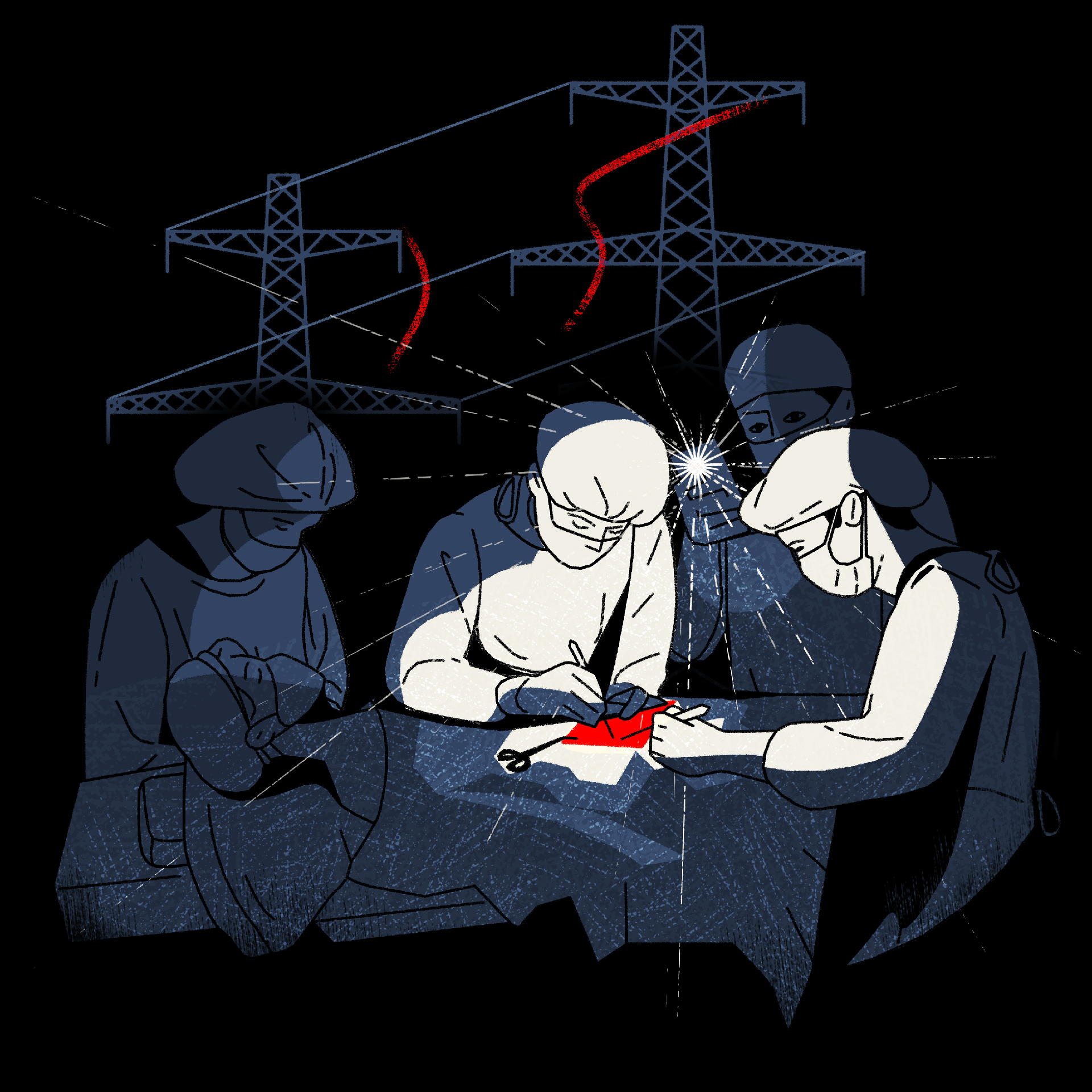
Data collected by TH and PHR since the start of the full-scale invasion shows that the cumulative impacts of Russia’s direct attacks on health facilities, as well as strikes on energy infrastructure with reported impact on health care facilities, have impeded health care delivery and endangered patients and health care workers alike. For example, since the start of the full-scale invasion, health care workers and patients at the Okhmatdyt National Specialized Children’s Hospital have faced multiple attacks that have caused death and suffering. Airstrikes shattered its windows in March 2022, forcing vulnerable patients, including terminally ill and immunocompromised children, to be treated underground despite the grave health risks of doing so. On October 10, 2022 – the day that Russia began its large-scale aerial assault on Ukrainian energy infrastructure – a missile strike killed one of Okhmatdyt’s doctors as she drove to work. In the months that followed, frequent power outages lasting up to several days resulted in lights shutting off in all departments but intensive care. The energy cuts jeopardized patient health by interrupting or delaying surgeries; forcing surgeons to operate in darkness illuminated only by headlamps; discontinuing flow of water to the hospital, creating unhygienic conditions; and rendering diagnostic and treatment equipment unusable.
On July 8, 2024, a missile hit the hospital’s toxicology building, killing two civilians, injuring 50 others, and knocking out power and water in the hospital. Dr. Anastasiia Zakharova, a pediatrician and department head at Okhmatdyt, recalls:
It was dark and dusty,” she remembers, hearing “beeping devices, signaling errors [and] the screams of children.”
Her colleague, Dr. Svitlana Lukyanchuk, did not survive the impact. The hospital was left non-functional, with temporary power generation systems taking days to restore services. As Dr. Lesia Lysytsia, a pediatric ophthalmological surgeon, reflected:
“You can work in this mode for a couple of years, but not forever. […] For me, Okhmatdyt was a fortress. I thought a children’s hospital wouldn’t get hit.”
Similarly, the Mariupol Regional Intensive Care Hospital has also faced challenges after the full-scale invasion. In February and March 2022, the hospital endured several direct attacks during the assault on Mariupol, while the siege cut off its power. The hospital was later occupied by Russian forces and turned into a military base. By December 2022, the hospital had relocated to Kyiv with the help of medical personnel who evacuated from Mariupol.
Even in its new location, the hospital’s functionality is often limited due to ongoing attacks on energy infrastructure. Dr. Olena Lazarieva, an intensive care anesthesiologist, describes how the hospital faces frequent blackouts:
“Sometimes during my 16-hour shift, the power was on for 40 minutes, sometimes for an hour and a half. If there are severe patients, if they need oxygen, artificial lung ventilation, without electricity, it can be bad,”
says Dr. Lazarieva. Without electricity, surgeries are postponed, and lifesaving equipment is at risk of failing
“When you hear an [air raid] alarm, you immediately think what to do – whether there will be a power outage, whether the oxygen station will work, what to do next during the surgery,”
says another doctor at the hospital.
Physicians report that patients experience panic attacks and cardiac arrhythmia due to lack of power and face delays in surgery and other essential health care.
Despite the international legal prohibition on attacks on health care and attacks on civilian energy infrastructure, the Russian Federation’s ongoing aggression has severely impacted Ukraine’s health care system, with attacks on energy infrastructure causing widespread disruptions in many hospitals like Okhmatdyt and Mariupol.
A survey of 2,261 health care workers conducted as part of this research project indicates that the experiences of clinicians in Mariupol and Okhmatdyt hospitals are far from unique. Key findings from the survey include:
92,3%
of health care workers report experiencing power outages at their health facility as a result of attacks on energy infrastructure.
66,3%
reported that power outages due to attacks on energy infrastructure affected medical procedures in their facilities.
8,4%
noted delays in elective surgeries, 1.7 percent experienced interruptions during surgery, and 1.8 percent reported failures in life support systems due to outages.
35,7%
outages disrupted communication systems, water supply (21.5 percent), heating and ventilation (19 percent), and elevators (16.5 percent).
7,8%
of respondents noted malfunctions in diagnostic equipment, such as X-ray machines and MRIs due to outages.
13,8%
medication storage issues, leading to spoilage, and 3.6 percent informed about problems with storing biological samples like blood or embryos.
36 reports
permanent health harms and deaths (20 reports) were also reported.
82,9%
of health workers experienced increased stress, burnout, and other challenges due to these attacks on energy infrastructure and disruption of services, with 27 percent facing these hardships daily.
Preliminary analysis suggests that these attacks may constitute violations of international law, including the laws of war and the human rights to life and health, and in some cases may give rise to criminal culpability as a matter of international criminal law. Accountability is crucial to deter future violations, uphold legal obligations, and provide justice and reparations for survivors. Immediate action is needed to investigate these attacks, support Ukraine’s health care system, and ensure the long-term recovery of critical infrastructure.
This report – a joint undertaking by Physicians for Human Rights (PHR) and Truth Hounds (TH)


Conclusion and Recommendations
The Russian Federation must immediately cease its aggression and stop attacking health care workers and facilities, targeting energy infrastructure essential to civilian life, and refrain from indiscriminate attacks that endanger both health and civilian energy systems. Further, PHR and TH also make the following recommendations:
To Prosecutors and Investigative Bodies:
- Focus investigations on attacks on energy and health infrastructure as war crimes and crimes against humanity, ensuring integration of cases and collaboration between national and international teams.
- Dedicate resources to building cases of harm to the health care system and preserving evidence for future legal use.
To the Government of Ukraine:
- Implement legal and policy measures to ensure that attacks on energy and health care are fully documented and investigated.
- Fully document health impacts and support affected patients and health care facilities, including providing mental health assistance.
Міжнародній спільноті:
- Increase the support to Ukrainian health care facilities to respond to their critical needs.
- Publicly denounce attacks on health and energy infrastructure and advocate for their immediate cessation.
- Enhance enforcement of international norms protecting health care and civilian infrastructure, support accountability mechanisms, and condemn arms sales violating UN resolutions.
- Improve data collection and sharing on attacks impacting health and energy services.
- Strengthen cooperation with non-governmental organizations (NGOs) and national health agencies to improve documentation as well as resilience of health care facilities affected by prolonged power outages.
About the Authors
Physicians for Human Rights (PHR) is an international human rights organization that documents and seeks accountability for violations of human rights and other international crimes. It has a particular focus on protecting health facilities, workers, and volunteers providing medical assistance and care during conflict.
Truth Hounds (TH) is a human rights organization that documents and investigates international crimes and grave human rights violations in Ukraine and other conflict affected regions. TH collects witness testimonies and other evidence to contribute to investigations by the International Criminal Court, Ukrainian authorities, and criminal justice actors in other states applying universal jurisdiction.