
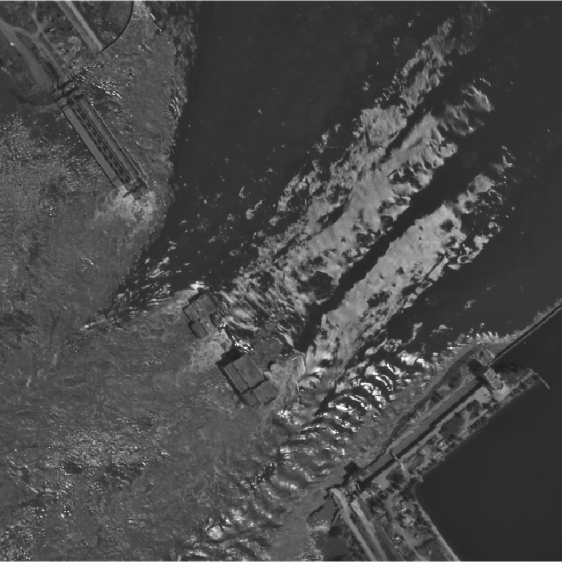
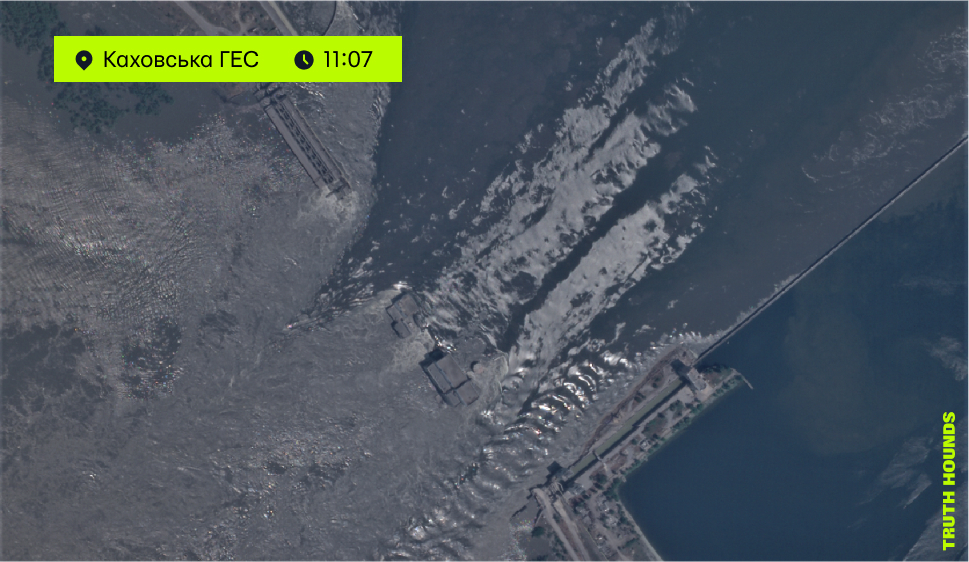
On the morning of June 06, 2023, Ukrainian officials reported that Russian occupation forces had blown up the dam of the Kakhovka hydroelectric power plant. The available photos and videos showing the extent of the damage to the dam provide convincing evidence that it was blown up with explosives. A missile attack could not have caused such massive damage in one go. Given Russia’s effective control over the hydroelectric power plant and reports of Russian mining dating back to at least October 2022, it now seems highly likely that the detonation of explosives caused the dam’s destruction.
Dams, like other installations and structures containing hazardous forces, are under special protection of international humanitarian law. According to Article 56 of Additional Protocol I to the Geneva Conventions of 1949, attacks on such objects are permissible only in the case expressly stated in Part 2 of the same article: “for a dam or a dyke only if it is used for other than its normal function and in regular, significant and direct support of military operations and if such attack is the only feasible way to terminate such support”. As follows from the text above, a scenario with a permissible attack on the dam could occur if it was used by the enemy for military purposes. Obviously, Ukraine did not use the dam for military operations and, moreover, did not control it. Thus, there was no even theoretical possibility of such use. As Article 56 suggests, preventive attacks, which could include the detonation of previously planted explosives, are not permissible for fear of using the dam for military operations.
The attack on the Kakhovka dam has endangered the lives of thousands of people and jeopardized the nuclear safety at the Zaporizhzhia Nuclear Power Plant. There is no doubt that it will have a large-scale impact on the region’s food security, primarily by limiting access to fresh water. According to Ukrainian official statements, the dam’s explosion will also be felt in other parts of the world, most notably in the countries of the so-called Global South. The environmental impact of the explosion is yet to be assessed, but it will be undoubtedly significant to affect various aspects of the environment, from the death of flora and fauna to the pollution of the Black Sea. It is likely that, using the IHL dictionary, the damage to the environment can be described as widespread, long-term, and severe.
Unlike other cases of violations of IHL, Russia will fail to use its favourite “whataboutism” to justify its attack. Indeed, attacks on dams during armed conflicts have occurred even in the recent past. During World War II, the Dnipro hydroelectric power plant and many dams across Europe were blown up, the most famous of which were the dams on the Edersee and the Möhne river. Dams in North Korea and Vietnam have also been attacked. In 2017, the United States attacked the Tabqa Dam in Syria. These facts have indeed happened.
But it is also a fact that a direct prohibition of attacks on dams appeared later than the military campaigns of World War II, North Korea, or Vietnam. In addition, most of the world’s states have assumed obligations under Additional Protocol I. Unlike the United States, the Russian Federation has made such commitments. All signatories of the Additional Protocol I undertook an obligation to “repress grave breaches, and take measures necessary to suppress all other breaches, of the [Geneva] Conventions [1949] or of this Protocol [Additional Protocol I] which result from a failure to act when under a duty to do so”, as well as “undertake to act, jointly or individually, in co-operation with the United Nations and in conformity with the United Nations Charter ”.
The dam explosion provides grounds not only for the liability of the Russian Federation for breach of its obligations under Additional Protocol I, but also for individual criminal liability of those responsible for planning, organizing, and carrying out the attack. Such criminal liability derives from the prohibition, specified in Article 8(2)(b)(iv) of the Rome Statute, of “intentionally launching an attack in the knowledge that such attack will cause incidental loss of life or injury to civilians or damage to civilian objects or widespread, long-term and severe damage to the natural environment which would be clearly excessive in relation to the concrete and direct overall military advantage anticipated.” The consequences of the attack on civilians, civilian infrastructure, and environment suggest that considerations of military advantage can neither balance nor justify the attack.
Moreover, one of the elements of the war crime of disproportionate attack is the perpetrator’s awareness that his attack will have a negative impact on the natural environment. Since at least the autumn of 2022, Russian state media and key speakers have been conducting a systematic propaganda campaign, falsely accusing the Ukrainian authorities and armed forces of intending to destroy the Kakhovka hydroelectric dam. The Permanent Representative of the Russian Federation to the United Nations Vasily Nebenzya, even stated that the Russian Federation had appealed to the UN leadership regarding the actions of Ukrainians. In this and numerous other statements, Russian officials spoke directly about the consequences of the potential destruction of the dam, including the flooding of nearby territories, the death of civilians, and the deprivation of water supply for the population for the next “10-15 years.” The first deputy chairman of the State Duma Committee on International Affairs, Alexey Chepa, said that the destruction of the dam would also affect ZNPP, as its reactors are cooled by water from the Kakhovka reservoir. Rosenergoatom, Russian nuclear power station operations subsidiary, also claimed that the destruction of the dam would lead to the flooding of the Zaporizhzhia NPP. All of this directly indicates that the persons who planned, organized, and carried out the attack on the Kakhovka dam were fully aware of the scale of the consequences of the hydroelectric power plant explosion.
In addition, almost a week before the explosion at the Kakhovskaya dam, on May 30, 2023, the Russian government adopted Resolution No. 873, which states that no accidents resulting from “military operations”, and in particular terrorist attacks on occupied Ukrainian territories, will not be investigated until January 1, 2028 . The document also contains clauses stating that until 2024, the part “On the industrial safety of dangerous production facilities” and “On the safety of hydrotechnical structures” will not be applied at the facilities. This fact also indicates that the attack on the Kakhov Dam seems to have been planned in advance and created conditions to make the investigation of the crime impossible.