
Dedicated to all those affected by double-tap strikes in Ukraine and Syria. With deep respect for all the rescuers and first responders who selflessly provide aid in the aftermath of Russian attacks.
A special thank you to the White Helmets organisation for co-authoring the first section of this report.

Contents
This document has been produced with the financial assistance of the European Union and National Endowment for Democracy (NED). The contents of this document are the sole responsibility of Truth Hounds and can under no circumstances be regarded as reflecting the position of the European Union and NED.


Also read in Ukrainian
Executive Summary
Double-tap strikes have emerged as a brutal tactic in modern warfare, particularly in Russia’s ongoing full-scale war on Ukraine. An initial strike is followed by a secondary strike usually aimed at first responders and civilians, amplifying the chaos caused by the first strike and multiplying the suffering on the ground.
This report aims to explore the pattern and implications of Russian double-tap strikes in Ukraine as well as to provide a legal assessment of these actions and analyse this phenomenon from the perspective of international law as a whole.
To identify a broader pattern of Russian double-tap strikes, we collaborated with Syria Civil Defence, widely known as the ‘White Helmets’, to incorporate their insights into our report. Since 2014, the White Helmets have provided life-saving humanitarian services amid immense danger and their experiences in Syria offer crucial perspectives on the use of double-tap tactics.
While working on this report, Truth Hounds researchers verified 36 instances of double-tap strikes conducted by Russia from the launching of the full-scale invasion of Ukraine in February 2022 through 31 August 2024. This figure represents only those instances that have been verified according to the methodology of this research, which includes confirmation of the strike location, an interval of at least five minutes to several hours between strikes in the same area (depending on the context of the attack), and verification of the arrival of first responders.
The total number of incidents monitored by Truth Hounds that display characteristics of double-tapping exceeds 60. This includes those cases where at least one of the verification criteria described above could not be confirmed.
At the beginning of the full-scale invasion, the intensity of the Russian offensive overwhelmed the capacity of media and human rights organisations to document and report such strikes thoroughly, complicating accurate accounting and analysis of cases from 2022. Despite this challenge, a clear trend by which the frequency of such strikes increased emerged over the course of 2024. From 1 January to 31 August 2024, we verified 20 instances of double-tap strikes, highlighting a troubling escalation in the use of this tactic in the conflict, surpassing the combined total for 2022 and 2023. However, the actual number of such attacks is likely significantly higher.
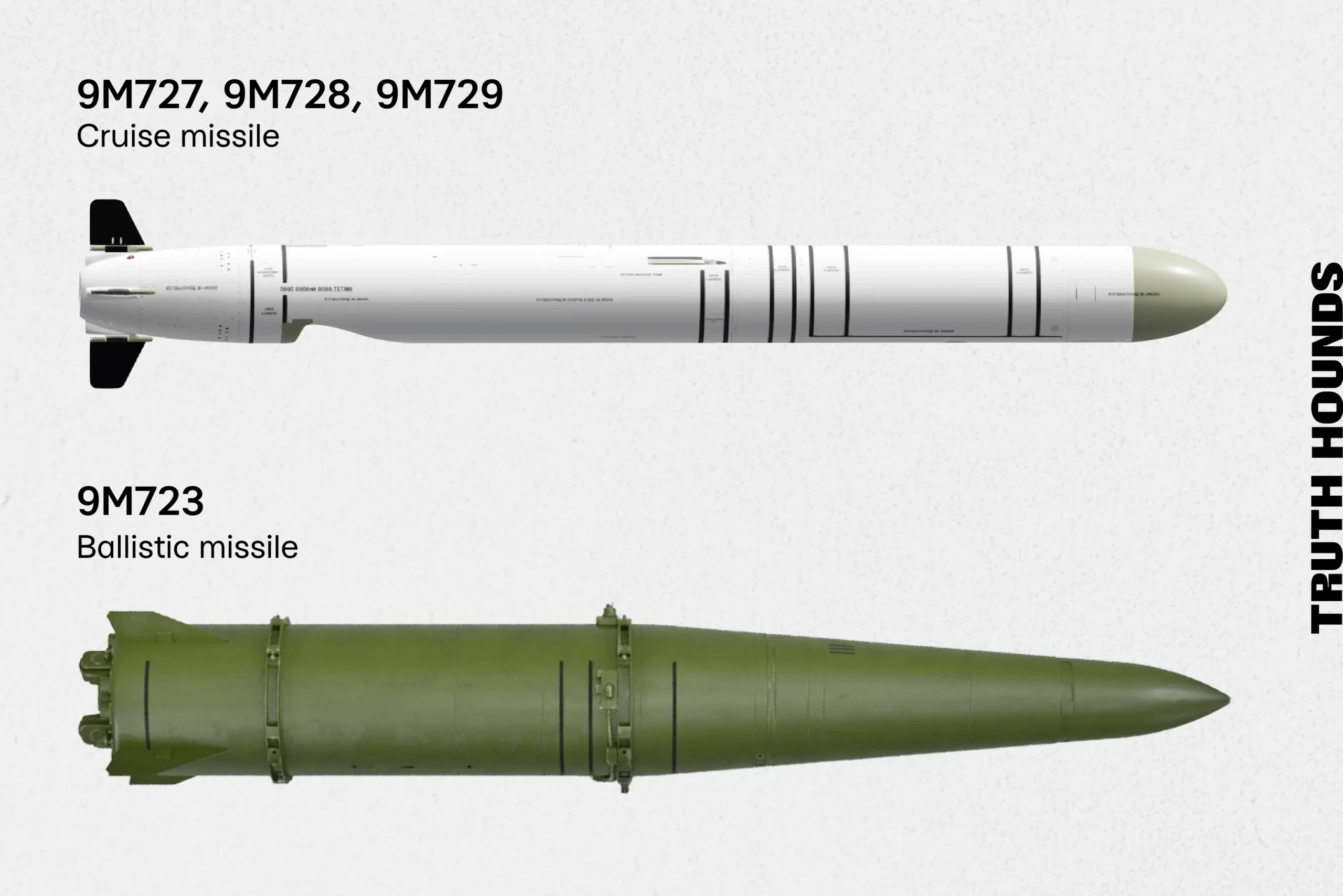
Notably, there has been a sharp increase in such strikes involving missile systems, particularly the use of 9M723 ballistic missiles and 9M727, 9M728, and 9M729 cruise missiles, which are launched using the Iskander operational-tactical missile system.
The rise in double-tap strikes aligns with the appointment of a new commander of the Russian Missile Troops and Artillery, along with a new head of the Main Missile and Artillery Directorate of the Ministry of Defence of the Russian Federation. This fact warrants further investigation to uncover the underlying interdependencies, including potential shifts in operational strategy or tactical priorities under their leadership.
We identified a distinct pattern in these strikes, typically characterised by an interval of several tens of minutes between attacks. Significantly, in nearly all instances, the second strike primarily results in casualties among first responders, including rescuers, medical personnel, journalists, police, and others. Russian forces often carry out secondary strikes based not only on calculations regarding the potential arrival of first responders at the site of the initial attack, but also by maintaining control over the attack scene through the use of reconnaissance drones. Open-source reports contain confirmations of such secondary strikes being carried out when Russian forces observed the arrival of first responders and other civilians at the attack site.
Furthermore, we found evidence that Russian propaganda actively encourages strikes conducted in this manner and seeks to legitimise the killing of first responders, especially personnel of the State Emergency Service of Ukraine and the National Police of Ukraine, who are all protected persons under international humanitarian law.
This report presents a comprehensive examination of two notable instances of double-tap strikes: one in Pokrovsk on 7 August 2023 and the other in Cherkaska Lozova on 19 May 2024. In the first instance, cruise missiles were used, while in the second, ballistic missiles were employed, all launched from the Iskander operational-tactical missile system. Alongside a detailed analysis of the circumstances and consequences of these strikes, the report also sheds light on the algorithm for identifying those responsible for planning, ordering, and executing attacks involving the use of such missiles.
The report also provides a legal assessment of the key attacks examined, along with a broader analysis of the tactic of double-tap strikes. It offers a thorough examination of the conditions under which double-tap strikes may constitute a war crime and when their employment may be deemed lawful.
Methodology
The decision to undertake a comprehensive study of Russian double-tap strikes was prompted by our observation of the growth of such attacks in Ukraine, beginning in Spring 2024.
In this report, ‘double-tap strikes’ refer to the tactic of executing two or more consecutive strikes on a single target or area, with intervals between the strikes ranging from at least five minutes to several hours (depending on the context of the attack) — sufficient to allow for the arrival of first responders and the commencing of their activities.
Utilising daily open-source monitoring, the Truth Hounds team systematically recorded incidents that showed signs of double-tap strikes. These recorded incidents were then subjected to rigorous verification by our research team, which meticulously cross-referenced available open-source data and conducted a detailed analysis of the circumstances surrounding each event. The verification process entailed evaluating monitored incidents based on the following criteria:
These criteria ensured a thorough examination of the incidents to validate their authenticity and relevance. At the same time, we acknowledge that this approach does not allow us to ascertain the total number of double-tap strikes due to the limitations of the information available from open sources. However, our aim is not to determine the total number of such strikes, but to examine their pattern.
In some cases, verification was enhanced through collaboration with field researchers who visited specific strike locations to gather on-the-ground evidence. As part of our work on this topic, Truth Hounds field researchers conducted six field missions to document both the course and aftermath of some specific double-tap strikes. These missions took place in Kharkiv, Cherkaska Lozova, Pokrovsk, Zaporizhzhia, Odesa, and Khmelnytskyi. Initial documentation of double-tap attacks by our team began in April 2023, shortly following an incident in Khmelnytskyi. Subsequent field missions were carried out between May and July 2024. Witness and survivors interviews were performed in accordance with the documentation methodology employed by Truth Hounds since 2014. Interviews were carried out without interpretation in the language preferred by the interlocuteurs. Each participant was informed about the research objectives and consented to the analysis of the information they provided. For reasons of safety and witness protection, we do not publish the names or any identifying information of interviewees.
A significant component of the research consisted of interviews with a group of experts on Russian missile weaponry and the associated command chain for its deployment. To address security concerns and per the terms of our collaboration, the identities of these experts have been anonymised.
Additionally, a substantial portion of this report relies on open-source intelligence (OSINT) inquiries, particularly in order to gather information on Russian missile brigades, groups of forces, and contextual details about the strikes analysed.
We also developed Truth Hounds’ legal position on the legality and potential classifications of double-tap strikes through a comprehensive analysis of these attacks in Ukraine and an extensive review of relevant legal sources. Additionally, we considered the perspectives of human rights experts and international lawyers who have examined double-tap strikes in other conflicts.
To identify a broader pattern of Russian double-tap strikes, we expanded our research to include the Syrian context. We engaged directly with the Syrian NGO White Helmets (Syria Civil Defence), which provides aid to those affected by the conflict in Syria. Representatives of this organisation have frequently been targeted by double-tap strikes and been made the subjects of Russian propaganda alleging their involvement in ‘terrorist’ activities. The White Helmets authored Subsection 1.1 of this report, which details double-tap strikes in Syria.
Section 1. Double-Tap Strikes in Modern Warfare
The term ‘double-tap’ denotes a shooting technique of firing two shots in quick succession at the same target, aiming to maximise the likelihood of neutralising it. This method achieves its effectiveness through the impact of two bullets hitting almost the same area on an opponent’s body.
While the origins of this technique lie in firearms, over time, the concept of the double-tap has expanded to encompass the application of missile weaponry, drones, artillery, and bombs during combat operations. The tactic of double-tap strikes on the battlefield involves delivering two consecutive strikes on a single location with a short interval between them. This interval is typically sufficient for rescuers, medical personnel, and other first responders to arrive at the scene in order to provide assistance to those injured by the initial strike. Consequently, with the second strike, the attacker aims to harm the rescuers, other civilians, and the wounded.
It is conceivable that instances of double-tap strikes may occur due to an attacker’s awareness of insufficient accuracy of available weaponry when targeting a military objective, prompting them to use multiple analogical missiles to enhance the likelihood of hitting the intended target.[1] However, the use of such weapons to attack targets in densely populated civilian areas would be deemed illegal. Moreover, in order to destroy a military objective, missiles must hit it almost simultaneously to prevent the vehicles or military personnel targeted from leaving the affected area.
The history of armed conflicts and military operations in the 21st century offers numerous examples of the application of such tactics. For instance, during the most active phase of the US drone campaign predominantly conducted in the Federally Administered Tribal Areas (FATA) of Pakistan, cases of double-tap strikes were documented. The first confirmed incident occurred in May 2009 in North Waziristan, resulting in casualties among both militants and rescuers.[2]
Human rights activists and legal experts have repeatedly criticised the numerous cases of US drone strikes for their violations of international humanitarian law (IHL) and resulting harm to civilians.[3] In particular, it has been noted that the practice of double-tap strikes may constitute a war crime.
An independent joint report by the Stanford International Human Rights and Conflict Resolution Clinic and the Global Justice Clinic at New York University School of Law on the US drone attacks in Pakistan underlines that the double-tap strikes probably violate IHL’s principles of distinction, proportionality, and precautions, as well as protected status for medical and humanitarian personnel, and individuals hors de combat.[4]
Double-tap strikes are extensively documented across Southwest Asian countries, where they have been committed by various parties using various weapons. A notable example occurred in the city of Sanaa, Yemen, on 16 October 2016, amid the Saudi-led intervention in the Yemeni Civil War, with Al-Kubra Hall being targeted during a funeral ceremony. The attack resulted in the deaths of at least 137 civilians and injuries to 695 others.[5] Although military personnel and civilian officials engaged in the war effort were present at the ceremony, human rights experts insisted that the attack was unlawfully disproportionate due to the attendance of several hundred civilians.[6] An additional element of this attack was the use of the double-tap tactic. Witnesses reported that minutes after the initial strike of the first two bombs, there was a subsequent strike by a third and, presumably, a fourth bomb.[7] The moment of the second strike was captured on video.[8] Despite widespread condemnation from international organisations, the use of double-tap attacks continued throughout the Yemeni Civil War.[9]
Double-tap strikes have also been repeatedly documented during escalations in the Gaza Strip. For instance, a joint report by Physicians for Human Rights – Israel and local Palestinian NGOs indicates that, in 2014, repeated Israeli airstrikes in Gaza specifically targeted rescuers and medical evacuation teams responding to initial strikes. Based on eyewitness testimonies, the report confirms that the double-tap tactic resulted in medical personnel being severely wounded or killed upon arriving at the scene of initial attack.[10]
This tactic persisted in later conflicts in the region. Notably, following the Hamas attack in October 2023, the Israel Defence Forces (IDF) continued to employ the double-tap tactic. One particularly notorious incident occurred on 13 July 2024, when the IDF attacked Al-Mawasi in southern Gaza. The first attack targeted a building that, according to the Israeli side, housed Hamas military commanders. After rescue teams arrived, a subsequent strike was carried out with an unknown type of munition, which exploded on a crowded street directly in front of Gaza Civil Defence vehicles. In total, more than 90 people were killed in the two strikes.[11]
1.1. Double-tap Strikes in Syria
The use of double-tap strikes has become widespread during the civil war in Syria. The Syria Justice and Accountability Centre (SJAC)[12] has identified 58 cases of double-taps occurring between 2013 and 2021.[13] This number includes only those incidents which investigators verified based on three key criteria: (а) the location of the initial strike; (b) the arrival of first responders or civilians at the location after the strike was conducted; and (c) the occurrence of at least one subsequent attack on the same location within an hour of when first responders or civilians arrived on site after the initial strike. All of these incidents occurred outside of the territory controlled by the Syrian government, indicating the responsibility of Syrian government forces and their ally, Russia, for these strikes. The authors of the report note that the number and intensity of double-tap strikes significantly increased after Russia’s entry into the conflict in 2015, leading to a surge in the scale of destruction.[14]
These strikes in Syria aim not only to harm civilians but also to target rescue workers, including the Syrian Civil Defence, widely known as the White Helmets, who have provided life-saving humanitarian services in the face of immense danger since the organisation’s formation in 2014. Their role in rescuing civilians from airstrikes and other assaults has become even more challenging due to the deliberate use of double-tap strikes. In 2023, the White Helmets reported that, since the beginning of their operations, 306 of their rescuers had been killed by Syrian and Russian armed forces, mostly as a result of double-tap strikes during rescue operations.[15]
This subsection highlights the use of double-tap strikes during the Syrian conflict and the severe consequences for the White Helmets. By examining key incidents and operational challenges, we aim to shed light on the enormous risks faced by these responders and the adaptations they have made to continue saving lives amid constant danger.
Incident 1: March 2016 – Bineen Olive Press Factory, A Turning Point
In March 2016, According to a White Helmets first responder, one of the first notable instances of a double-tap strike by Russia occurred. After an initial airstrike on an olive press factory in Bineen, north of Maaret Al-Nomaan, White Helmets volunteers rushed to the scene to assist the wounded. Minutes later, around 11 strikes hit the same location, with five to ten minutes between each strike, killing several rescuers, wounding others, and exacerbating the destruction.[16] This incident marked a pivotal moment in recognising the tactical shift towards targeting emergency response teams directly. The White Helmets were forced to quickly adapt their operational protocols to mitigate risks, as these strikes became a regular threat.
Incident 2: 5 May 2016 – Al-Kamooneh IDP Camp Attack
On 5 May 2016, an assault on the Al-Kamooneh Internally Displaced Person (IDP) Camp in northern Idlib involved the launching of three missiles from an aircraft, resulting in the deaths of approximately 45 individuals and injury to around 70 others. During the interval between the first two strikes, the White Helmets and other humanitarian teams arrived to evacuate families, assist the injured, and contain the fire. As they were working, a third strike hit the camp, close to a firetruck and several volunteers.[17]
Incident 3: 22 July 2019 – Maarat al-Numan Market Attack
On 22 July 2019, Russian forces carried out a double-tap strike on the vegetable marketplace in Maarat al-Numan. The initial strike resulted in numerous casualties among civilians. White Helmets volunteers arrived shortly after the initial strike to provide aid and assist survivors. Mere minutes after their arrival, a second bomb struck the same location, targeting both the remaining civilians and the rescue workers. According to a White Helmets rescuer present at the scene, this subsequent attack led to over 80 deaths and more than 200 injuries,[18] underscoring the calculated cruelty of double-tap strikes, where rescuers themselves are deliberately targeted. Among the victims was Amer Al-Bunni, a 25-year-old first responder displaced from Wadi Barada and who had settled in Maarat al-Numan.
Witnesses of the attack claim that there were no military objectives near the bombed location. Video footage from open sources confirms that rescue teams arrived at the scene following the initial strike, but then an aircraft conducted another attack eight minutes later.[19]
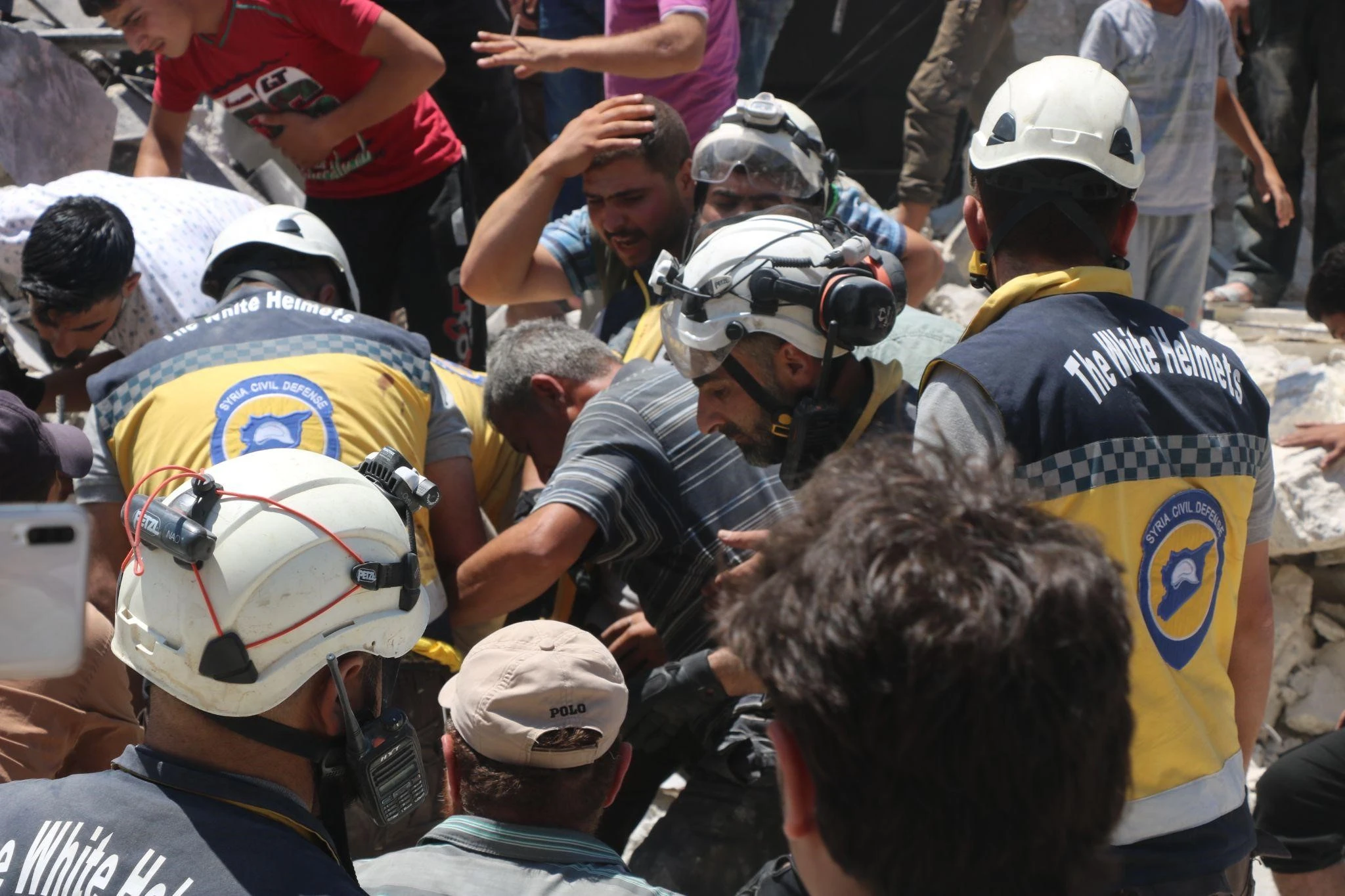
The killing of Amir Albini by a Russian double-tap strike. 22 July 2019 – Maarat al-Numan Market Attack.
Source: The White Helmets
The Russian Armed Forces officially denied their involvement in the attack, stating that their aviation was not operating in the area on July 22. Moreover, they claimed that the market had not been hit at all. As such, they published footage from an intelligence drone and a video recorded from the ground depicting an intact local market in Maarat al-Numan. However, the footage shown was of the Al-Hal wholesale market, located 350 metres away from the market that was actually targeted on that day.[20]
Analysis conducted by investigators from The New York Times, incorporating eyewitness videos, flight logs, and cockpit recordings, strongly suggests that Russian forces were indeed responsible for the attack.[21] According to a BBC investigation, a Russian fighter jet reportedly took off from the Russian-operated Khmeimim Airbase, situated approximately 80 km from the city of Maarat al-Numan, where the attack occurred.[22]
These attacks were also accompanied by a multi-level Russian-backed propaganda campaign and the spreading of false narratives about the activities of Syrian humanitarian organisations, including the White Helmets. Threats of violence and false accusations, including of terrorism, against the White Helmets aimed to undermine their efforts to provide assistance to victims and justify their killings.[23]
Operational Challenges and Adaptations
The increasing frequency of double-tap strikes after Russian forces entered the conflict has forced the White Helmets to adapt swiftly to ensure their survival and effectiveness. Their work has become a delicate balance of saving lives while navigating an evolving and dangerous battlefield.
In response to the escalating threat of double-tap strikes, the White Helmets have implemented new operational protocols designed to minimise exposure to additional attacks. Teams now employ a two-phase approach when entering a strike zone. Initially, a small rapid response group enters the area to quickly assess and address immediate needs. This group is followed by a second team that waits for a designated period before entering the site to ensure that it is safe. The second team then continues to provide aid and evacuate the wounded to a safer location.
This cautious approach is complemented by strategic reconnaissance efforts. Low-level reconnaissance is conducted using motorbikes and on-foot patrols, allowing teams to assess the situation and confirm that no further attacks are imminent. This method ensures a minimal presence in the danger zone until it is deemed secure, thereby enhancing the safety of both responders and those they assist.
These reconnaissance techniques involve assessing the immediate surroundings, monitoring air activity, and scanning for signs of additional hostile intent. Volunteers use local knowledge and spotters to predict the likelihood of further strikes. This method has been vital in preventing further loss of life, but it comes at the cost of delaying critical aid to victims trapped in the initial attack.
The White Helmets have increasingly integrated advanced surveillance technologies into their response protocols. They use an early warning system that sends location-based notifications via Telegram and Facebook. For example, subscribers in Idlib receive alerts about potential strikes in that area, which helps them to prepare and respond more effectively.
Additionally, White Helmets centres and hospitals are equipped with a light warning system to communicate critical information. A yellow light indicates an incoming aircraft, a red one indicates that an aircraft is one minute away from a location, while a blue light signals that wounded victims are arriving. This system helps coordinate responses and manage resources more efficiently.
Scout teams also provide real-time information on enemy movements and potential threats. This data enables safer and more calculated entry into affected zones. Despite these technological advances, the high-risk environment continues to present challenges and limitations, necessitating ongoing adaptation and vigilance.
Working under the threat of double-tap strikes has had a profound psychological impact on White Helmets volunteers. The constant fear of becoming a target themselves is a daily reality, as they witness the aftermath of horrific violence and face the ever-present danger of additional attacks. Acknowledging this fear is crucial, as it shapes every aspect of their operations.
The trauma of experiencing repeated violence, witnessing civilian deaths, and losing fellow volunteers has had long-lasting effects on the mental health of responders. The fear that every mission could be their last is pervasive, yet they continue to operate in these terrifying conditions. The introduction of formal psychological support services (PSS) at the end of 2022 marks a critical step toward addressing the mental toll this work takes on rescuers.
The courage and resilience of the White Helmets inspires hope and offers reassurance within their communities. Despite operating under the constant threat of double-tap strikes, their presence provides a vital sense of security to civilians, assuring them that help is available even in the most perilous situations. Their ability to perform under such conditions exemplifies their unwavering dedication to humanitarian principles and the wellbeing of their communities.
The use of double-tap strikes by Russian forces during the Syrian conflict exemplifies the extreme measures taken to demoralise both civilians and the humanitarian workers who risk their lives to save them. The White Helmets, despite being acutely aware of the danger, continue to operate in this perilous environment, adapting their protocols, using innovative tools, and confronting the psychological burden of this relentless violence.
Section 2. Russian Double-Tap Strikes in Ukraine: Characteristics in Brief
Truth Hounds researchers have verified 36 instances of double-tap strikes conducted by Russia from the launching of the full-scale invasion of Ukraine in February 2022 through 31 August 2024 (a detailed table of all verified cases is available in Appendix 1 of this report). This figure represents only those instances that have been verified by us according to the criteria outlined in the methodology section. Specifically, it includes cases where the attack location was confirmed, where there was an interval of at least a few minutes to several hours between strikes in the same area (depending on the context of the attack), and where the arrival of first responders was verified.
The total number of incidents monitored by Truth Hounds that display characteristics of double-tapping exceeds 60. This includes cases where at least one of the verification criteria described above could not be confirmed.
The calculation of Russian double-tap strikes on Ukraine is hindered by several factors. Many such strikes either have not been documented in the media or official reports while information that is available sometimes lacks the detail necessary to definitively classify attacks as double-taps. Verification of double-tap strikes is particularly challenging with regard to border regions or small settlements along the line of contact, where there is often a scarcity of sources or detailed information.
At the beginning of the full-scale invasion, the intensity of the Russian offensive overwhelmed the capacity of media and human rights organisations to document and report on attacks thoroughly. Consequently, even where strikes were recorded, details such as the exact location of the strikes, the number of strikes, the intervals between them, and the type of weapon used were often missing. This lack of detailed information significantly complicates the task of accurately accounting for and analysing cases from 2022.
In this research, our objective was not to determine the precise number of double-tap strikes that occurred in Ukraine. Rather, we aimed to analyse their patterns and assess their legality. This section of the report provides a comprehensive review of verified double-tap strikes.
The first verified double-tap occurred on 1 March 2022, just four days after the invasion began.[24] The Kharkiv Regional State Administration building was targeted by two missiles: the first missile struck the square in front of the building at 8:01 AM, followed by a second missile which hit the roof of the building 12 minutes later.[25] In its report on IHL violations in Ukraine, the Organisation for Security and Cooperation in Europe (OSCE) noted that the second missile deliberately targeted rescuers and individuals wounded by the initial strike in contravention of Article 41 of Additional Protocol I to the Geneva Conventions of 1949.[26] According to official data, a total of 44 people were killed in this double-tap attack.[27]
In 2022, Russia conducted at least six double-tap strikes on military and civilian infrastructure in Ukraine using missiles, artillery, and Shahed drones. These strikes targeted Kharkiv on 1 and 17 March,[28] the village of Natalivka in Zaporizhzhia Oblast on 18 March,[29] Dnipro on 10 April,[30] Bilytske in Donetsk Oblast on 14 August,[31] and Ladyzhyn in Vinnytsia Oblast on 11 October.[32]
In 2023, there were at least ten such strikes. However, in 2024, there has been a notable increase in their frequency. From the beginning of the year until 31 August, we have been able to verify 20 such strikes. Although this figure reflects only the cases we have verified, its surpassing of the combined total for 2022 and 2023 underscores a notable escalation in Russia’s use of double-tap tactics starting in 2024.

Russian armed forces employ a range of weaponry to execute double-tap strikes, including ballistic and cruise missiles, barrel and rocket artillery, as well as strike drones and FPV drones. Identifying the specific type of weapon used in these attacks can be challenging due to the often-limited photographic evidence of debris and the difficulties field researchers face in accessing the strike sites.
Among the documented types of weaponry employed in these strikes, high-precision systems are notably prevalent. These include Kalibr 3M54-1 and 9M727, 9M728, and 9M729 (often referred to simply as Iskander-K) cruise missiles, 9M723 (often referred to simply as Iskander-M) ballistic missiles, artillery shells, and drones that enable operators to maintain target guidance up to the moment of impact.
However, this arsenal also includes types of weaponry that lack high precision. For example, during the 3 May 2024 attack on Chuhuiv, Kharkiv Oblast, Russia employed two rockets equipped with cluster warheads launched from a Tornado-S system for the first strike, followed by two missiles launched from an S-300 system 50 minutes later for the second strike.[33] Cluster munitions are intended to affect a broad area, making them suitable for targeting dispersed objects. When firing at ground objects, the S-300 surface-to-air missile system is armed with 5V55 or 48N6 missiles, which are designed for aerial targets.[34] Consequently, these missiles are less effective and less accurate when used against ground targets. However, since the Russian military intentionally used such weaponry to cause widespread damage during the initial strike, the use of missiles launched from the S-300 system allowed them to repeatedly target the same area.
Weapons with lower precision also include Iranian-made Shahed strike drones, which Russia uses for double-tap strikes. These drones deviate from their target only in the case of the use of electronic warfare systems by the adversary, which can shift the drone from following its GPS-defined trajectory.[35] However, in cases of double-tap strikes, that Shahed drones target the same location within a time interval consistent with other documented double-tap strikes suggests that the drones successfully reached their intended targets in the verified incidents.
Among missile weaponry, Russian forces most frequently employ Iskander 9K720 missile systems to execute double-tap strikes. Of the 15 strikes we verified that involved missile systems, ten were conducted using 9M727, 9M728, and 9M729 cruise missiles and 9M723 ballistic missiles. Both types are considered highly precise, with a circular error probable (CEP) of up to 10 metres for the ballistic missile and up to 30 metres for the cruise missiles.[36] The majority of double-tap strikes involving Iskanders feature attacks using the 9M723 ballistic missile. This can be attributed not only to the manoeuvrability of the missile system itself and the high speed of the ballistic missile, but also to their high accuracy, which enables them to hit nearly the same target location during a secondary strike.
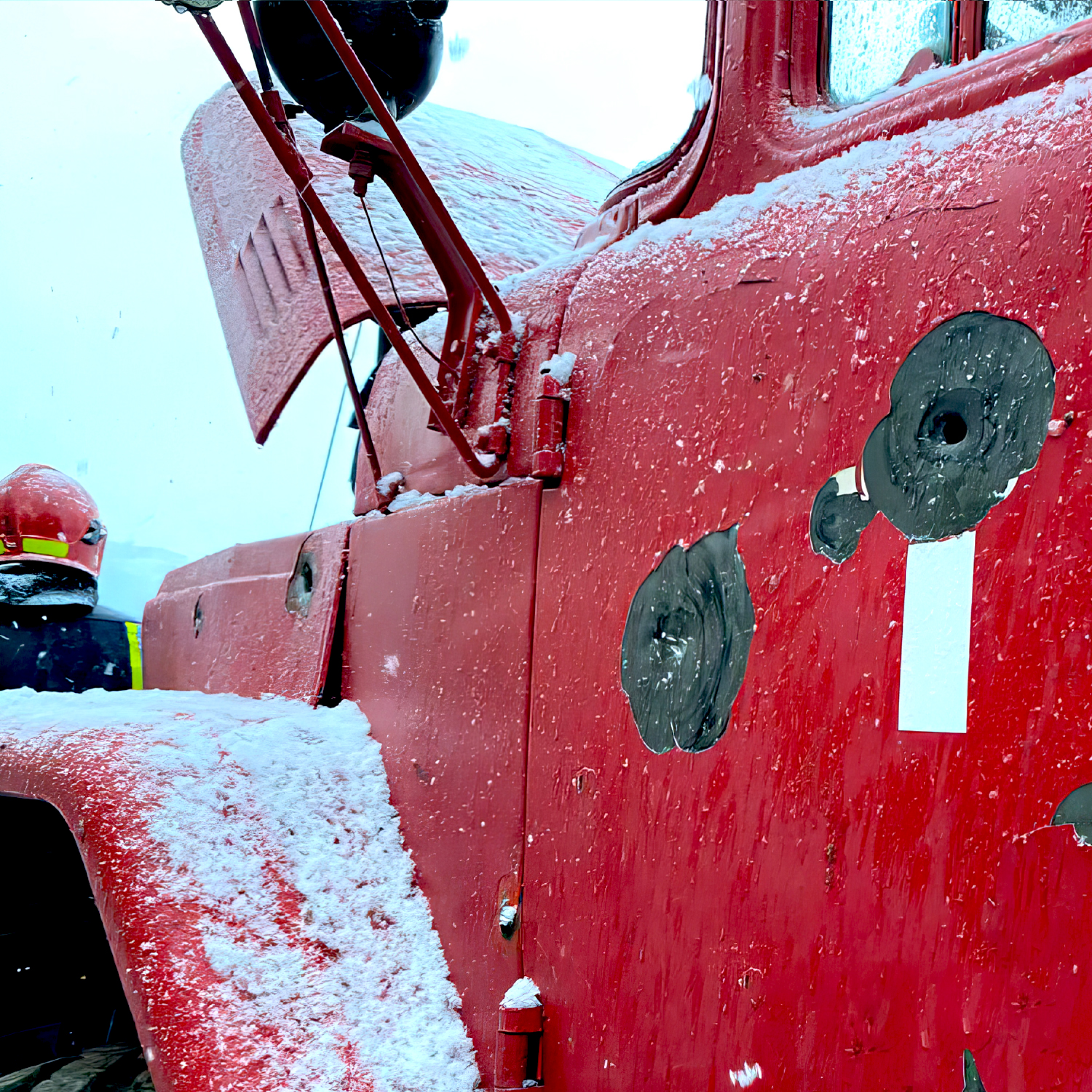
The double-tap strike tactic is employed in both attacks on civilian objects and assaults on legitimate military targets. For instance, on 27 February 2023, Russia attacked a military base of one of the Special Operation Forces units in Khmelnytskyi with Shahed drones. The initial strike occurred around 2:10 AM and hit a military barracks. Truth Hounds field researchers found that there were no casualties as a result of the initial strike, but the barracks itself caught fire.[37]
The second drone strike took place at 2:32 AM, when rescuers had already arrived to extinguish the fire. As a result of this strike, two State Emergency Service of Ukraine (SES)[38] workers were fatally injured and three others were wounded. Half an hour later, a third drone struck another barracks located approximately 50 metres from the site of the first strike,[39] causing no casualties.
[38] The State Emergency Service of Ukraine is a government agency responsible for managing and coordinating emergency response and disaster relief efforts within Ukraine. Its functions include civil protection, protection of the Ukrainian population and Ukrainian territories from emergencies, prevention of emergencies, rectification of the consequences of an emergency, rescue work, extinguishing fires, fire and technogenic safety, accident rescue service activities, and hydrometeorological activities.
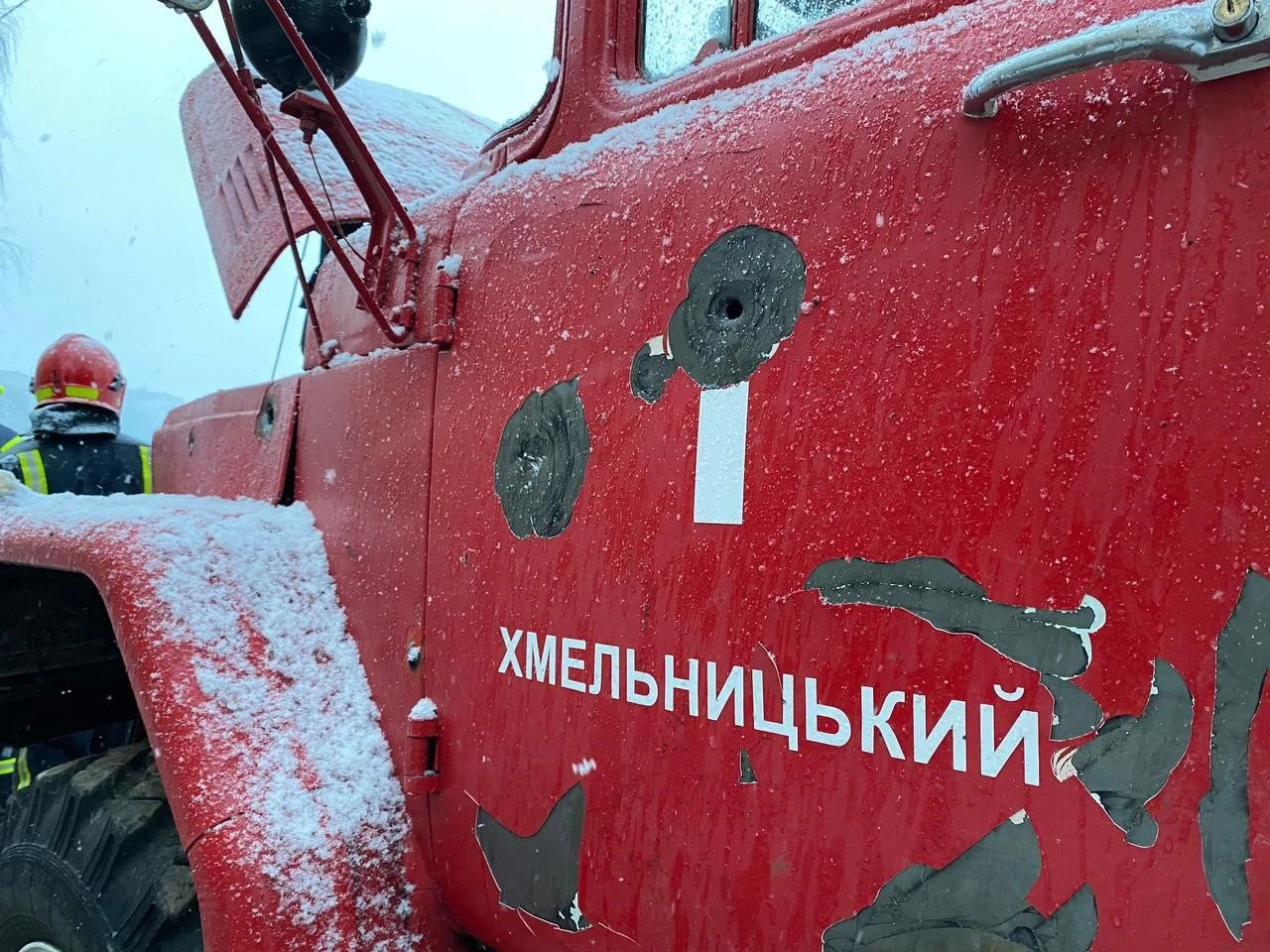
A fire engine damaged in a drone attack in Khmelnytskyi
Source: @dsns_telegram via Telegram.[40]
Another example of an initial strike targeting military objectives occurred on 13 July 2024 in the village of Budy, Kharkiv Oblast. At approximately 3:40 PM,[41] the first strike targeted military equipment located on flatcars at a local railway station. A video of the attack was subsequently published on Russian Telegram channels, likely recorded by an Orlan-10 reconnaissance drone, indicating the real-time guidance of the Russian missiles.[42]
The video clearly shows firefighters working at the scene after the initial strike. However, half an hour later, Russian forces launched another missile at the same location.[43] The attack resulted in the deaths of the Head of the Kharkiv District Department of the State Emergency Service in Kharkiv Oblast, Artem Kostyria, and policeman Oleksii Koshchi, who arrived at the scene after the first strike.[44] Additionally, the attack caused injuries to at least 25 other people, including two children.[45]
Such a significant interval between the two strikes, coupled with comprehensive control of the attack scene through a reconnaissance drone, suggests that the second strike deliberately targeted the rescuers who had arrived at the site. If the attacker’s intention had solely been to maximise damage to military equipment, the second missile would likely have been launched almost immediately after the first, or shortly thereafter once the impact of the initial strike had been assessed. The presence of a reconnaissance drone enabled swift assessment of strike site conditions.
Similarly, there are numerous instances where civilian objects have been targeted in initial strikes. One such example is the attack on Kharkiv with Shahed drones during the night of 4 April 2024. Around 1:00 AM, a drone struck a residential area on Planova Street, followed shortly after by another drone targeting a residential building at 47 Lyubov Malaya Avenue. These strikes resulted in one civilian being injured, crushed by debris from the building damaged by the second attack.[46]
Eyewitnesses reported that rescuers arrived five to ten minutes after the second strike. Approximately half an hour later, a third drone targeted the area near rescue vehicles stationed next to a house damaged on Lyubov Malaya Avenue. This third strike resulted in the immediate death of three rescuers, with a police officer later passing away from his injuries in hospital. Another rescuer and a nurse were also injured in the incident. Witnesses interviewed by Truth Hounds indicated that there were no military personnel, equipment, or bases in the vicinity of the attack site[47].
In 2024, a notable trend has emerged involving double-taps on the same location using various types of drone-dropped munitions. We have verified several such incidents and documented numerous reports throughout the summer of 2024 for further verification. These attacks are particularly prevalent near the border and near the frontline, attributable to the limited range of the drones used. The employment of double-tap strikes in this manner indicates a high level of control over the target area by the attacker. These drones are equipped with cameras, allowing the operator to see exactly what is being targeted. For instance, on 11 July 2024, Kherson experienced such an attack. Following the shelling of Perekopska Street, while rescuers and utility workers were managing the aftermath, a Russian unmanned aerial vehicle (UAV) dropped explosives on them, resulting in injuries to two individuals.[48]
SES personnel are among those most affected by double-tap strikes. In at least 20 of the 36 attacks analysed for this section, rescuers were killed or injured.
SES workers are typically the first to arrive at the site of an attack, where they spend considerable time dismantling rubble, extinguishing fires, and rescuing trapped individuals. A typical rescue crew usually consists of eight to ten people, and depending on the scale of the emergency, one or more crews may respond. On 14 April 2024, Ukrainian Minister of Internal Affairs Ihor Klymenko announced that the SES had changed its response protocols due to the increase in Russian double-tap attacks and had egun to use more protective body armour.[49]
In July 2024, the head of the SES, Andrii Danyk, reported that 93 emergency workers had been killed since the start of the full-scale invasion, with almost 400 wounded.[50] These figures encompass not only victims of double-tap strikes but also those affected by targeted attacks on the infrastructure of the SES and other incidents that occurred within the context of the armed conflict. In addition to double-taps, Russian forces have deliberately targeted SES infrastructure, including fire stations in Ukrainian cities. Reported incidents include strikes on fire stations in Dnipro, Kherson, Izium, Borova, Druzhkivka, and elsewhere.
The second group of first responders at significant risk are police officers, who are responsible for documenting the aftermath of attacks and assisting those injured by initial strikes. Police officers typically have the required first aid training and frequently serve as the initial responders at the scene of attacks. Their role as first responders is crucial in providing immediate assistance and managing the initial impact of incidents. At 11:58 AM on 24 June 2024, in Pokrovsk, a 9M723 missile struck a residential area, resulting in fatalities and injuries among locals.[51] After police had arrived at the scene, approximately 30 minutes later, a subsequent 9M723 missile hit a location several dozen metres from the initial strike site. The follow-up attack resulted in additional casualties, including injuries to three policemen who were responding to the first incident.[52]
Medics also encounter substantial risks as they provide first aid to the wounded, frequently placing themselves in immediate danger, especially when there is a short interval between strikes. Medics are responsible for both evacuating severely injured individuals to hospitals and administering first aid on site before leaving the scene, resulting in significantly less time spent at the site compared to police officers or SES personnel. This group includes not only certified medical professionals but also individuals with relevant medical knowledge who volunteer to assist the injured.
For instance, on 10 April 2024, in Chornomorsk, a 9M723 missile struck a railway bridge and a petrol station.[53] Roman Yukhevych, a combat medic and member of the Ukrainian Rescue Service, arrived at the scene to provide medical assistance to the wounded as he was passing by the site of the strike. While delivering first aid, he was killed in a follow-up strike that occurred 11 minutes later.[54]
There are documented cases where missiles or drones have damaged gas pipes, leading to the ignition of the gas within and resulting in severe fires. These intense flames make it exceedingly difficult for firefighters to control or extinguish the blaze. Gas workers are frequently summoned to shut off the gas supply in buildings damaged by strikes. For instance, on 7 August 2023, in Pokrovsk, a gas service worker was killed by a double-tap missile strike while responding to a call to secure damaged gas pipelines.[55]
Journalists can be classified as first responders due to their rapid arrival at the scene of incidents to provide coverage. For example, during a double-tap attack on Kharkiv on 4 April 2024, two journalists were injured and another two were wounded the following day in a similar attack on Zaporizhzhia.[56]
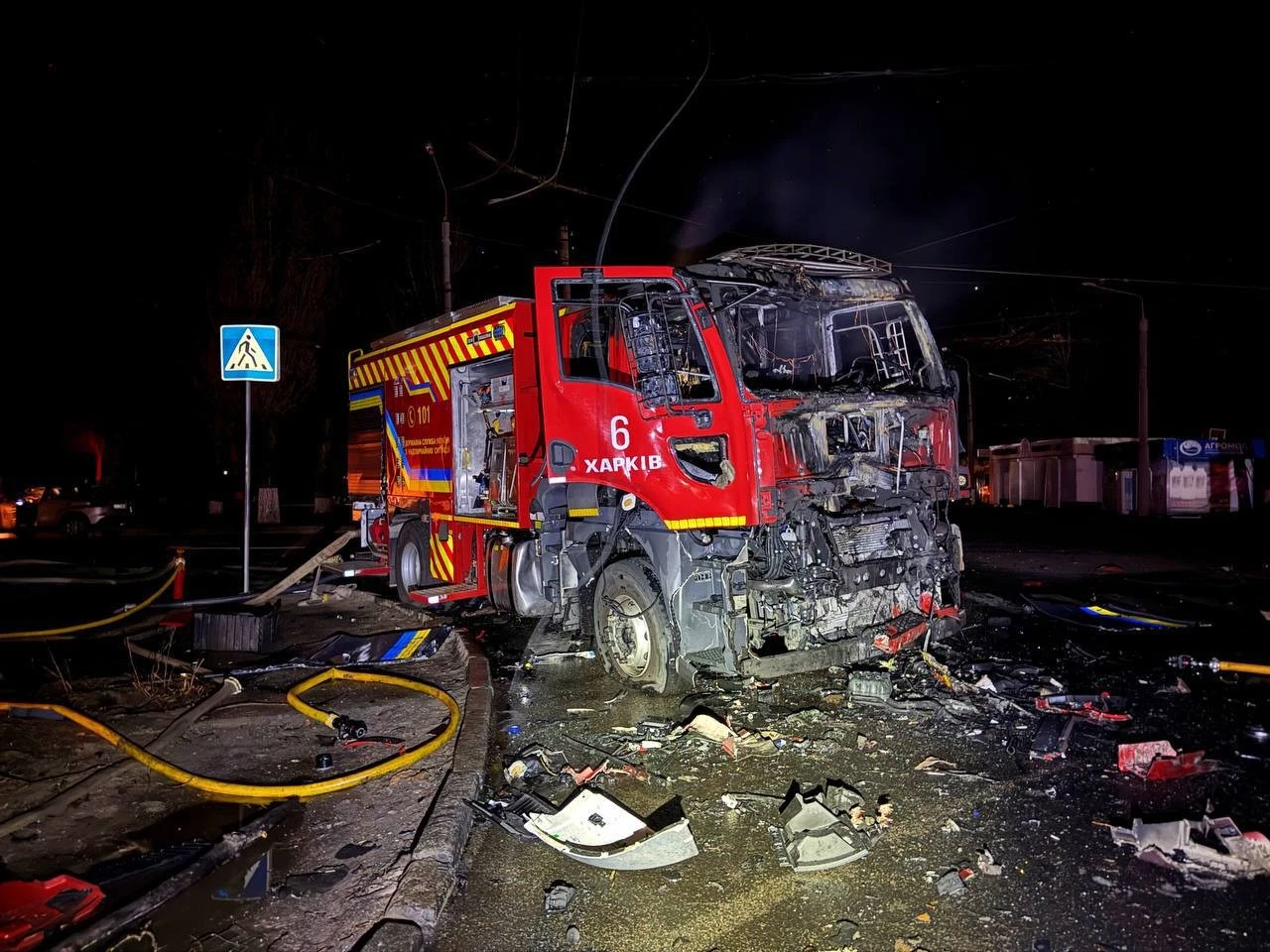
A fire engine damaged in a drone attack in Kharkiv
Source: @ihor_terekhov via Telegram.[57]
Local residents often arrive first at the scene of an incident. While they typically cede the primary responsibility for providing aid to professional rescuers and medical personnel upon their arrival, they frequently remain at the site to observe the unfolding situation or to assess and clear their own damaged property.
A significant challenge for first responders is the unpredictable nature of sequential strikes, making it difficult to determine when the threat has entirely subsided. The interval between successive attacks can vary widely, from as little as 10 minutes to several hours, which means that the cessation of an air alert does not guarantee that the danger has passed. Additionally, there is always the potential for a third strike following the initial attacks. For instance, on 10 April 2024, Chornomorsk was struck twice with only an 11-minute interval between the first[58] and second[59] missile strikes. Similarly, on 10 April 2022, Dnipro Airport was hit by a second strike approximately two hours and 20 minutes[60] after the initial attack. During the second strike on Dnipro, six SES workers sustained serious injuries and one later died from the trauma.[61] This variability and extended risk exposure means that first responders remain in danger for hours after an initial strike.
During a single wave of attack, both individual munitions and multiple munitions can be launched sequentially. According to witness testimonies, the missile attack on Zaporizhzhia on 5 April 2024 involved Russian forces conducting two distinct waves of strikes. The first wave consisted of three missiles launched a few minutes apart. This was followed by a second wave an hour and a half later, during which two more missiles were launched, with a one-minute interval between them.[62]
Regardless of the object of attack, the second strike primarily kills civilians. First responders — such as rescuers, firefighters, medics, police officers, local residents, and journalists — are particularly vulnerable. In Ukraine, the composition of first responders can vary depending on the location, the nature of the attack, and the extent of the damage.
Among all the incidents examined, there is only one confirmed instance in which military command personnel were among the casualties of the follow-up attack. On 15 March 2024, Russia launched two 9M723 missiles with an interval of approximately 35 minutes on Mriya Sanatorium located in Odesa, where personnel from the Liut Assault Brigade of the National Police of Ukraine were stationed. As a result of the attack, the commander of one of the assault regiments and several officers from this special unit were killed. Additionally, two rescuers, a feldsher, and several other civilians — who were either assisting the victims or were in the vicinity — also lost their lives. In total, 21 individuals were killed in the attack.[63]
Russian official sources, media, and military bloggers generally do not comment on double-tap strikes. When such an attack is deemed ‘successful’, Russian news coverage typically reports the event without highlighting the specific technique employed.
However, since the summer of 2024, there has been a slight increase in the discourse regarding the Russian military’s use of double-tap strikes.
A popular Russian Telegram channel focused on military affairs, Voennyi Osvedomitel (‘Military Informer’), reported on the strike on the settlement of Budy on 13 July 2024, noting: ‘After the enemy began addressing the aftermath, a follow-up strike was conducted targeting employees of the Ukrainian Ministry of Internal Affairs and the State Emergency Service’.[64]
In their commentary on the deaths of the head of the Kharkiv District Department of the SES in Kharkiv Oblast and the police officers, the channel’s authors asserted that this incident is ‘not the first instance demonstrating the effectiveness of double-tap strikes on locations engaged in managing the consequences of initial attacks’.[65]
This statement indicates that the Russian side specifically aims to cause casualties among rescue workers and police officers responding to initial strikes. It also suggests that the attack on Budy is part of a broader strategy and a pattern in Russian operations, where double-tap attacks are used to compound the impact of initial attacks.
Additionally, on 4 August 2024 one of the most popular Russian war analysts, Mikhail Zvinchuk, reported on a Russian drone attack on the oil terminal in Hnivan, Vinnytsia Oblast, admitting that a double-tap was used.
‘Initially, there were three strikes on the target. After firefighters arrived on the scene, a fourth “Geran”[66] drone struck, hitting the reservoir directly. This indicates that we are adjusting our approach to fire damage, accounting for the time needed to extinguish fires and the arrival of evacuation teams’, Zvinchuk said.[67]
In particular, he acknowledged that the planning of these attacks takes into account the response times of firefighters and ‘evacuation teams’, who are subsequently targeted in follow-up strikes. He also indicated that the so-called ‘evacuation teams’ seem to be ‘often’ composed of personnel from ‘Ukrainian formations’.[68]
An important detail in this context is the report from the Telegram channel @gefestwar, which is associated with UAV operations. On 16 August 2024, the channel published a video documenting the aftermath of an attack on a school in Antonivka, Kherson Oblast.[69] This incident is one of the double-tap strikes that we have verified. Russian forces claimed that the Ukrainian military was using the school as an UAV control point.[70] Once the initial attack ignited a fire, rescuers arrived at the scene, but a subsequent strike took place shortly thereafter.[71] In the caption accompanying the video, the author advises civilians against extinguishing such fires, warning that doing so may render them targets for the follow-up strike.
The increase in the number of double-tap strikes aligns with the appointment of a new commander of the Russian Missile Troops and Artillery of the Russian Ground Forces (MT&A). On 17 November 2023, Lieutenant General Dmitry Klimenko succeeded Mikhail Matveyevsky, who had served in this role for 12 years.[72] General Klimenko’s military background includes participation in the First and Second Chechen Wars and he was awarded the title of Hero of the Russian Federation in 2002. His record also includes involvement in the artillery shelling of Mariupol in January 2015, which resulted in the deaths of 29 people.[73] With the beginning of Russia’s military intervention in Syria in September 2015, Klimenko was appointed the commander of the Missile Troops and Artillery of the Euphrates Group. He held this position at least until 2017.[74]
Similarly, the shift in trends coincided with personnel changes in the Main Missile and Artillery Directorate of the Ministry of Defence of the Russian Federation (known as the GRAU). In January 2024, Major General Aleksey Volkov was appointed as the new head, succeeding Lieutenant General Nikolai Parshin, who had held the position since 2012.[75]
During Lieutenant General Dmitry Klimenko’s tenure as commander of the MT&A and Major General Aleksey Volkov’s as head of the GRAU, there has been a noticeable increase in the use of both missile and artillery systems for executing double-tap strikes. This trend warrants further investigation to determine the underlying causes, such as potential changes in operational strategy or tactical priorities under their leadership.
Double-tap strikes involving artillery have increasingly been observed in populated areas near the frontline in southern Ukraine, as well as along the northeastern border. For example, on 2 July 2024, Russian forces conducted an artillery strike on the centre of Kherson. Following the initial attack, which ignited a fire, a subsequent artillery strike targeted the area while firefighters were attempting to extinguish the blaze. This secondary attack forced emergency responders to withdraw from the site. The incident was documented in a video released by the SES.[76] In addition to Kherson, double-taps conducted with artillery have been reported in other areas, including Nikopol, Bilytske, Velykyi Burluk, Kruhlyakivka, and Antonivka.
The first international reaction to Russian double-tap strikes in Ukraine appeared soon after the attack on the Kharkiv Regional State Administration building on 1 March 2022.[77] However, significant attention from international organisations and both international and Ukrainian media emerged in 2024, following several high-profile incidents involving double-tap strikes.
For instance, on 11 April 2024, Edem Wosornu, Director of Operations and Advocacy for the UN Office for the Coordination of Humanitarian Affairs (OCHA), addressed the UN Security Council, stating, ‘Attacks directed against the wounded and those helping them are prohibited by international humanitarian law. They are cruel, unconscionable, and must stop.’[78] Furthermore, on 18 April 2024, both the US Mission and the Delegation of Canada to the OSCE highlighted the increase in Russian double-tap attacks. They condemned this tactic as illegal during the 1469th Plenary Meeting of the Permanent Council, reflecting a growing international consensus against such methods.[79] The European Union also addressed the issue of Russian double-tap strikes in a statement on 11 June 2024, condemning such attacks as a severe violation of international norms.[80]
Despite this increased attention to Russian double-tap strikes, no organisations or media outlets have yet conducted a comprehensive analysis or provided a legal assessment of this tactic. This report aims to fill this gap by offering a detailed examination and legal evaluation of double-tap strikes. In the following two sections of the report, we will conduct a detailed analysis of two cases of double-tap strikes to provide a clearer understanding of their progression and implications.
[66] Geran-1 and Geran-2 are Russian designations for Iranian Shahed 131 and Shahed 136 kamikaze drones.
Section 3. Pokrovsk: Circumstances and Accountability
On 7 August 2023, a missile attack occurred on the city of Pokrovsk, located in the western part of Donetsk Oblast, approximately 35 km from the frontline at that time. The attack resulted in the deaths of at least 10 people and injuries to 93 others.[81]
The first missile hit a five-story residential building at 147 Tsentralna Street (coordinates: 48°16’56.4″N 37°10’35.8″E) at approximately 7:15 PM, completely destroying the top two floors and heavily damaging others on the western side of the building. The building struck by the missile was situated in the very centre of the city and housed local residents. The presence of civilians residing there is substantiated by both photographs and videos captured immediately after the strike, along with eyewitness testimonies gathered by Truth Hounds field researchers.
For instance, videos posted to Telegram by the National Police of Ukraine and Musa Mahomedov,[82] which are probably the earliest footage of the aftermath of the first strike, primarily show people dressed in civilian clothes at the site of the strike.[83]
[82] Musa Mahomedov is a Ukrainian member of parliament.
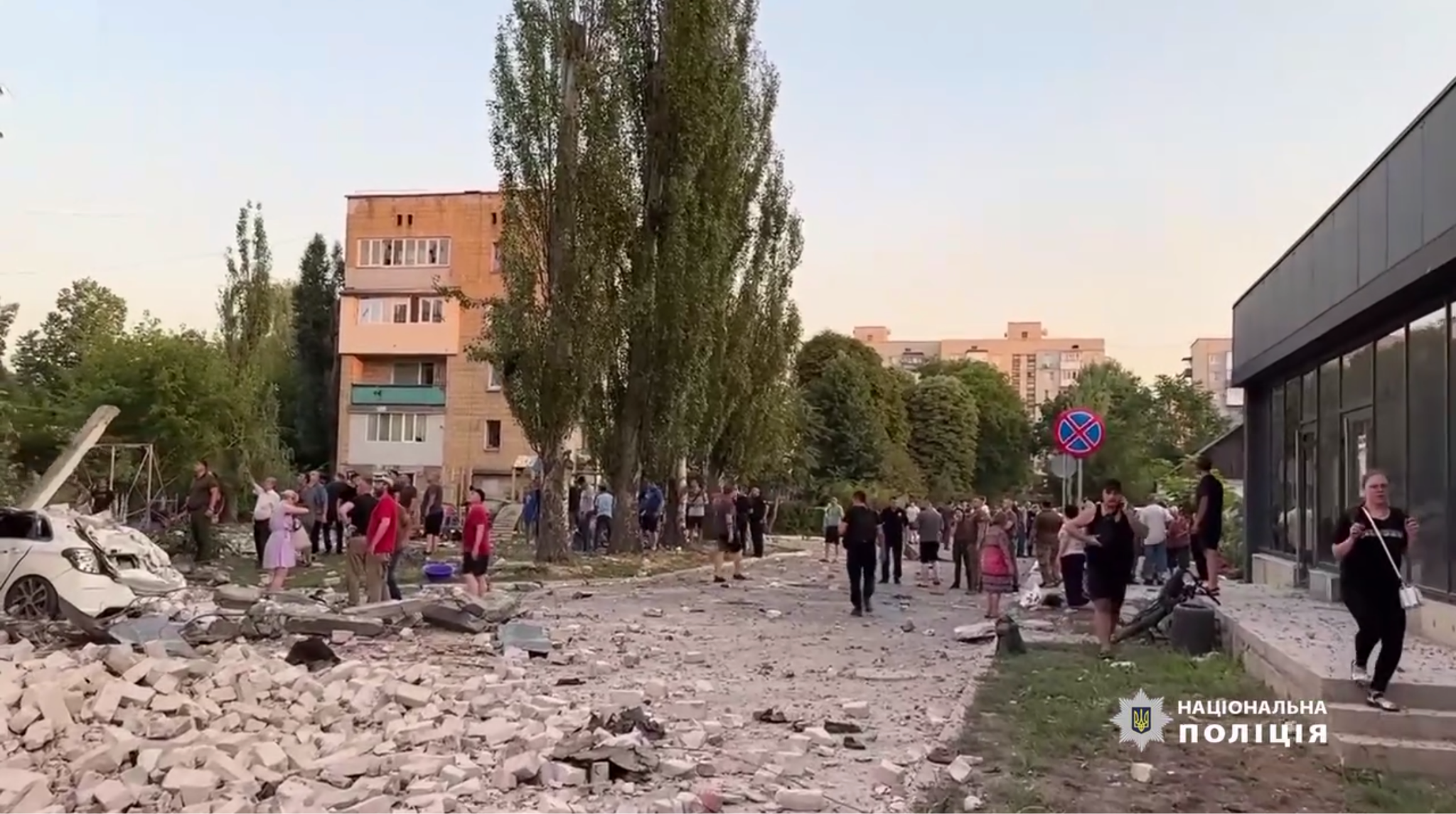
A screenshot showing primarily civilians at the scene shortly after the first strike.
Source: @UA_National_Police via Telegram.[84]
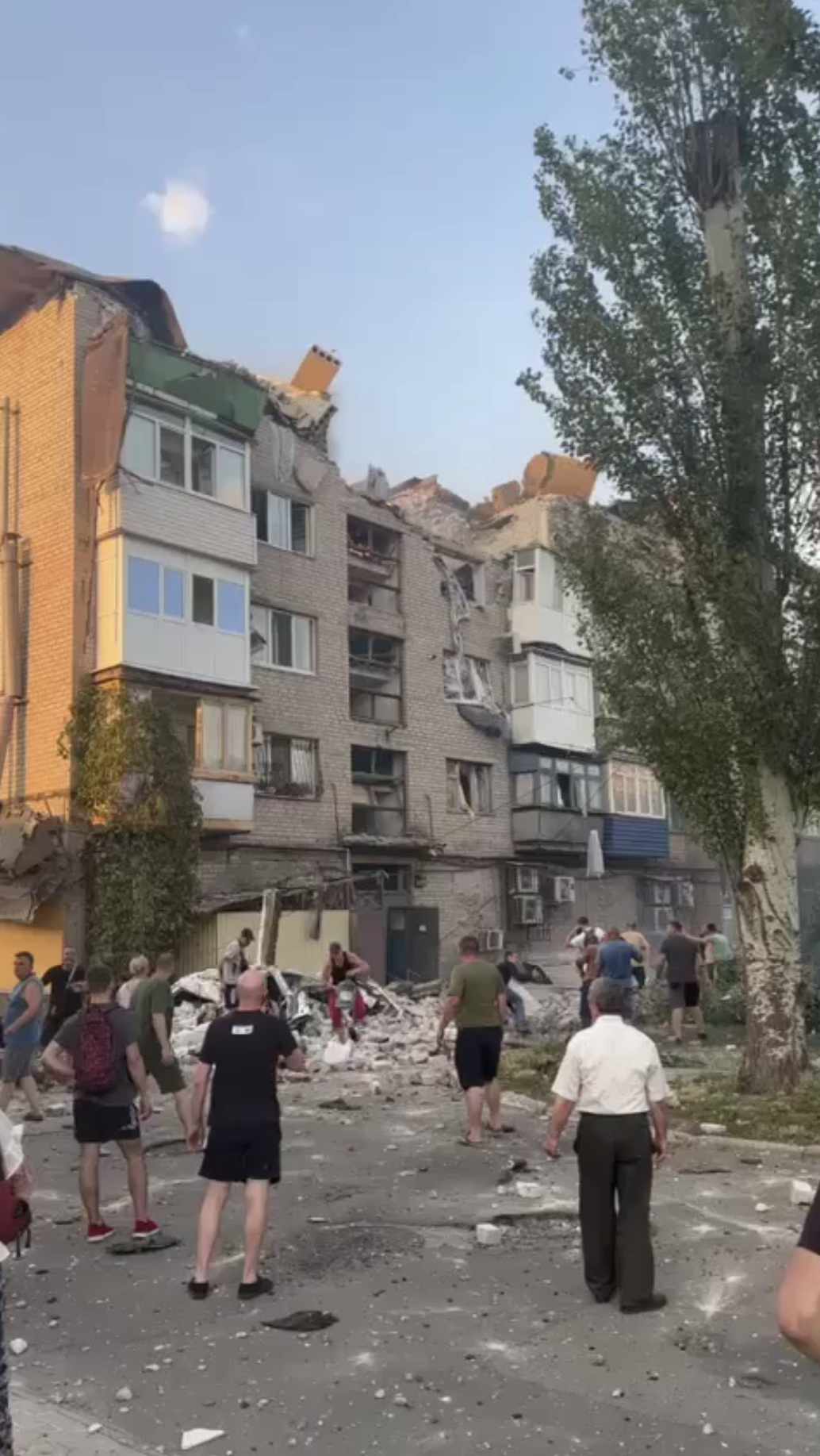
A screenshot from a different video showing primarily civilians at the scene shortly after the first strike.
@magomedov_mus via Telegram.[85]
‘I had a stretcher in my car. I grabbed it and began assisting with the evacuation of people from the building. First, I brought out a woman, then a boy who appeared to be around 12 or 13 years old. Inside, there was also a man named Serhiy who was trapped under the rubble of the house. I shouted to him and he responded’, recounted a witness to the attack, a resident of a neighbouring building and one of the first responders after the first missile hit, speaking to Truth Hounds.[86]
According to witnesses, approximately 10 minutes after the impact, police officers, paramedics and SES workers arrived at the scene.[87] Footage from police bodycams shows that paramedics and police officers were primarily responsible for providing medical aid to the injured and managing their evacuation, while SES workers were evacuating people trapped under the rubble.[88]
At 7:52 PM, a secondary impact occurred when a another missile struck the upper floors of the Druzhba hotel on 149 Tsentralna Street (coordinates: 48°16’56.3″N 37°10’34.2″E), situated approximately 20 metres from the building affected by the initial strike. By that time, police had managed to relocate most civilians from the vicinity of the initial strike by a couple dozen metres. Nevertheless, some local residents remained in the centre of the impacted area, continuing to provide assistance to the wounded civilians, alongside police and medical personnel.[89]
Following the second strike, the number of fatalities rose to 10 and dozens of people were injured. We identified nine of the ten individuals killed in this double-tap attack. Of these, only two fatalities were the result of the initial strike: Rostyslava Petrenko, a cook, and Artem Stepanenko, a restaurant manager, both of whom worked at the Carleone cafe located on the first floor of the building hit by the first missile. The following is a list of individuals who were killed as a result of the second strike:
- One serviceman: Sergeant of the Ukrainian Military Police, Ihor Subotiak;
- Two SES workers: Deputy Head of the SES in Donetsk Oblast, Andrii Omelchenko, and the Head of the 9th State Fire and Rescue Unit, Vitalii Kints;
- One gas service worker: Head of the Emergency Dispatch Service of Pokrovsk Gas Supply and Gasification Department of Donetskoblgaz, Roman Datsenko; and
- Two local residents: Yurii Skachok and Chernyshenko Maria.
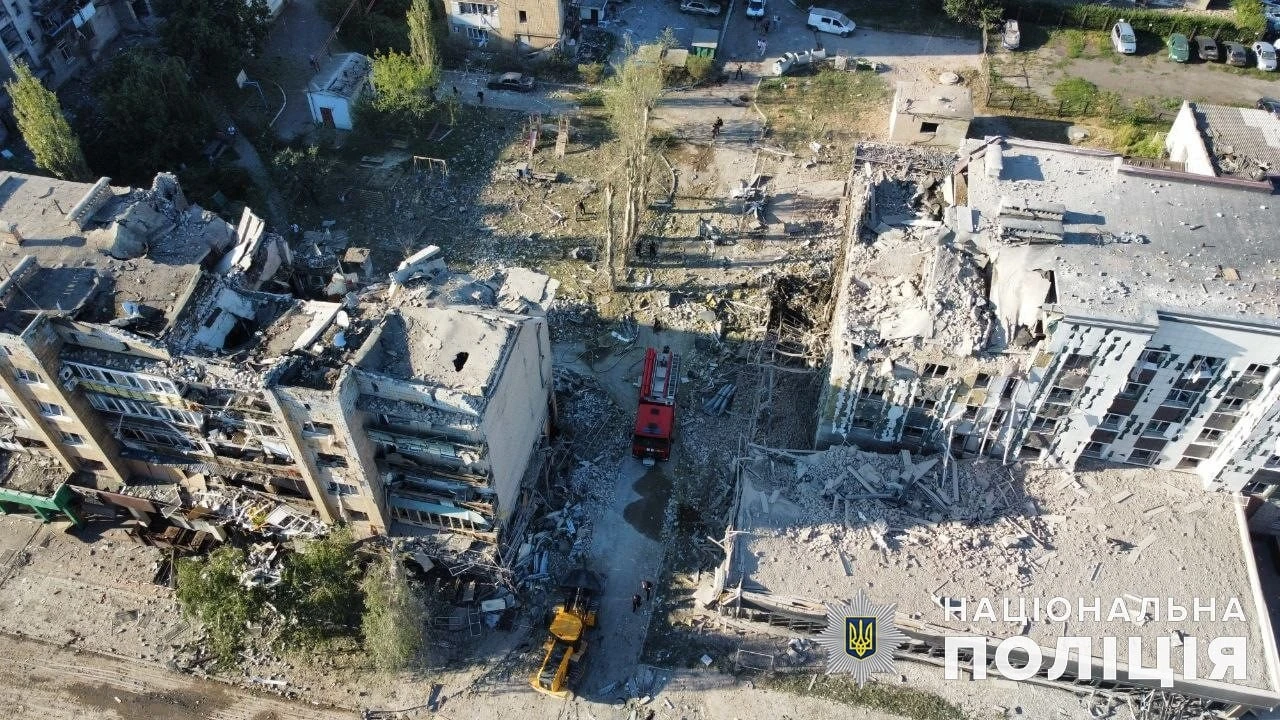
The consequences of the attack.
Source: @UA_National_Police via Telegram.[90]
Information gathered by our field researchers indicates that the hotel was closed at the time of the attack. However, it has been documented that the hotel remained operational and was receiving guests up until a few days prior to the incident.[91]
Truth Hounds field researchers stayed at the hotel in early August 2023. They reported that both civilians and military personnel were staying there, while the hotel basement was used solely as a shelter during air raids. Among the civilian guests were relatives of soldiers visiting their family members, as well as journalists, volunteers, and other individuals. There were no visible military commanders among the visitors, and there was no apparent evidence to suggest that the hotel or its basement housed a command centre or headquarters.[92]
Local residents testified that, on the day of the strike, there was no unusual activity observed near the hotel, nor were there any concentrations of military personnel or military equipment.[93]
Witnesses to the attack reported hearing a noise comparable to that of a fighter jet passing overhead prior to both impacts. Furthermore, some witnesses were able to visually track the missile. These observations offer valuable insights into the missile’s characteristics. The ability of witnesses to visually track the missile indicates that it was moving at subsonic speeds. Additionally, reports of a sound resembling that of a fighter jet indicate the presence of a turbojet engine, a common feature in cruise missiles.
A photograph of the missile wreckage, released by the National Police of Ukraine, reveals an engine from a 9M727 / 9M728 / 9M729 cruise missile.[94]
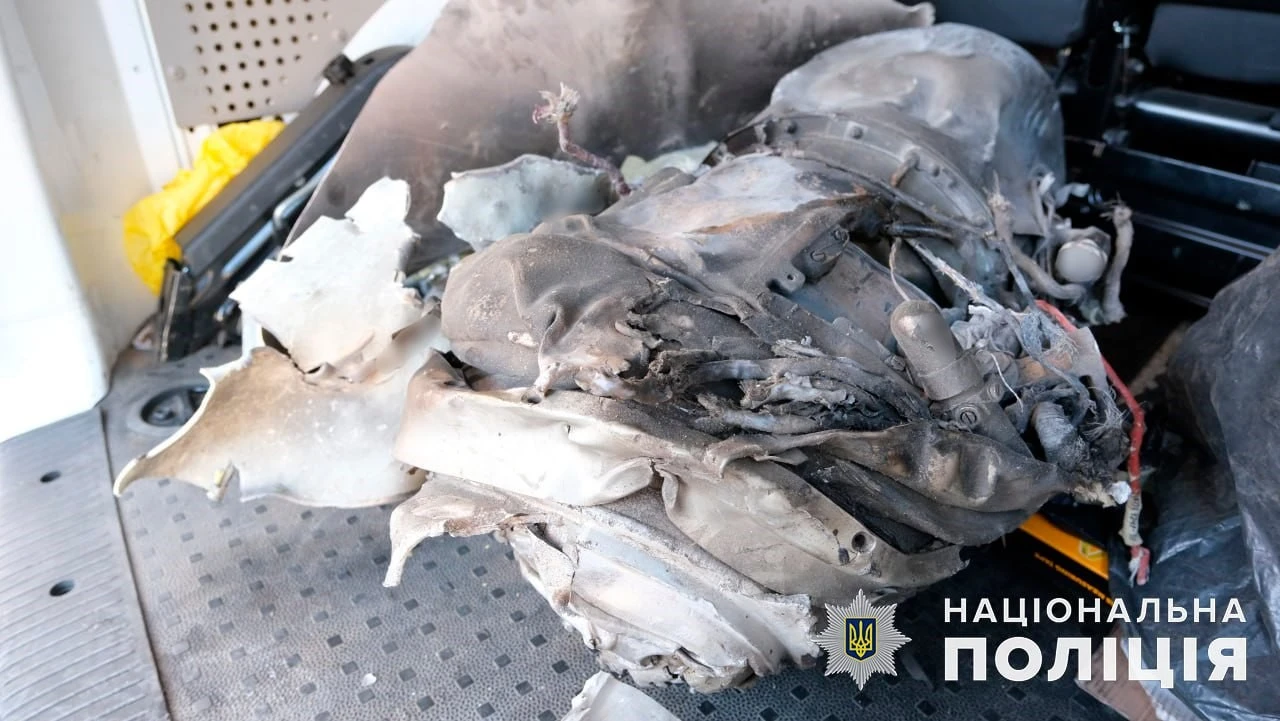
An engine from a 9M727 / 9M728 / 9M729 cruise missile.
Source: @UA_National_Police via Telegram.[95]
The day after the strike, the Russian Ministry of Defense reported the destruction of the command post of the Khortytsia Operational-Strategic Group of Ukrainian Ground Forces supposedly located in Pokrovsk (referred to as Krasnoarmeysk in Russian reports).[96] While many leading Russian military analysts and Telegram channels did not address the attack, others circulated claims alleging that the strike had led to the removal of ‘Western curators [sic]’ and ‘mercenaries’.[97]
Additionally, some reports also emphasised that the strike had led to the ‘elimination’ of the Deputy Head of the SES in Donetsk Oblast, Andrii Omelchenko.[98] This fact further illustrates the observation noted in an earlier section that Russia is actively promoting a narrative that justifies and emphasises the necessity of targeting SES personnel.
A few days after the attack, on 10 August 2023, Russian forces targeted another hotel, the Reikartz, in Zaporizhzhia. While this incident involved the use of two 9M727 / 9M728 / 9M729 cruise missiles and could technically be classified as a double-tap strike, it does not meet the criteria set forth in our methodology for defining ‘double-tap attacks’. In this case, the two missiles impacted the hotel with an interval of one minute,[99] which is not consistent with the general pattern of double-taps outlined in our analysis.
The day after the attack, the Russian Ministry of Defence stated that they hit a temporary base used by ‘foreign mercenaries’ in Zaporizhzhia.[100] In fact, the hotel accommodated civilians who came to the city on business,[101] as well as employees of humanitarian organisations, and also frequently served as a base for UN personnel dealing with humanitarian issues in the region.[102] As a result of the attack, one person was killed and 19 others were injured.[103]
3.1. Responsibility for the attack
Truth Hounds consulted with a group of experts with extensive experience in analysing Russian missile weaponry. This group possesses specialised knowledge on the command chain protocols associated with the deployment of cruise and ballistic missiles launched from Iskander operational-tactical missile systems.
To determine responsibility for a missile attack using Iskander systems, it is essential to consider not only the front sector where the strike occurred but also the type of missile used and the characteristics of the targeted object.
With regard to front sectors, in mid-2022, the Russian Armed Forces established a new organisational structure designed to improve operational effectiveness in the ongoing conflict in Ukraine. This structure, termed the ‘United Group of Russian Forces in Ukraine’ included the ‘Zapad’, ‘Tsentr’, ‘Yug’, ‘Vostok’, and ‘Dniepr’ (‘West’, ‘Centre’, ‘South’, ‘East’, and ‘Dnipro’) groups of forces. Each group was composed of regular combined arms armies and assigned the responsibility of overseeing and coordinating military operations along specific sections of the frontline.[104]

Each group of forces has a specific number of units armed with Iskander missile systems assigned in order to conduct strikes at both tactical and operational depths within the territory of Ukraine. Russia is estimated to have approximately 160 Iskander self-propelled launchers.[105] According to Ukrainian intelligence, as of September 2023, 46 of these launchers were stationed along the Ukrainian border and within the occupied territory of Crimea.[106]
The Russian Armed Forces primarily deploy 9M727, 9M728, and 9M729 cruise missiles to strike pre-identified targets, such as ammunition depots, command posts, and enemy troop deployments. These targets are selected in advance and the strikes are subject to detailed planning. The interval between target approval and an actual strike can exceed one day, with a standard tactical planning window of two hours and 20 minutes. Effective use of these cruise missiles involves meticulous programming of the missile’s flight path, incorporating terrain features to minimise radar visibility and considerations of the locations of the enemy’s air defence systems.[107]
Since the end of 2022, targets for such strikes are approved exclusively by the headquarters of the United Group of Russian Forces in Ukraine.[108] Since January 2023, the group has been commanded by Army General Valery Gerasimov, with Colonel General Alexei Kim and Army General Oleg Salyukov serving as his deputies.[109]
9M723 ballistic missiles are predominantly employed to engage targets identified via reconnaissance assets, such as UAVs, or through agent intelligence. Their high velocity makes them particularly effective at striking targets that are capable of rapid relocation. Typical targets include troop concentrations, convoys, high-value military equipment, air defence systems, and aircraft and helicopters stationed at airfields. For these scenarios, the standard tactical planning and execution window between target approval and a missile strike is 20 minutes.[110]
In these instances, the interval between decisionmaking and strike execution is notably brief and the command chain is less hierarchical compared to the previously described scenario. Decisions on these strikes are generally made at the level of a group of forces headquarters.[111]
The choice of weapon offers important insights into the decisionmaking process, but it should not be considered definitive or exhaustive in isolation. Each case must be analysed within a broader context, including the location and strategic relevance of the targeted objects. For instance, the double-tap strike on Odesa by two 9M723 ballistic missiles on 15 March 2024, as discussed in the previous section, exemplifies this principle. Although the missiles were launched from the temporarily occupied Crimean Peninsula and were likely managed by a brigade associated with the Dniepr group, it is unlikely that this group’s command was responsible for the attack. This is because the targeted object did not fall within the operational focus of the group and its destruction held neither tactical nor operational significance for the group. Therefore, it is highly likely that the planning for this strike was carried out by the headquarters of the United Group of Russian Forces in Ukraine.[112]
Based on the analysis provided, it is highly plausible that the 7 August 2024 attack on Pokrovsk with two cruise missiles launched from an Iskander missile system was orchestrated from the headquarters of the United Group of Russian Forces in Ukraine.
Located in the western part of Donetsk Oblast, Pokrovsk fell under the operational scope of the Yug Group of Forces as of August 2023, when the strike occurred. This is supported by reports from the Russian Ministry of Defence, which confirm that attacks on adjacent settlements were conducted by forces from this specific group.[113] However, since the decision to execute the attack was made at a higher command level than that of the Yug group, the missile brigade responsible for the launch may not necessarily be part of this group. In the absence of open-source information regarding the missile launch area, it is not feasible to identify the specific missile brigade responsible for the launch on that day based solely on the data currently available.
Section 4. Cherkaska Lozova: Circumstances and Accountability
Cherkaska Lozova is a village in Kharkiv Oblast, 1 km north of Kharkiv Ring Road. On 19 May 2024, the local Bereh Recreation Centre, situated on the shore of the Lozovenka Reservoir, was hit by a Russian doubletap missile attack, which killed at least 9 people and injured 26.[114]
At 11:03 AM, the first missile struck next to the beach on the grounds of the centre (coordinates: 50°05’32.2″N 36°12’25.4″E), killing five people and injuring at least another five.[115] The impact created a crater, promptly flooded by water from the nearby reservoir.
‘I noticed the body of a man struck in the head by shrapnel, another man lying face down on the ground, and a pregnant woman lying upside down on a bench. I thought about helping her, but given the seriousness of her wounds, I realised that I would not be able to help. I also know that Anatoliy, who was fishing on the territory of the centre, and Mykola, who was fishing nearby, were both killed in the initial attack’, a witness to the attack told Truth Hounds.[116]
Five to seven minutes after the initial impact, police arrived at the scene, with emergency medical services arriving shortly thereafter, within another five to six minutes.[117] At that time, SES personnel had not yet arrived at the site of the strike. Meanwhile, medics and police immediately began to provide first aid to the wounded.
The second strike occurred at 11:21 AM. The missile detonated close to a fountain situated at the centre of the grounds, approximately 40 metres from the location of the first impact (coordinates: 50°05’32.3″N 36°12’27.6″E).[118]
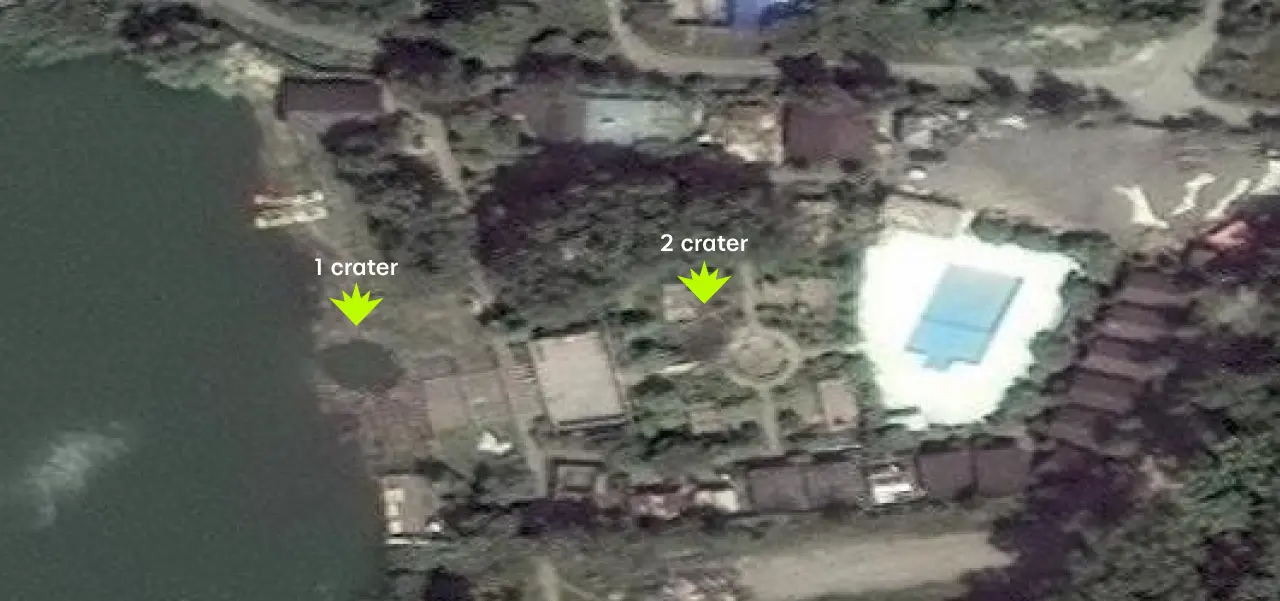
The locations of the first and second strikes. Satellite imagery from 12 July 2024.
‘As a result of this attack [the second strike], I broke both shin bones and an ankle joint on my left leg. Also I lost one phalanx on my index finger and two phalanges on the middle finger of my left hand. I broke ribs, got an acubarotrauma, which left me unable to hear in my left ear. I suffer from dizziness and nausea. In the first days, I could not sleep because of nightmares about the incident, the dead people’, shared a survivor of the second strike.[119]
As a result of the second strike, four people were killed and the number of wounded increased to 26. Among the injured were a policeman and a health worker who provided assistance to the wounded after the first strike. Media reports and public statements by law enforcement published in the days after the attack indicate that around seven people were killed and 28 wounded as a result of the attack.[120] However, two more people later died from their injuries in the hospital, including the husband of a pregnant woman killed in the initial strike.[121]
Eyewitnesses to the attack assert that, on the day of the attack and in the days leading up to it, there were no Ukrainian military personnel present at the recreation centre. Although one serviceman was killed in the attack, he was at the base on holiday with his wife. According to the centre’s staff and local residents, there were no military facilities or dual-purpose objects nearby, only houses inhabited by civilians.[122]
We further analysed the available satellite imagery of the surrounding area. The most recent images prior to the attack are from 4 and 9 May 2024. These dates are too distant from the attack to assess what was occurring in the area immediately before the strike. However, the analysis indicates that, as of early May, there were no military bases, air defence systems, or concentrations of armoured vehicles in the vicinity of the recreation centre.

Satellite imagery of the recreation centre and the surrounding area on 4 May 2024.
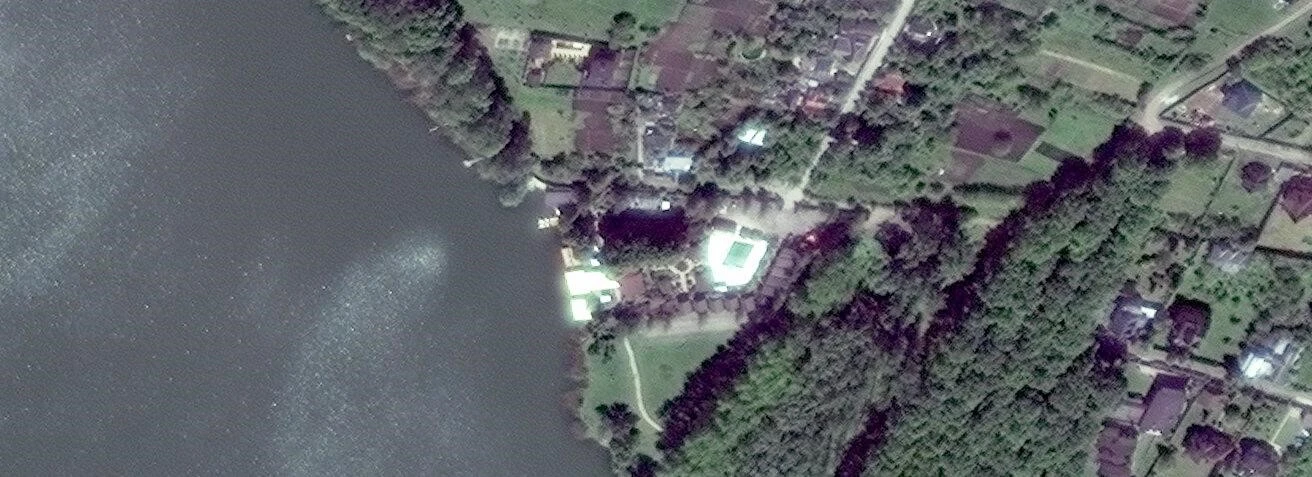
Satellite imagery of the recreation centre and the surrounding area on 9 May 2024.
A few minutes before the first strike, the Ukrainian Air Force reported a threat of ballistic missile attacks from the east.[123] Following the strikes, the Kharkiv Regional Prosecutor’s Office reported that the attack had been executed using two 9M723 ballistic missiles launched from the territory of Russia’s Belgorod Oblast. Additionally, they published photos of missile fragments found at the impact site.[124]
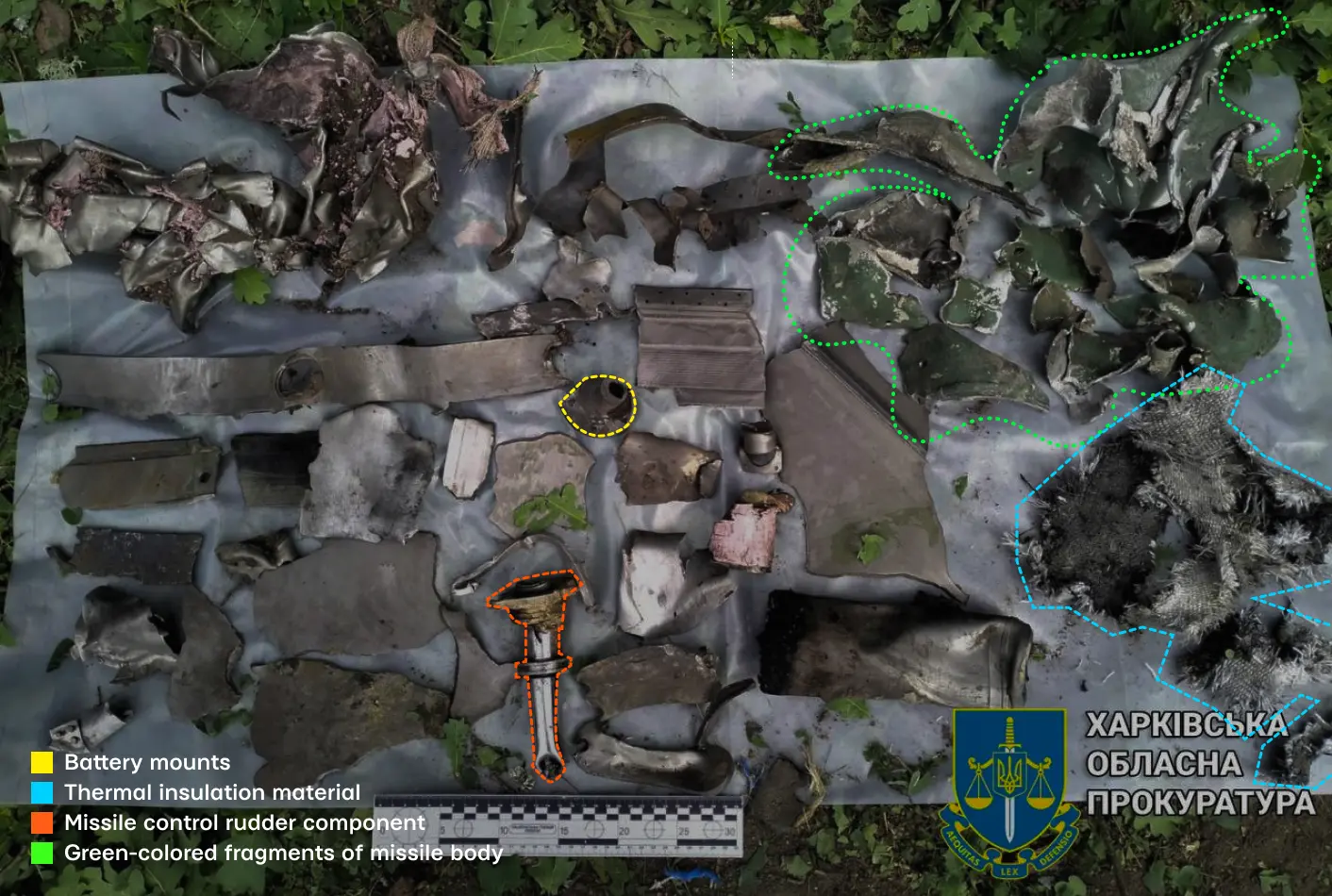
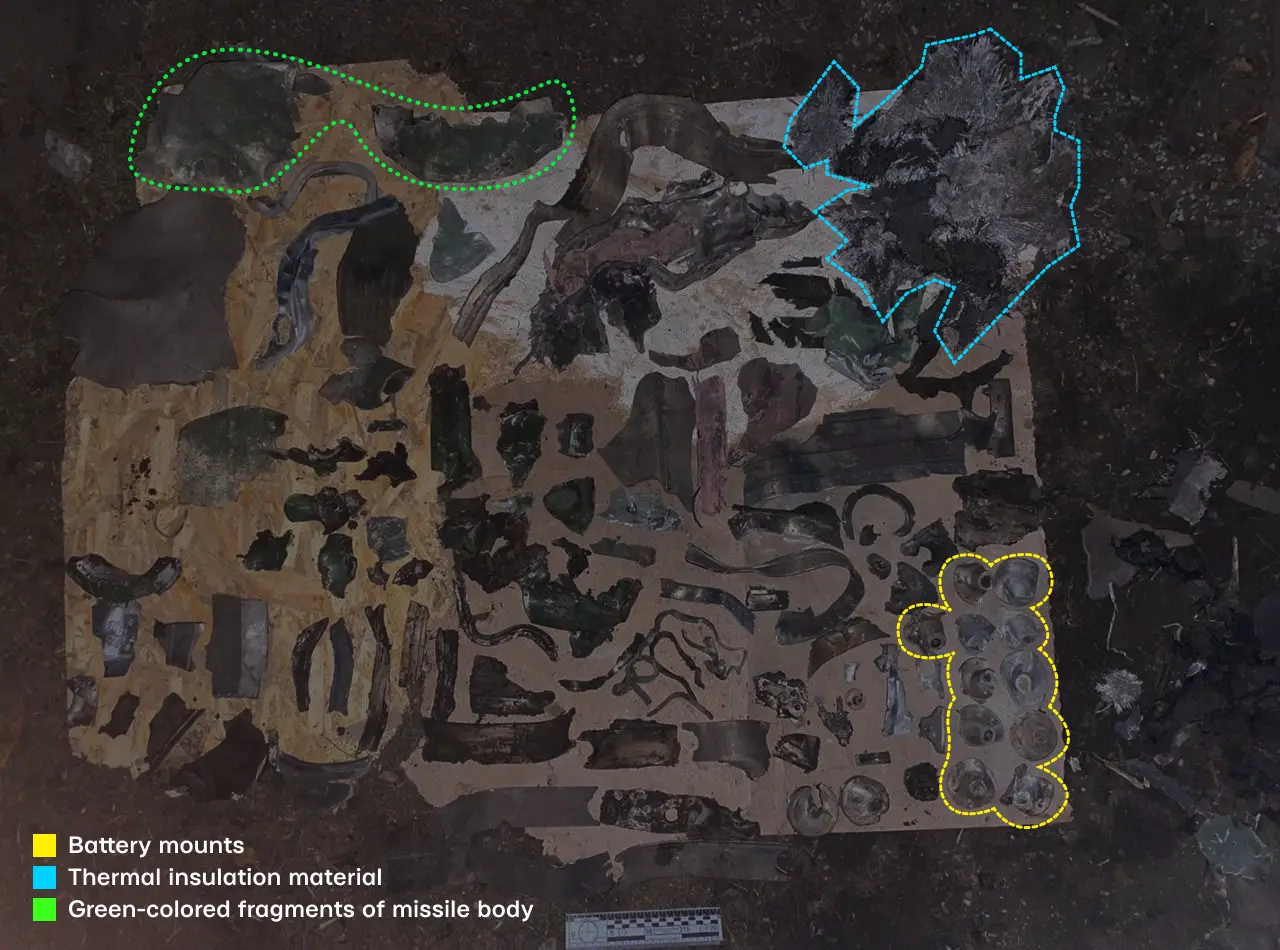
Based on these photographs, we can compare the fragments of the missile found at the attack site with those found at 9M723 ballistic missile impact sites in other settlements in Kharkiv Oblast. The images clearly reveal common fragments from the distinctive green-coloured missile’s body, thermal insulation material, battery mounts, missile control rudder components, and other details.
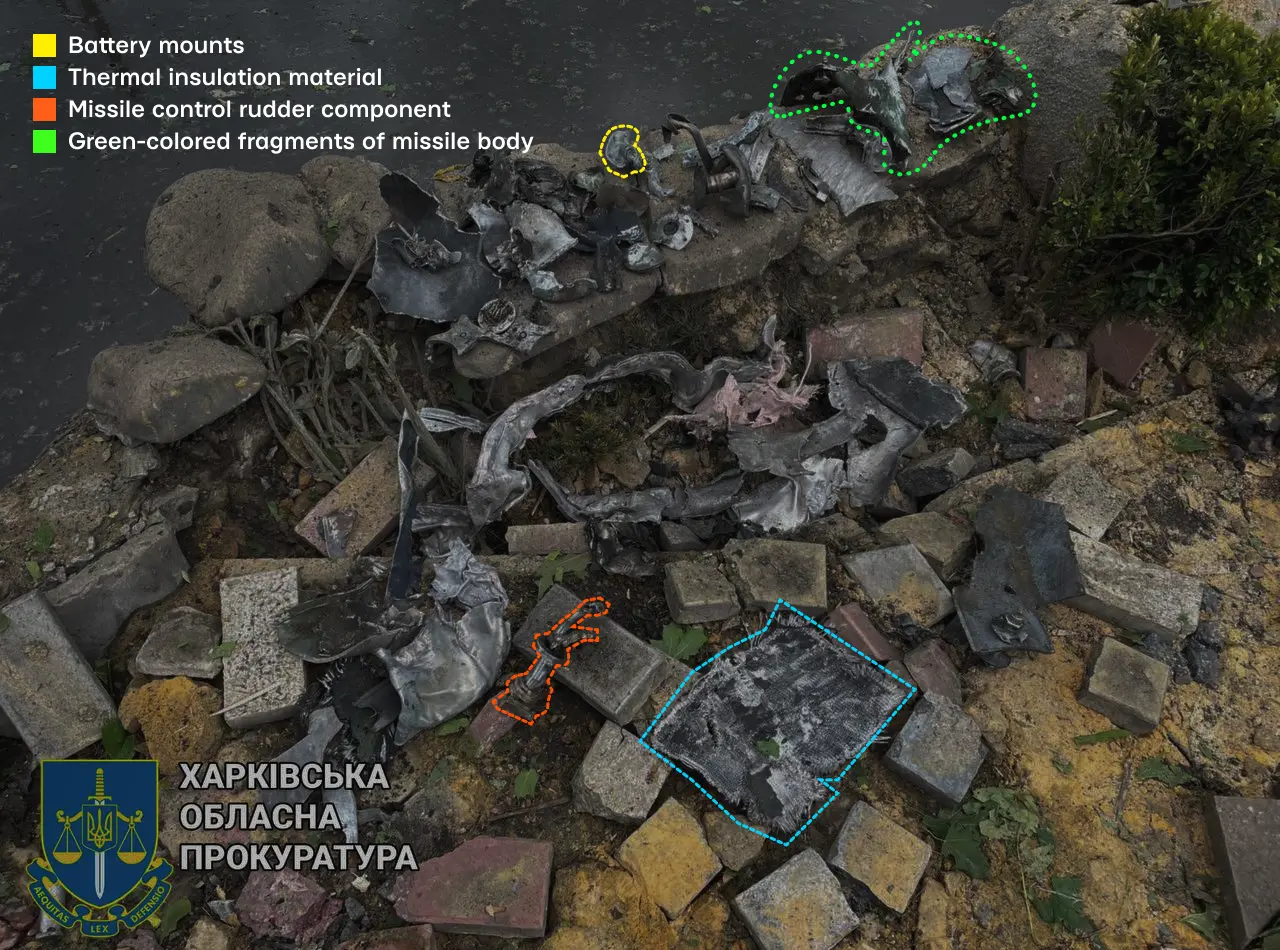
9M723 ballistic missile fragments found in Cherkaska Lozova.
Source: @prokuratura_kharkiv via Telegram.[125]
9M723 ballistic missile fragments found in Kutkivka.
Source: @prokuratura_kharkiv via Telegram.[126]
9M723 ballistic missile fragments found in Pervomaiskyi.
Source: @Сергій Болвінов via Facebook.[127]
Assessing the crater parameters is challenging due to several factors. First, the Truth Hounds field team did not have the opportunity to examine or measure the craters. Second, the initial strike’s crater was immediately flooded with water from the reservoir, making even rough estimates of its depth based on open-source images impossible. According to witness testimony, the diameter of the first crater was approximately six metres, while the diameter of the second crater from the subsequent hit was only about two metres.[128]
Typically, the warhead of a 9M723 missile, weighing 500 kg, would create a crater of at least five to six metres in diameter. A crater with a diameter of two metres can be attributed to the possibility that the missile’s detonation occurred above ground level rather than upon direct impact with the surface.
A missile could explode above the surface due to a so-called proximity (non-contact) fuse. Non-contact detonators are installed on missiles, bombs, and shells (including cluster munitions). The primary objective of an airburst detonation is to maximise the dispersion radius of fragments and blast effects, thereby inflicting damage over the greatest possible area.
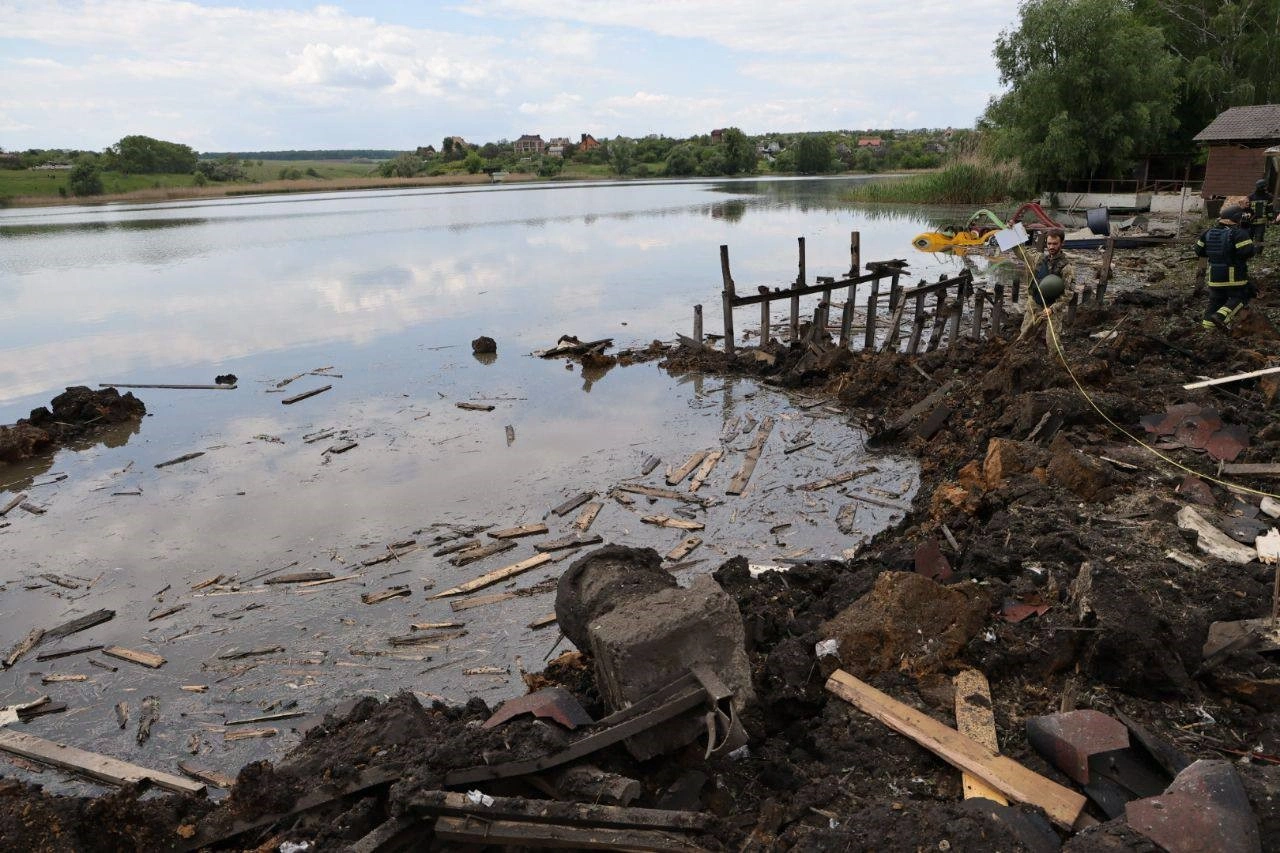
The crater formed after the first strike on the recreation centre in Cherkaska Lozova.
Source: @kharkivlife via Telegram.[129]
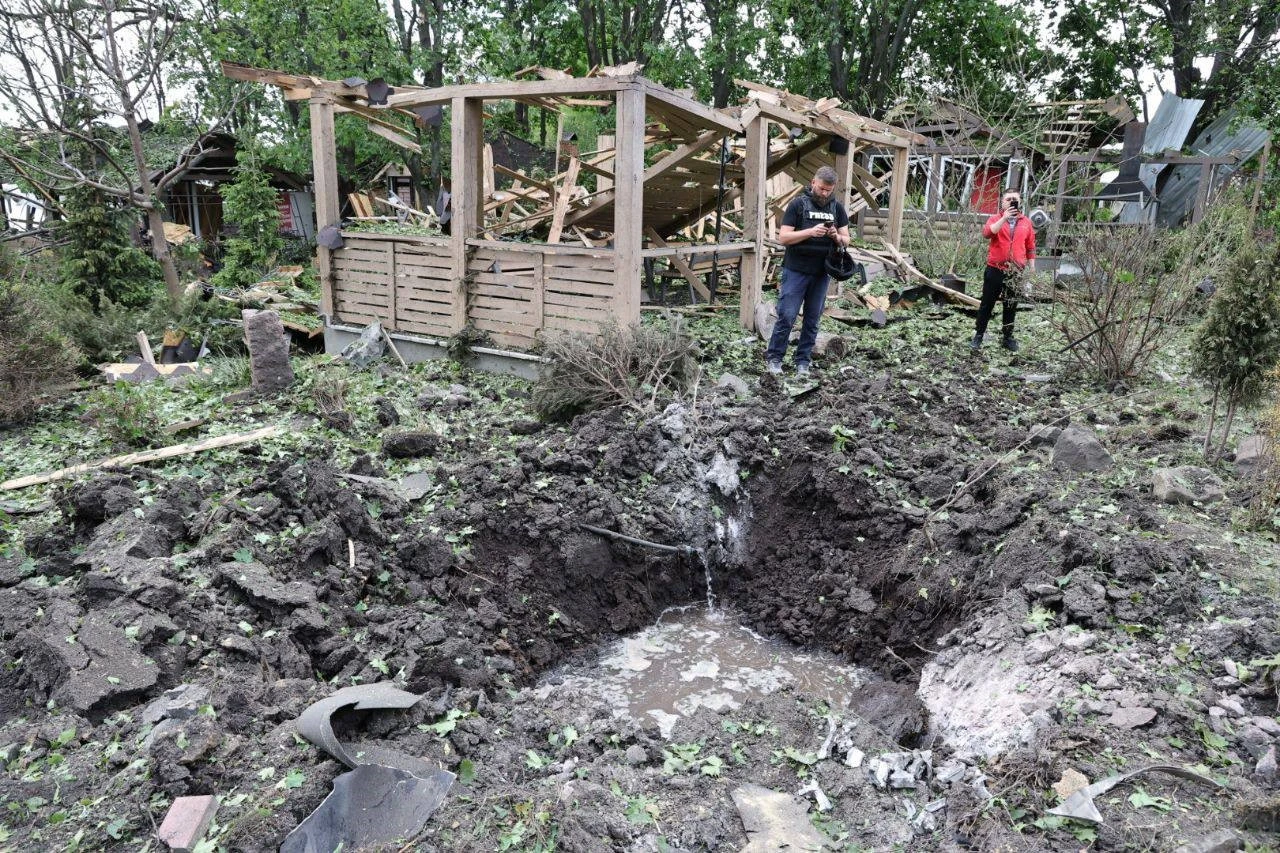
The crater formed after the second strike on the recreation centre in Cherkaska Lozova.
Source: @kharkivlife via Telegram.[130]
Non-contact detonators are also utilised in ballistic Iskander missiles. According to publicly available information, Almaz-Antey concern’s enterprise, PJSC NPP Impulse, manufactures laser detonation altitude sensors for 9N123 (launched from Tochka missile systems), 9M723, and other missiles. The manufacturer claims that such fuses are made on the basis of unified technical solutions and can therefore be installed on various types of missiles.[131] Additionally, it is known that the Iskander-E missile system, an export variant of the Iskander-M, integrated a new-generation laser sensor into its equipment starting in 2012.[132] The main differences between the two systems are the export version’s reduced range of 280 km and a more significant circular probable deviation.[133]
A video demonstrating the use of a 9M723 missile equipped with such a warhead was published online nine days prior to the attack on Cherkaska Lozova. According to a Russian military correspondent, the footage purportedly depicts the destruction of an M902/903 launching station and an AN/MPQ-65 radar from a Patriot surface-to-air missile system.[134] The authors of the Ukrainian informational portal ‘Tysk’ presented evidence indicating that the Russian side had only destroyed mock-ups of the launching station and radar.[135]
The video clearly shows a mid-air detonation and the resulting crater. The crater is comparable in size to the one left after the second strike on Cherkaska Lozova.
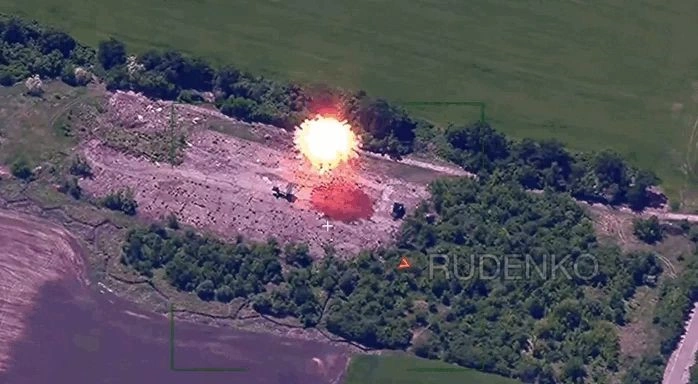
Mid-air detonation of a 9M723 ballistic missile provided for by a proximity fuse.
Source: @RtrDonetsk via Telegram.[136]
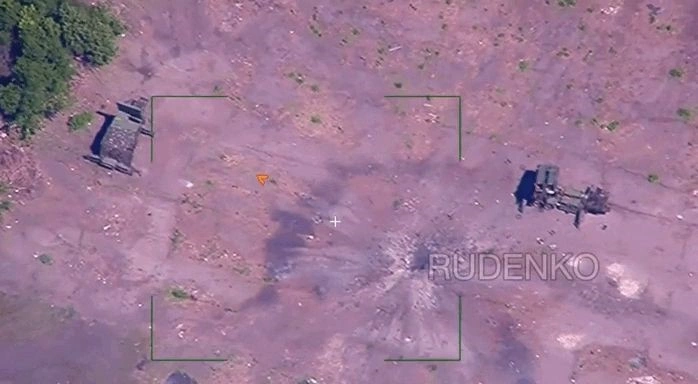
A crater formed after the mid-air detonation of a 9M723 ballistic missile.
Source: @RtrDonetsk via Telegram.[137]
Therefore, the assault on the recreation centre in Cherkaska Lozova involved the use of 9M723 ballistic missiles. The second missile most likely appeared to detonate in mid-air to maximise its area of impact.
Neither the Russian Ministry of Defence nor Russian military observers issued any comments regarding the strike. The incident was only covered by relatively small Telegram channels disseminating propaganda which alleged that the attack targeted a base of ‘militants’. Furthermore, the presence of a tattoo on one of the victims was interpreted as evidence of his association with ‘mercenaries’.[138]
4.1. Responsibility for the attack
Based on the analysis presented in Subsection 3.1, it is highly probable that the decision to execute the strike on Cherkaska Lozova was made by the headquarters of the group of forces responsible for that sector at the time.
In April 2024, the Russian Ministry of Defence established a new group of forces designated as ‘Sever’ (‘North’).[139] This formation was established following the disbanding of the Western Military District, whose units comprised the Zapad Group of Forces. On its basis, the Moscow Military District and the Leningrad Military District were then created.
The area of operations for the Zapad group was narrowed to active engagements on the Lyman and Kupiansk directions (the units of the reformatted Zapad group became part of the Moscow Military District). Simultaneously, the newly established Sever Group of Forces assumed responsibility for all personnel stationed in the Bryansk, Kursk, and Belgorod oblasts of Russia (the units of the Sever group became part of the Leningrad Military District). This formation was tasked with both serving as a deterrent against potential incursions by the Ukrainian Armed Forces into these regions and executing new offensive operations, particularly in the northern part of Kharkiv Oblast.[140]

However, following the abolition of the Western Military District, the 26th and 152nd Missile Brigades were integrated into the Leningrad Military District, while the 112th and the 448th Missile Brigades became a part of the Moscow Military District.
According to military analysts, in May 2024, Russian offensive operations in northern Kharkiv Oblast was conducted not only by units of the Sever group but also by select units from the Zapad group.[141] This implies that the Iskander missile strikes on Kharkiv and surrounding settlements, including Cherkaska Lozova, could have been executed by missile brigades from either of these groups of forces. In early May 2024, military analysts highlighted the deployment of a tactical group comprising up to six launchers of the 9M720 Iskander operational-tactical missile system to support the operations of the Sever group.[142] At the same time, there were no reports regarding the number of active Iskander launchers within the Zapad group.
As such, it is highly plausible that the decision to conduct the strike on Cherkaska Lozova was made by the headquarters of either the Sever or Zapad group of forces, with execution carried out by one of the brigades listed. A brief overview of each brigade follows.
The 26th Missile Brigade
The brigade belongs to the 6th Combined Army, which is one of the main units in the Sever Group of Forces. In a conversation with an undercover Ukrainian journalist, Konstantin Elfimov, the commander of the 26th Missile Brigade, confirmed the brigade’s involvement in hostilities, explicitly acknowledging that Kharkiv was among the cities targeted by the brigade.[143] Additional evidence of the brigade’s involvement in attacks on Ukraine includes a video published in 2023, celebrating ‘Victory Day’ on 9 May.[144] In this video, soldiers from the brigade refer to themselves as ‘heroes of the “special military operation”’, indirectly affirming their participation in the ongoing conflict.
The 448th Missile Brigade
The brigade belongs to the 20th Combined Army, which is a part of the Zapad Group of Forces. The brigade’s involvement in hostilities is confirmed by video footage showing a missile launch from a self-propelled launcher bearing the brigade’s tactical insignia on its door.[145] The Main Directorate of Intelligence of the Ministry of Defence of Ukraine has also confirmed the brigade’s involvement in the armed conflict in Ukraine and has published a list of some of its personnel[146]. According to this list, the brigade’s commander is Colonel Dmitry Martynov (at least as of March 2022).
The 152nd Missile Brigade
The 152nd missile brigade belongs to the 11th Army Corps, which is a part of the Sever Group of Forces. The brigade participated in the invasion of Ukraine by supporting Russian forces in their attacks on Kharkiv Oblast in 2022.[147] As of April 2023, part of the brigade was operating in the Kupiansk direction,[148] while another segment likely remained near its location of permanent deployment in Kaliningrad Oblast to safeguard the Russian semi-exclave, as it is the only unit in the region armed with Iskander systems.[149] The brigade is most likely commanded by Lieutenant Colonel Anatoliy Gromov.[150]
The 112nd Missile Brigade
The 112nd Missile Brigade belongs to the 1st Guards Tanks Army, which is a part of the Zapad Group of Forces. The participation of the brigade in the invasion was confirmed by its commander in a conversation with an undercover Ukrainian journalist.[151] The brigade is commanded by Colonel Sergey Ponomarev.[152]
Section 5. International Law Perspective
‘Double-tapping’ describes the practice of striking a target twice or even three times to ensure the initial target is neutralised or, more insidiously, to specifically target first responders[153] who arrive to assist the victims of the initial strike.[154]
Previously, double-tapping was primarily understood as targeting a military target first and then at arriving first responders.[155] However, perceptions have shifted towards acknowledging that it can also involve multiple targeting of a purely civilian target, first aimed at civilians and/or civilian objects and then aimed at arriving first responders.[156]
To ensure a thorough and objective analysis, this section of the report will examine both types of practices from the perspectives of international humanitarian law and international criminal law (ICL).
5.1. Double-tapping civilians and civilian objects
5.1.1. Protection of civilians and civilian objects under international humanitarian and criminal law
The principle of distinction, usually referred to as the ‘cardinal principle’[157] of international humanitarian law, requires the parties to an armed conflict at all times to distinguish between civilians and combatants, between civilian objects and military objectives.[158]
The principle of distinction is codified in Article 48 of Additional Protocol I (hereafter, AP(I)) and other provisions of the Protocol providing protection to civilians and civilian objects.[159] The former provides:
In order to ensure respect for and protection of the civilian population and civilian objects, the Parties to the conflict shall at all times distinguish between the civilian population and combatants and between civilian objects and military objectives and accordingly shall direct their operations only against military objectives.[160]
Civilian objects are all objects which are not military objectives as defined in paragraph 2.[161]
Attacks shall be limited strictly to military objectives. In so far as objects are concerned, military objectives are limited to those objects which by their nature, location, purpose or use make an effective contribution to military action and whose total or partial destruction, capture or neutralization, in the circumstances ruling at the time, offers a definite military advantage.
(i) The nature, location, purpose, or use which makes an effective contribution to military action; and
(ii) The total or partial destruction, capture, or neutralisation which in the circumstances ruling at the time offers a definite military advantage.[162]
The nature of objects as a first criterion concerns the category of objects directly used by armed forces, namely weapons, equipment, transports, fortifications, depots, staff headquarters, and so on. The location of objects as a second criterion highlights that certain objects that are not of a military nature but which, due to their location, make an effective contribution to military action can be considered as military objectives. A bridge, a railroad, or a construction that might be of special significance for the military operations of one of the parties to a conflict, either due to the fact that it must be seized or that it is crucial to prevent the enemy from seizing it or would otherwise necessitate compelling the enemy to withdraw from it, would be an example. Finally, while use refers to the present function of an object, purpose concerns the intended future use of it. For instance, a school accommodating troops of one of the parties to a conflict would be considered a military objective because of its use.[163] On the other hand, if one of the parties to a conflict is planning to attack the adversary’s firing positions on the outskirts of a town and such adversary is planning to retreat from its positions to houses further inside of the town, due to the intended purpose of the use of these houses as an escape route, they are likely to be considered as military objectives.[164]
The notion of effective contribution to one of the parties’ military actions does not require the direct connection between military objectives and combat operations, meaning that even a civilian object indirectly used for combat action, which nevertheless provides an effective contribution to the overall war effort of one the parties to the conflict, would suffice.[165]
Besides the fact that a military objective should make an effective contribution to one of the parties’ military actions, its total or partial destruction, capture, or neutralisation by the adversary must offer a definite military advantage in the circumstances ruling at the time. Such an anticipated military advantage should be determined in the context of the military advantage anticipated from the specific military operation – of which the attack is a part – considered as a whole, excluding its assessment only from isolated or particular parts of that operation.[166] At the same time, the anticipated military advantage cannot be ‘indeterminate or potential’.[167]
It can be inferred that, in certain circumstances, civilian objects may be used for the benefit of an army, so they are simultaneously used for both civilian and military purposes. These objects are commonly referred to as ‘dual-use objects’, e.g., power grids, industrial facilities, highways, and railroad tracks that often have a dual function. In such situations, to qualify the respective object as a military objective, it is necessary to take into account the time and place of the attack (in circumstances ruling at the time),[168] together with the expected indirect civilian harm (loss among the civilian population and damage to civilian objects).[169]
In case of doubt whether an object which is normally dedicated to civilian purposes, such as a place of worship, a house or other dwelling, or a school, is being used to make an effective contribution to a military action, it shall be presumed not to be so used, as per Article 52(3) of AP(I).[170]
NB
Just as in the second sentence of Article 48 of AP(I), Article 52(2) of AP(I) stipulates that attacks (operations) can be directed ‘only against military objectives’. The term ‘military objective’ encompasses not solely military objects, but also includes combatants.[171]
The named provisions of AP(I) should be read conjointly with other IHL rules, namely the prohibition on attacking persons recognised to be hors de combat (see Subsection 5.2.1 for more detail) and the already mentioned protection of civilians against attack unless and for such time as they take a direct part in hostilities.[172] Consequently, the principle of distinction can be explained in the way that a person is ‘targetable under international humanitarian law … by virtue of having a continuous combat function or directly participating in hostilities’.[173]
It can be inferred from such an explanation that any attack, be it a one-time strike or a double-tap strike against a purely civilian target (civilians and/or civilian objects), would violate the IHL principle of distinction. Thus, it would constitute the war crime of attacking civilians and/or civilian objects/ under Articles 8(b)(i) and 8(b)(ii) of the Rome Statute.[174]
At the same time, this report clearly demonstrates that the repeated use of double-tapping in Ukraine by Russia is often aimed at the first responders to initial attacks on civilian targets — medical personnel, SES workers, police officers, journalists, and others. While in such a scenario it is explicit that both strikes constitute the war crime of attacking civilians and/or civilian objects, it is necessary to establish how the qualification of the second strike would differ from the former under both IHL and ICL considering the protected statutes of some of the targeted groups.
(i) Protection of medical personnel
Under international humanitarian law, civilian medical personnel must be respected and protected in all circumstances.[175] Civilian medical personnel can be defined as medical personnel who are not members of the armed forces but who have been assigned by a party to the conflict exclusively to medical tasks.[176] Civilian medical personnel would lose their protection only if they commit, outside of their humanitarian function, acts harmful to the enemy.[177]
According to Article 18(1) of AP(I), the respective party to the conflict shall endeavour to ensure that medical personnel, medical units, and transports are identifiable.[178] Annex 1 to the Protocol, as well as Protocol III to the Geneva Conventions (hereafter, GC), which display the respective distinctive emblems, are relevant here.[179]
Under ICL, a direct attack on medical personnel (either as such or as first responders) would qualify as the war crime of attacking objects or persons using the distinctive emblems of the Geneva Conventions prohibited under Article 8(2)(b)(xxiv) of the Rome Statute.
(ii) Protection of State Emergency Service of Ukraine personnel and materiel
SES personnel responsible for carrying out state policy in the domain of civil protection, namely prevention of emergencies, rectification of the consequences of an emergency, rescue work, extinguishing fires, fire and technogenic safety, accident rescue service activities, and hydrometeorological activities,[180] constitute civil defence personnel protected under international humanitarian law.[181]
Civil defence is defined in IHL according to tasks performed rather than by a list of specific organisations carrying out such civil defence tasks. First, Article 61(a) of AP(I)[182] mentions that civil defence ‘means the performance of some or all of the undermentioned humanitarian tasks intended to protect the civilian population against the dangers, and to help it to recover from the immediate effects of hostilities or disasters and also to provide the conditions necessary for its survival’. Then, Article 61(a) of AP(I) lists these ‘humanitarian tasks’ which include warning, evacuation, management of blackout measures, rescue, fire-fighting, and so on.
b) “civil defence organizations” means those establishments and other units which are organized or authorized by the competent authorities of a Party to the conflict to perform any of the tasks mentioned under sub-paragraph a), and which are assigned and devoted exclusively to such tasks;[183]
c) “personnel” of civil defence organizations means those persons assigned by a Party to the conflict exclusively to the performance of the tasks mentioned under sub-paragraph a), including personnel assigned by the competent authority of that Party exclusively to the administration of these organizations;
d) “matériel” of civil defence organizations means equipment, supplies and transports used by these organizations for the performance of the tasks mentioned under sub-paragraph a).[184]
Civilian civil defence organizations and their personnel shall be respected and protected, subject to the provisions of this Protocol, particularly the provisions of this Section. They shall be entitled to perform their civil defence tasks except in case of imperative military necessity.
Buildings and materiel used for civil defence purposes and shelters provided for the civilian population are covered by Article 52. Objects used for civil defence purposes may not be destroyed or diverted from their proper use except by the Party to which they belong.[185]
This protection is supplementary to the general protection of civilian populations and civilian objects under Article 51 and Article 52 of AP(I).[186] Respectively, civilian defence personnel and their materiel are protected to the extent they are assigned exclusively[187] to one of the above-listed tasks, even if temporary.[188]
Under Article 65(1) of AP(I), civil defence organisations, personnel, buildings, shelters, and materiel would lose protection only if ‘they commit or are used to commit, outside their proper tasks, acts harmful to the enemy’. Further, Article 65(2) of AP(I) states that the following acts are not to be considered as harmful to the enemy:
a) that civil defence tasks are carried out under the direction or control of military authorities;
b) that civilian civil defence personnel co-operate with military personnel in the performance of civil defence tasks, or that some military personnel are attached to civilian civil defence organizations;
c) that the performance of civil defence tasks may incidentally benefit military victims, particularly those who are hors de combat.
Lastly, Paragraphs 3 and 4 of Article 65 of AP(I) additionally emphasise that bearing light individual weapons as well as the formation of civil defence organisations along military lines and compulsory service in them should not deprive them of the respective protection.[189]
The already mentioned Article 8(2)(b)(xxiv) of the Rome Statute on the war crime of attacking objects or persons using the distinctive emblems of the Geneva Conventions in conformity with international law is also relevant here. Although the authoritative commentaries to the Rome Statute do not explicitly include civil defence personnel in the list of protected persons under Article 8(2)(b)(xxiv),[190] they do recognise the fact that other protected signs have been added by Additional Protocol I and that such extended scope of protected signs is foreseen by the wording of Element 1 of the respective war crime:
‘The perpetrator attacked one or more persons, buildings, medical units or transports or other objects using, in conformity with international law, a distinctive emblem or other method of identification indicating protection under the Geneva Conventions’.[191]
In particular, Chapter V of Annex 1 to AP(I), read together with Article 66(4) of AP(I), enshrines that the international distinctive sign of civil defence consists of an equilateral blue triangle on an orange background.[192]
NB
The obligation to display the international distinctive sign of civil defence and to carry an identity card, required by Chapter V of Annex 1 to AP(I) and Article 66(3) of AP(I), applies only when civil defence activities are conducted in occupied territories and in areas where fighting is taking place or is likely to place as well as when personnel are exclusively devoted to the performance of civil defence tasks.[193]
Accordingly, the attack on SES personnel and their materiel would per se fall under the provisions of Article 8(2)(b)(i) of the Rome Statute as the war crime of attacking on civilians. However, given the broad wording of Article 8(2)(b)(xxiv) of the Rome Statute, it should not be excluded that the named personnel and their materiel might alternatively fall under its protection, just as medical personnel.
(iii) Protection of journalists and members of the National Police of Ukraine
Russian double-tapping on Ukraine has demonstrated that often not only medical and civil defence personnel tend to be the first responders to initial strikes but also journalists arriving at the scene to film the targeted site and police officers arriving to help people in need, ensure security, and document the attack.
Under IHL, journalists engaged in dangerous professional missions in areas of armed conflict are civilians per se and cannot be directly attacked as long as they do not take direct part in hostilities. Specifically, pursuant to Article 79(2) of AP(I), journalists are protected provided that they take no action adversely affecting their status as civilians, and without prejudice to the right of war correspondents accredited to the armed forces to the status provided for in Article 4(A)(4) of GC(III).[194]
Additionally, as it has been clearly highlighted in the previous section of the report, police officers are often first responders to initial strikes, as they provide first aid to survivors as well as document the events that took place. Under IHL, police officers are combatants if they are incorporated into the armed forces of one of the parties to a conflict[195]. Otherwise, they are civilians benefiting from the protection provided to civilians by IHL.[196]
Consequently, journalists and police officers are protected from a direct attack as civilians, unless and for such time as they take direct part in hostilities, meaning Article 8(2)(b)(i) of the Rome Statute would be the breached if they are unlawfully attacked by one of the parties to a conflict.[197]
This implies that both IHL and ICL prohibit intentional attacks against protected objectives,[198] be it a civilian population or civilian objects, medical or civilian defence personnel, or those hors de combat (see detailed explanation in Subsection 5.2.2.).
5.1.2. Relevant incidents documented
Having scrutinised the definitions of protected persons and objects and their protection under international law, we will now focus on the essence of the report. Relying on the findings of this research, the below-provided examples demonstrate the use of double-tapping by Russia at purely civilian targets in Ukraine.
Incident № 1
On 7 August 2023, the Russian Armed Forces launched two cruise missiles on a residential area in Pokrovsk.[199] The details of this twofold aerial attack are thoroughly analysed in Section 3 of this report. Below are only the key contextual details relevant for the legal assessment of the incident.
At approximately 7:15 PM, the first missile struck a five-storey residential building at 147 Tsentralna Street, partially destroying it. At least two civilians died as a result of the first strike.[200]
The footage taken after the first strike clearly demonstrates that the primary first responders to the initial strike were civilians, as they were actively involved in the search for people trapped under the rubble and the evacuation of those who stayed in the damaged building.[201] Around 10 minutes after the initial strike, police officers, paramedics, and emergency service workers arrived at the scene, as confirmed by police bodycam footage and witness testimony.[202]
At 7:52 PM, a second cruise missile struck the upper floors of the Druzhba hotel at 149 Tsentralna Street, Pokrovsk, situated approximately 20 metres from the building affected by the initial strike. Due to the second strike, the number of fatalities rose to 10 civilians, with dozens more injured.[203]
Witnesses interviewed by Truth Hounds confirmed that the hotel was not operational at the time of the attack and was not used as a command centre or headquarters.[204]
Hence, it is highly unlikely that the Druzhba hotel constituted a military object at the time of the attack, as nothing indicated that it was used or was intended to be used for military purposes of the Ukrainian Army.
Timing
An interval of more than 30 minutes between the first and second strikes demonstrates that the Russian Armed Forces aimed the second strike at first responders, namely civilians (local residents) and arriving medical and civil defence personnel at the initially attacked residential site. If not, the second strike would have immediately followed the initial one, which would still have constituted a war crime but of a deliberate attack on civilians and civilian objects under Articles 8(2)(b)(i) and 8(2)(b)(ii) of the Rome Statute (see below the qualification of the first strike).
Type of weapons employed
To conduct this twofold strike, a 9M727 / 9M728 / 9M729 cruise missile was employed.[205] This missile is a highly precise weapon, with a CEP of only 30 m metres.[206] In the present case, the fact that the second strike targeted the hotel only 20 metres away from the initially struck residential building, demonstrates that the double-tapping was aimed at first responders.
On the basis of the aforementioned, we can conclude that the twofold aerial attack on Pokrovsk on 7 August 2023, constituted:
- (1) The war crime of attacking a civilian population and civilian objects under Articles 8(2)(b)(i) and 8(2)(b)(ii) of the Rome Statute, with respect to the first strike; and
- (2) The war crime of attacking a civilian population and civilian objects under Articles 8(2)(b)(i) and 8(2)(b)(ii) of the Rome Statute concerning the attacked civilians, police, and hotel building with regard to the second strike; and
- (3) The war crime of attacking medical transports and personnel using the distinctive emblems of the Geneva Conventions in conformity with international law under Article 8(2)(b)(xxiv)[207] of the Rome Statute concerning paramedics and civil defence personnel with regard to the second strike.
Incident № 2
Another incident involving Russian double-tapping of a civilian target is the twofold aerial attack on Cherkaska Lozova, Kharkiv Oblast, on 19 May 2024. The details of this attack are thoroughly analysed in Section 4 of this report. Below are only the key contextual details relevant for the legal assessment of the incident.
At 11:03 AM, a 9M723 ballistic missile struck the premises of the Bereh recreation centre, killing five and injuring at least five civilians.[208] Within 10 minutes of the initial strike, police and emergency medical workers arrived at the scene and began to provide first aid to the wounded сivilians.[209]
A second missile hit occurred at 11:21 AM, detonating approximately 40 metres from the first impact site.[210] The second 9M723 missile likely had a proximity fuse, which caused it to detonate above ground, increasing its impact area. This strike resulted in four additional fatalities and brought the total number of wounded to 26.[211]
Witnesses who were present at the recreation centre during the attack reported that the area was used by civilians and that no military objects or even so-called “dual-used objects” were on the grounds of the recreational centre or in its vicinity.[212] This information corroborates testimonies from first responders which Truth Hounds has been able to gather.[213] Additionally, the most recent satellite imagery prior to the attack, dating from 4 and 9 May 2024, does not reveal any military base or other type of military object of the Ukrainian military.
Timing
The 10-minute time period between the first and second strike highlights that the second strike was deliberately aimed by Russian armed forces at those who would arrive as first responders to the initially struck area. Otherwise, the second strike would have occurred immediately after the first strike, which would still have constituted a war crime but of a deliberate attack on civilians and civilian objects under Articles 8(2)(b)(i) and 8(2)(b)(ii) of the Rome Statute (see below the qualification of the first strike).
Type of weapons employed
To conduct this twofold strike, a 9M723 ballistic missile was employed. This missile constitutes a highly precise weapon and, compared to cruise type missiles, has a lower CEP of only 10 metre.[214] The fact that the second missile detonated 40 metres from the initially struck area, indicates that the second strike was deliberately aimed at those arriving as first responders.
Therefore, we can conclude that the twofold aerial attack on Cherkaska Lozova on 19 May 2024 constituted:
- (1) The war crime of attacking a civilian population and civilian objects under Articles 8(2)(b)(i) and 8(2)(b)(ii) of the Rome Statute with respect to the first strike;
- (2) The war crime of attacking a civilian population under Article 8(2)(b)(i) of the Rome Statute concerning the attacked police members with regard to the second strike; and
- (3) The war crime of attacking medical transports and personnel using the distinctive emblems of the Geneva Conventions in conformity with international law under Article 8(2)(b)(xxiv) of the Rome Statute on attacked medical personnel with regard to the second attack.
Despite a scarcity of international jurisprudence on double-tapping civilians and civilian objects, the findings of the UN-mandated investigative bodies, UN Independent experts, and the OSCE are of guidance here. In its 2020 report, the UN Inquiry Commission on Syria established that the Russian Air Force carried out a ‘double-tap’ attack on a market in Syria in July 2019, in which the second strike hit the same target while rescue workers were on-site. It was found that 43 civilians, including four children, were killed and at least 109 injured. The Commission was able to conclude that:
‘[T]he Russian Air Force did not direct the attacks at a specific military objective, amounting to the war crime of launching indiscriminate attacks in civilian areas’.[215]
Similarly, the unlawfulness of double-tapping against protected persons is emphasised by Christof Heyns, Special Rapporteur on Extrajudicial, Summary, or Arbitrary Executions to the UN Human Rights Council in his 2013 report. Specifically, it is noted that, if one drone attack is followed up by another, targeting the arriving medical personnel or those hors de combat (see Subsection 5.2.1), it constitutes a war crime.[216]
In the realm of the armed conflict between Russia and Ukraine, at the very outset of the full-scale invasion of Ukraine, the OSCE was able to establish the following:
‘A particularly insidious form of attack involving violations of the rules on distinction, proportionality and precautions are “double-tap attacks”. On 1 March 2022 the Kharkiv regional administration on Liberty Square was hit, allegedly by a Russian Kalibr-class cruise missile. After the rescuers arrived (after 5-7 minutes) there was a second strike by a similar rocket that hit the building. This implies that the rescuers and the persons wounded by the first attack, who are in any case protected against attacks, were deliberately targeted’.[217]
‘Emergency response workers and members of civilian police enjoy protected status as civilians under IHL. Conducting a new attack on the same location or target during the timeframe in which medical and other emergency response workers would be known or foreseeably expected to be on scene to assist victims raises serious concerns, at the very least, as to a lack of sufficient precaution required under IHL to minimize harm caused to civilians. If the documented attacks were conducted with the purpose of killing or injuring first responders or other civilians, they would constitute deliberate attacks on civilians, a war crime.’[218]
[200] Rostyslava Petrenko, a cook, and Artem Stepanenko, a restaurant manager, both of whom worked at the Carleone cafe located on the first floor of the building hit by the first missile.
[203] Of the 10 civilians who died as a result of the second strike, Truth Hounds field researchers were able to identify nine. See Section 4 for more detail. Pokrovsk: Circumstances and Accountability.
5.2. Double-tapping involving a first strike aimed at a military objective
Despite the common Russian practice of multiple shelling of civilian targets, it is necessary to also look at instances of the use of double-tapping where the first strike is aimed at a military target.
In this subsection, we aim to examine both the legal frameworks applicable to documented instances of such Russian double-tap strikes in Ukraine and more broadly reflect on how international law might apply to other potential, yet undocumented, aspects of double-tap strikes involving an initial strike on a military target.
5.2.1. When double-tapping involving an initial strike on a military objective is clear-cut a war crime
At the heart of the previous subsection (5.1) lies the IHL principle of distinction, which requires an attack to be directed only at military objectives and not at civilians / civilian objects.
Such a principle should be read in conjunction with the IHL prohibition on attacking individuals recognised as being hors de combat, which forbids making them the object of an attack.[219]
NB
In certain circumstances, wounded and sick people hors de combat may be incidentally harmed by a double-tap strike. For a detailed explanation, please refer to Subsection 5.2.2 of the present report.
(a) he is in the power of an adverse Party;
(b) he clearly expresses an intention to surrender; or
(c) he has been rendered unconscious or is otherwise incapacitated by wounds or sickness, and therefore is incapable of defending himself;
provided that in any of these cases he abstains from any hostile act and does not attempt to escape.
While the article outlines three different scenarios where a person can be recognised as hors de combat, given the subject of this particular report, further focus will be placed on the wounded and sick as hors de combat, in correlation with Geneva Convention I on the protection of wounded and sick (hereafter, GC(I)).[220]
Wounded and sick refers to those persons who are in need of medical care as a result of a trauma, disease or other physical or mental disorder or disability and who refrain from any act of hostility.[221] In short, as the International Committee of the Red Cross (ICRC) Commentary stipulates, it would mean ‘the fact of being struck down, of having given up’.[222] Additionally, the ICRC Commentary of 2016 to Article 12 of GC(I) on the protection and care of the wounded and sick may be relevant,[223] providing that a wounded and sick person is ‘in need of medical care’.[224]
NB
Article 12 of GC(I) provides general protection to the wounded and sick, while Article 41 of AP(I) is limited to those wounded and sick, incapable of defending themselves. This means that the definition of wounded and sick under GC(I) is broader than under Article 41 of AP(I).[225]
At the same time, the obligation to abstain from attacking wounded and sick applies not particularly due to the unconsciousness of the combatant, or due to the combatant being wounded or sick, but also due to the combatant being incapable of defending themself.[226] Rule 47 of customary IHL provides, for instance, that ‘anyone who is defenceless because of unconsciousness, shipwreck, wounds or sickness’ is to be considered hors de combat.[227] Such a determination would be contingent on the ‘common sense and good faith’ of a party to the conflict.[228]
Therefore, to be considered hors de combat under Article 41(2)(c) of AP(I) and to be subsequently protected from a direct attack, the respective combatant should be (1) unconscious or be otherwise wounded or sick and (2) be incapable of defending themself.
While the notion of the abstention of the hors de combat from any hostile acts is more relevant in the context of the battlefield, it highlights that double-tapping a combatant who, despite being wounded, continues to be engaged in hostilities, would be lawful.[229]
As for the protection of first responders (medical and civil defence personnel and journalists), please see Subsection 5.1.
Under ICL, direct attacks on the hors de combat are prohibited under Article 8(2)(b)(vi) of the Rome Statute and, as stated earlier, direct attacks on civilian populations, civilian objects, and medical and civil defence personnel are forbidden pursuant to Articles 8(2)(b)(i), 8(2)(b)(ii), and 8(2)(b)(xxiv)[230] of the Rome Statute,[231] respectively.
Accordingly, the first scenario when double-tapping involving an initial strike at a legitimate military target amounts to a war crime is when the strike is specifically aimed at the wounded and sick (hors de combat) from the first attack, not merely killing or injuring them as the incidental consequences of an attack not aimed at them per se.[232]
In practice, if a party to a conflict targets a military barracks with a twofold attack, with a short time interval to avoid first responders from being harmed, in order to injure the remaining active military personnel of an adversary, such an attack would likely be lawful under IHL.[233]
Nevertheless, if in such a case it is clearly established that the following strike by an attacker aimed specifically at the wounded and sick military personnel from the first strike, the second strike would be considered the war crime of a deliberate attack on the hors de combat under Article 8(2)(b)(vi) of the Rome Statute.
The second scenario when double-tapping, comprising an initial strike at a legitimate military objective, constitutes a war crime occurs if the second strike is aimed at the first responders to the attack, unless they are combatants.
Based on the findings described in Section 2 of this report, there are several clear examples of such a tactic of Russian double-tapping being used in Ukraine.
Incident № 3
Similarly, the double-tap strike on the village of Budy, Kharkiv Oblast on 13 July 2024 demonstrated the deliberate use of a second strike to target arriving first responders following an initial strike on a legitimate military objective and even civilians in the vicinity of the initially struck military target. At approximately 3:40 PM, a 9M723 ballistic missile hit military equipment positioned on flatcars located at a local railway station.[234] After the first strike, SES personnel and police arrived at the targeted site. This incident is distinctive for the fact that Russian armed forces were using a surveillance reconnaissance drone to monitor the targeted area. A video published on Russian Telegram channels, most likely recorded by an Orlan-10 reconnaissance drone, shows rescuers at the scene shortly after the initial strike.[235] Thirty minutes after the first strike, Russian armed forces launched another 9M723 missile at the same target.[236] As a result of the second strike, at least 25 civilians were injured, including two children, while the head of the Kharkiv District Department of the SES in Kharkiv Oblast and one police officer were killed.[237]
Timing
Type of weapons employed
Surveillance
As earlier established, Russian armed forces were surveilling the targeted area using a reconnaissance drone and were allegedly able to identify the civil defence personnel arriving to the site in realtime. This particular factor is crucial in terms of proving the intent of Russian armed forces to attack the first responders and civilians with the second strike.
It can be concluded that the second strike by Russian armed forces on Budy on 13 July 13 2024 was aimed at the arriving civil defence personnel and the civilian population in the vicinity of the initially targeted military equipment and, thus, constituted a war crime under Articles 8(2)(b)(xxiv)[238] and 8(2)(b)(i) of the Rome Statute.
In addition to prohibiting intentional attacks on protected objectives (civilians and civilian objects, medical and civil defence personnel, and the hors de combat), both IHL and ICL forbid any type of indiscriminate attacks. The difference between indiscriminate and direct attacks is that the attacker is deliberately trying to target a protected object in the latter case while, in the former, the attacker is indifferent as to whether the target is protected or not.[239]
According to Article 51(4) of AP(I), indiscriminate attacks are the following:
a) those which are not directed at a specific military objective;
b) those which employ a method or means of combat which cannot be directed at a specific military objective; or
c) those which employ a method or means of combat the effects of which cannot be limited as required by this Protocol;
and consequently, in each such case, are of a nature to strike military objectives and civilians or civilian objects without distinction.
a) an attack by bombardment by any methods or means which treats as a single military objective a number of clearly separated and distinct military objectives located in a city, town, village or other area containing a similar concentration of civilians or civilian objects; and
b) an attack which may be expected to cause incidental loss of civilian life, injury to civilians, damage to civilian objects, or a combination thereof, which would be excessive in relation to the concrete and direct military advantage anticipated.[240]
Article 52(4)(b-c) highlights that despite the fact that an attacker may claim the primary purpose an attack to be to strike a legitimate target, as long as they accepted, by using such means or methods, to shell protected objects alongside legitimate targets, indistinctly, the attack would be indiscriminate under IHL.[241]
For instance, the UN Independent Commission of Inquiry on the 2014 Gaza Conflict has established that the use of a weapon ‘with such a wide impact area’ (a GBU-32/MK-82 10001b or GBU-31/MK-84 20001b bomb) in a densely populated zone, regardless of its precision, was likely to constitute an indiscriminate attack due to the lack of an ability on the part of the attackers to adequately distinguish between civilian and military targets.[242]
In certain circumstances, an indiscriminate attack can be qualified as a deliberate attack on civilians. Under the practice of the International Criminal Tribunal for the former Yugoslavia (ICTY), an attack that employs certain means of combat which cannot discriminate between civilians and civilian objects and military objectives can be equated with a deliberate attack on civilians.[243]
In the Galic case, the ICTY found that an attack on a crowd of approximately 200 people, including numerous children, despite the presence of a substantial number of soldiers, ‘would be clearly to cause incidental loss of life and injuries to civilians excessive in relation to the direct and concrete military advantage anticipated’ and hence constituted an indiscriminate shelling.[244] The use of weaponry incapable of hitting specific targets in densely populated civilian areas would point to the indiscriminate character of a specific attack, as follows from the ICTY’s reasoning in the Martic case.[245]
In the Katanga case, which was later confirmed in the Ntaganda case, the International Criminal Court (ICC) Trial Chamber was able to find the following:
…[I]ndiscriminate attacks – proscribed by a rule of custom − may qualify as intentional attacks against the civilian population or individual civilians, especially where the damage caused to civilians is so great that it appears to the Chamber that the perpetrator meant to target civilian objectives. Use of weaponry that has indiscriminate effects may, inter alia, show that the attack was directed at the civilian population or individual civilians[246].
However, this does not mean that any indiscriminate attack automatically amounts to an intentional attack on civilians, as it is important to prove the respective mens rea (mental element) in each particular case.[247] In practice, this might occur when an attacker has an indirect intent — he/she is considered to intend not only the result of an action but even other anti-juridical results when they are both virtually certain to occur and appreciated by the attacker.[248]
In the context of Russian double-tapping on Ukraine, the mentioned rule on indiscriminate attacks might be relevant in the scenario where the first and second strikes might initially seem to be aimed at a military objective, but the nature of strikes is such that it points to the deliberate character of the attack on civilians.
NB
Incident № 4
For instance, a threefold incident in Khmelnytskyi on 27 February 2023 illustrates this. Initially, at 2:10 AM, Russian armed forces used a Shahed-136/131 drone to attack a functioning military barracks used by a Special Operations Forces unit. The strike started a fire but resulted in no casualties among military personnel, as they were not present in the barracks at the time. Then, at 2:32 AM, nearly 20 minutes after the initial strike and when rescuers had already arrived at the scene, a second drone strike hit the same target, resulting in fatalities and injuries among civil defence personnel. At 3:02 AM, a third drone strike took place at the premises of another barracks located approximately 50 metres from the site of the first strike, causing no additional casualties.
Timing
The significant time interval between the first and second strikes signals that the aim of the second strike by the Russian Armed Forces was not only to weaken the adversary and simultaneously solidify the military advantage gained from the initial attack but also to target the civil defence personnel arriving at the site.
Type of weapons employed
In this three-fold-strike, Shahed-136/131 kamikaze drones were employed. As explained earlier, these drones deviate from their target only in the case of the use of electronic signals intelligence by an adversary, which can shift the drone from its GPS-set trajectory. However, the multiple strikes at the very same area in Khmelnytskyi demonstrate that the drones followed their originally set target.
It is important to highlight that the Special Operations Forces barracks indeed constituted a military objective at the time of the attack given that it was a functioning base for the Ukrainian military.
As a result, the first and third strikes as part of the Russian double-tapping directed at such a military barracks in Khmelnytskyi on 27 February 2023, causing no indirect civilian harm, were lawful both under IHL and ICL. With respect to the second strike, which is highly likely to constitute a war crime, its qualification under ICL may vary.
It may be qualified as an indiscriminate attack on a civilian population given that it would strike the military objective and the civilian population without distinction. While it can be argued that the second strike per se aimed at the remaining active military personnel and/or the other military objects at the site, it was apparent that in the 30 minutes following the initial strike, first responders providing medical help to the wounded military personnel and putting out fires would have already arrived at the site. With the high likelihood of civilian harm (to medical and civil defence personnel) from striking the military objective, apparent to the attacker, it would be possible to argue for the qualification of the second strike as the war crime of intentionally directing an attack against personnel using the distinctive emblems of the Geneva Conventions under Article 8(2)(b)(xxiv) of the Rome Statute.[249]
Otherwise, such an attack on a military target involving incidental loss of life or injury to civilians or damage to civilian objects is to be qualified as the war crime of disproportionate attack on civilians / civilian objects under Article 8(2)(b)(iv) of the Rome Statute (for explanation see further).
The proportionality considerations, in turn, come into operation when an attack is directed at a military target (objective)[250] but there is incidental loss of life or injury to civilians and/or damage to civilian objects.[251] The proportionality principle is enshrined in Article 57(2)(a)(iii) of AP(I):
2. With respect to attacks, the following precautions shall be taken:
a) those who plan or decide upon an attack shall:
(iii) refrain from deciding to launch any attack which may be expected to cause incidental loss of civilian life, injury to civilians, damage to civilian objects, or a combination thereof, which would be excessive in relation to the concrete and direct military advantage anticipated.[252]
This rule is also mirrored in Article 8(b)(iv) of the Rome Statute, with a slight change of the wording.[253]
It means that disproportionate attack is twofold:
- Indirect: Just as in indiscriminate attacks, civilians and civilian objects are not the direct targets of the attack; and
- Incidental: The attack is prohibited because a foreseeable side consequence of the attack on civilian targets that might be excessive is accepted,[254] rather than the shelling of similar concentrations of protected targets alongside lawful targets, is envisaged.[255]
In light of the abovementioned, and especially Article 51(5)(b) of AP(I) along with the ICTY judgments, proving the indiscriminate nature of the attack through disproportionality, a question arises as to what is the difference between ‘indiscriminate’ and ‘disproportionate’ attacks.
To pursue solely the rule of proportionality for the expected harm to civilians and/or civilian objects from the attack, such harm has to be incidental. This also stems from the fact that the procedure of application of the proportionality principle in Article 57 of AP(I) is listed through precautionary measures, such as the obligation of an attacker to select, from among multiple military objectives, such, the attack on which may be expected to cause the least danger to civilian lives and to civilian objects, if a similar military advantage can be obtained (Article 57(3) AP(I)) and so on.[256] This means that incidental civilian harm has to be avoided or minimised according to precautionary measures, even if the harm is not excessive.[257] As a result, the admission of non-incidental, extremely extensive, prevalent civilian harm by the attacker would be out of the proportionality assessment, being far beyond its limits.[258] For instance, the use of a 1000 kg bomb to target a single person or even a flat would certainly be ‘manifestly out of proportion to the objective the attacker intended to perceive’ and, thus, would constitute an indiscriminate attack.[259]
This, again, distinguishes a disproportionate attack from an indiscriminate one because a disproportionate attack is prohibited not because the shelling of similar concentrations of protected persons and objects alongside a lawful military objective is intended but due to the foreseeable side consequence of excessive civilian harm.
NB
Returning to the alternative line of argumentation for Incident № 4, as for the qualification of the second strike as disproportionate under Article 8(2)(b)(iv), it would be necessary to prove that the resulting civilian harm (medical personnel and rescuers) was incidental and not only indirect. However, in light of the significant time period between the first and second attacks, this alternative qualification of the second strike seems less rational.
The third scenario involves a war crime when a double-tap attack targets a legitimate military objective but the second strike causes civilian harm and/or damage to civilian objects, as the first did.
In particular, if the initial strike caused significant civilian harm and was only arguably proportional, while the second strike results in even greater civilian harm, the entire attack is likely disproportionate under IHL and ICL, constituting a war crime under Article 8(2)(b)(iv) for knowingly causing excessive civilian harm relative to the anticipated military advantage.[260]
To sum up, double-tapping involving an initial strike at a military target would constitute a war crime in the following circumstances:
- The second strike was aimed at wounded and sick as hors de combat; or
- The second strike was aimed at medical and civilian personnel arriving as first responders to the initial attack; or
- The second strike was aimed at the very same military target, again causing incidental loss of life or injury to civilians or damage to civilian objects.
Therefore, irrespective of whether the first strike aimed at a legitimate military target, the following strike on a purely civilian target (be it civilians, civilian objects, or medical and civil defence personnel) would already constitute a war crime under Articles 8(2)(b)(i), 8(2)(b)(ii), and 8(2)(b)(xxiv) of the Rome Statute. Even if the first strike aimed at a military target but caused incidental сivilian harm likely to be excessive towards the anticipated military advantage, a subsequent strike again involving substantial civilian harm is likely to represent the war crime of disproportionate attack under Article 8(2)(b)(iv).
5.2.2. When double-tapping an initially military target is not a clear-cut war crime
In several instances, however, it is highly challenging to establish whether double-tapping involving an initial strike at a legitimate military target is a war crime.
Imagine the following incident: UAV intelligence of one of the parties to a conflict reveals that a large number of enemy armed forces are stationed at Point B. The first strike is aimed at point B. UAV intelligence further confirms that many of the soldiers have been injured or even killed. At the same time, the UAV intelligence indicates a movement of a significant number of enemy military personnel as first responders towards Point B. The second strike is launched at Point B to target the arriving military personnel.
The question arises, while the first strike is most likely to conform with IHL and, subsequently, ICL, is the second strike (attack) also lawful and, thus, does not constitute a war crime?
The straightforward answer is that although many enemy hors de combat as a protected category under IHL can be harmed by the second strike, the latter is, first and foremost, aimed at the arriving military personnel. Hence, the second attack is likely to be lawful and not constitute a war crime under Article 8(2)(b)(vi) of the Rome Statute.[261]
The central issue that becomes apparent from the abovementioned example is whether wounded and sick persons as hors de combat are to be counted in the proportionality analysis prescribed in AP(I).[262]
The proportionality rule enshrined in Article 57(2)(a)(iii) of AP(I) is clearly limited to ‘civilians’ and ‘civilian objects’. This is confirmed by the ICRC Commentary to AP(I)[263] as well as other AP(I) provisions on proportionality.[264] For instance, Article 51(5)(b) of AP(I) provides the following:
(b) an attack which may be expected to cause incidental loss of civilian life, injury to civilians, damage to civilian objects, or a combination thereof, which would be excessive in relation to the concrete and direct military advantage anticipated.
Furthermore, on the basis of relevant state practice,[265] there is not yet sufficient evidence to establish a customary rule on the protection of hors de combat under the proportionality principle. In particular, most state military manuals do not require military commanders to weigh the foreseeable harm to protected military personnel (hors de combat) in relation to the military advantage anticipated.[266]
A certain new line of discussion of the proportionality issue has been set by the recently updated 2016 ICRC Commentary to Article 12 of the Geneva Convention I for the Amelioration of the Condition of the Wounded and Sick in Armed Forces in the Field (hereafter, GC(I)), which enshrines that wounded and sick members of armed forces are to be respected and protected in all circumstances. Compared to the old ICRC Commentary of 1952,[267] the updated version tries to shed light on the protection of hors de combat under the IHL proportionality principle:
However, in view of the specific protections accorded to the wounded and sick, namely the obligation to respect (and to protect) them in all circumstances, a fortiori they should also benefit from the protection accorded to civilians. In other words, if civilians are to be included in the proportionality assessment all the more so should the wounded and sick. Indeed, if the wounded and sick were not to be considered for purposes of the proportionality principle, their presence in the vicinity of legitimate military objectives would be legally irrelevant. However, this would contradict the explicit obligation to respect them in all circumstances and the basic rationale of according special protection to them. It would be unreasonable to consider that direct or indiscriminate attacks against the wounded and sick would be strictly prohibited and would amount to a grave breach, while incidental harm and even excessive incidental casualties would not be prohibited. Accordingly, the presence of wounded and sick members of the armed forces in the vicinity of a military objective is to be taken into consideration when carrying out a proportionality assessment prior to an attack. In addition, and on the basis of the same rationale, an attacker must take precautions in accordance with Article 57 of Additional Protocol I in relation not only to civilians but also to wounded and sick members of the armed forces, to protect them from direct attack and collateral damage.[268]
A question that arises is whether the obligation to respect the wounded and sick entails that they must be taken into consideration for the purposes of the proportionality assessment. This is controversial and of particular relevance in the context of Article 12, which refers exclusively to wounded and sick members of the armed forces and other persons mentioned in Article 13. Article 51(5)(b) of Additional Protocol I, which is part of a specific chapter on ‘Civilians and Civilian Protection’, mentions civilians but not the wounded and sick specifically. The omission of the wounded and sick from this provision might have been for editorial reasons, given the subject matter of the chapter, rather than the intentional exclusion of certain categories of protected persons from the proportionality assessment.
The preparatory work for Article 12 is silent on the matter. This is not surprising given that in 1949 the relevant rules regarding the conduct of hostilities had not been spelled out in as much detail as they are today. However, one might have expected such a discussion in 1977, when simultaneously both the obligation to respect and protect the wounded and sick (Article 10 of Additional Protocol I) and specific rules pertaining to the conduct of hostilities (Articles 51, 57 and 58 of Additional Protocol I) were at issue. Nevertheless, the preparatory work for Article 10 of the Protocol is likewise silent on the matter.[269]
While the inclusion of ‘wounded and sick’ by the ICRC into the IHL proportionality protection seems to be reasonable in light of the general humanisation tendency of the law of armed conflict (IHL),[270] the Сommentary does not specify the extent of the application of this protection. The main concern is when the proportionality rule is applicable, either when there is actual knowledge of the presence of hors de combat near the anticipated target or when a reasonable attacking commander should anticipate such damage. During hostilities, it is often that only after an attack begins can a commander realise there have been certain casualties among hors de combat or assess the likelihood of such. Likewise, the knowledge of an adversary’s order of battle (general structure, strength, and disposition of forces) usually indicates that non-combatant members of armed forces and sick and wounded as hors de combat are mixed with combatants. Practically, this means that distinguishing between combatants and non-combatants / hors de combat is highly challenging.[271]
NB
The authors of this report do not justify any deliberate attacks on such protected IHL categories as hors de combat, medical personnel, and war correspondents, who usually appear close to combatants. See the detailed explanation on the protection of such categories in Subsection 5.2.1.
Additionally, the question of when excessive harm to wounded and sick is permissible and when this threshold is triggered is not addressed. In particular, the ICRC Commentary does not clearly explain whether the rules for permissible harm apply across all operational and tactical situations or whether they are context-dependent (whether it is immediate upon a combatant being classified as wounded or sick or whether there is a delay between when a combatant is incapacitated and when the proportionality protection is enforced).[272]
Hence, the inclusion of ‘wounded and sick’ by the ICRC into the IHL proportionality analysis seems to, if not to run contrary, then to be not sufficiently supported by existing state practice, as mentioned earlier, and rather constitutes a mere point towards broadening the scope of the application of the proportionality principle (a sort of ‘call for proportionality custom broadening’).
At the same time, it should not be concluded that if the proportionality rule is not per se applicable to wounded and sick as hors de combat, the latter can be blatantly attacked by the adversary and be counted as so-called ‘collateral damage’.
In addition to the prohibition on deliberate attacks on the hors de combat, IHL foresees an obligation on attackers to employ precautionary measures when launching an attack on a military objective in Article 57 of AP(I). The importance of the obligation to take precautionary measures with respect to hors de combat has been notably supported by state practice after the updated version of the ICRC Commentary to GC(I) came into place.
Specifically, in 2016, the US Department of Defence (DoD) published an updated version of the Law of War Manual, which includes a precautionary measures rule with respect to an attack that incurs a risk of incidental harm to hors de combat:
7.3.3.1. Although the presence of the wounded, sick, or shipwrecked on the battlefield does not serve to exempt military objectives from attack due to the risk that such personnel would be incidentally harmed, feasible precautions must be taken to reduce the risk of harm to the wounded, sick, or shipwrecked.[273]
Such an inclusion of a precautionary measures rule is based on Articles 57(2)(a)(i) and 57(2)(b) of AP(I), which provides protection not only to civilians and civilian objects but also to people and places under ‘special protection’.[274]
Having analysed the issue of whether the hors de combat benefit from the ‘protection’ of the principle of proportionality, it is important to analyse the example below.
Imagine the following incident: The intelligence of one of the parties to a conflict reveals that a high-ranking commander of the opposing party is currently at enemy Military Unit K, where many conscripts are undergoing training before their deployment to the frontline. Based on the intelligence report, the party decided to launch a double-tap attack of two airstrikes at Military Unit K.[275]
It is highly likely that such double-tapping would not constitute the war crime of a deliberate attack on hors de combat. However, if the double-tap attack on Military Unit K had an interval of around 20 minutes between the first and second strikes, the second strike might also be viewed as one specifically aimed at hors de combat and not the military commander. The qualification of the second strike as an attack on hors de combat would not be obvious and would depend on several factors, such as:
- Whether the party striking at the military target had any ‘control’ over the moving target (the commander). For instance, modern warfare takes place through the active use of UAV intelligence, which provides a possibility to transmit realtime information and data to those launching attacks. This means that if UAV intelligence would have reported the survival of the high-ranking commander following the first attack (aimed at him), the following attack would allegedly still be lawful, despite harming hors de combat; and
- Whether the party conducting the double-tapping took precautionary measures. For instance, if instead of striking at the whole building of Military Unit K, it targeted only the part of the building containing the high-ranking military commander, the attack is highly likely to be lawful, even though hors de combat could have been harmed.
In practice, of course, it is challenging to assess whether one or another strike constitutes a war crime or not, given the lack of information about the operational data the striking forces possessed at the time of the attacks, as well as the scarcity of information on precautionary measures the party took while launching the attack(s).
Therefore, to conduct a comprehensive legal assessment of each case of double-tapping, it is essential to meticulously analyse all contextual and technical dimensions of the attack. This thorough examination will ensure a more informed and nuanced understanding of the circumstances involved, thereby providing a solid basis for constructing a legal evaluation of the case.
Conclusions and Recommendations
Double-tapping represents a cruel tactic for conducting hostilities, often aimed at the first responders to an initial strike. This tactic is often perceived as targeting military objectives, but Russia’s active use of double-tapping in Syria and, more recently, in Ukraine reveals its deliberate application against purely civilian targets, including civilians and civilian populations. This strategy intensifies harm by preventing rescue efforts and exacerbating the suffering of the civilian population.
This study reveals a significant escalation in Russia’s use of double-tap strikes, with at least 20 instances occurring in 2024 alone. This figure surpasses the combined verified total for such strikes in 2022 and 2023, highlighting a trend that demands urgent attention and a response from the international community. Overall, our monitoring has identified more than 60 cases exhibiting signs of double-tap strikes during Russia’s full-scale invasion of Ukraine. However, some of these cases require further in-depth verification.
The documented pattern of attacks, characterised by the strategic timing of secondary strikes, highlights a deliberate tactic by Russian forces aimed at maximising casualties. Furthermore, the frequent use of reconnaissance drones in many instances indicates a calculated effort to monitor and target first responders, which constitutes a war crime. It aligns with Russian propaganda encouraging strikes conducted in this manner and seeks to legitimise the killing of first responders, especially personnel of the State Emergency Service of Ukraine and National Police of Ukraine, who are protected persons under international humanitarian law.
It has been shown that if double-tapping comprises multiple strikes at solely civilian targets, it constitutes the war crime of a deliberate attack on a civilian population and/or civilian objects under Article 8(2)(b)(i) and/or Article 8(2)(b)(ii) of the Rome Statute. If double-tapping aims at civilian first responders, such as journalists, police officers, and medical civil defence personnel, it represents the war crimes of intentionally attacking the civilian population under Article 8(2)(b)(i) Rome Statute and a deliberate attack on medical personnel under Article 8(2)(b)(xxiv) of the Rome Statute.
In addition, even if double-tapping involves an initial strike at a legitimate military target, if the following strike is clearly aimed at the wounded and sick as hors de combat, it amounts to a war crime of a deliberate attack on hors de combat as a protected category under Article 8(2)(b)(vi) of the Rome Statute.
Our legal assessment indicates that some double-tap strikes may potentially be framed within military operations and deemed lawful, specifically in cases where double-tapping is aimed at legitimate military targets, with respective prohibitions on intentionally directing attacks against hors de combat and principles of proportionality and precautionary measures to be followed. However, in the incidents of Russian double-tap strikes in Ukraine analysed, the focus is not on a legitimate military strategy against an adversary, rather, the aim appears to be to terrorise the civilian population and inflict direct harm on first responders on the scene.
Illegitimate double-tap strikes constitute a fundamental aspect of the Russian method of warfare. Their extensive use in both Syria and Ukraine highlights this reality. In our assessment, these strikes are designed to demoralise the population by instilling a pervasive sense of threat and the risk of subsequent attacks. This approach aims to diminish both the willingness and capacity of individuals to provide assistance, while also seeking to physically eliminate those whose duty is to provide help.
Furthermore, the impunity Russia has experienced for these attacks in Syria has fostered a concerning trend toward greater reliance on this tactic in Ukraine through years of war. Qualitative documentation and investigation of such attacks, along with a thorough examination of their patterns, are essential for holding those responsible accountable.
Building international solidarity with Ukrainian rescue workers — who are among the most affected by double-tap strikes — is of utmost importance. This solidarity should stem not only from their suffering due to criminal attacks while providing aid to those in need within Ukraine, but also from their aspirations to respond to disasters in other countries, even amid the war and widespread destruction in their homeland.
For insance, Ukrainian rescuers responded to flooding in Poland in September 2024,[276] assisted in Slovenia in August 2023,[277] and helped to deal with the aftermath of the earthquake in Turkey in February 2023.[278] Moreover, Ukrainian rescuers — often jointly with medical personnel — addressed the consequences of earthquakes, wildfires and floods in Georgia, Greece, Hungary, Iran, Israel, India, Kyrgyzstan, Pakistan, Spain, and other countries.[279] They also actively contributed to the delivery of humanitarian aid to various regions around the world, including Indonesia,[280] Ethiopia, Somalia,[281] and beyond.
The extensive network of activities of Ukrainian rescuers worldwide call for corresponding supportive actions, especially given the ongoing destruction of their specialised equipment, facilities, and targeted killings of personnel. Showing solidarity could involve targeted investments to restore or replace their vital equipment. Furthermore, a united effort among rescue organisations globally could apply pressure on Russia to cease attacks on rescue workers in Ukraine. Such actions would enhance the operational capabilities of Ukrainian rescuers and emphasise the importance of safeguarding humanitarian efforts in conflict zones.
In conclusion, the pervasive use of double-tap strikes by Russian forces constitutes a significant breach of international humanitarian law, putting civilian populations in conflict zones at grave risk. This situation highlights the urgent need for accountability and protective measures to safeguard those at risk.
— TH
Recommendations
To Ukrainian Law Enforcement Agencies
- In the course of investigating criminal proceedings related to double-tap strikes in Ukraine concerning specific suspects or defendants situated within the country, their potential involvement in similar attacks in other countries, including Syria, should be examined to ensure accountability under Article 8 of the Criminal Code of Ukraine.
To Criminal Justice Actors of Foreign States
In instances where the legislative frameworks of a specific country limit the grounds for activating the principle of universal jurisdiction, resulting in an insufficient basis for prosecuting such crimes committed in both Ukraine and Syria, we recommend that this country at least initiate proceedings for the crimes committed in one of the mentioned states. However, even in such cases, it is crucial to analyse the actions of Russian armed forces in the other country as evidence of a consistent pattern and intent.
To the International Criminal Court
- Take into account the pattern of double-tap strikes in Ukraine when investigating attacks on civilian populations. Particular attention should be given to incidents involving missile weaponry and artillery, as they may reflect a deliberate adoption of this tactic and potential endorsement by the senior leadership of the Armed Forces of the Russian Federation;
- Thoroughly examine cases of double-tap strikes targeting energy infrastructure in Ukraine.
To the International Organizations
- Support joined efforts to disseminate evidence-based data on double-tap strikes in Ukraine and Syria, enhancing global awareness and fostering public condemnation of these war crimes. This issue should be included on the agenda of international forums on human rights and international humanitarian law to ensure sustained attention to the problem;
- Urge criminal justice actors worldwide to exercise universal jurisdiction in prosecuting those responsible for double-tap strikes in Ukraine and Syria;
- Advocate for stronger sanctions against the Russian Federation as a state that systematically violates international humanitarian law.
To the Governments of Foreign States
List of Contributors
Annex I. Verified Russian Double-Tap Strikes in Ukraine
(24 February 2022 — 31 August 2024)
Around 1:00 PM, Russian forces shelled Barabashovo, Ukraine’s largest market, with rockets launched from a Grad BM-21 multiple rocket launcher. While firefighters were extinguishing the resulting blaze, a second attack occurred at approximately 2:40 PM, resulting in the death of one firefighter and injuring at least one other.
Around 8:00 AM, Russian rocket artillery shelled a military training ground, as well as an adjacent factory and quarry in the village of Natalivka. A few hours later, when the team of firefighters were extinguishing the resulting fire, they were caught by a follow-up shelling. Nine people were killed as a result of the attack, including one rescuer. Five more rescuers were injured.
Around 2:00 AM, a Shahed drone attacked a military base in Khmelnytskyi. Firefighters and medics arrived after the first strike, but a second attack 35 minutes later resulted in the deaths of two firefighters and injuries to three others. At 3:12 AM, a third Shahed drone hit the base with no casualties.
At 11:04 AM, a 9M723 missile hit a sanatorium building where a military unit was quartered. Seventeen minutes later, when first responders and military officers arrived at the scene, the second missile hit the building. As a result of the second strike, two firefighters, two police officers, and a medic were killed.
Around 1:00 AM, a Shahed drone hit a sanatorium building in Kharkiv that then caught fire but resulted in no casualties. Firefighters and police arrived at the scene, then around 1:50 AM, a second drone hit the ground near the sanatorium, injuring two firefighters, a police officer, and a 19-year-old man. Later, a third drone hit a residential building nearby with no casualties.
Around 1:00 AM, two drones struck a residential area with a short interval, injuring a civilian. Half an hour later, a third drone hit the area where the firefighters who had arrived at the site had parked their vehicles. Three firefighters and a police officer later died in hospital. In addition, a firefighter, a nurse, and two journalists were injured.
At 11:03 AM, a missile hit the territory of a recreation centre, killing five civilians and injuring at least five others. A second missile struck at 11:21 AM, approximately 40 metres from the location of the first strike. Four people were killed and the number of injured increased to 26. Among the injured were a policeman and a health worker who provided assistance to the wounded after the first strike.
At 11:58 AM, a 9M723 missile struck a residential area, resulting in fatalities and injuries among local residents. When police arrived at the scene, a subsequent missile hit a railway infrastructure building several dozen metres from the site of the initial strike. The second attack resulted in more injured people, including three police officers who were responding to the first strike.
30
On the evening of 6 July, the Russian Army carried out an attack on Nikopol, which resulted in a fire breaking out in a residential building. Upon their arrival at the scene of the fire, firefighters were subjected to a follow-up strike. No injuries were reported among the firefighting personnel. However, the attack caused damage to two fire engines.
Russian troops shelled Kherson with a tank, damaging residential buildings. Police officers, firefighters, and municipal service workers arrived at the scene. Then Russian drones dropped explosives on the first responders. Two police officers, a firefighter, a press service worker from the local administration, and a civilian were injured. A fire engine was also damaged.
At approximately 3:40 PM, a missile targeted military equipment on flatcars located at a railway station. A video of the attack was subsequently published on Russian Telegram channels, indicating realtime guidance of missiles and showing firefighters arriving at the scene of the attack. Half an hour later, another missile hit the same location, killing the head of the local department of the SES and a police officer. In addition, at least 25 people were injured.
Around 12:00 PM, two 9M723 ballistic missiles hit the Kharkiv Armoured Plant. Approximately an hour later, another ballistic missile carrying a cluster warhead hit the plant and the grounds around it. Initial reports indicate that no first responders were killed or injured in these attacks, as they had either evacuated the premises or sought shelter in advance. However, the attacks did result in several injuries to civilians who were in the vicinity, with injuries attributed to shrapnel from the explosions.
List of references
[1] Nasut, M. J., (2011). Hellfire Missile Accuracy Problems Uncovered in Pentagon Data. Kabul Press کابل پرس, URL: https://archive.ph/2NB8Z (Accessed: 19.09.2024).
[2] Woods, C., and Lamb, C., (2012). CIA tactics in Pakistan include targeting rescuers and funerals. The Bureau of Investigative Journalism, URL: https://archive.ph/7xWRn (Accessed: 19.09.2024).
[3] Cavallaro, J., Sonnenberg, S., and Knuckey, S., (2012). Living Under Drones: Death, Injury and Trauma to Civilians from US Drone Practices in Pakistan. Stanford: International Human Rights and Conflict Resolution Clinic, Stanford Law School; New York: NYU School of Law, Global Justice Clinic, URL: https://law.stanford.edu/wp-content/uploads/2015/07/Stanford-NYU-LIVING-UNDER-DRONES.pdf (Accessed: 19.09.2024); Human Rights Clinic & Center for Civilians in Conflict, (2012). The Civilian Impact of Drones: Unexamined Costs, Unanswered Questions, URL: https://scholarship.law.columbia.edu/human_rights_institute/54 (Accessed: 19.09.2024); Amnesty International, (2013). ‘Will I be Next?’ US Drone Strikes in Pakistan. London: Amnesty International Publications, URL: https://www.amnesty.org/en/wp-content/uploads/2021/06/asa330132013en.pdf (Accessed: 19.09.2024).
[4] Cavallaro, J., et al., (2012). Living Under Drones: Death, Injury and Trauma to Civilians from US Drone Practices in Pakistan. p.76, URL: https://law.stanford.edu/wp-content/uploads/2015/07/Stanford-NYU-LIVING-UNDER-DRONES.pdf (Accessed: 19.09.2024).
[5] United Nations High Commissioner for Human Rights, and Office of the High Commissioner and the Secretary-General, (2018). Situation of human rights in Yemen, including violations and abuses since September 2014, p. 5, URL: https://documents.un.org/doc/undoc/gen/g18/252/79/pdf/g1825279.pdf (Accessed: 19.09.2024).
[6] Human Rights Watch, (2016). Yemen: Saudi-Led Funeral Attack Apparent War Crime, URL: https://archive.ph/kR5rl (Accessed: 19.09.2024).
[7] Bellingcat Yemen Project, (2019). The Al Kubra Funeral Hall Strike, URL: https://archive.ph/QLnbh (Accessed: 19.09.2024).
[8] The Telegraph, (2016). Video shows moment ‘double tap’ air strike hits Yemen funeral. YouTube, URL: https://www.youtube.com/watch?v=cqP6CSJHxQc&ab_channel=TheTelegraph (Accessed: 19.09.2024).
[9]‘Double tap’ attacks in Yemen’s civil war, (2022). BBC, URL: https://archive.ph/rMDgU (Accessed: 19.09.2024).
[10] Bachmann, J., Baldwin-Ragaven, L., Petter Hougen, H., Leaning, J., Kelly, K., Özkalipci, Ö., Reynolds, L. and Vacas, A., (2015). Gaza, 2014 Findings of an independent medical fact-finding mission. Gaza Health Attack, URL: https://gazahealthattack.wordpress.com/wp-content/uploads/2015/01/gazareport_eng.pdf (Accessed: 19.09.2024).
[11] Israeli attack on al-Mawasi kills at least 90 people: What we know so far, (2024). AL Jazeera, URL: https://archive.ph/bAPV3 (Accessed: 19.09.2024); Mellen, R., Israel Struck Twice in Its Attack on Al-Mawasi, Videos and Photos Show, (2024). The New York Times, URL: https://archive.ph/WHmJD (Accessed: 19.09.2024).
[12] The Syria Justice and Accountability Centre is a Syrian human rights organisation working for meaningful justice and accountability for Syria that holds perpetrators accountable and addresses grievances with a view to achieving a lasting peace. SJAC collects documentation of violations from all available sources, stores it in a secure database, catalogues it according to human rights standards, and analyses it using legal expertise and big-data methodologies.
[13] Syria Justice and Accountability Centre, (2022). When the Planes Return: Double Tap Airstrikes in Syria, p. 1, URL: https://syriaaccountability.org/when-the-planes-return/ (Accessed: 19.09.2024).
[14] Ibid., p. 2.
[15] A Statement On the Double-Tap Attack of a White Helmets Rescue Team and the Martyrdom of Volunteer Abdul Basit Ahmed Abdulkhaleq, (2023). Syria Civil Defence: The White Helmets, URL: https://archive.ph/sXO7i (Accessed: 19.09.2024).
[16] Witness Sr-383.
[17] Syria Justice and Accountability Centre, (2022). When the Planes Return: Double Tap Airstrikes in Syria, p. 10, URL: https://syriaaccountability.org/when-the-planes-return/ (Accessed: 19.09.2024).
[18] Witness Sr-384.
[19] Cumming-Bruce, N., (2020). U.N. Panel Says Russia Bombed Syrian Civilian Targets, a War Crime. The New York Times, URL: https://archive.ph/5PXQU (Accessed: 19.09.2024).
[20] Idlib ‘double tap’ air strike Russia says never was, (2019). BBC, URL: https://archive.ph/7tnhC (Accessed: 19.09.2024).
[21] Cumming-Bruce, N., (2020). U.N. Panel Says Russia Bombed Syrian Civilian Targets, a War Crime. The New York Times, URL: https://archive.ph/5PXQU (Accessed: 19.09.2024).
[22] Idlib ‘double tap’ air strike Russia says never was, (2019). BBC, URL: https://archive.ph/7tnhC (Accessed: 19.09.2024).
[23] The Syria Campaign, (2017). Killing the Truth: How Russia is fuelling a disinformation campaign to cover up war crimes in Syria. The Syria Campaign, URL: https://thesyriacampaign.org/wp-content/uploads/2017/12/KillingtheTruth.pdf (Accessed: 19.09.2024).
[24] Dezhkina, M., Menshykova, Ye. ta Yemets, V., (2024). U Kharkovi vshanuvaly zahyblykh vnaslidok vluchannia po obladministratsii 1 bereznia 2022 roku. Suspilne Kharkiv, URL: https://archive.ph/GWV9g (Accessed: 19.09.2024).
[25] Ukrainska Pravda, (2022). Kharkiv. Aviaudar. Okupanty bombyly ploshchu Svobody, vluchyly v ODA. YouTube, timecode: 00:27, URL: https://www.youtube.com/watch?v=2g6nUezFcwE&t=27s (Accessed: 19.09.2024).
[26] Benedek, W., Bílková, V. and Sassòli, M., (2022). Report On Violations Of International Humanitarian And Human Rights Law, War Crimes And Crimes Against Humanity Committed in Ukraine since 24 February 2022. Warsaw: OSCE, p. 31, URL: https://web.archive.org/web/20240902134654/https://www.osce.org/files/f/documents/f/a/515868.pdf (Accessed: 19.09.2024).
[27] Tsomyk, H., and Hrebinnyk, D., (2023). 44 liudyny zahynuly vnaslidok udariv 1 bereznia 2022 roku po tsentru Kharkova — dani prokuratury. Suspilne Kharkiv, URL: https://archive.ph/fB363 (Accessed: 19.09.2024).
[28] Tsomyk, H., (2022). Hasyv pozhezhu na “Barabashovo”: u Kharkovi pid obstrilom zahynuv riatuvalnyk. Suspilne Kharkiv, URL: https://archive.ph/7yj83 (Accessed: 19.09.2024).
[29] Vnaslidok rankovykh obstriliv na Zaporizhzhi zahynuv riatuvalnyk, shche piatero poraneni, (2022). Suspilne, URL: https://archive.ph/niCcO (Accessed: 19.09.2024).
[30] Balachuk, I., and Tyshchenko, K., (2022). Missile strikes on Dnipro: 6 casualties. Ukrainska pravda, URL: https://web.archive.org/web/20240902102933/https://www.pravda.com.ua/eng/news/2022/04/10/7338610/ (Accessed: 19.09.2024).
[31] Dvoie riatuvalnykiv na Donechchyni otrymaly poranennia vnaslidok obstriliv, (2022). Suspilne Donbas, URL: https://archive.ph/MDaxK (Accessed: 19.09.2024).
[32] Po Ladyzhynskii TES povtorno vdaryly raketoiu pid chas roboty riatuvalnykiv, (2022). Slovo i dilo, URL: https://web.archive.org/web/20240902103214/https://www.slovoidilo.ua/2022/10/11/novyna/suspilstvo/po-ladyzhynskij-tes-povtorno-vdaryly-raketoyu-roboty-ryatuvalnykiv (Accessed: 19.09.2024).
[33] Tsomyk, H., (2024). Rosiiany zavdaly podviinoho udaru po Chuhuievu — politsiia. Suspilne Kharkiv, URL: https://archive.ph/SMthr (Accessed: 19.09.2024).
[34] Kozatskyi, S., (2023). Balistychna zahroza: vykorystannia ZRK S-300/400 dlia udariv po nazemnykh tsiliakh. Militarnyi, URL: https://archive.ph/K7VDd (Accessed: 19.09.2024).
[35] Ne tilky Shahed-136, ziavylos detalne doslidzhennia shche odnoho iranskoho drona kamikadze, yakyi vykorystovuie RF, (2022). Defense Express, URL: https://archive.ph/sjwPU (Accessed: 19.09.2024).
[36] Truth Hounds, (2023). Iskander-М vs Iskander-К, URL: https://web.archive.org/web/20240902104608/https://dev.truth-hounds.org/cases/iskander-m-vs-iskander-k/ (Accessed: 19.09.2024).
[37] Witness Khm-898;Witness Khm-809.
[38] The State Emergency Service of Ukraine is a government agency responsible for managing and coordinating emergency response and disaster relief efforts within Ukraine. Its functions include civil protection, protection of the Ukrainian population and Ukrainian territories from emergencies, prevention of emergencies, rectification of the consequences of an emergency, rescue work, extinguishing fires, fire and technogenic safety, accident rescue service activities, and hydrometeorological activities.
[39] Ibid.
[40] DSNS Ukrainy / Serhii Kruk: “Voroh prodovzhuie svii teror [@dsns_telegram], (27.02.2023), Telegram, URL: https://web.archive.org/web/20240902105004/https://t.me/dsns_telegram/14121 (Accessed: 19.09.2024).
[41] Tsomyk, H., (2024). Rosiia zavdala podviinoho udaru po Budakh na Kharkivshchyni: ye zahybli ta poraneni. Suspilne Kharkiv, URL: https://archive.ph/2ZEJj (Accessed: 19.09.2024).
[42] Zvezdanews / Dve raketyi kompleksa «Iskander-M» udarili po mestu stoyanki zheleznodorozhnogo eshelona 53-y ombr s boepripasami v sele Budyi Harkovskoy oblasti [@zvezdanews], (13.07.2024), Telegram, URL: https://web.archive.org/web/20240902105343/https://t.me/zvezdanews/146332 (Accessed: 19.09.2024).
[43] Tsomyk, H., (2024). Rosiia zavdala podviinoho udaru po Budakh na Kharkivshchyni: ye zahybli ta poraneni. Suspilne Kharkiv, URL: https://archive.ph/2ZEJj (Accessed: 19.09.2024).
[44] Kharkivska oblasna prokuratura / Za taktykoiu povtornoho udaru zs rf atakuvaly raketamy selyshche Budy: zahynuly dvoie liudei, ponad 20 travmovani [@prokuratura_kharkiv], (13.07.2024), Telegram, URL: https://web.archive.org/web/20240902132028/https://t.me/prokuratura_kharkiv/17546 (Accessed: 19.09.2024).
[45] Kharkivska oblasna prokuratura / UPD: kilkist travmovanykh zrosla do 25 liudei, sered nykh 14-richna divchynka ta 9-richnyi khlopchyk [@prokuratura_kharkiv], (13.07.2024), Telegram, URL: https://web.archive.org/web/20240902131736/https://t.me/prokuratura_kharkiv/17551(Accessed: 19.09.2024).
[46] Witness Khr-565; Witness Khr-566.
[47] Ibid.
[48] Bieliakova, K., (2024). Rosiiski viiskovi vdaryly po Dniprovskomu raionu Khersona: shcho vidomo. Suspilne Kherson, URL: https://archive.ph/wip/FGQmP (Accessed: 19.09.2024).
[49] Tyshchenko, K., (2024). Ukraine’s Emergency Service response protocols completely changed. Ukrainska pravda, URL: https://web.archive.org/web/20240902105614/https://www.pravda.com.ua/eng/news/2024/04/14/7451200/ (Accessed: 19.09.2024).
[50] Holova DSNS: Voroh vlashtuvav poliuvannia na nashykh spivrobitnykiv, postiino zminiuiemo pidkhody roboty, (2024). InterFax Ukraine, URL: https://archive.ph/wip/81QtS (Accessed: 19.09.2024).
[51] Mirer, P. ta Halasiuk, A., (2024). Dvichi vdaryly v odne mistse. Raketnyi udar po Pokrovsku: naslidky rosiiskoi ataky. Suspilne Donbas, URL: https://archive.ph/tHpCs (Accessed: 19.09.2024).
[52] Politsiia Donetskoi oblasti / Podviinyi udar po Pokrovsku 24 chervnia [@don.gunp], (24.06.2024), Facebook, URL: https://archive.ph/2sKT7 (Accessed: 19.09.2024).
[53] Uvecheri u Chornomorsku prolunaly potuzhni vybukhy: poshkodzheno AZS, chetvero zahyblykh, zokrema dytyna, (2024). Chornomorska informatsiina sluzhba, URL: https://web.archive.org/web/20240902110156/https://chis-chernomorsk.com.ua/2024/04/10/uvecheri-u-chornomorsku-prolunaly-potuzhni-vybukhy-poshkodzheno-azs-chetvero-zagyblykh-zokrema-dytyna.html (Accessed: 19.09.2024).
[54] 151 Navchalnyi Tsentr / Vchora 10.04.2024 v rezultati raketnoho udaru po Odesi, zahynuv nash pobratym, instruktor z taktychnoi medytsyny, Roman Yukhnevych [@center151], (11.04.2024), Facebook, URL: https://archive.ph/ZjKuI (Accessed: 19.09.2024).
[55] Pid chas likvidatsii naslidkiv vorozhoho obstrilu u Pokrovsku zahynuv nachalnyk avariino-dyspetcherskoi sluzhby Krasnoarmiiskoho UHH, sliusar — otrymav poranennia, (2023). Donetskoblhaz, URL: https://web.archive.org/web/20240902110518/https://oblgaz.donetsk.ua/mul-novyny-donetskoblhazu/novyny-donetskoblhazu/1218-u-pokrovsku-zahynuv-nachalnyk-ads-krasnoarmiiskoho-uhh (Accessed: 19.09.2024).
[56] 589 crimes against the media and journalists in Ukraine committed by Russia in the two years and two months of the full-scale war, (2024). Institute of Mass Information, URL: https://archive.ph/wip/czgUQ (Accessed: 19.09.2024).
[57] Ihor Terekhov / Kharkiv perezhyv tiazhku nich [@ihor_terekhov], (04.04.2024), Telegram, URL: https://web.archive.org/web/20240902131317/https://t.me/ihor_terekhov/1180?single (Accessed: 19.09.2024).
[58] Chornomorsk INFO / Ebnulo [@ourChornomorsk], (10.04.2024), Telegram, URL: https://archive.ph/WGvgO (Accessed: 19.09.2024).
[59] Chornomorsk INFO / Silnyiy vzryiv [@ourChornomorsk], (10.04.2024), Telegram, URL: https://archive.ph/4ozKy (Accessed: 19.09.2024).
[60] Dnipro Operatyvnyi / Viina / V Dnepre byilo slyishno vzryiv [@dnepr_operativ], (10.04.2022), Telegram, URL: https://web.archive.org/web/20240902123826/https://t.me/dnepr_operativ/13429 (Accessed: 19.09.2024); Dnipro Operatyvnyi / Viina / V Dnepre slyishno vzryivyi [@dnepr_operativ], (10.04.2022), Telegram, URL: https://web.archive.org/web/20240902125016/https://t.me/dnepr_operativ/13448 (Accessed: 19.09.2024).
[61] Pomerla riatuvalnytsia, yaka postrazhdala pid chas raketnoi ataky Dnipra, (2023). Ukrinform, URL: https://web.archive.org/web/20240902111029/https://www.ukrinform.ua/rubric-regions/3679427-pomerla-ratuvalnica-aka-postrazdala-pid-cas-raketnoi-ataki-dnipra.html (Accessed: 19.09.2024).
[62] Witness Zpr-317; Witness Zpr-318; Witness Zpr-319.
[63] Shukova, O., (2024). V Odesi cherez rosiisku ataku zahynula 21 liudyna ta ponad 70 poraneno. Suspilne Odesa, URL: https://archive.ph/wip/9Zc5h (Accessed: 19.09.2024).
[64] Voennyi Osvedomitel / Po zh/d sostavu v poselke Budyi Harkovskoy oblasti priletelo dva “Iskandera”, soobschayut ukrainskie vlasti [@milinfolive], (13.07.2024), URL: https://archive.ph/wip/Y5CDg (Accessed: 19.09.2024).
[65] Ibid; while the translated quote above is accurate to the original post, a more naturalistic translation might read that the incident was ‘not the first instance demonstrating the effectiveness of double-tap strikes on targets where the enemy is engaged in managing the consequences of an initial attack’.
[66] Geran-1 and Geran-2 are Russian designations for Iranian Shahed 131 and Shahed 136 kamikaze drones.
[67] Ryibar, (2024). Krizisnyie regionyi mira: itogi 3-4 avgusta. Rutube, URL: https://archive.ph/ZBMtm (Accessed: 19.09.2024).
[68] Ibid.
[69] Moisey | Bezdushnaya Aviatsiya / Ups, zapitpalili tochku vzleta ukrofashistov [@gefestwar], (16.08.2024), Telegram, URL: https://archive.ph/qCgkb (Accessed: 19.09.2024).
[70] Moisey | Bezdushnaya Aviatsiya / A vot vam dokazatelstva togo, kak etu shkolu ispolzovali v kachestve punkta BPLA [@gefestwar], (16.08.2024), URL: https://archive.ph/wip/Xwsli (Accessed: 19.09.2024).
[71] DSNS Kherson / Khersonski riatuvalnyky potrapyly pid povtornyi vorozhyi obstril [@dsns_kherson], (16.08.2024), URL: https://archive.ph/p7wv0 (Accessed: 19.09.2024); Roman Mrochko / UPD: Pid chas hasinnia pozhezhi, yaka ostatochno znyshchyla “zelenu shkolu”, pid povtornyi vorozhyi obstril potrapyly riatuvalnyky [@roman_mrochko], (16.08.2024), URL: https://archive.ph/73MML (Accessed: 19.09.2024).
[72] Naznachen novyiy glava raketnyih voysk i artillerii VS Rossii, (2023). Teleport.RF, URL: https://web.archive.org/web/20240902122531/https://www.teleport2001.ru/news/2023-11-18/174965-naznachen-novyy-glava-raketnykh-voysk-i-artillerii-vs-rossii.html (Accessed: 19.09.2024).
[73] Russian Officers and Militants Identified as Perpetrators of the January 2015 Mariupol Artillery Strike, (2018). Bellingcat, URL: https://web.archive.org/web/20240902113648/https://www.bellingcat.com/news/uk-and-europe/2018/05/07/russian-officers-and-militants-identified-as-perpetrators-of-the-january-2015-mariupol-artillery-strike/ (Accessed: 19.09.2024).
[74] Meeting with Russian and Syrian service personnel at Khmeimim Airbase, (2017). President of Russia, URL: https://archive.ph/3yEcx (Accessed: 19.09.2024).
[75] Volkov Aleksey Viktorovich. Ministerstvo oboronyi Rossiyskoy Federatsii, URL: https://archive.ph/ML1IM (Accessed: 19.09.2024); Glavnoe raketno-artilleriyskoe upravlenie Ministerstva oboronyi Rossiyskoy Federatsii Parshin Nikolay Mihaylovich. Ministerstvo oboronyi Rossiyskoy Federatsii, URL: https://archive.ph/Uwp1j (Accessed: 19.09.2024); Parshin Nikolay Mihaylovich. Ministerstvo oboronyi Rossiyskoy Federatsii, URL: https://archive.ph/c6jtY (Accessed: 19.09.2024).
[76] DSNS Ukrainy / Riatuvalnyky Khersona potrapyly pid povtornyi obstril: vnochi armiia rf masovano obstriliala tsentralnu chastynu mista [@dsns_telegram], (02.07.2024), Telegram, URL: https://archive.ph/EKcAX (Accessed: 19.09.2024).
[77] Benedek, W., Bílková, V., and Sassòli, M., (2022). Organization for Security and Co-operation in Europe Office for Democratic Institutions and Human Rights OSCE report № 132/2022. Warsaw: OSCE, URL: https://web.archive.org/web/20240902114120/https://www.osce.org/files/f/documents/f/a/515868_0.pdf (Accessed: 19.09.2024).
[78] Wosornu, E., (2024). OCHA urges Security Council to pursue peace, ensure respect for the rules of war in Ukraine. OCHA, URL: https://web.archive.org/web/20240902114352/https://www.unocha.org/news/ocha-urges-security-council-pursue-peace-ensure-respect-rules-war-ukraine (Accessed: 19.09.2024).
[79] The Russian Federation’s Ongoing Aggression Against Ukraine, (2024). U.S. Mission to OSCE, URL: https://web.archive.org/web/20240902114511/https:/osce.usmission.gov/the-russian-federations-ongoing-aggression-against-ukraine-83/ (Accessed: 19.09.2024); Delegation of Canada to the OSCE, (2024). Statement By Ambassador Jocelyn Kinnear On The Russian Federation’s Ongoing Aggression Against Ukraine: 1469th Meeting Of The Permanent Council, 18 April 2024. OSCE, URL: https://web.archive.org/web/20240902114847/https:/www.osce.org/files/f/documents/8/1/567403.pdf (Accessed: 19.09.2024).
[80] OSCE Permanent Council No.1478, EU Statement on the Russian Federation’s ongoing aggression against Ukraine, (2024). OSCE, URL: https://web.archive.org/web/20240902114957/https:/www.osce.org/files/f/documents/7/9/571255.pdf (Accessed: 19.09.2024).
[81] Na Donechchyni zatrymaly informatoriv, yaki navodyly vorozhi rakety na Pokrovsk, (2024). Ukrinform, URL: https://archive.ph/6SiqA (Accessed: 20.09.2024).
[82] Musa Mahomedov is a Ukrainian member of parliament.
[83] Musa Mahomedov / Orky obstrilialy tsentr Pokrovska Donetskoi oblasti. Prodovzhuiut viinu iz tsyvilnymy, suky… [@magomedov_mus], (07.08.2023), Telegram, URL: https://archive.ph/RQIFm (Accessed: 20.09.2024); National Police of Ukraine / Footage from body cameras of the policemen at the scene in Pokrovsk [@UA_National_Police], (11.08.2023), Telegram, URL: https://archive.ph/CtK6d. (Accessed: 20.09.2024).
[84] National Police of Ukraine / Pokrovsk. Footage of the rescue operation [@UA_National_Police], (08.08.2023), Telegram, URL: https://archive.ph/LRIcs (Accessed: 20.09.2024).
[85] Musa Mahomedov / Orky obstrilialy tsentr Pokrovska Donetskoi oblasti. Prodovzhuiut viinu iz tsyvilnymy, suky… [@magomedov_mus], (07.08.2023), Telegram, URL: https://archive.ph/RQIFm (Accessed: 20.09.2024).
[86] Witness Pkr-121.
[87] Witness Pkr-456.
[88] National Police of Ukraine / Footage from body cameras of the policemen at the scene in Pokrovsk [@UA_National_Police], (11.08.2023), Telegram, URL: https://archive.ph/CtK6d. (Accessed: 20.09.2024).
[89] Witness Pkr-121.
[90] National Police of Ukraine / 7 people died and 81 were injured as a result of the Russian attack on Pokrovsk. Police officers continue to work at the scene of the shooting [@UA_National_Police], (08.08.2023), Telegram, URL: https://archive.ph/Z8tOI (Accessed: 20.09.2024).
[91] Witness Pkr-132; Witness Pkr-987; Witness Pkr-456.
[92] Witness Pkr-987.
[93] Witness Pkr-121; Witness Pkr-132.
[94] National Police of Ukraine / 7 people died and 81 were injured as a result of the Russian attack on Pokrovsk. Police officers continue to work at the scene of the shooting [@UA_National_Police], (08.08.2023), Telegram, URL: https://archive.ph/Z8tOI (Accessed: 20.09.2024).
[95] Ibid.
[96] Ministry of Defense of Russian Federation / Summary of the Ministry of Defense of the Russian Federation on the conduct of a special military operation (as of August 8, 2023) [@mod_russia], (08.08.2023), Telegram, URL: https://web.archive.org/web/20230813110245/https://t.me/mod_russia/29065 (Accessed: 20.09.2024).
[97] Pryamoy Efir • Novosti / Raketnyiy udar VS RF po Krasnoarmeysku (Pokrovsku) — prilet prishelsya po restoranu [@novosti_efir], (07.08.2023), Telegram, URL: https://archive.ph/kXWzu (Accessed: 20.09.2024); Russkaya Vesna Z : spetsoperatsiya na Ukraine i Donbasse / Gostinitsa «Druzhba» v Krasnoarmeyske (Pokrovske) posle vcherashnego udara Armii Rossii [@rusvesnasu], (08.08.2023), Telegram, URL: https://archive.ph/0xVdB (Accessed: 20.09.2024); Nevoenkor Kurlaeva / Ochen pokazatelnaya istoriya s udarom po gostinitse “Druzhba” v Krasnoarmeyske (Pokrovske) [@KotNaMirotvorze], (07.08.2023), Telegram, URL: https://archive.ph/QogHV (Accessed: 20.09.2024).
[98] Colonelcassad / V rezultate udara kryilatoy raketoy 08.08.2023 po gorodu Pokrovsk (Krasnoarmeysk) likvidirovan polkovnik Andrey Omelchenko [@boris_rozhin], (08.08.2023), Telegram, URL: https://archive.ph/snhYS (Accessed: 20.09.2024).
[99] Dobroho vechora, my iz Zaporizhzhia / VYBUKh u Zaporizhzhi [@we_from_zaporizhzhia], (10.08.2023), Telegram, URL: https://archive.ph/YgAso (Accessed: 20.09.2024); Dobroho vechora, my iz Zaporizhzhia / Shche odyn! Shvydko v ukryttia! [@we_from_zaporizhzhia], (10.08.2023), Telegram, URL: https://archive.ph/ca536 (Accessed: 20.09.2024); BBC News Ukraine, (2023). Udar po hoteliu v Zaporizhzhi. Kadry vluchannia rosiiskoi rakety v Reikartz [@bbcua], YouTube, URL: https://www.youtube.com/watch?v=rhfLkqwjWrk (Accessed: 20.09.2024)
[100] Zvezdanews / V rayone Zaporozhya porazhen punkt vremennoy dislokatsii inostrannyih naemnikov, soobschili v MO RF [@zvezdanews], (11.08.2023), Telegram, URL: https://archive.ph/XQNvE (Accessed: 20.09.2024).
[101] Suspilne Zaporizhzhia, (2023). «Tse bulo duzhe strashno». Zaporizhtsi pro obstril Zaporizhzhia 10 serpnia | Novyny [@SuspilneZaporizhzhya], YouTube, URL: https://www.youtube.com/watch?v=Iz3pnHsqwa0 (Accessed: 20.09.2024).
[102] This hotel is the main base for un staff and other humanitarians serving the people of Zaporizhzhia, (2023). United Nations Ukraine, URL: https://archive.ph/DVcwL (Accessed: 20.09.2024).
[103] Anatolii Kurtiev / Vid uchorashnoho raketnoho udaru u Zaporizhzhi postrazhdalo 19 liudei, sered nykh – chetvero ditei [@kurtievofficial], (11.08.2023), Telegram, URL: https://archive.ph/u1W71 (Accessed: 20.09.2024); Rosiiany vdaryly po hoteliu v Zaporizhzhi. Odna liudyna zahynula, 9 poranenykh, (2023). BBC News Ukraine, URL: https://archive.ph/5mRfz (Accessed: 20.09.2024).
[104] Komanduyuschim Ob’edinennoy gruppirovkoy voysk v rayone SVO naznachen general armii Sergey Surovikin, (2022). Zvezda, URL: https://archive.ph/iq1UQ (Accessed: 20.09.2024).
[105] Iak Rosiia zastosuie novyi 14-y bryhadnyi komplekt OTRK “Yskander-M”: analiz Defense Express, (2021). Defense Express, URL: https://archive.ph/KtRyB (Accessed: 20.09.2024).
[106] Holovne upravlinnia rozvidky MO Ukrainy / Na okupovanykh terytoriiakh Ukrainy moskva zoseredyla ponad 420 tysiach viiskovykh, ― Vadym Skibitskyi [@DIUkraine], (10.09.2023), Telegram, URL: https://archive.ph/lAs5A (Accessed: 20.09.2024).
[107] Interview with Expert-042 and Expert-043.
[108] Ibid.
[109] Gerasimov Appointed Top Commander In Reshuffle Of Leaders Overseeing Russian Forces In Ukraine, (2023). Radio Free Europe Radio Liberty, URL: https://archive.ph/EuQ5H (Accessed: 20.09.2024).
[110] Ibid.
[111] Ibid.
[112] Ibid.
[113] Minoboronyi Rossii / Zayavlenie nachalnika press-tsentra gruppirovki «Yug» [@mod_russia], (04.07.2023), Telegram, URL: https://archive.ph/cttAB (Accessed: 20.09.2024).
[114] Witness Clv-132; Witness Clv-586.
[115] Witness Clv-132.
[116] Ibid.
[117] Witness Clv-249; Witness Clv-586.
[118] Witness Clv-132.
[119] Witness Clv-132.
[120] Kharkivska oblasna prokuratura / Otzhe, kilkist zahyblykh zrosla do 7. Poraneno 28 liudei [@prokuratura_kharkiv], (20.05.2024), Telegram, URL: https://web.archive.org/web/20240905230211/https://t.me/prokuratura_kharkiv/16168 (Accessed: 20.09.2024); Andreykovets, K., (2024). Strike on Cherkaska Lozovaya: the death toll has increased, divers have found a man’s body. Babel, URL: https://web.archive.org/web/20240602192249/https:/babel.ua/news/107274-udar-po-cherkaskiy-lozoviy-kilkist-zagiblih-zrosla-vodolazi-znayshli-tilo-cholovika (Accessed: 20.09.2024).
[121] Witness Clv-132; Witness Clv-586.
[122] Witness Clv-249; Witness Clv-132. See also, Mediagroup Nakypilo Kharkiv / How so? This is not a military base [@nakipelovo], (19.05.2024), Telegram, URL: https://web.archive.org/web/20240523042708/https:/t.me/nakipelovo/34709 (Accessed: 20.09.2024).
[123] Povitriani Syly ZS Ukrainy / Air Force of the Armed Forces of Ukraine / Uvaha! Zahroza zastosuvannia balistychnoho ozbroiennia v oblastiakh, de oholoshena tryvoha zi skhidnoho napriamku! [@kpszsu ], (19.05.2024), Telegram, URL: https://archive.ph/FtiFG (Accessed: 20.09.2024).
[124] Kharkivska oblasna prokuratura / Po taktytsi «povtornoho udaru» viiska rf atakuvaly peredmistia Kharkova: pʼiat liudei zahynuly, shche 16 — poraneni [@prokuratura_kharkiv], (19.05.2024), Telegram, URL: https://archive.ph/lricf (Accessed: 20.09.2024).
[125] Kharkivska oblasna prokuratura / Po taktytsi «povtornoho udaru» viiska rf atakuvaly peredmistia Kharkova: pʼiat liudei zahynuly, shche 16 — poraneni [@prokuratura_kharkiv], (19.05.2024), Telegram, URL: https://archive.ph/lricf (Accessed: 20.09.2024).
[126] Kharkivska oblasna prokuratura / Cherez rosiiski obstrily Kharkivshchyny odna liudyna zahynula, shche dvoie travmovani [@prokuratura_kharkiv], (11.07.2024), Telegram, URL: https://archive.ph/TyouM (Accessed: 20.09.2024).
[127] Serhii Bolvinov / Viiskovosluzhbovtsi rf nanesly raketnyi udar po obiektu tsyvilnoi infrastruktury v misti Pervomaiskyi [@100002276907245], (26.09.2022), Facebook, URL: https://archive.ph/CgmaY (Accessed: 20.09.2024).
[128] Witness Clv-132.
[129] Kharkov Life | Kharkiv / Naslidky rosiiskoho teroru [@kharkivlife], (19.05.2024), Telegram, URL: https://archive.ph/FkOgR (Accessed: 20.09.2024).
[130] Kharkov Life | Kharkiv / Naslidky rosiiskoho teroru [@kharkivlife], (19.05.2024), Telegram, URL: https://archive.ph/FkOgR (Accessed: 20.09.2024).
[131] Maltsev, A.I., (2021). 120th anniversary of JSC Research and Production Company “Impulse”. Journal of «Almaz – Antey» Air and Space Defence Corporation. (4), pp. 94-111, URL: https://archive.ph/zgvoF (Accessed: 20.09.2024).
[132] K 120-letiyu PAO «NPP «Impuls, (2021). PAO «NPP «Impuls».URL: https://web.archive.org/web/20220314043136/https://www.impuls.ru/news/12/ (Accessed: 20.09.2024).
[133] Kak zhurnalistyi mir spasli. Rossiyskie takticheskie raketyi «Iskander-E» edva ne izmenili balans sil na Blizhnem Vostoke, (2005). Lenta.RU, URL: https://archive.ph/TSbWw (Accessed: 20.09.2024).
[134] ReportYor Rudenko V / Porazhenie ZRK «Patriot» i RLS «AN/MPQ-65» VSU raketnyim udarom OTRK «Iskander» [@RtrDonetsk], (10.05.2024), Telegram, URL: https://archive.ph/W8EMe (Accessed: 20.09.2024).
[135] NIP «Tysk» / Zastosuvannia OTRK «Yskander» po ukrainskym maketam skladovykh ZRK «Patriot» [@TyskNIP], (10.05.2024), Telegram, URL: https://archive.ph/THWFN (Accessed: 20.09.2024).
[136] ReportYor Rudenko V / Porazhenie ZRK «Patriot» i RLS «AN/MPQ-65» VSU raketnyim udarom OTRK «Iskander» [@RtrDonetsk], (10.05.2024), Telegram, URL: https://archive.ph/W8EMe (Accessed: 20.09.2024).
[137] ReportYor Rudenko V / Porazhenie ZRK «Patriot» i RLS «AN/MPQ-65» VSU raketnyim udarom OTRK «Iskander» [@RtrDonetsk], (10.05.2024), Telegram, URL: https://archive.ph/W8EMe (Accessed: 20.09.2024).
[138] Kazachya Lopan Z / Nash istochnik iz Ukrainyi popravlyaet, chto udaryi prishlis ne po samoy Maloy Danilovke [@kozacha23], (19.05.2024), Telegram, URL: https://archive.ph/1IKdT (Accessed: 20.09.2024); Kazachya Lopan Z / EschYo foto iz mesta prilYota po baze otdyiha v Cherkasskoy Lozovoy Harkovskoy oblastnoy [@kozacha23], (19.05.2024), Telegram, URL: https://archive.ph/qAndO (Accessed: 20.09.2024).
[139] Ministry of Defense of Russian Federation / Summary of the Ministry of Defense of the Russian Federation on the conduct of a special military operation (as of August 8, 2023) [@mod_russia], (08.08.2023), Telegram, URL: https://web.archive.org/web/20230813110245/https://t.me/mod_russia/29065 (Accessed: 20.09.2024).
[140] Sherzad, T., (2024). Kak priblizit pobedu novaya gruppirovka voysk «Sever». Vzglyad, URL: https://archive.ph/m58bb (Accessed: 20.09.2024); Zvizdec Manhustu / Segodnya — o bespokoyaschem napravlenii: Sumyi, Harkov [@zvizdecmanhustu], (05.05.2024), Telegram, URL: https://archive.ph/9HqK2 (Accessed: 20.09.2024); Zvizdec Manhustu / Posle formirovaniya na baze voysk (sil) Zapadnogo voennogo okruga (ZVO) dvuh drugih okrugov — Moskovskogo i Leningradskogo (MVO i LVO) prodolzhaetsya peregruppirovka voysk byivshego ZVO [@zvizdecmanhustu], (14.04.2024), Telegram, URL: https://archive.ph/qn0V8 (Accessed: 20.09.2024); Zvizdec Manhustu / O vrazheskoy gruppirovke voysk (GV) «Sever», ibo, ya smotryu, mnogih «ne otpuskaet» na schet «gipoteticheskogo proryiva protivnika v Harkov» [@zvizdecmanhustu], (17.04.2024), Telegram, URL: https://archive.ph/WhjpE (Accessed: 20.09.2024).
[141] Zvizdec Manhustu / Teper, otnositelno vtorogo uchastka, napravlenie na s.Liptsyi — Slobozhanskoe [@zvizdecmanhustu], (16.05.2024), Telegram, URL: https://archive.ph/mCOif (Accessed: 20.09.2024).
[142] Zvizdec Manhustu / Segodnya — o bespokoyaschem napravlenii: Sumyi, Harkov [@zvizdecmanhustu], (05.05.2024), Telegram, URL: https://archive.ph/9HqK2 (Accessed: 20.09.2024).
[143] Suspilne Chernihiv, (2024). Raketnyi udar po tsentru Chernihova: pro zahyblykh, vynnykh i vidpovidalnykh┃TRAHEDIIa V DRAMI + ENG SUB [@SuspilneChernihiv], YouTube, timecode: 45:10, URL: https://youtu.be/AqUEy3HQtNs?t=2710 (Accessed: 20.09.2024).
[144] Krasnaya zvezda / S DnYom Pobedyi! [@priozerskzvezda], (08.05.2023), VKontakte, URL: https://archive.ph/1q5wV (Accessed: 20.09.2024).
[145] Naalsio / 10.9 Unknown location 25 April 2022 [@naalsio26], (28.04.2022), X (Twitter), URL: https://archive.ph/YpOPn (Accessed: 20.09.2024); Naalsio / 10.1 20th Combined Arms Army tactical markings thread #10 [@naalsio26], (28.04.2022), X (Twitter), URL: https://archive.ph/VHhcb (Accessed: 20.09.2024).
[146] Voennyie prestupniki – voennosluzhaschie 448 raketnoy brigadyi, sovershayuschie voennyie prestupleniya protiv naroda Ukrainyi, (2022). Defence Intelligence of Ukraine, URL: https://archive.ph/4BUQ4 (Accessed: 20.09.2024).
[147] Chernyahovsk Glavnyiy / Gvardii mayor Kovrikov Aleksandr Sergeevich 05.07.1985 goda rozhdeniya [@glavche], (02.07.2022), VKontakte, URL: https://archive.ph/XwOhS (Accessed: 20.09.2024); Maria Avdeeva / Russia is running out of manpower and is sending school-age soldiers to Ukraine [@maria_avdv], (08.09.2022), X (Twitter), URL: https://archive.ph/6P3Mm (Accessed: 20.09.2024); Iván Ramírez de Arellano, The Jomini of the West / 5/ Luhansk OD. The pace of operations in this Operational Direction (OD) has slowed for both Russian and Ukrainian forces [@JominiW], (07.04.2023), X (Twitter), URL: https://archive.ph/jlZUG (Accessed: 20.09.2024).
[148] Iván Ramírez de Arellano, The Jomini of the West / 5/ Luhansk OD. The pace of operations in this Operational Direction (OD) has slowed for both Russian and Ukrainian forces [@JominiW], (07.04.2023), X (Twitter), URL: https://archive.ph/jlZUG (Accessed: 20.09.2024).
[149] Kretsul. R., Ramm, A., (2023). Artilleriyskiy tolk: Kaliningradskuyu oblast usilili RSZO i gaubitsami. Izvestiya, URL: https://archive.ph/uLJ57 (Accessed: 20.09.2024); Ob’yasnyayu na paltsah V kakih tochkah Rossii razmeschenyi samyie groznyie raketyi – “Iskander” [@onp], (18.05.2022), Dzen.ru, URL: https://archive.ph/UYLa5 (Accessed: 20.09.2024).
[150] Doshevskiy, V., (2023). Aviatoryi byistree vseh. Ministerstvo oboronyi Rossiyskoy Federatsii, URL: https://archive.ph/2XNf5 (Accessed: 20.09.2024).
[151] Suspilne Chernihiv, (2024). Raketnyi udar po tsentru Chernihova: pro zahyblykh, vynnykh i vidpovidalnykh┃TRAHEDIIa V DRAMI + ENG SUB [@SuspilneChernihiv], YouTube, timecode: 43:53, URL: https://youtu.be/AqUEy3HQtNs?t=2633 (Accessed: 20.09.2024).
[152] Ponomarev Sergey Sergeevich, (2023). The book of executioners of the Ukrainian people, URL: https://archive.ph/rFaZh (Accessed: 20.09.2024).
[153] In this section of the report, the term ‘first responders’ encompasses the medical personnel, civilian defense personnel (rescuers) and civilians, including journalists as specially protected categories under international humanitarian law.
[154] Cavallaro, J., et al., (2012). Living Under Drones: Death, Injury and Trauma to Civilians from US Drone Practices in Pakistan. p. 74, URL: https://law.stanford.edu/wp-content/uploads/2015/07/Stanford-NYU-LIVING-UNDER-DRONES.pdf (Accessed: 19.09.2024);
[155] Ibid.; Alexander, S., (2017). Double-Tap Warfare: Should President Obama Be Investigated for War Crimes?, 69 Fla. L. Rev. 261. pp. 2-4, URL: https://scholarship.law.ufl.edu/flr/vol69/iss1/7 (Accessed: 20.09.2024).
[156] When the Planes Return: Double-Tap Strikes on Civilians in Syria, (2022). The Syria Justice and Accountability Centre, pp. 3-4, 24, URL: https://web.archive.org/web/20240912213007/https:/syriaaccountability.org/content/files/2022/08/English-Double-Tap-1.pdf (Accessed: 20.09.2024); Hall, R., (2022). How Russia’s brutal tactics in Ukraine were foreshadowed in Syria. Independent, URL: https://archive.ph/NXcaa (Accessed: 20.09.2024); Sapuppo, M., and Magid, S., (2024). Death Toll Climbs in Ukraine With Russia’s Double-Tap Strikes. Just Security, URL: https://web.archive.org/web/20240912150921/https:/www.justsecurity.org/97455/ukraine-russia-double-tap-strikes/ (Accessed: 20.09.2024).
[157] ICJ, (1996). Legality of the Threat or Use of Nuclear Weapons, Advisory Opinion, paras. 78–79.
[158] Article 48 of AP(I). See also, Henckaerts, J.-M., and Doswald-Beck, L., (2005). Customary International Humanitarian Law Volume I: Rules, Rules 1 and 7.
[159] Article 51(2) of AP(I) provides protection to civilians, while Article 52(2) of AP(I) to civilian objects.
[160] Article 48 of AP(I).
[161] Article 52(2) of AP(I).
[162] Article 52(2) of AP(I). See in detail, Sandoz, Y., Swinarski, C., and Zimmermann, B. (eds), (1987). Commentary on the Additional Protocols of 8 June 1977 to the Geneva Conventions of 12 August 1949. Geneva: International Committee of the Red Cross, Martinus Nijholf Publications, para. 2018; Bothe, M., Partsch, K.J., and Solf, W.A., (1982). New Rules for Victims of Armed Conflict: Commentaries on the Two 1977 Protocols Additional to the Geneva Conventions of 1949, Nijhoff, The Hague, p. 365, para. 2.4.1.
[163] Sandoz, Y., et al., (1987). Commentary on the Additional Protocols of 8 June 1977 to the Geneva Conventions of 12 August 1949, ICRC, paras. 2020-2023; Bothe, M., et al., (1982). New Rules for Victims of Armed Conflict: Commentaries on the Two 1977 Protocols Additional to the Geneva Conventions of 1949, p. 365, para. 2.4.2.
[164] Cohen, A. and Zlotogorski, D., (2021). Proportionality in International Humanitarian Law: Consequences, Precautions and Procedures. Oxford University Press, p. 156.
[165] Bothe, M., et al., (1982). New Rules for Victims of Armed Conflict: Commentaries on the Two 1977 Protocols Additional to the Geneva Conventions of 1949, pp. 365-366, para. 2.4.3.
[166] Sandoz, Y., et al., (1987). Commentary on the Additional Protocols of 8 June 1977 to the Geneva Conventions of 12 August 1949, ICRC, para. 2027; Bothe, M., et al., (1982). New Rules for Victims of Armed Conflict: Commentaries on the Two 1977 Protocols Additional to the Geneva Conventions of 1949, p. 366, para. 2.4.4.
[167] International Criminal Court, (2014). Situation in the Democratic Republic of the Congo in the case of The Prosecutor v. Germain Katanga, Judgment pursuant to article 74 of the Statute, ICC-01/04-01/07-3436-tENG, 7 March 2014, para. 893, URL: https://www.icc-cpi.int/sites/default/files/CourtRecords/CR2015_04025.PDF : “It is therefore important to assess the “military advantage” from the attacker’s perspective for each targeted object, and such an advantage must be definite and cannot in any way be indeterminate or potential.” referring to Sandoz, Y., et al., (1987). Commentary on the Additional Protocols of 8 June 1977 to the Geneva Conventions of 12 August 1949, ICRC, paras. 2024, 2028 and to ICTY, Strugar Trial Judgement, para. 295. See in detail, Sandoz, Y., et al., para. 2028, 2218: “in the case of Article 57 (Precautions in attack) this condition must also be fulfilled, but in addition, the military advantage which should also be concrete and direct must be weighed against the civilian losses and damage which could result from an attack”, “In addition, it should be noted that the words “concrete and direct” impose stricter conditions on the attacker than those implied by the criteria defining military objectives in Article 52 (General protection of civilian objects), paragraph 2.”
[168] As it was mentioned earlier, Article 52(2) of AP(I) provides a two-fold test for an object to be qualified as a military objective, and the second element of such test is that the total or partial destruction, capture or neutralization which in the circumstances ruling at the time offers a definite military advantage.
[169] Sandoz, Y., et al., (1987). Commentary on the Additional Protocols of 8 June 1977 to the Geneva Conventions of 12 August 1949, ICRC, para. 2023: “Other establishments or buildings which are dedicated to the production of civilian goods may also be used for the benefit of the army. In this case the object has a dual function and is of value for the civilian population, but also for the military. In such situations the time and place of the attack should be taken into consideration, together with, on the one hand, the military advantage anticipated, and on the other hand, the loss of human life which must expected among the civilian population and the damage which would be caused to civilian objects”; Bothe, M., et al., (1982). New Rules for Victims of Armed Conflict: Commentaries on the Two 1977 Protocols Additional to the Geneva Conventions of 1949, p. 325, para 2.4.2; Cohen, A. and Zlotogorski, D., (2021). Proportionality in International Humanitarian Law: Consequences, Precautions and Procedures. Oxford University Press, p. 157.
[170] Article 52(3) of AP(I).
[171] Bothe, M., et al., (1982). New Rules for Victims of Armed Conflict: Commentaries on the Two 1977 Protocols Additional to the Geneva Conventions of 1949, p. 325, para 2.2.1.: “In the last clause, however, ‘military objectives’ is used as the sole permitted object of the military operations. It would, of course, be manifestly absurd to conclude from this somewhat imprecise drafting, that combatants are not a legitimate object of attack. In any event, the context of Arts. 37, 41, 42, 43(2), 44(3), 51(3) and 52(2) makes it clear that combatants, as well as objects having military value, are included within the term ‘military objectives’ as used in Protocol I.”; Sandoz, Y., et al., (1987). Commentary on the Additional Protocols of 8 June 1977 to the Geneva Conventions of 12 August 1949, ICRC, para. 2017: on Art. 52(2) of AP(I), “It should be noted that the definition is limited to objects but it is clear that members of the armed forces are military objectives.”
[172] Henckaerts, J.-M., and Doswald-Beck, L., (2005). Customary International Humanitarian Law Volume I: Rules, Rule 1 referring to Rules 6 and 47, p. 3.
[173] Heyns, C., (2013). Report of the Special Rapporteur on extrajudicial, summary or arbitrary executions. United Nations. Doc A/68/382. para. 72, URL: https://documents.un.org/doc/undoc/gen/n13/473/63/pdf/n1347363.pdf (Accessed: 20.09.2024).
[174] See also, Simpson, S.W., (2006). Shoot First, Ask Questions Later: Double-Tapping under the Laws of War, 108 W. Va. L. Rev., p. 767: if striking once at a civilian not taking direct part in hostilities would violate the principle of distinction, striking twice would clearly be such a violation.
[175] AP (I) provides protection to civilian medical personnel in addition to the protection of military medical personnel. Article 15(1) of AP(I): “Civilian medical personnel shall be respected and protected.” See also, Article 24 of GC(IV) on protection of medical personnel exclusively engaged in the search for, or the collection, transport or treatment of the wounded or sick, or in the prevention of disease, staff exclusively engaged in the administration of medical units and establishments, as well as chaplains attached to the armed forces; Art. 20 of GC(IV); Sandoz, Y., et al., (1987). Commentary on the Additional Protocols of 8 June 1977 to the Geneva Conventions of 12 August 1949, ICRC, para. 610: “Finally, it should be remembered that not all civilian medical and nursing personnel is covered here, but only those who have been assigned to medical tasks by the Party to the conflict on which they depend.”
[176] Article 8(c) of AP(I).
[177] Henckaerts, J.-M., and Doswald-Beck, L., (2005). Customary International Humanitarian Law Volume I: Rules, Rule 25.
[178] Article 18(1) of AP(I): “Each Party to the conflict shall endeavour to ensure that medical and religious personnel and medical units and transports are identifiable.”; See also, Article 42(1) of GC(I): “The distinctive flag of the Convention shall be hoisted only over such medical units and establishments as are entitled to be respected under the Convention, and only with the consent of the military authorities.”
[179] Annex I to Protocol Additional I to the Geneva Conventions of 1949 : Regulations concerning identification, as amended on 30 November 1993, URL: https://archive.ph/nlo3e (Accessed: 20.09.2024); Protocol additional to the Geneva Conventions of 12 August 1949, and relating to the Adoption of an Additional Distinctive Emblem (Protocol III), 8 December 2005, (2007). International Humanitarian Law Databases, URL: https://archive.ph/JHC0O (Accessed: 20.09.2024).
[180] The main tasks of the State Emergency Service of Ukraine. State Emergency Service of Ukraine, URL: https://web.archive.org/web/20220413034907/https:/dsns.gov.ua/en/diyalnist-sluzhbi (Accessed: 20.09.2024).
[181] Polyakov, L., (2023). Ukrainian civil defence is integral to the response to Russia’s invasion. Austrian Strategic Policy Institute, URL: https://web.archive.org/web/20240520144930/https:/www.aspistrategist.org.au/ukrainian-civil-defence-is-integral-to-the-response-to-russias-invasion/ (Accessed: 20.09.2024).
[182] Compared to GC(IV) that broached civil defense activities in occupied territories, AP(I) expands civil defense protection by safeguarding its activities everywhere and not only in occupied territories. See in detail, Sandoz, Y., et al., (1987). Commentary on the Additional Protocols of 8 June 1977 to the Geneva Conventions of 12 August 1949, ICRC. paras. 2323-2325.
[183] Sandoz, Y., et al., (1987). Commentary on the Additional Protocols of 8 June 1977 to the Geneva Conventions of 12 August 1949, ICRC, para. 2413: “In fact, to be recognized as civil defence organizations they must be ‘assigned and devoted exclusively’ to civil defence tasks. This expression requires explanation. Exclusive assignment or devotion does not mean an unlimited assignment in time. Although this is not specified here, it may be of a temporary nature. In fact, the report of Committee II specified that organizations were included:‘which are assigned and devoted to such tasks only for a limited period, even if that period is a relatively short one, provided, however, that they are assigned or devoted exclusively to those tasks, during that period’.”
[184] Article 61 of AP(I).
[185] Article 62(1) and (3) of AP(I).
[186] ICRC, (2001). Civil Defense in International Humanitarian Law, URL: https://web.archive.org/web/20240911085844/https:/www.icrc.org/sites/default/files/document/
file_list/civil-defence-in-ihl.pdf (Accessed: 20.09.2024). See in detail, Sandoz, Y., et al., (1987). Commentary on the Additional Protocols of 8 June 1977 to the Geneva Conventions of 12 August 1949, ICRC, paras. 2440-2441, 2459: “As the report of Committee II clearly shows, it was wished to indicate that members of civil defence personnel are firstly ‘protected as civilians under this Protocol’, and as such they are protected in particular by the provisions included in Part IV, Section I; they are then more particularly covered by Articles 61-66, which therefore supplement, though do not replace, the general provisions… This reminder of the general protection which members of civilian civil defence organizations enjoy as civilians means that it was unnecessary to mention that they should not be made the object of attack, or as the 1973 draft in particular recommended, they should not be deliberately attacked. 13 As mentioned above, the provisions of Part IV, Section I, particularly those of Article 51 (Protection of the civilian population), are the ones which actually apply in this respect… Thus civil defence objects are subject to the same rules as other civilian objects,31 and the efficacy of their protection depends to a large extent on their distance from any military objective.… Moreover, in this respect these objects are comparable to other objects authorized to display a distinctive protective emblem, such as medical objects and cultural objects. In common with medical objects, they also have similar provisions specifying when the right to protection ceases, and how this should be carried out.”
[187] Sandoz, Y., et al., (1987). Commentary on the Additional Protocols of 8 June 1977 to the Geneva Conventions of 12 August 1949, ICRC, para. 2415: “Civil defence personnel may therefore be assigned alternately to civil defence tasks and to other tasks, but only on two conditions: on the one hand, such other tasks must not be harmful to the enemy; if they are, such personnel would probably lose the right to protection, even if they once more carried out civil defence tasks; on the other hand, such personnel only enjoy protection — and the right to use the sign of civil defence — while they carry out civil defence tasks.”
[188] Supra note. 22. See also, Sandoz, Y., et al., (1987). Commentary on the Additional Protocols of 8 June 1977 to the Geneva Conventions of 12 August 1949, ICRC, paras. 2422, 2649: “On the other hand, it then became essential to specify that the special protection of Chapter VI (Civil defence) of Part IV is only granted to personnel while they are exclusively devoted to the performance of civil defence tasks.”
[189] Article 65 of AP(I).
[190] Elements of Crimes, Article 8(2)(b)(xxiv). Elements of Crimes is one of the core legal texts for the ICC, which “shall assist the Court in the interpretation and application of articles 6, 7, 8 and 8 bis” (as provided by Article 9 of the Rome Statute). Triffterer, O., and Ambos K., (2016). The Rome Statute of the ICC: A Commentary. Hart Publishing, 3rd edition, paras. 754, 756, pp. 506-507; Dörmann K., (2003). Elements of war crimes under the Rome Statute of the International Criminal Court: sources and commentary. Cambridge University Press, pp. 351-360.
[191] Triffterer, O., and Ambos K., (2016). The Rome Statute of the ICC: A Commentary. Hart Publishing, 3rd edition, para. 754, p. 507; Dörmann K., (2003). Elements of war crimes under the Rome Statute of the International Criminal Court: sources and commentary. Cambridge University Press, p. 361.
[192] Annex I to Protocol Additional I to the Geneva Conventions of 1949: Regulations concerning identification, as amended on 30 November 1993, Chapter V. International Humanitarian Law Databases, URL: https://archive.ph/nlo3e (Accessed: 20.09.2024).
[193] Article 66(3) of AP(I) and Annex I to Protocol Additional I to the Geneva Conventions of 1949: Regulations concerning identification, as amended on 30 November 1993, Chapter V, URL: https://archive.ph/nlo3e (Accessed: 20.09.2024). See in detail, Sandoz, Y., et al., (1987). Commentary on the Additional Protocols of 8 June 1977 to the Geneva Conventions of 12 August 1949, ICRC, paras. 2658-2659, 2669: “Secondly, the necessity of displaying the sign and carrying an identity card in occupied territories and areas where fighting is taking place, as well as the obligation only to wear the sign and carry the card during missions exclusively devoted to civil defence tasks, argue in favour of the exclusive and permanent — or at least long-term — assignment of such personnel to civil defence tasks, at any rate in such territories and areas, to avoid any confusion.”
[194] Article 79 (1-2) of AP(I). See also, Henckaerts, J.-M., and Doswald-Beck, L., (2005). Customary International Humanitarian Law Volume I: Rules, Rule 34. As for the war correspondents, see Sandoz, Y., et al., (1987). Commentary on the Additional Protocols of 8 June 1977 to the Geneva Conventions of 12 August 1949, ICRC, para. 3248: “Thus war correspondents are included among those who accompany the armed forces without actually being members thereof. However, only those correspondents who have special authorization permitting them to accompany the armed forces fall under this category: accredited correspondents. An identity card issued by the military authorities will assist them in proving their status.”; ICRC, (2017). How does IHL protect journalists? URL: https://web.archive.org/web/20240911124640/https:/www.icrc.org/sites/default/files/document/
file_list/handout_7_-_how_does_ihl_protect_journalists.pdf (Accessed: 20.09.2024).
[195] Article 43(3) of AP(I). See also, Henckaerts, J.-M., and Doswald-Beck, L., (2005). Customary International Humanitarian Law Volume I: Rules, Rule 5, p. 17.
[196] Sassòli, M., (2003). Legitimate Targets of Attacks under International Humanitarian Law. Cambridge: International Humanitarian Law Research Initiative, p. 9, URL: https://www.hpcrresearch.org/sites/default/files/publications/Session1.pdf (Accessed: 20.09.2024).
[197] Article 51(3) of AP(I): “Civilians shall enjoy the protection afforded by this Section, unless and for such time as they take a direct part in hostilities.” See in detail, Protection des journalistes et des médias en période de conflit armé,” ALEXANDRE BALGUYGALLOIS, IRRC, March 2004, Vol. 86 No. 853, pp. 37-68; original in French; unofficial translation. Footnotes omitted; Sassòli, M., (2003). Legitimate Targets of Attacks under International Humanitarian Law, p. 9, URL: https://www.hpcrresearch.org/sites/default/files/publications/Session1.pdf (Accessed: 20.09.2024).
[198] In the particular section of the report, the term ‘objective’ is used interchangeably with the term ‘target’.
[199] National Police of Ukraine / 7 people died and 81 were injured as a result of the Russian attack on Pokrovsk. Police officers continue to work at the scene of the shooting [@UA_National_Police], (08.08.2023), Telegram, URL: https://archive.ph/Z8tOI (Accessed: 20.09.2024).
[200] Rostyslava Petrenko, a cook, and Artem Stepanenko, a restaurant manager, both of whom worked at the Carleone cafe located on the first floor of the building hit by the first missile.
[201] Witness Pkr-121.
[202] Witness Pkr-121. National Police of Ukraine / Footage from body cameras of the policemen at the scene in Pokrovsk [@UA_National_Police], (11.08.2023), Telegram, URL: https://archive.ph/CtK6d. (Accessed: 20.09.2024).
[203] Of the 10 civilians who died as a result of the second strike, Truth Hounds field researchers were able to identify nine. See Section 4 for more detail. Pokrovsk: Circumstances and Accountability.
[204] Witness Pkr-987.
[205] A photograph of the missile wreckage, released by the National Police of Ukraine, reveals the tail section of a cruise missile launched from an Iskander missile system ( 9M727 / 9M728 / 9M729 missiles). See: National Police of Ukraine / 7 people died and 81 were injured as a result of the Russian attack on Pokrovsk. Police officers continue to work at the scene of the shooting [@UA_National_Police], (08.08.2023), Telegram, URL: https://archive.ph/Z8tOI (Accessed: 20.09.2024).
[206] Truth Hounds, (2023). Iskander-М vs Iskander-К, URL: https://web.archive.org/web/20240902104608/https://dev.truth-hounds.org/cases/iskander-m-vs-iskander-k/ (Accessed: 19.09.2024).
[207] While Article 8(2)(b)(xxiv) of the Rome Statute would apply to the medical personnel (paramedics in this case), its application to civil defence personnel (rescuers) will depend on whether civil defence personnel fall under the protection of Article 8(2)(b)(xxiv) of the Rome Statute, alternatively to Article 8(2)(b)(i).
[208] Witness Clv-132.
[209] Witness Clv-249; Witness Clv-586.
[210] Witness Clv-132.
[211] Kharkiv Regional Prosecutor’s Office / So, the number of dead increased to 7. 28 people were injured [@prokuratura_kharkiv], (20.05.2024), Telegram, URL: https://archive.ph/2I2Qo (Accessed: 19.09.2024); Kostya Andreykovets, K., (2024). Strike on Cherkaska Lozovaya: the death toll has increased, divers have found a man’s body. Babel, URL: https://web.archive.org/web/20240602192249/https:/babel.ua/news/107274-udar-po-cherkaskiy-lozoviy-kilkist-zagiblih-zrosla-vodolazi-znayshli-tilo-cholovika (Accessed: 20.09.2024).
[212] Witness Clv-249; Witness Clv-132. See also, Mediagroup Nakypilo Kharkiv / How so? This is not a military base [@nakipelovo], (19.05.2024), Telegram, URL: https://web.archive.org/web/20240523042708/https:/t.me/nakipelovo/34709 (Accessed: 20.09.2024).
[213] Witness Clv-132; Witness Clv-586; Witness Clv-249.
[214] Truth Hounds, (2023). Iskander-М vs Iskander-К, URL: https://web.archive.org/web/20240902104608/https://dev.truth-hounds.org/cases/iskander-m-vs-iskander-k/ (Accessed: 19.09.2024).
[215] UN Commission of Inquiry on Syria: Unprecedented levels of displacement and dire conditions for civilians in the Syrian Arab Republic, (2020). United Nations Human Rights. N. Doc. A/HRC/43/57 (2 March, 2020), para. 25.
[216] Heyns, C., (2013). Report of the Special Rapporteur on extrajudicial, summary or arbitrary executions. United Nations. Doc A/68/382. para. 73, URL: https://documents.un.org/doc/undoc/gen/n13/473/63/pdf/n1347363.pdf (Accessed: 20.09.2024).
[217] OSCE, (2022). Report of the OSCE Moscow Mechanism’s mission of experts entitled ‘Report On Violations Of International Humanitarian And Human Rights Law, War Crimes And Crimes Against Humanity Committed In Ukraine Since 24 February 2022’” (13 April 2022).
[218] OHCHR, (2024). Report on The Human Rights Situation in Ukraine: 1 March 2024 — 3 (May 2024), para. 37, URL: https://web.archive.org/web/20240909162457/https:/www.ohchr.org/sites/default/files/documents/
countries/ukraine/2024/24-07-02-OHCHR-39th-periodic-report-Ukraine.pdf (Accessed: 20.09.2024). See also, Delegation of the European Union to the United Nations in New York, (2024). EU Statement — UN Security Council: Maintenance of International Peace and Security (Ukraine), URL: https://web.archive.org/web/20240830154351/https:/www.eeas.europa.eu/delegations/un-new-york/eu-statement-un-security-council-maintenance-international-peace-and-security-ukraine_en (Accessed: 20.09.2024): “The UN has repeatedly documented Russia’s targeting of energy infrastructure as well as its use of so-called ‘double-tap’ strikes, where it uses high-precision weapons to strike the same location twice within a short interval, causing additional casualties among civilians and first responders.”
[219] Henckaerts, J.-M., and Doswald-Beck, L., (2005). Customary International Humanitarian Law Volume I: Rules, Rules 1 and 47, pp. 3, 165-166. See also, Cohen, A. and Zlotogorski, D., (2021). Proportionality in International Humanitarian Law: Consequences, Precautions and Procedures. Oxford University Press, p. 136, fn. 4 referring to Sandoz, Y., et al., (1987). Commentary on the Additional Protocols of 8 June 1977 to the Geneva Conventions of 12 August 1949, ICRC, para. 1913 and Henckaerts, J.-M., and Doswald-Beck, L., (2005). Rule 3: “This should be taken to mean that all those who are not civilians may be targeted. There are certain members of the military who are protected from direct attack. This includes not only the hors de combat but also certain non-combatants, including medical and religious personnel in the military.”
[220] “Hors de combat” is further used in the report as an interchangeable synonym for “wounded and sick”.
[220] Sandoz, Y., et al., (1987). Commentary on the Additional Protocols of 8 June 1977 to the Geneva Conventions of 12 August 1949, ICRC, para. 1620.
[222] Ibid.
[223] Bothe, M., et al., (1982). New Rules for Victims of Armed Conflict: Commentaries on the Two 1977 Protocols Additional to the Geneva Conventions of 1949, p. 252, para. 2.1.2.
[224] ICRC, (2016). Commentary to Article 12 of the Geneva Convention I for the Amelioration of the Condition of the Wounded and Sick in Armed Forces in the Field, para. 1342, URL: https://archive.ph/SWpNY (Accessed: 20.09.2024): “The decisive criterion for determining when a person is wounded or sick in the sense of Article 12 – in addition to refraining from any act of hostility – is that of being in need of medical care.”
[225] Ibid., para. 1344: “It has been suggested that Article 12 only pertains to those persons whose medical condition is of such severity that they are physically incapable of continuing to fight. Such an interpretation is too limiting. A definition which refers only to physically incapacitating medical conditions would equate being wounded or sick with being hors de combat, which does not provide an all-encompassing definition of ‘wounded or sick’ for the purposes of Article 12.”
[226] Sandoz, Y., et al., (1987). Commentary on the Additional Protocols of 8 June 1977 to the Geneva Conventions of 12 August 1949, ICRC, para. 1620. See also, Reitz, A.S., (2024). Hors de combat: Clarifying the U.S. Law of War Manual. Lieber Institute: “Under the hors de combat standard, a combatant is recognized as wounded if they are incapacitated by their wounds to the extent they are unable to defend themselves. This hors de combat standard is based chiefly on Article 41 of AP I.”
[227] Henckaerts, J.-M., and Doswald-Beck, L., (2005). Customary International Humanitarian Law Volume I: Rules, Rule 47.
[228] J. Pictet (ed.), (1958). Commentary on the First Geneva Convention. ICRC, p. 134: “The meaning of the words ‘wounded and sick’ is a matter of common sense and good faith.”
[229] Simpson, S.W., (2006). Shoot First, Ask Questions Later: Double-Tapping under the Laws of War, 108 W. Va. L. Rev., p. 768. Also, Article 41 (1) provides that additionally to abstaining from any hostile acts, the combatant rendered hors de combat should not attempt to escape. The evacuation of wounded from the battlefield to medical facilities would not fall under such exemption and would not avail the respective wounded combatant from protection. In any case, this escape exception rule would apply only to those who express an intent to surrender and those who are in the power of an enemy (Article 41(2)(a-b) of AP(I)).
[230] As already stated, while such an article will certainly apply to civilian medical personnel, its application to civil defence personnel is not straightforward.
[231] Article 8(2)(b)(vi): Killing or wounding a combatant who, having laid down his arms or having no longer means of defence, has surrendered at discretion; See also, Article 8(2)(b)(i): Intentionally directing attacks against the civilian population as such or against individual civilians not taking direct part in hostilities; Article 8(2)(b)(ii): Intentionally directing attacks against civilian objects, that is, objects which are not military objectives; Article 8(2)(b)(xxiv): Intentionally directing attacks against buildings, material, medical units and transport, and personnel using the distinctive emblems of the Geneva Conventions in conformity with international law;
[232] Sandoz, Y., et al., (1987). Commentary on the Additional Protocols of 8 June 1977 to the Geneva Conventions of 12 August 1949, ICRC, para. 1605 on Article 41(1) of AP(I): “this change was designed to make clear that what was forbidden was the deliberate attack against persons hors de combat, not merely killing or injuring them as the incidental consequence of attacks not aimed at them per se.” See also, Bothe, M., et al., (1982). New Rules for Victims of Armed Conflict: Commentaries on the Two 1977 Protocols Additional to the Geneva Conventions of 1949, p. 253, para 2.2.1.
[233] While more relevant to the context of close quarters fighting than to the aerial shelling that Russia employs to conduct double-tapping in Ukraine, still important is Montazzoli’s legal analysis of the second strike employed to render the remaining active military personnel of an adversary hors de combat, Montazzoli, M., (2021). Down is not always out: Hors de combat in the close fight. Lieber Institute, URL: https://web.archive.org/web/20240607232021/https:/lieber.westpoint.edu/down-not-always-out-hors-de-combat-close-fight/ (Accessed: 20.09.2024): “For example, imagine soldiers attack an enemy bunker and shoot an enemy who falls inside the bunker. The soldiers are convinced that particular enemy fighter is out of combat, but other enemy fighters continue to engage the soldiers from the same bunker. The soldiers could employ direct fire, fragmentation grenades, a recoilless rifle, or even close air support to silence the bunker, as the target of their attack is the enemy fighters who remain in the fight and the attack satisfies the principle of distinction—the bunker and the unharmed fighters inside of it are lawful targets and the hors de combat enemy is not treated as a civilian, thus rendering him “off the books” for proportionality purposes.”
[234] Tsomyk, H., (2024). Rosiia zavdala podviinoho udaru po Budakh na Kharkivshchyni: ye zahybli ta poraneni. Suspilne Kharkiv, URL: https://archive.ph/2ZEJj (Accessed: 19.09.2024).
[235] Zvezdanews / Dve raketyi kompleksa «Iskander-M» udarili po mestu stoyanki zheleznodorozhnogo eshelona 53-y ombr s boepripasami v sele Budyi Harkovskoy oblasti [@zvezdanews], (13.07.2024). Telegram, URL: https://archive.ph/BcqZZ (Accessed: 20.09.2024).
[236] Tsomyk, H., (2024). Rosiia zavdala podviinoho udaru po Budakh na Kharkivshchyni: ye zahybli ta poraneni. Suspilne Kharkiv.URL: https://archive.ph/2ZEJj (Accessed: 19.09.2024).
[237] Kharkivska oblasna prokuratura / Za taktykoiu povtornoho udaru zs rf atakuvaly raketamy selyshche Budy: zahynuly dvoie liudei, ponad 20 travmovani [@prokuratura_kharkiv], (13.07.2024), Telegram, URL: https://archive.ph/EyPiH (Accessed: 20.09.2024).
[238] The application of such an article will depend on whether civil defence personnel (rescuers) can fall under the protection of Article 8(2)(b)(xxiv) of the Rome Statute, alternatively to Article 8(2)(b)(i).
[239] See in detail: Bell, C., and Pfeiffer, J., (2017). “Indiscriminate Attacks” in Lachenmann, Frauke and Wolfrum, Rüdiger (eds.), The Law of Armed Conflict and the Use of Force, Max Planck Encyclopedia of Public International Law, Thematic Series Vol. II. Oxford: Oxford University Press, p. 497, para. 2: “The difference between indiscriminate and direct attacks against protected objectives is that in direct attacks the attacker is deliberately trying to target civilians (→ Civilian Population in Armed Conflict), whereas an indiscriminate attack implies that the attacker is indifferent as to whether the targets are civilians or not, → civilian objects or military targets.”
[240] Article 51(4-5) of the AP(I).
[241] Daniele, L., (2023). A lethal misconception, in Gaza and beyond: disguising indiscriminate attacks as potentially proportionate in discourses on the laws of war. Ejil:Talk!, URL: https://web.archive.org/web/20240618102712/https:/www.ejiltalk.org/a-lethal-misconception-in-gaza-and-beyond-disguising-indiscriminate-attacks-as-potentially-proportionate-in-discourses-on-the-laws-of-war/ (Accessed: 20.09.2024).
[242] Human Rights Council, (2015). Report of the detailed findings of the Independent Commission of Inquiry on the 2014 Gaza Conflict, UN Doc. A/HRC/29/CRP.4, T 215 (June 24, 2015), pp. 62-62, para. 226 URL: https://www.inew.org/wp-content/uploads/2015/06/A_HRC_CRP_4.pdf (Accessed: 20.09.2024).
[243] ICTY, (2003). Prosecutor v. Stanislav Galic, IT-98-29-T, Trial Judgement, 5 December 2003, para 57, URL: https://www.refworld.org/jurisprudence/caselaw/icty/2003/en/40194 (Accessed: 20.09.2024); ICTY, (2007). Prosecutor v. Milan Martić, IT-95-11-T, Trial Judgement, 12 June 2007, paras 69, URL: https://www.refworld.org/jurisprudence/caselaw/icty/2007/en/91909 (Accessed: 20.09.2024). The methods and means of warfare employed are to be viewed on a case-by-case basis, see in detail, ICTY, (2000). Prosecutor v. Tihomir Blaškić, IT-95014-T, 2 March 2000, paras. 501, 512, URL: https://www.refworld.org/jurisprudence/caselaw/icty/2000/en/19490 (Accessed: 20.09.2024): “The Trial Chamber inferred from the arms used that the perpetrators of the attack had wanted to affect Muslim civilians. The “baby-bombs” are indeed “home-made mortars”1128 which are difficult to guide accurately. Since their trajectory is “irregular” and non-linear, they are likely to hit non-military targets. In this case, these blind weapons were sent onto Stari Vitez where they killed and injured many Muslim civilians1130. They also resulted in substantial material civilian damage.”; ICTY, (2004). Prosecutor v. Tihomir Blaškić, № IT-95-14-A, Appeals Judgement, 19 July 2004. paras. 463-464, 466, URL: https://www.refworld.org/jurisprudence/caselaw/icty/2004/en/40041 (Accessed: 20.09.2024): However, the Appeals Chamber reversed the ICTY Trial Chamber’s findings: “…the Appeals Chamber considers that the trial and additional evidence does not prove beyond reasonable doubt that the attack targeted the Muslim civilian population or their property in Stari Vitez, or that the Appellant ordered the use of the ‘baby bombs’ against Muslim civilians or their property in Stari Vitez, or that he ordered the attack with the awareness of a substantial likelihood that ‘baby bombs’ would be used against the Muslim civilian population or their property during the attack.” At the same time, the Appeals Chamber held that “[i]t need not be decided whether, in general terms, the use of ‘baby-bombs’ is illegal.”
[244] ICTY, (2003). Prosecutor v. Stanislav Galic, IT-98-29-T, Trial Judgement, 5 December 2003, para. 387, URL: https://www.refworld.org/jurisprudence/caselaw/icty/2003/en/40194 (Accessed: 20.09.2024). See also, ibid., para. 60: “The Trial Chamber considers that certain apparently disproportionate attacks may give rise to the inference that civilians were actually the object of attack. This is to be determined on a case by-case basis in light of the available evidence.”
[245] In Martić, the ICTY held that the use of a non-guided high-dispersion M-87 Orkans that employs a cluster bomb, incapable of hitting specific targets, in densely populated civilian areas, such as Zagreb, will result in infliction of severe casualties. Then, the ICTY reiterated: “in particular due to the characteristics of the M-87 Orkan and due to the large-scale nature of the attack, the Trial Chamber finds that the shelling constituted a widespread attack directed against the civilian population of Zagreb”; ICTY, (2007). Prosecutor v. Milan Martić, IT-95-11-T, Trial Judgement, 12 June 2007, paras 69, 463, 469, 472, URL: https://www.refworld.org/jurisprudence/caselaw/icty/2007/en/91909 (Accessed: 20.09.2024). See also, ICTY, (2000). Prosecutor v. Kupreškič, IT-95-16-T, Trial Judgement, 14 January 2000, para. 513, URL: https://www.refworld.org/jurisprudence/caselaw/icty/2000/en/91846 (Accessed: 20.09.2024): On the matter of indiscriminate attacks, the ICTY held that: “it is nevertheless beyond dispute that at a minimum, large numbers of casualties would have been interspersed among the combatants. The point which needs to be emphasised is the sacrosanct character of the duty to protect civilians […] Even if it can be proved that the Muslim population of Ahmici was not entirely civilian but comprised some armed elements, still no justification would exist for widespread and indiscriminate attacks against civilians.”
[246] International Criminal Court, (2014). Situation in the Democratic Republic of the Congo in the case of The Prosecutor v. Germain Katanga, Judgment pursuant to article 74 of the Statute, ICC-01/04-01/07-3436-tENG, 7 March 2014, para. 802, URL: https://www.icc-cpi.int/sites/default/files/CourtRecords/CR2015_04025.PDF; See also, Triffterer, O., and Ambos, K., (2016). The Rome Statute of the ICC: A Commentary. C.H. Beck/Hart/Nomos, München/Oxford/Baden-Baden, 3rd edition, p. 361, para. 203; International Criminal Court, (2019). Situation in the Democratic Republic of the Congo in the case of The Prosecutor v. Bosco Ntaganda, Judgment, ICC-01/04-02/06, 8 July 2019, para. 921, URL: https://www.icc-cpi.int/sites/default/files/CourtRecords/CR2019_03568.PDF : In Ntaganda, the ICC Trial Chamber reiterated that: “the use of weapons that have inherently indiscriminate effects in an area where civilians are present may constitute an attack directed at the civilian population or individual civilians.”
[247] International Criminal Court, (2014). Situation in the Democratic Republic of the Congo in the case of The Prosecutor v. Germain Katanga, Judgment pursuant to article 74 of the Statute, ICC-01/04-01/07-3436-tENG, 7 March 2014, para. 802, URL: https://www.icc-cpi.int/sites/default/files/CourtRecords/CR2015_04025.PDF; See also, Triffterer, O., and Ambos, K., (2016). The Rome Statute of the ICC: A Commentary. C.H. Beck/Hart/Nomos, München/Oxford/Baden-Baden, 3rd edition, p. 361, para. 203.
[248] Daniele, L., (2023). A lethal misconception, in Gaza and beyond: disguising indiscriminate attacks as potentially proportionate in discourses on the laws of war. Ejil:Talk!, URL: https://web.archive.org/web/20240618102712/https:/www.ejiltalk.org/a-lethal-misconception-in-gaza-and-beyond-disguising-indiscriminate-attacks-as-potentially-proportionate-in-discourses-on-the-laws-of-war/ (Accessed: 20.09.2024).
[249] Article 8(2)(b)(xxiv) of the Rome Statute: Intentionally directing attacks against buildings, material, medical units and transport, and personnel using the distinctive emblems of the Geneva Conventions in conformity with international law.
[250] The terms ‘target’ and ‘objective’ are used as interchangeable synonyms in this report. See supra note.
[251] Corn, G. S., and Culliver, A., (2017). Wounded Combatants, Military Medical Personnel, and the Dilemma of Collateral Risk (December 13, 2016). Georgia Journal of International and Comparative Law, 45 (3), p. 448, URL: http://dx.doi.org/10.2139/ssrn.2884854 (Accessed: 20.09.2024).
[252] Article 57(2)(a)(iii) of AP(I).
[253] Article 8(b)(iv) of the Rome Statute.
[254] “Accepted” means “foreseen” and not “directly intended”
[255] Daniele, L., (2023). A lethal misconception, in Gaza and beyond: disguising indiscriminate attacks as potentially proportionate in discourses on the laws of war. Ejil:Talk!, URL: https://web.archive.org/web/20240618102712/https:/www.ejiltalk.org/a-lethal-misconception-in-gaza-and-beyond-disguising-indiscriminate-attacks-as-potentially-proportionate-in-discourses-on-the-laws-of-war/ (Accessed: 20.09.2024).
[256] Cohen, A. and Zlotogorski, D., (2021). Proportionality in International Humanitarian Law: Consequences, Precautions and Procedures. Oxford University Press, p. 178, referring to Article 57 of AP(I).
[257] Daniele, L., (2023). A lethal misconception, in Gaza and beyond: disguising indiscriminate attacks as potentially proportionate in discourses on the laws of war. Ejil:Talk!, URL: https://web.archive.org/web/20240618102712/https:/www.ejiltalk.org/a-lethal-misconception-in-gaza-and-beyond-disguising-indiscriminate-attacks-as-potentially-proportionate-in-discourses-on-the-laws-of-war/ (Accessed: 20.09.2024).
[258] Ibid.
[259] Declaration of Professor Antonio Cassese in Ra’ed Mohamad Ibrahim Matar et al. v. Avraham Dichter, former Director of Israel’s General Security Service, U.S. District Court Southern District of New York 05. Civ. 10279 (WHP), Decision, 2 May 2007, pp. 6-7, paras. 26-27, URL: https://archive.ph/IbE5i (Accessed: 20.09.2024). See also, Sandoz, Y., et al., (1987). Commentary on the Additional Protocols of 8 June 1977 to the Geneva Conventions of 12 August 1949, ICRC, para. 1963: “For example, if a 10 ton bomb is used to destroy a single building, it is inevitable that the effects will be very extensive and will annihilate or damage neighbouring buildings, while a less powerful missile would suffice to destroy the building. There are also methods which by their very nature have an indiscriminate character, such as poisoning wells”.
[260] Alexander, S., (2017). Double-Tap Warfare: Should President Obama Be Investigated for War Crimes?, 69 Fla. L. Rev. 261. p. 271, URL: https://scholarship.law.ufl.edu/flr/vol69/iss1/7 (Accessed: 20.09.2024): “This is the key distinction between double-strikes and their counterparts: while it is plausible to argue that single target, or multiple targets, could be so immediately valuable that the loss of civilian life from an initial strike was proportional to the military advantage gained by killing the target, this reasoning no longer stands up to scrutiny when a second or third strike hits the same location, and large numbers of civilians and other non-combatants are foreseeably killed”.
[261] Corn, G. S., and Culliver, A., (2017). Wounded Combatants, Military Medical Personnel, and the Dilemma of Collateral Risk (December 13, 2016), pp. 456-457, URL: http://dx.doi.org/10.2139/ssrn.2884854 (Accessed: 20.09.2024); Cohen, A., and Zlotogorski, D., (2021). Proportionality in International Humanitarian Law: Consequences, Precautions and Procedures. Oxford University Press, p. 76.
[262] Bothe, M., et al., (1982). New Rules for Victims of Armed Conflict: Commentaries on the Two 1977 Protocols Additional to the Geneva Conventions of 1949, p. 253, para 2.2.1.: “Paragraph 1 protects hors de combat personnel from attacks directed at them. It does not protect them against the unintended collateral injury resulting from attacks on legitimate military objectives which might be in their vicinity. The accidental killing or wounding of such per- sons, due to their presence among, or in proximity to, combatants actually engaged, by fire directed against the latter, gives no just cause for complaint, but any anticipated collateral casualties of hors de combat persons should not be excessive in relation to the military advantage anticipated.”; Gillard, E.C., (2018). Proportionality in the Conduct of Hostilities The Incidental Harm Side of the Assessment. Chatham House. pp. 29-30 URL: https://www.chathamhouse.org/sites/default/files/publications/research/2018-12-10-proportionality-conduct-hostilities-incidental-harm-gillard-final.pdf (Accessed: 20.09.2024); Bartels, R., (2013). Dealing with the Principle of Proportionality in Armed Conflict in Retrospect: The Application of the Principle in International Criminal Trials. Israel Law Review, 46, pp. 305-306, URL: doi:10.1017/S0021223713000083 (Accessed: 20.09.2024); Corn, G. S., and Culliver, A., (2017). Wounded Combatants, Military Medical Personnel, and the Dilemma of Collateral Risk (December 13, 2016), pp. 457-459, 463, 466-473, URL: http://dx.doi.org/10.2139/ssrn.2884854 (Accessed: 20.09.2024); Cohen, A., and Zlotogorski, D., (2021). Proportionality in International Humanitarian Law: Consequences, Precautions and Procedures. Oxford University Press, p. 76; Lederman, M., (2016). A quick response to John Merriam on proportionality and military medical personnel. Just Security, URL: http://web.archive.org/web/20240902143832/https:/www.justsecurity.org/31909/quick-response-john-merriam-proportionality-military-medical-personnel/ (Accessed: 20.09.2024); Meier, M.W., (2024). The Principle of Proportionality in the DoD Law of War Manual. Just Security, URL: http://web.archive.org/web/20240902155027/https:/www.justsecurity.org/91319/the-principle-of-proportionality-in-the-dod-law-of-war-manual/ (Accessed: 20.09.2024).
[263] Sandoz, Y., et al., (1987). Commentary on the Additional Protocols of 8 June 1977 to the Geneva Conventions of 12 August 1949, ICRC, paras. 2216, 2213.
[264] Cohen, A. and Zlotogorski, D., (2021). Proportionality in International Humanitarian Law: Consequences, Precautions and Procedures. Oxford University Press, p. 60. The IHL principle of proportionality is enshrined in several articles of AP(I). In our context, Article 51(5)(b) and, especially, Article 57(2)(a)(iii) are of interest.
[265] ICRC. Survey on Practice relating to Rule 14: Proportionality in Attack, URL: https://archive.ph/jiWgi (Accessed: 20.09.2024). For instance, the law of armed conflict manuals of several states do support the application of the rule of proportionality to hors de combat, while the manuals of many other states do not. See the manuals of several states that do support such application: Lederman, M., (2016). A quick response to John Merriam on proportionality and military medical personnel. Just Security, URL: http://web.archive.org/web/20240902143832/https:/www.justsecurity.org/31909/quick-response-john-merriam-proportionality-military-medical-personnel/ (Accessed: 20.09.2024), referring to the ICRC. Survey on Practice relating to Rule 14: Proportionality in Attack, URL: https://archive.ph/jiWgi (Accessed: 20.09.2024). See also, Philippine’s Air Power Manual, (2000): “The chief unifying principle always applies – that the importance of the military mission (military necessity) determines, as a matter of balanced judgment (proportionality), the extent of permissible collateral or incidental injury to [an] otherwise protected person or object.”
[266] Lederman, M., (2016). A quick response to John Merriam on proportionality and military medical personnel. Just Security, URL: http://web.archive.org/web/20240902143832/https:/www.justsecurity.org/31909/quick-response-john-merriam-proportionality-military-medical-personnel/ (Accessed: 20.09.2024), referring to the ICRC Survey on Practice relating to Rule 14: Proportionality in Attack, URL: https://archive.ph/jiWgi (Accessed: 20.09.2024).
[267] ICRC, (1952). Commentary to Article 12 of the Geneva Convention I for the Amelioration of the Condition of the Wounded and Sick in Armed Forces in the Field, URL: https://archive.ph/8hBT1 (Accessed: 20.09.2024).
[268] ICRC, (2016). Commentary to Article 12 of the Geneva Convention I for the Amelioration of the Condition of the Wounded and Sick in Armed Forces in the Field, para. 1357, URL: https://archive.ph/SWpNY (Accessed: 20.09.2024).
[269] Ibid., paras. 1355-1356.
[270] Meron, T., (2000). The Humanization of Humanitarian Law. The American Journal of International Law, 94(2), pp. 239–78, URL: https://doi.org/10.2307/2555292, (Accessed: 20.09.2024), from page 2.
[271] Corn, G. S., and Culliver, A., (2017). Wounded Combatants, Military Medical Personnel, and the Dilemma of Collateral Risk (December 13, 2016), p. 456, URL: http://dx.doi.org/10.2139/ssrn.2884854 (Accessed: 20.09.2024).
[272] Ibid.
[273] General Counsel of the Department of Defense, (2023). Department of Defense Law of War Manual, June 2015 (Updated July 2023), pp. 451-452, rule 7.3.3.1, URL: https://media.defense.gov/2023/Jul/31/2003271432/-1/-1/0/DOD-LAW-OF-WAR-MANUAL-JUNE-2015-UPDATED-JULY%202023.PDF (Accessed: 20.09.2024).
[274] Corn, G. S., and Culliver, A., (2017). Wounded Combatants, Military Medical Personnel, and the Dilemma of Collateral Risk (December 13, 2016), pp. 468-469, URL: http://dx.doi.org/10.2139/ssrn.2884854 (Accessed: 20.09.2024).
[275] See also, Bartels, R., (2013). Dealing with the Principle of Proportionality in Armed Conflict in Retrospect: The Application of the Principle in International Criminal Trials, pp. 305-306, URL: doi:10.1017/S0021223713000083 (Accessed: 20.09.2024).
[276] Verkhovna Rada Ukrainy / Druzhnia Polshcha styknulasia z masshtabnymy poveniamy [@verkhovnaradaukrainy], (16.09.2024), Telegram, URL: https://archive.ph/C4MRs (Accessed: 22.09.2024).
[277] Ukraina dopomozhe Slovenii podolaty naslidky ruinivnykh povenei, (2023). The State Emergency Service of Ukraine, URL: https://dsns.gov.ua/uk/news/ostanni-novini/ukrayina-dopomoze-sloveniyi-podolati-naslidki-ruinivnix-povenei (Accessed: 22.09.2024).
[278] Bohdanok, O., (2023). “Komanda, yaka vidbula, maie praktychnyi dosvid u poshuku liudei pid zavalamy” — DSNS pro dopomohu Turechchyni. Suspilne Novyny, URL: https://archive.ph/pXoAq (Accessed: 22.09.2024).
[279] International search and rescue operations. The State Emergency Service of Ukraine, URL: https://dsns.gov.ua/mizhnarona-diyalnist/mizhnarodni-poshukovo-ryatuvalni-operaciyi (Accessed: 22.09.2024); U yakykh krainakh ukrainski riatuvalnyky dopomahaly likviduvaty naslidky stykhiinykh lykh, (2024). Slovo i Dilo, URL: https://archive.ph/rQHRZ (Accessed: 22.09.2024).
[280] Riatuvalnyky MNS dopravyly humanitarnyi vantazh postrazhdalomu vid zemletrusiv indoneziiskomu narodu, (2006). The State Emergency Service of Ukraine, URL: https://dsns.gov.ua/uk/news/ostanni-novini/1436 (Accessed: 22.09.2024).
[281] Kabinet Ministriv Ukrainy, (2022).Postanova vid 16 veresnia 2022 r. № 1040 Pro nadannia humanitarnoi dopomohy Federatyvnii Demokratychnii Respublitsi Efiopiia ta Federatyvnii Respublitsi Somali. Government portal. URL: https://archive.ph/VXBze (Accessed: 22.09.2024).