
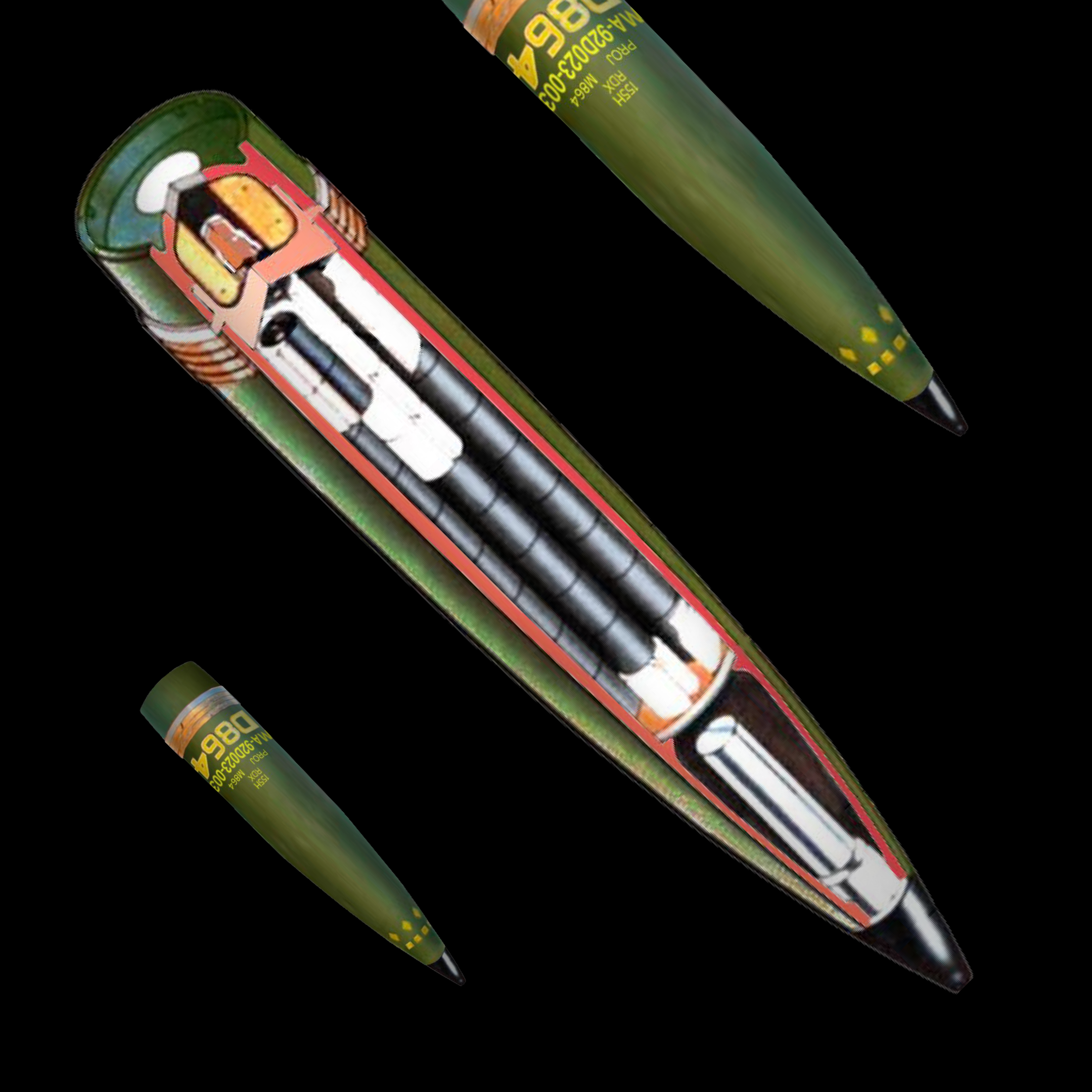
In July 2023, the United States announced the transfer of cluster munitions – “dual-purpose improved conventional munitions” (DPICMs). According to Jake Sullivan, the United States national security advisor to President Joe Biden, this decision was caused by the gradual depletion of the stockpiles of unitary munitions supplied to Ukraine. As he stated, the supply of cluster munitions to Ukraine will stop when the United States sufficiently intensifies the production of unitary munitions to correlate with Ukraine’s needs on the battlefield.
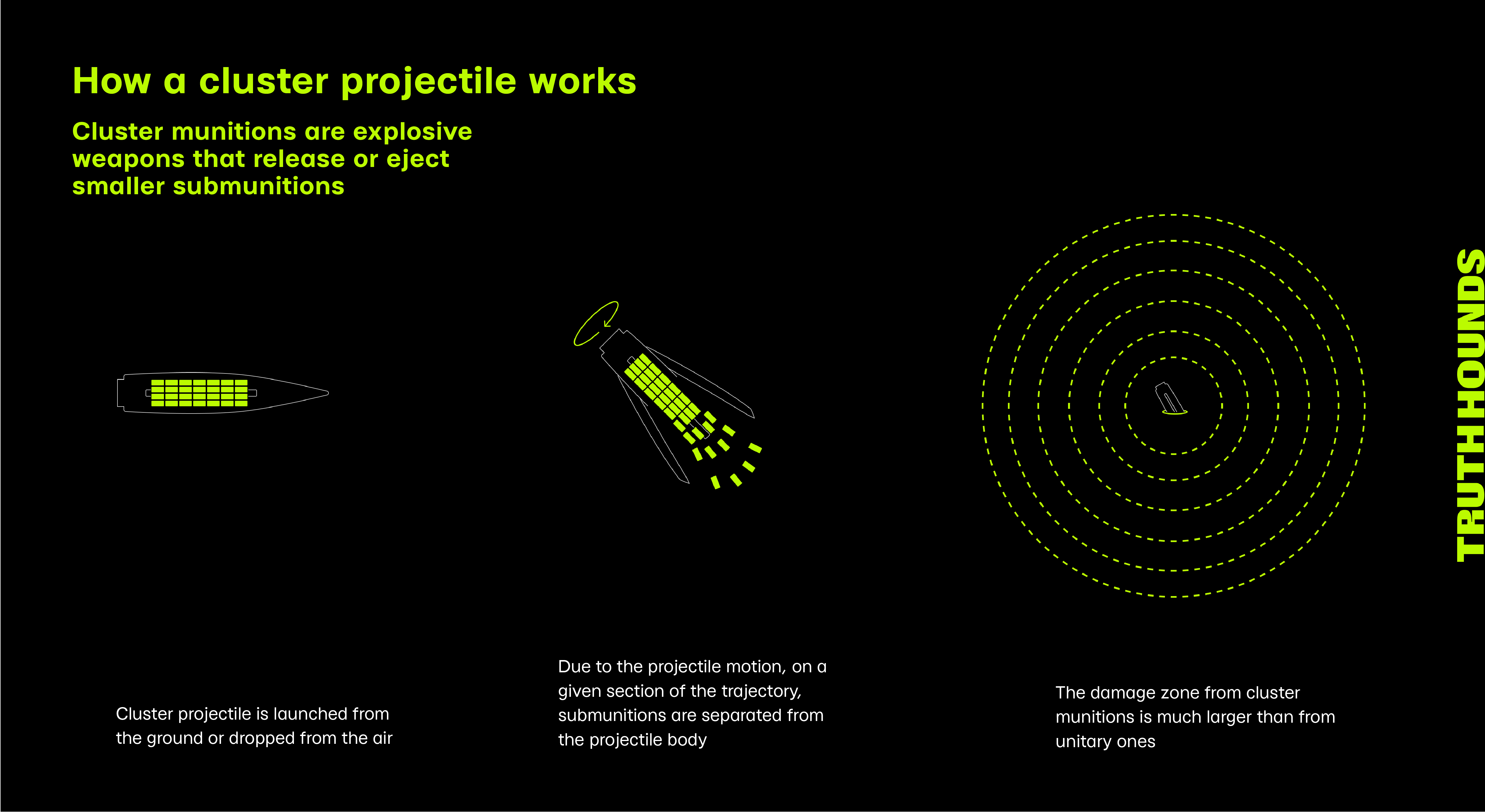
Cluster munitions may be fired from artillery, MLRS, or missile systems or dropped by aircraft. The unique trait of these munitions is that due to the projectile motion, on a given section of the trajectory, the explosive submunitions are separated from the projectile body and scattered over a large territory. Such weapons can be effective in destroying personnel, artillery positions, and armored vehicles in open terrain.
Cluster munitions are explosive weapons that release or eject smaller submunitions.
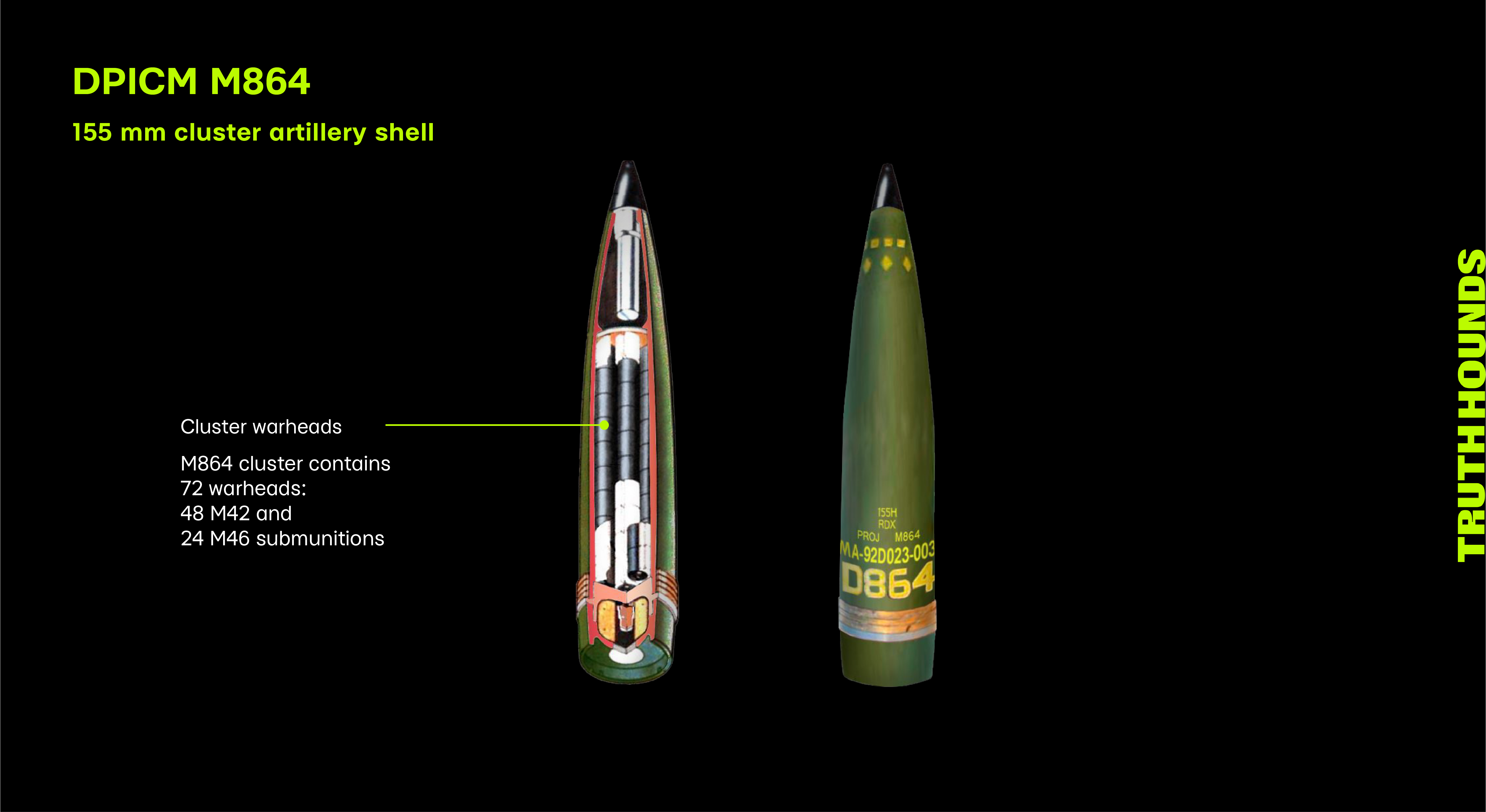
In this case, the US is transferring 155-mm M864 cluster shells to Ukraine. The cartridge of such a projectile contains a total of 72 warheads: 48 M42 submunitions and 24 M46 submunitions. According to the Pentagon, the percentage of submunitions that do not detonate is only 2.35%. At the same time, a public report on the use of mines by the US armed forces during the Persian Gulf War in 2002 states that the dud rate for M42 and M46 submunitions is over 14 percent.
Like any other type of weapon, cluster weapons can pose risks to civilians. In some places, these risks are higher, such as, for example, in the case of its use in densely populated areas. Also, submunitions may not explode and pose a threat to the civilian population until they are defused by specialists.
For these reasons several international organizations criticized the provision of cluster munitions to Ukraine. For example, Human Rights Watch argued that “the use of cluster munitions in areas with civilians makes an attack indiscriminate in violation of international humanitarian law, and possibly a war crime.”. The Cluster Munitions Coalition reported that they were shocked by the decision to transfer cluster munitions to Ukraine. Earlier, in August 2022, the International Committee of the Red Cross stated that “any use of cluster munitions, anywhere, by anyone, must be condemned”.
What does the international law of armed conflict really say about cluster munitions?
Human rights organizations refer to the Convention on Cluster Munitions, which prohibits the use, transfer, production, and stockpiling of cluster munitions. The convention has been ratified by 111 countries, but Ukraine, the USA, and the Russian Federation do not belong to this list. In any case it cannot be claimed that the rules defined in the Convention have acquired the status of customary law. For a rule of customary international law to arise sufficiently widespread, representative, and consistent state practice and opinio juris (recognition of the legal obligation of practice by states) are required. Given that the Convention has not been signed by more than 70 countries, including the owners of the largest artillery arsenals (such as the United States, China, the Russian Federation, South Korea, Pakistan, India, and Turkey), it is clear that the current state practice of banning cluster munitions is neither widespread nor representative enough for a rule of customary international law regarding cluster munitions to arise. However, as with any other weapon, international law regulates how they may be used.
The rule of distinction and prohibition of indiscriminate attacks
Human Rights Watch, Amnesty International, and the International Committee of the Red Cross call cluster munitions “weapons of indiscriminate nature” and oppose any use of them.
According to Art. 51 of Protocol Additional to the Geneva Conventions of 1949, which is valid for Ukraine and the Russian Federation, “indiscriminate attacks are prohibited”. These attacks include:
- an attack which is not directed at a specific military objective;
- an attack which employs a method or means of combat which cannot be directed at a specific military objective;
- an attack which employs a method or means of combat the effects of which cannot be limited as required by this Protocol; and consequently, in each such case, is of a nature to strike military objectives and civilians or civilian objects without distinction;
- an attack by bombardment by any methods or means which treats as a single military objective a number of clearly separated and distinct military objectives located in a city, town, village or other area containing a similar concentration of civilians or civilian objects;
- an attack which may be expected to cause incidental loss of civilian life, injury to civilians, damage to civilian objects, or a combination thereof, which would be excessive in relation to the concrete and direct military advantage anticipated.
On this basis, can it be argued that any combat use of cluster munitions would be an indiscriminate attack? No.
In order to analyze whether the attack is indiscriminate, it is necessary to comprehensively consider the context and conditions of the use of weapons. While bombing of military targets located near civilian objects with cluster munitions may indeed violate international law, their use against strictly military targets with the necessary precautions for the safety of the civilian population would comply with the rules of the law of armed conflicts (international humanitarian law).
Is Ukraine aware of the risks?
As Deputy Permanent Representative of Ukraine to International Organizations in Vienna, Natalia Kostenko stated: “Ukraine remains fully committed to its obligations under international law. The specific ammunition provided at this stage of repelling Russian aggression meets the most urgent needs of the Ukrainian Defense Forces. In close cooperation with our international partners, the Ukrainian military command carefully assessed the potential risks to the civilian population.”
This thesis was further elaborated by the Minister of Defense of Ukraine, Oleksii Reznikov, who has outlined 5 principles that Ukraine promised to comply with in connection with the transfer of cluster munitions. Among them, human rights defenders should be most interested in the following two:
- cluster munitions won’t be used in urban areas to avoid the risks for the civilian populations. Cluster munitions will be used only in the fields where there is a concentration of Russian military;
- territories, where cluster munitions were used after the de-occupation and victory of Ukraine, will become a priority for demining.
It follows from the above that Ukraine is fully aware of the risks to the civilian population that the use of cluster weapons carries and is ready to act to minimize these risks.
Given the critical shortage of unitary artillery shells for a counteroffensive, the failure to use cluster munitions can lead to a significant delay or even the impossibility of de-occupation as such. In this case, the occupied Ukrainian territories where hostilities are taking place may never become safe for civilians.
It is also worth understanding that the Russian-Ukrainian war is the most intense artillery war since the Second World War. De-occupied territories, as well as territories adjacent to the front line, are already extremely contaminated with various types of unexploded ordnance (UXO). Clearing and securing these territories from unexploded ordnance is possible only in case of a breakthrough of the defense lines installed by the Russians and active demining work, which, as we observed, is being carried out by the Ukrainian forces immediately after the de-occupation of the territories. Given Ukraine’s promise to use cluster munitions only for attacks on concentrations of the Russian military, as well as to prioritize the demining of those areas where they will be used, the real risks to the civilian population from unexploded submunition are significantly reduced and will not exceed those that already exist from contamination of the territory unexploded ordnance of other types.