
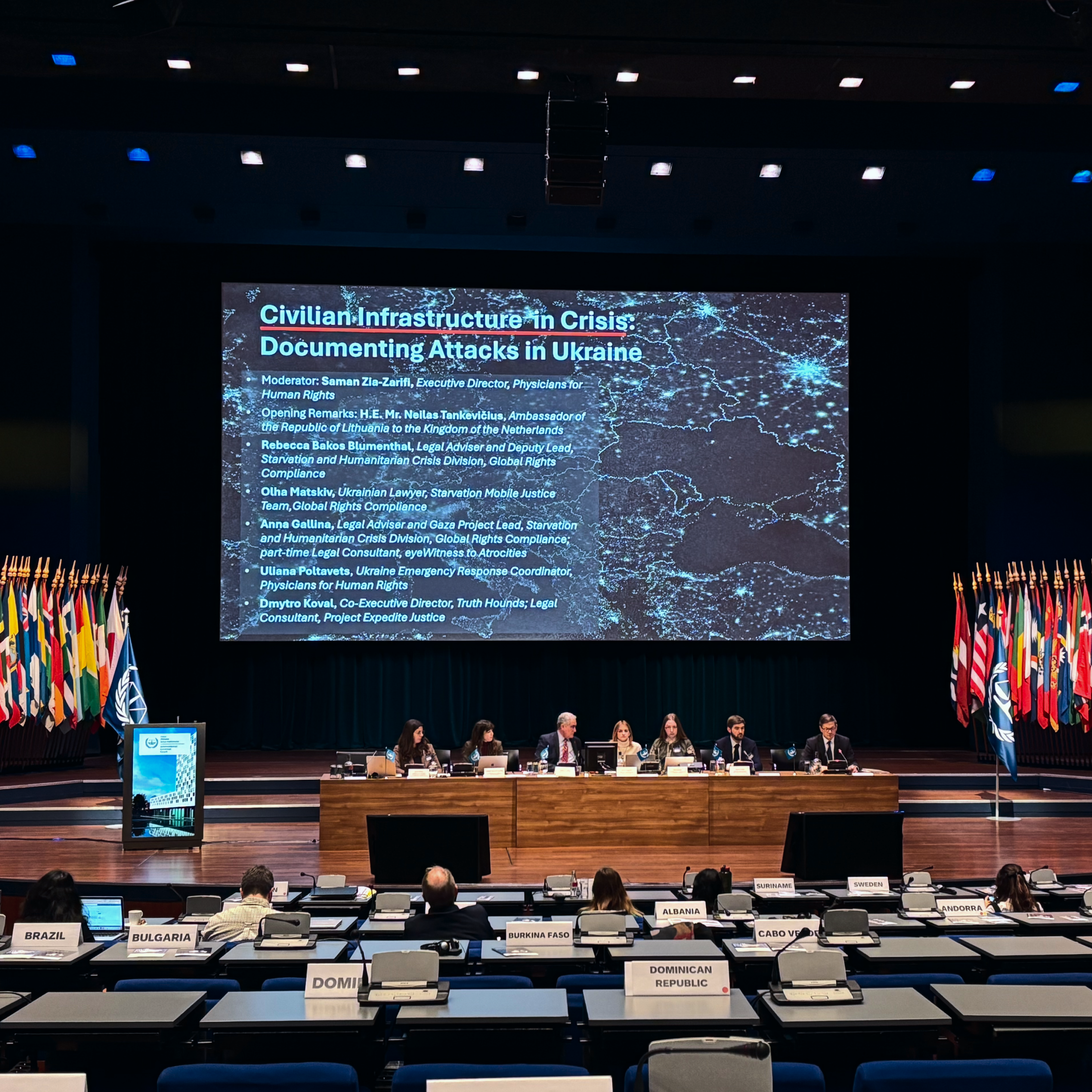
The Republic of Lithuania, together with Global Rights Compliance (GRC), eyeWitness to Atrocities, Physicians for Human Rights (PHR), and Truth Hounds, hosted a critical side event titled Civilian Infrastructure in Crisis: Documenting Attacks in Ukraine during the 23rd Assembly of States Parties (ASP) to the Rome Statute. The discussion highlighted the widespread and systematic assaults on Ukraine’s civilian infrastructure since the start of Russia’s full-scale invasion, focusing on their devastating humanitarian impact and the legal avenues for accountability.
Opening the event, the H.E. Neilas Tankevičius, Ambassador of the Republic of Lithuania to the Kingdom of the Netherlands stressed the importance of addressing these violations on an international platform, stating:
“It is crucial to bring global attention to the deliberate destruction of infrastructure that directly impacts the survival of civilians.”
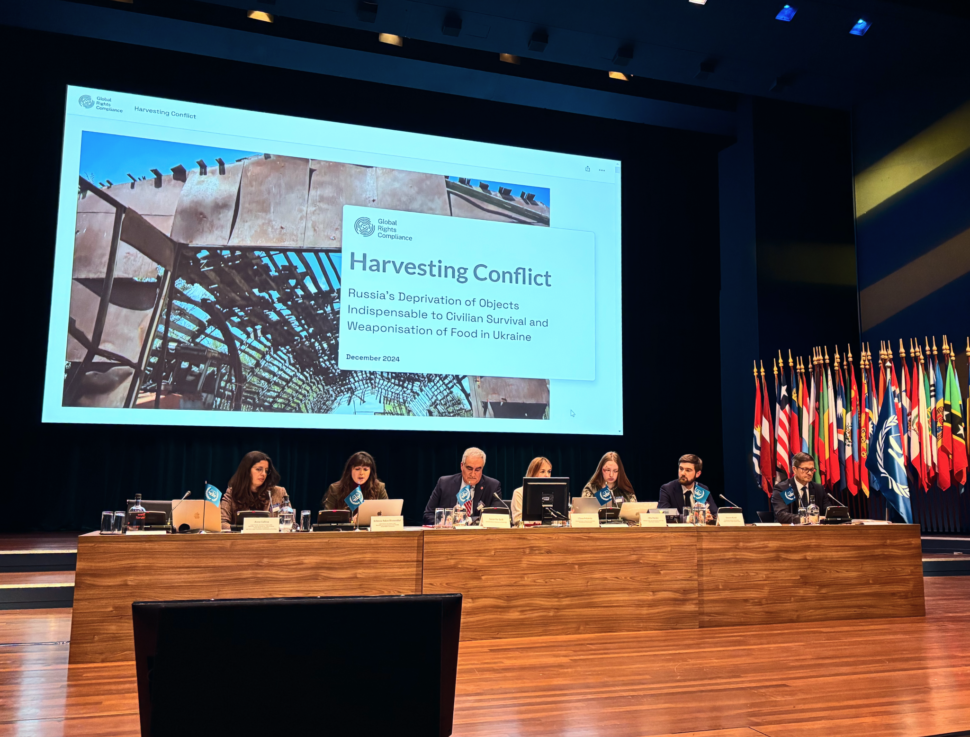
Rebecca Bakos Blumenthal, Legal Adviser and Deputy Lead of GRC’s Starvation and Humanitarian Crisis Division, presented the findings of a two-year on-the-ground work by the Starvation Mobile Justice Team (SMJT). She detailed how food has been weaponised during the war in three phases: besieging civilian areas to cut off access to essentials, systematic attacks on infrastructure, and targeting agriculture through restrictions on Ukrainian grain exports and repeated attacks on grain and port facilities. She presented GRC’s new StoryMap, saying:
“For the last two years the SMJT has documented in meticulous detail, through comprehensive analyses of open-source intelligence including photographs, videos, public statements by officials, and other digital data, how the weaponisation of food in Ukraine has formed an integral part of the conflict dynamics and has manifested in three distinct phases. Now, I am proud to present our newest StoryMap, highlighting our investigations and high-level findings.”
Anna Gallina, Legal Advisor and Gaza Project Lead of GRC’s Starvation and Humanitarian Crisis Division and Legal Consultant with eyeWitness to Atrocities, explained how technology can enhance accountability efforts. She showcased the eyeWitness app, explaining how it that facilitates its admissibility as evidence in court. She presented a three-year long collaboration with a coalition of civil society organisations to shed light on attacks on health care and underscored:
“Attacks on critical infrastructure and healthcare facilities have become alarmingly frequent in recent years, reflecting a disturbing global trend. Across various conflict situations, we are seeing similar patterns of attacks against these essential services, underscoring the urgent need to continue prioritising the investigation of these attacks in our work.”




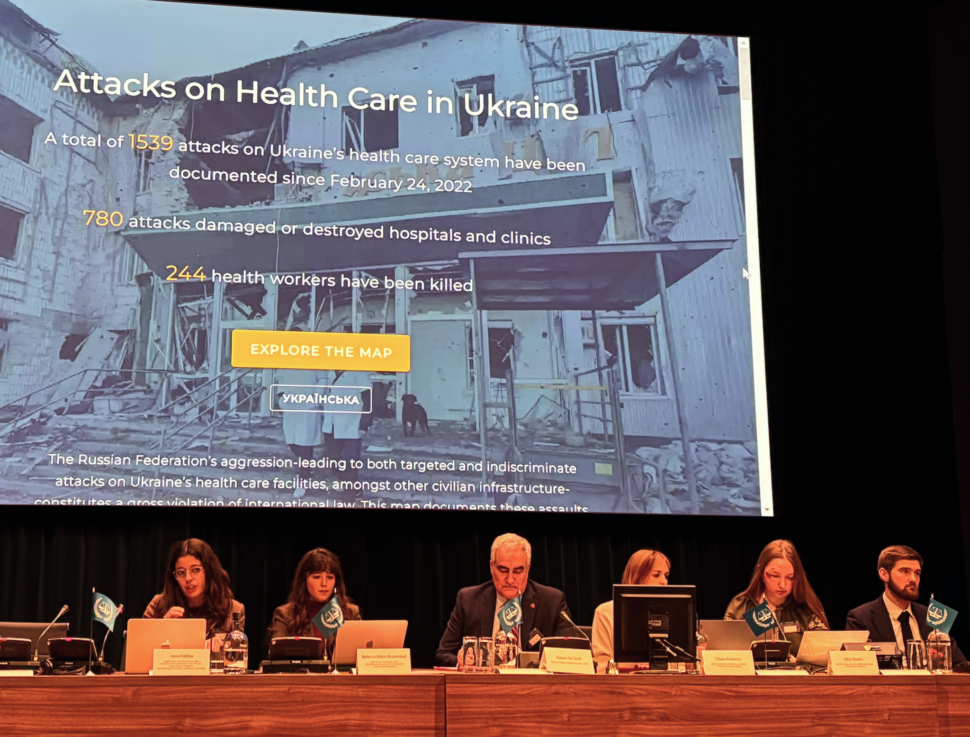
Olha Matskiv, a Ukrainian lawyer on GRC’s Critical Infrastructure and Starvation Mobile Justice Team, shared the profound impact of infrastructure attacks on civilian lives. She highlighted the severe consequences of electricity shortages, from freezing winters and disrupted water supply to economic instability and challenges faced by people with disabilities:
“The lack of electricity in Ukraine, caused by Russia’s attacks on critical infrastructure, has severely impacted daily life. Key areas affected include heating during freezing winters, water supply and sanitation, food storage and supply chains, communication systems, and economic stability. These attacks not only devastate infrastructure but also disproportionately impact the most vulnerable segments of the population.”
Physicians for Human Rights and Truth Hounds presented their new report on the disruption of healthcare services and energy infrastructure, highlighting the broader humanitarian impact of these attacks.
Uliana Poltavets, Ukraine Emergency Response Coordinator for PHR, highlighted:
“The Russian assault on Ukraine’s power grid has cut patients off from lifesaving medical care triggering a cascade of far-reaching consequences. 66 percent of health care workers surveyed reported disruptions in medical procedures in their facilities, with surgeries postponed and interrupted, water supply interrupted, diagnostic equipment rendered unusable, and medication storage affected leading to spoilage. These strikes go far beyond mere ‘inconveniences’ for civilians – they pose a severe threat to the lives and health of millions. The global community must ignite efforts to hold Russia to account for violations of international law resulting from these attacks on energy and health.”
Dmytro Koval, Co-Executive Director of Truth Hounds, then emphasised the findings of a recent report on the destruction of the Kakhovka Dam and its aftermath. He explained that the dam’s destruction has had significant consequences for Ukraine’s energy stability, climate, and environment.
“Potentially, the biggest effect, though, which on its own may satisfy the widespread, long-term, and severe criteria of damage set out by the Rome Statute of the International Criminal Court, was the disappearance of the biggest in Ukraine source of fresh water – the Kakhovka reservoir. Vanishing of the reservoir endangers life in the whole region, causes a dramatic decrease in the level of ground waters, and contributes to the salinization of soil. Everything taken together allows us to stress that the destruction of the dam is a war crime against environment as provided by article 8(2)(b)(iv) of the Rome Statute”
The event concluded by emphasizing the urgency of the need for the International Criminal Court to prioritise these violations in its investigations. The panellists called for collective international action to hold perpetrators accountable and protect civilian populations from further harm.