
Read in Ukrainian
In Ukrainian media, the question has been raised as to whether volunteers can use electronic warfare (EW) equipment. The authors of the article argued that, under applicable international humanitarian law (IHL), the use of EW equipment by volunteers equates them with military personnel; as civilians, they do not have the right to use these means while carrying out their missions.
In order to determine whether civilians, including volunteers, have the right to use electronic warfare means, it is necessary to analyse certain legal aspects of IHL.
Killzone: How Russian Drones Are Devastating the River Dnipro’s Right Bank
Civilian status and direct participation in hostilities
IHL divides the population of states engaged in armed conflict into two main categories: combatants and civilians. In most cases, combatants are members of the armed forces of those states.
Combatants have the right to participate in hostilities and to conduct military operations against military objectives of the adversary – that is, to target enemy combatants and military objects.
Civilian status, by contrast, provides individuals with guarantees that the parties to the conflict do not have the right to make them the object of attack. At the same time, civilians shall not take a direct part in hostilities against the parties to the conflict; otherwise, their privilege of “immunity” is lost and they become lawful targets. In addition, states acquire the right to initiate criminal proceedings against such individuals solely on the basis of their participation in hostilities. In other words, under IHL, as long as a person retains civilian status, they must not directly participate in hostilities – otherwise, the opposing state and its combatants may lawfully target them and/or prosecute them for such participation in hostilities.
Unfortunately, the treaties and customary rules of IHL currently lack a clear and unambiguous definition of which specific actions by civilians qualify as direct participation in hostilities. However, the International Committee of the Red Cross (ICRC) has proposed three cumulative criteria, all of which must be met in order to establish that a civilian is directly participating in hostilities:
- The civilian’s act is likely to adversely affect the military operations or military capacity of the adversary (threshold of harm);
- There must be a direct causal link between the civilian’s act and the harm likely to result from that act (direct causation);
- The civilian’s act must be specifically designed to directly cause the required level of harm to one party to the conflict in support of another party to the armed conflict (belligerent nexus/purpose).
It should be noted that these criteria constitute the ICRC’s interpretation of what amounts to direct participation in hostilities. At the same time, they are not explicitly set out in legally binding rules, and therefore cannot be said to definitively reflect the essence of the concept of direct participation in hostilities under IHL.
Does a civilian have a right to self-defence under IHL?
The ICRC argues that civilians do have a right to self-defence, and that such actions do not amount to direct participation in hostilities, since civilians lack the intent to cause harm to one party to the conflict for the benefit of another party—meaning that the third criterion of direct participation in hostilities, according to the ICRC’s interpretation, is absent. This point was recently reiterated in a blog post by ICRC legal advisers:
“Persons who defend themselves against acts of violence prohibited under IHL, or against ordinary crimes, cannot be regarded as directly participating in hostilities. Such acts of individual self-defence cannot be considered as support for one party to the conflict against another. This may be the case, for example, when civilians use force to defend themselves or others against unlawful killings or sexual violence…”
Some international lawyers argue that the third criterion also excludes situations in which civilians act to the detriment of one party to an armed conflict not only for reasons of self-defence, but also for personal gain (for example, stealing military equipment for resale and profit) – since the key issue is whether such civilian conduct is intended to harm one party to the conflict in support of another. In particular, international lawyer and professor of international law Michael N. Schmitt notes the following:
“Examples of acts that may qualify as direct participation under the first two criteria, but fail to satisfy the third criterion due to the absence of a nexus to hostilities, include attacks on soldiers for reasons unrelated to the armed conflict, theft of military equipment for purposes of sale, defending oneself or others against unlawful violence (even if committed by combatants)…”
With regard to self-defence, under the ICRC’s logic, it would be unjust to deprive civilians of their immunity from further attacks and criminal prosecution merely because they attempted to save themselves or other civilians from killing, assault, sexual violence, or other unlawful acts that should never have been directed against them in the first place. Moreover, if self-defence against prohibited violence were to result in civilians losing protection from further attack, this would effectively amount to legitimising the prior unlawful attack.
In support of this argument, it is worth recalling the Martens Clause, an integral part of IHL that addresses aspects of warfare not regulated by treaty law. Under the Martens Clause, in cases not covered by international agreements, civilians and belligerents remain under the protection and authority of the principles of humanity and the dictates of public conscience. Accordingly, acts of self-defence by civilians against criminal conduct by combatants do not deprive them of civilian immunity, as such conduct must be justified by the dictates of public conscience.
Electronic warfare devices as a means of self-defence
Electronic warfare (EW) encompasses a range of tools used to jam navigation systems and disrupt the operation of enemy drones and other strike weapons, intercept enemy communications for intelligence purposes, suppress communications between enemy forces, and similar activities.
The use of EW by volunteers or other civilians may, depending on the purpose and context, either constitute direct participation in hostilities or fall outside that concept. For example, if volunteers or civilians use EW to jam enemy drones’ radio signals in order to facilitate the advance of military equipment belonging to their armed forces, such conduct would amount to direct participation in hostilities, as all three of the ICRC criteria mentioned above would be met, namely: (1) such actions are likely to adversely affect the adversary’s military operations or military capacity, since EW negatively impacts the functioning of enemy drones; (2) there is a direct causal link between the use of EW and the loss of the adversary’s military capability; and (3) EW is used with the purpose of giving a military advantage to one party to the armed conflict to the detriment of the other.
By contrast, the use of EW by volunteers for the purpose of self-defence and the protection of the lives of civilians to whom they are providing humanitarian assistance does not constitute direct participation in hostilities, because the third ICRC criterion is absent: electronic warfare is not employed in order to conduct military operations in support of one of the belligerent states, but rather to protect civilians from acts of violence.
The need for volunteers to use EW during the evacuation of civilians and wounded persons in frontline regions of Ukraine has become increasingly acute due to the threat posed by Russian FPV drones. In its submission, the Ukrainian Helsinki Human Rights Union (UHHRU) noted that during the first two and a half years of the full-scale invasion, law enforcement authorities registered 799 criminal proceedings related to the dropping of explosive devices on civilians and civilian objects in the Kherson Oblast, including public transport. The phenomenon of Russian drones hunting civilians with explosives has become infamously known as “human safari.”
The media have repeatedly reported cases of Russian drone attacks not only on civilian passers-by, but also on volunteer teams engaged in evacuations. In particular, near Pokrovsk in February 2025, a Russian drone struck a volunteer minibus bearing the clearly visible red “EVACUATION” marking on a white background. As a result of the strike, the volunteer driver sustained severe injuries, requiring the amputation of his left arm and leg. In an article about this incident, Radio Free Europe/Radio Liberty also mentioned the volunteers’ use of EW equipment:
“Although the team had drone-jamming devices that could be installed on vehicles, they chose not to take them in order to avoid being mistaken for military vehicles.”
In April, again near Pokrovsk, Russian UAVs attacked a vehicle belonging to volunteers evacuating animals. On the same day in Kharkiv Oblast, Russian forces twice struck volunteer vehicles with FPV drones while they were delivering humanitarian aid to residents of a village.
In July 2025, a Russian FPV drone attempted to strike a volunteer team directly during an evacuation mission. A representative of the team described the incident as follows:
“The drone noticed our mission, started circling, and then attacked the people standing near the vehicle. The people managed to run away; only the vehicle was damaged. The Russians could see that we were not military. Our vehicles were clearly marked as civilian. It was obvious that there were many civilians preparing to leave and that this was a civilian operation.”
A month later, in August, Russian forces again attempted to strike a volunteer mission using drones, this time in Sumy Oblast. Several drones were directed at their vehicle and dropped bottles filled with explosives; eventually, an FPV drone carrying a full charge struck the vehicle.
One volunteer, in an interview with Truth Hounds documenters, provided the following testimony regarding the need to use EW during civilian evacuations, describing the constant threat of attack:
“As for EW… I see it as a safety tool that protects me, not as a weapon. I can’t cause harm with EW… I feel much more tension when I’m returning with people than when I’m alone. And when we’re returning with people, even they know roughly how long the dangerous zone lasts, and during that time, there is complete silence in the vehicle.”
The deliberate targeting of civilians in Ukraine by Russian military drones may amount to both war crimes and crimes against humanity. Pablo de Greiff, a member of the Independent International Commission of Inquiry on Ukraine, stated that Russian drone “safaris” against Ukrainian civilians demonstrate an intent to spread terror among the civilian population and constitute serious violations of IHL.
In its report published in May 2025, the UN Independent International Commission of Inquiry on Ukraine found that since July 2024, the Russian armed forces have systematically attacked civilians in the Kherson Oblast using drones; “the targets were manifestly civilian, and no military personnel or equipment were identified at or near the sites of the attacks.” The report further stated:
“Drone operators used real-time video feeds transmitted by onboard cameras to target clearly civilian objects and drop explosives on them. The evidence gathered by the Commission leaves no doubt that the perpetrators intended to carry out these acts.”
In light of the above, the use of EW by volunteers in the course of their humanitarian activities is a necessity both for their own protection and for the protection of the lives of civilians they assist, against alleged war crimes committed by Russian servicemen through the intentional targeting of civilians with drones. Accordingly, in such circumstances, the use of electronic warfare by volunteers cannot be equated with direct participation in hostilities, as the third criterion of such participation is absent: volunteers lack the intent to harm one party to the armed conflict for the benefit of another.
It is also worth noting that when EW is used for self-defence, volunteers indiscriminately jam drones operating in their immediate vicinity – that is, both Russian and Ukrainian drones. As a result, drones belonging to both sides may be equally affected by the use of electronic warfare for protective purposes. This further reinforces the argument that the third criterion of direct participation in hostilities – namely, the intent to provide a military advantage to one party to the conflict over another – is absent.
At the same time, beyond the legal context, the factual situation in frontline territories must also be taken into account when assessing the advisability of using EW equipment. EW systems are military technologies, and their use is primarily associated with military personnel, which may, in itself, trigger a drone attack. Military experts interviewed by Truth Hounds do not recommend that civilians use EW equipment due to the difficulty of obtaining up-to-date information on drone operating frequencies, lack of training in using such equipment, and their generally low effectiveness. Instead, military experts advise civilians to use drone detectors with video feeds, which are significantly easier to operate, more affordable, and do not interfere with Ukrainian military operations.
Conclusions
The use of EW equipment by volunteers during the evacuation of civilians or the delivery of humanitarian aid is justified, given that Russian forces frequently target such missions with drones, thereby endangering the lives of both volunteers and the civilians they assist.
Although the conventions do not set out in detail the criteria under which civilians lose their immunity, it is generally accepted that when acting in self-defence, civilians do not forfeit their right to protection from military attack.
Accordingly, the use of EW by volunteers for self-defence and/or the protection of other civilians is justified and appropriate and does not deprive them of civilian immunity.
Anastasiia Moiseienko, Truth Hounds intern, graduate of the “Legal Skills in a Time of War” Summer School at the CEELI Institute.
This material was prepared within the framework of the Truth Hounds mentorship programme.
Read in Ukrainian
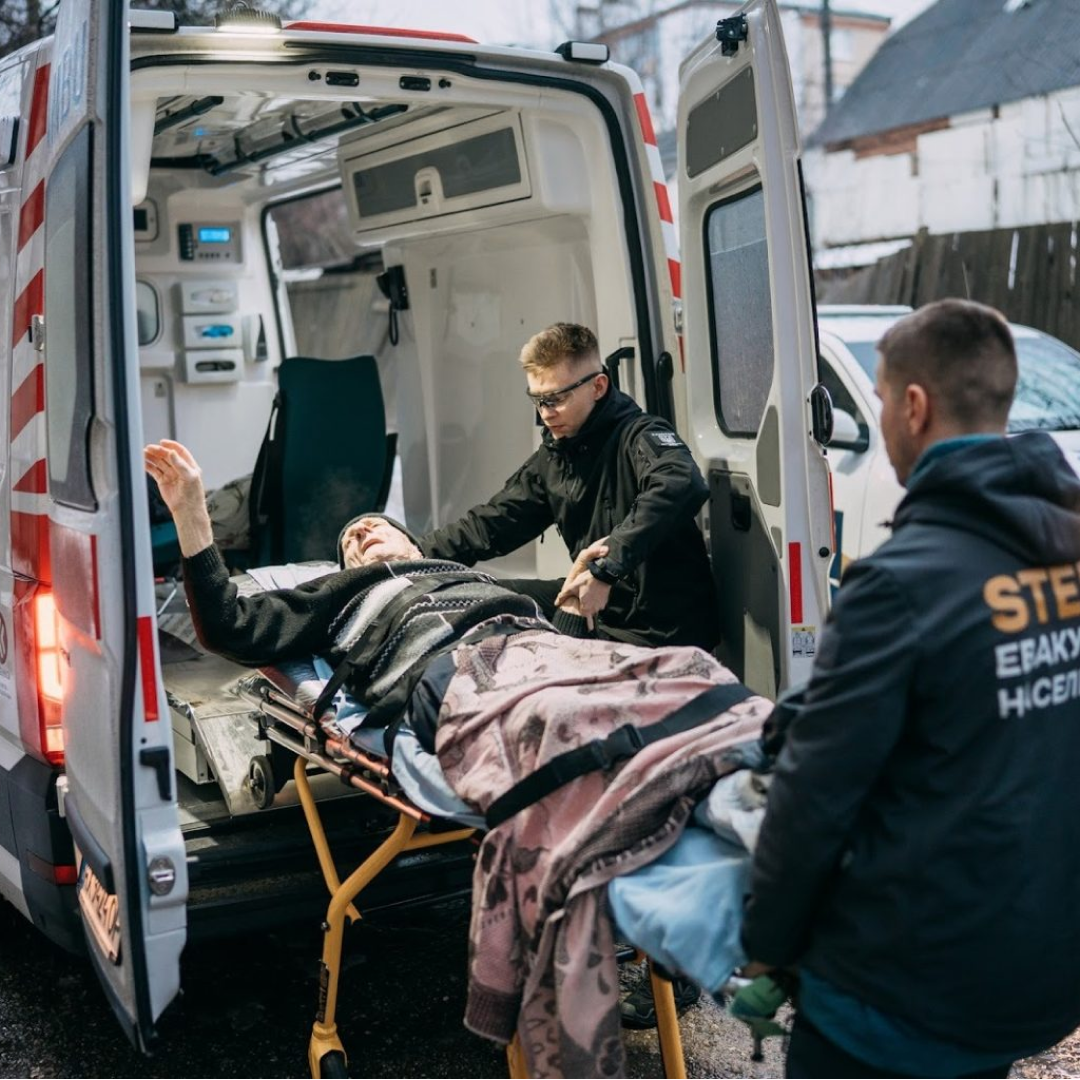
Photo: Volunteers evacuate an elderly man in a special vehicle.
Photo: Khaustov Charity Foundation